
How Much Does a Forklift Weigh? Complete Specifications Guide for Every Class and Capacity
How much does a forklift weight? Full specifications guide covering weight by class, 🟢 capacity, dimensions, and rental options for every operator.
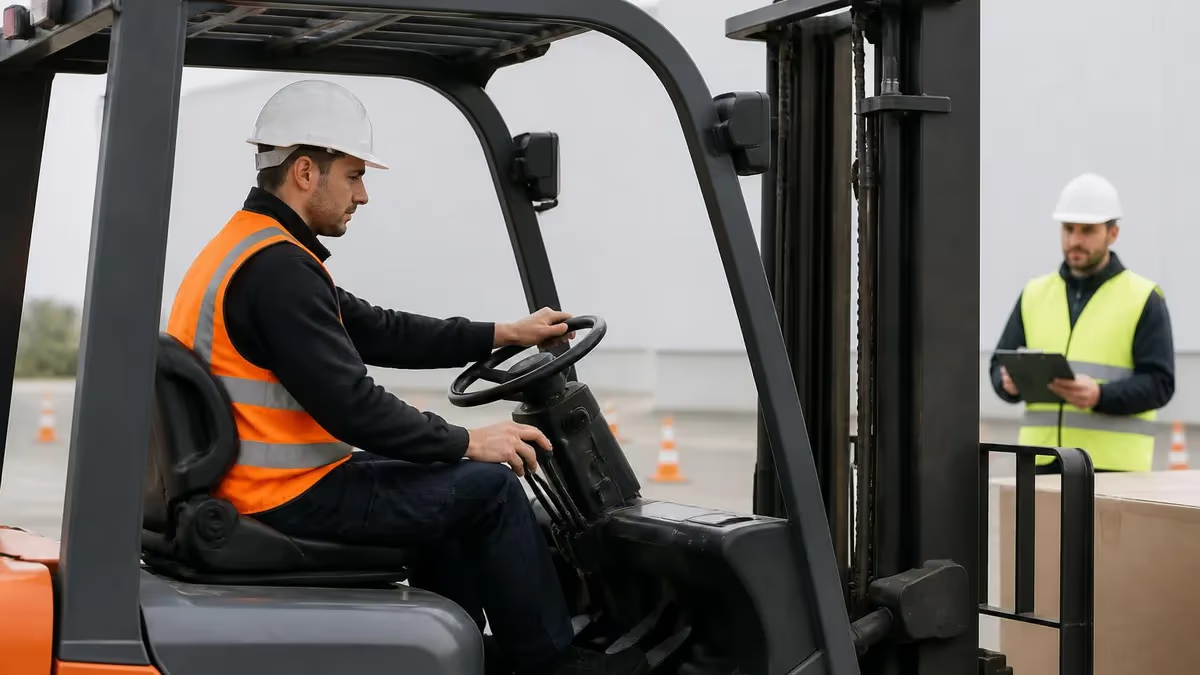
If you have ever stood next to a warehouse lift truck and wondered just how much does a forklift weight, the honest answer is that it depends entirely on the class, fuel type, and lifting capacity of the machine in front of you. A standard 5,000-pound capacity Class IV cushion-tire forklift typically weighs between 8,000 and 9,500 pounds empty, while a heavy industrial 30,000-pound capacity unit can tip the scales at over 60,000 pounds. Understanding these numbers matters for floor loading, trailer transport, and operator safety.
The weight of a forklift is engineered, not accidental. Manufacturers add a counterweight at the rear of the chassis specifically to offset the load being lifted at the forks. Without that mass, the truck would tip forward the moment a pallet left the ground. That is why a 5,000 lb capacity electric rider often weighs more than a similar-capacity internal combustion model — the battery itself serves as part of the counterweight, eliminating the need for cast iron blocks.
Specifications also drive procurement decisions for fleet managers searching for a forklift rental near me or evaluating a long-term purchase. Whether you're moving 2,000-pound pallets in a tight retail backroom or staging 12,000-pound coils in a steel mill, weight, turning radius, lift height, and tire type determine whether a machine can even fit through your doors. Renting the wrong unit is an expensive mistake that costs hours of downtime and damaged inventory.
This guide walks through every meaningful specification you need to know before you operate, buy, rent, or get certified on a forklift. We'll cover OSHA's seven equipment classes, capacity charts, mast types, fuel options, and the dimensional data that determines whether your aisle width is wide enough. You'll also see how weight ties directly into safe operation, certification standards, and the practical questions on every operator exam in the United States.
Forklifts are not one-size-fits-all. The little walkie pallet jack rolling through a grocery stockroom shares almost nothing mechanically with the diesel container handler at the Port of Long Beach. Yet both are technically classified as powered industrial trucks under 29 CFR 1910.178. Knowing where your machine falls in that spectrum is the first step toward safe, productive, and compliant operation.
By the end of this article you'll be able to read a forklift data plate the way a mechanic reads a vehicle ID number, decode capacity downratings at extended load centers, and confidently match a machine spec sheet to the job at hand. Whether you're studying for certification, sourcing equipment, or training new operators, the numbers below are the foundation that everything else builds on.
Forklift Specifications by the Numbers

OSHA's Seven Forklift Classes and Their Weight Ranges
Sit-down counterbalanced electric trucks used indoors. Typical weight: 7,500–12,000 lb for 3,000–6,000 lb capacity. The lead-acid battery doubles as ballast, eliminating cast counterweights.
Reach trucks and order pickers built for racks 30+ feet high. Weights run 8,000–14,000 lb with extended battery packs and outrigger legs for stability in 8-foot aisles.
Pallet jacks and stackers, both manual and electric. Weight ranges dramatically from 200 lb (manual jack) to 3,500 lb (walkie stacker with 4,500 lb capacity).
Internal combustion sit-down trucks with solid cushion tires for smooth indoor floors. A 5,000 lb capacity LPG model weighs 8,500–9,500 lb empty; a 10,000 lb unit doubles that.
Outdoor diesel and LPG trucks with air-filled tires for rough yards. Standard 5,000 lb units weigh 9,000–10,500 lb; 15,000 lb capacity models reach 25,000–30,000 lb.
The single most important relationship in forklift specifications is the ratio between the truck's own weight and its rated lifting capacity. As a rule of thumb, a counterbalanced forklift weighs roughly 1.5 to 2.5 times its rated capacity. A 5,000-pound capacity machine usually weighs between 7,500 and 12,500 pounds. This is not arbitrary — it is physics. The rear counterweight must produce a moment equal to or greater than the load moment at the forks, otherwise the truck pivots forward on its front axle.
The pivot point — known as the fulcrum — sits on the front drive axle. Everything in front of it (mast, forks, load) creates forward moment. Everything behind it (engine, operator, counterweight) creates rearward moment. Engineers calculate these moments so precisely that adding aftermarket attachments like side shifters or paper roll clamps almost always reduces rated capacity. That is why the data plate shows multiple capacity figures depending on attachment and load center distance.
Load center is the horizontal distance from the front face of the forks to the center of gravity of the load. The U.S. industry standard is 24 inches, assuming a 48x48-inch pallet. If your load's center of gravity sits further out — say a long pipe or a deep crate — capacity drops sharply. A truck rated 5,000 pounds at 24 inches may only handle 3,500 pounds at 36 inches. Operators must memorize this trade-off before lifting non-standard loads.
Truck weight also affects floor loading. A 9,000-pound forklift carrying a 5,000-pound load distributes 14,000 pounds across just two front tires when loaded — that's roughly 7,000 pounds per contact patch. Older warehouse slabs rated for 250 psi may crack under repeated loading from a heavy diesel pneumatic unit. Mezzanines, elevators, and trailer floors all require weight verification before driving onto them. This is one reason rental companies ask about your floor type during the quote.
Tire choice further shifts the numbers. Solid cushion tires reduce truck height and overall length slightly compared to pneumatics, while pneumatic tires raise the truck three to six inches and add 200–400 pounds. Solid pneumatics — used in scrap yards where punctures are common — add even more weight because they're literally solid rubber. Each tire choice changes the truck's balance, footprint, and the maximum gradient it can climb safely with a load.
Finally, capacity is not a hard wall — it's a calculated limit with no safety factor for operator error. OSHA prohibits exceeding the rated capacity at the rated load center under any circumstances. Reviewing equipment knowledge through a focused practice resource like forklifts training materials helps operators internalize how capacity, weight, and stability interact in real time on the job.
Forklift certification Practice Test Questions
Prepare for the Forklift certification Certification exam with our free practice test modules. Each quiz covers key topics to help you pass on your first try.
Forklift certification Certification Forkl...
Forklift certification Exam Questions covering Certification Forklift certification Maintenance and Repairs. Master Forklift certification Test concepts for certification prep.
Forklift certification Certification Forkl...
Free Forklift certification Practice Test featuring Certification Forklift certification Maintenance and Repairs Questions and Answers. Improve your Forklift certification Exam score with mock test prep.
Forklift certification Certification Forkl...
Forklift certification Mock Exam on Certification Forklift certification Operator Training and Certification Requirements. Forklift certification Study Guide questions to pass on your first try.
Forklift certification Certification Forkl...
Forklift certification Test Prep for Certification Forklift certification Operator Training and Certification Requirements Questions and Answers. Practice Forklift certification Quiz questions and boost your score.
Forklift certification Load Handling and S...
Forklift certification Questions and Answers on Load Handling and Stability. Free Forklift certification practice for exam readiness.
Forklift certification OSHA Regulations an...
Forklift certification Mock Test covering OSHA Regulations and Compliance. Online Forklift certification Test practice with instant feedback.
Forklift certification Pre-Operation Inspe...
Free Forklift certification Quiz on Pre-Operation Inspections. Forklift certification Exam prep questions with detailed explanations.
Forklift certification Refueling and Recha...
Forklift certification Practice Questions for Refueling and Recharging Procedures. Build confidence for your Forklift certification certification exam.
Forklift certification Safe Driving and Ma...
Forklift certification Test Online for Safe Driving and Maneuvering. Free practice with instant results and feedback.
Forklift certification Workplace Hazard Id...
Forklift certification Study Material on Workplace Hazard Identification. Prepare effectively with real exam-style questions.
Forklift certification Forklift Instructions
Free Forklift certification Test covering Forklift Instructions. Practice and track your Forklift certification exam readiness.
Forklift certification Forklift MCQ
Forklift certification Exam Questions covering Forklift MCQ. Master Forklift certification Test concepts for certification prep.
Forklift certification Forklift Employer R...
Free Forklift certification Practice Test featuring Forklift Employer Responsibilities. Improve your Forklift certification Exam score with mock test prep.
Forklift certification Forklift Penalties ...
Forklift certification Mock Exam on Forklift Penalties for Non-Compliance. Forklift certification Study Guide questions to pass on your first try.
Comparing Electric Forklift, LPG, and Diesel Specifications
An electric forklift trades engine weight for battery weight. A typical 5,000 lb capacity Class I unit weighs 8,500–10,000 lb, of which 2,000–3,500 lb is the lead-acid battery alone. That battery is positioned low in the chassis to lower the center of gravity, improving stability when lifting at full height. Lithium-ion alternatives weigh 30–40% less but require ballast to maintain the same counterweight effect.
Electric trucks dominate indoor warehouses because they produce zero tailpipe emissions and run quieter than combustion models. Specifications usually include an 8-hour run time per charge for single-shift operations, with opportunity charging extending lithium units to 24/7 duty. Maintenance costs run about 30% lower than diesel because there are no oil changes, spark plugs, or exhaust systems to service over the truck's 10,000-hour service life.

Heavy Counterweight Forklifts: Pros vs. Cons
- +Higher rated capacities handle heavier industrial loads safely
- +Greater stability when lifting at maximum mast height
- +Better traction on inclines and uneven outdoor surfaces
- +Built-in mass dampens vibration for smoother operation
- +Stronger frames withstand abuse in construction and ports
- +Longer service life — typically 15,000+ engine hours
- +Better resale value due to durability and demand
- −Damages thin concrete slabs and asphalt surfaces over time
- −Requires reinforced trailer floors and shipping arrangements
- −Higher fuel and tire replacement costs per operating hour
- −Slower acceleration and turning compared to lighter trucks
- −Cannot use elevators or mezzanines in most facilities
- −Increased operator fatigue from larger steering inputs
- −Higher insurance premiums based on replacement value
Pros and Cons at a Glance
| Pros | Cons |
|---|---|
| Higher rated capacities handle heavier industrial loads safely | Damages thin concrete slabs and asphalt surfaces over time |
| Greater stability when lifting at maximum mast height | Requires reinforced trailer floors and shipping arrangements |
| Better traction on inclines and uneven outdoor surfaces | Higher fuel and tire replacement costs per operating hour |
| Built-in mass dampens vibration for smoother operation | Slower acceleration and turning compared to lighter trucks |
| Stronger frames withstand abuse in construction and ports | Cannot use elevators or mezzanines in most facilities |
| Better resale value due to durability and demand | Increased operator fatigue from larger steering inputs |
Forklift Specification Checklist Before Operation
- ✓Read the data plate and confirm capacity matches your load
- ✓Verify the load center distance against your pallet dimensions
- ✓Check tire type matches your floor surface and operating area
- ✓Confirm overall height clears all doorways and racking levels
- ✓Measure aisle width against the truck's right-angle stacking spec
- ✓Inspect the counterweight for cracks, missing bolts, or damage
- ✓Verify attachment serial number matches the supplemental data plate
- ✓Test the parking brake and service brake hold capacity
- ✓Review the truck's gradeability rating for any ramps in your route
- ✓Confirm fuel or charge level supports your full shift duration
Every Inch of Load Center Matters
Moving the load center from 24 inches to 36 inches can reduce a forklift's rated capacity by 30% or more. A 5,000 lb truck may only legally lift 3,500 lb when the load is deep. Always check the de-rated capacity chart on the data plate before lifting long, oversized, or off-balance loads.
Every forklift in the United States must carry a legible data plate, also called a nameplate or capacity plate, riveted to the dashboard or near the operator's compartment. OSHA 1910.178(a)(5) makes this non-negotiable: if the plate is missing, illegible, or altered, the truck cannot legally be operated. The plate contains the serial number, model, fuel type, attachment information, mast type, tire specification, and — most critically — the rated capacity at one or more load centers.
Start at the top with the manufacturer and model. Major brands include Toyota, Hyster, Yale, Crown, Raymond, Komatsu, Mitsubishi, and CAT. Each manufacturer follows a slightly different naming convention, but you can usually decode capacity, fuel type, and tire style from the model number. A Toyota 8FGCU25, for instance, is the 8th-generation gasoline/LPG cushion-tire truck with 2,500 kg (5,000 lb) capacity. Knowing your fleet's models speeds parts ordering and operator familiarization.
Below the model line you'll see the truck weight. This figure is the empty operating weight — no operator, no load, no fuel. Always add operator weight, fuel weight, and load weight when calculating axle loads for trailer transport or floor capacity. A 9,000 lb truck plus a 200 lb operator plus a 5,000 lb load equals 14,200 lb total — and most of that pressure rides on the front axle when lifting.
The mast specification tells you maximum fork height, lowered height, and free lift. A standard two-stage mast lifts 188 inches at a lowered height of 83 inches; a triple-stage lifts 240 inches from a lowered height of 87 inches with 60 inches of free lift. Free lift is critical in trailers and low-ceiling areas — it tells you how high the forks rise before the mast itself extends. Without free lift, you may not clear a trailer's roof.
Tire information lists size and type — cushion, pneumatic, or solid pneumatic — along with the wheel count. Side shifter, fork positioner, paper roll clamp, drum handler, push-pull, and rotator attachments each get their own line, with attached capacity reduction shown. If your truck has a side shifter you didn't know about, the capacity might be 4,700 lb instead of 5,000 lb. Always read every line.
The data plate is also where the truck's compliance designation lives — for example, LP, LPS, DS, EE, EX, or G. These codes specify which atmospheres the truck may operate in. An LP-only truck cannot enter a grain elevator (which requires EE or EX). Familiarity with these designations is tested on most certification exams and is essential when matching equipment to hazardous-location work. Studying through resources like a certification of forklift inspection course reinforces these compliance details with realistic scenarios.

Federal inspectors routinely issue citations under 29 CFR 1910.178(a)(5) when capacity plates are painted over, missing, or unreadable. Penalties start at $16,131 per violation in 2026. Replace damaged plates through your manufacturer before returning the truck to service — never operate a forklift without a clear, legible capacity plate.
Forklift certification under OSHA 29 CFR 1910.178(l) is mandatory for every operator regardless of equipment class. Certification is not a one-time event — it must be renewed every three years, and any operator involved in a near-miss, accident, or assigned to a new truck type must be re-evaluated immediately. A significant portion of the written certification exam tests specification knowledge: weight ratios, load center math, mast types, tire choices, and compliance designations.
The practical evaluation portion verifies that the operator can apply that specification knowledge in real conditions. The examiner watches whether you correctly identify the data plate, calculate adjusted capacity for an attachment, perform a pre-operation inspection, and demonstrate stability awareness while turning with a raised load. Operators who can recite OSHA chapter and verse but cannot read a data plate fail the practical every time.
Specification knowledge also drives career mobility. Operators trained on a 3,000 lb electric pallet jack cannot legally jump to a 15,000 lb diesel pneumatic without additional training and a fresh evaluation. Each truck type, attachment, and even mast configuration may require its own certification. This is why warehouses with mixed fleets schedule recertification in batches and require operators to log hours on each unit type before solo operation.
If you're seeking employment, demonstrating broad specification knowledge during interviews sets you apart. Employers looking for experienced operators want candidates who can step into a yard, identify the equipment, and start moving freight on day one. Listing specific classes and capacities on your resume — for example, "Class V pneumatic up to 8,000 lb capacity, Class II reach truck to 30 feet" — speaks directly to hiring managers reviewing roles like a stand up forklift position.
Specifications also affect compensation. Operators certified on heavy outdoor equipment (Class V, VI, VII) typically earn 15–25% more than those limited to indoor cushion-tire machines. Container handler operators at major ports can earn $80,000–$120,000 per year, while standard warehouse operators average $42,000–$55,000. Certification breadth directly equals earning potential, making continued training a high-ROI investment for any career operator.
Finally, specification literacy protects you legally. If an accident occurs and you operated a truck whose capacity you could not document, OSHA and civil courts will treat the incident as operator negligence. Knowing your truck — empty weight, rated capacity, load center, attachments, and applicable atmosphere — transforms you from a button-pusher into a qualified industrial equipment professional. That difference matters every day and especially in the moments that count most.
Practical readiness for a specifications-heavy exam comes down to repetition with the actual numbers. Print a sample data plate from your manufacturer's website and practice reading every line aloud until it becomes automatic. Identify the model, serial number, empty weight, fuel type, tire type, mast lift height, free lift, rated capacity, load center, and attachment de-rating in under 30 seconds. That is the speed expected during an OSHA-style practical evaluation.
Memorize the most common capacity-versus-truck-weight ratios. For Class IV and V counterbalanced units: a 3,000 lb capacity truck weighs about 5,500–6,500 lb; 5,000 lb capacity weighs 8,500–9,500 lb; 8,000 lb capacity weighs 14,000–16,000 lb; 10,000 lb capacity weighs 17,000–19,000 lb; 15,000 lb capacity weighs 25,000–28,000 lb. Knowing these ranges by heart lets you sanity-check any data plate you encounter.
Practice the load center math problems that appear on nearly every written test. A truck rated 5,000 lb at 24 inches will lift roughly 4,000 lb at 30 inches and 3,300 lb at 36 inches. The relationship is linear with respect to moment, so capacity drops in proportion to how far the load extends beyond the standard center. Sketch the lever arm on paper until you can visualize it instantly under exam pressure.
Pay close attention to OSHA's stability triangle concept, which is rooted in truck weight distribution. The triangle is formed by the two front wheels and the center of the rear axle. As long as the combined center of gravity of the truck plus the load stays inside that triangle, the forklift stays stable. Raising loads, turning sharply, or driving on slopes shifts the combined center of gravity — and operator certification requires understanding exactly how.
Don't neglect the seemingly simple questions. Exams routinely include items like "What is the standard load center distance in the U.S.?" (24 inches) and "How often must forklift operators be re-certified?" (every three years, or after an incident). These quick wins anchor your score. Use a free question bank to drill them until you can answer in under 10 seconds each, freeing your mental energy for the harder calculation problems.
Finally, treat the truck itself as a study tool. Walk around your facility's forklifts during break time, point to each component, and recite what it does and how it factors into the weight and stability of the machine. Reading specifications in a book is one thing; standing next to a 9,000 lb cushion-tire truck and pointing to the cast counterweight at the back fixes the concept permanently in your memory and on exam day.
Operators who combine these tactics — data plate drills, ratio memorization, load center math, stability triangle visualization, fast easy-question recall, and physical walk-arounds — consistently pass certification on their first attempt and outperform peers in the field. Specifications are the language of the trade. Become fluent and every other aspect of safe, productive forklift operation falls into place.
Sample Forklift certification Practice Questions
Try these questions from our free Forklift certification practice tests. The correct answer and an explanation follow each question.
A warehouse manager wants to use a special clamp attachment to handle rolls of paper. The forklift's original data plate only shows the capacity for standard forks. What does OSHA require to be done before this clamp can be used?
- A. The operator must estimate the new safe capacity.
- B. The forklift must be marked to identify the attachment and show the new rated capacity.
- C. As long as the paper roll is lighter than the original max capacity, no changes are needed.
- D. The clamp manufacturer's capacity rating is sufficient documentation.
Answer: B. The forklift must be marked to identify the attachment and show the new rated capacity.
According to OSHA 29 CFR 1910.178(a)(5), if a truck is equipped with front-end attachments, the user must request that the truck be marked to identify the attachments and show the approximate weight of the truck and attachment combination at maximum elevation with the load laterally centered. The forklift's data plate must be updated to reflect the new capacity with the specific attachment.
Adding a heavier attachment to a forklift generally does what to its rated capacity?
- A. Increases the capacity
- B. Reduces the rated capacity
- C. Has no effect on capacity
- D. Doubles the capacity
Answer: B. Reduces the rated capacity
Attachments add weight and can move the load center, which lowers the truck's effective load capacity.
What does OSHA require regarding the load capacity of a forklift?
- A. It can be exceeded briefly
- B. It must never be exceeded
- C. It applies only to new trucks
- D. It is a suggestion
Answer: B. It must never be exceeded
OSHA requires that a forklift's rated load capacity never be exceeded.
You notice a hydraulic fluid leak spreading under a parked forklift. What hazard does this create?
- A. Slip and fall plus fire hazard, and possible loss of lift function
- B. Only a minor cosmetic issue
- C. Improved floor lubrication for pallet jacks
- D. No hazard if the forklift is off
Answer: A. Slip and fall plus fire hazard, and possible loss of lift function
Hydraulic leaks create slip, fire, and equipment-failure hazards and must be cleaned and reported immediately.
Forklift Questions and Answers
Forklift Jobs Near Me: Complete Guide to Finding Best Opportunities
Forklift Operation & Equipment Knowledge Practice Test Video Answer
Forklift Inspection & Maintenance Practice Test Video Answer
Forklift Operator Jobs Near Me: Pay, Top Employers, Specialty Roles
30-Day Forklift certification Certification Study Plan — Pass on Your First Try
About the Author

Certified Crane Operator & Skilled Trades Exam Specialist
Ferris State UniversityRobert Martinez is a Journeyman Ironworker, NCCCO-certified crane operator, and forklift trainer with a Bachelor of Science in Construction Technology from Ferris State University. He has 21 years of ironworking, rigging, and heavy equipment operation experience across high-rise and industrial construction sites. Robert prepares candidates for crane operator, rigger, forklift, and skilled trades certification examinations.