
Forklift Mast: Complete Guide to Types, Components, Operation, and Certification
Learn everything about the forklift mast — types, components, operation, and how it affects forklift rental, training, and operator certification. ✏️
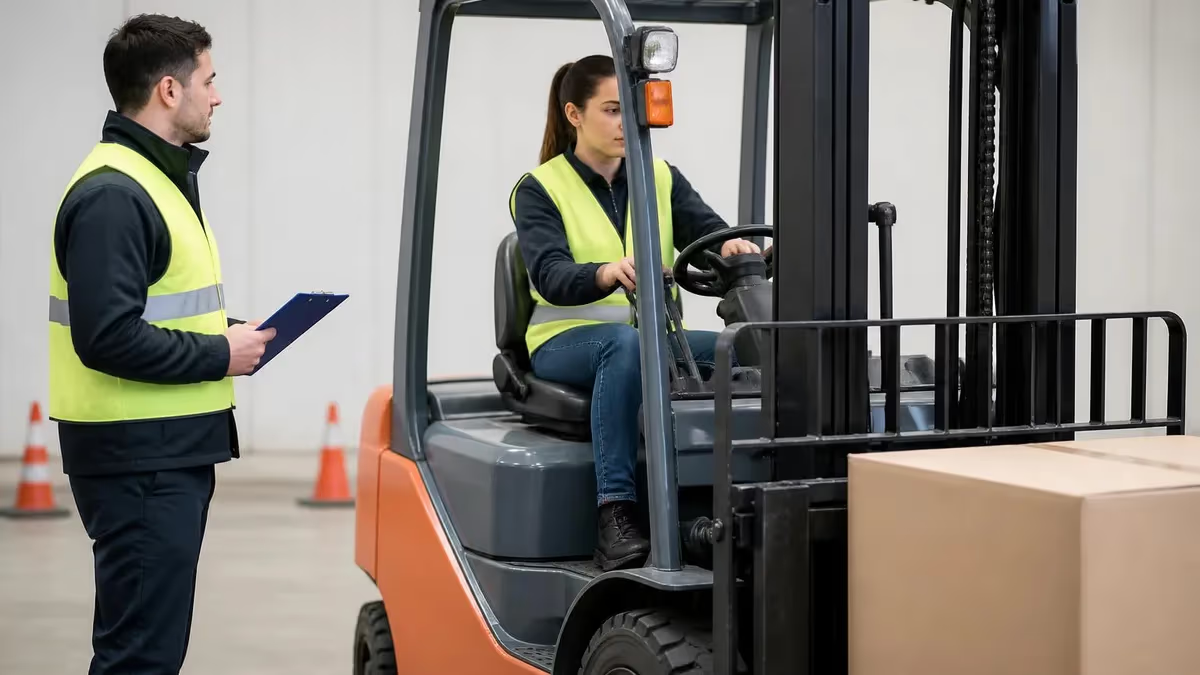
Forklift rental decisions often come down to one critical factor that many buyers and renters overlook: the mast. The forklift mast is the vertical assembly mounted at the front of every forklift, and it is the mechanical backbone that allows operators to lift, lower, tilt, and position loads with precision. Whether you are evaluating forklifts for a warehouse, a construction site, or a manufacturing floor, understanding how the mast works will directly affect your productivity, your safety record, and your bottom line.
The mast consists of interlocking steel channels, hydraulic cylinders, a carriage, and a set of forks or attachments. When the operator activates the lift controls, hydraulic fluid is pushed into the cylinders, extending the inner mast channels upward and raising the carriage along with whatever load sits on the forks. The tilt cylinders allow the mast to lean forward or backward, giving operators precise control over load stability. On a standard counterbalanced forklift, tilt range is typically 5 to 6 degrees forward and 10 to 12 degrees back.
For anyone pursuing certification of forklift operation, the mast is one of the first mechanical systems covered in formal training. OSHA standard 29 CFR 1910.178 requires that every powered industrial truck operator be trained and evaluated on the specific truck types they will use — and mast configuration is a defining characteristic of truck type. A two-stage mast behaves differently from a four-stage mast, and operators must understand those differences before they are permitted to operate.
Forklift training programs spend considerable time on mast operation because improper technique causes a disproportionate share of workplace injuries. The National Safety Council estimates that forklift accidents result in roughly 85 fatalities and nearly 35,000 serious injuries in the United States every year. A significant percentage of those incidents involve load instability during lifting or lowering — situations that proper mast knowledge and technique can prevent. This is why employers and certification bodies treat mast competency as non-negotiable.
Whether you are a new forklift operator working toward your first certification, an experienced driver moving to a different lift truck configuration, or a fleet manager making forklift rental decisions, this guide covers everything you need to know. We will walk through the main mast types, explain how each component functions, compare the pros and cons of different configurations, and show you how mast selection fits into the broader context of forklift operator certification and workplace safety compliance.
Different industries have vastly different mast requirements. A beverage distribution center with 30-foot racking needs a different mast than a lumber yard loading flatbed trucks at ground level. An electric forklift in a cold-storage facility may need a mast rated for low-temperature hydraulic fluid, while a stand up forklift in a retail backroom needs a mast short enough to clear dock doors. Matching the mast to the application is as important as matching engine type or tire configuration, and smart forklift rental decisions account for all of these variables.
This article is part of a broader series on forklift systems and certification. As you read, you will notice that mast knowledge connects directly to daily pre-shift inspections, load capacity calculations, and the written and practical evaluations required for operator certification. By the time you finish this guide, you will have a solid foundation for both the practical operation of forklift masts and the certification knowledge tested on OSHA-aligned exams.
Forklift Mast by the Numbers
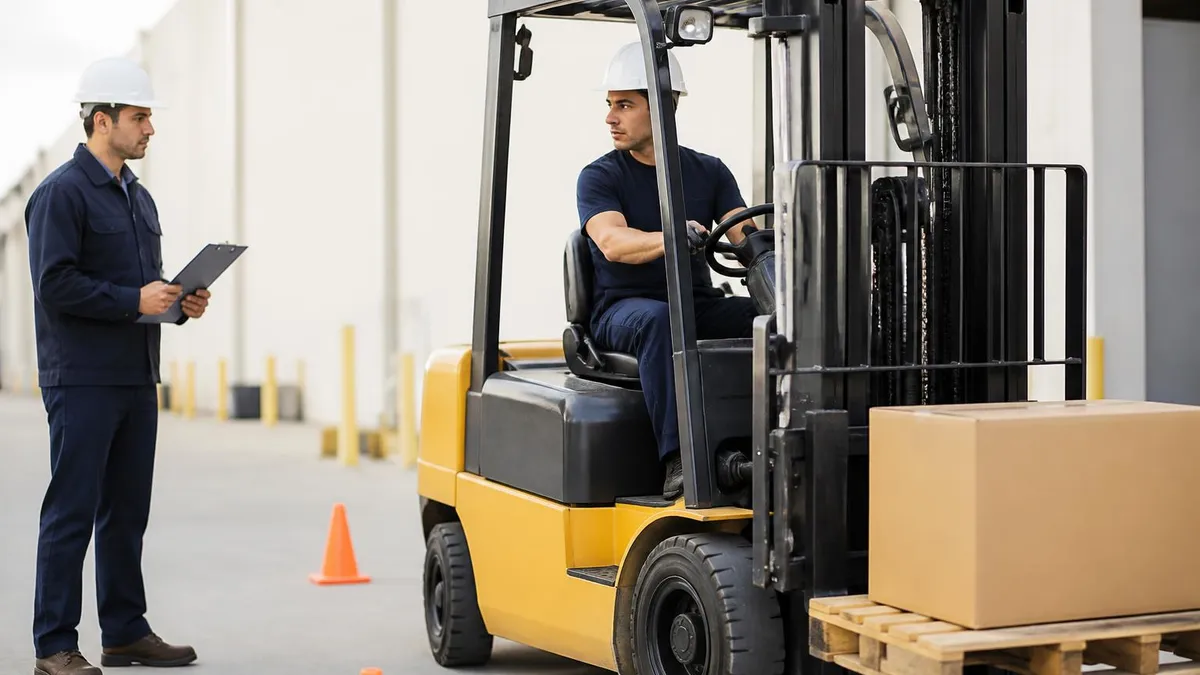
The Four Main Forklift Mast Types
A single-channel mast with no free lift — the entire carriage and mast rise together. Best for outdoor and dock applications where overhead clearance is not a concern. Lift heights typically max out around 10 feet, making this the simplest and most durable configuration for heavy-duty outdoor use.
Features a free-lift zone where the carriage rises within the collapsed mast before the outer channels extend. This gives operators the ability to lift loads inside buildings with low ceilings before extending fully. Lift heights range from 10 to 20 feet, making duplex masts the most common choice for general warehousing.
The standard choice for high-rack warehouses, the triplex mast uses three interlocking channel sets to achieve lift heights of 20 to 30 feet while keeping the collapsed height low enough to clear standard dock doors. This mast type is the most widely specified configuration for forklift for sale listings in the US.
Used in specialized very-narrow-aisle (VNA) applications, the quad mast can reach 35 feet or more while maintaining a very compact collapsed height. These masts are hydraulically complex and require advanced operator training. They are common in large distribution centers with tall selective or drive-in rack systems.
Understanding how each component of the forklift mast works together is essential for both safe operation and passing your operator certification evaluation. The mast is not a single part — it is a system of mechanical and hydraulic components that must work in precise coordination. When any single element degrades or fails, the consequences can range from reduced productivity to catastrophic load drop. Let us walk through each major component in detail.
The mast channels, sometimes called uprights or rails, are the vertical steel beams that form the structural skeleton of the mast. On a duplex or triplex mast, you will have an outer fixed channel welded to the forklift frame and one or two inner channels that telescope upward when the lift cylinders are pressurized. The channels are hardened and precisely machined so the inner channels slide smoothly. Worn or damaged channels increase friction, cause jerky movement, and can create dangerous binding under load.
The lift cylinders are the hydraulic actuators that extend the mast. A simplex or duplex mast typically uses a single center cylinder, while triplex and quad masts add side cylinders for the secondary and tertiary stages. The cylinders are fed by the forklift's hydraulic pump, which is powered by the engine or electric motor depending on whether you are operating an internal combustion or electric forklift. Cylinder seals degrade over time and with temperature extremes — a leaking cylinder is one of the most common forklift rental return issues that fleet managers document.
The carriage is the horizontal platform that runs in tracks on the inner mast channel. The forks or attachments mount directly to the carriage via fork pins or a hook-type mounting system. A standard ITA (Industrial Truck Association) Class III carriage supports forks rated from 4,000 to 5,500 pounds, while a Class IV or V carriage handles heavier capacities. The carriage also houses the tilt cylinder pivot points, allowing the entire mast to lean forward or backward relative to the forklift body.
Chains and chain anchors are critical load-bearing components that many operators do not inspect carefully enough. The lift chains run from the carriage up and over sheaves (pulleys) at the top of the inner mast, then anchor to the outer mast frame. The chains bear the full rated load of the forklift, so any cracking, corrosion, or wear is an immediate safety concern. OSHA and most forklift manufacturer guidelines require chain replacement when wear exceeds 3 percent elongation of any 12-inch section. Regular chain lubrication is mandatory maintenance — dry chains wear rapidly and can snap under dynamic load.
The tilt cylinders are typically mounted on the sides of the mast and connect the mast to the forklift's front axle housing or frame. They allow the operator to rake the mast forward for load pickup and backward for transport position. The backward tilt — typically 10 to 12 degrees — is critical for travel stability because it shifts the load's center of gravity toward the forklift's drive axle, keeping the machine stable on ramps and uneven surfaces. New forklift operators frequently underuse backward tilt during travel, which is a top failure point in practical certification evaluations.
The load backrest extension (LBR) is the vertical frame that rises above the fork carriage to prevent loads from sliding backward toward the operator. While technically a separate attachment, the LBR is so universally installed that most operators consider it part of the mast assembly. OSHA requires a substantial overhead guard above the operator and a load backrest when the load could fall rearward — most manufacturers install both as standard equipment. Understanding which attachments are compatible with a given mast carriage class is a key part of forklift training for operators who will handle diverse load types.
Forklift certification Practice Test Questions
Prepare for the Forklift certification Certification exam with our free practice test modules. Each quiz covers key topics to help you pass on your first try.
Forklift certification Certification Forkl...
Forklift certification Exam Questions covering Certification Forklift certification Maintenance and Repairs. Master Forklift certification Test concepts for certification prep.
Forklift certification Certification Forkl...
Free Forklift certification Practice Test featuring Certification Forklift certification Maintenance and Repairs Questions and Answers. Improve your Forklift certification Exam score with mock test prep.
Forklift certification Certification Forkl...
Forklift certification Mock Exam on Certification Forklift certification Operator Training and Certification Requirements. Forklift certification Study Guide questions to pass on your first try.
Forklift certification Certification Forkl...
Forklift certification Test Prep for Certification Forklift certification Operator Training and Certification Requirements Questions and Answers. Practice Forklift certification Quiz questions and boost your score.
Forklift certification Load Handling and S...
Forklift certification Questions and Answers on Load Handling and Stability. Free Forklift certification practice for exam readiness.
Forklift certification OSHA Regulations an...
Forklift certification Mock Test covering OSHA Regulations and Compliance. Online Forklift certification Test practice with instant feedback.
Forklift certification Pre-Operation Inspe...
Free Forklift certification Quiz on Pre-Operation Inspections. Forklift certification Exam prep questions with detailed explanations.
Forklift certification Refueling and Recha...
Forklift certification Practice Questions for Refueling and Recharging Procedures. Build confidence for your Forklift certification certification exam.
Forklift certification Safe Driving and Ma...
Forklift certification Test Online for Safe Driving and Maneuvering. Free practice with instant results and feedback.
Forklift certification Workplace Hazard Id...
Forklift certification Study Material on Workplace Hazard Identification. Prepare effectively with real exam-style questions.
Forklift certification Forklift Instructions
Free Forklift certification Test covering Forklift Instructions. Practice and track your Forklift certification exam readiness.
Forklift certification Forklift MCQ
Forklift certification Exam Questions covering Forklift MCQ. Master Forklift certification Test concepts for certification prep.
Forklift certification Forklift Employer R...
Free Forklift certification Practice Test featuring Forklift Employer Responsibilities. Improve your Forklift certification Exam score with mock test prep.
Forklift certification Forklift Penalties ...
Forklift certification Mock Exam on Forklift Penalties for Non-Compliance. Forklift certification Study Guide questions to pass on your first try.
Mast Selection for Forklift Rental and Purchase
When searching for forklift rental near me, the first specification to nail down is the required lift height. A duplex mast is the default for most short-term forklift rentals because it handles the widest range of common tasks — loading trucks, stacking pallets to 18 feet, and operating inside standard warehouse facilities. Rental rates for a duplex LP-gas forklift in the 5,000-pound class typically run $200 to $400 per month, making it the most cost-effective general-purpose choice for short-term projects and seasonal demand spikes.
For applications requiring lift heights above 20 feet, forklift rentals shift to triplex masts, which carry a rental premium of $100 to $200 per month over comparable duplex units. Before committing to any forklift rental, measure your facility's door heights and ceiling clearances with the mast fully collapsed — a triplex mast can stand 7 to 8 feet tall when collapsed, and many older buildings have dock doors as low as 8.5 feet. Failing to account for collapsed mast height is a common and costly mistake that forces operators to work around a machine that physically cannot enter the building.
Triplex Mast: Pros and Cons for Warehouse Operations
- +Reaches 20–30 ft lift heights needed for modern high-bay racking systems
- +Free-lift zone allows carriage to rise before mast extends, clearing low dock doors
- +Widely available in both forklift rental and forklift for sale markets
- +Compatible with most ITA standard attachments and carriage classes
- +Balanced visibility — three-stage design keeps mast profiles narrower than quad
- +Suitable for both electric forklift and LP-gas powertrains in standard warehouse applications
- −Higher collapsed height than duplex masts can restrict access in older or low-clearance facilities
- −More hydraulic components (additional cylinders, chains, sheaves) mean higher maintenance costs
- −Greater mast weight increases overall machine weight and may stress floor surfaces
- −Requires more operator training time to master full-height precision placement
- −Hydraulic system complexity increases downtime risk if seals or cylinders fail
- −Higher purchase price and forklift rental rate compared to simplex or duplex configurations
Daily Forklift Mast Inspection Checklist
- ✓Visually inspect all mast channels for cracks, bends, or weld fractures before the first lift of the shift.
- ✓Check lift chains for corrosion, cracked links, or elongation — lubricate dry chains before operating.
- ✓Verify chain anchors and anchor pins are secure and show no signs of deformation or wear.
- ✓Inspect hydraulic cylinders for fluid leaks around seals, especially at the base and rod end.
- ✓Confirm carriage rollers move freely in the mast channels with no binding or excessive play.
- ✓Test tilt cylinders by raking the mast fully forward and backward — movement should be smooth and equal on both sides.
- ✓Check the load backrest extension (LBR) for secure mounting and structural integrity.
- ✓Ensure fork mounting pins and fork locking clips are fully seated and undamaged.
- ✓Operate the mast through full lift height while unloaded, listening for unusual sounds or vibrations.
- ✓Confirm the overhead guard above the operator is undamaged and all fasteners are tight before starting work.
Mast Inspection Is a Graded Exam Skill
OSHA-aligned forklift certification evaluations include a practical component where the examiner observes the operator completing a pre-shift inspection. Mast and hydraulic system checks account for a significant portion of that assessment. Candidates who skip chain inspection, fail to test tilt cylinders, or do not check for hydraulic leaks risk failing the practical exam even if they scored perfectly on the written portion.
Certification of forklift operators in the United States is governed primarily by OSHA 29 CFR 1910.178(l), which mandates that employers ensure every operator is competent to operate a powered industrial truck safely.
The standard does not prescribe a specific course format, but it does require training to cover the truck-related topics relevant to each class of equipment the operator will use — and the mast is explicitly listed as a topic area. This means that an operator certified only on Class IV sit-down counterbalanced forklifts is not automatically authorized to operate a Class II reach truck with a different mast system.
Forklift training programs that meet OSHA's requirements typically cover mast operation across three domains: mechanical knowledge (how the mast works), operational technique (how to use the mast correctly during work tasks), and inspection skills (how to identify mast defects before they cause incidents). Written evaluations test mechanical and regulatory knowledge, while practical evaluations assess the operator's actual skill in controlling the mast under realistic worksite conditions. Both components must be successfully completed for the certification to be considered valid.
The forklift operator certification cycle does not end at initial training. OSHA requires employers to conduct refresher training and re-evaluation whenever an operator is observed operating unsafely, is involved in an incident or near-miss, or is assigned to operate a different type of truck than they were originally certified on. Additionally, operators must be re-evaluated at least every three years regardless of observed performance. Many employers pair the three-year evaluation with a written knowledge test to confirm that operators retain mast-specific knowledge alongside broader safety content.
For operators preparing for initial or renewal certification, understanding the stability triangle is one of the most tested mast-related concepts. The stability triangle is the three-point support zone formed by the two front drive axle points and the single rear steer axle pivot point.
When a load is raised on the mast, the combined center of gravity of the truck and load moves forward — and the higher the load, the further forward that shift. If the combined center of gravity exits the stability triangle (because the load is too heavy, raised too high, or the forklift is turning too fast), the machine will tip forward or sideways.
Mast tilt settings directly affect stability triangle dynamics during travel. The OSHA-recommended travel position requires the mast to be tilted fully back and the forks carried 6 to 8 inches above the floor. This position lowers the combined center of gravity and shifts it toward the rear of the stability triangle, maximizing stability during movement. Operators who travel with the mast upright or partially elevated dramatically reduce their stability margin — a practice that shows up frequently in accident investigation reports and is a near-certain fail point on practical certification evaluations.
Load capacity ratings are stamped on the forklift's data plate and are calculated at a specific load center distance — the horizontal distance from the front face of the fork to the center of gravity of the load. The standard load center for most forklifts is 24 inches. If your load is longer, wider, or heavier than the rated parameters, the effective capacity drops.
Mast tilt angle also affects rated capacity: a mast tilted fully forward shifts load weight toward the front wheels and reduces effective capacity. This is why experienced forklift operators minimize forward tilt when carrying heavy loads and why training programs cover capacity plate interpretation in detail.
The written portion of most forklift certification exams includes several questions specifically about mast components, lift heights, capacity ratings, and tilt operations. Candidates should be able to identify the parts of a mast from a diagram, explain how chain elongation is measured, describe the correct travel position, and calculate whether a given load exceeds the rated capacity at a non-standard load center. Practicing with OSHA-aligned sample questions before your evaluation significantly improves first-attempt pass rates, particularly for operators new to the subject material.
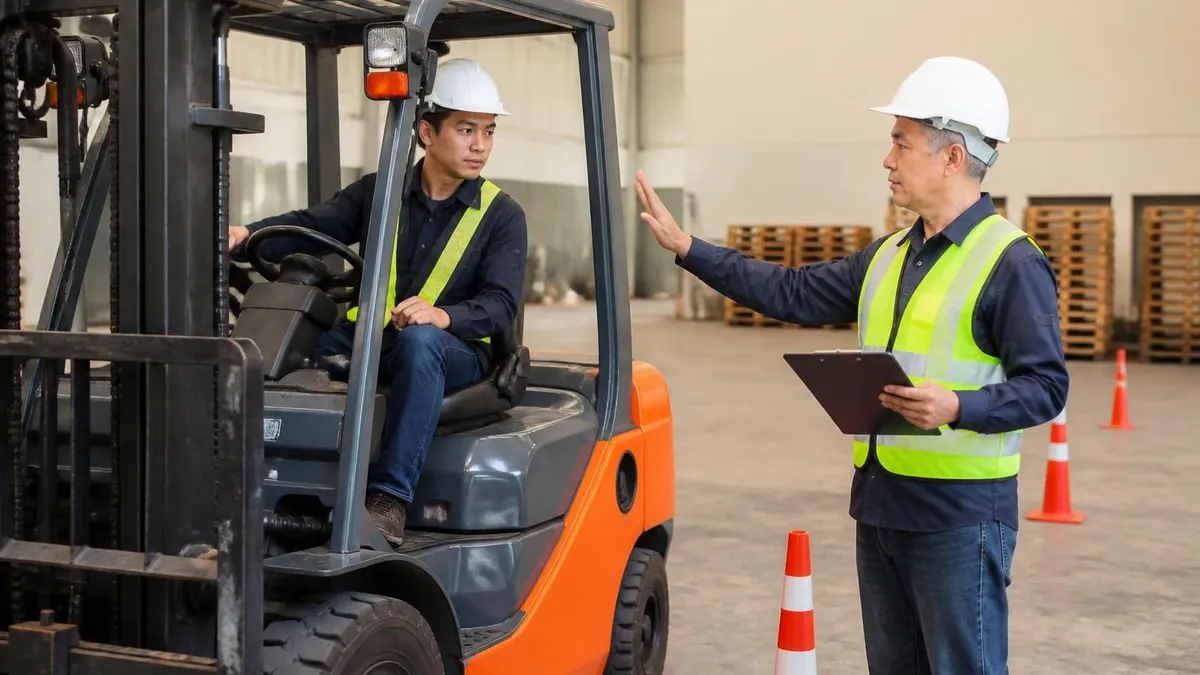
Operating a forklift mast beyond its rated lift height — even briefly — can buckle the inner channels, snap lift chains, or cause catastrophic hydraulic failure. The rated maximum lift height on the data plate is a hard engineering limit, not a recommendation. Always verify that your application's required lift height falls within the machine's rated capacity before committing to a forklift rental or purchase, and retrain operators any time a new machine with a different mast configuration is introduced to the fleet.
Maintaining a forklift mast properly extends the machine's service life, reduces unplanned downtime, and is a direct requirement under OSHA's powered industrial truck standard. Employers are required to ensure that forklifts are maintained in safe operating condition, that defects are reported promptly, and that trucks with safety-critical defects are removed from service until repaired. The mast, as the system that bears the full weight of every load the forklift carries, receives particular scrutiny from OSHA inspectors and insurance auditors alike.
Scheduled preventive maintenance (PM) for the mast typically follows the manufacturer's recommended intervals, which are usually based on operating hours. A standard forklift operating two shifts per day might accumulate 4,000 hours per year, triggering major mast services every 12 to 18 months. A typical mast PM service includes chain inspection and lubrication, roller and bearing replacement if worn, cylinder seal inspection, channel alignment check, and carriage pin inspection. Labor for a full mast service at an authorized dealer typically runs $300 to $600, depending on machine age and the parts required.
Lift chain replacement is the most significant mast maintenance expense most fleet operators encounter. A full set of lift chains for a mid-size counterbalanced forklift costs $150 to $400 in parts, plus 2 to 4 hours of labor. Chains should be replaced as a matched set — installing one new chain alongside a worn chain creates unequal load distribution that accelerates wear on both the new chain and the mast channels. Most manufacturers recommend replacing chains every 3,000 to 5,000 operating hours regardless of visual condition, because fatigue failure in chains can occur without visible surface defects.
Hydraulic cylinder seal replacement is another common mast repair. Cylinder seals typically last 5,000 to 10,000 hours under normal operating conditions, but cold temperatures, contaminated hydraulic fluid, and overloading can shorten seal life significantly. Signs of failing seals include visible oil streaks on the cylinder rod, slow or uneven mast lift, and mast drift (the load slowly descending when the operator releases the control lever). Mast drift is not just a maintenance issue — it is a safety hazard and an OSHA violation if the machine continues to be operated in that condition.
For fleet managers weighing forklift rental versus ownership, mast maintenance costs are a key variable in the total cost of ownership calculation. Short-term forklift rentals generally include maintenance in the rental agreement, shifting the PM burden to the rental company. Long-term leases (24 to 60 months) typically make the lessee responsible for consumable maintenance items including chains and seals while the leasing company handles major structural repairs. Outright purchase puts all maintenance costs on the owner, which is why many mid-sized warehouses maintain a mix of owned standard-mast machines and rented high-reach machines that are maintained by the rental provider.
When evaluating a used forklift for sale, mast condition is one of the top three inspection points alongside tires and hydraulic fluid condition. Request the machine's maintenance history and look specifically for records of chain replacement, cylinder seal service, and any mast straightening or channel replacement.
A used forklift with no chain service records and 8,000+ hours on the clock is a liability — the chains are likely overdue for replacement, and the cost of that service should be factored into your offer price. A competent mechanic can inspect a used machine's mast in about 30 minutes and provide a written condition report that protects both buyer and seller.
Forklift operators also play a direct role in mast longevity through their daily operating habits. Smooth, controlled hydraulic movements extend the life of seals, chains, and rollers compared to aggressive pumping of the controls. Carrying loads at the correct travel height (6 to 8 inches off the floor) rather than dragging forks reduces carriage wear. Avoiding sudden stops while carrying elevated loads prevents shock loading on chains and cylinder anchors. These techniques are covered in every quality forklift training program, and reinforcing them during the three-year recertification cycle keeps both the machines and the operators in top working condition.
Preparing for a forklift operator certification exam requires a combination of hands-on practice and solid written knowledge. Most employers offer on-site training using the actual equipment the operator will use on the job, but many candidates supplement this with self-study using practice questions, reference guides, and video walkthroughs of mast operation. The written component of the evaluation typically covers OSHA regulations, stability principles, load capacity calculations, pre-shift inspection procedures, and mast-specific mechanical knowledge — all topics where targeted practice pays off significantly.
One of the best study strategies for mast-related certification content is to work through OSHA 29 CFR 1910.178 directly. The standard is publicly available and written in plain language that operators can understand without legal or engineering background. Pay particular attention to the sections covering pre-operation inspection, safe speeds, load handling, and maintenance requirements — these are the sections most frequently tested on written exams. Cross-reference the standard's requirements with your employer's site-specific training materials, because employers are permitted to add stricter requirements beyond OSHA minimums.
Practice tests are one of the most effective tools for identifying knowledge gaps before the real evaluation. A well-designed practice exam will include questions about mast component identification, chain inspection criteria, capacity plate interpretation, and correct travel techniques — the same content areas that appear on OSHA-aligned evaluations. Taking multiple practice tests under timed conditions builds both knowledge and exam confidence. If you consistently miss questions about a specific topic — say, chain elongation limits or tilt cylinder operation — that signals where to focus your review before the actual evaluation.
For operators approaching their three-year recertification evaluation, refresher training is typically shorter than initial certification but covers the same content areas. Many employers conduct a brief classroom review followed by a practical evaluation on the specific truck types used at that facility. If your workplace has recently added new equipment — for example, switching from LP-gas counterbalanced forklifts to electric reach trucks with high-mast configurations — the recertification should explicitly address the mast differences between the old and new equipment types, because those differences are operationally significant and safety-critical.
Employers who operate multiple forklift types should maintain a matrix tracking which operators are certified on which truck classes. This matrix protects the employer in the event of an OSHA inspection or a workplace accident investigation, and it ensures that supervisors can quickly verify that the right operator is assigned to the right machine. An operator certified on a standard counterbalanced forklift who is reassigned to a reach truck with a 30-foot mast needs additional training and evaluation before operating the new equipment — assigning them without that training exposes the employer to significant regulatory liability.
The relationship between forklift mast knowledge and career advancement is real and quantifiable. Operators who demonstrate proficiency across multiple mast types — particularly high-reach triplex and quad mast configurations — command higher wages and have broader employment options.
The Bureau of Labor Statistics reports a median wage of approximately $38,000 per year for forklift operators, but operators with multi-class certification and high-mast experience in distribution center environments frequently earn $45,000 to $55,000, with senior operators and lead positions reaching $60,000 or more in high-cost-of-living metro areas. Building mast expertise is not just about passing a certification exam — it is an investment in long-term earning potential.
If you are just beginning your forklift career or preparing for initial certification, focus on mastering the fundamentals covered in this guide: mast types and their applications, the function of each major component, the daily inspection procedure, correct operating techniques, and the OSHA regulatory framework. These fundamentals form the foundation of every forklift training program and every certification evaluation. With a solid understanding of the mast system — and consistent practice with realistic exam questions — you will be well positioned to pass your certification on the first attempt and build a safe, productive career as a certified forklift operator.
Forklift Questions and Answers
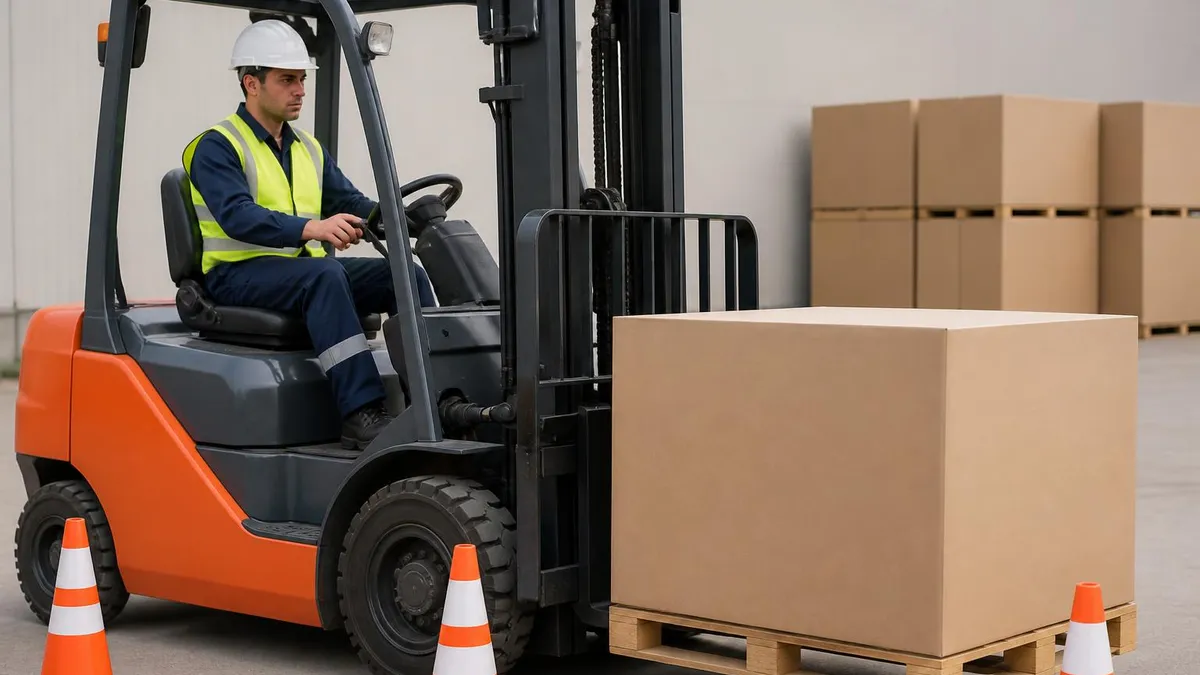
Forklift Tires: Complete Guide to Types, Sizing, Wear Patterns, and Replacement Costs
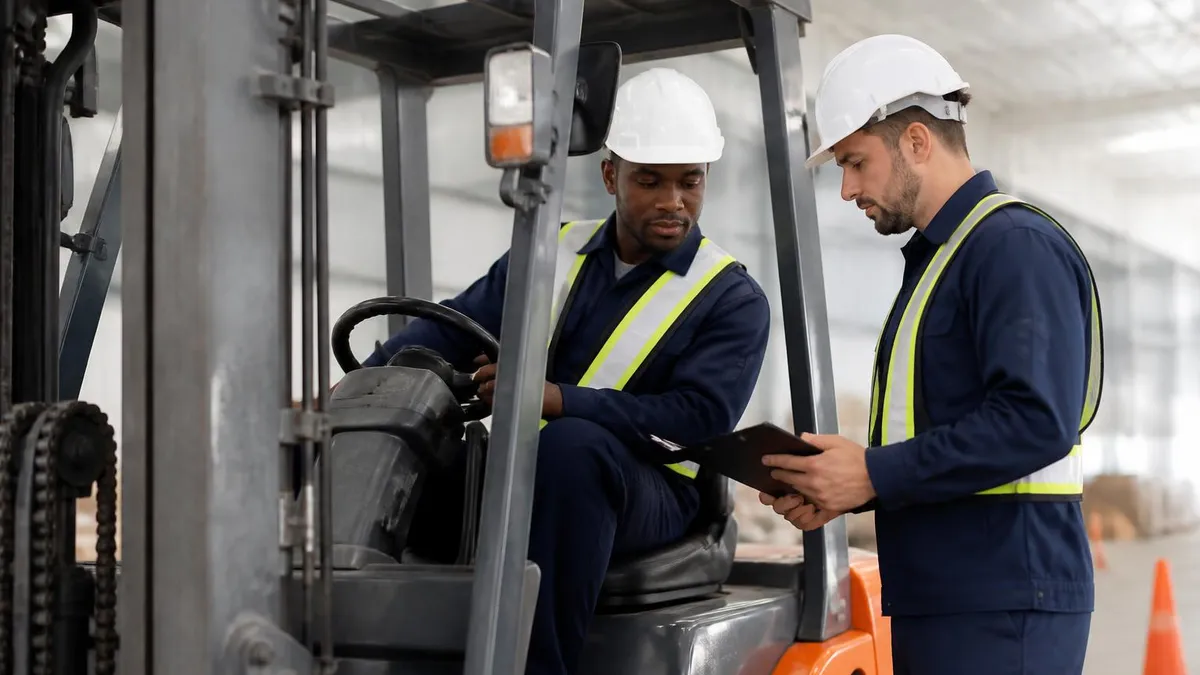
Forklift Operator Duties: Complete Guide to Daily Responsibilities, Safety Tasks, and Career Path for 2026
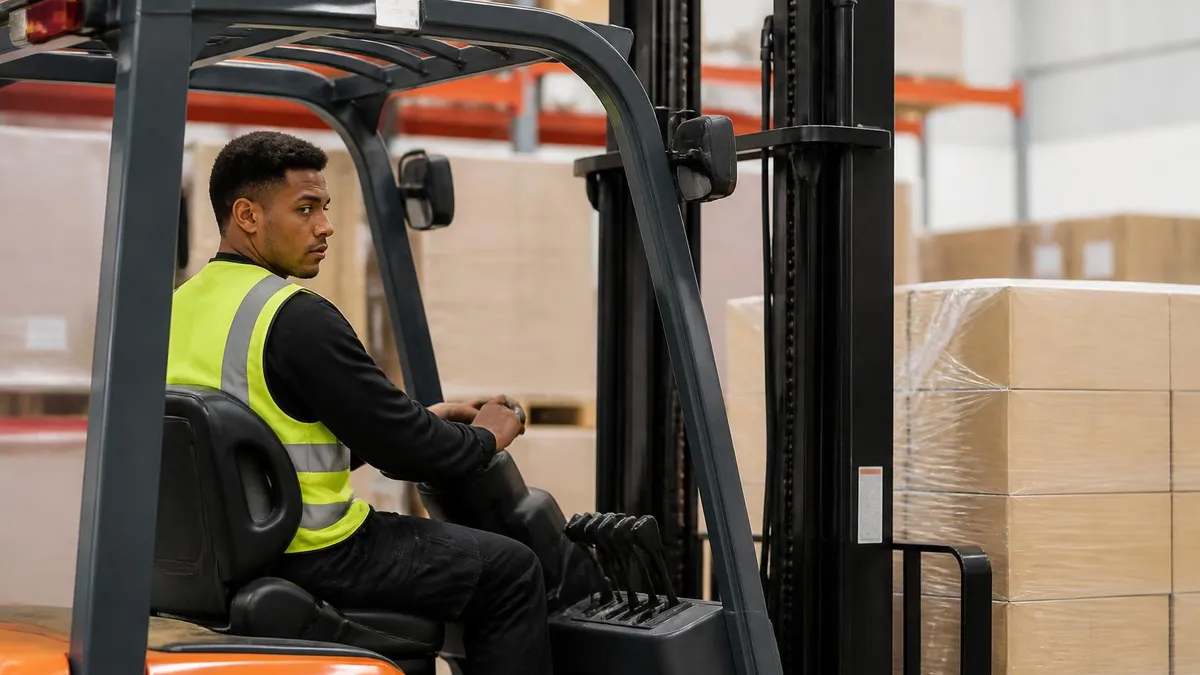
Forklift Course: Complete Training Guide, Certification Requirements, and Operator Tips for 2026
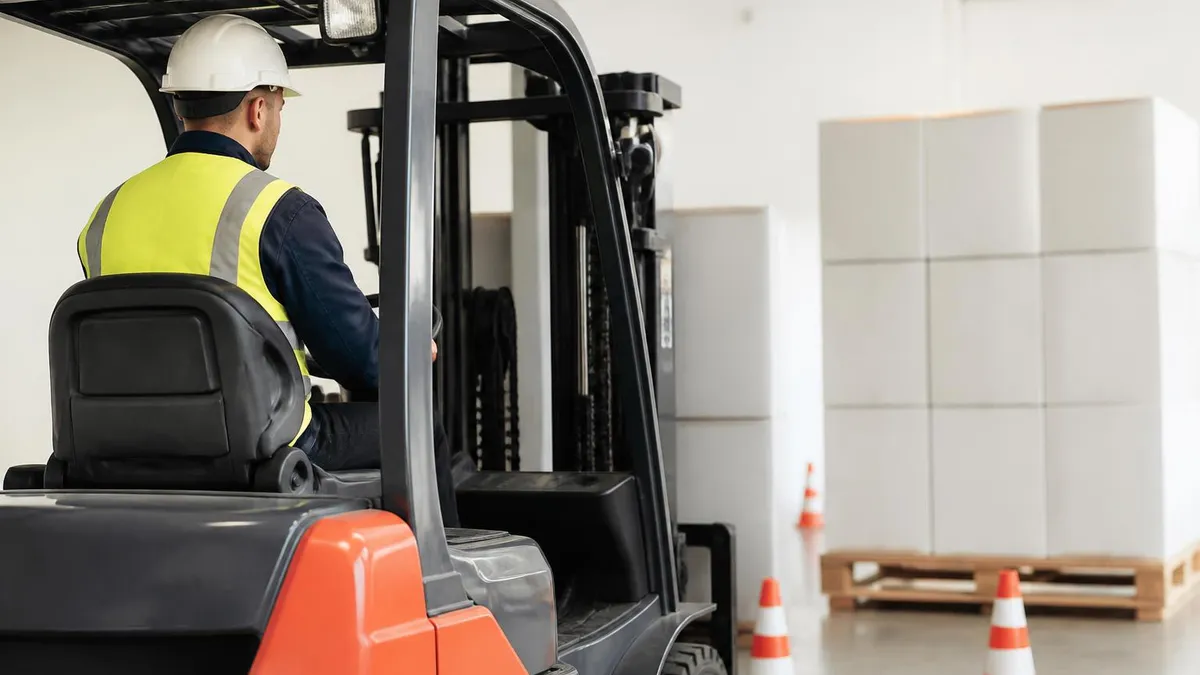
Forklift License Renewal: Complete Guide to Forklift License Expiry, OSHA Recertification, and Operator Requirements for 2026
Sit Down Forklift Jobs: Complete Guide to Careers, Pay, Training, and Hiring in 2026
About the Author

Certified Crane Operator & Skilled Trades Exam Specialist
Ferris State UniversityRobert Martinez is a Journeyman Ironworker, NCCCO-certified crane operator, and forklift trainer with a Bachelor of Science in Construction Technology from Ferris State University. He has 21 years of ironworking, rigging, and heavy equipment operation experience across high-rise and industrial construction sites. Robert prepares candidates for crane operator, rigger, forklift, and skilled trades certification examinations.