
Sit Down Forklift Jobs: Complete Guide to Careers, Pay, Training, and Hiring in 2026 October
Sit down forklift jobs guide: 🧠 pay, training, certification, hiring employers, and how to land your first role. Includes forklift rental insights.
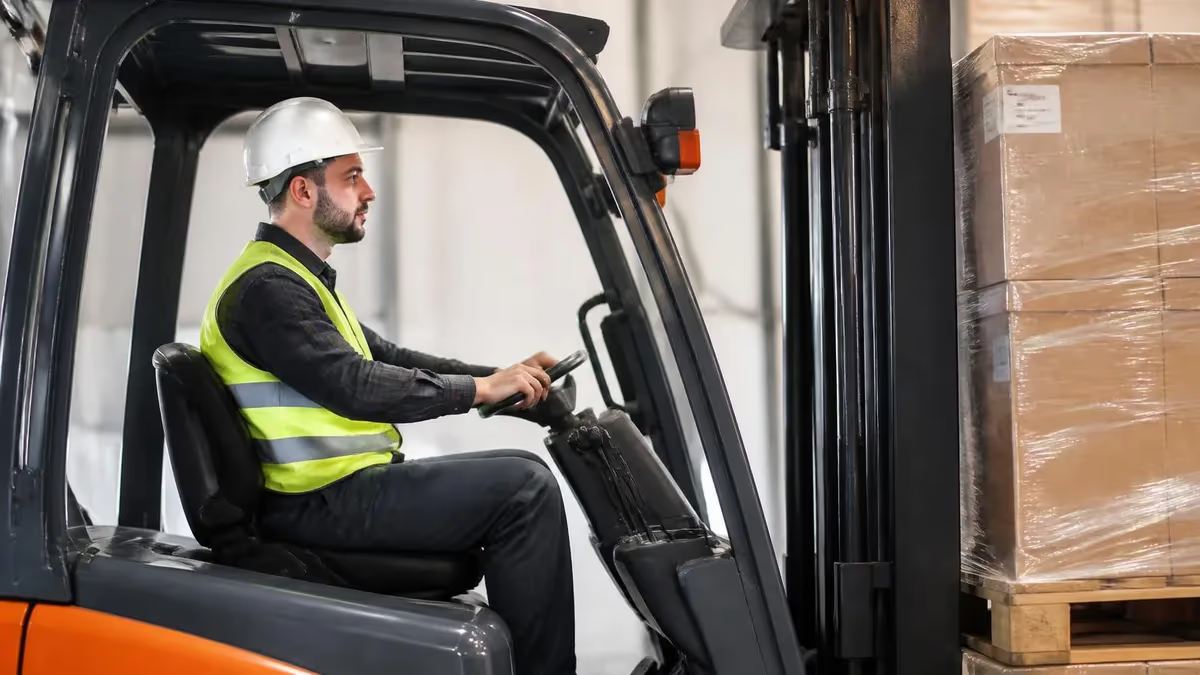
Sit down forklift jobs are among the most in-demand warehouse positions in the United States, with more than 850,000 active forklift operator roles tracked by the Bureau of Labor Statistics in 2026. Whether you are exploring entry-level warehouse work, transitioning from retail, or upgrading from a stand up forklift role, the sit-down counterbalance class represents the bread and butter of American logistics, manufacturing, and distribution. These jobs offer stable hourly pay, full benefits, predictable shifts, and a clear path toward higher-paying lead, trainer, and supervisor positions over time.
The sit-down forklift, formally known as a Class IV (cushion tire) or Class V (pneumatic tire) counterbalance lift truck under OSHA classifications, is the machine most people picture when they hear the word forklift. Operators sit in an enclosed or open cab, steer with rear wheels, and use a tilting mast with forks to lift palletized loads typically weighing 3,000 to 8,000 pounds. Mastering this machine opens doors at Amazon, Walmart, FedEx, UPS, Home Depot, Costco, and tens of thousands of smaller warehouses across every state.
Hiring demand has stayed unusually strong through 2026 because e-commerce fulfillment continues to expand, and because experienced operators retire faster than new ones enter the field. According to Indeed and LinkedIn data pulled in March 2026, the median time-to-hire for a certified sit-down operator is just 9 days, compared to 24 days for unskilled warehouse associates. Employers are now offering signing bonuses of $500 to $2,500, paid OSHA certification, and shift differentials of $1.50 to $4.00 per hour for evenings and weekends.
Pay has moved meaningfully upward. The national median wage for sit-down forklift operators sits at $22.40 per hour in 2026, up from $18.10 in 2022. Top-paying metros — Seattle, San Jose, Newark, Chicago, and Denver — regularly post hourly rates above $28, with cold-storage and hazmat positions commanding even higher premiums. Annualized, a full-time sit-down operator with overtime can clear $55,000 to $72,000 before benefits, which compares favorably to many roles requiring two-year degrees.
Getting hired starts with a recognized OSHA-compliant certification, which most employers will either provide on-site within your first week or accept as a transferable credential from a training school. Some operators get their start with an entry-level role at a rental yard, where exposure to dozens of brands and configurations builds versatility quickly — companies offering forklift repair services often hire forklift operators to test, shuttle, and stage rental units for delivery, which doubles as paid hands-on experience.
This complete guide walks through everything you need to land, keep, and grow a sit-down forklift job in 2026. You will learn the exact certification pathway, current wage data by metro, the top hiring employers, what a real shift looks like, the physical requirements, and how to move from temp-to-hire into permanent placement with benefits. We will also cover common interview questions, drug-screening expectations, and the red flags that disqualify otherwise strong candidates from getting offers.
Whether you are 18 and looking for your first real job, 45 and pivoting from a worn-out trade, or already certified and chasing a higher wage, the sit-down forklift career path remains one of the most accessible high-paying blue-collar opportunities in the country. Bookmark this page, work through the free practice quizzes embedded throughout, and use the checklists in section 4 and section 6 to track your progress from application to first paycheck.
Free Forklift certification Study Tools
Interactive Forklift certification resources on PracticeTestGeeks, free to start:
- Forklift certification flashcards — review key terms and concepts card by card
- Forklift certification study guide — topic-by-topic overview of what the exam covers
- Forklift certification cheat sheet — one-page printable summary for last-minute review
Sit Down Forklift Jobs by the Numbers (2026)

Top Employers Hiring Sit Down Forklift Operators in 2026
Hires PIT (Powered Industrial Truck) operators at $22–$28/hr with paid certification, full benefits day one, and stock grants after six months. Sit-down forklifts are used heavily in inbound dock and pallet receive operations.
Distribution centers pay $24–$32/hr with quarterly bonuses, tuition reimbursement, and clear promotion ladders into lead and area manager roles. Walmart's MyShare program adds up to $1,000 quarterly for hitting team metrics.
Freight terminals run sit-down forklifts around the clock, with night-shift premiums of $2–$4/hr. Union UPS positions through Teamsters Local contracts offer top-tier pay, pension, and gold-standard healthcare benefits.
Tyson, Smithfield, Lineage Logistics, and Americold pay premiums of $3–$5/hr for freezer environments down to -20°F. Expect specialized PPE, shorter rotation cycles, and aggressive retention bonuses ranging from $1,500 to $5,000.
Home Depot, Lowe's, and Menards hire receiving associates at $18–$24/hr with consistent daytime schedules, employee discounts, and a much lower production-quota pressure than fulfillment center work.
Wages for sit-down forklift jobs vary widely by region, industry, and shift, but the upward pressure on pay has been remarkable. Five years ago, $16 per hour was a competitive starting rate in most secondary markets. In 2026, that same market typically opens at $20 per hour, with experienced operators clearing $26 to $30 once shift premiums, attendance bonuses, and overtime are factored in. The biggest pay jumps come from moving into specialized environments — cold storage, hazardous materials, food-grade clean rooms, and high-bay narrow-aisle operations all command meaningful premiums.
Shift differentials remain the single most underrated lever for boosting take-home pay. A second-shift premium of $1.50 per hour is worth roughly $3,120 annually for a full-time operator, while a third-shift premium of $3 per hour adds about $6,240. Weekend-only schedules at FedEx and Amazon can pay $26 to $30 per hour for just three 12-hour shifts, leaving four days a week free for a second job, school, or family. Read every shift posting carefully before applying — the headline wage rarely tells the full story.
Benefits packages have improved dramatically. Most major employers now offer health insurance starting on day one or after a 30-day waiting period, with employee premiums typically running $40 to $120 per month for a single plan. Dental, vision, 401(k) matching of 3% to 6%, paid sick leave, and tuition reimbursement of $3,000 to $5,250 annually are standard at Amazon, Walmart, UPS, and Target distribution centers. Smaller regional warehouses often match or beat these benefits to compete for qualified operators.
Overtime opportunities are nearly unlimited during peak season, which runs from late August through January for retail and year-round for grocery and pharmaceutical distribution. Operators routinely log 50 to 60 hours per week during peak, with time-and-a-half over 40 and double-time on certain holidays. Smart operators plan their saving and tax strategy around peak earnings, treating fall and winter as the windfall season that funds vacations, debt payoff, or a down payment on a vehicle.
Geographic arbitrage works in your favor if you are willing to relocate. Cities with the highest sit-down forklift wages — Seattle, San Francisco Bay Area, Newark, Chicago, and Boston — pay $26 to $34 per hour but come with steep housing costs. Secondary markets like Louisville, Indianapolis, Memphis, Kansas City, and Dallas-Fort Worth offer $20 to $26 per hour with dramatically lower cost of living, often producing higher real disposable income. UPS, Amazon, and FedEx hub cities are especially worth considering, including operators who service equipment rentals through a lull forklift dealer network.
Pay transparency laws in California, New York, Colorado, Washington, and a growing list of other states now require employers to post wage ranges in job listings. Use these mandated postings to benchmark offers — if an employer in a transparency state is offering you the bottom of the range, you have grounds to negotiate based on your certification, experience, and willingness to work undesirable shifts. Indeed, ZipRecruiter, and LinkedIn now display wage ranges by default for most listings, which makes apples-to-apples comparison fast.
Finally, do not overlook the value of stable hours. Many sit-down forklift jobs run fixed Monday-to-Friday schedules with predictable start and end times, which is rare in modern hourly work. For workers with kids in school, second jobs, or college classes, that consistency is worth real money. When comparing two offers, calculate the effective hourly wage including commute time, schedule flexibility, and the cost of childcare or babysitting required by each shift before deciding.

Forklift certification Practice Test Questions
Prepare for the Forklift certification Certification exam with our free practice test modules. Each quiz covers key topics to help you pass on your first try.
Forklift certification Certification Forkl...
Forklift certification Exam Questions covering Certification Forklift certification Maintenance and Repairs. Master Forklift certification Test concepts for certification prep.
Forklift certification Certification Forkl...
Free Forklift certification Practice Test featuring Certification Forklift certification Maintenance and Repairs Questions and Answers. Improve your Forklift certification Exam score with mock test prep.
Forklift certification Certification Forkl...
Forklift certification Mock Exam on Certification Forklift certification Operator Training and Certification Requirements. Forklift certification Study Guide questions to pass on your first try.
Forklift certification Certification Forkl...
Forklift certification Test Prep for Certification Forklift certification Operator Training and Certification Requirements Questions and Answers. Practice Forklift certification Quiz questions and boost your score.
Forklift certification Load Handling and S...
Forklift certification Questions and Answers on Load Handling and Stability. Free Forklift certification practice for exam readiness.
Forklift certification OSHA Regulations an...
Forklift certification Mock Test covering OSHA Regulations and Compliance. Online Forklift certification Test practice with instant feedback.
Forklift certification Pre-Operation Inspe...
Free Forklift certification Quiz on Pre-Operation Inspections. Forklift certification Exam prep questions with detailed explanations.
Forklift certification Refueling and Recha...
Forklift certification Practice Questions for Refueling and Recharging Procedures. Build confidence for your Forklift certification certification exam.
Forklift certification Safe Driving and Ma...
Forklift certification Test Online for Safe Driving and Maneuvering. Free practice with instant results and feedback.
Forklift certification Workplace Hazard Id...
Forklift certification Study Material on Workplace Hazard Identification. Prepare effectively with real exam-style questions.
Forklift certification Forklift Instructions
Free Forklift certification Test covering Forklift Instructions. Practice and track your Forklift certification exam readiness.
Forklift certification Forklift MCQ
Forklift certification Exam Questions covering Forklift MCQ. Master Forklift certification Test concepts for certification prep.
Forklift certification Forklift Employer R...
Free Forklift certification Practice Test featuring Forklift Employer Responsibilities. Improve your Forklift certification Exam score with mock test prep.
Forklift certification Forklift Penalties ...
Forklift certification Mock Exam on Forklift Penalties for Non-Compliance. Forklift certification Study Guide questions to pass on your first try.
Forklift Training & Certification of Forklift Operators
OSHA 29 CFR 1910.178(l) is the federal regulation governing forklift operator training and certification of forklift personnel. Every employer is required to provide formal instruction, practical training, evaluation, and recertification every three years. The standard applies to all powered industrial trucks, including sit-down counterbalance lifts, stand up forklift models, reach trucks, and order pickers used in commercial settings.
Training must cover truck-related topics like controls, instrumentation, stability, capacity, maintenance, and refueling, plus workplace-related topics like surface conditions, pedestrian traffic, narrow aisles, ramps, and hazardous environments. An employer cannot legally allow an operator to run a forklift in production until the trainer has signed off on both classroom and hands-on evaluations.
Sit Down vs Stand Up Forklift Jobs: Which Pays Better?
- +Sit-down operators typically earn $1–$3/hr more than stand-up operators in equivalent facilities
- +Far less physical fatigue across a 10-hour shift, especially on knees, back, and feet
- +Easier to learn — most new operators are productive within 2–3 days of hands-on practice
- +Wider job availability since sit-down is the most common forklift class in U.S. warehouses
- +More transferable skills across rental yards, manufacturing, retail, and freight terminals
- +Better tolerance for outdoor and uneven surfaces with pneumatic tire (Class V) models
- −Slower in narrow-aisle environments where stand-up reach trucks dominate productivity
- −Larger turning radius makes tight warehouse layouts more challenging to navigate
- −Limited high-bay rack access — sit-down lifts typically max out around 188-inch lift height
- −More crush-injury risk in pedestrian-heavy zones due to enclosed cab visibility blind spots
- −Higher fuel and maintenance costs for propane and diesel models versus electric stand-ups
- −Fewer opportunities to specialize into premium-pay roles like very-narrow-aisle (VNA) operations
Pros and Cons at a Glance
| Pros | Cons |
|---|---|
| Wider job availability since sit-down is the most common forklift class in U.S. warehouses | Slower in narrow-aisle environments where stand-up reach trucks dominate productivity |
| More transferable skills across rental yards, manufacturing, retail, and freight terminals | Larger turning radius makes tight warehouse layouts more challenging to navigate |
| Better tolerance for outdoor and uneven surfaces with pneumatic tire (Class V) models | More crush-injury risk in pedestrian-heavy zones due to enclosed cab visibility blind spots |

Sit Down Forklift Operator Hiring Checklist
- ✓Obtain or refresh an OSHA-compliant forklift operator certification card before applying
- ✓Update your resume to list specific equipment classes (Class IV, Class V) and brands operated
- ✓Quantify experience in years, average pallets per shift, and load weight ranges handled
- ✓Pass a 5-panel pre-employment drug screen — THC remains disqualifying at most large employers
- ✓Pass a basic physical exam including lifting 50 lbs and prolonged sitting and twisting
- ✓Complete a background check covering the last 7 years — most felonies require disclosure
- ✓Be prepared for a hands-on driving evaluation lasting 15–30 minutes at offer stage
- ✓Bring two forms of valid government ID for I-9 verification at orientation
- ✓Have steel-toe boots ready before your first day — most employers do not provide them
- ✓Confirm shift, pay rate, attendance policy, and benefits eligibility in writing before accepting
Use staffing agencies strategically — not as a long-term plan
Roughly 60% of sit-down forklift operators at Amazon, Walmart, Target, and major 3PLs start through staffing agencies like Adecco, ProLogistix, Aerotek, and Integrity Staffing. Temp roles typically pay $1–$3/hr less than direct-hire equivalents but offer fast placement (often within 48 hours), a no-strings tryout, and a clear conversion path at 90 to 180 days. Set a hard internal deadline — if no conversion offer materializes by day 120, redirect your applications to direct-hire postings.
A typical day in a sit-down forklift job starts 10 to 15 minutes before your scheduled shift with a pre-shift inspection of the lift truck you have been assigned. OSHA requires a documented daily inspection covering brakes, steering, controls, warning devices, mast, tires, forks, hydraulic hoses, propane tank or battery, and overhead guard. Most facilities use a paper checklist or a tablet-based system, and failing to complete this inspection is one of the most common reasons newer operators get written up during their first 90 days.
Once your truck is cleared, you receive your work assignment from a lead, supervisor, or warehouse management system (WMS). Common tasks include unloading inbound trailers at the dock, putting away pallets into bulk floor storage or rack locations, replenishing pick faces for order selectors, loading outbound trailers, and shuttling pallets between zones. A typical productivity target is 18 to 30 pallet moves per hour, depending on travel distance, dock door configuration, and load complexity.
Physical demands are real but manageable for most healthy adults. You will sit for long stretches but also climb on and off the truck repeatedly, twist to look behind you in reverse, occasionally hand-stack damaged cases, and walk significant distances to retrieve paperwork or talk to supervisors. Operators in cold storage rotate out of the freezer every 30 to 60 minutes for warm-up breaks, while operators in propane-fueled facilities swap tanks themselves several times per shift, each weighing roughly 35 pounds.
Safety incidents are the single largest threat to your job tenure. The most common preventable incidents include pedestrian strikes, rack damage, tip-overs while turning with elevated loads, and dock plate accidents during trailer entry and exit. Most large employers operate a points-based safety system where minor infractions accumulate and trigger coaching, suspension, or termination. Read your facility's safety policy in your first week and ask questions before you make assumptions about what is and is not acceptable.
Pace varies enormously by employer culture. Amazon, FedEx Ground, and large e-commerce 3PLs run aggressive production rates with electronic monitoring of every move, while traditional manufacturing, lumber yards, and grocery DCs tend to value consistent quality and zero damage over raw throughput. Visit the parking lot at shift change before accepting a job — operators who look exhausted, frustrated, or are openly complaining are giving you free intelligence about the facility's culture and management style.
Communication and teamwork separate average operators from the ones who get promoted. Radio etiquette, clean handoffs between shifts, helping the receiving team during inbound surges, and proactively flagging equipment issues build a reputation that gets you considered for trainer, lead, and supervisor roles within 12 to 24 months. The operators who stay anonymous on the floor for years are usually the same ones still earning a starting wage three years in, even though their tenure should command a meaningful premium.
End-of-shift duties include returning the truck to its charging or refueling station, plugging in or topping off propane, completing any post-shift inspection paperwork, and handing off open work to the incoming shift. Operators who consistently leave a clean truck, a tidy work area, and accurate notes for the next shift earn quiet respect from leads and supervisors — and that respect translates directly into preferred shifts, preferred equipment, and faster promotion when openings appear.
Some smaller warehouses misclassify forklift operators as independent contractors (1099) to avoid paying overtime, payroll taxes, and benefits. This is almost always illegal under federal Fair Labor Standards Act rules — if you wear a uniform, follow a fixed schedule, use the employer's equipment, and report to a supervisor, you are a W-2 employee. If an offer letter says 1099, walk away or report it to your state Department of Labor.
Career growth in sit-down forklift work is far better than most outsiders realize. The most common first-step promotion is becoming a forklift trainer, typically after 18 to 36 months of clean operating history, perfect attendance, and a recommendation from your supervisor. Trainers usually earn a $1 to $3 per hour premium over their previous rate and gain valuable experience in coaching, documentation, and OSHA compliance — credentials that transfer easily to any employer in the country.
The next rung up is lead operator or shift lead, which combines hands-on driving with coordination of a small team of 4 to 12 operators. Lead pay typically runs $26 to $34 per hour with a small annual bonus tied to safety and productivity metrics. Many leads continue logging 50% to 70% of their time on the truck, which keeps the work physically engaging while building the supervisory experience needed for the next promotion.
Above lead sits the area supervisor or operations supervisor role, which is usually a salaried position paying $58,000 to $85,000 plus a 10% to 20% annual bonus. This is where the work shifts decisively away from operating equipment toward managing people, schedules, performance reviews, and budgets. Some operators love the change. Others find they miss being on the truck and either move back into a senior operator role or pivot into adjacent fields like maintenance, logistics planning, or safety management.
Specialized operator tracks pay meaningfully better than general warehouse work. Reach truck and very-narrow-aisle (VNA) operators earn $2 to $5 per hour above sit-down rates because the learning curve is steeper and the labor pool is smaller. Hazmat-certified operators handling DOT-regulated freight earn similar premiums. Operators who cross-train into yard hostler or shunt truck operation can clear $30 per hour at large freight terminals, often with a more predictable schedule than warehouse work.
Mechanical and maintenance career paths are increasingly popular for sit-down operators who enjoy the equipment side of the work. Forklift technicians who can troubleshoot hydraulics, electrical systems, and propane fuel systems are in massive demand, with experienced techs earning $32 to $48 per hour plus a company van, take-home tools, and overtime. Some operators get their start by joining a dealer's parts or service department as a delivery driver and learning the trade from experienced techs — a path frequently followed by graduates of the community forklift training programs in major metros.
Owner-operator and small-business paths exist too. Experienced operators with mechanical aptitude have built profitable businesses around buying off-lease used forklifts, refurbishing them, and reselling or renting them to small contractors and event venues. Others run mobile forklift training and certification businesses, charging $300 to $600 per operator at customer sites. These paths require capital, hustle, and tolerance for risk, but the upside is far higher than any hourly job offers.
Long-term, the most successful sit-down forklift operators treat the job as the foundation of a career rather than a placeholder. Stack certifications (Class IV, Class V, reach truck, order picker, aerial lift, hazmat). Cultivate relationships with supervisors at multiple employers. Save aggressively during peak season. Track your safety record meticulously. Within five to seven years, the gap between operators who did this and operators who coasted is usually $15,000 to $30,000 per year in total compensation, plus dramatically better job security through any downturn.
Landing your first sit-down forklift job comes down to preparation, presentation, and persistence. Start by getting your OSHA-compliant certification before you apply anywhere, even if the employer offers free in-house training. Walking into an interview with a current card signals seriousness, eliminates a 1- to 2-week training delay for the employer, and bumps you ahead of uncertified applicants competing for the same opening. Spend $50 to $99 on a reputable online course and complete the practical evaluation at any local rental yard, training school, or current employer.
Polish your resume even if you have never worked in a warehouse before. List any experience involving heavy equipment, mechanical work, manual labor, or working in a safety-sensitive environment. Construction, landscaping, military, agriculture, and manufacturing backgrounds all translate well. Quantify everything you can — square footage of a yard you maintained, pounds of material you moved, hours per shift, days without incident. Hiring managers skim hundreds of resumes per week, so concrete numbers stand out far more than vague descriptions of responsibilities.
Apply directly through company career sites whenever possible. Indeed and ZipRecruiter are useful for discovery, but the application often gets passed to a third-party screener who filters out candidates before the hiring manager sees them. Going directly to Amazon.jobs, careers.walmart.com, jobs.fedex.com, or the careers page of any regional 3PL puts your application in front of an internal recruiter much faster. Apply to 8 to 12 employers per week during your job search rather than spraying 100 generic applications.
Interview prep matters even for hourly roles. Expect questions about your attendance history, ability to work overtime, comfort with shift work, drug-testing policies, and any felony or misdemeanor convictions. Be ready to explain any employment gaps honestly and briefly. The most common deal-killer in sit-down forklift interviews is not lack of experience — it is lack of preparation. Showing up on time, dressed cleanly in long pants and closed-toe shoes, with a printed resume and a notebook signals professionalism that many applicants skip entirely.
The hands-on driving evaluation at offer stage is where many candidates lose the job. Slow down, complete a visible pre-shift inspection even if not explicitly asked, use the horn at every blind intersection, look in the direction of travel including over your shoulder in reverse, tilt the mast back before traveling with a load, and lower the forks to 4 to 6 inches off the floor before moving.
Smooth and safe always beats fast and sloppy in an evaluator's eyes, no matter how productive you think you look. A forklift evaluator with twenty years of experience can spot a careless forklift driver within 90 seconds.
Once hired, your first 90 days set the tone for your entire tenure. Show up 10 minutes early every shift. Never call out in your first 60 days unless you are genuinely unable to stand. Ask questions when you do not know something rather than guessing. Volunteer for the worst tasks — trailer unloading in summer heat, cooler picks in winter, weekend overtime — and your supervisors will notice. The operators who survive probation become eligible for shift bidding, benefits, and 401(k) matching, after which the real career compounding begins.
Finally, network inside your facility relentlessly. Eat lunch with different coworkers, learn the names of every lead and supervisor on your shift and the next, and ask veteran operators how they handle specific situations. Forklift work looks like a solo job, but career advancement is overwhelmingly driven by who knows and trusts you. Operators who get promoted are almost always the ones supervisors think of first when an opening appears — and that mental shortlist is built through small, consistent positive interactions over months.
Sample Forklift certification Practice Questions
Try these questions from our free Forklift certification practice tests. The correct answer and an explanation follow each question.
Seat belts on a sit-down forklift should be worn:
- A. Only on ramps
- B. Only outdoors
- C. Whenever operating the truck
- D. Never, they restrict movement
Answer: C. Whenever operating the truck
Seat belts keep the operator within the protective cage during a tip-over.
The 'stability triangle' of a sit-down counterbalanced forklift is formed by:
- A. The two front tires and the load
- B. The two front wheels and the center of the rear axle
- C. The mast and the two forks
- D. The seat and the two front wheels
Answer: B. The two front wheels and the center of the rear axle
The stability triangle connects the two front wheels and the pivot point at the center of the rear (steer) axle.
When traveling down a ramp with a loaded forklift, which direction should the forks point?
- A. Downhill (facing down the ramp)
- B. Uphill (load pointing up the grade)
- C. Sideways across the ramp
- D. It does not matter with a load
Answer: B. Uphill (load pointing up the grade)
A loaded forklift should travel with the load pointed uphill on grades to maintain stability.
What is the purpose of the forklift's data plate?
- A. To display the operator's name
- B. To show the forklift's load capacity and attachment specifications
- C. To list the manufacturer's contact information
- D. To record daily mileage
Answer: B. To show the forklift's load capacity and attachment specifications
The data plate provides critical information including load capacity, lift height limits, and approved attachments specific to that truck.
Forklift Questions and Answers
Forklift Tires: Complete Guide to Types, Sizing, Wear Patterns, and Replacement Costs
Forklift Accessories: Complete Guide to LED Lights, Attachments, Safety Gear, and Productivity Upgrades for 2026
Can a Forklift Enter a 26 ft Box Truck? Complete Guide to Loading, Operations, and Equipment Selection
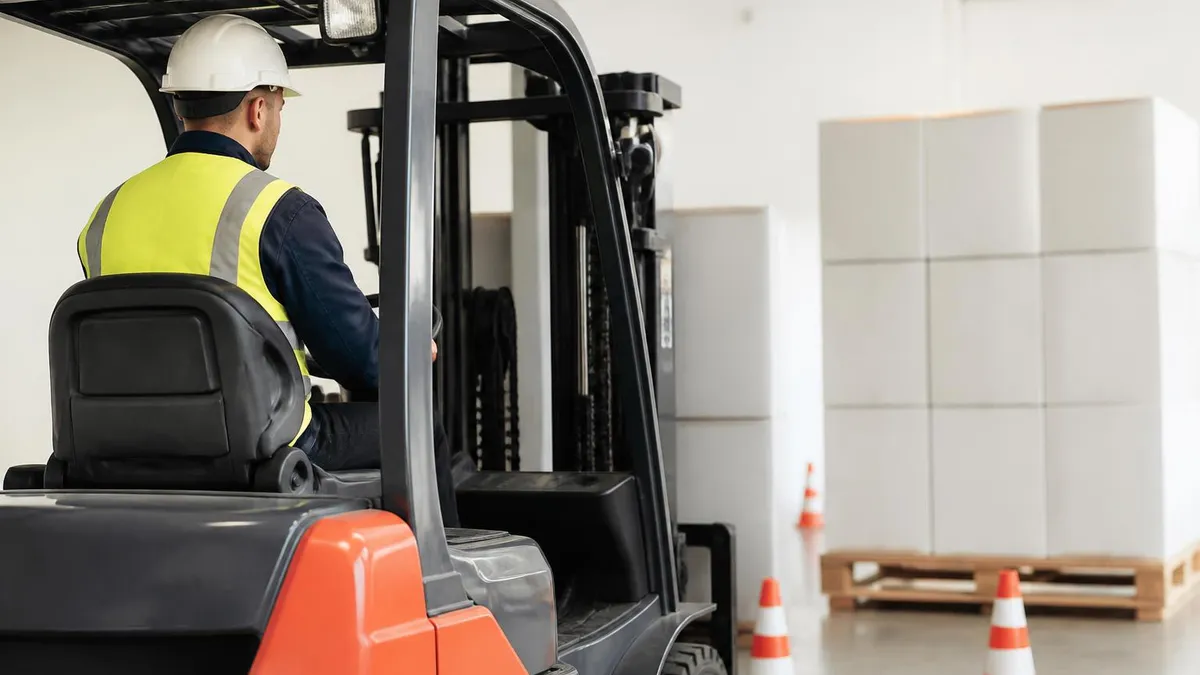
Forklift License Renewal: Complete Guide to Forklift License Expiry, OSHA Recertification, and Operator Requirements for 2026
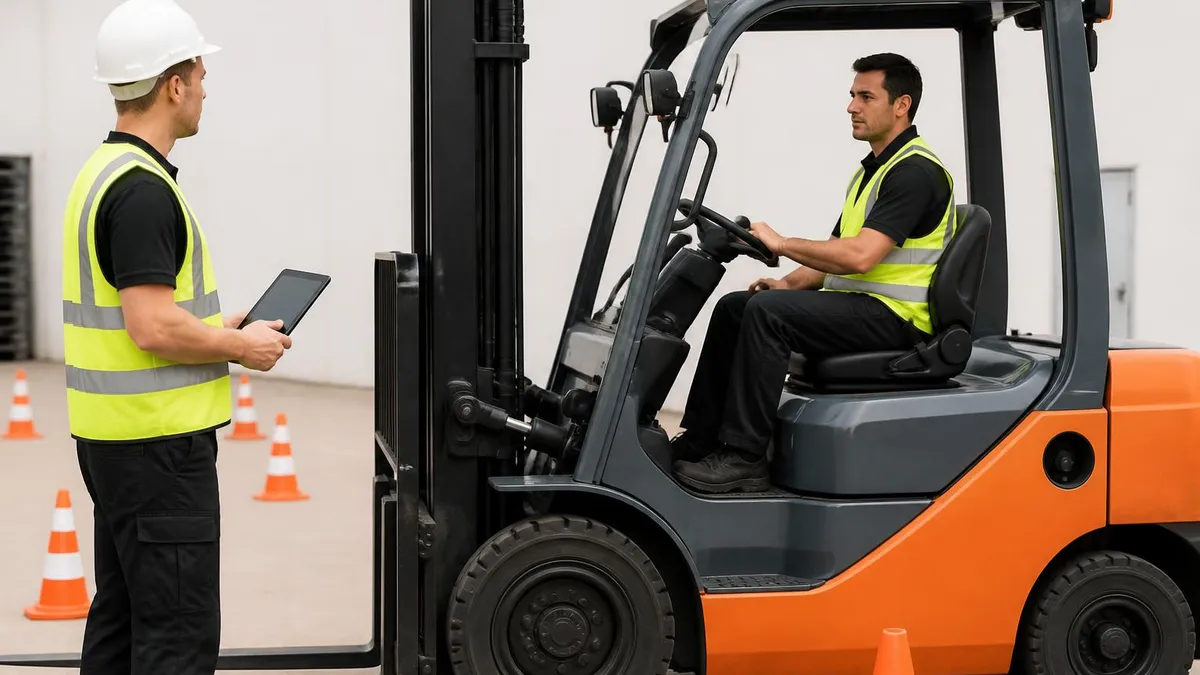
Forklift Safety Training: Complete OSHA Compliance Guide for Operators and Employers
About the Author

Certified Crane Operator & Skilled Trades Exam Specialist
Ferris State UniversityRobert Martinez is a Journeyman Ironworker, NCCCO-certified crane operator, and forklift trainer with a Bachelor of Science in Construction Technology from Ferris State University. He has 21 years of ironworking, rigging, and heavy equipment operation experience across high-rise and industrial construction sites. Robert prepares candidates for crane operator, rigger, forklift, and skilled trades certification examinations.