
Forklift Operator Pay 2026 October: Complete Salary Guide by State, Industry, Certification, and Experience Level
Forklift operator pay guide for 2026 October: average salaries, hourly rates by state, industry premiums, certification bonuses, and career growth. ✏️
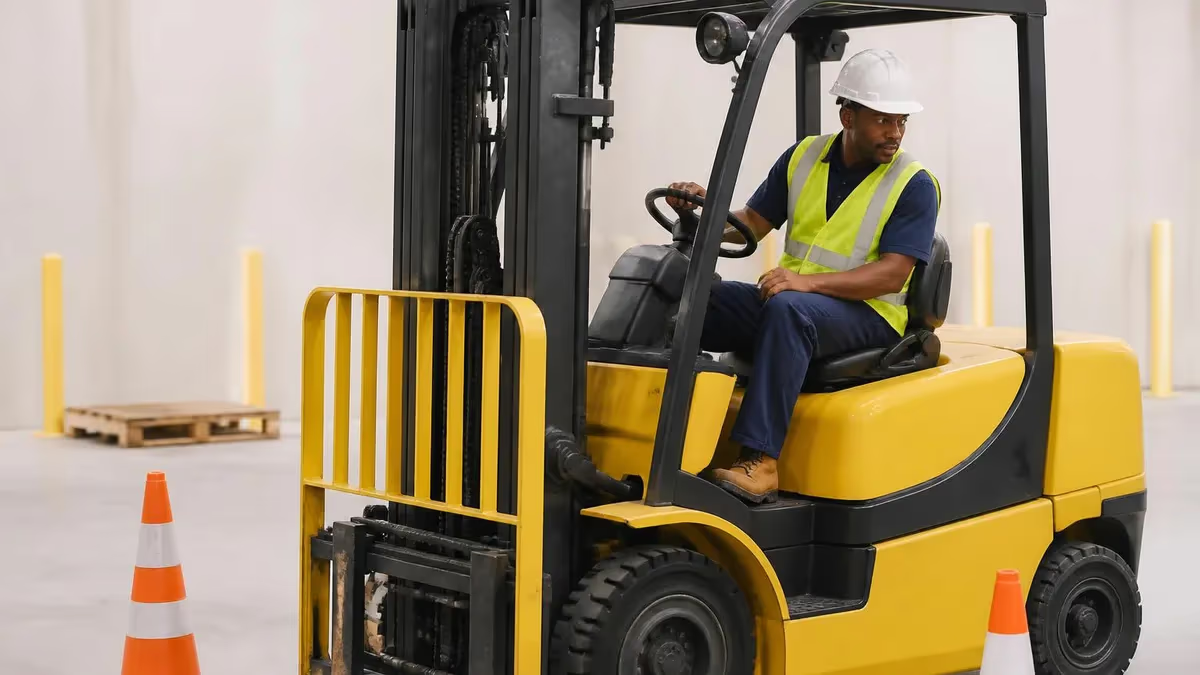
Forklift operator pay in 2026 has climbed faster than most warehouse and logistics roles, driven by ecommerce expansion, persistent labor shortages, and stricter OSHA compliance demands that reward certified, experienced lift truck drivers. The national average sits at roughly $21.40 per hour, or about $44,500 annually, but skilled operators in cold storage, ports, automotive, and aerospace routinely earn $28 to $36 per hour. Pay varies dramatically by state, equipment class, shift, and whether you hold endorsements for reach trucks, order pickers, or sit-down counterbalance lifts.
This guide breaks down exactly what you can expect to earn as a forklift operator in 2026, including base hourly rates, overtime structures, sign-on bonuses, and the certifications that push paychecks higher. We'll cover entry-level pay for new hires, mid-career rates after three to five years, and senior operator wages for those running specialized equipment like swing-reach trucks or pantograph reaches in narrow-aisle environments. Real numbers, not averages buried under marketing fluff.
Industry matters enormously. A new operator at a regional distribution center may start at $17 per hour, while the same person at a unionized port terminal can earn $34 per hour plus benefits worth another $15 per hour. Cold storage facilities, where operators endure subzero temperatures inside freezers, typically pay a $2 to $4 hourly differential. Hazmat-certified operators handling chemicals, batteries, or pharmaceuticals command additional premiums of $1 to $3 per hour above standard warehouse rates across most metropolitan markets nationwide.
Certification is the single biggest lever you can pull to raise your pay. OSHA requires every powered industrial truck operator to complete formal training, evaluation, and a three-year recertification cycle, but employers increasingly favor candidates with multi-class endorsements covering Class I electric riders, Class II narrow-aisle trucks, Class IV cushion-tire lifts, and Class V pneumatic tire models. Operators certified on a telehandler forklift or rough-terrain machine earn 15 to 25 percent more than warehouse-only operators in construction-heavy regions and on infrastructure projects.
Geography drives the other major pay swing. California, Washington, Alaska, Massachusetts, and New Jersey lead the nation, with median wages between $24 and $29 per hour. Mississippi, Arkansas, West Virginia, and parts of the rural Midwest sit at the bottom, often near $15 to $17 per hour. Cost of living explains some of the gap, but union density, port activity, and manufacturing concentration matter just as much when comparing real take-home pay across different regional markets across the country.
Experience compounds quickly in this trade. A first-year operator typically earns $17 to $19 per hour, but by year three you should be at $22 to $25, and by year seven, with multiple endorsements and a clean safety record, $28 to $32 is realistic. Trainers, leads, and shift supervisors who came up through the ranks often clear $70,000 annually with overtime, and warehouse managers who started on a stand up forklift can reach six figures within a decade at large logistics employers operating round the clock.
This article gives you the full pay picture so you can negotiate confidently, choose the right certification path, and target the industries and regions where forklift operator pay is highest. We pair the salary data with practical guidance on building experience, stacking endorsements, and avoiding the common mistakes that keep otherwise capable operators stuck at entry-level wages for years longer than necessary in today's competitive logistics labor market nationwide.
Forklift Operator Pay by the Numbers

Forklift Operator Pay by Experience Level
New operators with fresh OSHA certification typically earn $16 to $19 per hour, or roughly $33,000 to $39,500 annually. Most enter through temp agencies or warehouse training programs before transitioning to direct hire after 90 to 180 days on the job.
After a year of clean records and consistent productivity, pay climbs to $19 to $23 per hour. This is the stage where adding endorsements for reach trucks, order pickers, or hazmat handling delivers the fastest return on training investment for ambitious operators.
Experienced operators with multi-class certifications earn $23 to $28 per hour. At this level, employers compete aggressively, sign-on bonuses of $1,500 to $3,000 become common, and lateral moves between facilities often deliver $2 to $4 hourly raises with each new role.
Veteran operators running specialized equipment in ports, cold storage, or aerospace can earn $28 to $36 per hour. Lead operator and trainer roles add another $2 to $5 hourly, often pushing total compensation past $75,000 annually with consistent overtime opportunities available.
Operators who move into shift supervision, warehouse management, or fleet coordination roles typically earn $65,000 to $110,000 salaried. Many large logistics employers promote exclusively from within, making forklift operation a credible launching pad for long-term warehouse leadership careers across the industry.
Forklift operator pay varies more by state than almost any other warehouse role, with the top-paying states offering nearly double the hourly rate of the lowest-paying markets. California leads the nation at roughly $28.60 per hour, driven by port activity in Long Beach and Oakland, strict labor protections, and dense distribution networks serving the West Coast. Washington follows closely at $27.80, with Seattle-Tacoma's container terminals and aerospace manufacturing in Everett creating sustained demand for highly certified operators capable of running multiple equipment classes safely.
The Northeast corridor pays well across the board. New Jersey averages $26.40, Massachusetts $25.90, and New York $25.20, reflecting both cost of living and the concentration of import-export logistics around the Port of New York and New Jersey. Connecticut and Maryland sit just behind at $24 to $25. Operators in these states often work for major retailers, pharmaceutical distributors, and ecommerce fulfillment centers, where pay scales reset upward each year as Amazon, Walmart, and Target compete fiercely for experienced talent in dense metropolitan labor markets.
Midwest pay tells a more nuanced story. Illinois averages $23.10 thanks to Chicago's massive intermodal rail and trucking hub, while Indiana, Ohio, and Michigan cluster around $20 to $22 per hour due to automotive manufacturing and Tier 1 supplier networks. Wisconsin and Minnesota pay slightly higher at $22 to $23. Iowa, Nebraska, and Kansas trail at $18 to $20, though rural cost of living makes those wages stretch further than coastal numbers suggest when you factor in housing, transportation, and overall household expenses for typical operator families.
Southern states show the widest internal range. Texas averages $20.80 statewide, but Houston-area chemical plants and Dallas-Fort Worth distribution centers push operator pay to $24 or more, while rural East Texas warehouses pay $16 to $18. Florida sits at $19.40, Georgia at $19.80, and North Carolina at $20.10, with Atlanta and Charlotte logistics hubs paying premiums. Mississippi, Alabama, and Arkansas remain the lowest-paying southern markets, averaging $16 to $18 per hour even for experienced operators with multiple endorsements and clean safety records over many years.
Mountain West and Pacific Northwest markets have surged since 2022. Colorado averages $23.70, Utah $22.40, Arizona $21.90, and Nevada $22.80, with Reno and Las Vegas fulfillment centers driving wages upward. Oregon matches Washington at roughly $26.50 thanks to Portland's port and tech-adjacent distribution. Alaska tops the entire country at $29.40 for operators willing to work in Anchorage's logistics terminals or remote industrial sites, though housing costs and isolation make the premium less impressive than the headline number suggests for relocating workers considering long-term moves.
Within any state, metro areas pay $3 to $6 more per hour than rural locations. Operators willing to commute 30 to 45 minutes into major logistics hubs typically earn enough extra to justify the drive. For workers without reliable transportation, locating hyster forklift training programs near a major distribution corridor can be the single most important career decision, because the certification opens doors at the highest-paying employers in any regional market across the United States today.
Cost of living matters when comparing offers across states. A $26 hourly job in San Jose delivers less real purchasing power than a $20 job in Indianapolis once you account for rent, taxes, and groceries. Smart operators evaluate offers using take-home pay after taxes divided by local housing costs, not just gross hourly rate. Online cost-of-living calculators from MIT, NerdWallet, and Bankrate make this comparison straightforward when weighing relocation offers or deciding whether to chase higher nominal wages in expensive coastal labor markets nationwide.

Forklift certification Practice Test Questions
Prepare for the Forklift certification Certification exam with our free practice test modules. Each quiz covers key topics to help you pass on your first try.
Forklift certification Certification Forkl...
Forklift certification Exam Questions covering Certification Forklift certification Maintenance and Repairs. Master Forklift certification Test concepts for certification prep.
Forklift certification Certification Forkl...
Free Forklift certification Practice Test featuring Certification Forklift certification Maintenance and Repairs Questions and Answers. Improve your Forklift certification Exam score with mock test prep.
Forklift certification Certification Forkl...
Forklift certification Mock Exam on Certification Forklift certification Operator Training and Certification Requirements. Forklift certification Study Guide questions to pass on your first try.
Forklift certification Certification Forkl...
Forklift certification Test Prep for Certification Forklift certification Operator Training and Certification Requirements Questions and Answers. Practice Forklift certification Quiz questions and boost your score.
Forklift certification Load Handling and S...
Forklift certification Questions and Answers on Load Handling and Stability. Free Forklift certification practice for exam readiness.
Forklift certification OSHA Regulations an...
Forklift certification Mock Test covering OSHA Regulations and Compliance. Online Forklift certification Test practice with instant feedback.
Forklift certification Pre-Operation Inspe...
Free Forklift certification Quiz on Pre-Operation Inspections. Forklift certification Exam prep questions with detailed explanations.
Forklift certification Refueling and Recha...
Forklift certification Practice Questions for Refueling and Recharging Procedures. Build confidence for your Forklift certification certification exam.
Forklift certification Safe Driving and Ma...
Forklift certification Test Online for Safe Driving and Maneuvering. Free practice with instant results and feedback.
Forklift certification Workplace Hazard Id...
Forklift certification Study Material on Workplace Hazard Identification. Prepare effectively with real exam-style questions.
Forklift certification Forklift Instructions
Free Forklift certification Test covering Forklift Instructions. Practice and track your Forklift certification exam readiness.
Forklift certification Forklift MCQ
Forklift certification Exam Questions covering Forklift MCQ. Master Forklift certification Test concepts for certification prep.
Forklift certification Forklift Employer R...
Free Forklift certification Practice Test featuring Forklift Employer Responsibilities. Improve your Forklift certification Exam score with mock test prep.
Forklift certification Forklift Penalties ...
Forklift certification Mock Exam on Forklift Penalties for Non-Compliance. Forklift certification Study Guide questions to pass on your first try.
Forklift Operator Pay by Industry
Warehouse and distribution center operators represent the largest segment of forklift jobs nationwide, with average pay of $19 to $24 per hour at major retailers like Amazon, Walmart, Target, and Costco. Pay scales typically include automatic step increases at 90 days, six months, and one year, plus shift differentials of $1 to $2 for second shift and $2 to $3 for overnight operations.
Ecommerce fulfillment centers pay slightly more than traditional retail distribution, often $1 to $2 hourly above local averages, because productivity expectations are higher and operators frequently run multiple equipment types in single shifts. Cold storage warehouses add another $2 to $4 differential. The tradeoff is fast pace, strict productivity metrics, and physically demanding conditions that lead to higher turnover than older-style grocery and dry goods distribution operations.
Is Becoming a Forklift Operator Worth It Financially?
- +Entry into skilled labor with only 1-2 weeks of training and OSHA certification
- +Hourly rates 30-50% higher than general warehouse labor with same physical demands
- +Overtime opportunities frequently push annual pay past $55,000 for full-time operators
- +Clear advancement path into lead operator, trainer, supervisor, and warehouse management roles
- +Transferable skills across virtually every industry, providing strong job security nationwide
- +Sign-on bonuses of $500 to $3,000 common at distribution centers and manufacturing plants
- +Union opportunities in ports, automotive, and grocery distribution offer top-tier wages and benefits
- −Physical demands including standing, twisting, and vibration can lead to long-term injuries
- −Productivity metrics at large ecommerce employers create high-stress, high-burnout environments
- −Rural and small-town wages remain stuck below $18 per hour with limited advancement
- −Shift work, weekends, and holiday coverage often required at most logistics employers
- −Pay growth flattens after 7-10 years unless you move into supervision or specialized equipment
- −Recertification every three years and ongoing training requirements add unpaid time off the clock
Pros and Cons at a Glance
| Pros | Cons |
|---|---|
| Clear advancement path into lead operator, trainer, supervisor, and warehouse management roles | Physical demands including standing, twisting, and vibration can lead to long-term injuries |
| Transferable skills across virtually every industry, providing strong job security nationwide | Productivity metrics at large ecommerce employers create high-stress, high-burnout environments |
| Union opportunities in ports, automotive, and grocery distribution offer top-tier wages and benefits | Shift work, weekends, and holiday coverage often required at most logistics employers |

Certifications and Endorsements That Raise Forklift Operator Pay
- ✓Complete initial OSHA 1910.178 certification covering classroom, hands-on, and evaluation components
- ✓Add Class I electric rider endorsement for stand-up and sit-down counterbalance trucks
- ✓Earn Class II narrow-aisle certification for reach trucks, order pickers, and turret trucks
- ✓Complete Class IV and V certifications for cushion-tire and pneumatic-tire sit-down forklifts
- ✓Pursue Class VII rough-terrain telehandler certification for construction and outdoor industrial sites
- ✓Add hazmat handling endorsement for chemical, pharmaceutical, and battery manufacturing employers
- ✓Complete cold storage and freezer operator training for distribution centers paying differentials
- ✓Earn lead operator or trainer certification to qualify for higher hourly rates and supervision roles
- ✓Add lockout-tagout, confined space, and respiratory certifications for industrial manufacturing premiums
- ✓Maintain a clean three-year recertification cycle with documented safety record and no incidents
Stack three OSHA equipment class endorsements within your first 18 months
Operators certified on Class I, Class II, and Class IV equipment earn an average of 18 percent more than single-class operators within their first two years on the job. The reason is simple: employers can deploy multi-class operators across more workstations, justifying higher wages with greater flexibility. Most training programs add a second or third class endorsement for $150 to $300, with payback in under a month at typical raise levels.
Overtime is where forklift operator pay accelerates dramatically beyond the base hourly rate, and understanding how it works at different employers can mean the difference between earning $45,000 and $65,000 in the same job. Federal law requires time-and-a-half pay for hours worked beyond 40 per week, but many union and industrial employers add double-time for Sundays, holidays, and hours beyond 12 in a single shift. Cumulative effects matter enormously when peak season spans October through January.
Sign-on bonuses became standard practice between 2022 and 2026 as labor shortages forced employers to compete aggressively for trained operators. Typical bonuses range from $500 for entry-level warehouse positions to $5,000 for experienced operators willing to work overnight shifts at major distribution centers. Read the fine print carefully: most bonuses pay in installments at 30, 90, and 180 days, and leaving early often triggers full repayment clauses that can wipe out months of accumulated earnings unexpectedly for departing workers.
Referral bonuses add another income stream for connected operators. Amazon, FedEx, UPS, and major third-party logistics firms pay $500 to $2,000 for referring qualified candidates who stay 90 days or longer. Some operators earn $5,000 to $10,000 annually just from referrals at high-turnover facilities. This compounds especially well for bilingual operators who can recruit from broader candidate pools and for those active in vocational schools, community colleges, and union apprenticeship programs across major regional labor markets.
Benefits frequently exceed $10,000 in annual value at quality employers, dramatically changing the real value of any offer. Healthcare premiums covered by employers typically save operators $4,000 to $9,000 annually compared to ACA marketplace plans. 401(k) matches of three to six percent add another $1,500 to $3,000 yearly at average wage levels. Paid time off, holidays, and bereavement leave compound the total. A $20 hourly union job with full benefits often beats a $26 nonunion offer once benefits enter the calculation honestly.
Shift differentials are universal in 24/7 operations and add up quickly across a year. Second shift typically pays $0.75 to $2 extra per hour, third shift pays $1.50 to $4 extra, and weekend differentials add another $1 to $3. An operator working overnight in a cold storage facility might stack a $2 cold differential, a $3 overnight differential, and a $1.50 weekend bonus on top of a $21 base, taking actual hourly pay above $27 for hours worked during premium times throughout the workweek.
Production bonuses and performance incentives reward operators who exceed productivity targets without compromising safety. Amazon's quarterly safety bonus typically pays $200 to $500, while picker accuracy bonuses at distribution centers can add $1,000 to $3,000 annually. Some employers offer profit-sharing or year-end bonuses tied to facility performance, typically one to four percent of annual earnings. These bonuses favor operators who track their own metrics daily and consistently rank in the top quartile of their team in every measured category.
Pension and retirement contributions vary widely. Union operators in mature industries often receive defined-benefit pensions worth $1,500 to $3,000 monthly after 25 to 30 years of service, a benefit that has nearly disappeared from nonunion employment. Nonunion operators typically receive 401(k) matches of three to six percent of pay, with vesting schedules of two to six years. Calculating the lifetime value of pension versus 401(k) benefits is essential when weighing union opportunities against higher hourly rates offered elsewhere across the industry.
Sign-on bonuses look great in job postings, but most contracts require you to stay 12 to 24 months or repay the full amount. If you leave at month 11, you may owe back the entire bonus plus payroll taxes you already paid on it. Always read the repayment terms before accepting and factor them into your honest commitment to the role before signing the offer letter.
Negotiating higher forklift operator pay starts long before you sit down with a hiring manager. The single most effective preparation is gathering verified salary data from three sources: the BLS Occupational Employment Statistics for your specific metro area, Indeed and Glassdoor reviews mentioning the target employer by name, and conversations with current employees through LinkedIn or local union halls. Walking into a negotiation knowing the company pays $22 to $26 for your experience level transforms the conversation immediately and credibly.
Document your endorsements, certifications, and clean safety record in a single-page summary you can hand the hiring manager. Include exact dates of OSHA recertification, equipment classes you're qualified to operate, hazmat or specialty endorsements, and any leadership or training experience. Employers consistently underestimate certified operators because resumes typically bury this information in dense paragraphs. A clear visual summary positions you as a professional with documented credentials rather than just another applicant filling out a generic job application form.
Always negotiate on starting pay before discussing schedules, benefits, or start date. Hiring managers have flexibility on initial wage offers, but that flexibility evaporates once paperwork starts. If the offer is $20, counter with $23 and cite specific data: your endorsements, the market rate, and any competing offers. Even if you settle at $21.50, that buck-fifty translates to $3,120 annually for full-time work, compounding through every raise and promotion over your entire career with that particular employer's wage scale.
Sign-on bonuses are often more negotiable than hourly rates because they don't permanently raise the wage scale. If a hiring manager won't budge on base pay, ask for a $1,500 to $3,000 sign-on bonus paid at 90 days. Many employers have discretionary bonus budgets specifically for closing offers. The downside is that bonuses are typically taxed at higher supplemental rates, but the lump-sum cash often helps with relocation, transportation, or tooling costs new operators face when starting a different position immediately.
Shift assignment is a hidden negotiation lever many candidates miss entirely. If the employer needs overnight or weekend operators urgently, ask for a higher base rate plus the full shift differential rather than just the differential alone. Some employers will agree to $0.50 to $1.50 more on the base wage in exchange for committing to a less desirable schedule, effectively stacking your raise on top of the differential and compounding income across every overtime hour you work in that position.
Annual raises typically range from two to four percent at most employers, but operators who request reviews at the six-month mark and document specific accomplishments often secure five to seven percent increases. Bring metrics: pallets moved per hour, accuracy rates, zero-incident months, training contributions, and any cross-functional work you've completed. Treat the review as a business proposal, not a request. The best operators schedule their reviews proactively rather than waiting for HR to schedule them, demonstrating professionalism and ownership of career trajectory in tangible ways.
Finally, never stop building use by exploring outside offers and considering relevant forklift training near me options that expand your qualifications further. Even if you have no intention of leaving, an active job search uncovers what the market actually pays for your skills. Operators who interview elsewhere every 18 to 24 months consistently earn 15 to 30 percent more across their careers than those who passively accept annual raises from a single employer over many years without testing the market value.
Practical tips for maximizing forklift operator pay start with treating your career like a long-term investment rather than a series of jobs. Operators who think strategically about which employers, certifications, and shifts they accept consistently out-earn equally skilled peers by $10,000 to $20,000 annually. The strategies below combine field-tested advice from career operators with current 2026 market data, and they apply whether you're just starting out or already running specialized equipment in a senior role across the country.
Target employers with documented internal promotion pipelines. Companies like UPS, FedEx, USPS, Costco, Sysco, and most major automotive manufacturers promote operators into lead, trainer, and supervisor roles regularly, with documented pay progressions. Amazon offers fast promotions but burns operators out quickly. Smaller regional warehouses sometimes pay more initially but offer no advancement path. Research promotion patterns by asking current employees how long operators typically wait before moving into the first lead role at any given facility before accepting offers.
Develop a portable certification portfolio that travels with you across employers. Keep digital copies of every OSHA certificate, training completion record, and equipment evaluation, ideally in cloud storage you can access from any phone. When opportunities arise, you can immediately verify credentials without waiting for old employers to confirm. This single habit shortens hiring cycles, accelerates offers, and positions you as the most prepared candidate in any interview pool you encounter during transitions between facilities, employers, or industry verticals throughout your operating career.
Track your own productivity metrics independently of employer systems. Note pallets moved, accuracy rates, incident-free days, and any extra responsibilities like equipment inspections, training new hires, or covering shifts. These numbers become powerful in raise negotiations, interviews, and applications for lead positions. Many operators discover during review conversations that they have no concrete data to support raise requests, while peers who track metrics consistently negotiate from positions of measurable strength rather than vague self-assessment that managers easily dismiss.
Consider geographic flexibility as a wage strategy. Operators willing to relocate to high-paying markets, even temporarily for two to four years, can accelerate lifetime earnings significantly. Port cities, aerospace hubs, and major intermodal terminals consistently pay 20 to 40 percent above national averages. Travel work in construction telehandlers, particularly on infrastructure projects funded through federal grants, can pay $30 to $40 per hour plus per diem and lodging, dramatically outpacing what stationary warehouse jobs offer in lower-cost regions.
Stay current with industry trends like automation, electric equipment transitions, and warehouse management system integrations. Operators who can work alongside autonomous mobile robots, fleet telematics, and warehouse execution systems become significantly more valuable than those who treat technology as a threat. Many employers now prefer operators comfortable with tablets, RF scanners, and digital workflow tools. Spending 30 minutes weekly reading industry publications like Modern Materials Handling positions you ahead of peers for technology-adjacent roles that increasingly command pay premiums.
Finally, protect your operating record like the asset it is. A single recordable incident can disqualify you from union jobs, port work, and senior positions for years. Defensive operating, complete pre-shift inspections, and immediate reporting of equipment issues prevent the small mistakes that compound into career-limiting incidents. The highest-paid operators in any facility are almost always the ones with the longest incident-free streaks, because employers pay premiums for proven reliability over raw speed every single time they make hiring or promotion decisions.
Sample Forklift certification Practice Questions
Try these questions from our free Forklift certification practice tests. The correct answer and an explanation follow each question.
While transporting a load, the operator notices the hydraulic fluid level warning light is on. What should the operator do?
- A. Ignore the warning and complete the current task
- B. Continue operating at a slower speed and check fluid after the shift
- C. Lower the load, park the forklift safely, and report the issue to maintenance
- D. Raise the forks higher to reduce hydraulic system strain
Answer: C. Lower the load, park the forklift safely, and report the issue to maintenance
A hydraulic warning indicates a potential failure that can cause sudden load drop; the operator must safely lower and secure the load, then remove the forklift from service.
How long must employers retain forklift operator certification records?
- A. 1 year
- B. 3 years
- C. Duration of the employee's employment
- D. OSHA does not require record-keeping
Answer: C. Duration of the employee's employment
OSHA requires employers to maintain records of forklift operator training and certification. These records must be kept for the entire duration of the employee's employment as a forklift operator. This ensures that there is a continuous record of compliance and that the employer can demonstrate that the operator has met all training requirements throughout their tenure, aiding in accountability and safety audits.
A forklift operator's certification is found to be expired. Who is primarily held responsible under OSHA?
- A. The operator only
- B. The employer
- C. The equipment manufacturer
- D. The dealership that sold the forklift
Answer: B. The employer
The employer is responsible for ensuring operators are properly trained and certified before allowing them to operate a forklift.
What documentation should an employer maintain to prove forklift operator certification compliance?
- A. No documentation is required under OSHA
- B. Records showing each operator was trained and evaluated, including dates and trainer identity
- C. Only a signed statement from the operator
- D. A general training log with no individual names
Answer: B. Records showing each operator was trained and evaluated, including dates and trainer identity
Employers must keep records that identify the operator, confirm training and evaluation were completed, and show when they occurred.
Forklift Questions and Answers
Forklift Tires: Complete Guide to Types, Sizing, Wear Patterns, and Replacement Costs
Forklift Accessories: Complete Guide to LED Lights, Attachments, Safety Gear, and Productivity Upgrades for 2026
Forklift Safety Training: Complete OSHA Compliance Guide for Operators and Employers
Forklift Repair Service: Complete Guide to Costs, Common Repairs, and Choosing the Right Technician
Forklift Price Guide 2026: New, Used, Rental, and Total Cost of Ownership Breakdown
About the Author

Certified Crane Operator & Skilled Trades Exam Specialist
Ferris State UniversityRobert Martinez is a Journeyman Ironworker, NCCCO-certified crane operator, and forklift trainer with a Bachelor of Science in Construction Technology from Ferris State University. He has 21 years of ironworking, rigging, and heavy equipment operation experience across high-rise and industrial construction sites. Robert prepares candidates for crane operator, rigger, forklift, and skilled trades certification examinations.