
Forklift Repair Service: Complete Guide to Costs, Common Repairs, and Choosing the Right Technician
Forklift repair service guide covering costs, common repairs, when to fix vs replace, finding qualified technicians, and preventive maintenance schedules. ✅
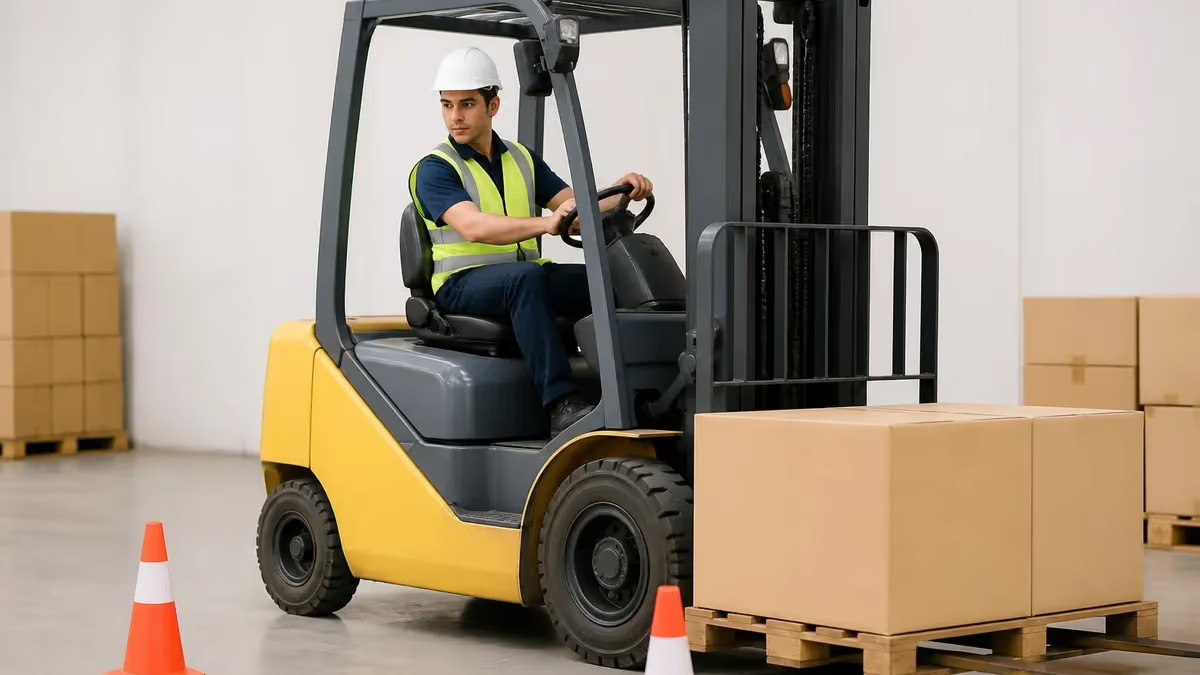
A reliable forklift repair service keeps your warehouse moving, your operators safe, and your operating costs predictable. Whether you run a single electric forklift in a small distribution center or manage a fleet of twenty internal combustion units across multiple shifts, downtime is expensive. Industry surveys show that an idle forklift costs the average operation between $300 and $1,200 per day in lost productivity, missed shipments, and overtime labor. Choosing the right repair partner matters as much as choosing the right truck in the first place.
The forklift repair industry has grown alongside the broader materials handling sector, which now supports more than 855,000 forklift operators across the United States according to the Bureau of Labor Statistics. Every one of those trucks needs scheduled service, unplanned repairs, and eventually major component overhauls. Knowing what to expect, what fair pricing looks like, and how to evaluate a service provider protects your budget and your team. Many fleet managers also weigh forklift rental as a stopgap while major repairs are completed.
This guide breaks down the full landscape of forklift repair: the most common failures by truck type, realistic labor and parts costs, how OSHA compliance intersects with maintenance, and the warning signs that tell you a truck needs immediate attention. We also cover the decision framework for fixing versus replacing aging equipment, since the breakeven point shifts depending on hours, fuel type, and application severity. If you operate, manage, or service forklifts, the information here will save you money.
Repair work falls into three broad buckets: preventive maintenance performed on a fixed schedule, predictive maintenance triggered by sensor data or inspection findings, and reactive repairs that happen when something fails. Top-performing fleets spend roughly 70 percent of their maintenance budget on preventive work and only 30 percent on reactive repairs. Underperforming fleets flip that ratio and pay dearly for it through emergency service calls, expedited parts shipping, and the cascading damage that one ignored leak or worn bearing creates.
The cost of a single major failure illustrates the math. A transmission rebuild on a 5,000-pound capacity internal combustion forklift runs $4,500 to $8,500 in parts and labor. A mast cylinder replacement runs $1,800 to $3,200. A traction motor on an electric forklift can hit $2,500 to $5,000. By contrast, the preventive maintenance program that would have caught the underlying problem typically costs $400 to $900 per year per truck. That ratio is why every reputable repair service pushes scheduled inspections hard.
Beyond the dollars, there is a regulatory dimension. OSHA standard 1910.178(q)(1) requires that any forklift found to be in unsafe operating condition be removed from service until repairs restore it to safe condition. Operators must also perform daily pre-shift inspections under 1910.178(q)(7). A documented relationship with a qualified repair service is part of how employers demonstrate compliance during an inspection or after an incident. Skipping repairs is not just expensive — it creates legal exposure that can dwarf the maintenance bill.
Throughout this guide we will reference both dealer service networks and independent repair shops, since most warehouse operators eventually use both. Dealer technicians offer factory training, OEM parts, and warranty authority. Independent shops typically beat dealer hourly rates by 15 to 30 percent and can service multiple brands from one visit. Each model has trade-offs, and the right answer depends on your fleet mix, geography, and how much downtime you can tolerate. You also need to confirm any technician working on lifting components has the proper certification of forklift systems knowledge for your truck class.
Forklift Repair by the Numbers

Most Common Forklift Repairs by Component
Leaking cylinders, worn seals, contaminated fluid, and failing pumps account for roughly 28 percent of all forklift repair calls. Symptoms include slow lifting, drift under load, and visible fluid pooling.
Slipping gears, harsh shifting, and torque converter failure usually appear between 6,000 and 9,000 hours. Internal combustion units suffer this more than electric trucks due to thermal cycling and load shock.
On electric forklifts, contactor wear, use chafing, and battery cell failure dominate service tickets. IC trucks see starter, alternator, and ignition coil failures most frequently in cold-storage applications.
Worn chains, cracked carriages, bent forks, and damaged lift cylinders typically result from operator abuse or overloading. Annual mast inspection catches stress fractures before they become catastrophic failures.
Cushion and pneumatic tires wear unevenly when alignment drifts or operators corner aggressively. Replacement is the single most frequent maintenance line item, with press-on tires lasting 2,000 to 4,000 hours.
Forklift repair pricing varies more than most fleet managers realize, and understanding the components of a service invoice is the first step toward controlling costs. Three line items dominate every bill: labor hours, parts, and travel or trip charges. Labor in 2026 averages $95 to $165 per hour at dealer service centers, while independent shops typically charge $75 to $125 per hour.
Master technicians working on specialized equipment like reach trucks or high-capacity rigs may bill $180 or more. Travel charges, often called portal-to-portal billing, can add 30 minutes to two hours per visit depending on your distance from the shop.
Parts pricing follows a predictable hierarchy. OEM components from the truck manufacturer carry the highest list price but include factory warranty support. Aftermarket parts from suppliers like TVH, Intella, or Lift Parts Warehouse run 30 to 50 percent less and cover the vast majority of routine wear items — filters, belts, hoses, hydraulic seals, ignition components, and brake parts. Reman or rebuilt assemblies for transmissions, engines, and traction motors split the difference, typically saving 40 percent versus new while including a one-year warranty. Most reputable repair services will quote both options and let you choose.
The annual maintenance budget for a single forklift depends heavily on hours of use and application severity. A truck running one shift in a clean dry warehouse might cost $450 to $700 per year in parts and scheduled labor. The same truck running three shifts in a foundry or recycling plant can easily hit $2,800 to $4,500 per year because heat, dust, and impact damage accelerate every wear curve. Cold storage operations occupy a middle ground around $1,200 to $1,800 annually, though battery and contactor life on electric trucks suffers in freezer environments.
Major component repairs represent the spikes in any maintenance budget. Replacing a hydraulic pump assembly costs $1,400 to $2,600 installed. Rebuilding an engine on a 5,000-pound LP forklift runs $3,500 to $6,500. Replacing the mast assembly entirely — rare but necessary after severe damage — can reach $8,000 to $14,000 on larger trucks. These numbers explain why many operators consider a forklift for sale listing whenever a truck approaches three of these major repairs in the same year.
Emergency service carries its own premium structure. After-hours calls typically include a minimum two-hour labor charge plus a $150 to $400 emergency dispatch fee. Weekend and holiday rates often run 1.5x to 2x standard labor. The economics here favor preventive maintenance heavily — a $600 PM service that prevents one $1,800 emergency call has already paid for itself, and the math gets stronger as your downtime costs climb. Operations that run lean inventory or just-in-time fulfillment cannot afford reactive maintenance philosophies.
Service contracts offer a middle path between pay-as-you-go and full-coverage warranties. A typical planned maintenance contract bundles four PM services per year, all filters and lubricants, and priority dispatch for $850 to $1,400 per truck annually. Full-maintenance contracts that include all repairs except operator damage run $1,800 to $3,200 per truck per year, and many dealers will quote them across a fleet. The break-even point depends on your fleet age and application, but contracts make budgeting predictable and shift repair risk to the provider.
One often-overlooked cost driver is the documentation requirement built into your service agreements. OSHA requires you to retain maintenance records for the life of each forklift, and a proper repair service should provide detailed work orders that itemize parts, labor, and findings. These records become critical evidence if an incident occurs and an inspector asks how the truck was maintained. Shops that hand you a one-line invoice for $487 with no detail are creating liability for your operation. Insist on itemized documentation every time.

Forklift certification Practice Test Questions
Prepare for the Forklift certification Certification exam with our free practice test modules. Each quiz covers key topics to help you pass on your first try.
Forklift certification Certification Forkl...
Forklift certification Exam Questions covering Certification Forklift certification Maintenance and Repairs. Master Forklift certification Test concepts for certification prep.
Forklift certification Certification Forkl...
Free Forklift certification Practice Test featuring Certification Forklift certification Maintenance and Repairs Questions and Answers. Improve your Forklift certification Exam score with mock test prep.
Forklift certification Certification Forkl...
Forklift certification Mock Exam on Certification Forklift certification Operator Training and Certification Requirements. Forklift certification Study Guide questions to pass on your first try.
Forklift certification Certification Forkl...
Forklift certification Test Prep for Certification Forklift certification Operator Training and Certification Requirements Questions and Answers. Practice Forklift certification Quiz questions and boost your score.
Forklift certification Load Handling and S...
Forklift certification Questions and Answers on Load Handling and Stability. Free Forklift certification practice for exam readiness.
Forklift certification OSHA Regulations an...
Forklift certification Mock Test covering OSHA Regulations and Compliance. Online Forklift certification Test practice with instant feedback.
Forklift certification Pre-Operation Inspe...
Free Forklift certification Quiz on Pre-Operation Inspections. Forklift certification Exam prep questions with detailed explanations.
Forklift certification Refueling and Recha...
Forklift certification Practice Questions for Refueling and Recharging Procedures. Build confidence for your Forklift certification certification exam.
Forklift certification Safe Driving and Ma...
Forklift certification Test Online for Safe Driving and Maneuvering. Free practice with instant results and feedback.
Forklift certification Workplace Hazard Id...
Forklift certification Study Material on Workplace Hazard Identification. Prepare effectively with real exam-style questions.
Forklift certification Forklift Instructions
Free Forklift certification Test covering Forklift Instructions. Practice and track your Forklift certification exam readiness.
Forklift certification Forklift MCQ
Forklift certification Exam Questions covering Forklift MCQ. Master Forklift certification Test concepts for certification prep.
Forklift certification Forklift Employer R...
Free Forklift certification Practice Test featuring Forklift Employer Responsibilities. Improve your Forklift certification Exam score with mock test prep.
Forklift certification Forklift Penalties ...
Forklift certification Mock Exam on Forklift Penalties for Non-Compliance. Forklift certification Study Guide questions to pass on your first try.
Repair Differences: Electric Forklift vs Internal Combustion vs Cherry Picker Forklift
An electric forklift simplifies many repair categories but introduces others. There is no engine, no transmission fluid, no exhaust system, and no fuel system to service. That eliminates roughly 40 percent of the labor hours an IC truck of similar capacity accumulates over its life. Drive motors, hydraulic motors, and contactors are the primary wear items, and traction batteries dominate the replacement budget at $4,500 to $9,500 every five to seven years depending on usage and watering discipline.
Lithium-ion conversions have changed the economics further. Li-ion battery packs cost more upfront — typically $12,000 to $22,000 — but they eliminate watering, equalization, and acid spills while extending cycle life to 3,000 plus charges. Many operators report 25 to 40 percent lower total maintenance costs over a five-year horizon when they switch from lead-acid to lithium. The repair conversation shifts toward firmware updates, BMS diagnostics, and connector inspection rather than acid neutralization and cell replacement.
Dealer Service vs Independent Repair Shop
- +Dealer technicians receive factory training and access OEM diagnostic software
- +Genuine OEM parts maintain warranty coverage on newer equipment
- +Dealers can authorize warranty repairs without dispute or pre-approval delays
- +Larger dealer networks offer better parts availability for rare components
- +Service history feeds directly into manufacturer telematics platforms
- +Dealers typically provide loaner trucks during extended repairs at no charge
- +Multi-truck service contracts come with predictable monthly billing and SLA guarantees
- −Dealer labor rates run 20 to 40 percent higher than independent shops
- −Dealers push OEM parts pricing even when aftermarket equivalents work fine
- −Response times can be slow during peak season due to large customer base
- −Brand-specific dealers cannot service mixed fleets efficiently
- −Some dealers refuse to install customer-supplied parts, even quality aftermarket
- −Diagnostic fees often apply before any actual repair work begins
Pros and Cons at a Glance
| Pros | Cons |
|---|---|
| Dealer technicians receive factory training and access OEM diagnostic software | Dealers push OEM parts pricing even when aftermarket equivalents work fine |
| Genuine OEM parts maintain warranty coverage on newer equipment | Response times can be slow during peak season due to large customer base |
| Dealers can authorize warranty repairs without dispute or pre-approval delays | Brand-specific dealers cannot service mixed fleets efficiently |
| Larger dealer networks offer better parts availability for rare components | Some dealers refuse to install customer-supplied parts, even quality aftermarket |
| Service history feeds directly into manufacturer telematics platforms | Diagnostic fees often apply before any actual repair work begins |

Pre-Service Inspection Checklist for Forklift Operators
- ✓Walk around the truck and document any visible damage, leaks, or missing components with photos
- ✓Check hydraulic fluid level on a cold truck and note color and clarity
- ✓Inspect lift chains for stretch, rust, missing pins, or visible cracking at links
- ✓Test all lights, horn, backup alarm, and seatbelt buckle operation
- ✓Verify forks are not bent, cracked, or worn beyond 10 percent of original thickness
- ✓Check tire condition for chunking, flat spots, or worn tread below replacement marks
- ✓Record current hour meter reading and compare against last service interval
- ✓Test parking brake holding capacity on a graded surface before sign-off
- ✓Document any operator complaints in writing with date, time, and load conditions
- ✓Verify capacity plate, data plate, and warning decals are present and legible
Every dollar spent on preventive maintenance saves four dollars in reactive repairs
Industry benchmarking from MHEDA and the Industrial Truck Association consistently shows a 4:1 return on preventive maintenance investment. Fleets that hit their 250-hour PM intervals see 60 percent fewer emergency calls and extend useful life by 15 to 20 percent compared to reactive-only fleets.
Choosing a forklift repair provider is one of the highest-use decisions a fleet manager makes. The wrong choice creates a cycle of delayed repairs, repeat failures, and finger-pointing about who damaged what. The right choice gives you a partner who understands your operation, anticipates problems, and helps you plan capital decisions. Start by mapping your needs honestly: how many trucks, what brands, what shifts, what response time tolerance, and what compliance documentation you require. A provider that fits a five-truck single-shift operation may be wrong for a 40-truck three-shift distribution center.
Certification and training matter more than marketing claims. Ask any prospective provider for proof that their technicians complete annual factory training on the brands they service. Reputable shops can produce certificates from Toyota, Crown, Hyster-Yale, Raymond, Mitsubishi-Caterpillar, or the relevant OEM. Beyond brand training, look for technicians who hold credentials from the Industrial Truck Association or have completed programs comparable to what operators get when they pursue stand up forklift safety certification. Skilled technicians understand the safety systems they are working on, not just the mechanical parts.
Insurance and bonding are non-negotiable. Any technician working in your facility needs general liability coverage of at least $1 million per occurrence and workers compensation that meets your state requirements. Larger fleets should require $2 million liability plus garage keepers coverage that protects your trucks while they are at the shop. Ask for a certificate of insurance naming your business as an additional insured before the first service call. Providers who hesitate to produce this paperwork are a red flag — it means either they do not have proper coverage or they have something to hide.
Response time guarantees separate professional providers from the rest. A solid agreement specifies maximum hours from your service call to technician arrival, broken out by emergency versus routine status. Common SLA tiers are four-hour emergency response, next-business-day routine response, and 48-hour scheduled maintenance windows. The provider should also commit to first-time fix rates and warranty their work for a specified period — 30 days on minor repairs and 90 days on major component work is standard. Get these commitments in writing before any work begins.
Geographic coverage and shop capacity influence every decision after the contract is signed. A repair service operating from a single shop 90 miles away will struggle to hit four-hour emergency response, no matter what they promise. Look for providers with multiple service vans pre-stocked with common parts, a parts warehouse within reasonable driving distance, and ideally a network of mobile technicians rather than just shop-based mechanics. The shop tour matters — visit before signing anything and look at cleanliness, organization, diagnostic equipment, and how customer trucks are being handled.
Pricing transparency is the final filter. The right provider gives you written rate sheets with hourly labor by technician class, travel charges, after-hours premiums, diagnostic fees, and standard parts markup percentages. They quote major repairs in writing before starting work and never exceed quoted amounts without prior approval. They itemize every invoice with parts numbers, labor minutes, and findings notes. Providers who resist this level of disclosure are not partners — they are vendors hoping to bury margin in vague line items. Walk away from anyone unwilling to commit pricing structure to paper.
References from comparable operations should close the evaluation. Ask for three to five customer references with similar fleet size, application type, and geographic footprint. Call those references and ask specific questions: how often do invoices match quotes, how often do they hit response time commitments, how often is the first repair attempt successful, and how do they handle disputes. References will tell you more in fifteen minutes than any sales pitch ever does. A provider who refuses to share references is a provider you should not hire.
Under 29 CFR 1910.178(q)(1), any forklift in unsafe condition must be removed from service immediately. Continuing to operate a truck with known defects exposes employers to citations averaging $16,131 per violation and criminal liability if an injury results.
A preventive maintenance strategy is the foundation of cost-effective forklift ownership. The framework starts with manufacturer recommended intervals, which typically specify service every 250 operating hours or every 90 days, whichever comes first. These intervals were established under typical-duty conditions, and real-world fleets running in severe environments — heat, dust, cold, corrosive atmospheres, or three-shift continuous duty — should compress those intervals by 25 to 50 percent. Severe-duty operations may require PM service every 150 hours to keep up with accelerated wear curves.
The standard PM service includes engine oil and filter on IC trucks, hydraulic filter change, transmission fluid check, lubrication of all grease fittings, brake adjustment, mast chain tension and lubrication, tire inspection, battery and electrical check, and a comprehensive safety system test. Expect a thorough PM to take 90 to 150 minutes per truck depending on configuration. Anything shorter is probably not a real PM service. Documentation should include before-and-after photos, fluid samples if oil analysis is performed, and a written findings report that identifies any items needing attention before the next service.
Telematics and predictive maintenance technology have transformed PM scheduling for fleets large enough to justify the investment. Connected forklifts transmit operating hours, impact events, error codes, and battery health data to cloud platforms that schedule service automatically. The technology pays back fastest on fleets of 15 or more trucks where the data volume justifies subscription costs of $25 to $45 per truck per month. Smaller fleets benefit more from disciplined manual tracking using hour meters and a simple spreadsheet or maintenance management system.
Operator training is the unsung hero of preventive maintenance. A trained operator who performs proper pre-shift inspections catches 60 to 70 percent of developing problems before they become repairs. Programs that emphasize the connection between operator behavior and equipment longevity dramatically improve fleet condition. Documented pre-shift inspections, completed honestly and reviewed by supervision, become both a maintenance tool and a compliance document. Operations with strong inspection discipline report 40 percent lower unplanned downtime than peers with weak inspection programs — finding a qualified forklift certification near me program builds this discipline from day one.
Oil analysis is a low-cost predictive tool worth implementing on any IC fleet of five or more trucks. For $25 to $40 per sample, a lab identifies wear metals, contamination, and fluid degradation that signal developing problems weeks or months before failure. Sampling at every PM service builds a trend line for each truck and flags anomalies automatically. Operations that adopt oil analysis typically catch two to four catastrophic failures per year that would otherwise blindside them — easily $20,000 to $40,000 in avoided emergency repairs and downtime on a fleet of 20 trucks.
Spare parts strategy rounds out the preventive picture. Even with a great repair provider, keeping critical wear items in your own parts cabinet eliminates downtime when something fails outside business hours. The standard kit for a small fleet includes filters, belts, hoses, common hydraulic seals, brake pads, tail and headlight bulbs, fuses, and a complete set of forks. Total investment runs $800 to $1,500 and pays back the first time you avoid a $400 emergency parts run. Larger fleets justify more extensive stocking, including spare batteries, contactor assemblies, and even a complete spare truck for critical lines.
Finally, treat your maintenance records as a strategic asset, not a regulatory burden. The full service history of every truck — every PM, every repair, every operator damage incident, every part replaced — tells you which trucks to keep, which to trade, and which suppliers actually deliver value. Fleets that analyze their maintenance data quarterly identify their most expensive trucks, most expensive applications, and most expensive failure modes. That analysis drives capital decisions, training investments, and supplier negotiations in ways that hunch-based management never matches. Data turns a cost center into a competitive advantage.
Practical execution of a forklift repair program comes down to discipline, documentation, and relationships. Start by building a maintenance calendar for every truck in your fleet, anchored to hour meter readings rather than wall calendars. Most modern truck operating systems can export hour data weekly, and even older trucks can be tracked manually with a simple log book or spreadsheet. Cross-reference each truck against the manufacturer service schedule and your provider's PM contract, and schedule service appointments at least two weeks in advance to lock in technician availability.
Train your operators to be your first line of defense. The pre-shift inspection required under OSHA 1910.178(q)(7) is not paperwork to be completed in 30 seconds — it is a genuine engineering inspection that detects developing problems. Build inspection forms that match the truck type, require photos of any flagged items, and have supervisors review forms daily rather than weekly. Operators who know their inspections matter take them seriously. Operators who know their inspections get filed without review check the boxes and move on, missing exactly the problems the inspection is designed to catch.
Establish clear authority for taking trucks out of service. Anyone — operator, supervisor, mechanic, safety manager — should have unambiguous authority to red-tag a truck and remove it from service if they identify a safety defect. The lockout-tagout procedure should require physical lockout of the key switch and a written tag identifying the defect, the person who tagged it, and the date. Repair work then proceeds in priority order, with the repair provider notified immediately for any item that cannot be safely deferred. This single discipline prevents most serious forklift incidents.
Negotiate service contracts on three-year terms with annual price adjustments capped at a published index like the Producer Price Index for industrial machinery repair. Longer terms get you better rates, but uncapped escalators create budget surprises. Build SLA penalties into the contract — credits or rate reductions when the provider misses response time commitments, fails first-time fix rates, or exceeds quoted repair costs without authorization. Providers who refuse SLA penalties are telling you they cannot consistently hit their own commitments. Walk away.
Create a parts and consumables stocking strategy that matches your operating pattern. Single-shift operations can tolerate next-day parts delivery for most items. Multi-shift operations need on-site stock of critical wear items because every hour of downtime costs more than the parts inventory. Work with your repair provider to identify the right stocking list for your specific trucks and applications. Many providers will set up consigned inventory at your facility, billing only for items used. This eliminates capital tied up in parts inventory while ensuring availability when something fails at 2 AM on a Sunday.
Plan capital replacement around total cost of ownership rather than acquisition price alone. The true cost of a forklift over its life is the sum of acquisition, financing, fuel or electricity, maintenance, repairs, and disposal. Trucks running near 10,000 hours typically enter the steep portion of the maintenance cost curve, and the decision to repair major components versus replace the truck depends on remaining application life, residual value, and your appetite for downtime risk. A simple rule of thumb: if a single repair exceeds 50 percent of the truck's current trade-in value, evaluate replacement seriously.
Finally, build redundancy into your fleet sizing. Operations that run at 100 percent utilization on every truck have zero capacity to absorb a breakdown. The math usually favors carrying one to two spare trucks per ten in active service, with the spares rotated through duty assignments to keep them serviceable. The cost of spare capacity is modest compared to the cost of stopping production when a critical truck fails. Combine spare capacity with a strong repair provider relationship and disciplined preventive maintenance, and forklift downtime becomes a managed risk rather than a business crisis.
Sample Forklift certification Practice Questions
Try these questions from our free Forklift certification practice tests. The correct answer and an explanation follow each question.
Which of the following actions is most likely to cause a forklift to tip over sideways (lateral tip-over)?
- A. Driving with the load tilted back.
- B. Coming to a sudden stop in a straight line.
- C. Turning too sharply, especially at speed.
- D. Carrying a load that is below the rated capacity.
Answer: C. Turning too sharply, especially at speed.
Making a sharp turn, particularly at an unsafe speed, shifts the forklift's center of gravity outside of the stability triangle. This dynamic force is a primary cause of lateral tip-overs, which are among the most common and dangerous types of forklift accidents.
What happens to the forklift's maximum capacity when the load center distance increases beyond the rated value?
- A. The safe capacity decreases
- B. The safe capacity increases
- C. Capacity is unaffected by load center
- D. Capacity doubles
Answer: A. The safe capacity decreases
A load center farther from the mast increases the tipping moment, so the truck can safely lift less weight.
What causes most forklift tip-overs?
- A. Turning too sharply or too fast
- B. Driving in a straight line
- C. Parking on level ground
- D. Lowering the forks slowly
Answer: A. Turning too sharply or too fast
Sharp, fast turns shift the center of gravity outside the stability triangle, causing tip-overs.
Which lighting condition is a workplace hazard for forklift operation?
- A. Inadequate lighting in a storage aisle
- B. Bright, even overhead lighting
- C. Marked emergency exit lighting
- D. Task lighting at a workbench
Answer: A. Inadequate lighting in a storage aisle
Poor lighting reduces the operator's ability to see pedestrians, obstacles, and load conditions.
Forklift Questions and Answers
Forklift Tires: Complete Guide to Types, Sizing, Wear Patterns, and Replacement Costs
Forklift Safety Training: Complete OSHA Compliance Guide for Operators and Employers
Forklift Jobs Near Me: Complete Guide to Finding Best Opportunities
Forklift Operation & Equipment Knowledge Practice Test Video Answer
Forklift Inspection & Maintenance Practice Test Video Answer
About the Author

Certified Crane Operator & Skilled Trades Exam Specialist
Ferris State UniversityRobert Martinez is a Journeyman Ironworker, NCCCO-certified crane operator, and forklift trainer with a Bachelor of Science in Construction Technology from Ferris State University. He has 21 years of ironworking, rigging, and heavy equipment operation experience across high-rise and industrial construction sites. Robert prepares candidates for crane operator, rigger, forklift, and skilled trades certification examinations.