
Forklift Safety Training: Complete OSHA Compliance Guide for Operators and Employers
Forklift safety training guide covering OSHA rules, forklift rental safety, 💡 operator certification, hazard checks, and refresher requirements for U.S....
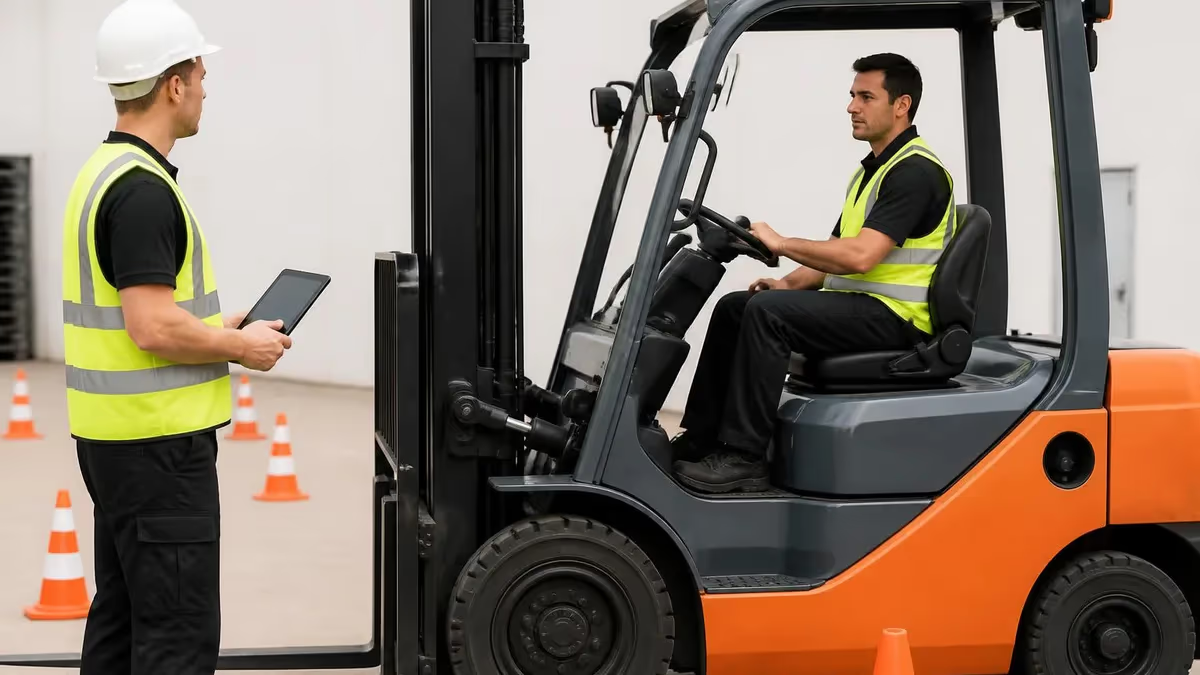
Forklift safety training is the single most important investment any warehouse, distribution center, or construction yard can make in its workforce. Whether your operators run an certification of forklift program for owned units or pull machines from a forklift rental yard each week, the federal rules are identical: OSHA 29 CFR 1910.178 requires every operator to be formally trained, evaluated, and certified before touching the controls. Untrained operators cause roughly 85 of the 100 forklift fatalities recorded each year in the United States, and most of those deaths involve tipovers, pedestrians, or falls from elevated platforms.
The good news is that comprehensive forklift safety training reduces incidents by 25 to 30 percent in the first year, according to data from the National Safety Council. Trained operators perform better pre-shift inspections, recognize unstable loads, and understand the physics of the stability triangle. They also know when to refuse a task — a critical skill that protects both the worker and the employer from costly citations averaging $16,131 per serious violation and up to $161,323 for willful repeat offenses.
This guide walks you through every element of a compliant forklift training program, from the classroom theory required by OSHA to the hands-on evaluation each operator must pass. We cover the seven powered industrial truck classes, the specific hazards of electric forklift use indoors, the unique requirements for cherry picker forklift operators working at height, and the documentation employers must keep on file for three years.
You will also learn how the rules apply when your company uses forklifts rentals instead of owned equipment. Many supervisors mistakenly believe rented forklifts come with operator certification — they do not. The rental company supplies the machine and a familiarization briefing, but the employer remains responsible for verifying every operator is trained on that specific truck type and attachment.
We pull from OSHA enforcement letters, ANSI/ITSDF B56.1 consensus standards, and real incident reports compiled by the Bureau of Labor Statistics. Each section includes the regulatory citation so you can verify the requirement in the Code of Federal Regulations and defend your program during an inspection.
By the end of this article you will know exactly what a defensible training program looks like, how often refreshers are required, what triggers an immediate retraining event, and how to evaluate whether your current provider meets OSHA's competent-trainer standard. You will also have a checklist you can hand to a supervisor tomorrow morning and a study path for operators preparing for their certification evaluation.
The cost of a single tipover — medical care, OSHA penalties, lost productivity, increased insurance premiums, and potential wrongful-death litigation — averages $188,000 per incident in published case studies. A complete training program runs $80 to $250 per operator. The math has never been clearer, and the regulatory pressure has never been higher.
Forklift Safety Training by the Numbers

OSHA Training Requirements at a Glance
Lectures, written materials, videos, or computer-based modules covering operating instructions, warnings, truck differences, workplace hazards, and the requirements of 29 CFR 1910.178.
Hands-on demonstration by the trainer and supervised exercises performed by the trainee on the actual truck type they will operate in their workplace, with their actual attachments.
A workplace evaluation by a qualified person assessing the operator's ability to drive, maneuver, load, stack, and react to hazards. Must be documented with operator name, date, and evaluator.
Required after any accident, near-miss, unsafe observation, assignment to a new truck type, or workplace condition change. A baseline three-year evaluation is mandatory regardless.
Employers must keep written certification on file containing the operator's name, training date, evaluation date, and trainer/evaluator identity. Must be available during OSHA inspections.
A defensible forklift safety training curriculum has three pillars that OSHA spells out in 1910.178(l): truck-related topics, workplace-related topics, and the requirements of the standard itself. Skipping any pillar exposes the employer to citations even if no incident occurs. Most third-party trainers blend these into an 8-hour classroom day followed by 2 to 4 hours of practical evaluation, though the regulation does not specify a minimum time — only that the operator must be competent.
The truck-related portion teaches operators how a forklift differs from an automobile. Counterbalance trucks pivot on the rear wheels, creating a swing radius that surprises new drivers. The stability triangle — the imaginary three-point area between the front wheels and the rear pivot — determines whether the truck stays upright.
Operators learn that lifting a load raises the combined center of gravity and shrinks the triangle, which is why high-lift work demands slower travel and zero turning while elevated. This is also where a stand up forklift earns its place: its tighter turning circle makes it ideal for narrow aisles but unforgiving when operators drift outside trained patterns.
Workplace topics cover the specific environment the operator will work in: floor surfaces, ramps, pedestrian traffic, hazardous atmospheres, and the loads typical to the facility. A trainer who only covers generic warehouse scenarios misses the point. If your operators handle 4,000-pound rolls of paper, the curriculum must address roll clamp attachments, the derated capacity that comes with them, and the visibility loss when stacked four high.
Attachments matter more than most employers realize. Adding a side-shifter reduces capacity by roughly 5 percent; a paper-roll clamp can cut it 30 percent or more. OSHA requires the data plate to reflect every attachment, and operators must be trained on each one. Running a fork-mounted carpet pole without specific training is a documented citation category that closed several distribution centers in 2023.
Pedestrian interaction is statistically the deadliest hazard. Roughly 20 percent of forklift fatalities involve a pedestrian being struck or crushed. Training must cover horn use at blind corners, the 10-foot rule for keeping pedestrians clear of elevated loads, and the difference between marked pedestrian lanes and shared travel paths. Many programs now include virtual-reality modules that put trainees in the pedestrian's perspective to drive the lesson home.
The regulation-specific portion of training closes the loop by walking operators through 1910.178 itself. They should be able to cite the refresher requirement, the inspection mandate, the load-handling rules, and the prohibition on riders. Operators who understand the legal framework make better decisions when supervisors pressure them to cut corners.
Finally, the practical evaluation is not a formality. The evaluator watches the trainee perform the tasks they will actually do — pulling loads from a rack, stacking pallets, navigating a loading dock, and stopping smoothly with a load elevated. The evaluator documents each task and signs the certification. Generic certificates issued without this hands-on step are worthless during an OSHA inspection.

Forklift certification Practice Test Questions
Prepare for the Forklift certification Certification exam with our free practice test modules. Each quiz covers key topics to help you pass on your first try.
Forklift certification Certification Forkl...
Forklift certification Exam Questions covering Certification Forklift certification Maintenance and Repairs. Master Forklift certification Test concepts for certification prep.
Forklift certification Certification Forkl...
Free Forklift certification Practice Test featuring Certification Forklift certification Maintenance and Repairs Questions and Answers. Improve your Forklift certification Exam score with mock test prep.
Forklift certification Certification Forkl...
Forklift certification Mock Exam on Certification Forklift certification Operator Training and Certification Requirements. Forklift certification Study Guide questions to pass on your first try.
Forklift certification Certification Forkl...
Forklift certification Test Prep for Certification Forklift certification Operator Training and Certification Requirements Questions and Answers. Practice Forklift certification Quiz questions and boost your score.
Forklift certification Load Handling and S...
Forklift certification Questions and Answers on Load Handling and Stability. Free Forklift certification practice for exam readiness.
Forklift certification OSHA Regulations an...
Forklift certification Mock Test covering OSHA Regulations and Compliance. Online Forklift certification Test practice with instant feedback.
Forklift certification Pre-Operation Inspe...
Free Forklift certification Quiz on Pre-Operation Inspections. Forklift certification Exam prep questions with detailed explanations.
Forklift certification Refueling and Recha...
Forklift certification Practice Questions for Refueling and Recharging Procedures. Build confidence for your Forklift certification certification exam.
Forklift certification Safe Driving and Ma...
Forklift certification Test Online for Safe Driving and Maneuvering. Free practice with instant results and feedback.
Forklift certification Workplace Hazard Id...
Forklift certification Study Material on Workplace Hazard Identification. Prepare effectively with real exam-style questions.
Forklift certification Forklift Instructions
Free Forklift certification Test covering Forklift Instructions. Practice and track your Forklift certification exam readiness.
Forklift certification Forklift MCQ
Forklift certification Exam Questions covering Forklift MCQ. Master Forklift certification Test concepts for certification prep.
Forklift certification Forklift Employer R...
Free Forklift certification Practice Test featuring Forklift Employer Responsibilities. Improve your Forklift certification Exam score with mock test prep.
Forklift certification Forklift Penalties ...
Forklift certification Mock Exam on Forklift Penalties for Non-Compliance. Forklift certification Study Guide questions to pass on your first try.
Forklift Classes, Hazards, and Training Differences
Class I electric counterbalance and Class II narrow-aisle trucks dominate indoor warehousing. Battery weight contributes to stability, but the silent operation creates pedestrian hazards because workers do not hear the truck approaching. Training must emphasize horn use at every blind intersection and the additional caution required around order pickers and reach trucks.
An electric forklift also requires battery-handling training. Lead-acid changes expose operators to sulfuric acid and hydrogen gas; lithium-ion units demand thermal-event response procedures. Both fall under separate OSHA standards (1910.178(g) for batteries) and must be integrated into your overall safety curriculum, not treated as an optional add-on.
In-House vs. Third-Party Forklift Safety Training: Which Is Better?
- +In-house trainers know your exact facility, loads, and hazards
- +Lower per-operator cost once a certified trainer is on staff
- +Easier to schedule refreshers and new-hire onboarding
- +Trainer can observe daily performance, not just evaluation day
- +Training scenarios use the actual equipment and racking layouts
- +Builds internal safety culture and supervisor accountability
- +Reduces production downtime by avoiding travel to off-site classes
- −Initial train-the-trainer investment runs $1,200 to $2,500 per person
- −Trainer must stay current on OSHA letters of interpretation
- −Risk of complacency when the trainer is also a coworker
- −Documentation burden falls entirely on internal staff
- −Third parties bring exposure to industry best practices
- −Liability defense is stronger with an independent expert evaluator
- −Small employers rarely train enough operators to justify the overhead

Pre-Shift Forklift Safety Inspection Checklist
- ✓Verify operator certification is current and matches the truck class assigned
- ✓Check the data plate for capacity, attachments, and load center
- ✓Inspect tires for cuts, chunking, or low pressure (pneumatic only)
- ✓Test horn, backup alarm, and all lights before moving the truck
- ✓Inspect forks for cracks, bends, or excessive heel wear beyond 10 percent
- ✓Check hydraulic hoses and cylinders for leaks, kinks, or visible damage
- ✓Verify seat belt operation and presence of operator restraint system
- ✓Test service brake, parking brake, and steering through full range
- ✓Inspect mast chains, rollers, and the carriage for damage or wear
- ✓Check fuel, battery charge, or LP tank level before starting shift
- ✓Document any defects in writing and remove damaged trucks from service
- ✓Confirm fire extinguisher is charged and accessible if required by class
OSHA evaluates the program, not just the paperwork
During a forklift incident investigation, OSHA inspectors interview operators directly. If an operator cannot explain the stability triangle, identify the data plate capacity, or describe what to do during a tipover, your certificate is treated as invalid regardless of the date on it. Training depth matters more than training frequency.
The three-year refresher cycle is the floor, not the ceiling. OSHA 1910.178(l)(4)(ii) lists five specific events that trigger immediate retraining regardless of when the operator was last certified. The first is observation of unsafe operation. If a supervisor sees an operator carrying an elevated load, exceeding speed limits, or skipping the seat belt, that operator must be retrained before resuming work. Documentation of the observation, the retraining, and the follow-up evaluation must go in the personnel file.
The second trigger is involvement in an accident or near-miss. Many employers fail to retrain after near-misses because no damage occurred, but OSHA explicitly includes these in the regulation. A pallet falling from forks because the load was not centered is a near-miss — retrain. A truck rolling because the parking brake was skipped is a near-miss — retrain. The legal exposure of skipping this step is identical whether or not anyone was hurt.
The third trigger is an evaluation revealing operator deficiency. Some employers conduct annual evaluations even though OSHA only mandates them every three years. Annual evaluations catch skill decay early, especially for operators who run multiple truck types or work seasonally. Treat the evaluation as a coaching opportunity, not a pass-fail audit.
The fourth trigger is assignment to a new truck type. An operator certified on a Class I sit-down counterbalance cannot legally operate a Class II reach truck or a Class VII telehandler without specific training on that class. Many warehouses violate this rule when they rent equipment outside their normal fleet during peak season. Before signing a forklift rental near me agreement, confirm every operator has documented training on the specific class being delivered.
The fifth trigger is a workplace condition change. A new racking layout, narrower aisles, different load types, mezzanine addition, or transition from indoor to outdoor operation all require supplemental training. The trainer documents what changed, what was taught, and how the operator was re-evaluated under the new conditions.
Documentation is the thread that holds compliance together. The certification record must include the operator's full name, the date of training, the date of the most recent evaluation, and the name of the person who conducted the evaluation. OSHA accepts paper or electronic records, but they must be available during an inspection. Cloud-based learning management systems with automated refresher reminders have become the standard for fleets of 20 or more operators.
Penalties scale with severity. A first-time serious citation runs $16,131 in 2024 dollars. Willful or repeat violations escalate to $161,323 per instance. When an untrained operator is involved in a fatality, OSHA frequently issues willful citations because the training requirement has been in place since 1971 and there is no plausible ignorance defense.
If your operation pulls forklifts from a rental yard, the rental company is responsible only for delivering a safe machine. Your company remains 100 percent responsible for verifying each operator is trained on that specific truck class before keys are handed over. OSHA citations for untrained operation on rented equipment have averaged $18,400 per case since 2022.
Building a compliant forklift safety training program starts with a written plan that lives outside the trainer's head. The plan should identify who is authorized to train, who is authorized to evaluate, which truck classes are in the fleet, which attachments are in use, and how often refreshers happen. A written plan turns training from a personal initiative into a defensible system that survives staff turnover.
Select your trainer carefully. OSHA requires a trainer to have the knowledge, training, and experience to train operators and evaluate their competence. There is no required certificate, but in practice an OSHA Outreach card, an industry trainer credential from organizations like NSC or CITA, and at least two years of operator experience set a defensible baseline. Document the trainer's qualifications in the same folder as the operator records.
Match training to your actual fleet. Many programs cover only sit-down counterbalance trucks because that is what the trainer brought to the facility. If your fleet includes order pickers, reach trucks, walkie-stackers, or rough-terrain machines, each must be covered explicitly. The cheapest way to expand a curriculum is to film your own facility-specific videos with the trainer narrating real hazards on the actual production floor.
Schedule refreshers proactively. A common practice is to align refreshers with annual safety meetings rather than waiting for the three-year deadline. Annual touchpoints catch skill decay, refresh memory on the standard, and create natural moments to introduce new equipment or attachments. Operators consistently report higher confidence and lower incident rates under annual programs.
Integrate forklift training with broader warehouse safety efforts. Pedestrian awareness training for non-operators, racking inspection programs, dock-safety procedures, and PPE policies all interact with forklift hazards. Many of the worst incidents happen when one of these supporting systems fails — a damaged rack collapses under a routine lift, or a pedestrian wanders into an aisle without high-visibility apparel. Find your nearest forklift certification near me resource and use the practice tests to standardize knowledge across shifts.
Audit your program at least annually. Pull five operator files at random and verify the certification record contains the four required elements. Walk the floor and watch operators perform the tasks listed in their evaluation. Interview two operators about the stability triangle, load-handling rules, and refresher triggers. If any element is missing or unclear, you have time to fix it before an OSHA inspector finds it for you.
Finally, build a culture where operators feel safe stopping work. The leading indicator of a strong training program is not the certificate file but the willingness of operators to refuse an unsafe lift. When supervisors back operators who stop work, training translates into behavior. When supervisors override them, even the best curriculum becomes paperwork.
Operators preparing for their first certification evaluation often feel the practical exam is the hardest part. In reality, evaluators are looking for predictable, deliberate behavior more than speed or finesse. The candidates who pass on the first attempt consistently follow the same pattern: complete the pre-shift inspection out loud, fasten the seat belt before touching any control, sound the horn at every blind corner, and travel with forks at four to six inches off the ground. Evaluators check off those items in the first 90 seconds.
Spend dedicated time on load handling. Approach the pallet square, level the forks, insert them fully, and tilt back slightly before lifting. Lift only after the forks are completely under the load, then back up at least one truck length before turning. Most failed evaluations come from rushing this sequence — operators tilt forward while inserting forks, drag a load on the ground, or turn while the load is still elevated above travel height. Practice the sequence until it feels mechanical.
Study the data plate language. Capacity is rated at a specific load center, usually 24 inches. If your load center exceeds that, capacity drops proportionally. An evaluator may hand you a written scenario describing a 36-inch load center and ask whether the truck can handle it. The math is straightforward but only if you have practiced it. The same applies to attachment derating — a side-shifter, a paper roll clamp, or a fork extension each carry their own capacity reduction stamped on a separate plate.
Review tipover response. If a sit-down truck starts to tip, stay in the seat, brace your feet, grip the wheel, and lean away from the impact. Do not jump — operators who jump are typically crushed by the overhead guard. Stand-up rider trucks have the opposite rule: step off backward away from the falling truck. Knowing the right response for your specific class is a frequent oral-exam question and a literal life-saver.
Brush up on pedestrian and traffic rules. Pedestrians have the right of way at all intersections. Maintain three truck lengths between forklifts traveling in the same direction. Never pass another forklift at an intersection, on a ramp, or in a blind spot. These rules sound obvious in writing but are the most commonly violated in real warehouses — evaluators specifically watch for them. If you are weighing an upcoming forklift for sale decision or an equipment upgrade, factor in the visibility and operator-assist features that make these rules easier to follow.
Use free practice tests to calibrate your knowledge before the written portion. Most certification written exams contain 25 to 50 multiple-choice questions covering OSHA rules, stability, inspections, and load handling. Operators who take three or four practice tests before the real exam consistently score 15 to 20 points higher than those who walk in cold. Treat the practice tests as a study tool, not a measurement, and re-read the explanation for every question you miss.
On evaluation day, eat a normal meal, hydrate, and arrive 30 minutes early. Walk the course before the evaluation if the trainer permits it. Listen carefully to the evaluator's instructions and ask clarifying questions before moving. Operators who pause to think look professional; operators who guess and recover look unsafe. Pass rates for prepared candidates routinely exceed 90 percent, while unprepared candidates fail at roughly 35 percent and must repeat the entire training day.
Forklift Questions and Answers
Forklift Tires: Complete Guide to Types, Sizing, Wear Patterns, and Replacement Costs
Forklift Jobs Near Me: Complete Guide to Finding Best Opportunities
Forklift Operation & Equipment Knowledge Practice Test Video Answer
Forklift Inspection & Maintenance Practice Test Video Answer
30-Day Forklift certification Certification Study Plan — Pass on Your First Try
About the Author

Certified Crane Operator & Skilled Trades Exam Specialist
Ferris State UniversityRobert Martinez is a Journeyman Ironworker, NCCCO-certified crane operator, and forklift trainer with a Bachelor of Science in Construction Technology from Ferris State University. He has 21 years of ironworking, rigging, and heavy equipment operation experience across high-rise and industrial construction sites. Robert prepares candidates for crane operator, rigger, forklift, and skilled trades certification examinations.