
Forklift Equipment Guide: Rentals, Sales, Scales, and Operator Certification Essentials
Forklift rental, sales, scales, and certification explained. 🔎 Compare stand up forklift, cherry picker forklift, and operator training options for US
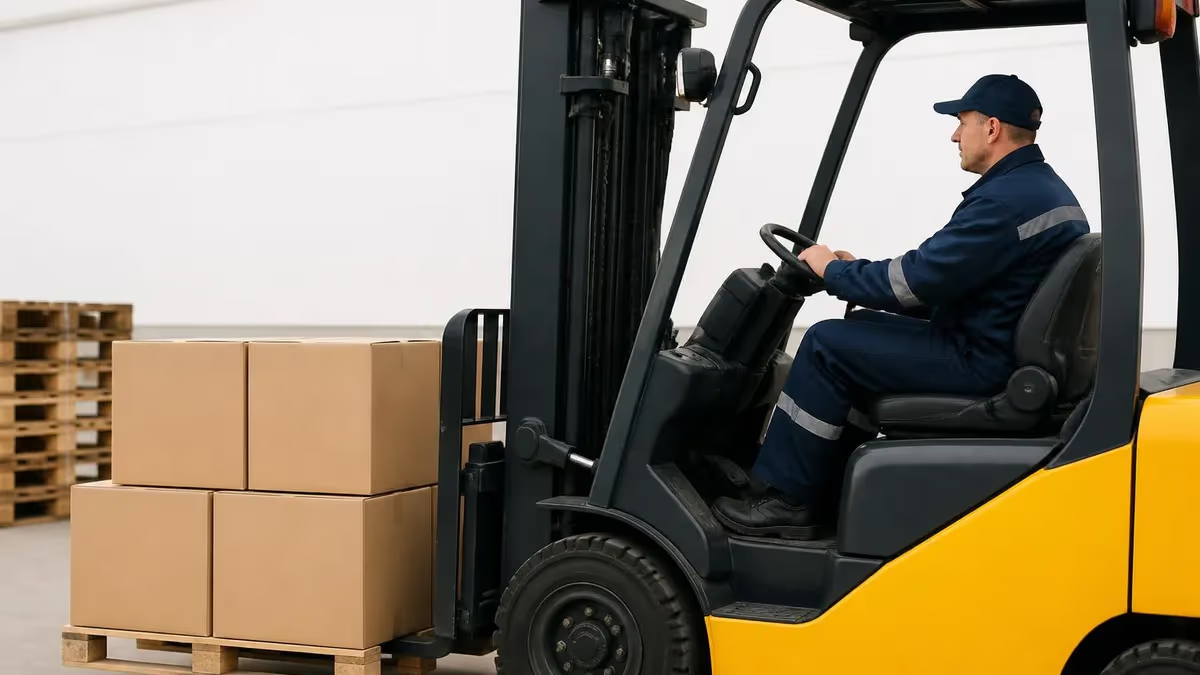
Forklift scales have quietly become one of the most useful upgrades in modern warehouses, turning ordinary lift trucks into mobile weighing stations that capture pallet weight at the point of pickup. Whether you operate a single counterbalance unit or manage a fleet of stand up forklift trucks, integrating onboard scales lets you verify load weight before you ever leave the dock, reduce overloaded trailers, and tighten inventory accuracy without slowing throughput. For US operations facing tighter DOT axle-weight enforcement and rising freight claims, this small piece of equipment pays back fast.
This guide walks through the full ecosystem of forklift equipment that supports a productive, compliant operation: rental options, purchase considerations, attachments like scales and side shifters, and the operator credentials that hold it all together. We will cover what a forklift rental actually includes, how to evaluate a forklift for sale against a long-term lease, and why a properly trained forklift operator multiplies the value of every dollar you spend on hardware.
If you are searching for forklifts to add to a growing fleet, or simply trying to understand which class of truck fits a specific environment, the equipment decision rarely stands alone. Aisle width, ceiling height, floor type, load profile, fuel preference, and shift length all shape the recommendation. So does your local labor market — a warehouse that cannot hire certified operators should not buy a fifth truck.
OSHA standard 1910.178 requires that every powered industrial truck operator be trained and evaluated on the specific type of equipment they run, and the federal rule treats forklift scales, fork extensions, and other attachments as factors that change handling characteristics. That means buying a scale-equipped truck without retraining your operators creates a paper compliance gap that an inspector or insurance adjuster will spot immediately after an incident.
We will also look at the financial side. National rental rates, residual values, attachment ROI, and certification costs are all moving targets in 2026, with electric Class I and Class II trucks now reaching price parity with internal-combustion equivalents over a five-year ownership window. Knowing where the market sits this quarter helps you negotiate every line item, from delivery fees to mast height adders to optional onboard telematics.
Finally, expect plenty of practical detail. By the end of the article you will know how to size a forklift to a job, when to rent versus buy, how onboard scales actually weigh a load, what cherry picker forklift trucks do that a reach truck cannot, and how to build a training program that keeps your team — and your inspections — sharp. Use the table of contents to jump to a specific section, or read straight through.
Every recommendation here aligns with current OSHA, ANSI/ITSDF B56.1, and NIST Handbook 44 guidance for legal-for-trade weighing where applicable. Local AHJ rules can differ, so verify any specific rental, registration, or weighing application with your state department of agriculture or weights and measures office before treating a forklift scale reading as a billable measurement.
Forklift Equipment by the Numbers

Forklift Classes and Equipment Types
Battery-powered sit-down trucks with cushion or pneumatic tires. Ideal for indoor warehouses with smooth floors. Zero emissions, quieter operation, lower fuel cost than IC but require charging infrastructure and spare battery rotation.
Reach trucks, order pickers, and turret trucks designed for 8–10 foot aisles. Operator stands or sits in a cab that can improve. High racking productivity but limited to indoor concrete floors and lower travel speeds.
Walkie pallet jacks, walkie stackers, and rider pallet trucks. Cheapest entry point, light-duty cycle, and short charge times. Used heavily for dock loading, order picking, and short horizontal moves under 50 feet.
LPG, gasoline, or diesel sit-down trucks with cushion (IV) or pneumatic (V) tires. Higher capacity, faster refuel, and outdoor-friendly. Cherry picker forklift and rough-terrain variants live here for construction and lumber yards.
Heavy-duty pneumatic tires, four-wheel drive, and high ground clearance for jobsites. Variable-reach telehandlers extend booms 20–55 feet. Required for most outdoor construction work where pavement is absent or uneven.
The rent-versus-buy decision usually comes down to utilization, capital flexibility, and how predictable your work mix really is. A general rule heard across the industry is that if a truck runs more than 1,500 hours per year, owning or long-term leasing wins on total cost; under 1,000 hours, rental or short-term lease comes out ahead. Between those numbers, the math depends on financing rate, maintenance contract, and whether you can resell the unit when your needs shift.
Rental pricing in 2026 spans a wide range. A standard 5,000 lb Class IV cushion-tire forklift rents for roughly $700 to $1,300 per week, with monthly rates discounted 15 to 25 percent and daily rates carrying a premium of 30 to 40 percent. Pneumatic outdoor units cost more, reach trucks cost more still, and specialty equipment like cherry picker forklift trucks or telehandlers sit at the top of the rate card. Always ask whether delivery, propane tank exchange, and damage waiver are included or billed separately.
If you are typing forklift rental near me into a search bar, the closest dealer is not always the best one. Ask each provider how quickly they swap a downed unit, whether their maintenance team is in-house or subcontracted, and what hours their service desk runs. A truck that breaks Friday afternoon and cannot be replaced until Monday costs more in lost throughput than the cheapest weekly rate saves.
For purchase decisions, focus on total cost of ownership over a five to seven year horizon. New Class I electric trucks priced at $30,000 to $40,000 typically cost another $25,000 in maintenance, energy, and battery replacement over seven years. An equivalent IC truck saves on capital and battery but spends 20 to 40 percent more on fuel and maintenance, and adds ventilation requirements indoors. Used trucks with documented service history at 6,000 to 10,000 hours can land at 35 to 55 percent of new price.
Leasing splits the difference. A 48-month full-maintenance lease bundles the truck, scheduled service, planned battery replacement, and a fixed-rate buyout option. Lease payments are predictable monthly operating expenses, which makes budgeting easier and frees capital for racking, automation, or hiring. The trade-off is total spend over the term is usually 10 to 15 percent higher than buying outright in cash, although it remains competitive once you factor in maintenance variability.
Tax treatment also matters. Section 179 expensing and bonus depreciation rules let many US businesses write off a significant portion of forklift purchase cost in the year of acquisition, subject to annual caps. Operating leases stay off the balance sheet under some accounting treatments, while capital leases and purchases appear as assets and liabilities. Talk to your CPA before signing anything north of $25,000, especially if you expect to sell or roll the truck within two years.
Finally, do not forget attachments and infrastructure. A new forklift might need fork extensions, a side shifter, a fork positioner, or onboard scales. Indoor electric fleets need charging stations and possibly fast-charge infrastructure. Outdoor IC fleets need propane storage or a diesel tank. These costs can add 10 to 25 percent to the headline price of the truck itself.

Forklift certification Practice Test Questions
Prepare for the Forklift certification Certification exam with our free practice test modules. Each quiz covers key topics to help you pass on your first try.
Forklift certification Certification Forkl...
Forklift certification Exam Questions covering Certification Forklift certification Maintenance and Repairs. Master Forklift certification Test concepts for certification prep.
Forklift certification Certification Forkl...
Free Forklift certification Practice Test featuring Certification Forklift certification Maintenance and Repairs Questions and Answers. Improve your Forklift certification Exam score with mock test prep.
Forklift certification Certification Forkl...
Forklift certification Mock Exam on Certification Forklift certification Operator Training and Certification Requirements. Forklift certification Study Guide questions to pass on your first try.
Forklift certification Certification Forkl...
Forklift certification Test Prep for Certification Forklift certification Operator Training and Certification Requirements Questions and Answers. Practice Forklift certification Quiz questions and boost your score.
Forklift certification Load Handling and S...
Forklift certification Questions and Answers on Load Handling and Stability. Free Forklift certification practice for exam readiness.
Forklift certification OSHA Regulations an...
Forklift certification Mock Test covering OSHA Regulations and Compliance. Online Forklift certification Test practice with instant feedback.
Forklift certification Pre-Operation Inspe...
Free Forklift certification Quiz on Pre-Operation Inspections. Forklift certification Exam prep questions with detailed explanations.
Forklift certification Refueling and Recha...
Forklift certification Practice Questions for Refueling and Recharging Procedures. Build confidence for your Forklift certification certification exam.
Forklift certification Safe Driving and Ma...
Forklift certification Test Online for Safe Driving and Maneuvering. Free practice with instant results and feedback.
Forklift certification Workplace Hazard Id...
Forklift certification Study Material on Workplace Hazard Identification. Prepare effectively with real exam-style questions.
Forklift certification Forklift Instructions
Free Forklift certification Test covering Forklift Instructions. Practice and track your Forklift certification exam readiness.
Forklift certification Forklift MCQ
Forklift certification Exam Questions covering Forklift MCQ. Master Forklift certification Test concepts for certification prep.
Forklift certification Forklift Employer R...
Free Forklift certification Practice Test featuring Forklift Employer Responsibilities. Improve your Forklift certification Exam score with mock test prep.
Forklift certification Forklift Penalties ...
Forklift certification Mock Exam on Forklift Penalties for Non-Compliance. Forklift certification Study Guide questions to pass on your first try.
Forklift Scales, Attachments, and Forklift Training
Onboard forklift scales weigh a pallet by reading hydraulic pressure in the lift cylinders or by using load cells built into the carriage. Hydraulic systems retrofit easily to most Class IV and V trucks and deliver around 1 percent accuracy on calibrated equipment. Load cell carriages are pricier but reach 0.1 to 0.2 percent accuracy, which qualifies some installations for legal-for-trade weighing under NIST Handbook 44 when paired with a sealed indicator.
The ROI is faster than most fleet managers expect. Catching even a few overweight outbound trailers per month avoids DOT fines that start near $1,000 per axle violation. Verifying inbound supplier weights catches short shipments. And accurate weighing supports cycle counting and freight claims. Most operators recoup the $3,500 to $6,500 install cost within twelve months on a moderate-throughput dock.
Buying New vs Renting Forklifts
- +Lower per-hour cost on high-utilization fleets above 1,500 hours per year
- +Full control of attachments, telematics, and customization
- +Section 179 and bonus depreciation can offset capital cost
- +Build resale equity with documented maintenance history
- +Predictable availability — no truck swaps mid-shift
- +Better operator familiarity reduces accident rates over time
- −Large upfront capital outlay or financing requirement
- −You own all maintenance, downtime, and battery replacement risk
- −Resale value is volatile and brand-dependent
- −Wrong sizing decision is hard to reverse without a loss
- −Need to plan and pay for charging or fueling infrastructure
- −Insurance, registration, and storage costs are ongoing
Pros and Cons at a Glance
| Pros | Cons |
|---|---|
| Full control of attachments, telematics, and customization | Large upfront capital outlay or financing requirement |
| Build resale equity with documented maintenance history | You own all maintenance, downtime, and battery replacement risk |
| Predictable availability — no truck swaps mid-shift | Resale value is volatile and brand-dependent |
| Better operator familiarity reduces accident rates over time | Wrong sizing decision is hard to reverse without a loss |

Daily Pre-Use Forklift Inspection Checklist
- ✓Walk around the truck and check tires for cuts, flat spots, or low pressure
- ✓Inspect forks for cracks, bends, or worn heel sections beyond 10 percent
- ✓Verify the data plate is legible and matches any attachments installed
- ✓Test the horn, headlights, backup alarm, and strobe lights
- ✓Check hydraulic lines and cylinders for leaks or visible damage
- ✓Cycle the lift, tilt, and side shift through full range with no load
- ✓Test service brake, parking brake, and seat-presence switch
- ✓Confirm fire extinguisher is charged, sealed, and securely mounted
- ✓Check fuel, propane tank seal, or battery state-of-charge before use
- ✓Document the inspection on the OSHA-compliant log sheet and report defects
Avoid one DOT axle fine and you have likely covered the scale install
Federal axle-weight overage fines start near $1,000 per violation and escalate with weight, repeat offenses, and state surcharges. A mid-priced hydraulic onboard scale system runs $3,500 to $6,500 installed. Catching three to four overweight trailers a year — easy on a moderately busy dock — fully recovers the investment, before counting reduced freight claims, faster cycle counts, and tighter inventory accuracy.
Forklift operator certification is governed federally by OSHA 29 CFR 1910.178(l), which requires formal classroom or e-learning instruction, hands-on practical training, and a workplace evaluation before any employee operates a powered industrial truck unsupervised. The rule applies to every general industry and construction worksite in the United States, including warehouses, distribution centers, lumber yards, paper mills, retail backrooms, and construction jobsites where a forklift or telehandler is used.
A complete certification of forklift operators includes truck-type specifics, workplace hazards, and operator responsibilities. Truck-type topics cover stability triangle, load center calculation, traveling with improved loads, ramp operation, and pedestrian interaction. Workplace topics cover dock plates, narrow aisles, freezer operation, charging room procedures, and any unique hazards in your facility. Generic online-only certificates that skip the workplace evaluation do not satisfy OSHA — a real evaluator must watch the operator drive the actual truck on the actual floor.
Recertification is required at minimum every three years, and sooner if the operator is involved in an accident or near miss, is observed operating unsafely, is assigned to a new truck type, or experiences a workplace condition change. Many employers run shorter refresher cycles — annually or every two years — because their insurance carrier requires it, and because incident rates measurably drop with more frequent refreshers and unannounced supervisor observations.
The training itself usually runs four to eight hours for a new operator with no prior experience, split roughly half classroom and half hands-on. Experienced operators moving between truck types can often complete a focused two to four hour conversion course. Costs range from $75 to $250 per operator for in-house programs using employer trainers, and $150 to $500 per operator for third-party trainers who travel to your facility with their own curriculum and evaluation tools.
Documentation is where many programs fall short. OSHA expects the employer to maintain a written record showing the operator name, training date, evaluation date, trainer name, and the specific equipment evaluated. Keep records for the duration of employment plus three years after the most recent evaluation. If an inspector or insurance adjuster shows up, you should be able to produce that record for any active operator in under five minutes — anything slower suggests systemic gaps.
Operators driving specialty trucks like order pickers, cherry picker variants, telehandlers, or pivot-steer narrow-aisle units need equipment-specific training even if they already hold a counterbalance certification. The control layouts, fall protection requirements, and stability characteristics differ enough that OSHA treats each as a separate classification. Skipping the conversion training is one of the most common citations issued during forklift-related investigations.
Finally, the trainer needs to be qualified too. OSHA does not license forklift trainers federally, but it does require the trainer to have the knowledge, training, and experience to teach and evaluate operators. In practice that means someone with several years of hands-on forklift experience, documented training in adult instruction and OSHA standards, and demonstrated competence on every truck type in your fleet. Document the trainer credentials the same way you document operator credentials.
A web-only certificate that promises full compliance in 60 minutes cannot satisfy OSHA 1910.178(l) because the rule requires a workplace evaluation on the specific truck and conditions the operator will actually use. Online classroom content is valid as one component, but a qualified evaluator must still observe the operator in your facility. Treat any vendor claiming otherwise as a compliance liability, not a shortcut.
A solid forklift maintenance program is built around three layers: operator daily inspections, planned preventive maintenance by qualified technicians, and condition-based repairs triggered by telematics or operator reports. Skipping the first layer is what most often causes the catastrophic failures — a tire shred, a hydraulic line burst, or a chain failure that an attentive pre-shift check would have caught hours earlier. The other two layers protect against the failures that happen quietly.
Planned preventive maintenance typically runs on an hour-meter schedule rather than calendar time. A common cadence is an A-service every 250 hours (filters, lube, basic inspection), a B-service every 500 hours (hydraulics, brakes, chains), and a C-service every 2,000 hours (drive train, mast, full diagnostic). Battery-electric trucks add quarterly battery watering and equalization for flooded lead-acid systems, while lithium-ion packs swap most of that for battery management system checks.
If you contract out maintenance, request a written scope that lists every item performed at each interval and the parts replaced. Many discount maintenance contracts skip critical chain-stretch checks or carriage roller inspections, then bill heavily when those parts fail. A modest premium for a thorough scope from a factory-authorized dealer almost always saves money over the life of the truck, and produces the documentation your insurance underwriter wants to see.
Operator training and equipment care intersect at the pre-use inspection. Build a culture where reporting a defect is rewarded rather than treated as bad news. The cheapest fix is the one done in the shop on a Tuesday morning, not the one done on the dock after a chain snaps mid-lift. Some fleets post weekly leaderboards for defects-caught-early to reinforce the behavior, and tie a small monthly bonus to inspection quality verified by spot audits.
For specialty equipment like a cherry picker forklift or an order picker, fall protection adds another maintenance dimension. Uses and lanyards need monthly visual inspections and full annual inspections by a competent person under ANSI Z359. Anchorage points on the platform must be load tested per the manufacturer schedule. Document each inspection on the use tag so the operator can verify it before clipping in at the start of every shift.
Telematics now play a big role in proactive maintenance. Modern fleet management systems track impact events, idle time, fault codes, battery health, and operator login. Pairing telematics with a strong shop process catches drift early — a truck whose hydraulic oil temperature is creeping up over a month is far cheaper to fix than one that fails in the middle of a busy week. The data also reveals operator behavior worth coaching, like aggressive braking or repeated impacts on the same dock door.
Finally, think about end-of-life and trade-in timing. Most fleets see maintenance cost per hour rise sharply after 12,000 to 15,000 hours on a Class IV truck and 15,000 to 20,000 hours on a Class I electric. Trading or selling before that knee in the curve preserves more residual value and reduces unplanned downtime. Track maintenance cost per hour by unit, not just by fleet average, so you can spot the outliers and act before they consume your service budget.
Practical buying tips start with knowing the duty cycle. Count your average lifts per hour, average travel distance per cycle, average load weight, and peak weights. A truck sized to the average rather than the peak will fail prematurely under stress, while one oversized for every job wastes capital and burns extra energy. Many dealers will perform a free site survey with a data-logging unit for a week before quoting — accept that offer whenever possible, especially for fleets above three trucks.
When evaluating any forklift for sale, check the hour meter, look for evidence of mast and carriage repairs, inspect the chains for stretch and corrosion, and request the full service history. A truck at 6,000 hours with documented full service costs significantly more than one at 4,000 hours with no records, and is usually the better long-term value. Always test drive on a representative load and ask to see the most recent annual safety inspection report.
For rental customers, build a short-list of two dealers rather than relying on a single source. Even when one dealer is your clear primary, a backup with parallel terms protects you against capacity squeezes during seasonal peaks. Negotiate the swap-out response time in writing — 24 hours during business hours is typical, four hours with a premium contract — and confirm whether weekend delivery is available without surcharge if your operation runs Saturday or Sunday shifts.
Specify safety options on every truck regardless of class. A blue spot light, motion sensor backup alarm, and seatbelt-interlock are inexpensive and dramatically reduce pedestrian-strike risk in high-traffic warehouses. Operator presence systems that disable hydraulics when the operator leaves the seat are required by most insurance carriers today. For night shifts or trailer loading, an LED strobe and amber flasher visible from 50 feet improves awareness in low-light areas.
For onboard scales, choose a vendor that supports remote calibration, cloud data capture, and integration with your warehouse management system. A standalone scale that produces a paper ticket is useful, but a scale that pushes weights directly to your WMS captures value across receiving, shipping, and inventory reconciliation. Calibration intervals are typically annual for non-legal-for-trade use and semi-annual for legal-for-trade, with documented calibration certificates kept on file for audit.
Don't overlook the human factors. A truck cab with adjustable seating, ergonomic controls, and clear sightlines reduces operator fatigue and turnover. Operators on poorly designed trucks file more workers' compensation claims for back, neck, and shoulder injuries — costs that easily eclipse the price difference between a base cab and an ergonomic package. Ask your operators to test drive shortlisted units before purchase; they will catch issues a buyer cannot.
Finally, plan the rollout. New trucks should come into service with a kickoff meeting covering data-plate capacity, attachment specifics, charging or fueling procedure, and reporting any concerns. Run a 30-day post-deployment review that gathers operator feedback, telematics data, and shop observations. Small adjustments early — repositioning a horn button, swapping a mirror, adjusting seat suspension — pay back in operator satisfaction, productivity, and equipment life for years afterward.
Forklift Questions and Answers
Forklift Jobs Near Me: Complete Guide to Finding Best Opportunities
Forklift Operation & Equipment Knowledge Practice Test Video Answer
Forklift Inspection & Maintenance Practice Test Video Answer
Forklift Operator Jobs Near Me: Pay, Top Employers, Specialty Roles
30-Day Forklift certification Certification Study Plan — Pass on Your First Try
About the Author

Certified Crane Operator & Skilled Trades Exam Specialist
Ferris State UniversityRobert Martinez is a Journeyman Ironworker, NCCCO-certified crane operator, and forklift trainer with a Bachelor of Science in Construction Technology from Ferris State University. He has 21 years of ironworking, rigging, and heavy equipment operation experience across high-rise and industrial construction sites. Robert prepares candidates for crane operator, rigger, forklift, and skilled trades certification examinations.