
Forklift Maintenance: The Complete Guide to Keeping Your Fleet Running Safely and Efficiently
Master forklift maintenance with daily checks, PM schedules, OSHA rules, and cost-saving tips for owners, renters, and certified forklift operators. 🔎
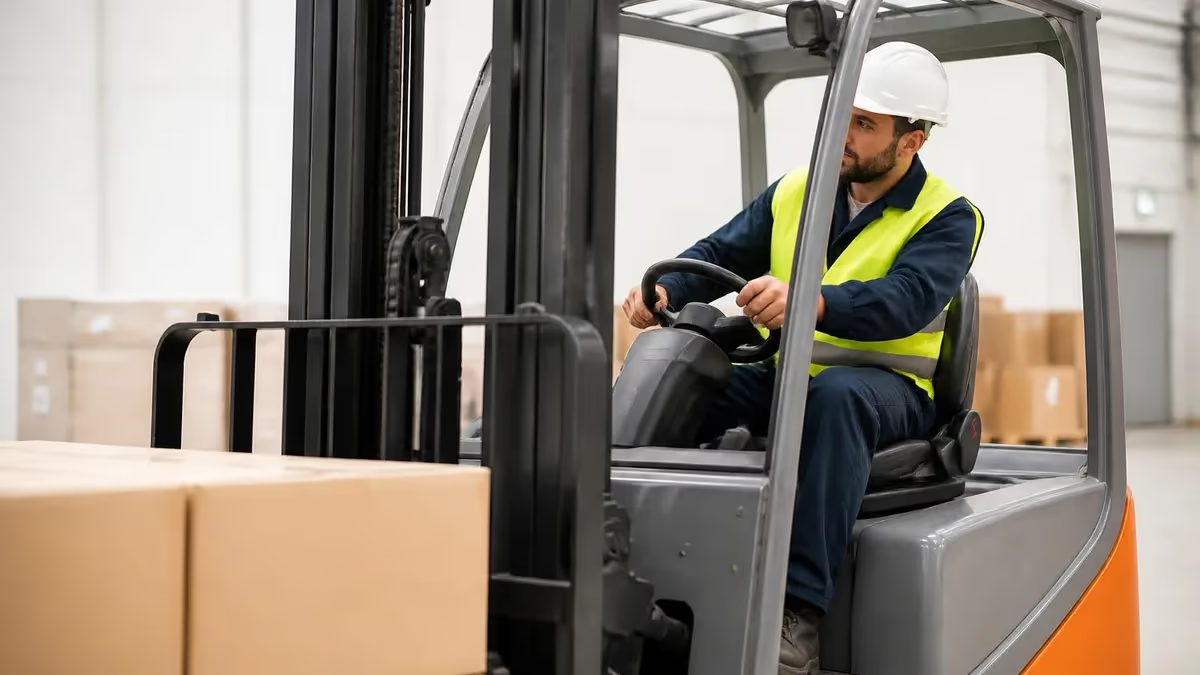
Forklift maintenance is the single most important factor separating a profitable warehouse from one bleeding cash on downtime, repairs, and OSHA citations. Whether you operate a single propane lift in a small distribution center or manage a hundred-truck mixed fleet across multiple sites, the discipline you bring to daily inspections, planned service, and component replacement directly shapes your operating budget, your worker safety record, and your insurance premiums. The good news is that effective forklift maintenance is not complicated — it is consistent.
Industry data from the Industrial Truck Association suggests that roughly 70% of unplanned forklift breakdowns trace back to deferred or skipped routine maintenance. That means most catastrophic hydraulic failures, mast drops, brake fires, and tip-over incidents could have been prevented during a five-minute pre-shift inspection or a thirty-minute planned service interval. The cost difference is staggering: a $40 hydraulic hose changed during PM costs roughly $3,200 when it ruptures mid-lift and totals a pallet of product.
This guide walks you through every layer of a modern maintenance program, from the operator-led OSHA daily checklist all the way through 2,000-hour major overhauls. We cover internal combustion trucks, forklifts powered by lithium-ion and lead-acid batteries, narrow-aisle reach trucks, order pickers, and the increasingly common stand-up rider models that dominate cold storage and e-commerce fulfillment. The principles travel across brands — Toyota, Hyster, Yale, Crown, Raymond, Mitsubishi, Komatsu, and Linde all share the same core service logic.
You will also learn how maintenance intersects with rental decisions. Many operations managers searching for a forklift rental quote do not realize that rental contracts often bundle full preventive maintenance into the monthly rate, while short-term rentals may push that responsibility back onto the renter. Knowing the difference can save thousands per truck per year and is critical when comparing a long-term lease to outright ownership of an electric forklift or stand up forklift.
Maintenance is also tightly linked to operator certification. OSHA 1910.178 makes the operator the front line of inspection, and a properly trained forklift operator catches 80% of developing failures before they become incidents. That is why companies with strong certification cultures consistently report 40-60% lower maintenance spending per operating hour than those that treat training as a paperwork formality.
By the end of this guide, you will have a defensible, audit-ready maintenance framework you can hand to a new fleet supervisor on their first day. You will know how to read meter hours, build a tiered PM schedule, source replacement parts without overpaying, evaluate dealer service contracts, and decide when a truck has crossed the economic threshold that makes replacement smarter than another repair. We will close with the practical tips and FAQs that most operators only learn after a decade in the warehouse.
Forklift Maintenance by the Numbers

Forklift Maintenance Schedule by Operating Hours
Daily / Pre-Shift (8-10 hrs)
250-Hour Service
500-Hour Service
1,000-Hour Service
2,000-Hour Overhaul
The daily inspection is the cornerstone of every credible forklift maintenance program and the only maintenance task that OSHA explicitly requires by federal law. Under 29 CFR 1910.178(q)(7), powered industrial trucks must be examined before being placed in service, and they shall not be placed in service if the examination shows any condition adversely affecting the safety of the vehicle. This examination must be performed at least daily, and if the truck is used on a round-the-clock basis, it must be examined after each shift.
A proper pre-shift inspection breaks into two phases: a key-off walkaround and a key-on functional test. The walkaround covers visual items that do not require power — tire condition, fork wear and cracks, mast chain tension and lubrication, hydraulic hoses for weeping, propane tank mounting, battery cable corrosion, overhead guard integrity, data plate legibility, and seat belt condition. Operators should physically tug on chains, sight down the forks for bend, and tap the tank lock pin to confirm engagement.
The key-on phase tests the dynamic systems. Horn must sound on first press. Lights, including headlights, taillights, and any blue spot or red zone safety lights, must illuminate. Steering should be smooth with no excessive play — more than 2 inches of free play at the wheel rim signals a worn steer cylinder or kingpin. Service brakes must hold the loaded truck on a 10% grade, and the parking brake must engage with audible click. Lift and tilt functions should cycle smoothly without chatter, drift, or unusual noise.
Documentation is where most fleets fall short. A daily inspection that is not written down legally did not happen, and an OSHA inspector who finds undocumented trucks can issue citations of $16,131 per serious violation as of 2026. Use a paper checklist hung on the truck, a clipboard at the dispatch desk, or a digital inspection app like Crown InfoLink, Toyota T-Matics, or third-party tools like Forkliftcertification.com. Digital records timestamp the inspection and create the audit trail insurance carriers want to see.
Operator-detected defects must be classified and routed correctly. A red-tag defect — failed brakes, hydraulic leak, broken fork, missing seat belt, or any safety system fault — removes the truck from service immediately. A yellow-tag item, like a worn tire approaching minimum or a slow hydraulic drift, gets logged and scheduled for the next PM. Empowering operators to red-tag without manager pushback is cultural work, but it is non-negotiable for a safe fleet.
The inspection cycle also creates valuable trend data. When the same defect appears on three trucks within a month, you are looking at a systemic issue — maybe a contaminated hydraulic fluid batch, a bad supplier of mast chains, or operators driving too aggressively over a specific dock plate. Reviewing inspection logs weekly turns reactive maintenance into predictive maintenance and is one of the cheapest fleet improvements available.
Finally, tie inspections to the certification of forklift operators. Every certified operator must demonstrate competence on the daily inspection during their evaluation, and every refresher training cycle — required every three years or after any incident — should retest inspection skills. This is the cheapest insurance policy your warehouse will ever buy.

Forklift certification Practice Test Questions
Prepare for the Forklift certification Certification exam with our free practice test modules. Each quiz covers key topics to help you pass on your first try.
Forklift certification Certification Forkl...
Forklift certification Exam Questions covering Certification Forklift certification Maintenance and Repairs. Master Forklift certification Test concepts for certification prep.
Forklift certification Certification Forkl...
Free Forklift certification Practice Test featuring Certification Forklift certification Maintenance and Repairs Questions and Answers. Improve your Forklift certification Exam score with mock test prep.
Forklift certification Certification Forkl...
Forklift certification Mock Exam on Certification Forklift certification Operator Training and Certification Requirements. Forklift certification Study Guide questions to pass on your first try.
Forklift certification Certification Forkl...
Forklift certification Test Prep for Certification Forklift certification Operator Training and Certification Requirements Questions and Answers. Practice Forklift certification Quiz questions and boost your score.
Forklift certification Load Handling and S...
Forklift certification Questions and Answers on Load Handling and Stability. Free Forklift certification practice for exam readiness.
Forklift certification OSHA Regulations an...
Forklift certification Mock Test covering OSHA Regulations and Compliance. Online Forklift certification Test practice with instant feedback.
Forklift certification Pre-Operation Inspe...
Free Forklift certification Quiz on Pre-Operation Inspections. Forklift certification Exam prep questions with detailed explanations.
Forklift certification Refueling and Recha...
Forklift certification Practice Questions for Refueling and Recharging Procedures. Build confidence for your Forklift certification certification exam.
Forklift certification Safe Driving and Ma...
Forklift certification Test Online for Safe Driving and Maneuvering. Free practice with instant results and feedback.
Forklift certification Workplace Hazard Id...
Forklift certification Study Material on Workplace Hazard Identification. Prepare effectively with real exam-style questions.
Forklift certification Forklift Instructions
Free Forklift certification Test covering Forklift Instructions. Practice and track your Forklift certification exam readiness.
Forklift certification Forklift MCQ
Forklift certification Exam Questions covering Forklift MCQ. Master Forklift certification Test concepts for certification prep.
Forklift certification Forklift Employer R...
Free Forklift certification Practice Test featuring Forklift Employer Responsibilities. Improve your Forklift certification Exam score with mock test prep.
Forklift certification Forklift Penalties ...
Forklift certification Mock Exam on Forklift Penalties for Non-Compliance. Forklift certification Study Guide questions to pass on your first try.
Electric Forklift vs IC Truck Maintenance
Electric forklift maintenance is dominated by battery care, which accounts for roughly 30% of total lifecycle cost on a lead-acid unit. Watering must happen after charging, never before, and only with distilled water filled to the indicator level. Equalizing charges every 5-10 cycles prevents sulfation, and cell-specific gravity readings every quarter catch failing cells before they kill the whole pack.
Beyond batteries, electric trucks demand contactor inspection every 500 hours, cable connection torque checks, and motor brush replacement around 5,000 hours on DC units. AC drive systems eliminate brushes but require controller cooling-fan service. Lithium-ion packs slash maintenance to almost zero — opportunity charging, no watering, no equalization — but the upfront premium is $8,000-$15,000 per truck.
In-House Maintenance vs Dealer Service Contract
- +Dealer techs carry brand-specific diagnostic laptops and certified training
- +Parts availability is faster through dealer supply chains, often same-day
- +Contract pricing locks in predictable monthly budget with no surprise invoices
- +Warranty claims are simpler when the dealer handles all service records
- +Loaner trucks during major repairs prevent operational downtime
- +Documented dealer service history significantly improves trade-in value
- −Hourly labor rates run $135-$185, double an in-house mechanic's loaded cost
- −Response times for non-contract emergencies can stretch 24-72 hours
- −Contracts often exclude wear items like tires, forks, and batteries
- −Dealer techs may upsell unnecessary repairs on older equipment
- −Less flexibility to defer or rebundle services around your operational peaks
- −Loss of institutional knowledge — your team never learns the equipment
Pros and Cons at a Glance
| Pros | Cons |
|---|---|
| Dealer techs carry brand-specific diagnostic laptops and certified training | Contracts often exclude wear items like tires, forks, and batteries |
| Parts availability is faster through dealer supply chains, often same-day | Dealer techs may upsell unnecessary repairs on older equipment |
| Contract pricing locks in predictable monthly budget with no surprise invoices | Less flexibility to defer or rebundle services around your operational peaks |
| Warranty claims are simpler when the dealer handles all service records | Loss of institutional knowledge — your team never learns the equipment |

Complete Pre-Shift Forklift Inspection Checklist
- ✓Walk around the truck and check tires for cuts, chunking, or pressure loss
- ✓Inspect forks for cracks at the heel, bend, or wear beyond 10% of original thickness
- ✓Verify mast chains are properly tensioned and free of kinks, twists, or broken links
- ✓Check hydraulic hoses and cylinders for visible leaks, weeping, or chafing
- ✓Test horn, headlights, taillights, backup alarm, and blue safety spotlight
- ✓Confirm seat belt latches firmly and retracts without binding
- ✓Verify overhead guard is undamaged with no cracked welds or missing bolts
- ✓Start engine and listen for unusual knocking, smoking, or rough idle
- ✓Test service brake, parking brake, and steering response with truck stationary
- ✓Cycle lift, tilt, and any attachments through full range checking for drift or chatter
- ✓Confirm data plate is legible and capacity rating matches the load you plan to handle
- ✓Document all findings on the daily inspection sheet and red-tag any defects
A documented five-minute inspection saves an average of $1,200 per truck per year
Fleets that consistently document pre-shift inspections experience 40% fewer unplanned breakdowns, 60% lower OSHA citation exposure, and significantly better insurance loss ratios. The math is simple: five minutes per shift, performed by a certified operator who knows what to look for, prevents the vast majority of catastrophic failures and saves multiples of the labor cost in avoided repairs.
Understanding forklift maintenance costs is essential whether you own outright, lease long-term, or sign a forklift rental contract. The total cost of ownership for a Class IV cushion-tire IC truck averages $2.80-$3.40 per operating hour over a 10,000-hour life, with maintenance representing 35-45% of that figure. Electric trucks run lower at $2.10-$2.60 per hour thanks to fewer moving parts and no fuel, though battery replacement at year five resets the math significantly.
Budget your annual maintenance in three buckets. The first is planned preventive maintenance — predictable, recurring expenses tied to operating hours, typically $1,200-$2,000 per truck per year for a single-shift operation. The second is wear items: tires ($400-$1,200 per set), forks ($350-$800 per pair), batteries ($4,500-$9,000 for lead-acid replacement), and chains ($600-$1,400 per pair). The third is unplanned repairs, which should run about 15-20% of total maintenance spending in a well-managed fleet.
Tracking cost per operating hour is the single most useful fleet metric. When a truck's trailing twelve-month cost exceeds $4.50 per hour for an IC unit or $3.50 for electric, it has likely crossed the economic replacement threshold. Continuing to repair past that point is throwing good money after bad — the cumulative cost over the next two years will almost always exceed the cost of a new or quality used unit. Many operators discover this only after a major hydraulic or transmission failure forces the decision.
Rental economics deserve careful thought. A standard forklift rental near me search returns daily rates around $150-$250, weekly rates of $600-$900, and monthly rates of $1,800-$2,800 for a 5,000-pound cushion-tire truck. Most monthly rentals include preventive maintenance and breakdown response, while daily rentals shift that risk to the renter. For seasonal demand peaks of 8-12 weeks, rental almost always beats ownership; for sustained 50+ hour weekly use over years, ownership wins by a wide margin.
Parts sourcing strategy can swing total cost by 25-40%. OEM parts from Toyota, Crown, or Hyster carry premiums of 30-80% over quality aftermarket equivalents from suppliers like Intella Parts, TVH, or Lift Parts Warehouse. For wear items, attachments, and non-critical components, aftermarket is almost always the right call. For safety-critical components — mast chains, hydraulic cylinders, brake assemblies, electronic control modules — stick with OEM or certified-equivalent parts.
Labor strategy is the other big lever. An in-house mechanic loaded at $85-$110 per hour beats dealer rates of $135-$185, but only if you have enough trucks to justify the position — generally 25 or more units. Below that threshold, a hybrid approach works best: contract the dealer for major PM and warranty work, and train your own maintenance team or a designated lead operator to handle daily inspections, fluid top-offs, tire changes, and minor adjustments.
Finally, build a maintenance reserve fund equal to 8-12% of replacement cost per truck per year. That cushion absorbs the inevitable hydraulic pump failure, transmission rebuild, or controller burnout without disrupting your operating budget. Fleets that skip this reserve are forced into reactive decisions — cheap part, fast fix, longer downtime — that compound costs over time.
OSHA inspectors routinely review forklift inspection records during warehouse audits, and missing or falsified documentation carries serious-violation penalties up to $16,131 per truck as of 2026. Willful violations climb to $161,323. Beyond fines, an undocumented inspection program voids most insurance coverage in the event of an incident, exposing the company to direct liability for medical costs, lost wages, and OSHA-imposed abatement programs.
Operator training is inseparable from forklift maintenance because the operator is the front-line technician on every truck. OSHA 1910.178(l) requires that every powered industrial truck operator be trained, evaluated, and certified before operating equipment, with refresher training every three years and immediately after any near-miss, accident, or assignment to a new truck type. The training must include formal instruction, practical demonstration by the trainee, and evaluation by a qualified person.
A serious training program covers far more than just driving. Operators must understand load capacity charts, stability triangles, the physics of tip-over, fuel and battery handling, attachment-specific operation, pedestrian interaction, and — most relevant here — daily inspection procedures and basic troubleshooting. Trainees who can identify the difference between normal hydraulic chatter and a failing relief valve catch problems weeks earlier than operators who simply drive.
The qualified evaluator is a role many warehouses underestimate. OSHA requires the evaluator to have the knowledge, training, and experience to train operators and evaluate their competence — but the agency does not certify evaluators itself. In practice, this means your evaluator should have at least three years of operating experience across the truck classes you run, completed train-the-trainer instruction from a recognized provider, and maintain documented continuing education.
Equipment-specific training is non-negotiable. A counterbalance certification does not authorize a worker to operate a reach truck, order picker, or stand up forklift. Each class — and within Class I, II, III, IV, V, VI, and VII — has unique handling characteristics, controls, and inspection points. Cross-training across classes is valuable, but each truck type requires its own evaluation and documentation in the employee's file.
For workers seeking certification or employers building a training program, plenty of structured options exist. Many community colleges offer 8-16 hour programs for $150-$400, and most industrial safety consultants run on-site programs that combine classroom and practical evaluation for $75-$150 per operator. Online classroom modules are acceptable for the theory portion, but the hands-on evaluation must happen in person on the actual equipment the operator will use.
Maintenance literacy in your operator pool pays massive dividends. Operators who understand why fluid color matters, why mast chains stretch, and how brake fade develops will report problems early, drive more gently, and treat the equipment as a long-term asset. Many fleets pair certification with a small bonus tied to inspection completion and zero red-tag misses — a powerful cultural reinforcement that costs almost nothing.
If you are evaluating your own career options or hiring, the labor market for trained operators is strong. Browse current forklift rental near me listings and you will see that warehouses now routinely require documented certification plus maintenance-awareness skills as a baseline. The premium for operators who can both drive safely and contribute to fleet uptime runs $3-$6 per hour above the standard wage.
Practical forklift maintenance success comes down to a handful of disciplines repeated week after week. The first is meter-hour tracking — every truck needs an accurate, regularly recorded operating-hour reading because hours, not calendar time, drive every PM interval. Set up a weekly meter-read routine, ideally captured in a fleet management spreadsheet or telematics system, so service intervals never sneak up on you. Trucks running multiple shifts can hit a 250-hour service in just three weeks.
The second discipline is fluid sampling. For $25-$45 per sample, oil analysis labs like Polaris Labs, WearCheck, or Caterpillar SOS can identify internal wear, coolant intrusion, fuel dilution, and metallic contamination weeks or months before symptoms appear. Sampling at every 500-hour PM on engine oil, transmission fluid, and hydraulic fluid catches developing failures cheaply and creates a documented trail that supports trade-in valuations and warranty claims.
Third, standardize your parts inventory. Stocking the right consumables on-site eliminates the 24-48 hour parts-runner delay that turns a 30-minute repair into a half-day of downtime. Minimum stock list: oil filters, fuel filters, hydraulic filters, spark plugs, common bulbs, brake fluid, hydraulic fluid, distilled water for batteries, and one spare tire per fleet size of ten. For mixed fleets, organize parts by truck class and post a parts location guide in the maintenance area.
Fourth, document everything. A maintenance log per truck — paper or digital — captures every inspection, service, repair, and parts replacement with date, hours, technician, and cost. This log is your audit defense, your warranty support, your trade-in justification, and your decision-support tool for replace-versus-repair calls. Free templates are available from most major manufacturers, or invest in fleet management software like Cetaris, Dossier, or Toyota's T-Matics for fleets over 15 trucks.
Fifth, plan for end-of-life. Every truck has an economic replacement point, and predicting it 6-12 months in advance lets you budget capital, evaluate forklift rentals as a bridge, and time the purchase to fiscal year-end discounts. Trucks beyond 10,000 hours, with rising maintenance cost-per-hour, or facing major component failure are candidates for retirement. Selling earlier captures higher residual value while waiting too long produces a salvage-only outcome.
Sixth, build relationships with your local dealer service department even if you maintain in-house. When a controller fails, when you need a recall checked, when you want a second opinion on a transmission diagnosis, having a friendly named contact at the local Toyota, Crown, Hyster, or Raymond dealer pays off. Schedule one social visit per quarter — coffee with the service manager — and your emergency response times will improve dramatically.
Finally, treat operator feedback as gold. The driver who says "this truck feels different today" is almost always right and almost always early. Create an easy reporting channel — radio call, text line, paper form, or app — and follow up on every report within 24 hours. Operators who see their concerns taken seriously will report more issues, catch more developing failures, and protect your fleet far better than any maintenance contract ever could.
Sample Forklift certification Practice Questions
Try these questions from our free Forklift certification practice tests. The correct answer and an explanation follow each question.
You will be using your forklift to drive up and down the hill that is your project site. Which method is usually the safest for doing this?
- A. Keep the heaviest part of the vehicle on the downhill side
- B. Use ballast to ensure the vehicle is always heaviest at the back
- C. Keep the heaviest part of the vehicle on the uphill side
- D. Use ballast to ensure the vehicle weight and load is evenly distributed
Answer: C. Keep the heaviest part of the vehicle on the uphill side
When driving a forklift up or down a hill, it is safest to keep the heaviest part of the vehicle on the uphill side. This means the load should face uphill when ascending, and the forklift should drive in reverse down the slope if loaded, with the load still facing uphill. This method helps maintain stability by counteracting the natural tendency for the vehicle to tip or roll, ensuring the center of gravity remains secure.
What maintenance record should be kept for each forklift?
- A. Only the purchase date
- B. A log of all inspections, repairs, and maintenance performed
- C. The operator's personal notes
- D. No records are required by OSHA
Answer: B. A log of all inspections, repairs, and maintenance performed
OSHA and best practices require maintaining a complete maintenance log for each forklift to track its service history and identify recurring problems.
Which of these is an employer responsibility regarding forklift maintenance?
- A. Remove damaged trucks from service until repaired
- B. Allow use until the truck fully fails
- C. Let operators repair trucks themselves without training
- D. Delay repairs to the annual inspection
Answer: A. Remove damaged trucks from service until repaired
Employers must remove any forklift in unsafe condition from service until it is repaired.
Which of the following fluid levels should be checked regularly as part of forklift maintenance?
- A. Engine oil, hydraulic fluid, and coolant
- B. Only the fuel level
- C. Only the brake fluid
- D. Battery water only
Answer: A. Engine oil, hydraulic fluid, and coolant
Regular maintenance requires checking engine oil, hydraulic fluid, and coolant to keep the forklift operating safely.
Forklift Questions and Answers
Forklift Jobs Near Me: Complete Guide to Finding Best Opportunities
Forklift Operation & Equipment Knowledge Practice Test Video Answer
Forklift Inspection & Maintenance Practice Test Video Answer
Forklift Operator Jobs Near Me: Pay, Top Employers, Specialty Roles
30-Day Forklift certification Certification Study Plan — Pass on Your First Try
About the Author

Certified Crane Operator & Skilled Trades Exam Specialist
Ferris State UniversityRobert Martinez is a Journeyman Ironworker, NCCCO-certified crane operator, and forklift trainer with a Bachelor of Science in Construction Technology from Ferris State University. He has 21 years of ironworking, rigging, and heavy equipment operation experience across high-rise and industrial construction sites. Robert prepares candidates for crane operator, rigger, forklift, and skilled trades certification examinations.