
Forklift Attachments Guide: Spreader Bars, Booms, Clamps & Safe Operation
🏆 Complete forklift attachments guide covering forklift spreader bar, jibs, clamps, rotators, and safe operator practices for every job site.
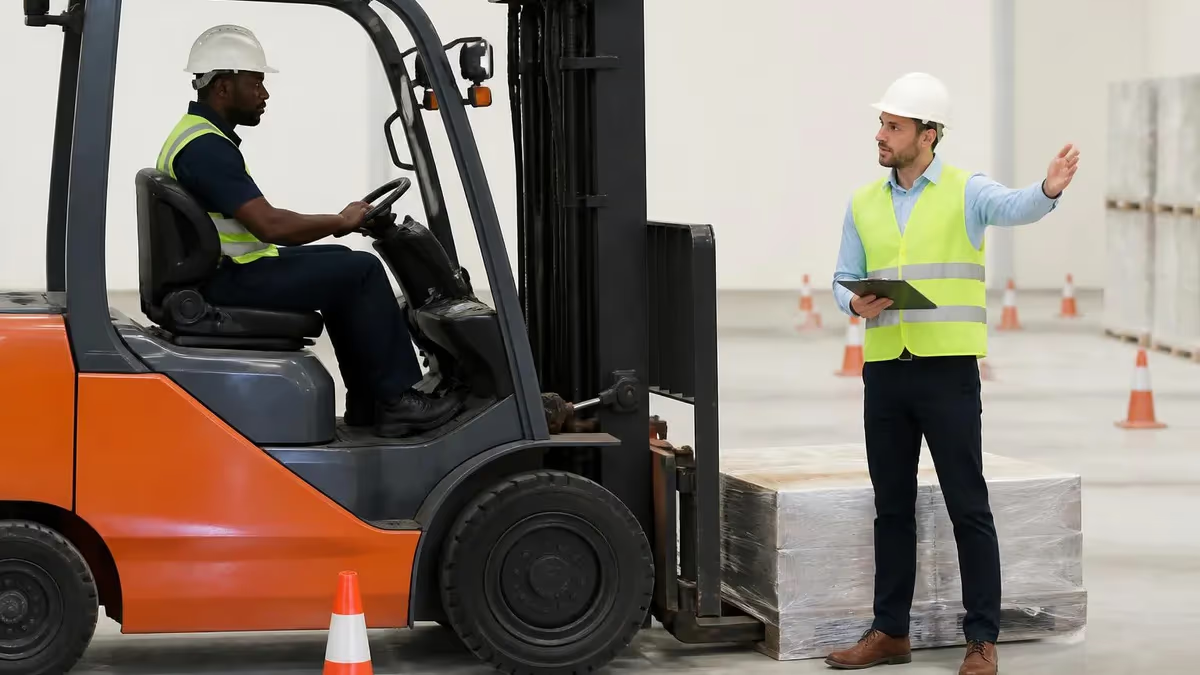
A forklift spreader bar is one of the most important load-handling attachments on a modern job site, and understanding how it interacts with your truck, your load center, and your rated capacity is the difference between a safe lift and a costly accident. Whether you operate a stand up forklift inside a warehouse or a rough-terrain unit on a construction pad, attachments expand what a forklift can do — but they also reduce capacity, shift the load center, and create new pinch points the operator must respect every time.
This guide walks through the full attachment family that turns ordinary forklifts into multi-purpose lift trucks: spreader bars, jibs and booms, fork extensions, drum handlers, paper roll clamps, carton clamps, rotators, slip-sheet push-pulls, side shifters, fork positioners, and man baskets. Each one changes the geometry of the load and demands a fresh look at the data plate, the manufacturer instructions, and the operator's pre-shift inspection routine before the first lift of the day.
OSHA 29 CFR 1910.178(a)(4) is explicit: modifications and additions affecting capacity and safe operation cannot be made without the manufacturer's prior written approval, and the data plate must be updated to reflect every attachment installed. That single sentence has driven thousands of citations because operators bolt on a paper roll clamp or a fork-mounted boom and never recheck what the truck is actually rated to lift with that hardware in place.
If you are sourcing equipment for a short project, comparing a forklift rental against buying outright will involve the same attachment math, because rental yards usually quote a base truck and add attachments as separate line items with their own capacity derates. The rental contract should always list each attachment, its serial number, and the combined capacity plate so you can train operators against the right numbers.
Forklift operators with a current certification of forklift training have already covered the basics of stability triangle, load center, and pre-operational inspection, but attachments multiply the variables. A 5,000-pound truck rated at a 24-inch load center may only lift 3,200 pounds once a rotator and clamp are installed, and the picture changes again when the attachment is at full extension or full rotation. Treat every attachment as a new truck.
The goal of this article is to give warehouse supervisors, fleet managers, and operators a working reference: what each attachment does, how it affects capacity, what training and inspection it requires, and what the most common citations and incidents look like. We will close with a checklist, a set of frequently asked questions, and links to practice tests that mirror the language used on OSHA-aligned certification exams.
By the end you should be able to look at a forklift data plate, read the attached capacity chart, perform a competent inspection of the spreader bar or clamp, and decide whether the task in front of you is within the truck's safe envelope — or whether you need a different unit, a different attachment, or a different lift plan altogether.
Forklift Attachments by the Numbers

Main Forklift Attachment Categories
Fork-mounted or carriage-mounted beams that convert a forklift into a crane-style lifter using slings, hooks, or chains for awkward loads, steel, machinery, and bundled materials.
Hydraulic jaw attachments that grip cylindrical or rectangular loads without pallets. Common in paper mills, appliance distribution, and recycling. Significantly reduce truck capacity.
Hydraulic devices that slide forks left/right or adjust spacing without leaving the seat. Standard on most modern trucks; reduce pallet damage and speed cycle times.
360-degree rotators dump containers; push-pulls handle slip-sheet loads instead of pallets, common in food and beverage distribution. Both require specialized operator training.
OSHA-compliant personnel platforms for improved work. Require secondary safety chain, fall protection, and dedicated operator at the controls. Not the same as a cherry picker forklift.
Every forklift sold in the United States carries a manufacturer's data plate that lists the truck's rated capacity at a specific load center, almost always 24 inches for sit-down counterbalance forklifts. The moment you bolt on a spreader bar, a paper roll clamp, or even a set of fork extensions, that number on the plate is no longer accurate. The new combined capacity has to be calculated by the manufacturer, stamped on a supplemental plate, and posted on the truck where the operator can read it from the seat.
The physics behind the derate is straightforward. Every attachment has its own weight and its own effective load center — the horizontal distance from the face of the carriage to the center of gravity of the load when it is being carried. A 200-pound side shifter that extends the load center by one inch will steal a few hundred pounds of capacity. A heavy rotator with a clamp head can push the effective load center out by six or eight inches and steal 1,500 to 2,000 pounds from a 5,000-pound truck.
Spreader bars are particularly tricky because the load hangs below the bar on slings, which can swing, twist, and dynamically load the forks if the operator accelerates or brakes too quickly. The published rating of the spreader bar assumes a static, centered load with the truck stationary or moving at a walking pace on a level surface. Anything else — a slope, a wet floor, a sudden stop — adds dynamic forces that the rated capacity does not cover.
For fleet managers comparing trucks across a yard, a quick walk past the data plates often reveals trouble: a clamp that has been moved from one truck to another with no recalculated plate, a fork extension that exceeds the 150% rule, or a homemade jib welded onto a carriage with no engineering paperwork. Each of these is a textbook OSHA citation and a real-world fatality risk. The same caution applies when you browse forklifts at auction or in classifieds, because attachments often arrive with no documentation at all.
The 50% rule of thumb that some trainers teach — "derate by half when you add a clamp" — is a survival heuristic, not a substitute for the manufacturer's capacity chart. Some attachments derate only 10%, others 50% or more, and the only authoritative answer is the chart provided by the truck or attachment maker. When in doubt, call the dealer, give them the truck serial number and the attachment serial number, and ask for the calculation in writing.
Operators should also remember that capacity charts are usually given at full lift height with the mast vertical. Tilting the mast forward, lifting above the maximum charted height, or extending a telescoping boom all reduce capacity further. A spreader bar rated for 4,000 pounds at the carriage may only be safe for 2,800 pounds when extended to its longest setting because the use on the truck multiplies the moment about the front axle.
Finally, every attachment changes how the truck feels. A loaded clamp sits higher and farther forward than a loaded pallet, raising the center of gravity and shrinking the stability triangle. Operators who switch between attachments during a shift need to mentally reset every time, slow down on turns, and re-learn the truck's behavior before they trust it with a full load.

Forklift certification Practice Test Questions
Prepare for the Forklift certification Certification exam with our free practice test modules. Each quiz covers key topics to help you pass on your first try.
Forklift certification Certification Forkl...
Forklift certification Exam Questions covering Certification Forklift certification Maintenance and Repairs. Master Forklift certification Test concepts for certification prep.
Forklift certification Certification Forkl...
Free Forklift certification Practice Test featuring Certification Forklift certification Maintenance and Repairs Questions and Answers. Improve your Forklift certification Exam score with mock test prep.
Forklift certification Certification Forkl...
Forklift certification Mock Exam on Certification Forklift certification Operator Training and Certification Requirements. Forklift certification Study Guide questions to pass on your first try.
Forklift certification Certification Forkl...
Forklift certification Test Prep for Certification Forklift certification Operator Training and Certification Requirements Questions and Answers. Practice Forklift certification Quiz questions and boost your score.
Forklift certification Load Handling and S...
Forklift certification Questions and Answers on Load Handling and Stability. Free Forklift certification practice for exam readiness.
Forklift certification OSHA Regulations an...
Forklift certification Mock Test covering OSHA Regulations and Compliance. Online Forklift certification Test practice with instant feedback.
Forklift certification Pre-Operation Inspe...
Free Forklift certification Quiz on Pre-Operation Inspections. Forklift certification Exam prep questions with detailed explanations.
Forklift certification Refueling and Recha...
Forklift certification Practice Questions for Refueling and Recharging Procedures. Build confidence for your Forklift certification certification exam.
Forklift certification Safe Driving and Ma...
Forklift certification Test Online for Safe Driving and Maneuvering. Free practice with instant results and feedback.
Forklift certification Workplace Hazard Id...
Forklift certification Study Material on Workplace Hazard Identification. Prepare effectively with real exam-style questions.
Forklift certification Forklift Instructions
Free Forklift certification Test covering Forklift Instructions. Practice and track your Forklift certification exam readiness.
Forklift certification Forklift MCQ
Forklift certification Exam Questions covering Forklift MCQ. Master Forklift certification Test concepts for certification prep.
Forklift certification Forklift Employer R...
Free Forklift certification Practice Test featuring Forklift Employer Responsibilities. Improve your Forklift certification Exam score with mock test prep.
Forklift certification Forklift Penalties ...
Forklift certification Mock Exam on Forklift Penalties for Non-Compliance. Forklift certification Study Guide questions to pass on your first try.
Inspection, Training & Compliance for Forklift Operator Attachment Work
Every shift starts with a written pre-operational inspection that covers the truck and every attachment installed. For a spreader bar, the operator visually inspects welds for cracks, checks shackles and pins for wear, verifies that safety latches on hooks close fully, and confirms that the rated capacity tag is legible and matches the load plan for the day's work.
Hydraulic attachments add a second layer: check hoses for abrasion or weeping, cylinders for drift, and quick-disconnects for full engagement. Operate the attachment through its full range with no load before lifting anything, and listen for cavitation or hammering. Any defect that affects safe operation removes the truck from service until repaired by a qualified technician, per OSHA 1910.178(q)(1).
Are Forklift Attachments Worth the Investment?
- +Convert a single truck into a multi-purpose materials handler, reducing fleet size
- +Eliminate the need for separate cranes, hoists, or specialty equipment for occasional lifts
- +Increase productivity for repetitive tasks like roll handling, drum dumping, or slip-sheet loading
- +Reduce product damage by gripping loads precisely instead of relying on pallet quality
- +Available for short-term needs through forklift rental near me searches and dealer fleets
- +Improve operator ergonomics with hydraulic side shift and fork positioners
- +Support OSHA-compliant improved work when used with approved man baskets and uses
- −Reduce rated truck capacity by 15-40%, sometimes more for heavy rotators
- −Require additional operator training and documented evaluations per attachment
- −Add hydraulic complexity and more failure points to inspect daily
- −Demand updated data plates and manufacturer written approval to remain OSHA-compliant
- −Carry purchase prices from $1,500 for basic side shifters to $15,000+ for rotators
- −Increase risk of citations and incidents if used without proper plate or training

Pre-Shift Attachment Inspection Checklist for Forklift Training
- ✓Confirm the data plate reflects the truck plus installed attachment with combined capacity
- ✓Visually inspect all welds, pins, shackles, and structural members for cracks or wear
- ✓Check hydraulic hoses, fittings, and cylinders for leaks, abrasion, or sponginess
- ✓Verify safety latches on hooks and locking pins on quick-attach systems fully engage
- ✓Cycle the attachment through full range of motion with no load before first lift
- ✓Inspect forks for heel wear over 10%, cracks, or bent blades that fail the straightness test
- ✓Confirm the operator is trained and evaluated on this specific truck-attachment combination
- ✓Review the load plan: weight, dimensions, load center, and lift path before approaching
- ✓Verify the work area is clear of pedestrians and that overhead clearances are adequate
- ✓Document the inspection on the daily checklist and report any defects immediately
The data plate is the law
If the data plate does not list the attachment currently installed, the truck is non-compliant the moment it leaves the parking spot. Stop work, contact the supervisor, and get the correct plate before lifting anything — no exceptions for "quick jobs" or short-term rentals.
Common attachment-related citations and incidents fall into a predictable pattern, and reviewing them is one of the fastest ways to sharpen your own safety culture. The single most cited issue is missing or incorrect data plates after an attachment swap. A truck arrives from a rental yard with a clamp installed, the receiving facility never updates the plate, and the operator works to the original 5,000-pound rating instead of the 3,400-pound derated number. Three months later an inspector walks the floor and writes the citation.
The second pattern is unauthorized modification. A welder in the shop fabricates a custom jib boom because the OEM version is on a six-week lead time, and it goes into service on Monday. Even if the welds are perfect and the steel is appropriately sized, OSHA 1910.178(a)(4) requires written manufacturer approval for any modification or addition that affects capacity or safe operation. Without that paperwork, every lift is a violation and every incident becomes both an OSHA case and a civil liability problem.
The third pattern is inadequate operator-specific training. A worker certified on a basic sit-down truck is told to grab the paper roll clamp truck because someone called in sick. They have never operated a clamp, do not understand that the clamp must be closed gently to avoid crushing the roll, and do not realize the truck's capacity is now derated 30%. The result is product damage at best, a tip-over at worst, and an OSHA citation for failure to train per 1910.178(l).
The fourth pattern involves spreader bars and slings. Operators pick up a load on a fork-mounted spreader bar, drive over a floor joint or pothole, and the load swings into a rack or a coworker. The fix is straightforward: use shorter slings, secure the load with taglines, and travel at walking speed with the load as low as possible. Spreader bars are not cranes, and the truck has no swing damping.
The fifth pattern is using man baskets that were not designed and approved for the truck. A homemade platform, even one with toe boards and a top rail, does not meet 1910.178(m)(12) if it has not been engineered for that specific forklift. The right answer is a manufacturer-approved platform with a secondary safety chain, locked to the carriage with bolts not just hooks, an operator at the controls at all times, and full personal fall protection on the worker in the basket.
The sixth pattern is fork extensions that exceed the 150% rule. The general guideline is that fork extensions should not be longer than 150% of the supporting fork length. A 42-inch fork supports up to a 63-inch extension; anything longer concentrates bending stress in the fork blade and risks catastrophic failure under load. Extensions must also be locked to the forks with the manufacturer's retainer, not held on by friction alone.
The seventh pattern is operator fatigue and complacency on attachments the operator uses every day. Familiarity breeds shortcuts, and shortcuts on a rotator or clamp produce expensive mistakes. The most experienced operators are the ones who still walk around the truck before every shift, still read the load plan, and still respect the derated capacity chart even when no supervisor is watching.
OSHA 29 CFR 1910.178(a)(4) prohibits any modification or addition that affects capacity or safe operation without prior written approval from the manufacturer. This includes welded brackets, drilled holes in forks, homemade booms, and field-built man baskets. Get the approval in writing before the truck returns to service.
Choosing the right attachment starts with a clear-eyed look at what the truck actually does on a typical day. If 80% of the workload is standard pallet handling and 20% is occasional roll or drum work, it is often cheaper to schedule a dedicated truck for the specialty work or to bring in a short-term rental than to permanently derate a primary truck with a heavy clamp. Run the math on cycle times, capacity loss, and operator training costs before you commit.
For high-volume specialty work — a paper mill that handles thousands of rolls a day, a food distributor running slip-sheet loads, an appliance plant moving cartons — a dedicated truck with the right attachment and trained operators is the only economical answer. In those cases, work directly with the truck OEM and the attachment manufacturer to spec the combination, get the engineered capacity chart, and build the operator training curriculum from day one.
For one-off projects, rentals fill the gap. A spreader bar rental for a single steel set, a man basket for a quarterly HVAC service, or a drum handler for a single shutdown event all make sense as line items on a rental contract. Just confirm before delivery that the rental yard will provide the truck-and-attachment data plate, the manufacturer's manual, and a copy of the capacity chart in the cab.
Operators looking for steady work in attachment-heavy environments should know that employers value the certification of forklift training that explicitly covers clamps, rotators, and booms. Specialized attachment experience often commands a 10–20% wage premium over basic counterbalance work, and it opens doors at paper mills, beverage plants, lumber yards, and steel service centers that depend on attachment-equipped trucks.
Budget conscious buyers should also evaluate the total cost of ownership rather than the sticker price. A $4,500 side shifter that saves three seconds per pallet pays for itself inside a year in a busy distribution center. A $12,000 rotator that gets used twice a week may never recover its capital cost when you account for training, maintenance, and the productivity loss from the derated truck. Run the numbers, ask the dealer for case studies, and talk to operators who use the attachment daily.
Maintenance budgets should grow with attachment count. Hydraulic attachments add cylinders, hoses, valves, and seals to the inspection list, and a neglected clamp will leak fluid, lose grip pressure, and eventually drop a load. Plan on quarterly preventive maintenance for hydraulic attachments and annual structural inspection for spreader bars, jibs, and man baskets, with documentation kept for the life of the asset.
The bottom line for fleet managers is simple: attachments are powerful tools that solve real materials-handling problems, but they require discipline. Document everything, train every operator on every combination, inspect daily, and replace the data plate every time the configuration changes. Do those things and attachments earn their keep. Skip them and the next OSHA visit gets expensive in a hurry.
Practical preparation for working with forklift attachments comes down to repetition, supervision, and honest self-assessment. Start every certification or refresher cycle by reading the OSHA Powered Industrial Truck standard 1910.178 from start to finish — it is a short document, and the language about attachments, modifications, and operator training is unambiguous. Then read the manufacturer manual for your specific truck and each attachment in service.
Hands-on practice should always begin with an empty attachment and a clear yard. New operators run the clamp, rotator, or spreader bar through every motion at every height before they ever pick up a load, and they do it under the eye of a qualified trainer who can stop them if a mistake is brewing. Only once the muscle memory is in place should the operator try a light, well-marked test load.
Pair classroom material with practice quizzes that mirror real exam language. Practice tests build familiarity with phrasing about capacity derates, load center math, inspection requirements, and the regulatory citations auditors expect operators to recognize. Operators who walk into an evaluation cold often miss the easy questions on data plates and modification rules, not the hard ones on hydraulics.
Use a written load plan for any non-routine lift involving an attachment. The plan does not have to be elaborate — load weight, dimensions, load center, attachment in use, rated capacity at that configuration, lift path, and ground conditions are enough. Writing it down forces the operator and supervisor to confirm the math before the wheels move, and it produces a record that protects everyone if anything goes wrong.
Stay current on OEM bulletins and recall notices. Attachment manufacturers issue service bulletins when field failures reveal a design weakness, and fleet managers should subscribe to every relevant alert list. A spreader bar with a known weld defect or a clamp with a documented hydraulic recall must come out of service the day the bulletin arrives, not the next quarterly inspection.
Anyone shopping equipment should compare a fresh forklift rental near me search against used and new purchase options, because the right answer depends entirely on duty cycle. Short campaigns favor rentals with attachments included; daily production work favors purchase with a service contract that covers both the truck and the attachment hydraulics. Talk to two or three dealers and one independent service shop before signing.
Finally, build a culture where operators feel safe stopping work to ask a question about an attachment. The cheapest minute on a job site is the minute spent confirming the capacity chart; the most expensive minute is the one immediately after a tip-over. Supervisors who reward stop-work calls — even when nothing was actually wrong — create teams that catch the real problems before they become incidents.
Forklift Questions and Answers
About the Author

Certified Crane Operator & Skilled Trades Exam Specialist
Ferris State UniversityRobert Martinez is a Journeyman Ironworker, NCCCO-certified crane operator, and forklift trainer with a Bachelor of Science in Construction Technology from Ferris State University. He has 21 years of ironworking, rigging, and heavy equipment operation experience across high-rise and industrial construction sites. Robert prepares candidates for crane operator, rigger, forklift, and skilled trades certification examinations.