
Forklift Safety: The Complete Guide to OSHA-Compliant Operation, Training, and Workplace Protection
Master forklift safety with our complete guide covering OSHA rules, operator training, certification, inspections, and accident prevention for warehouses. ⏳
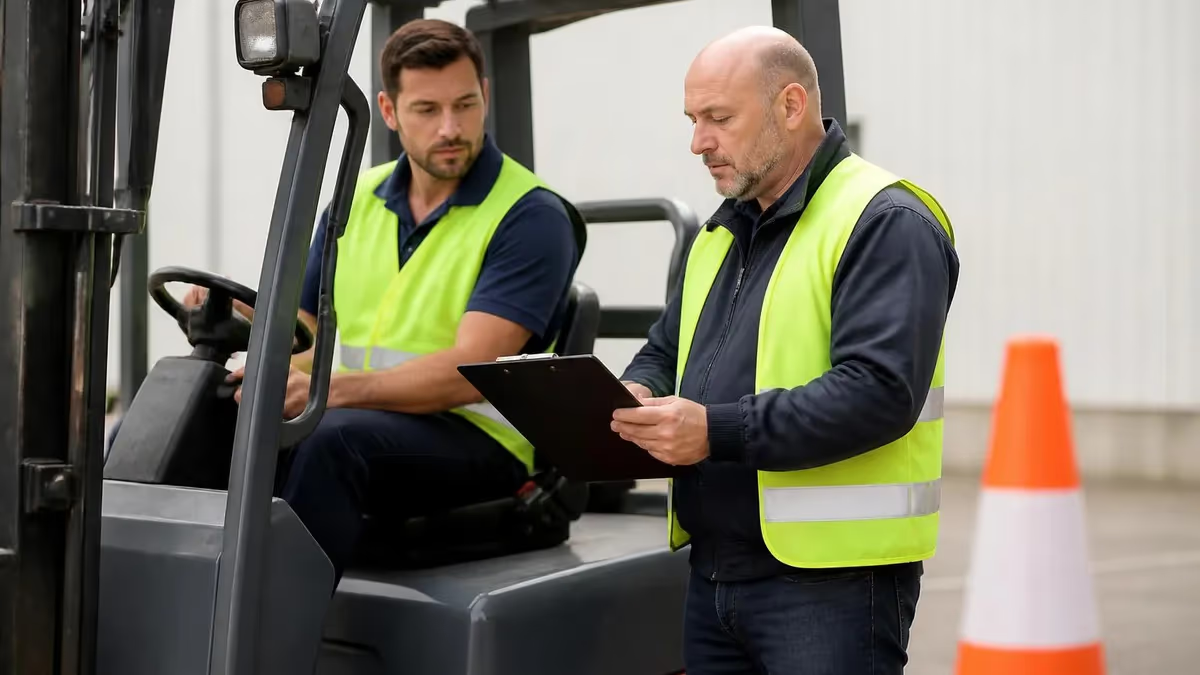
Forklift safety is the single most important factor that separates a productive warehouse from a tragic headline. Every year, the Occupational Safety and Health Administration (OSHA) records roughly 7,500 serious injuries and around 85 fatalities directly tied to powered industrial truck operation in the United States. Whether you manage a distribution center, run a construction yard, or operate a single counterbalance unit at a lumber supply, understanding the rules that govern safe lift truck operation protects lives, equipment, and the bottom line of every business that depends on material handling.
The stakes have risen sharply over the past decade. Warehouses have grown taller, aisles narrower, and delivery deadlines tighter, which means modern forklifts move faster and carry heavier loads than the equipment that existed when the original 1971 standard was written. Operators today routinely handle pallets weighing 4,000 to 6,000 pounds at heights exceeding 20 feet, while pedestrians, autonomous mobile robots, and conveyor systems share the same floor space. One moment of inattention can crush a foot, tip a load, or send a 9,000-pound machine into a racking system.
OSHA standard 29 CFR 1910.178 sets the legal floor for forklift operation in general industry, and 29 CFR 1926.602 covers construction sites. Both regulations require formal training, hands-on evaluation, and recertification at least every three years. Beyond compliance, however, smart employers build a culture where every operator inspects the truck before each shift, every pedestrian wears high-visibility apparel, and every supervisor enables workers to stop unsafe operations without fear of reprisal. That cultural layer is what turns a paper policy into actual injury reduction.
This guide walks through every major component of a modern forklift safety program. We cover daily inspection requirements, load handling physics, pedestrian segregation, battery and fuel hazards, recertification timelines, and the specific rules that apply to stand-up reach trucks, order pickers, rough-terrain lifts, and electric counterbalance units. You will also find practical checklists, common citation examples, and the exact OSHA standards a safety auditor will reference during a site visit.
If you are a new operator preparing for certification, a supervisor rebuilding a training program after a near-miss, or a small business owner trying to understand why insurance premiums spiked after one tip-over incident, the information here is designed to be actionable on Monday morning. We have organized the material so that you can read it cover to cover or jump directly to the section that matches your immediate question — whether that is how to choose between an electric forklift and an internal combustion unit, or how to document the operator evaluation that OSHA inspectors will demand to see.
Above all, remember that forklift safety is not a one-time training event. It is a continuous discipline reinforced by daily habits, monthly toolbox talks, quarterly audits, and triennial recertification. The operators who go home to their families every night are the ones who treat the pre-shift inspection as seriously as a pilot treats a flight checklist. By the time you finish this guide, you will have the framework to build that same discipline into your own facility.
Forklift Safety by the Numbers

Core OSHA Forklift Safety Standards Every Operator Must Know
The primary general-industry standard covering powered industrial trucks. Defines design, maintenance, operator training, refueling, battery charging, and load handling. Cited in roughly 2,500 OSHA inspections annually, making it a top-ten violated standard.
Construction-site equivalent covering material handling equipment including rough-terrain forklifts. Requires seat belts, rollover protection, and back-up alarms. Applies whenever a forklift operates on an active construction project regardless of duration.
Voluntary consensus standard from the Industrial Truck Standards Development Foundation. Defines design and performance criteria manufacturers follow. OSHA frequently references B56.1 when citing employers under the General Duty Clause.
National Fire Protection Association standard governing fuel and battery storage, refueling locations, and classification of forklifts for use in hazardous atmospheres. Critical for facilities handling flammable chemicals or dusts.
Section 5(a)(1) of the OSH Act requires employers to provide a workplace free from recognized hazards. Used to cite forklift practices that fall outside specific standards but still endanger workers.
The pre-shift inspection is the most powerful single tool in a forklift safety program, and it is also the most commonly skipped. OSHA standard 1910.178(q)(7) requires that powered industrial trucks be examined at least daily before being placed in service, and trucks used on a round-the-clock basis must be examined after each shift. The inspection is not optional, it is not a suggestion, and a missed inspection that contributes to an incident will absolutely surface during an OSHA investigation through maintenance logs and witness statements.
A proper inspection covers two phases. The first is a key-off walk-around that examines the physical condition of the truck. Operators look for hydraulic leaks under the mast and around the lift cylinders, check tire condition for cuts and chunking, verify that the data plate is legible, inspect the forks for cracks at the heel and bends along the blade, confirm that the load backrest extension is secure, and examine the overhead guard for damage. The seat belt is checked for proper latching, and the horn, lights, and back-up alarm are verified during the key-on portion.
The second phase is a key-on operational test. The operator starts the truck, lets it warm to operating temperature if it is an internal combustion model, then tests the service brake, parking brake, steering, lift and tilt functions, and any attachments such as side shifters or fork positioners. Unusual noises, hesitation in the hydraulics, or warning lights on the dashboard are immediate red flags that must be reported before the truck is placed in service. The proper certification of forklift programs teach operators exactly how to perform this check in a consistent sequence so nothing gets missed.
Documentation matters as much as the inspection itself. Most facilities use a paper or tablet-based checklist that the operator initials and dates, with space to note defects. When a defect is found, the truck must be tagged out of service immediately and reported to the supervisor. Returning a defective truck to operation without repair is one of the fastest paths to an OSHA citation, especially if the defect later contributes to an injury. The inspection log becomes evidence in any subsequent investigation.
Electric forklifts and internal combustion units share most inspection points but diverge on power systems. Electric trucks require battery checks including electrolyte level for flooded lead-acid units, cable condition, connector cleanliness, and state of charge. Propane trucks require a check of the LPG tank mounting, hose condition, and the leak-down test on the fuel system. Diesel and gasoline trucks add engine oil, coolant, and fuel level checks. Lithium-ion units have largely eliminated the watering and equalization steps, but operators must still verify connector integrity and battery management system warnings.
Supervisors play a critical role in making inspections meaningful. Walking the floor at shift start, spot-checking that operators are actually performing the inspection rather than pencil-whipping the checklist, and reviewing defect logs weekly all reinforce that the company takes the requirement seriously. When workers see leadership taking inspections seriously, compliance rises and incident rates fall. The best facilities pair the inspection program with a no-blame defect reporting culture so operators feel safe flagging problems.
Finally, never overlook the inspection of attachments. Slip sheet pushers, rotators, paper roll clamps, and carton clamps all alter the truck's center of gravity and load capacity. Each attachment must have its own data plate confirming the derated capacity, and that plate must match the truck it is mounted on. Operators must understand how to read the combined capacity chart and refuse to lift loads that exceed the derated rating, even if the original truck plate would have permitted the lift.

Forklift certification Practice Test Questions
Prepare for the Forklift certification Certification exam with our free practice test modules. Each quiz covers key topics to help you pass on your first try.
Forklift certification Certification Forkl...
Forklift certification Exam Questions covering Certification Forklift certification Maintenance and Repairs. Master Forklift certification Test concepts for certification prep.
Forklift certification Certification Forkl...
Free Forklift certification Practice Test featuring Certification Forklift certification Maintenance and Repairs Questions and Answers. Improve your Forklift certification Exam score with mock test prep.
Forklift certification Certification Forkl...
Forklift certification Mock Exam on Certification Forklift certification Operator Training and Certification Requirements. Forklift certification Study Guide questions to pass on your first try.
Forklift certification Certification Forkl...
Forklift certification Test Prep for Certification Forklift certification Operator Training and Certification Requirements Questions and Answers. Practice Forklift certification Quiz questions and boost your score.
Forklift certification Load Handling and S...
Forklift certification Questions and Answers on Load Handling and Stability. Free Forklift certification practice for exam readiness.
Forklift certification OSHA Regulations an...
Forklift certification Mock Test covering OSHA Regulations and Compliance. Online Forklift certification Test practice with instant feedback.
Forklift certification Pre-Operation Inspe...
Free Forklift certification Quiz on Pre-Operation Inspections. Forklift certification Exam prep questions with detailed explanations.
Forklift certification Refueling and Recha...
Forklift certification Practice Questions for Refueling and Recharging Procedures. Build confidence for your Forklift certification certification exam.
Forklift certification Safe Driving and Ma...
Forklift certification Test Online for Safe Driving and Maneuvering. Free practice with instant results and feedback.
Forklift certification Workplace Hazard Id...
Forklift certification Study Material on Workplace Hazard Identification. Prepare effectively with real exam-style questions.
Forklift certification Forklift Instructions
Free Forklift certification Test covering Forklift Instructions. Practice and track your Forklift certification exam readiness.
Forklift certification Forklift MCQ
Forklift certification Exam Questions covering Forklift MCQ. Master Forklift certification Test concepts for certification prep.
Forklift certification Forklift Employer R...
Free Forklift certification Practice Test featuring Forklift Employer Responsibilities. Improve your Forklift certification Exam score with mock test prep.
Forklift certification Forklift Penalties ...
Forklift certification Mock Exam on Forklift Penalties for Non-Compliance. Forklift certification Study Guide questions to pass on your first try.
Hazard Profiles by Forklift Operator Class
Class I sit-down electric counterbalance trucks are the workhorses of indoor warehousing. Powered by lead-acid or lithium-ion batteries, they offer zero emissions and quiet operation, making them ideal for food, pharmaceutical, and retail distribution. Capacities typically range from 3,000 to 12,000 pounds. The primary hazards involve battery handling during change-outs, including acid burns, hydrogen gas accumulation in charging areas, and crushed fingers from improperly secured cell connectors.
Operators must understand the truck's longer wheelbase compared to stand-up models, which affects turning radius in narrow aisles. Regenerative braking can also feel different from a friction brake, particularly when descending grades with a load. Ventilation requirements in charging rooms follow NFPA 505 and require a minimum air exchange rate to keep hydrogen concentrations below 1 percent by volume.
Electric Forklifts vs. Internal Combustion for Safer Operations
- +Zero tailpipe emissions allow safe indoor use without ventilation concerns
- +Lower noise levels reduce operator fatigue and improve communication on the floor
- +Fewer moving parts mean lower maintenance frequency and reduced mechanical failure risk
- +Smoother acceleration and braking reduce the chance of load shifts during travel
- +No fuel handling eliminates propane and diesel fire and burn hazards
- +Lithium-ion units eliminate battery acid exposure and hydrogen gas accumulation
- −Lead-acid battery change-outs require lifting equipment and trained personnel
- −Cold storage environments can reduce battery capacity by 30 percent or more
- −Higher upfront purchase cost can strain capital budgets at smaller operations
- −Charging infrastructure requires dedicated electrical capacity and ventilation
- −Limited runtime versus a quick propane tank swap on multi-shift operations
- −Hydrogen gas from flooded batteries requires monitoring in enclosed charge rooms
Pros and Cons at a Glance
| Pros | Cons |
|---|---|
| Zero tailpipe emissions allow safe indoor use without ventilation concerns | Lead-acid battery change-outs require lifting equipment and trained personnel |
| Lower noise levels reduce operator fatigue and improve communication on the floor | Higher upfront purchase cost can strain capital budgets at smaller operations |
| Fewer moving parts mean lower maintenance frequency and reduced mechanical failure risk | Charging infrastructure requires dedicated electrical capacity and ventilation |
| Smoother acceleration and braking reduce the chance of load shifts during travel | Limited runtime versus a quick propane tank swap on multi-shift operations |
| No fuel handling eliminates propane and diesel fire and burn hazards | Hydrogen gas from flooded batteries requires monitoring in enclosed charge rooms |

Daily Forklift Safety Checklist for Every Shift
- ✓Complete the written pre-shift inspection and document any defects before key-on
- ✓Verify forks, mast chains, and load backrest extension show no cracks or bends
- ✓Test service brake, parking brake, steering, horn, lights, and back-up alarm
- ✓Confirm data plate is legible and matches any attachment capacity rating
- ✓Wear seat belt at all times while the truck is in motion or being improved
- ✓Travel with forks four to six inches above the floor and tilted slightly back
- ✓Sound horn at all intersections, blind corners, and pedestrian crossings
- ✓Never allow riders on the forks, counterweight, or any non-designated position
- ✓Maintain three truck lengths of following distance behind another forklift
- ✓Lower forks fully, set parking brake, and remove key when leaving the truck unattended
Center of gravity must stay inside the triangle at all times
A counterbalance forklift balances on a three-point stability triangle formed by the two front wheels and the center of the rear axle. The truck stays upright only as long as the combined center of gravity of the truck and load remains inside that triangle. Sharp turns at speed, sudden braking with improved loads, and operating on grades can shift the center of gravity outside the triangle in a fraction of a second, causing the dreaded sideways or longitudinal tip-over that kills dozens of operators each year.
OSHA training requirements for forklift operators are spelled out in 1910.178(l), and they are far more rigorous than many employers realize. The standard prohibits anyone under 18 years of age from operating a forklift in non-agricultural settings, and it requires that every operator receive formal classroom instruction, practical hands-on training, and a workplace-specific evaluation before being permitted to operate a powered industrial truck unsupervised. This three-part structure is non-negotiable, and skipping any element exposes the employer to citations and the operator to unnecessary risk.
The classroom portion covers operating instructions, warnings, and precautions specific to the truck classes the operator will use. Topics include differences between automobiles and forklifts, controls and instrumentation, engine or motor operation, steering and maneuvering, visibility limitations, fork and attachment adaptation, capacity and stability, refueling and recharging procedures, and any operating limitations identified by the manufacturer. Workplace-related topics include surface conditions, composition of loads, load manipulation, pedestrian traffic, narrow aisle operations, and hazardous classified locations where the truck will operate.
Hands-on training puts the operator behind the controls under the direct supervision of a qualified trainer. The trainer must have the knowledge, training, and experience to train operators and evaluate their competence, but the trainer does not have to hold a specific certification themselves. Training must occur on the same type of truck the operator will use in their actual job, because a sit-down counterbalance certification does not authorize operation of a stand-up reach truck or a rough-terrain unit. Each truck class requires its own evaluation.
The evaluation is the third leg and the one most commonly overlooked. After training, the operator must demonstrate the ability to perform a pre-shift inspection, maneuver the truck through a representative course, handle loads of various sizes, and respond to abnormal conditions. The evaluator documents the evaluation in writing, including the operator's name, date of training, date of evaluation, and the name of the person performing the evaluation. This document is what OSHA inspectors ask to see, and missing it generates immediate citations.
Refresher training is required under several circumstances spelled out in 1910.178(l)(4). These include observation of unsafe operation, an accident or near-miss, evaluation that reveals the operator is not operating safely, assignment to a different type of truck, or a change in workplace conditions that could affect safe operation. In addition, every operator must be re-evaluated at least once every three years. The recertification does not require repeating the full classroom curriculum unless the operator has shown deficiencies, but it does require a documented hands-on evaluation.
Online training programs have proliferated, and they can satisfy the classroom portion of the requirement, but they cannot replace the hands-on evaluation. An employer who accepts a printed certificate from an online vendor without conducting and documenting their own workplace evaluation has not met the OSHA standard. The same principle applies to operators hired from a temporary staffing agency, whose previous training and evaluation must be verified and supplemented with workplace-specific instruction at the new site.
Maintaining training records is straightforward but essential. Most facilities keep a roster of certified operators with the truck classes each is authorized to operate, expiration dates for the three-year cycle, and copies of evaluation forms. When an OSHA compliance officer arrives, they will request this roster within the first hour of the inspection. A facility that can produce complete, current records demonstrates organizational competence and often shortens the duration of the inspection.
If a sit-down counterbalance forklift begins to tip over, never jump out. Statistics show that operators who jump are crushed by the overhead guard at three times the rate of those who stay in the seat. Brace your feet, grip the steering wheel firmly, lean away from the direction of the fall, and ride the truck down. This is why seat belts are mandatory and why operator-presence systems prevent operation without them.
Pedestrian safety is the second great pillar of forklift incident prevention. Roughly 20 percent of forklift fatalities involve a pedestrian struck or pinned by a moving truck, often in a warehouse where the worker was performing an unrelated task and stepped into a traffic lane without looking. Engineering controls, administrative controls, and personal protective equipment all play a role in keeping foot traffic and lift traffic separated, and the best facilities layer all three rather than relying on any single solution.
Engineering controls are the most effective because they remove the hazard physically. Painted floor lanes, bollards, swing gates, and full-height guardrails between pedestrian paths and forklift travel routes give workers no opportunity to wander into traffic by accident. Mirrors at blind corners, blue spotlights projected ahead of the truck, and motion-activated warning lights at intersections all add layers of awareness. Some advanced facilities now deploy proximity detection systems that automatically slow or stop the truck when a pedestrian wearing a transponder enters a defined zone.
Administrative controls cover procedures and scheduling. Restricting forklift operation to specific hours when pedestrian traffic is minimal, requiring spotters during dock operations, and prohibiting cell phone use while operating are all examples. Training pedestrians is just as important as training operators. Workers who walk through forklift zones must understand to make eye contact with the operator before crossing, never to assume the operator has seen them, and to use designated walkways even when a shortcut looks faster.
Personal protective equipment includes high-visibility vests or shirts meeting ANSI/ISEA 107 Class 2 or Class 3 standards, steel-toe footwear, and hearing protection in areas with multiple trucks operating. Hard hats are required wherever overhead loads are present. While PPE is the last line of defense in the hierarchy of controls, it remains critical because no engineering solution is perfect and human error is inevitable. The combination of visibility apparel and operator awareness has measurably reduced struck-by injuries at facilities that enforce it consistently.
Dock operations deserve special attention because they combine forklift traffic, pedestrian traffic, and the additional hazards of trailer separation and dock plate failures. Wheel chocks or trailer restraint systems must be in place before any forklift enters a trailer, and dock locks should be interlocked with overhead doors so the door cannot open until the restraint is engaged. Trailer creep, the gradual movement of an unrestrained trailer away from the dock as forklifts enter and exit, has caused numerous fatal falls when operators drove into the gap between trailer and dock.
When sourcing trucks for short-term projects, many facilities turn to forklift rental near me providers, but rental equipment carries its own safety considerations. Rental trucks must have current annual inspections, legible data plates, and functional safety equipment, and the renting employer is still responsible for training operators on the specific model. Never assume a rental truck has been properly maintained simply because it arrived clean. Perform the same pre-shift inspection on day one as you would on any owned unit, and document any defects to the rental provider in writing before placing the truck in service.
Incident response planning closes the loop. Every facility should have a written procedure for what happens when a forklift incident occurs, including immediate medical response, securing the scene, preserving the truck for investigation, and notifying OSHA within the required time frames. Fatalities and hospitalizations of three or more workers must be reported within eight hours. Single-worker hospitalizations, amputations, and loss of an eye must be reported within 24 hours. Failure to report on time generates its own citation independent of the underlying incident.
Building a lasting forklift safety culture requires more than compliance with the minimum standards. The facilities with the lowest incident rates treat safety as a daily practice woven into every task, every shift huddle, and every performance review. They publish leading indicators such as near-miss reports, inspection completion rates, and training currency rather than relying solely on lagging indicators like recordable injury rates. Leading indicators reveal problems before they cause harm, and they give supervisors actionable data to address weaknesses in the program.
Toolbox talks held weekly or at minimum monthly keep safety topics fresh in operators' minds. Effective talks last 10 to 15 minutes, focus on a single specific hazard, and invite operator input on how to address it. Topics rotate through pre-shift inspections, load handling, pedestrian awareness, battery handling, attachment use, and seasonal hazards like winter floor conditions or summer heat illness. Documenting attendance and topics provides a record that the employer is reinforcing training between formal recertification cycles.
Near-miss reporting is the single most undervalued tool in industrial safety. For every recorded injury, research suggests there are between 30 and 300 near-misses that could have produced the same outcome. Capturing those near-misses through an anonymous reporting system and acting on the trends prevents the next actual incident. Operators must believe that reporting a near-miss will not be used against them, which requires consistent leadership messaging and visible follow-through on reported concerns.
Some employers source short-term equipment through specialized forklift rentals when seasonal volume spikes or when a planned outage takes owned equipment out of service. Rental partnerships work best when the safety expectations are spelled out in writing before delivery, including who is responsible for maintenance during the rental period, what inspection documentation will be provided, and how defects will be addressed. A clear contract prevents finger-pointing if an incident occurs and keeps the rental equipment at the same safety standard as owned units.
Investing in technology pays dividends. Telematics systems track operator behavior including speed, impacts, seat-belt use, and pre-shift inspection completion. The data identifies operators who need coaching and highlights locations where impacts repeatedly occur, often revealing layout problems that engineering changes can solve. Cameras mounted on the truck or in the facility capture incidents for investigation and training. Proximity detection and pedestrian alert systems continue to drop in price as adoption grows, making them feasible even for mid-sized operations.
Finally, recognize that forklift safety is a leadership responsibility. Operators take cues from supervisors, supervisors take cues from managers, and managers take cues from executives. When the plant manager wears a seat belt every time they ride along, when the operations director walks the floor looking for safe behaviors to recognize rather than only unsafe ones to correct, and when the CEO includes safety metrics in quarterly business reviews, the culture follows. Safety programs that thrive are the ones where leadership demonstrates that no production target is worth a worker's life or limb.
The investment in forklift safety pays back in measurable ways. Reduced workers compensation premiums, lower equipment damage costs, fewer production interruptions from incident investigations, and improved employee retention all flow from a strong safety program. The Bureau of Labor Statistics estimates that every dollar invested in workplace safety returns between four and six dollars in reduced direct and indirect costs. Those returns compound over years, making the business case as compelling as the moral case.
Forklift Questions and Answers
Forklift Jobs Near Me: Complete Guide to Finding Best Opportunities
Forklift Operation & Equipment Knowledge Practice Test Video Answer
Forklift Inspection & Maintenance Practice Test Video Answer
Forklift Operator Jobs Near Me: Pay, Top Employers, Specialty Roles
30-Day Forklift certification Certification Study Plan — Pass on Your First Try
About the Author

Certified Crane Operator & Skilled Trades Exam Specialist
Ferris State UniversityRobert Martinez is a Journeyman Ironworker, NCCCO-certified crane operator, and forklift trainer with a Bachelor of Science in Construction Technology from Ferris State University. He has 21 years of ironworking, rigging, and heavy equipment operation experience across high-rise and industrial construction sites. Robert prepares candidates for crane operator, rigger, forklift, and skilled trades certification examinations.