
Death by Forklift: Complete Guide to Fatal Forklift Accidents, OSHA Statistics, and Prevention Strategies for 2026 October
Death by forklift kills 85+ workers yearly. Complete guide to forklift accidents, 🏆 OSHA statistics, causes, and prevention strategies for 2026 October.
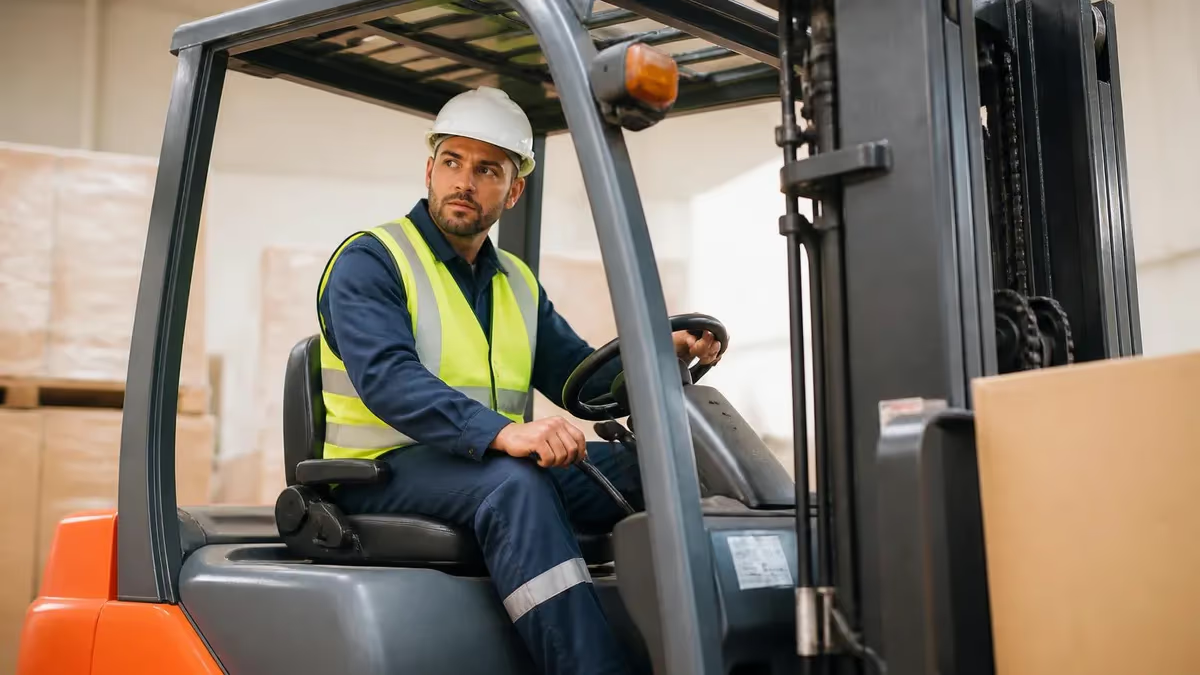
Death by forklift remains one of the most preventable yet persistent workplace tragedies in American industry, claiming approximately 85 to 100 lives every single year according to Bureau of Labor Statistics data. These powerful machines, weighing between 9,000 and 30,000 pounds, transform routine warehouse tasks into life-or-death situations when operators lack proper training, equipment fails, or safety protocols break down. Understanding how these accidents happen is the first critical step toward preventing them, whether you operate a single unit or manage a fleet of dozens.
The reality is sobering. OSHA reports that roughly 35,000 serious forklift-related injuries occur annually in the United States, with another 62,000 non-serious injuries documented across warehouses, manufacturing plants, construction sites, and retail distribution centers. Tip-overs alone account for 24% of all fatal forklift accidents, while pedestrians being struck represents another 20% of deaths. Falls from forklifts, crushing incidents, and falling loads round out the leading causes of operator and bystander fatalities nationwide.
Every forklift accident shares common warning signs that experienced safety managers learn to recognize: rushed operators, blocked sightlines, untrained pedestrians wandering through active loading zones, deteriorating equipment, and pressure from management to skip pre-operation inspections. When you combine these factors with the inherent physics of an unstable, top-heavy machine carrying loads above operator eye level, the math becomes terrifying. A forklift can crush a human chest in under a second.
This comprehensive guide examines every dimension of forklift accident prevention, from federal training requirements to engineering controls, from operator behavior to facility design. Whether you are searching for forklifts for sale, managing an existing fleet, or working as a frontline operator, the information here could literally save your life or the life of a coworker. We will explore real OSHA case studies, modern safety technology, certification requirements, and the cultural shifts that separate safe workplaces from dangerous ones.
The good news embedded in these statistics is that nearly every forklift fatality is preventable. OSHA estimates that 70% of forklift accidents could be eliminated through proper training and supervision alone. Modern technology adds another layer of protection through proximity sensors, automatic speed governors, blue spotlight warning systems, and seatbelt interlocks that prevent operation until restraints are engaged. Combined with engineering controls and administrative policies, these interventions have helped progressive companies achieve zero fatality rates for years at a time.
This article serves as both a sobering examination of what happens when forklift safety fails and a practical roadmap for ensuring it never does. We will cover the legal requirements every employer must meet, the operator behaviors that separate safe drivers from statistics, the warning signs of imminent danger, and the cultural commitments that build genuinely safe workplaces. By the time you finish reading, you will understand exactly what causes death by forklift and exactly how to prevent it from happening at your facility.
Forklift safety is not a checkbox compliance exercise. It is a daily commitment requiring vigilance from operators, supervisors, pedestrians, and executives alike. The companies that take this commitment seriously protect their workers, reduce insurance premiums, avoid regulatory fines, and build reputations that attract top talent. The companies that treat it casually inevitably appear in OSHA fatality reports, news headlines, and civil lawsuits. The choice between these two outcomes begins with understanding the material we are about to cover.
Forklift Accidents by the Numbers

Five Leading Causes of Death by Forklift
Account for 24% of forklift fatalities. Occur when loads exceed capacity, operators turn too sharply, or surfaces tilt unexpectedly. Crushing injuries are typically fatal within seconds of rollover.
Represent 20% of deaths. Workers walking through aisles, stepping from behind racks, or sharing operator blind spots get struck by moving forklifts, forks, or swinging loads at full speed.
Cause 12% of fatalities when operators or passengers fall from raised forks or improperly used personnel platforms. Drops of even 8 to 10 feet routinely produce fatal head and spinal injuries.
Kill operators and bystanders when improperly stacked pallets, unsecured materials, or overloaded forks release crushing weights from elevation. Single pallets can weigh 2,000+ pounds.
Operators get pinned between forklifts and walls, racks, trailers, or other equipment. These incidents often involve operators dismounting while equipment is still in gear or moving.
Understanding why forklift accidents happen requires examining the complex interplay between human factors, equipment design, and workplace environment. Tip-over incidents typically begin with operators carrying loads that exceed the rated capacity printed on the forklift's data plate, or operating with forks raised during travel rather than the proper 4 to 6 inches above the ground. When a top-heavy forklift makes even a moderate turn at speed, centrifugal force shifts the center of gravity outside the stability triangle, and physics takes over from human control.
The stability triangle concept proves critical to understanding forklift safety. Every counterbalance forklift has three points of stability: the two front wheels and the center point of the rear axle. As long as the combined center of gravity of the truck and load remains within this triangle, the unit stays upright.
When loads tilt back, sit too far forward on the forks, or the forklift accelerates through a turn, the center of gravity exits this triangle and the machine tips. Operators have less than two seconds to react, and trying to jump clear typically results in being crushed by the falling overhead guard.
Pedestrian fatalities reveal another category of preventable tragedy. OSHA case files document countless incidents where pedestrians stepped from behind a row of racking directly into the path of a moving forklift, or where operators backed up without checking blind spots, or where untrained workers attempted to walk under raised loads. The fundamental rule that pedestrians and forklifts should be physically separated whenever possible through marked walkways, barriers, and traffic patterns gets violated in facility after facility because separation costs money and slows production.
Operator error contributes to roughly 80% of forklift accidents according to industrial safety research. This includes excessive speed, especially around corners and through doorways, failure to sound horns at intersections, traveling with improved loads that block forward visibility, carrying passengers on forks or hood, using forklifts to push other vehicles, and ignoring pre-operation inspection requirements. Each of these behaviors represents a deliberate choice to bypass safety protocols, often under pressure from supervisors demanding faster throughput.
Equipment failures cause approximately 10% of fatalities but receive disproportionate attention because they appear in news headlines as mechanical defects rather than human errors. Failed brakes, broken steering components, malfunctioning hydraulic systems, and worn tires all contribute to incidents where operators lose control. Regular maintenance programs and qualified forklift repair near me services prevent the vast majority of these failures, but companies that defer maintenance to save money inevitably pay far higher costs in injuries, lawsuits, and OSHA citations.
Environmental factors round out the accident causation picture. Wet floors create traction problems that send forklifts skidding into racks or pedestrians. Loading dock edges have killed numerous operators who backed off trailers that pulled away prematurely or who drove onto unsupported dock plates. Poor lighting in warehouse corners hides pedestrians and obstacles. Sloped surfaces, even gentle inclines, can destabilize loaded forklifts during turns. Each environmental factor combines with operator behavior and equipment condition to create accident probability.
The cultural environment surrounding forklift operations may matter most of all. Facilities where supervisors model safe behavior, where operators feel enabled to refuse unsafe orders, where near-miss reporting is encouraged rather than punished, and where management invests visibly in safety equipment and training consistently achieve dramatically lower accident rates. Conversely, workplaces where production trumps safety, where shortcuts are tolerated, and where reporting hazards triggers retaliation produce accident statistics that make insurance adjusters wince. Culture is not a soft factor in forklift safety. It is the foundational determinant of whether your facility appears in OSHA fatality reports.
Forklift certification Practice Test Questions
Prepare for the Forklift certification Certification exam with our free practice test modules. Each quiz covers key topics to help you pass on your first try.
Forklift certification Certification Forkl...
Forklift certification Exam Questions covering Certification Forklift certification Maintenance and Repairs. Master Forklift certification Test concepts for certification prep.
Forklift certification Certification Forkl...
Free Forklift certification Practice Test featuring Certification Forklift certification Maintenance and Repairs Questions and Answers. Improve your Forklift certification Exam score with mock test prep.
Forklift certification Certification Forkl...
Forklift certification Mock Exam on Certification Forklift certification Operator Training and Certification Requirements. Forklift certification Study Guide questions to pass on your first try.
Forklift certification Certification Forkl...
Forklift certification Test Prep for Certification Forklift certification Operator Training and Certification Requirements Questions and Answers. Practice Forklift certification Quiz questions and boost your score.
Forklift certification Load Handling and S...
Forklift certification Questions and Answers on Load Handling and Stability. Free Forklift certification practice for exam readiness.
Forklift certification OSHA Regulations an...
Forklift certification Mock Test covering OSHA Regulations and Compliance. Online Forklift certification Test practice with instant feedback.
Forklift certification Pre-Operation Inspe...
Free Forklift certification Quiz on Pre-Operation Inspections. Forklift certification Exam prep questions with detailed explanations.
Forklift certification Refueling and Recha...
Forklift certification Practice Questions for Refueling and Recharging Procedures. Build confidence for your Forklift certification certification exam.
Forklift certification Safe Driving and Ma...
Forklift certification Test Online for Safe Driving and Maneuvering. Free practice with instant results and feedback.
Forklift certification Workplace Hazard Id...
Forklift certification Study Material on Workplace Hazard Identification. Prepare effectively with real exam-style questions.
Forklift certification Forklift Instructions
Free Forklift certification Test covering Forklift Instructions. Practice and track your Forklift certification exam readiness.
Forklift certification Forklift MCQ
Forklift certification Exam Questions covering Forklift MCQ. Master Forklift certification Test concepts for certification prep.
Forklift certification Forklift Employer R...
Free Forklift certification Practice Test featuring Forklift Employer Responsibilities. Improve your Forklift certification Exam score with mock test prep.
Forklift certification Forklift Penalties ...
Forklift certification Mock Exam on Forklift Penalties for Non-Compliance. Forklift certification Study Guide questions to pass on your first try.
Forklift Operator Safety Categories
Counterbalance forklifts represent the most common type involved in fatal accidents, accounting for roughly 60% of all forklift deaths. These machines use weight at the rear to offset loads on the front forks, making them inherently top-heavy and prone to tip-overs when overloaded or operated improperly through turns. Most warehouse forklift training programs focus on counterbalance operation because of this dominant accident pattern.
The certification process for counterbalance forklifts includes classroom instruction on stability principles, hands-on training under qualified supervisors, and practical evaluation in actual workplace conditions. Operators must demonstrate proficiency with the specific make and model they will use, and recertification is required every three years under OSHA standard 1910.178. Choosing the right forklift training program means verifying instructor credentials and ensuring evaluation occurs in your actual work environment.

Forklift Rental vs Ownership: Safety Implications
- +Forklift rental companies maintain newer fleets with current safety technology and sensors
- +Regular professional maintenance reduces equipment-related accident risk significantly
- +Renters can match equipment specifications precisely to load and environment requirements
- +Modern rental units include backup cameras, proximity alerts, and seatbelt interlocks
- +Rental agreements often include operator training support and certification documentation
- +Fleet flexibility allows scaling up for seasonal demands without overworking owned equipment
- −Operators unfamiliar with rental unit controls face higher accident risk during transition
- −Rental forklift checkout inspections may be rushed, missing developing equipment issues
- −Multiple operators using shared rental units create accountability gaps for damage and concerns
- −Rental cost pressures sometimes push companies toward older, less safe equipment options
- −Documentation of operator certification on rental equipment requires careful tracking
- −Site-specific hazard familiarity training rarely accompanies short-term rental arrangements
Pros and Cons at a Glance
| Pros | Cons |
|---|---|
| Forklift rental companies maintain newer fleets with current safety technology and sensors | Operators unfamiliar with rental unit controls face higher accident risk during transition |
| Regular professional maintenance reduces equipment-related accident risk significantly | Rental forklift checkout inspections may be rushed, missing developing equipment issues |
| Renters can match equipment specifications precisely to load and environment requirements | Multiple operators using shared rental units create accountability gaps for damage and concerns |
| Modern rental units include backup cameras, proximity alerts, and seatbelt interlocks | Rental cost pressures sometimes push companies toward older, less safe equipment options |
| Rental agreements often include operator training support and certification documentation | Documentation of operator certification on rental equipment requires careful tracking |
| Fleet flexibility allows scaling up for seasonal demands without overworking owned equipment | Site-specific hazard familiarity training rarely accompanies short-term rental arrangements |
Daily Forklift Safety Checklist for Operators
- ✓Complete pre-shift inspection of forks, mast, tires, brakes, horn, lights, and hydraulics before operation
- ✓Verify the data plate is legible and confirm load capacity for the specific attachment configuration in use
- ✓Always wear seatbelt before starting the engine and keep it fastened throughout operation
- ✓Travel with forks lowered 4 to 6 inches above ground, never raised during transport
- ✓Sound the horn at every intersection, blind corner, and when approaching pedestrians
- ✓Maintain minimum three forklift lengths of stopping distance behind other moving equipment
- ✓Never lift or carry passengers on forks, hood, or in operator compartment under any circumstances
- ✓Slow to walking pace through doorways, on ramps, around corners, and in pedestrian areas
- ✓Stop completely and look both directions before crossing aisles, dock doors, or pathways
- ✓Report all near-misses, equipment defects, and unsafe conditions immediately to supervisors
Seatbelts Save Lives in Every Tip-Over
OSHA data shows that 79% of forklift tip-over fatalities involve operators who were not wearing seatbelts. When a forklift tips, the natural instinct is to jump clear, but operators who jump are crushed by the overhead guard 9 times out of 10. Operators who stay in the seat with seatbelt engaged survive tip-overs with minor injuries roughly 85% of the time. Always wear the belt, every shift, every load.
The certification of forklift operators represents the single most effective intervention for preventing death by forklift, yet it remains widely misunderstood and inconsistently enforced across American workplaces. OSHA standard 1910.178(l) requires that every forklift operator complete formal training before independent operation, that this training include both classroom instruction and hands-on evaluation, and that operators be recertified at least every three years. The training must address the specific type of forklift the operator will use, the specific workplace conditions where operation occurs, and the specific hazards present in that environment.
Quality forklift training programs begin with classroom instruction covering OSHA regulations, stability principles, load handling, hazard recognition, fuel safety, battery handling for electric units, and emergency procedures. This classroom phase typically requires 4 to 8 hours of instruction with written examinations to verify comprehension. Online programs can satisfy the classroom requirement, but they cannot replace hands-on evaluation. Any provider claiming to offer complete certification through online learning alone is selling a fraudulent product that will not satisfy OSHA inspectors.
The practical evaluation phase requires a qualified trainer to observe the operator performing actual work tasks in the actual workplace environment. The trainer must verify that the operator can perform pre-operation inspections, navigate around pedestrians and obstacles, pick and place loads accurately, refuel or charge the equipment safely, and respond appropriately to emergency situations. This evaluation cannot be conducted by another operator who lacks trainer qualifications, nor can it be skipped because the operator has experience from a previous job.
Refresher training requirements extend beyond the three-year recertification cycle. OSHA requires immediate refresher training whenever an operator is observed performing unsafely, is involved in an accident or near-miss, receives an evaluation indicating the operator is not operating safely, is assigned to a different type of forklift, or when workplace conditions change in ways that affect safe operation. These triggers exist because skill and judgment degrade over time without reinforcement, and because new conditions require new competencies.
The cost of proper forklift training and certification typically ranges from $150 to $300 per operator for initial certification and $75 to $150 for recertification. Group training delivered on-site by professional training companies can reduce per-operator costs significantly. These investments are trivial compared to the costs of a single fatal accident, which routinely exceed $1 million in combined OSHA penalties, civil settlements, workers compensation, lost productivity, and reputational damage. Companies that view training as a cost rather than an investment have miscalculated the math severely.
Operator selection deserves attention alongside training quality. Not every employee makes a good forklift operator, regardless of how much training they receive. Operators need good vision, adequate physical coordination, the ability to remain calm under pressure, willingness to follow procedures even when shortcuts are tempting, and the spatial reasoning to predict how loads and equipment will behave. Companies that treat forklift operation as a default assignment for anyone available create accident statistics. Companies that select operators carefully and reward safe performance build genuinely safe operations.
Documentation requirements for forklift training compliance are specific and unforgiving. OSHA requires written records showing the operator's name, training date, evaluation date, and the name of the trainer or evaluator. These records must be retained for the duration of the operator's employment plus the period until the next recertification. Employers who cannot produce documentation during OSHA inspections face citations regardless of whether training actually occurred. Modern training providers offer digital documentation systems that simplify compliance and provide instant verification during audits.

OSHA penalties for forklift safety violations reached new highs in 2026, with willful violations carrying maximum fines of $165,514 per incident. Companies cited for repeat violations face penalties of $165,514 per violation, and operators of uncertified forklift drivers can face criminal prosecution following fatal accidents. Compliance is not optional, and the cost of non-compliance has never been higher.
OSHA compliance requirements for forklift operations extend far beyond operator certification to encompass equipment maintenance, workplace design, training documentation, and ongoing safety management. The foundational regulation is 29 CFR 1910.178, which addresses powered industrial trucks across approximately 30 subsections covering everything from design specifications to operator behavior to load capacity calculations. Understanding these requirements is essential for any employer using forklifts and for safety managers responsible for compliance verification.
The equipment requirements within OSHA standards specify that forklifts must meet ANSI B56.1 standards or equivalent design specifications, must display legible data plates showing capacity and attachment information, must include overhead guards and load backrest extensions appropriate to the application, and must be equipped with operational horns, lights, and parking brakes. Forklifts manufactured before 1971 may be exempted from some requirements, but most facilities have phased out such equipment due to insurance requirements and parts availability limitations.
Maintenance compliance requires that forklifts be examined before each shift, that defects discovered during inspection be reported and repaired before continued operation, that maintenance be performed by qualified technicians using manufacturer-approved parts and procedures, and that maintenance records be retained for OSHA review. The pre-shift inspection checklist must cover specific components including tires, mast, forks, brakes, steering, hydraulics, safety devices, and warning systems. Operators who discover defects must remove the equipment from service immediately. Sourcing qualified forklift rentals near me from reputable companies can simplify maintenance compliance significantly.
Workplace design requirements address aisle widths, floor surfaces, lighting, ventilation, traffic patterns, and the separation of forklift operations from pedestrian areas. Aisles must accommodate the largest forklift used plus appropriate clearance, with marked boundaries indicating travel paths. Loading docks must have visual indicators of dock door status, communication systems between operators and truck drivers, and physical barriers preventing forklifts from driving off raised surfaces. Battery charging areas require specific ventilation, fire protection, and spill containment provisions.
Recordkeeping obligations under OSHA include operator certification documentation, equipment maintenance records, accident and near-miss reports, training session records, and evaluations of operator performance. These records must be available for inspection during OSHA visits and must demonstrate ongoing compliance rather than one-time achievement. Many companies use safety management software to automate recordkeeping, reducing administrative burden while improving documentation quality.
Hazard communication requirements extend to forklift operations through the OSHA Hazard Communication Standard, requiring Safety Data Sheets for fuels and batteries used in forklift operations, training on chemical hazards associated with forklift fuels, and proper labeling of containers and storage areas. Propane, diesel, gasoline, and battery acid each require specific safety protocols and emergency response procedures. The exchange of a forklift propane tank requires trained personnel and proper equipment to prevent the serious injuries that occur during improper handling.
Inspection and citation processes follow predictable patterns that smart employers prepare for in advance. OSHA compliance officers reviewing forklift operations will request training records first, then observe actual operations to identify deficiencies. Common citation triggers include uncertified operators, missing or illegible data plates, inadequate pre-shift inspections, blocked aisles or exits, missing or non-functioning safety devices, and inadequate pedestrian protection. Companies that conduct internal audits matching OSHA inspection protocols rarely face surprises during actual inspections. Preparation eliminates the panic that produces costly citations and consent decrees.
Building a culture of forklift safety requires sustained commitment from every level of the organization, not just compliance with minimum regulatory requirements. The companies that achieve zero-fatality records over extended periods share common characteristics that begin with executive leadership and extend through frontline supervision to daily operator behavior. These organizations treat safety as a core operational value rather than a competing priority with production, quality, and cost. The result is consistent improvement in safety metrics alongside productivity gains that surprise skeptical executives.
Executive commitment manifests through visible behaviors including regular safety walks through operational areas, personal participation in incident investigations, public recognition of safety achievements, and investment decisions that prioritize safety equipment and training. When executives skip safety meetings, override safety stops to meet production targets, or punish managers for reporting incidents, the organization receives clear signals that safety is secondary. When executives demonstrate that safety drives their decisions, operators and supervisors follow that example.
Supervisor accountability translates executive commitment into daily reality. Frontline supervisors are the people who actually observe operator behavior, conduct daily safety briefings, respond to reported hazards, and decide whether to enforce or excuse safety rule violations. Supervisors who consistently model and enforce safe behavior produce teams with low accident rates. Supervisors who tolerate shortcuts, pressure operators to skip inspections, or look the other way when violations occur produce predictable accident statistics. Supervisor selection and training deserves as much attention as operator selection.
Operator empowerment completes the cultural foundation by ensuring that the people closest to the work have authority to refuse unsafe assignments, report hazards without retaliation, and stop production when conditions threaten safety. Many companies pay lip service to operator stop-work authority while creating cultural barriers that prevent operators from using it. Real empowerment requires written policies, public recognition of operators who exercise this authority appropriately, and consequences for managers who override or punish such decisions.
Near-miss reporting systems amplify safety culture by capturing the small incidents that precede major accidents. For every fatal forklift accident, dozens of near-misses typically occurred in the preceding months. Facilities that capture and analyze these near-misses can identify and address contributing factors before they produce fatalities. Effective reporting systems make submission easy, ensure follow-up communication with reporters, and visibly drive corrective actions that prevent recurrence. Punitive responses to reports kill the system within weeks.
Engineering controls reduce reliance on perfect human behavior by removing or controlling hazards through physical means. Marked pedestrian walkways with barriers, blue spotlight warning systems that project beams onto floors ahead of moving forklifts, automatic speed governors that prevent excessive velocity, proximity sensors that warn of impending collisions, and presence-sensing platforms that disable operation when operators step off all represent engineering interventions that prevent accidents regardless of operator decisions. These investments pay back rapidly through accident prevention.
Continuous improvement through metrics and feedback closes the cultural loop. Tracking leading indicators like training completion, inspection completion, and near-miss reports provides early warning of cultural drift before lagging indicators like injuries and fatalities accumulate. Regular safety audits, both internal and external, identify gaps between policy and practice. Annual safety meetings that review the year's performance, recognize achievements, and set goals for the next year reinforce the message that safety remains an ongoing priority rather than a project to be completed.
Sample Forklift certification Practice Questions
Try these questions from our free Forklift certification practice tests. The correct answer and an explanation follow each question.
According to OSHA, how frequently must a forklift be inspected before use?
- A. Weekly
- B. Monthly
- C. Before each shift or use
- D. Annually
Answer: C. Before each shift or use
OSHA requires forklifts to be inspected before each shift or before being placed in service.
According to OSHA guidelines, which of the following is strictly prohibited in areas designated for forklift refueling and battery charging?
- A. Listening to music with headphones.
- B. Parking forklifts for longer than one hour.
- C. Storing tools and spare parts.
- D. Smoking, open flames, and creating sparks.
Answer: D. Smoking, open flames, and creating sparks.
Both gasoline/LPG refueling and electric battery charging can create flammable vapors (fuel fumes or hydrogen gas). OSHA strictly prohibits any potential ignition sources, such as smoking, open flames, sparks, or electrical arcs, in these designated areas to prevent fires or explosions.
Under OSHA, what type of violation is issued when there is substantial probability that death or serious physical harm could result?
- A. Serious violation
- B. Other-than-serious violation
- C. De minimis violation
- D. Advisory notice
Answer: A. Serious violation
A serious violation is cited when there is substantial probability that death or serious physical harm could result from a hazard the employer knew or should have known about.
What is the minimum age OSHA sets for operating a forklift in a non-agricultural workplace?
- A. 16 years
- B. 18 years
- C. 21 years
- D. No minimum
Answer: B. 18 years
OSHA prohibits anyone under 18 from operating a forklift in non-agricultural employment.
Forklift Questions and Answers
Forklift Tires: Complete Guide to Types, Sizing, Wear Patterns, and Replacement Costs
Forklift Accessories: Complete Guide to LED Lights, Attachments, Safety Gear, and Productivity Upgrades for 2026
Forklift Operator Duties: Complete Guide to Daily Responsibilities, Safety Tasks, and Career Path for 2026
Forklift License Renewal: Complete Guide to Forklift License Expiry, OSHA Recertification, and Operator Requirements for 2026
Forklift Safety Training: Complete OSHA Compliance Guide for Operators and Employers
About the Author

Certified Crane Operator & Skilled Trades Exam Specialist
Ferris State UniversityRobert Martinez is a Journeyman Ironworker, NCCCO-certified crane operator, and forklift trainer with a Bachelor of Science in Construction Technology from Ferris State University. He has 21 years of ironworking, rigging, and heavy equipment operation experience across high-rise and industrial construction sites. Robert prepares candidates for crane operator, rigger, forklift, and skilled trades certification examinations.