
Forklift Accident Lawyers: Complete Guide to Legal Rights, Compensation, and Choosing the Right Attorney After a Warehouse Injury
Forklift accident lawyers explain compensation, OSHA claims, workers' comp, and third-party lawsuits after a forklift injury. Free case review 🔎
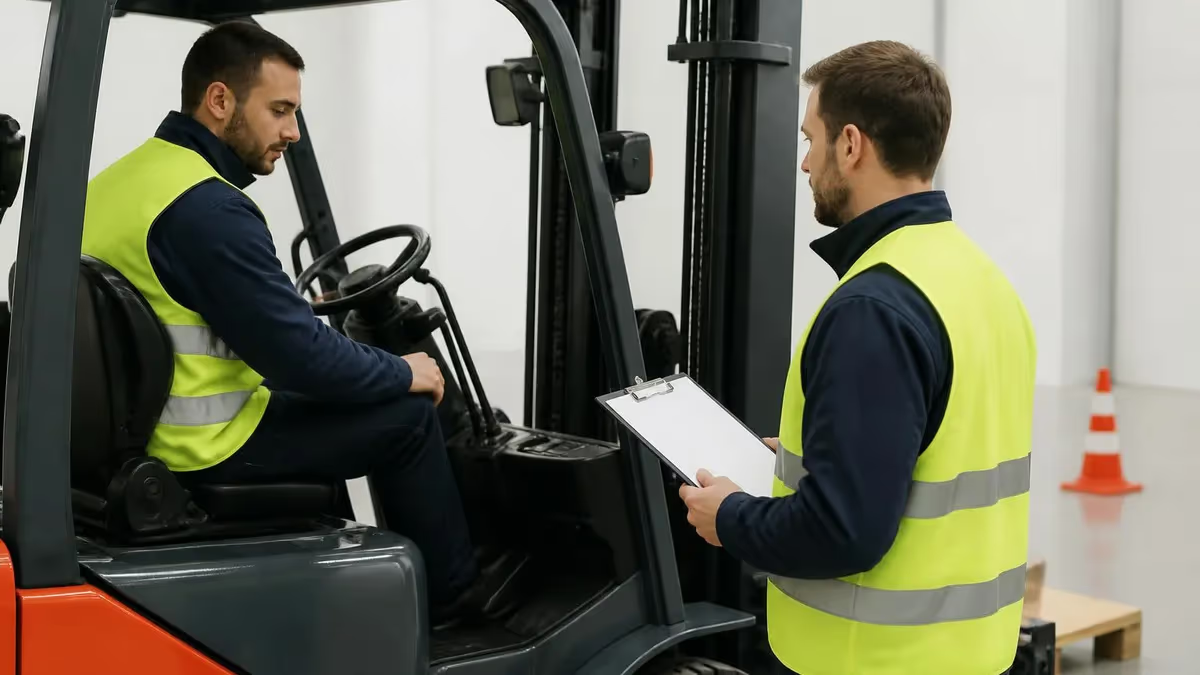
Forklift accident lawyers handle some of the most complex workplace injury cases in the United States, where powered industrial trucks cause roughly 85 fatalities and 34,900 serious injuries every year according to OSHA data. Whether the incident happened during a routine pallet move, a forklift rental delivery, or a tip-over on an uneven dock, the financial and medical consequences can be devastating. Understanding your rights early protects your ability to recover wages, medical costs, and long-term disability compensation before critical deadlines expire under state law.
Forklifts weigh between 3,000 and 30,000 pounds, and when they strike a pedestrian or roll onto an operator, the physics rarely favor the human body. Crush injuries, traumatic brain injuries, spinal fractures, and amputations dominate the litigation landscape. A skilled forklift accident lawyer investigates whether the operator was properly certified, whether the equipment had defective brakes or hydraulics, and whether the employer skipped required maintenance intervals that contributed to the catastrophic failure.
The legal pathways available to injured workers extend far beyond a simple workers' compensation claim. Third-party liability against manufacturers, maintenance contractors, property owners, and even staffing agencies often unlocks compensation that workers' comp alone cannot provide. Pain and suffering damages, loss of consortium, and punitive damages typically remain off-limits in workers' comp but are recoverable in civil suits when a negligent third party contributed to the crash. The right attorney maps every possible defendant within days of being hired.
Industry data shows forklift rental incidents account for a disproportionate share of claims because rental customers frequently operate equipment they have not been trained on. When a contractor rents a sit-down counterbalance truck for a one-week project and assigns it to an uncertified worker, liability can fall on the renter, the rental company, and the worksite controller simultaneously. Lawyers specializing in this area know how to obtain rental agreements, delivery checklists, and pre-rental inspection records before they disappear.
Equipment type matters enormously when building a case. A telehandler forklift rollover on uneven terrain involves entirely different engineering questions than an electric forklift battery explosion in a cold-storage warehouse. Stand up forklift accidents, where the operator rides in an open compartment, frequently involve foot crush and lower-leg amputation when the truck strikes a rack leg or another vehicle. Your lawyer must understand the mechanical specifics of the machine that caused the harm.
OSHA citations, while not automatically admissible in civil court, provide a powerful roadmap of employer failures. When an OSHA inspector documents that a company failed to provide certification of forklift training, allowed a damaged truck to remain in service, or ignored prior near-miss reports, that paper trail becomes the foundation of a third-party negligence theory or, in extreme cases, an exception to workers' comp exclusivity. Lawyers experienced in this niche request inspection files within the first 30 days.
This guide walks through every major issue an injured worker, family member, or risk manager needs to understand before signing a representation agreement. From statute of limitations traps to evidence preservation letters, from medical lien negotiations to maximum medical improvement strategy, the details below reflect how top-tier forklift injury firms actually build winning cases in 2026.
Forklift Accident Litigation by the Numbers

Common Types of Forklift Accidents and Their Causes
The single deadliest forklift event, accounting for nearly a quarter of fatalities. Causes include overloading, sharp turns at speed, uneven terrain, and operators jumping clear instead of staying belted inside the operator compartment.
Forklifts striking workers on foot is the second-leading injury category. Blind corners, missing audible alarms, distracted pedestrians, and a lack of designated walkways inside warehouses contribute to most pedestrian collision claims.
Improperly stacked pallets, damaged shrink wrap, and excessive lift heights cause loads to drop on workers below. Damaged forks, worn chains, and missing load backrests amplify the risk during routine racking operations.
Workers riding on forks or improvised platforms suffer catastrophic falls when the operator moves unexpectedly. OSHA prohibits this practice without an approved work platform, yet violations remain common in small warehouses.
Brake failures, hydraulic ruptures, steering loss, and battery explosions on electric forklifts indicate maintenance negligence or manufacturing defects. These cases often unlock product liability claims against the OEM or repair contractor.
The legal claims available after a forklift accident depend on who was at fault, the worker's employment status, and the state in which the incident occurred. Workers' compensation is typically the first avenue, providing no-fault medical coverage and partial wage replacement regardless of who caused the crash. However, workers' comp caps are notoriously low and exclude pain and suffering, making it essential to identify third-party defendants who may be sued in civil court for the full range of damages.
Third-party liability claims open up when someone other than the direct employer contributed to the injury. Equipment manufacturers face product liability suits when a forklift's design or warning labels prove defective. Maintenance contractors who serviced the brakes or hydraulics before the failure can be sued for negligent repair. Property owners may be liable for hazardous floor conditions, and staffing agencies for placing untrained workers on dangerous machinery without verifying certification of forklift training credentials.
Product liability cases against forklift manufacturers like Toyota, Crown, Yale, and Hyster typically center on three theories: design defect, manufacturing defect, and failure to warn. Design defect claims argue the entire model line is unreasonably dangerous, such as a stand up forklift without adequate operator compartment protection. Manufacturing defects involve a specific unit that left the factory flawed. Failure-to-warn claims target inadequate decals, missing capacity plates, or absent rollover warnings that would have prevented the harm.
Forklift rental cases create unique legal questions because liability is shared between the rental company, the renting business, and sometimes the worksite controller. Rental agreements often contain indemnification clauses that the lawyer must scrutinize. If the rental company delivered a truck with worn tires or failed brakes, they retain partial liability even if the renter operated it negligently. Forklift rental near me searches surge before peak seasons, and rushed delivery often skips required pre-rental inspections.
Operators working with forklift truck operators from temp agencies face complicated employment classifications. Borrowed servant doctrine, joint employer rules, and statutory employer provisions vary dramatically by state. A skilled attorney determines whether the injured worker can sue the worksite owner directly or whether workers' comp exclusivity bars the suit. In Texas, where employers can opt out of workers' comp, the legal landscape shifts entirely toward negligence litigation with full damages available.
Intentional tort exceptions allow injured workers to bypass workers' comp exclusivity when the employer's conduct rises beyond negligence. Examples include knowingly removing safety guards, falsifying training records, ordering an operator to work on a forklift with documented defects, or concealing prior near-miss incidents. These claims face high evidentiary bars but unlock punitive damages and full compensatory recovery when proven through internal emails, prior OSHA citations, or whistleblower testimony.
Wrongful death claims arise when a forklift accident kills a worker, and they belong to the surviving spouse, children, and dependents rather than the deceased worker's estate alone. Damages include funeral expenses, loss of financial support, loss of household services, and loss of companionship. Statutes of limitation for wrongful death often differ from personal injury deadlines, and survival actions for the decedent's pre-death pain and suffering may run on separate clocks that demand immediate legal action.
Forklift certification Practice Test Questions
Prepare for the Forklift certification Certification exam with our free practice test modules. Each quiz covers key topics to help you pass on your first try.
Forklift certification Certification Forkl...
Forklift certification Exam Questions covering Certification Forklift certification Maintenance and Repairs. Master Forklift certification Test concepts for certification prep.
Forklift certification Certification Forkl...
Free Forklift certification Practice Test featuring Certification Forklift certification Maintenance and Repairs Questions and Answers. Improve your Forklift certification Exam score with mock test prep.
Forklift certification Certification Forkl...
Forklift certification Mock Exam on Certification Forklift certification Operator Training and Certification Requirements. Forklift certification Study Guide questions to pass on your first try.
Forklift certification Certification Forkl...
Forklift certification Test Prep for Certification Forklift certification Operator Training and Certification Requirements Questions and Answers. Practice Forklift certification Quiz questions and boost your score.
Forklift certification Load Handling and S...
Forklift certification Questions and Answers on Load Handling and Stability. Free Forklift certification practice for exam readiness.
Forklift certification OSHA Regulations an...
Forklift certification Mock Test covering OSHA Regulations and Compliance. Online Forklift certification Test practice with instant feedback.
Forklift certification Pre-Operation Inspe...
Free Forklift certification Quiz on Pre-Operation Inspections. Forklift certification Exam prep questions with detailed explanations.
Forklift certification Refueling and Recha...
Forklift certification Practice Questions for Refueling and Recharging Procedures. Build confidence for your Forklift certification certification exam.
Forklift certification Safe Driving and Ma...
Forklift certification Test Online for Safe Driving and Maneuvering. Free practice with instant results and feedback.
Forklift certification Workplace Hazard Id...
Forklift certification Study Material on Workplace Hazard Identification. Prepare effectively with real exam-style questions.
Forklift certification Forklift Instructions
Free Forklift certification Test covering Forklift Instructions. Practice and track your Forklift certification exam readiness.
Forklift certification Forklift MCQ
Forklift certification Exam Questions covering Forklift MCQ. Master Forklift certification Test concepts for certification prep.
Forklift certification Forklift Employer R...
Free Forklift certification Practice Test featuring Forklift Employer Responsibilities. Improve your Forklift certification Exam score with mock test prep.
Forklift certification Forklift Penalties ...
Forklift certification Mock Exam on Forklift Penalties for Non-Compliance. Forklift certification Study Guide questions to pass on your first try.
Compensation Categories After a Forklift Operator Injury
Medical compensation covers emergency room bills, surgical procedures, rehabilitation, prescription medications, assistive devices, and long-term nursing care. For catastrophic forklift injuries involving spinal cord damage or traumatic brain injury, life care plans projecting decades of future medical needs become the largest damage category, often reaching $3 million to $10 million in projected costs documented through expert testimony.
Vocational rehabilitation, prosthetics for amputation victims, home modifications for wheelchair accessibility, and mental health treatment for PTSD all fall under medical damages. Lawyers work with life care planners and economists to project lifetime costs accurately. Insurance subrogation liens from health insurers and Medicare must be negotiated down before the worker receives net proceeds, which experienced attorneys routinely reduce by 30 to 50 percent.

Hiring a Forklift Accident Lawyer: Workers' Comp Only vs Full Litigation
- +Access to pain and suffering damages unavailable through workers' comp alone
- +Investigators preserve critical evidence before employers destroy it
- +Expert witnesses including biomechanical engineers and accident reconstructionists
- +Negotiation of medical liens reduces what you owe insurers from settlement
- +Contingency fee structure means no upfront cost to the injured worker
- +Lawyers identify all potentially liable parties beyond the direct employer
- +Higher settlement values driven by trial-ready preparation and credibility
- −Attorney fees typically consume 33-40 percent of gross recovery
- −Litigation can take 18-36 months versus weeks for a comp claim
- −Defense lawyers will scrutinize medical history, social media, and prior claims
- −Depositions and independent medical exams cause additional stress
- −Settlement amounts are taxable on certain components like lost wages
- −Workers' comp benefits may be reduced through subrogation when civil suit succeeds
- −Some claims are barred entirely by exclusivity rules in restrictive states
Pros and Cons at a Glance
| Pros | Cons |
|---|---|
| Access to pain and suffering damages unavailable through workers' comp alone | Defense lawyers will scrutinize medical history, social media, and prior claims |
| Investigators preserve critical evidence before employers destroy it | Depositions and independent medical exams cause additional stress |
| Expert witnesses including biomechanical engineers and accident reconstructionists | Settlement amounts are taxable on certain components like lost wages |
| Negotiation of medical liens reduces what you owe insurers from settlement | Workers' comp benefits may be reduced through subrogation when civil suit succeeds |
| Contingency fee structure means no upfront cost to the injured worker | Some claims are barred entirely by exclusivity rules in restrictive states |
Evidence Preservation Checklist After a Forklift Accident
- ✓Photograph the forklift, the accident scene, and any load or debris from multiple angles immediately
- ✓Identify witnesses by name and obtain phone numbers before they leave the property
- ✓Request the forklift's daily inspection logs and maintenance records for the prior 12 months
- ✓Demand preservation of any video surveillance covering the incident location for 90 days minimum
- ✓Obtain the operator's certification of forklift training documentation and last evaluation date
- ✓Secure the forklift itself from being repaired, sold, or scrapped through a spoliation letter
- ✓Document all medical treatment with copies of ER reports, imaging, and discharge summaries
- ✓Report the incident to OSHA within 8 hours if a fatality or 24 hours for hospitalization
- ✓Keep a daily pain journal recording symptoms, limitations, and missed activities for 90 days
- ✓File the workers' compensation claim within state deadlines, usually 30 to 90 days from injury
- ✓Avoid recorded statements to any insurance adjuster without legal counsel present
- ✓Retain attorney within two weeks to preserve product liability and third-party claims
Spoliation Letters Must Go Out Within 14 Days
Once a forklift accident occurs, the employer or rental company will often repair, repaint, or sell the equipment within weeks, destroying critical evidence. A spoliation preservation letter from your attorney creates a legal duty to preserve the machine, maintenance logs, and surveillance footage. Failure to comply allows juries to assume the destroyed evidence would have been unfavorable, dramatically strengthening your case.
Choosing the right forklift accident lawyer requires more diligence than selecting a general personal injury attorney. The mechanical, regulatory, and industrial context of these cases demands specialized knowledge that only comes from handling dozens of similar matters. Start by asking how many forklift cases the firm has resolved in the past five years, what percentage went to trial versus settled, and what the average recovery has been for cases involving similar injuries to yours. Vague answers signal a generalist who will subcontract the technical work.
Trial experience matters enormously even if your case ultimately settles. Insurance carriers and corporate defendants track which plaintiff firms actually take cases to verdict and which always cave under pressure. A lawyer with documented multi-million-dollar trial wins will receive settlement offers two to four times higher than a settlement-only practitioner. Ask specifically for jury verdict sheets and published opinions; a credentialed firm will provide them without hesitation as part of the initial consultation packet.
Resources determine outcomes in product liability and third-party negligence cases. Hiring biomechanical engineers, human factors experts, accident reconstructionists, and life care planners can cost $75,000 to $300,000 before trial even begins. Small firms without access to credit lines or litigation funding may pressure clients into early settlements simply because they cannot afford to develop the case fully. Ask whether the firm fronts all costs and how case expenses are deducted from settlement.
Communication standards separate professional firms from boiler-room operations. You should receive a dedicated case manager, predictable update intervals, and direct access to the lead attorney for major decisions. Firms that take 96 hours to return calls during litigation are signaling capacity problems that will hurt your outcome. Ask in writing what the communication protocol will be, what hours they respond, and who covers when the lead attorney is in trial.
Industry relationships with crown forklift experts, OSHA former inspectors, and union safety officers separate boutique forklift firms from general practitioners. The deposition of a former OSHA Region V investigator who personally cited your employer for similar violations is worth more than any document review. Ask which experts the firm regularly retains and request references from prior clients who can describe the depth of investigation conducted in their cases.
Fee structures are negotiable, especially in catastrophic injury cases where contingency percentages can be reduced from the standard 40 percent down to 33 or even 30 percent. Tiered fee agreements that charge 33 percent for pre-suit settlement and 40 percent only if trial is required align attorney incentives with client outcomes. Review the contract clause covering case costs, lien negotiations, structured settlements, and what happens if you decide to switch firms mid-case before signing.
Red flags include guarantees of specific dollar outcomes, pressure to sign before consulting with family, refusal to provide references, lack of malpractice insurance disclosure, and reluctance to put fee terms in writing. Reputable forklift accident lawyers offer free consultations, no-pressure decision timelines, and clear written agreements. They also explain the realistic range of outcomes based on your specific medical condition, the available defendants, your state's tort laws, and the insurance coverage limits actually available on each potential defendant.

Personal injury claims for forklift accidents must be filed within state-specific deadlines, ranging from one year in Kentucky and Louisiana to six years in Maine and North Dakota. Product liability claims often have separate statutes of repose that can bar claims regardless of when the injury occurred. Missing these deadlines permanently destroys your right to recover compensation, no matter how strong the underlying case.
Settlement versus trial strategy is one of the most consequential decisions in any forklift injury case, and the calculus shifts dramatically based on case strength, defendant resources, and the client's personal financial situation. Most forklift cases settle, often during mediation conducted six to twelve months after the lawsuit is filed. Settlements provide guaranteed money, faster resolution, confidentiality, and avoid the appellate risk of a defense verdict being upheld. Trials offer potentially higher awards but introduce uncertainty no lawyer can eliminate.
Mediation is typically the first formal settlement opportunity, conducted by a retired judge or experienced neutral attorney who shuttles between rooms negotiating with each side. Successful mediation requires complete medical documentation, all expert reports finalized, and clear understanding of insurance coverage limits. Lawyers who arrive at mediation with thin investigation files typically leave with disappointing offers. The cases that settle highest are those mediated after the lawyer has completed several key defense depositions and built credibility for trial.
Insurance policy limits frequently cap real-world recovery regardless of case value. A forklift accident with $20 million in damages against a small employer carrying only $1 million in liability coverage will rarely yield more than the policy limit, unless the employer has substantial corporate assets exposed beyond insurance. Forklift accident lawyers conduct early asset investigations to determine whether pursuing personal assets of business owners or parent corporations through veil-piercing theories is realistic given the defendant's financial structure.
Structured settlements provide tax-advantaged periodic payments that can guarantee lifetime income for catastrophically injured workers. Rather than receiving $3 million in a lump sum, a worker might accept $2.4 million present value in a structure that pays $200,000 annually for life with guaranteed minimum periods. Structures protect injured workers from poor investment decisions, divorce attacks on lump sum funds, and Medicaid disqualification when government benefits would otherwise be lost.
Trial preparation requires the client's full availability for depositions, independent medical exams, witness preparation, and the trial itself, which can last two to four weeks. Defense lawyers will probe medical history, employment records, prior injury claims, social media activity, and personal relationships looking for impeachment material. Cases involving hyster forklift maintenance failures often turn on document discovery battles where the defense fights to keep service records confidential under trade secret doctrines.
Jury selection is the most underappreciated phase of forklift trials. Industrial workers, union members, and former warehouse employees often view employer negligence sympathetically, while business owners and managers tend toward defense verdicts. Jury consultants analyze the venire to identify the most favorable panel, conducting focus groups months before trial to test arguments and themes. Forklift cases involving sympathetic injuries to younger workers with families generally outperform cases involving older workers nearing retirement age in plaintiff verdict surveys.
Appellate considerations should be discussed before trial because a defense verdict typically requires identifying preserved trial errors that justify a new trial. Plaintiff verdicts can be reduced by remittitur or eliminated by judgment notwithstanding the verdict. Experienced trial lawyers protect the record by objecting strategically, requesting precise jury instructions, and filing motions in limine that frame the legal issues for appellate review. Settlement on favorable terms often becomes the smart choice after a contested verdict to avoid years of appeals.
Practical next steps after a forklift accident determine whether you preserve a strong legal claim or undermine it through avoidable mistakes. Begin by seeking medical attention even if you feel functional, because adrenaline often masks spinal injuries, internal bleeding, and traumatic brain injury symptoms that emerge hours or days later. Document every symptom in the emergency room intake, because gaps between the accident date and first medical complaint become defense exhibits used to argue the injury occurred elsewhere.
Report the incident in writing to your supervisor the same day, keeping a personal copy of the report. Verbal reports vanish into corporate memory, while written reports create the foundation of your workers' compensation claim and any subsequent lawsuit. Include the date, time, exact location, equipment involved, names of witnesses, and a brief factual summary. Do not speculate about fault or describe the accident as your own mistake, since those statements will be quoted by defense counsel.
Avoid signing any document offered by the employer's insurance carrier, the forklift rental company, or any third-party claims adjuster before consulting an attorney. Release forms, recorded statements, and authorizations to access medical records are designed to limit your recovery before you understand the full extent of your injuries. Maximum medical improvement, the point at which doctors determine your condition has stabilized, is typically reached 6 to 18 months after the injury and is essential for accurate case valuation.
Preserve your own evidence by photographing visible injuries weekly during recovery, keeping all medical bills, recording mileage to medical appointments, and saving pay stubs showing lost income. Maintain a daily journal noting pain levels, sleep disruption, missed family activities, and emotional impact. Juries respond powerfully to contemporaneous documentation that shows the day-by-day reality of recovery rather than reconstructed testimony delivered years later under cross-examination.
Avoid social media entirely during litigation. Defense investigators will scour Facebook, Instagram, TikTok, and LinkedIn for any post that contradicts your injury claims. A single photo of a backyard barbecue can be twisted into evidence that you exaggerated lower back pain. Even private accounts are subject to subpoena, and friends' posts that tag you remain discoverable. The safest practice is full deactivation until your case resolves, with a written notice to friends not to post about you.
Coordinate with your treating physicians on work restrictions, light duty assignments, and the timing of independent medical examinations scheduled by the defense. Attend every scheduled appointment, follow all prescribed treatment, and complete any physical therapy or rehabilitation. Gaps in treatment create the strongest defense argument that you have recovered or that the injury was not serious. If transportation, childcare, or insurance issues prevent treatment, document those obstacles in writing for your attorney.
Plan financially for the litigation timeline. Most forklift cases take 12 to 30 months from injury to settlement, and longer if trial becomes necessary. Some clients qualify for pre-settlement funding, though interest rates often exceed 30 percent annually and should be a last resort. Workers' compensation benefits, short-term disability, and family resources should be coordinated to bridge income gaps. Your lawyer can help negotiate medical liens with health insurers, hospital systems, and Medicare to maximize your net recovery at the end.
Sample Forklift certification Practice Questions
Try these questions from our free Forklift certification practice tests. The correct answer and an explanation follow each question.
When changing a Liquid Propane Gas (LPG) cylinder on a forklift, what is the correct first step after parking the forklift in a designated area and setting the brake?
- A. Immediately disconnect the fuel hose from the cylinder.
- B. Close the valve on the LPG cylinder.
- C. Unfasten the straps holding the cylinder in place.
- D. Use a wrench to check the tightness of the fittings.
Answer: B. Close the valve on the LPG cylinder.
Before disconnecting any hoses, the valve on the LPG cylinder must be closed to stop the flow of gas. The engine should then be run until it stops to purge any remaining fuel from the lines, preventing a release of flammable gas when the hose is disconnected.
When should a forklift pre-operational inspection be performed?
- A. Weekly
- B. At the end of each shift
- C. Before each use
- D. Only when the forklift looks damaged
Answer: C. Before each use
OSHA and best safety practices dictate that a forklift pre-operational inspection must be performed before each shift or, if used continuously, before each use by a new operator. This ensures that the equipment is in safe working condition every time it is operated. Regular inspections minimize the risk of accidents due to unforeseen mechanical issues, promoting continuous safety.
The data plate (nameplate) on a forklift should be inspected to confirm it is:
- A. Legible and matches attachments in use
- B. Painted over
- C. Removed for cleaning
- D. Covered by a sticker
Answer: A. Legible and matches attachments in use
The data plate must be readable and accurate for the load capacity and any attachments installed.
What is the maximum grade you should typically avoid parking a forklift on?
- A. Any grade; park on level ground when possible
- B. Only grades steeper than 30 degrees
- C. Any grade under 10 degrees is fine
- D. Grades do not matter when parked
Answer: A. Any grade; park on level ground when possible
Forklifts should be parked on level ground; if parking on an incline is unavoidable, chock the wheels.
Forklift Questions and Answers
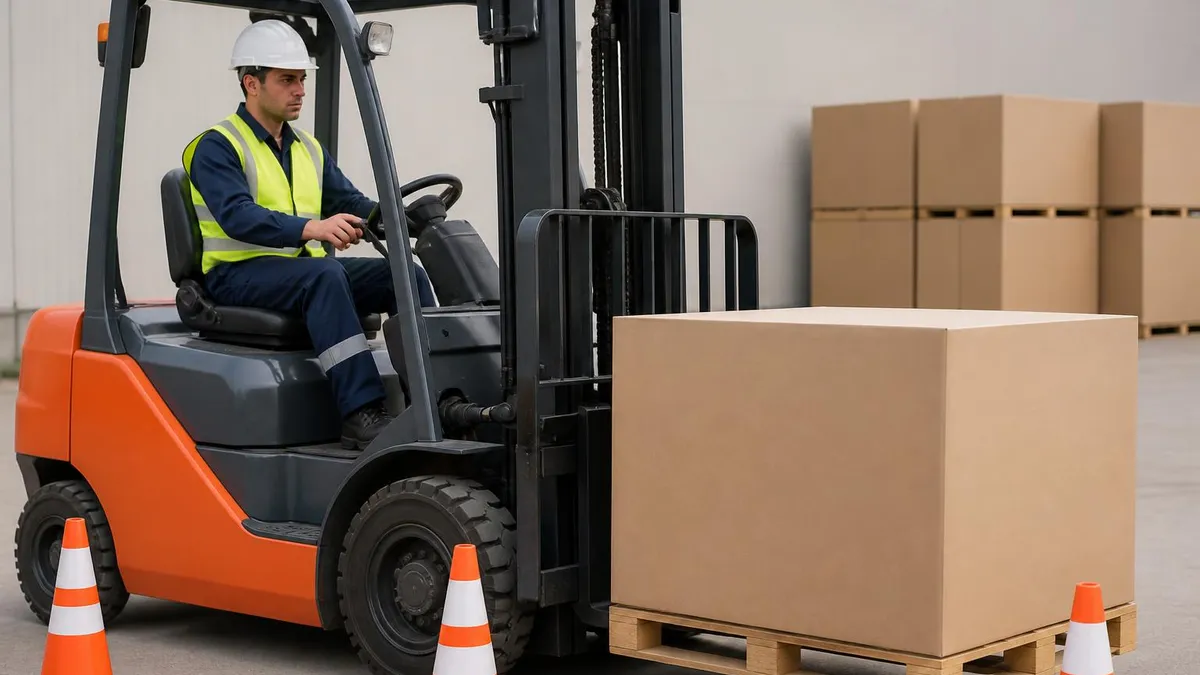
Forklift Tires: Complete Guide to Types, Sizing, Wear Patterns, and Replacement Costs
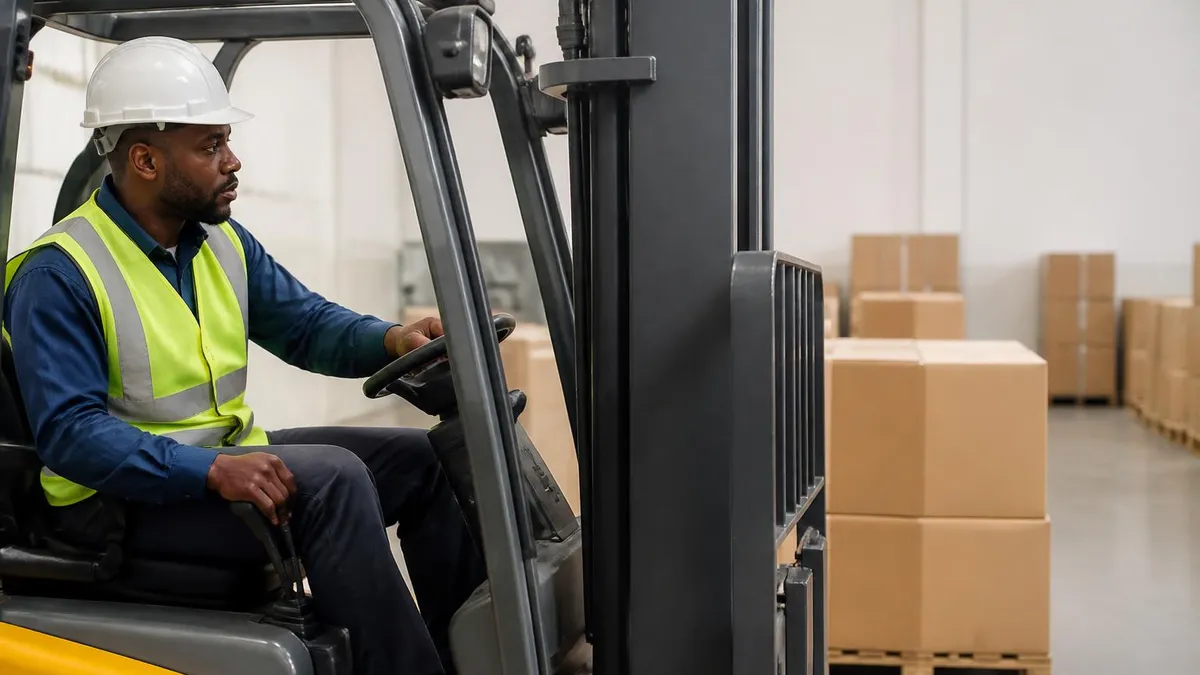
Forklift Accessories: Complete Guide to LED Lights, Attachments, Safety Gear, and Productivity Upgrades for 2026
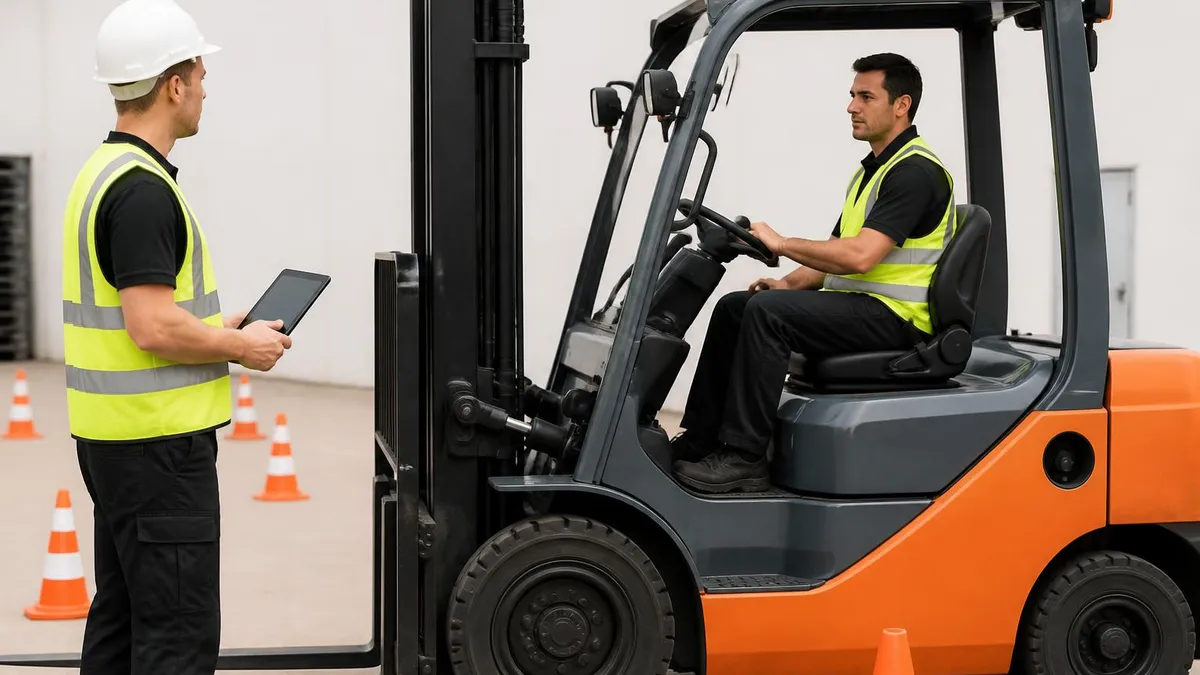
Forklift Safety Training: Complete OSHA Compliance Guide for Operators and Employers
Forklift Repair Service: Complete Guide to Costs, Common Repairs, and Choosing the Right Technician
Forklift Price Guide 2026: New, Used, Rental, and Total Cost of Ownership Breakdown
About the Author

Certified Crane Operator & Skilled Trades Exam Specialist
Ferris State UniversityRobert Martinez is a Journeyman Ironworker, NCCCO-certified crane operator, and forklift trainer with a Bachelor of Science in Construction Technology from Ferris State University. He has 21 years of ironworking, rigging, and heavy equipment operation experience across high-rise and industrial construction sites. Robert prepares candidates for crane operator, rigger, forklift, and skilled trades certification examinations.