
Forklift Safety Checklist: Complete Daily Pre-Operation Inspection Guide for OSHA Compliance in 2026 October
Complete forklift safety checklist for daily pre-operation inspections. OSHA-compliant guide covering electric, propane, and diesel forklifts for 2026 October. 🔎
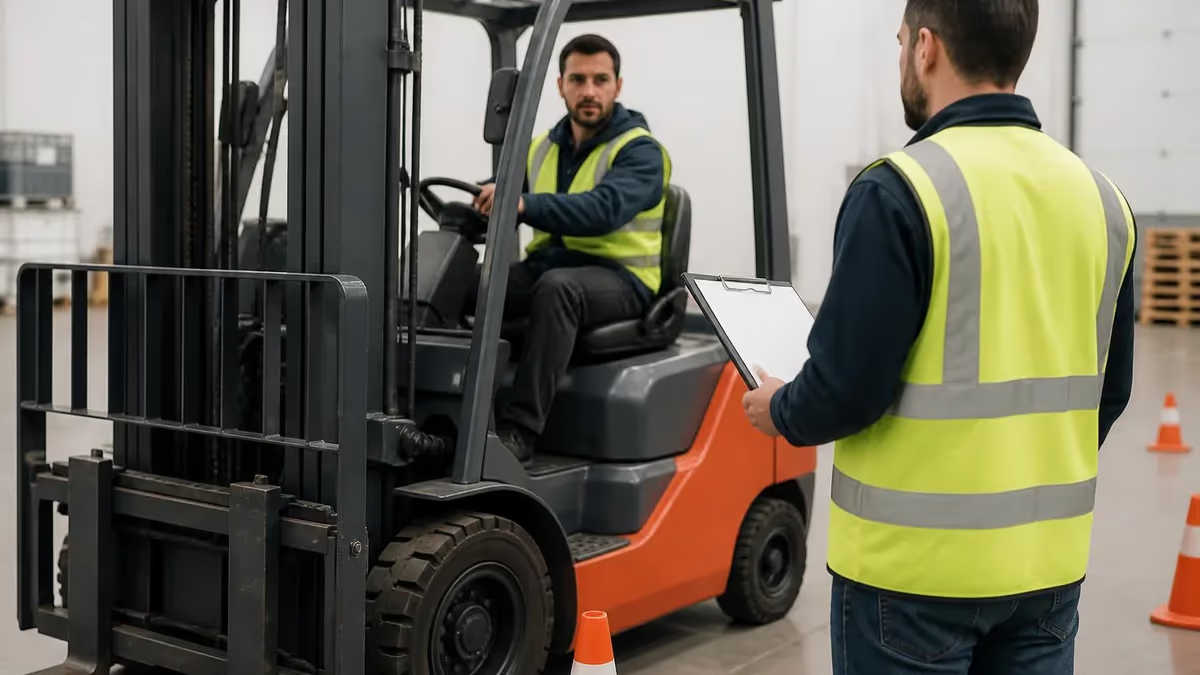
A thorough forklift safety checklist is the single most effective tool an operator can use to prevent workplace injuries, equipment damage, and OSHA citations. Whether you operate a forklift rental at a busy distribution center or own a fleet of forklifts at a manufacturing plant, the pre-operation inspection is your legal and ethical duty under OSHA standard 1910.178(q)(7). This regulation requires every powered industrial truck to be examined at least daily before being placed in service, and more often when used around the clock on multiple shifts.
The numbers behind forklift accidents are sobering. The Bureau of Labor Statistics reports that forklifts are involved in roughly 35,000 serious injuries and approximately 85 fatalities each year in the United States. The National Safety Council estimates that nearly 70% of these incidents could be prevented with proper operator training, routine maintenance, and rigorous use of a documented safety checklist. A five-minute walkaround inspection often catches issues that would otherwise lead to tip-overs, hydraulic failures, or pedestrian strikes.
This guide walks you through every element of a complete forklift safety checklist, from the visual walkaround to the functional operational checks performed once the engine is running. We cover internal combustion forklifts, electric forklift models, and specialty units like the stand up forklift used in narrow-aisle warehouses. Each section is built around OSHA requirements but extends into best practices recommended by ANSI/ITSDF B56.1, the consensus standard governing powered industrial trucks in North America.
If you are pursuing certification of forklift operation for the first time, expect your written and practical exams to test your knowledge of these exact checklist items. Examiners want to see that you can identify a damaged fork heel, recognize hydraulic seepage, and explain why a missing data plate immediately disqualifies a truck from service. Memorizing the checklist is not enough — you need to understand why each item matters and what failure modes it prevents.
Employers also bear significant responsibility. OSHA holds the company, not just the operator, accountable when a truck enters service in an unsafe condition. Supervisors must ensure that completed checklists are retained, defects are reported through a clear chain of communication, and any forklift that fails inspection is tagged out and removed from operation until a qualified technician returns it to service. Failure to maintain these records is one of the most commonly cited violations in warehouse safety audits.
The checklist also intersects with the way you manage your fleet financially. A well-documented inspection program extends the useful life of your equipment, reduces unscheduled downtime, and provides use when negotiating warranty claims or trade-in valuations with a forklift for sale dealer. Operators who treat the checklist as a chore miss its second purpose: it is a low-cost preventive maintenance program that pays back many times over in avoided repair bills.
In the sections that follow, you will find structured visual checks, operational tests, fuel-type-specific items, OSHA documentation requirements, and a downloadable-style 25-point checklist you can adapt to your own workplace. We also address common pitfalls — like operators who only inspect the side of the truck facing them — and explain how to build a culture where reporting a problem is rewarded rather than punished.
Forklift Safety Checklist by the Numbers

Pre-Operation Inspection Steps
Approach and Visual Survey
Engine-Off Component Check
Operator Compartment Review
Engine-On Functional Test
Documentation and Tag-Out
The visual walkaround is the foundation of any forklift safety checklist, and skipping it is the most common shortcut operators take when running late or under production pressure. A proper walkaround follows a consistent path — typically counterclockwise starting at the operator station — so that no component is ever overlooked. Forklifts are mechanically complex machines with hundreds of moving parts, and a defect on the side opposite the operator is just as dangerous as one within arm's reach.
Begin with the tires. On cushion-tire forklifts, look for chunking, flat spots, and exposed cord. On pneumatic-tire trucks used outdoors, check inflation pressure against the manufacturer's spec and inspect sidewalls for cuts or bulges. Tire condition directly affects stability, braking distance, and the location of the truck's center of gravity. A worn drive tire on a forklift rental may seem cosmetic, but it can shift the load center enough to cause a tip-over when handling a marginal load near maximum capacity.
Next, examine the forks themselves. Use a fork wear caliper or visually compare the heel thickness to the shank thickness. OSHA and ANSI require that forks be removed from service when heel wear exceeds 10% of the original thickness. Look for cracks at the heel weld, twists exceeding three degrees, and bent tips. Pay attention to the fork retention pins — missing pins are responsible for hundreds of dropped-load incidents every year, and replacement pins cost less than two dollars apiece.
The mast assembly hosts critical safety components. Inspect lift chains for stretch, broken plates, corrosion, and proper tension. Both chains must be evenly tensioned within manufacturer specifications, typically measured with a chain wear gauge applied to a 12-link section. Check the mast channels for cracks and the rollers for free movement. Hydraulic hoses routed up the mast should show no signs of abrasion, cracking, or pinhole leaks under pressure. A failing hydraulic line can release fluid at over 2,000 psi — enough to penetrate skin and cause serious medical emergencies.
Move to the chassis and undercarriage. Look for puddles or active drips of hydraulic oil, transmission fluid, coolant, or — on internal combustion units — fuel. A small leak today becomes a fire hazard tomorrow. Inspect the counterweight bolts, check for damage to the overhead guard, and verify that the load backrest extension is securely mounted. The backrest prevents loaded items from tipping back onto the operator and is non-negotiable on any forklift handling stacked goods.
Finally, confirm that all safety decals, capacity plates, and warning labels are legible. The data plate is a legal document — if it is missing or unreadable, the truck cannot be operated until it is replaced. The plate tells the operator the rated capacity at a specific load center, the attachment configuration, and the truck's classification under OSHA's seven powered industrial truck categories. Operators completing forklift training learn to read this plate as their first line of defense against overloading.
Document each visual finding immediately. Many warehouses now use digital inspection apps that timestamp each item and photograph any defects, creating a defensible audit trail. Whether digital or paper, the checklist must be completed before the truck is moved, and any deficiency must trigger a documented decision: minor cosmetic issue noted for the next service interval, or critical safety defect requiring immediate tag-out and repair.
Forklift certification Practice Test Questions
Prepare for the Forklift certification Certification exam with our free practice test modules. Each quiz covers key topics to help you pass on your first try.
Forklift certification Certification Forkl...
Forklift certification Exam Questions covering Certification Forklift certification Maintenance and Repairs. Master Forklift certification Test concepts for certification prep.
Forklift certification Certification Forkl...
Free Forklift certification Practice Test featuring Certification Forklift certification Maintenance and Repairs Questions and Answers. Improve your Forklift certification Exam score with mock test prep.
Forklift certification Certification Forkl...
Forklift certification Mock Exam on Certification Forklift certification Operator Training and Certification Requirements. Forklift certification Study Guide questions to pass on your first try.
Forklift certification Certification Forkl...
Forklift certification Test Prep for Certification Forklift certification Operator Training and Certification Requirements Questions and Answers. Practice Forklift certification Quiz questions and boost your score.
Forklift certification Load Handling and S...
Forklift certification Questions and Answers on Load Handling and Stability. Free Forklift certification practice for exam readiness.
Forklift certification OSHA Regulations an...
Forklift certification Mock Test covering OSHA Regulations and Compliance. Online Forklift certification Test practice with instant feedback.
Forklift certification Pre-Operation Inspe...
Free Forklift certification Quiz on Pre-Operation Inspections. Forklift certification Exam prep questions with detailed explanations.
Forklift certification Refueling and Recha...
Forklift certification Practice Questions for Refueling and Recharging Procedures. Build confidence for your Forklift certification certification exam.
Forklift certification Safe Driving and Ma...
Forklift certification Test Online for Safe Driving and Maneuvering. Free practice with instant results and feedback.
Forklift certification Workplace Hazard Id...
Forklift certification Study Material on Workplace Hazard Identification. Prepare effectively with real exam-style questions.
Forklift certification Forklift Instructions
Free Forklift certification Test covering Forklift Instructions. Practice and track your Forklift certification exam readiness.
Forklift certification Forklift MCQ
Forklift certification Exam Questions covering Forklift MCQ. Master Forklift certification Test concepts for certification prep.
Forklift certification Forklift Employer R...
Free Forklift certification Practice Test featuring Forklift Employer Responsibilities. Improve your Forklift certification Exam score with mock test prep.
Forklift certification Forklift Penalties ...
Forklift certification Mock Exam on Forklift Penalties for Non-Compliance. Forklift certification Study Guide questions to pass on your first try.
Fuel-Type-Specific Inspections for Every Forklift Operator
An electric forklift requires inspection items not found on combustion models. Check battery electrolyte levels on flooded lead-acid batteries — plates must be covered but not overfilled, since overflow during charging produces corrosive acid. Look for white sulfate buildup on terminals, cracked battery cases, and ensure the battery is fully seated and secured with retention bars. The hydrogen vent must be unobstructed to prevent gas accumulation during charging cycles.
Verify the battery connector is not damaged or arcing, and confirm the state-of-charge indicator reads within operating range. Listen for unusual contactor noise during the first lift and travel test. Lithium-ion units skip electrolyte checks but still require visual battery inspection, terminal cleanliness verification, and a thermal check for hot spots. Document the battery's serial number on the checklist for traceability across multi-shift operations.

Paper Checklists vs. Digital Inspection Apps
- +Digital apps timestamp each item automatically for defensible OSHA audit trails
- +Photos of defects attach directly to the inspection record
- +Trend analysis identifies recurring problems with specific forklifts
- +Supervisors receive real-time alerts when a truck fails inspection
- +Cloud storage eliminates lost paperwork and 7-year retention concerns
- +Integration with maintenance ticketing speeds up repair turnaround
- +Multi-language interfaces support diverse warehouse workforces
- −Initial software licensing costs $5-15 per truck per month
- −Battery-dead tablets in the warehouse cause inspection delays
- −Older operators may resist learning new digital workflows
- −Network outages can prevent submission of completed checklists
- −Paper backups are still required during system maintenance
- −Implementation requires training time and management buy-in
Pros and Cons at a Glance
| Pros | Cons |
|---|---|
| Digital apps timestamp each item automatically for defensible OSHA audit trails | Battery-dead tablets in the warehouse cause inspection delays |
| Photos of defects attach directly to the inspection record | Older operators may resist learning new digital workflows |
| Trend analysis identifies recurring problems with specific forklifts | Network outages can prevent submission of completed checklists |
| Supervisors receive real-time alerts when a truck fails inspection | Paper backups are still required during system maintenance |
| Integration with maintenance ticketing speeds up repair turnaround | Implementation requires training time and management buy-in |
The Complete 25-Point Forklift Safety Checklist
- ✓Confirm data plate is present, legible, and matches the truck's current attachment configuration
- ✓Inspect tires for cuts, chunking, flat spots, and proper inflation pressure
- ✓Check forks for cracks, bends, heel wear under 10%, and presence of retention pins
- ✓Examine mast chains for stretch, broken plates, and even tension across both sides
- ✓Inspect hydraulic hoses and cylinders for leaks, abrasion, and cracking
- ✓Verify the overhead guard is undamaged and securely mounted
- ✓Confirm the load backrest extension is present and fully welded
- ✓Test horn, lights, backup alarm, and strobe for proper function
- ✓Verify seatbelt retracts, seat switch engages, and parking brake holds
- ✓Check fluid levels: engine oil, coolant, hydraulic fluid, and brake fluid
- ✓Test service brake, steering, and hydraulic controls through full range
- ✓Confirm fire extinguisher is present, charged, and within inspection date
If You Cannot Complete the Checklist, You Cannot Operate the Forklift
OSHA inspectors routinely cite warehouses where the checklist is signed but obviously not performed — for example, signed at 6:00 a.m. for a truck that did not arrive on site until 8:00 a.m. A genuine inspection takes five to seven minutes. If your production schedule does not allow that time, the problem is the schedule, not the checklist. Document every inspection in real time, and never sign for a check you did not actually perform.
OSHA documentation requirements for forklift safety inspections are governed primarily by 29 CFR 1910.178, supplemented by the recordkeeping standard 29 CFR 1904. While OSHA does not mandate a specific checklist format, it does require that inspections be performed, that defects be addressed before use, and that operator training records be maintained for the duration of employment. Most enforcement officers expect to see completed daily checklists retained for at least 12 months, though many large warehousing operations retain them for three to seven years to support workers' compensation defense.
The operator's certificate of forklift training must include the trainee's name, the date of training, the date of evaluation, and the identity of the trainer or evaluator. Refresher training is required every three years, and immediately following any accident, near-miss, or observed unsafe operation. Employers who treat the three-year refresher as a calendar formality rather than a substantive retraining event are setting themselves up for citations during post-incident investigations.
A complete defect-reporting protocol has four mandatory elements: a clear method for operators to report problems, a tag-out procedure that physically prevents operation, a qualified person designated to assess and repair defects, and a return-to-service authorization process. Many warehouses use a three-tag system — green for serviceable, yellow for caution with notes, and red for out-of-service. The red tag may only be removed by the designated maintenance supervisor after written confirmation of repair.
Penalties for inadequate documentation have climbed sharply in the 2026 fee schedule. A serious violation now carries a maximum penalty of $16,131 per instance, and willful or repeat violations reach $161,323. OSHA's Severe Violator Enforcement Program flags employers with multiple forklift-related citations, leading to follow-up inspections, public press releases, and significantly higher insurance premiums. The economic case for rigorous documentation is now stronger than ever.
For operations running forklift rentals on short-term contracts, documentation responsibilities follow the operator, not the equipment. Even if the lessor performs a delivery inspection, the lessee's operators must conduct their own daily checklist and retain the records. Renting a forklift does not transfer OSHA liability to the rental company. If you sign for the truck and put it into service, your safety program is on the hook for everything that follows.
Technology has changed how documentation is captured but not what is required. Whether you use a clipboard, a tablet app, or a fleet telematics system that runs an automated startup interlock, OSHA evaluates whether the inspection actually occurred and whether defects were addressed. Some modern fleet systems will not allow a forklift to move until the operator answers a series of inspection prompts on the dash, then captures a photo of a defect or signs digitally that no defect was found.
One final note: documentation alone does not satisfy OSHA. If an investigator finds that a truck was operated with a known defect, the checklist becomes evidence against the employer rather than a defense. The point of the checklist is not paperwork; it is the discipline of actually finding and fixing problems before they cause harm. Treat every signature as a personal promise that the truck was genuinely inspected and is fit for service.

Any forklift with a defect affecting safe operation must be immediately removed from service per OSHA 1910.178(p)(1). This includes inoperative horns, brake issues, hydraulic leaks, missing data plates, or damaged overhead guards. The truck cannot return to service until a qualified mechanic certifies the repair in writing. Operating a tagged-out forklift exposes both operator and employer to citations exceeding $16,000 per occurrence in 2026.
Building a genuine safety culture around the forklift safety checklist is harder than writing a procedure. The technical requirements are well-documented, but cultural change requires consistent leadership behavior over months and years. Warehouses where the checklist is treated as a serious operational priority share certain characteristics: management performs random checklist audits, defects are repaired within 24 hours, operators are publicly recognized for catching problems, and there is zero tolerance for retaliation against anyone who tags out a truck.
Start with the language you use about safety. Operators who hear managers say "just get the order out" or "the truck's fine, run it" learn that production trumps inspection. Conversely, when supervisors visibly support tag-outs and thank operators for finding defects, the checklist becomes part of professional identity rather than a chore. This cultural alignment is especially important for new operators completing their certification of forklift operation, who calibrate their behavior to what they see senior workers tolerate.
Investment in equipment matters too. A well-maintained fleet generates fewer defect reports, which paradoxically makes operators more attentive when they do find an issue. Aging forklifts with chronic problems train operators to ignore minor warnings because everything seems to be slightly broken. If your fleet is reaching end-of-life, document the rising repair costs and present a capital case for replacement, lease, or expanded use of forklift rentals for peak-season demand spikes.
Training reinforcement is the next pillar. Refresher training every three years is the floor, not the ceiling. Best-in-class operations conduct monthly toolbox talks covering a single inspection element in depth — fork wear one month, hydraulic hose condition the next. These short sessions, run by lead operators rather than safety staff, build deep technical knowledge and reinforce that the checklist is owned by the operator team, not imposed by compliance. For deeper learning, point operators toward focused programs in forklift safety training.
Near-miss reporting closes the loop. Every successful tag-out, every avoided accident, and every newly identified hazard should feed back into checklist evolution. Generic OSHA checklists are a starting point, not a finished product. Customize yours to your facility — add items for the specific attachments you use, the racking heights you reach, and the pedestrian zones you cross. A checklist that mirrors your real working conditions gets used; a generic one gets pencil-whipped.
Metrics drive improvement when they measure the right things. Track defects-per-shift, average repair turnaround time, checklist completion rate, and percentage of inspections that meet a minimum time threshold. Avoid metrics that incentivize hiding problems, such as raw accident counts without context or punitive responses to defect reports. The goal is to surface issues, not suppress them. Healthy programs see defect reporting rates increase initially, then stabilize at a steady rate that reflects actual fleet condition.
Finally, recognize that the forklift safety checklist is one element of a broader operator development pathway. Workers who master the daily inspection, complete advanced training, and accumulate years of incident-free operation become candidates for trainer certification, fleet supervisor roles, and dock management positions. Treating safety competence as a career-advancing skill rather than a baseline expectation transforms how operators engage with the inspection routine and the broader safety program.
Practical tips for making the forklift safety checklist part of your daily rhythm start with timing. Schedule inspections at the moment of shift handoff, not after you have already been working for 20 minutes. The most reliable warehouses build five-minute pre-shift windows into the production schedule and treat that time as sacred — operators are paid for it, supervisors expect it, and no order release is permitted until checklists are filed. This small structural change shifts inspection from optional to inevitable.
Carry your own fork wear caliper, chain wear gauge, and tire tread depth tool. Provided tools tend to walk away from shared toolboxes, and an operator who depends on borrowed equipment will eventually skip a measurement. The full toolkit costs under $80 and lasts for years. Many experienced operators consider their personal inspection tools as essential as their steel-toed boots, and certification programs increasingly include tool ownership as a soft requirement for advanced credentialing.
Photograph the data plate of every truck you operate at the start of each shift. This creates a personal record of which equipment you used, supports defect documentation if issues arise, and gives you a quick reference to the truck's capacity ratings throughout the day. When you switch to a different truck mid-shift — a common scenario in operations using a mixed fleet of stand up forklift models and counterbalance trucks — repeating the data plate photo step keeps your records clean.
Practice the inspection on the same path every time. Operators who randomly bounce around the truck miss items consistently. A standardized counterclockwise route — operator station, left side, rear, right side, front, then climb on for operational checks — makes it physically obvious when you have skipped a zone. Visual memory builds over weeks of repetition, and within a month most operators can complete the inspection faster while catching more defects than they did initially.
For multi-shift operations, communicate clearly with the incoming shift. A simple two-minute handoff conversation prevents the second-shift operator from rediscovering issues the first shift already noted. Some warehouses use a clip-on whiteboard in the cab that lists open items, supervisor approvals, and any operational notes specific to that truck. When combined with electronic records, this physical artifact keeps the entire crew aligned.
Learn the truck's normal sounds, smells, and behaviors. Mechanical defects often announce themselves through subtle changes — a slightly slower lift speed, a faint hiss from a hydraulic fitting, an unusual vibration in the steering wheel. Experienced operators develop near-instinctive recognition of these signals, often catching problems weeks before they would show up on a formal checklist. New operators benefit from shadowing veterans during inspections to develop this sensory baseline.
Finally, remember that the checklist exists to protect you first, then your coworkers, then the equipment, and finally the employer. Operators who internalize this hierarchy treat inspections as personal protective equipment rather than corporate paperwork. The five minutes you spend before climbing into the cab is the cheapest insurance policy in the entire warehouse — and the only one that depends entirely on your decision to use it. Make the inspection a habit, defend the time it requires, and the rest of the safety program becomes far easier to sustain.
Sample Forklift certification Practice Questions
Try these questions from our free Forklift certification practice tests. The correct answer and an explanation follow each question.
When must a pre-operation inspection of a forklift be performed?
- A. Once a week
- B. At the start of each shift before use
- C. Only after a repair
- D. Once a month
Answer: B. At the start of each shift before use
OSHA requires a forklift to be examined at least daily, or before each shift when used around the clock.
Which document must an employer make available to demonstrate compliance during an OSHA inspection?
- A. Operator training certification records
- B. The operator's driver's license only
- C. A sales receipt for the forklift
- D. The employee handbook
Answer: A. Operator training certification records
Employers must maintain and produce training/certification records showing operators were properly trained.
Which document is typically used to record findings of a forklift pre-operation inspection?
- A. A daily inspection checklist
- B. The operator's paycheck stub
- C. The delivery invoice
- D. A weekly sales report
Answer: A. A daily inspection checklist
A daily inspection checklist documents that required items were checked and any defects found.
If a forklift is found to have a defect during the pre-operation inspection, what is the required next step?
- A. The operator can make a minor repair if they feel qualified.
- B. The forklift must be tagged 'Out of Service' and the defect reported immediately.
- C. The forklift can be used for light-duty tasks until it is repaired.
- D. The inspection form should be submitted at the end of the day for maintenance to review.
Answer: B. The forklift must be tagged 'Out of Service' and the defect reported immediately.
OSHA regulations are clear: if an inspection reveals any condition that could adversely affect the safety of the vehicle, it must not be placed in service. The standard procedure is to tag the vehicle and report the issue to a supervisor or the maintenance department immediately.
Forklift Questions and Answers
Forklift Tires: Complete Guide to Types, Sizing, Wear Patterns, and Replacement Costs
Forklift Operator Duties: Complete Guide to Daily Responsibilities, Safety Tasks, and Career Path for 2026
Forklift License Renewal: Complete Guide to Forklift License Expiry, OSHA Recertification, and Operator Requirements for 2026
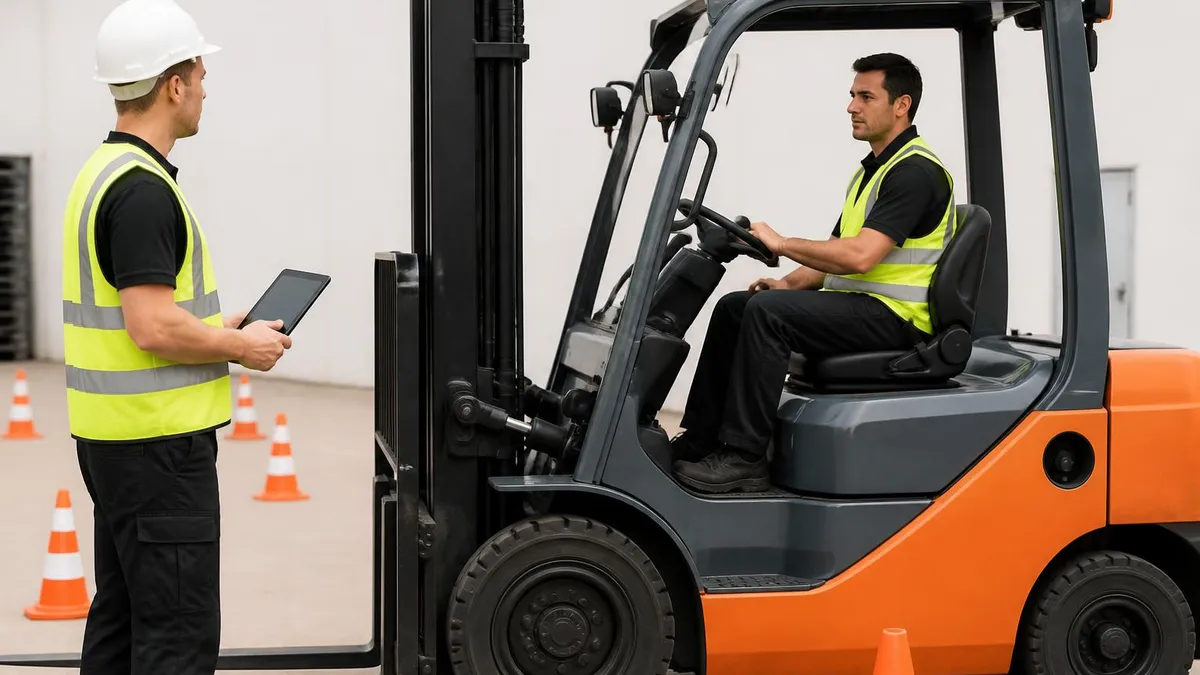
Forklift Safety Training: Complete OSHA Compliance Guide for Operators and Employers
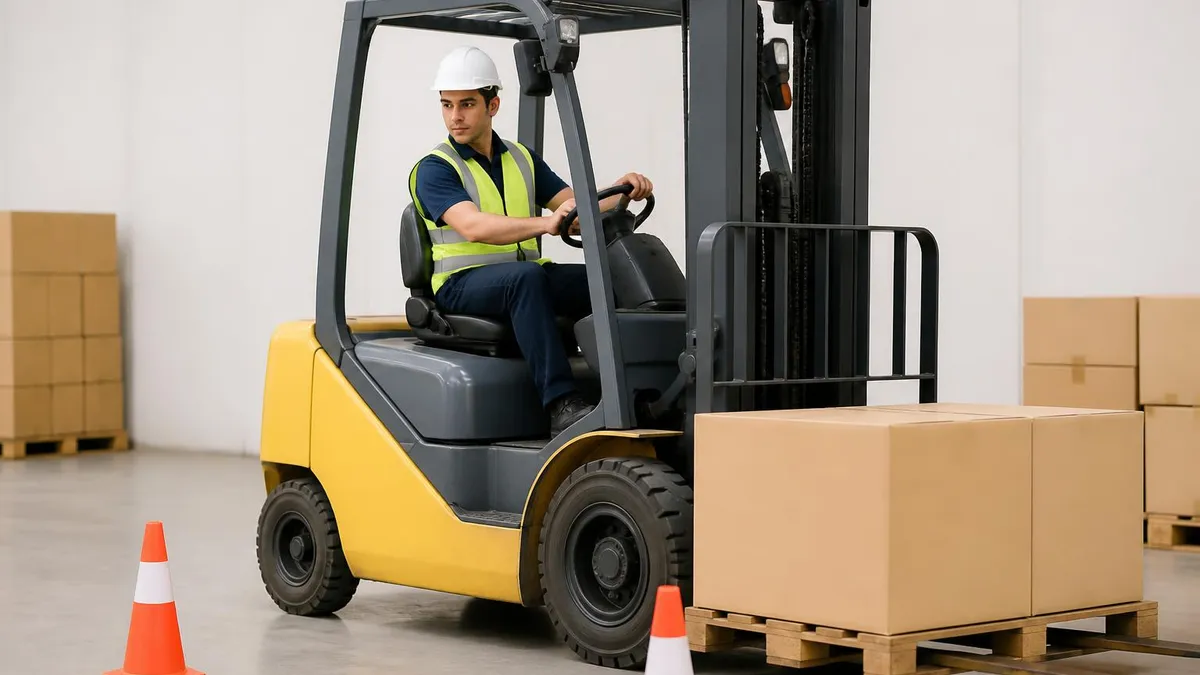
Forklift Repair Service: Complete Guide to Costs, Common Repairs, and Choosing the Right Technician
About the Author

Certified Crane Operator & Skilled Trades Exam Specialist
Ferris State UniversityRobert Martinez is a Journeyman Ironworker, NCCCO-certified crane operator, and forklift trainer with a Bachelor of Science in Construction Technology from Ferris State University. He has 21 years of ironworking, rigging, and heavy equipment operation experience across high-rise and industrial construction sites. Robert prepares candidates for crane operator, rigger, forklift, and skilled trades certification examinations.