
Forklift Training Near Me: Find OSHA-Approved Courses, Costs & Certification in 2026 October
Find forklift training near me with OSHA-approved courses, ✏️ costs, certification timelines, and operator job prep. Complete 2026 October guide for new and
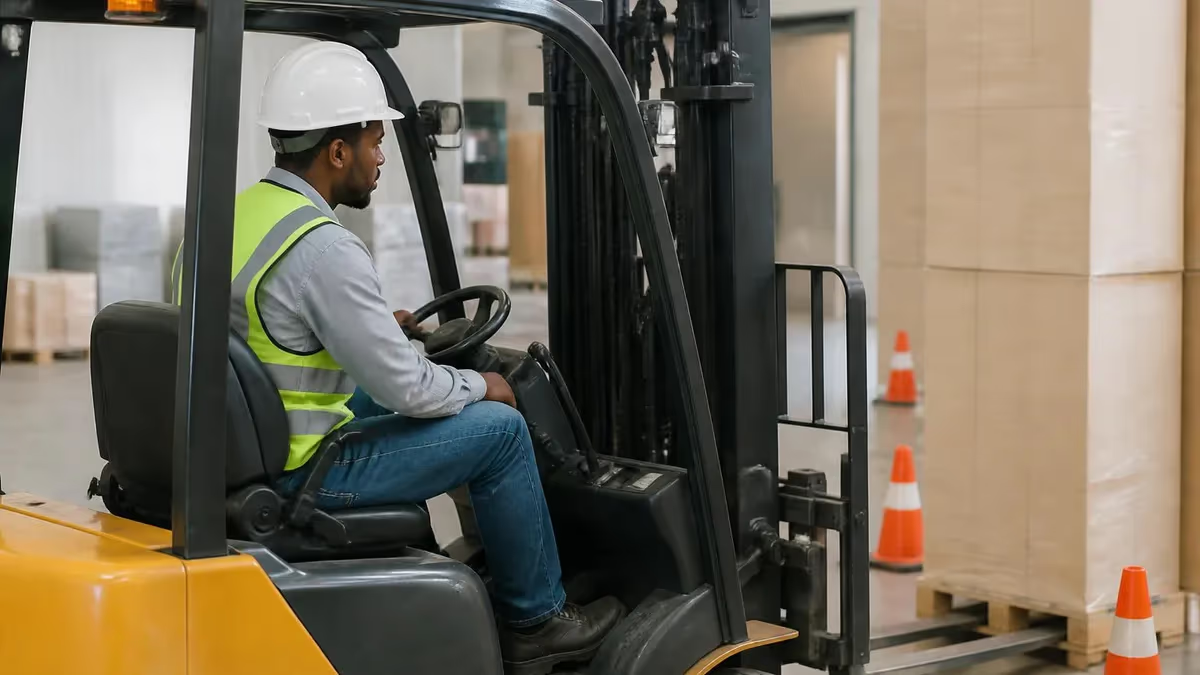
Searching for forklift training near me is the first step toward a stable, well-paying warehouse career, and the options in 2026 are broader than ever. Community colleges, private trade schools, mobile trainers who come to your workplace, and even online hybrid programs all offer OSHA-compliant instruction. The right choice depends on your schedule, your budget, and whether your employer will sponsor the certification of forklift operators in-house. Most learners complete classroom and hands-on portions within one to three days, then receive a wallet card valid for three years.
The federal rule that governs every program is OSHA 29 CFR 1910.178(l), which requires both formal instruction and practical evaluation on the specific truck a worker will operate. That means a class teaching only sit-down counterbalanced trucks does not legally certify you for reach trucks, order pickers, or a cherry picker forklift. Reputable schools disclose which classes (I through VII) they cover, and the best programs let you add endorsements for additional truck types at a reduced fee.
Pricing for forklift training ranges from $75 for a basic refresher to $250 for a full new-operator course that includes a written exam, a driving evaluation, and a printed certification card. Employer-paid training is increasingly common because warehouses, distribution centers, and construction sites cannot legally let an uncertified worker touch the controls. If you are hunting for a forklift rental near me at the same time you are job hunting, many rental yards now bundle a one-day operator class with the equipment.
Electric forklift demand is reshaping curricula in 2026. Battery-powered lift trucks now outsell internal-combustion models in North America for the first time, and training programs have added modules on lithium-ion safety, opportunity charging, and high-voltage lockout procedures. If you plan to work in food distribution, pharmaceutical warehousing, or any indoor environment, ask whether the course covers electric forklift handling specifically.
The job market continues to favor certified operators. The Bureau of Labor Statistics projects 67,400 annual openings for material moving machine operators through 2033, with median pay at $20.18 per hour and top earners crossing $30. Certified forklift operators consistently earn $2 to $4 more per hour than uncertified material handlers performing similar work, and they qualify for safety bonuses that uncertified workers cannot collect.
This guide breaks down where to find quality training, what each course actually covers, how to recognize OSHA-compliant providers, and how to prepare for both the written and practical evaluations. You will also see realistic timelines, costs, employer expectations, and the exact documentation you should walk away with on the last day of class. Bookmark the practice tests linked below so you can rehearse the written portion before you ever step into a classroom.
Forklift Training Near Me by the Numbers

Your Forklift Training Timeline From Sign-Up to Certification
Enrollment & Pre-Reading
Classroom Instruction
Written Examination
Hands-On Skills Drill
Practical Evaluation
Certification Card Issued
Finding quality forklift training near me starts with knowing which provider categories exist. Community colleges and technical schools host weekend or evening programs that range from $99 to $200, often through their continuing-education divisions. These programs typically use modern equipment and certified instructors with decades of warehouse experience. The downside is wait times — popular classes fill weeks in advance, especially in major metros like Atlanta, Dallas, Chicago, and Phoenix.
Private trade schools dedicated to material handling offer more flexibility. Companies like ForkliftCertification.com, CertifyMe.net, and National Forklift Foundation run open-enrollment classes nearly every weekday in industrial corridors. Pricing runs $150 to $250, but you walk out the same day with a printed card. Many partner with staffing agencies, so passing the course can lead directly to an interview the following week at a local distribution center.
Mobile trainers represent the fastest-growing segment. These instructors travel with portable equipment or use the employer's own forklifts to certify entire crews on-site. For small businesses, this eliminates the cost of sending workers off-property and ensures evaluation occurs on the actual machines used daily. Expect to pay $400 to $800 for a four-hour session that certifies up to six employees.
Online-hybrid programs split the classroom portion into self-paced video modules, followed by an in-person practical evaluation at a partner site. This format works well for night-shift workers or remote learners, but OSHA does not recognize purely online certification — the practical drive must always happen in person. Be wary of any website claiming you can earn a complete card without ever touching a truck. That document is worthless to a serious employer and exposes you to liability if cited during an OSHA audit.
Manufacturer dealer programs offer another path. Toyota, Crown, Hyster-Yale, Raymond, and Cat Lift Trucks all operate training academies tied to their service networks. These programs excel at brand-specific instruction, which matters if your future employer runs a fleet of one make. Dealer training often includes advanced modules on hydraulic systems, telematics, and predictive maintenance that go beyond baseline OSHA requirements.
Workforce development agencies in nearly every county fund free or subsidized forklift training for unemployed workers, veterans, and people transitioning out of incarceration. Look up your state's American Job Center or call 211 to be routed to local programs. Many cover the full course fee plus a small completion bonus, and graduates often receive job-placement assistance. WIOA funds, in particular, can cover both forklift and adjacent certifications like OSHA 10 in a single grant package.
When evaluating any provider, ask three questions before paying: does the program meet OSHA 29 CFR 1910.178(l) standards, will I receive a printed card the same day, and which truck classes does the certification cover? Reputable schools answer all three confidently. Schools that dodge or upsell paperwork should be avoided.

Forklift certification Practice Test Questions
Prepare for the Forklift certification Certification exam with our free practice test modules. Each quiz covers key topics to help you pass on your first try.
Forklift certification Certification Forkl...
Forklift certification Exam Questions covering Certification Forklift certification Maintenance and Repairs. Master Forklift certification Test concepts for certification prep.
Forklift certification Certification Forkl...
Free Forklift certification Practice Test featuring Certification Forklift certification Maintenance and Repairs Questions and Answers. Improve your Forklift certification Exam score with mock test prep.
Forklift certification Certification Forkl...
Forklift certification Mock Exam on Certification Forklift certification Operator Training and Certification Requirements. Forklift certification Study Guide questions to pass on your first try.
Forklift certification Certification Forkl...
Forklift certification Test Prep for Certification Forklift certification Operator Training and Certification Requirements Questions and Answers. Practice Forklift certification Quiz questions and boost your score.
Forklift certification Load Handling and S...
Forklift certification Questions and Answers on Load Handling and Stability. Free Forklift certification practice for exam readiness.
Forklift certification OSHA Regulations an...
Forklift certification Mock Test covering OSHA Regulations and Compliance. Online Forklift certification Test practice with instant feedback.
Forklift certification Pre-Operation Inspe...
Free Forklift certification Quiz on Pre-Operation Inspections. Forklift certification Exam prep questions with detailed explanations.
Forklift certification Refueling and Recha...
Forklift certification Practice Questions for Refueling and Recharging Procedures. Build confidence for your Forklift certification certification exam.
Forklift certification Safe Driving and Ma...
Forklift certification Test Online for Safe Driving and Maneuvering. Free practice with instant results and feedback.
Forklift certification Workplace Hazard Id...
Forklift certification Study Material on Workplace Hazard Identification. Prepare effectively with real exam-style questions.
Forklift certification Forklift Instructions
Free Forklift certification Test covering Forklift Instructions. Practice and track your Forklift certification exam readiness.
Forklift certification Forklift MCQ
Forklift certification Exam Questions covering Forklift MCQ. Master Forklift certification Test concepts for certification prep.
Forklift certification Forklift Employer R...
Free Forklift certification Practice Test featuring Forklift Employer Responsibilities. Improve your Forklift certification Exam score with mock test prep.
Forklift certification Forklift Penalties ...
Forklift certification Mock Exam on Forklift Penalties for Non-Compliance. Forklift certification Study Guide questions to pass on your first try.
Forklift Training Formats Compared
Traditional in-person forklift training combines classroom theory with hands-on practice at the school's facility. You spend three to four hours in a lecture room covering OSHA standards, load handling, and stability, then move outdoors or into a warehouse bay for the practical portion. This format is ideal for visual learners who benefit from immediate instructor feedback and the chance to ask questions in real time as concepts arise.
The trade-off is rigidity. Classes run on fixed schedules, usually weekdays from 8 a.m. to 4 p.m. or all-day Saturdays. If you work full time, you may need to burn vacation hours or wait for a weekend cohort. However, most graduates report higher confidence at the end because they completed every reps under direct supervision rather than self-pacing through video lectures.
Should You Pay for Training or Wait for Employer Sponsorship?
- +Self-paid certification gets you into the job market two to four weeks faster than waiting
- +You can apply to positions requiring a current OSHA card without explanation or delay
- +Staffing agencies pay $2 to $4 more per hour for certified operators on their rosters
- +You control the timing, location, and intensity of your training schedule
- +Certification is portable — the card stays valid even if you change employers
- +Many programs include resume coaching and direct introductions to local warehouse recruiters
- +Adds a verifiable credential to your background, helpful for parole, gig, or temp applications
- −Out-of-pocket cost ranges from $75 to $250 depending on provider and location
- −You must commit one to two full days, often unpaid, to attend classroom and practical sessions
- −Some employers will retrain you anyway on their own equipment as a policy
- −Lower-tier providers issue weak cards that careful employers may not accept
- −You assume the responsibility of renewing the card every three years yourself
- −Training does not guarantee a job; you still need the interview and references
- −Refunds are rare if you fail the practical evaluation and want your money back
Pros and Cons at a Glance
| Pros | Cons |
|---|---|
| Self-paid certification gets you into the job market two to four weeks faster than waiting | You must commit one to two full days, often unpaid, to attend classroom and practical sessions |
| You can apply to positions requiring a current OSHA card without explanation or delay | Some employers will retrain you anyway on their own equipment as a policy |
| You control the timing, location, and intensity of your training schedule | Lower-tier providers issue weak cards that careful employers may not accept |
| Certification is portable — the card stays valid even if you change employers | You assume the responsibility of renewing the card every three years yourself |
| Many programs include resume coaching and direct introductions to local warehouse recruiters | Training does not guarantee a job; you still need the interview and references |
| Adds a verifiable credential to your background, helpful for parole, gig, or temp applications | Refunds are rare if you fail the practical evaluation and want your money back |

Pre-Enrollment Checklist for Forklift Training Near Me
- ✓Confirm the program meets OSHA 29 CFR 1910.178(l) requirements in writing before paying
- ✓Verify the school issues a printed certification card the same day you pass
- ✓Ask which truck classes (I through VII) the course covers and whether endorsements are included
- ✓Request the instructor's credentials and years of operating experience for transparency
- ✓Check that the practical evaluation happens in person on an actual forklift you can touch
- ✓Confirm refund or retake policy in case you fail the written or practical portion
- ✓Ask whether reading materials and a study guide are provided before class begins
- ✓Inquire about job placement support, resume help, or staffing agency partnerships
- ✓Make sure closed-toe leather boots, long pants, and high-visibility vest are allowed or supplied
- ✓Bring two forms of ID, especially if the school reports to a state apprenticeship database
Mark your renewal date the day you certify
OSHA requires re-evaluation every three years, but also after any near-miss, accident, observed unsafe operation, equipment-type change, or workplace-condition change. Set a calendar reminder six weeks before expiration so you have time to schedule a renewal course without lapsing — an expired card legally bars you from operating, even briefly, on a job site.
Cost is the single biggest factor pushing learners toward one program over another, and the price spread is wider than most people realize. The cheapest legitimate option is a renewal-only refresher at $45 to $75 for someone whose card recently expired. Full new-operator training averages $149 for online-hybrid programs, $189 at community colleges, and $229 at private dedicated schools that include lunch, study materials, and a hard-copy card. Anything below $50 should raise red flags about OSHA compliance.
Employer sponsorship eliminates personal cost entirely. Major retailers and 3PLs — Amazon, Walmart, Target, FedEx, UPS, Costco, Home Depot, Lowes, GXO, DHL, and Performance Food Group — fund operator training as part of onboarding. New hires earn their regular hourly wage during the four to eight hour training window. The employer keeps a copy of the certification in your personnel file, and you receive the wallet card to keep regardless of how long you stay with that company.
Federal funding through the Workforce Innovation and Opportunity Act (WIOA) covers tuition for eligible workers, including the unemployed, dislocated workers, low-income adults, and youth aged 16 to 24. State workforce boards approve provider lists, so call your local American Job Center to confirm which schools accept WIOA vouchers. Veterans can use VET TEC or Chapter 31 Vocational Rehab funds, and many programs also accept GI Bill benefits for longer-term material handling certificates that bundle certification of forklift with OSHA 10 and warehouse logistics modules.
Trade unions including the Teamsters, Operating Engineers, and Carpenters offer member training at little or no cost. Apprenticeship programs through SkillsUSA, NCCER, and the Material Handling Institute also embed forklift training inside broader logistics curricula. If you are already in a related field — construction, manufacturing, agriculture — check whether your union local runs quarterly forklift refresher days for current members.
Tax treatment matters too. Out-of-pocket training expenses qualify for the Lifetime Learning Credit if the program is at an eligible institution, and unreimbursed work-related education may be deductible if you itemize. Keep the receipt and a copy of your certification card with your tax records for at least three years. For self-employed contractors who operate rental equipment, the full cost is a deductible business expense on Schedule C.
The hidden cost most learners overlook is wage time during training. Even if the course is free, taking two unpaid weekdays off can cost $300 to $400 in lost wages. Compare that to a $189 weekend class that does not disrupt your paycheck. For someone earning $18 an hour, the weekend option is often the cheaper choice once opportunity cost is factored in. Always run the math both ways before enrolling.
Forklift rental yards now bundle training with equipment hire, which is a powerful option for small businesses and construction sub-contractors. Renting a sit-down counterbalance machine runs $200 to $400 per day, and many United Rentals, Sunbelt, and Herc locations include a complimentary operator certification class with weekly or monthly rental agreements. Ask about this when you book — it can save your company several hundred dollars per worker.
Dozens of websites advertise a complete OSHA forklift certification in under one hour for $39 to $59, with no practical evaluation required. These certificates do not satisfy OSHA 29 CFR 1910.178(l) and will not protect you or your employer during an inspection. Citations for using these credentials average $15,625 per violation as of 2026. Always insist on an in-person practical drive before you accept any card as legitimate.
The practical evaluation is where most candidates feel anxiety, but it is also the most predictable portion of the day. Evaluators follow a standardized scoring sheet, so understanding the sequence in advance puts you ahead of half the room. Every evaluation begins with a complete pre-shift inspection: walk around the truck, check tires, forks, mast chains, hydraulic lines, horn, lights, seat belt, fluid levels, and data plate. Verbalize what you are checking — evaluators give full credit for narration even when nothing is wrong.
Mount the forklift correctly using three points of contact, settle into the seat, fasten the seat belt, and complete the operational checks before moving. Test the horn, headlights, brakes, steering, hydraulic tilt, and hydraulic lift in a clear area. Many candidates lose points here because they rush past operational checks to demonstrate driving skill. Evaluators rate the operational walk-through almost as heavily as the actual maneuvers.
For the driving portion, drive with the forks four to six inches off the ground, tilted slightly back, with no load in the air. Maintain a slow, steady pace and look in the direction of travel — that means turning your head to look over your shoulder when reversing. Use the horn at every blind corner, intersection, and pedestrian zone. Stop completely before changing direction. Never lift or lower a load while the truck is moving.
Stacking and de-stacking trips up beginners. Approach the rack squarely, stop two truck-lengths away, lift the forks to slightly above the destination height, creep forward, then lower onto the beams. Tilt forward gently to deposit the load, back up six inches, lower the forks fully, then exit the rack squarely. Reversing out at an angle is the most common point deduction because it risks contact with the upright. Practice this maneuver until it feels mechanical.
Pedestrian awareness matters as much as equipment skill. Evaluators stage a walker who crosses the lane mid-course to test whether you stop, sound the horn, and wait. Operators who keep moving fail this stage immediately. Always assume a pedestrian will appear at every blind corner, and treat the horn as your primary safety device, not a courtesy signal. Make eye contact with the walker before resuming travel.
If you are job hunting alongside training, browse open forklift rentals postings to understand the actual roles in your zip code. Posting boards reveal what local employers value — some prioritize narrow-aisle reach experience, others want order-picker specialists or stand-up rider operators. Tailoring your training endorsements toward in-demand specialties dramatically improves your interview rate.
Document everything from your certification day: scan the card, save a digital copy in cloud storage, photograph the front and back, and email a copy to yourself. Cards get lost, washing machines destroy them, and replacement fees from some schools run $25 to $50. Having a digital backup means you can show proof to a recruiter or staffing agency the moment a job opening appears, which gives you a real edge in fast-moving warehouse hiring cycles.
Walking into class prepared is the difference between a $189 investment and a $189 retake. Read the night before — your provider's pre-class packet, OSHA's free PowerPoint on powered industrial trucks (available at osha.gov), and at least one practice quiz on stability, load charts, and inspection. Even thirty minutes of focused review boosts written-exam scores by an average of fifteen percent according to instructor-collected pass-rate data from major training centers.
Dress for the practical drive even on classroom-only days, because many programs accelerate students into the driving portion the same afternoon. Closed-toe leather boots with reinforced toes, long pants, snug long sleeves or a high-visibility vest, safety glasses, and tied-back hair are standard. Some schools have spare PPE for borrowing, but arriving prepared signals professionalism and avoids delays that could push you into a different cohort.
Bring water, snacks, a notebook, two pens, photo identification, and any prior certifications you want listed on the new card. Phones must be silenced during instruction and stowed during the practical evaluation. Many schools confiscate or restrict phones during the written exam to prevent cheating — do not assume you can quietly look up answers. Failing for academic dishonesty can blacklist you from that provider for life.
Sleep matters more than cramming. The practical evaluation is part hand-eye coordination and part judgment, both degraded by fatigue. Aim for seven to eight hours of sleep the night before, eat a moderate breakfast, and avoid heavy caffeine that can make precise hydraulic control jittery. Skilled operators consistently report that calm focus beats nervous energy on the cone course.
After certification, request a letter of completion on letterhead in addition to the wallet card. Some staffing agencies and HR departments want a separate document for their files, and most schools provide one for free if asked at pickup. Save the letter alongside your card photo and the instructor's contact information. A reference call to your trainer can occasionally tip a borderline hiring decision in your favor.
Renew on schedule, not after expiration. OSHA requires re-evaluation every three years, but a card that lapses for even one day legally bars you from operating until you re-certify. Most schools offer a refresher class at half the new-operator rate, and many include the same printed card and digital archive. Calendar your renewal date the day you receive your card, with a six-week advance reminder so you have time to schedule without rushing.
Finally, treat your certification as the entry credential it is — valuable but only the beginning. Cross-train on additional truck classes (especially Class IV/V counterbalance, Class II narrow-aisle reach, and Class III pallet jacks) to maximize hiring options. Operators with three or more class endorsements typically earn $1.50 to $2.50 more per hour than single-class certified peers, and they qualify for cross-shift bonuses in operations that run multiple equipment types side by side.
Sample Forklift certification Practice Questions
Try these questions from our free Forklift certification practice tests. The correct answer and an explanation follow each question.
What happens if an employer fails to address unsafe forklift operations after an OSHA warning?
- A. Immediate forklift seizure
- B. Repeat violation fines up to $136,532
- C. Employees face fines
- D. Certification is permanently revoked
Answer: B. Repeat violation fines up to $136,532
OSHA imposes significant penalties for employers who repeatedly fail to address safety violations. If an employer receives a warning for unsafe forklift operations and does not correct the issue, they can face substantial repeat violation fines. These fines, which can be as high as $136,532 per violation, are designed to deter negligence and ensure strict compliance with safety regulations.
Can an employer allow an untrained employee to operate a forklift under direct supervision for training purposes?
- A. Yes, only during supervised training where it does not endanger the trainee or others
- B. No, never under any circumstance
- C. Yes, unsupervised if brief
- D. Yes, if the employee signs a waiver
Answer: A. Yes, only during supervised training where it does not endanger the trainee or others
Trainees may operate a truck only under direct supervision and where operation does not endanger anyone.
OSHA training must include which of the following components?
- A. Only classroom lectures
- B. Formal instruction, practical training, and evaluation
- C. Only a written test
- D. Watching one video
Answer: B. Formal instruction, practical training, and evaluation
OSHA training combines formal instruction, hands-on practical training, and workplace evaluation.
How often must OSHA require that each forklift operator's performance be evaluated?
- A. Every 6 months
- B. At least once every 3 years
- C. Every 5 years
- D. Only after an accident
Answer: B. At least once every 3 years
OSHA requires an operator evaluation at least once every three years.
Forklift Questions and Answers
Forklift Jobs Near Me: Complete Guide to Finding Best Opportunities
Forklift Operation & Equipment Knowledge Practice Test Video Answer
Forklift Inspection & Maintenance Practice Test Video Answer
Forklift Operator Jobs Near Me: Pay, Top Employers, Specialty Roles
30-Day Forklift certification Certification Study Plan — Pass on Your First Try
About the Author
Certified Crane Operator & Skilled Trades Exam Specialist
Ferris State UniversityRobert Martinez is a Journeyman Ironworker, NCCCO-certified crane operator, and forklift trainer with a Bachelor of Science in Construction Technology from Ferris State University. He has 21 years of ironworking, rigging, and heavy equipment operation experience across high-rise and industrial construction sites. Robert prepares candidates for crane operator, rigger, forklift, and skilled trades certification examinations.