
Forklift Rental Near Me: Complete Guide to Costs, Types & Where to Find One
Searching for forklift rental near me? Compare daily, 🆕 weekly, and monthly rates, equipment types, certification rules, and top suppliers in 2026 October.
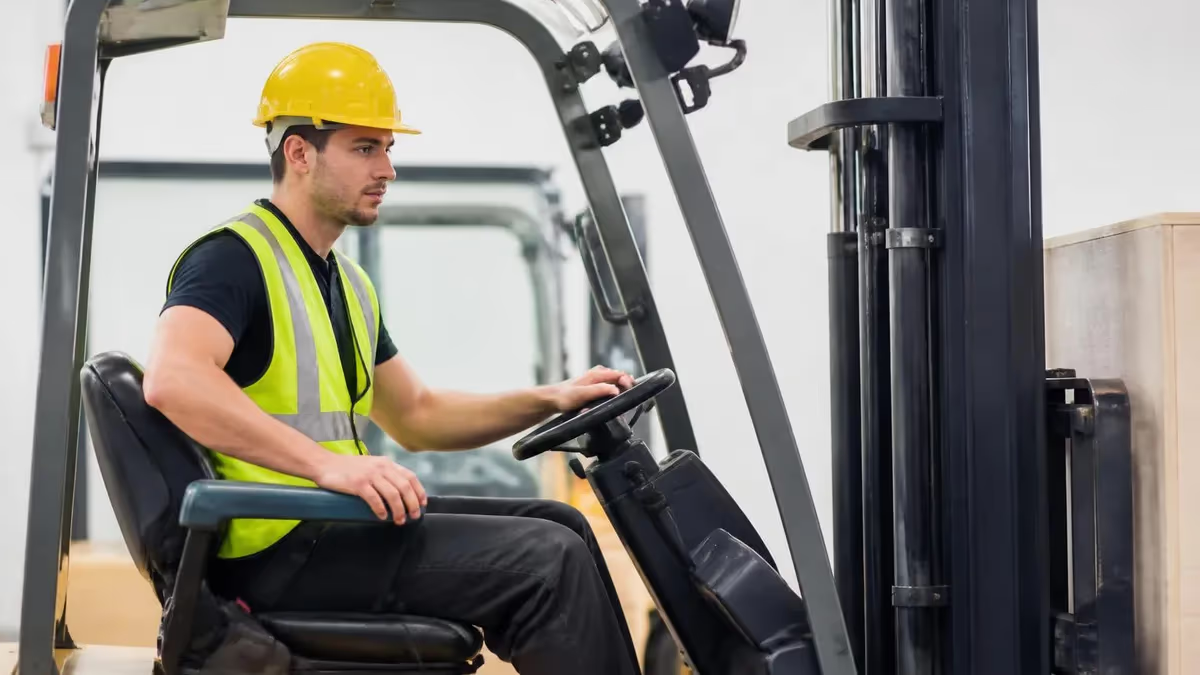
Searching for a forklift rental near me is one of the smartest moves a contractor, warehouse manager, or small business owner can make when a short-term lift job comes up. Renting gives you immediate access to professional-grade equipment without the six-figure purchase price, the maintenance overhead, or the depreciation curve that hits owned forklifts the moment they roll off the dealer lot. Whether you need a stand up forklift for a tight warehouse aisle or a rough-terrain machine for a muddy jobsite, the local rental market is bigger and more flexible than most first-time renters expect.
National chains like United Rentals, Sunbelt Rentals, Herc Rentals, and Home Depot run thousands of locations across the United States, while regional dealers such as Toyota Material Handling, Crown Lift Trucks, and Raymond Handling each maintain dense networks of branch yards. Add independent rental houses and equipment marketplaces like BigRentz, and most U.S. zip codes have at least three competitive options within a 30-mile delivery radius.
The pricing structure for forklifts is more predictable than people assume. A standard 5,000-pound capacity electric warehouse lift rents for roughly $150 to $250 per day, $450 to $750 per week, or $1,200 to $2,000 per month. Larger pneumatic or rough-terrain machines climb into the $300 to $500 daily range, and specialty equipment like a cherry picker forklift or telehandler can run $400 to $900 per day depending on lift height and reach capability.
Before you sign any rental agreement, you need three things lined up: the right forklift class for your load and surface, a certified operator who can legally run it under OSHA 29 CFR 1910.178, and proof of general liability insurance with the rental company listed as an additional insured. We will walk through each of those requirements in plain English, plus the often-overlooked questions about delivery fees, fuel surcharges, damage waivers, and overtime hour limits.
This guide also compares the real-world trade-offs between renting and buying, lists the specific forklifts you should consider for common job profiles, and gives you a printable pre-rental checklist you can take to any branch counter. By the end you will know exactly what to ask, what to budget, and how to avoid the three biggest mistakes new renters make when they walk into a rental yard for the first time.
One final note before we dig in. Rental availability tightens dramatically during peak construction season from April through October, around end-of-quarter warehouse inventory counts, and during the holiday retail surge from October through January. If you can book your forklift seven to ten days in advance during those windows, you will lock in better rates, get your first-choice equipment, and avoid the scramble that forces renters into oversized or underpowered machines that do not match the job.
We have organized this guide so you can jump directly to the section you need, whether that is pricing, equipment types, certification rules, or the supplier comparison. Use the table of contents on the right, and feel free to bookmark this page for the next time a project lands on your desk that needs lift capacity you do not currently own.
Forklift Rental Market by the Numbers

Forklift Rental Pricing by Term & Type
Knowing where to rent matters as much as knowing what to rent. The U.S. forklift rental market is dominated by four national chains and a long tail of regional and independent suppliers. United Rentals operates more than 1,500 branches and carries the broadest fleet, from 3,000-pound electric pallet jacks to 36,000-pound diesel container handlers. Sunbelt Rentals runs close to 1,100 locations and is often the most price-competitive on weekly and monthly terms for standard warehouse lifts.
Herc Rentals, spun off from Hertz Equipment, has roughly 400 locations concentrated in major metros and is known for newer fleet age, with most forklifts under three years old. The Home Depot Tool Rental Center carries lighter-duty forklifts at more than 1,300 retail locations and is the fastest option for same-day pickup of a 5,000-pound capacity machine, though their selection is limited compared to dedicated rental yards.
Beyond the chains, every major forklift manufacturer runs a dealer rental program. Toyota Material Handling dealers offer the most popular rental fleet by unit count, followed by Crown, Hyster-Yale, Raymond, and Mitsubishi Caterpillar. These dealer networks tend to carry the newest equipment, offer the best operator training packages, and provide the fastest service response if a rental unit breaks down mid-job, but their published daily rates often run 10 to 20 percent higher than the national chains.
Independent and regional rental houses fill the rest of the market. Companies like Carolina Handling in the Southeast, Wiese USA in the Midwest, and ProLift Industrial in the Mid-Atlantic compete aggressively on price and personal service. Online marketplaces such as BigRentz and EquipmentShare aggregate availability across multiple suppliers, letting you compare quotes from three to five vendors with a single online form, which is the fastest way to find the lowest rate in any given zip code.
When you call or click for a quote, always ask for three numbers: the base rental rate, the delivery and pickup fee, and the environmental or fuel surcharge. Those three line items together represent your true cost, and rental companies vary widely on the last two. A $185 daily rate with $250 round-trip delivery on a three-day job is actually $805, not the $555 you might assume from the advertised number. Comparing apples to apples requires forcing every quote into that same three-number format.
If you want to brush up on equipment knowledge before you walk into a rental yard, the practice questions at forklift rental near me cover the operator and equipment fundamentals every renter should know. Even seasoned managers find a quick refresher useful, because the rental counter staff will assume you know the difference between a Class I and Class IV lift, what cushion versus pneumatic tires mean for your floor surface, and whether a 188-inch triple-mast will clear your dock door.
Finally, do not overlook your local Caterpillar, Hyster, or Komatsu dealer for short-term rentals on construction-grade forklifts. These dealers often run promotional rates on slightly older inventory that is mechanically identical to their newest models, and they typically include a free safety walkaround at delivery that catches issues a self-service pickup from a national chain might miss.

Forklift certification Practice Test Questions
Prepare for the Forklift certification Certification exam with our free practice test modules. Each quiz covers key topics to help you pass on your first try.
Forklift certification Certification Forkl...
Forklift certification Exam Questions covering Certification Forklift certification Maintenance and Repairs. Master Forklift certification Test concepts for certification prep.
Forklift certification Certification Forkl...
Free Forklift certification Practice Test featuring Certification Forklift certification Maintenance and Repairs Questions and Answers. Improve your Forklift certification Exam score with mock test prep.
Forklift certification Certification Forkl...
Forklift certification Mock Exam on Certification Forklift certification Operator Training and Certification Requirements. Forklift certification Study Guide questions to pass on your first try.
Forklift certification Certification Forkl...
Forklift certification Test Prep for Certification Forklift certification Operator Training and Certification Requirements Questions and Answers. Practice Forklift certification Quiz questions and boost your score.
Forklift certification Load Handling and S...
Forklift certification Questions and Answers on Load Handling and Stability. Free Forklift certification practice for exam readiness.
Forklift certification OSHA Regulations an...
Forklift certification Mock Test covering OSHA Regulations and Compliance. Online Forklift certification Test practice with instant feedback.
Forklift certification Pre-Operation Inspe...
Free Forklift certification Quiz on Pre-Operation Inspections. Forklift certification Exam prep questions with detailed explanations.
Forklift certification Refueling and Recha...
Forklift certification Practice Questions for Refueling and Recharging Procedures. Build confidence for your Forklift certification certification exam.
Forklift certification Safe Driving and Ma...
Forklift certification Test Online for Safe Driving and Maneuvering. Free practice with instant results and feedback.
Forklift certification Workplace Hazard Id...
Forklift certification Study Material on Workplace Hazard Identification. Prepare effectively with real exam-style questions.
Forklift certification Forklift Instructions
Free Forklift certification Test covering Forklift Instructions. Practice and track your Forklift certification exam readiness.
Forklift certification Forklift MCQ
Forklift certification Exam Questions covering Forklift MCQ. Master Forklift certification Test concepts for certification prep.
Forklift certification Forklift Employer R...
Free Forklift certification Practice Test featuring Forklift Employer Responsibilities. Improve your Forklift certification Exam score with mock test prep.
Forklift certification Forklift Penalties ...
Forklift certification Mock Exam on Forklift Penalties for Non-Compliance. Forklift certification Study Guide questions to pass on your first try.
Forklift Types & Classes Available for Rent
Electric forklifts dominate indoor warehouse rentals because they produce zero emissions and run quietly enough for food, pharmaceutical, and retail backroom environments. Class I machines are sit-down rider trucks with cushion or pneumatic tires, typically rated for 3,000 to 6,000 pounds. Class II narrow-aisle reach trucks and stand-up forklifts handle racking up to 30 feet and need aisle widths of just 8 to 10 feet, making them ideal for dense storage operations.
Battery runtime is the critical spec to verify before renting. A standard 36-volt or 48-volt battery delivers six to eight hours of continuous use, enough for one shift. If you run two or three shifts, you need either a spare battery, an opportunity-charging compatible unit, or a lithium-ion fleet option. Ask the rental rep specifically about battery age, because a degraded lead-acid battery on a five-year-old rental truck can cut your runtime in half.
Renting vs. Buying a Forklift: Which Makes Sense?
- +Zero upfront capital outlay vs. $20,000 to $60,000 purchase price for a new lift
- +No long-term maintenance, repair, or rebuild costs as the machine ages
- +Rental cost is 100% tax-deductible as an operating expense in the year incurred
- +Access to newest model year equipment with current safety features and ergonomics
- +Flexibility to scale fleet up or down based on seasonal or project demand
- +Rental company handles all DOT registration, inspection, and compliance paperwork
- +Easy to swap equipment types if your job requirements change mid-project
- −Daily and weekly rates become expensive if you need the machine for more than 7 months per year
- −Limited customization options compared to spec-ing your own purchased unit
- −Availability tightens during peak construction season, sometimes forcing equipment compromises
- −Damage waivers and insurance add 10-15% to advertised base rates
- −No equity or resale value at the end of the rental term
- −Delivery and pickup fees can equal one full day of rental on short jobs
Pros and Cons at a Glance
| Pros | Cons |
|---|---|
| No long-term maintenance, repair, or rebuild costs as the machine ages | Limited customization options compared to spec-ing your own purchased unit |
| Access to newest model year equipment with current safety features and ergonomics | Availability tightens during peak construction season, sometimes forcing equipment compromises |
| Flexibility to scale fleet up or down based on seasonal or project demand | No equity or resale value at the end of the rental term |
| Rental company handles all DOT registration, inspection, and compliance paperwork | Delivery and pickup fees can equal one full day of rental on short jobs |

Pre-Rental Forklift Checklist: 10 Things to Confirm Before Signing
- ✓Confirm the exact load capacity rating at the lift height you actually need, not the base rating
- ✓Verify fuel type matches your job environment (electric for indoor, LPG for mixed, diesel for outdoor only)
- ✓Measure your dock door height, aisle width, and turning radius and match them to forklift specs
- ✓Check that mast collapsed height clears your lowest overhead obstacle (sprinklers, doors, beams)
- ✓Confirm tire type matches your floor surface (cushion for smooth concrete, pneumatic for outdoor)
- ✓Ask for a copy of the most recent annual inspection report and daily pre-use checklist
- ✓Verify your operators have current OSHA forklift certification valid for the specific class being rented
- ✓Get the delivery fee, pickup fee, fuel surcharge, and damage waiver in writing before signing
- ✓Confirm the included hour cap and the overtime hourly rate for jobs running long shifts
- ✓Add the rental company as additional insured on your general liability policy before delivery
If your job runs more than 9 days, ask for the monthly rate
Most rental companies quote monthly rates that work out to roughly 3.5 times the weekly rate, which means anything beyond 9 to 10 days of use is cheaper at the monthly tier. Rental reps rarely volunteer this math, so always ask both quotes and run the comparison yourself. On a 14-day job, switching from daily to monthly billing can save $800 to $1,500 on a standard 5,000-pound electric lift.
The single most expensive mistake first-time renters make is assuming the rental company verifies operator certification. They do not. OSHA 29 CFR 1910.178(l) places the entire burden of operator training, evaluation, and certification on the employer who uses the forklift, regardless of whether the equipment is owned or rented. If an uncertified operator runs your rented forklift, your company faces OSHA penalties starting at $16,131 per violation and climbing to $161,323 for willful or repeated violations as of the 2026 penalty adjustment schedule.
Valid operator certification requires three components: formal classroom or online training covering the specific equipment class, hands-on practical training using the same type of forklift, and a documented performance evaluation by a qualified trainer. The certification must be renewed every three years, and it is equipment-class specific. An operator certified on a Class I sit-down electric lift is not legally cleared to run a Class V pneumatic diesel unit without additional training documented in writing.
If your operators need to refresh or earn their certification of forklift before the rental delivery arrives, plan on a minimum of one full day for classroom plus practical training, ideally two days if you have multiple operators. National training providers like CertifyMe.net, ForkliftAcademy, and OSHA Education Center offer same-day online training that satisfies the classroom portion, leaving you to handle only the hands-on evaluation on your own site.
The rental company may offer to provide a certified operator with the equipment for an hourly fee, typically $45 to $85 per hour, plus a four-hour minimum. This is a common arrangement for one-off jobs and removes all certification liability from your business, but it doubles your cost compared to running with in-house operators. For projects longer than five days, certifying your own people almost always pencils out cheaper.
Daily pre-shift inspection is also legally required under OSHA, and the operator must document the inspection on a written or digital form before each shift begins. The rental company will provide an inspection checklist with the equipment, and your operator should walk through it methodically, checking fluid levels, hydraulic hoses, fork condition, mast operation, horn, lights, backup alarm, seat belt, and overhead guard before placing the truck in service. Any defect that affects safe operation must trigger an immediate return-to-yard for repair.
Specific industries face additional requirements layered on top of OSHA baselines. Food and pharmaceutical operations often require NSF-certified equipment with sealed components. Construction sites covered by 29 CFR 1926 add fall protection and traffic control rules. Distribution centers operating under California Cal/OSHA face stricter training documentation and more frequent renewal cycles. Verify these industry-specific overlays before your operators step on the truck.
Document everything. Keep operator certification cards, training records, daily inspection logs, and the signed rental agreement together in one project file for at least three years. If an incident occurs, OSHA investigators will ask for all of these documents, and the inability to produce any one of them typically converts an other-than-serious citation into a serious or willful violation with the corresponding penalty escalation.
Rental damage waivers typically cost 10-15% of the base rental rate and cover accidental damage, but they almost always exclude theft, vandalism, operator error, overhead damage, and damage from improper loading. Your commercial general liability policy may cover these gaps, but only if you add the rental company as an additional insured before delivery. Always request a certificate of insurance from your broker the same day you book the equipment.
The advertised daily rate is rarely the price you pay. A typical short-term forklift rental adds delivery fees, pickup fees, environmental surcharges, fuel charges, damage waivers, and overtime hour penalties that can increase your total bill by 30 to 50 percent. Understanding each line item before you sign protects you from sticker shock when the final invoice arrives, and gives you use to negotiate the items that are actually negotiable.
Delivery and pickup fees usually run $75 to $300 round-trip for distances under 25 miles, scaling up to $500 or more for longer hauls. These fees are based on driver time and truck mileage, and they are one of the most negotiable line items, especially if you bundle multiple pieces of equipment or commit to a longer rental term. Some suppliers waive delivery entirely on rentals over $2,500 or terms of two weeks or longer.
Environmental and fuel surcharges typically add 3 to 8 percent to the base rate and cover the rental company's cost of fluid disposal, emissions compliance, and rising fuel prices for their delivery fleet. These are generally non-negotiable but should always appear as a separate line item rather than buried inside the base rate, because a quote that hides surcharges makes comparison shopping impossible.
Hour caps and overtime rates catch many renters by surprise. Standard daily rentals include 8 operating hours, weekly rentals include 40 hours, and monthly rentals include 176 hours. Every hour beyond the cap bills at $5 to $15 per overage hour for standard equipment, and $20 to $40 per hour for telehandlers and specialty machines. If you run two shifts on a five-day rental, your overage charges alone can equal another full day of base rent.
Damage waivers deserve careful evaluation. The 10-15% surcharge buys you protection against accidental damage during normal operation, but typical waivers exclude theft, vandalism, weather damage, operator negligence, overhead impacts, and damage from loads exceeding capacity. If your commercial general liability policy already covers rented equipment, the waiver is duplicate coverage. If it does not, the waiver is essential, but you should still verify exactly what scenarios trigger or void coverage.
For projects requiring lift heights above 20 feet or any specialized work platform operations, consider a cherry picker forklift or a telehandler with a work-platform attachment instead of stacking a forklift with a basket. Most OSHA-compliant aerial work requires equipment specifically engineered and certified for personnel lifting, and rental yards stock dedicated order pickers and platform telehandlers that meet ANSI A92 standards without the legal exposure of improvised setups.
Finally, ask about loyalty programs and corporate accounts. United Rentals' Total Control program, Sunbelt's Command Center, and Herc Rentals' ProSolutions all offer negotiated pricing tiers, consolidated billing, dedicated account managers, and emergency replacement guarantees for repeat customers. Setting up a corporate account takes 30 minutes and saves 8 to 15 percent on every subsequent rental, often paying for itself on the second transaction.
With the strategy locked in, the final piece is execution day. Walk through this practical playbook the morning your rental arrives, and you will avoid the rookie mistakes that turn a smooth project into a billing dispute. Start with the unloading inspection. The delivery driver is required to remain on site while you and your designated forklift operator walk around the equipment, check for visible damage, photograph all four sides and the mast assembly, and confirm fluid levels, fork condition, tire wear, and operating hours on the meter.
Document the starting hour meter reading on the delivery ticket and take a clear photo of it. This single step prevents 90 percent of hour-cap billing disputes at the end of the rental. The same photo discipline applies at pickup: photograph the meter reading, all four sides, and the mast condition before the driver hauls the unit away. Email these photos to yourself and your bookkeeper the same day, so they are time-stamped and stored independently of the rental company's records.
Run a full functional test before the driver leaves. Cycle the mast through its entire range, test tilt forward and back, run forks side-shift if equipped, sound the horn, verify lights and backup alarm, and drive the unit forward and reverse at low speed. Any defect found during this initial test should trigger an immediate exchange request, not a workaround. Rental companies will swap the unit free of charge if you flag issues at delivery, but charge full repair costs if the same issue is reported three days later.
Set up a daily pre-shift inspection routine and stick to it. Use the OSHA-compliant checklist the rental company provides, or download a standard form from the National Safety Council. The inspection takes five to seven minutes per shift and creates the documentation trail you need for both OSHA compliance and end-of-rental damage disputes. Keep all completed forms together with the rental contract for at least three years after the rental closes.
Plan your fuel and battery logistics in advance. For LPG units, identify two propane exchange locations within 10 miles of your jobsite before delivery day. For electric units, confirm that your facility has 220V or 480V charging capacity matching the battery, and that the charger and cable arrived with the truck. Running out of propane mid-shift or discovering you have the wrong charger after-hours kills production and creates pressure to cut safety corners.
For longer-term rentals running 30 days or more, schedule a mid-term service call with the rental company. Most providers will send a technician to your site to perform 50-hour or 100-hour maintenance under the rental agreement, including fluid top-ups, hydraulic inspection, and brake checks. This service is included in the rental rate but only happens if you request it, and it dramatically reduces breakdown risk in the second half of the rental term.
Finally, close out the rental properly. Schedule pickup at least 48 hours in advance, complete the final inspection alongside the driver, get a signed pickup ticket with the final hour meter reading and damage assessment, and request the final invoice within 48 hours of equipment return. Reviewing the invoice while the rental details are still fresh in everyone's memory makes it easy to spot and dispute any incorrect line items before they age into the unpayable column on your accounting ledger.
Sample Forklift certification Practice Questions
Try these questions from our free Forklift certification practice tests. The correct answer and an explanation follow each question.
A forklift operator is working in an area where both forklifts and pedestrians share the same aisles. Which of the following is considered a primary engineering control to mitigate the hazard of collisions?
- A. Requiring pedestrians to wear high-visibility vests.
- B. Training operators to always yield to pedestrians.
- C. Installing physical barriers to create designated walkways.
- D. Posting signs that warn of forklift traffic.
Answer: D. Posting signs that warn of forklift traffic.
While training, PPE, and signs are important administrative controls, the most effective way to prevent collisions is to physically separate forklift traffic from pedestrian traffic. Installing guardrails or barriers is an engineering control that removes the hazard by design.
Where should LPG forklift refueling ideally take place?
- A. In an enclosed storage room
- B. In a well-ventilated outdoor or open area
- C. Next to the battery charging station
- D. In a sealed maintenance bay
Answer: B. In a well-ventilated outdoor or open area
Propane refueling should occur outdoors or in a well-ventilated area to prevent gas accumulation.
What should be done if the forklift's warning horn is found to be inoperable during inspection?
- A. Continue using the forklift but shout warnings verbally
- B. Remove the forklift from service until the horn is repaired
- C. Tape a note on the forklift informing others
- D. Only use the forklift in low-traffic areas
Answer: B. Remove the forklift from service until the horn is repaired
A functioning horn is a required safety device; an inoperable horn means the forklift must be taken out of service immediately.
To keep the forklift stable, the combined center of gravity must remain:
- A. Outside the stability triangle
- B. Within the stability triangle
- C. Directly over the rear axle
- D. As high as possible
Answer: B. Within the stability triangle
The truck stays upright only while the combined center of gravity stays inside the stability triangle.
Forklift Questions and Answers
Forklift Jobs Near Me: Complete Guide to Finding Best Opportunities
Forklift Operation & Equipment Knowledge Practice Test Video Answer
Forklift Inspection & Maintenance Practice Test Video Answer
Forklift Operator Jobs Near Me: Pay, Top Employers, Specialty Roles
30-Day Forklift certification Certification Study Plan — Pass on Your First Try
About the Author

Certified Crane Operator & Skilled Trades Exam Specialist
Ferris State UniversityRobert Martinez is a Journeyman Ironworker, NCCCO-certified crane operator, and forklift trainer with a Bachelor of Science in Construction Technology from Ferris State University. He has 21 years of ironworking, rigging, and heavy equipment operation experience across high-rise and industrial construction sites. Robert prepares candidates for crane operator, rigger, forklift, and skilled trades certification examinations.