
Forklift Inspection Checklist: Complete Pre-Shift OSHA Guide for 2026 October
📗 Complete forklift inspection checklist with OSHA pre-shift items, electric & propane checks, and downloadable daily log for operators.
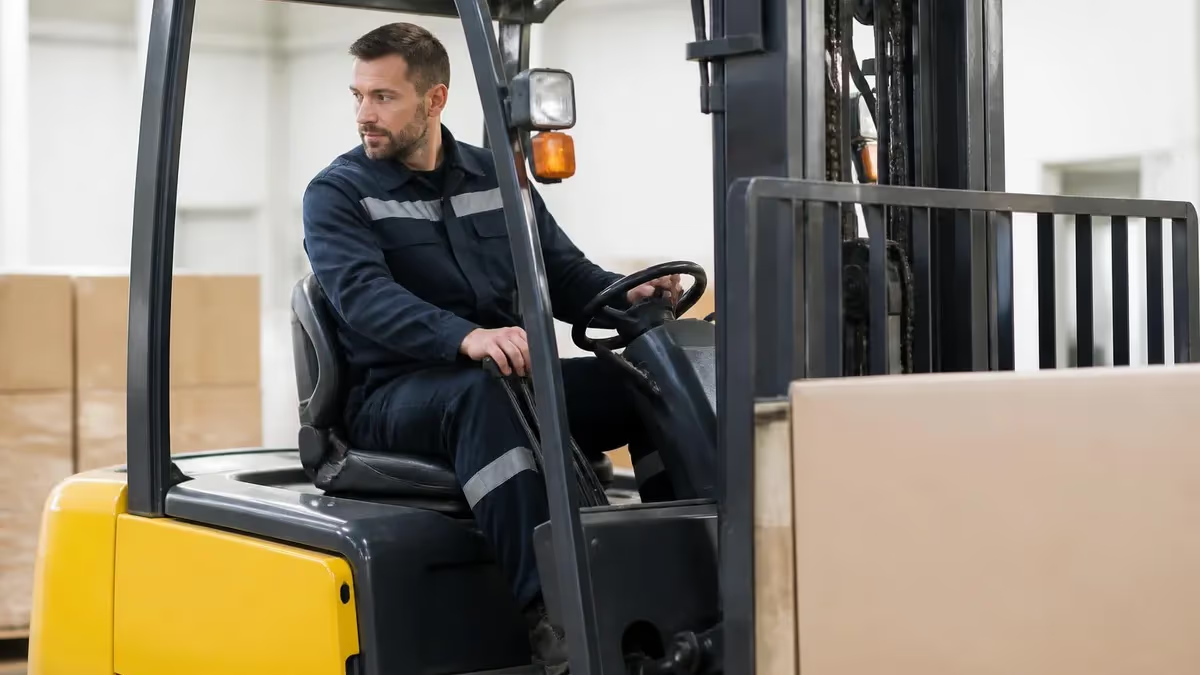
A thorough forklift inspection checklist is the single most important safety habit any operator can build before turning the key. OSHA 29 CFR 1910.178(q)(7) requires every powered industrial truck to be examined at least daily, and before every shift change when used around the clock. Whether you operate a brand new electric forklift in a clean food warehouse, a propane sit-down in a steel yard, or a beat-up rental from the local yard, the inspection routine looks remarkably similar and takes only seven to ten minutes when you know the sequence.
Most operators learn the checklist during their initial certification of forklift training, but skills fade fast. Surveys by the Industrial Truck Association show that fewer than 40% of operators perform a complete pre-shift inspection on any given day, and roughly one in four reported defects goes unrecorded. That gap is exactly where injuries, citations, and equipment downtime come from. A documented inspection is also your strongest legal defense if an incident later goes to court or to an OSHA compliance officer.
This guide breaks the inspection into the same logical zones professional fleet trainers use: walk-around visual, fluid and battery checks, operational checks with the engine off, and finally operational checks with the engine running. We will cover every item on the standard Class I through Class V truck, point out the most commonly missed defects, and show you exactly what to record on the daily log so your paperwork survives an audit. Real-world examples come from busy distribution centers, lumberyards, and dock operations.
You will also learn the difference between a defect that requires immediate red-tag and a defect that can be scheduled for routine maintenance. We borrow the same priority system used by ANSI/ITSDF B56.1, the consensus standard OSHA references for design and operation. By the end of this article, you should be able to walk up to any unfamiliar truck, perform a complete inspection, and confidently approve or reject it for service.
If you are still searching for steady work in this field, our deep-dive on forklifts employment opportunities pairs perfectly with this guide. Employers consistently rank inspection discipline as the top behavioral indicator they look for when promoting drivers to lead operator or trainer roles. The wage premium for an operator who can also train new hires on inspections runs $3 to $7 per hour in most US metros.
Finally, this article is written for the US workforce. Every regulation referenced is federal OSHA or ANSI; state plan states like California, Michigan, and Washington may impose stricter rules, especially around battery rooms and indoor air quality. Always cross-check your facility-specific procedures with the supervisor on duty before adapting any checklist below. With that in mind, let us walk through the numbers, the steps, and the documentation that turn a casual glance into a defensible safety routine.
By the time you finish reading, you will have a printable framework, a way to teach it to new hires in under thirty minutes, and a clear understanding of which findings shut a truck down versus which findings just get logged for the maintenance team. The goal is not paperwork for its own sake — it is fewer pinch-point injuries, fewer overturns, and a cleaner OSHA 300 log at the end of the year.
Forklift Inspection by the Numbers

Why Daily Forklift Inspections Are Legally Required
Powered industrial trucks must be examined at least daily before being placed in service. Trucks used on a round-the-clock basis must be examined after each shift. Defects must be reported and corrected before use.
The consensus design and operation standard requires the user to perform a pre-operation inspection. It defines specific items to check and outlines the operator's responsibility to remove unsafe trucks from service immediately.
Employers must retain inspection records for inspection by OSHA. Most facilities keep paper or digital logs for a minimum of one year. Failure to produce records during an audit is itself a citable offense.
Commercial general liability carriers routinely deny claims when documented inspections are missing. A complete, signed daily log is often the single deciding piece of evidence in litigation following a forklift incident.
The walk-around visual inspection is where roughly 80% of defects on rental and aging trucks show up, so do not rush it. Start at the operator compartment and circle the truck in the same direction every shift — most trainers recommend counter-clockwise so you finish at the data plate. Look for fluid puddles under the truck before you do anything else; fresh hydraulic oil is amber, engine oil is dark brown, transmission fluid is reddish, and coolant is bright green or orange. A puddle that was not there yesterday is always worth investigating before keying the truck on.
Tires are the next major checkpoint and the most commonly overlooked. Cushion (solid) tires should not show chunking deeper than one inch, exposed cord, or flat spots that cause the truck to thump as it rolls. Pneumatic tires need a tread depth check and inflation pressure within five PSI of the data plate spec. A low front tire on a counterbalanced truck shifts the load center forward and can quietly reduce your rated capacity by 10 to 15%, which is exactly how tip-overs happen on routine loads.
Move to the forks next. Each fork should be examined for cracks at the heel — the 90-degree bend where the upright meets the blade. Use a fork wear caliper or a simple gauge to confirm the blade thickness is at least 90% of the shank thickness. Heel cracks are not repairable; the fork must be replaced as a pair. Also inspect the positioning latches, the fork pins, and the carriage stops. A missing positioning pin lets a fork drift outward mid-lift, dropping the load.
The mast, chains, and hoses come next. Look up the channels for bent rails, worn bearings, or chain links that are stretched, twisted, or rusted. Chains should be measured with a chain wear gauge every 250 hours; a 3% elongation is the replacement threshold. Hydraulic hoses must be free of cracks, blisters, and weeping fittings. A weeping hose under 3,000 PSI hydraulic pressure can fail without warning and inject fluid into skin — a serious medical emergency.
Check the overhead guard, load backrest extension, seat, and seat belt. The overhead guard cannot be modified, drilled, or welded without manufacturer approval; even a small zip-tied flashlight bracket can void certification. The seat belt is mandatory on all sit-down counterbalanced trucks built after 1992 and must latch firmly. A frayed or cut belt is an immediate red-tag item. Many operators are surprised to learn that a missing data plate is also a red-tag item — without it, the rated capacity is legally unknown.
Finally, inspect the lights, horn, mirrors, and backup alarm if equipped. Pedestrian-heavy facilities increasingly require blue spotter lights and red zone lasers; if your facility specifies them, missing or broken units are inspection failures. Cleanliness counts too: a buildup of cardboard, plastic wrap, or hydraulic fluid on the engine compartment is a fire hazard, especially on propane trucks where ignition sources sit next to flammable debris. If you plan to advance into the field, our guide to the certification of forklift exam covers every visual inspection item in test-question format.
One final tip on walk-arounds: do them with the truck off and the key in your pocket. Operators have been crushed while inspecting masts when a coworker climbed on and accidentally lowered the carriage. The OSHA-recommended habit of pocketing the key is simple, free, and has prevented dozens of documented fatalities since the rule was popularized in the early 2000s. Make it a non-negotiable part of your routine no matter how rushed the morning feels.

Forklift certification Practice Test Questions
Prepare for the Forklift certification Certification exam with our free practice test modules. Each quiz covers key topics to help you pass on your first try.
Forklift certification Certification Forkl...
Forklift certification Exam Questions covering Certification Forklift certification Maintenance and Repairs. Master Forklift certification Test concepts for certification prep.
Forklift certification Certification Forkl...
Free Forklift certification Practice Test featuring Certification Forklift certification Maintenance and Repairs Questions and Answers. Improve your Forklift certification Exam score with mock test prep.
Forklift certification Certification Forkl...
Forklift certification Mock Exam on Certification Forklift certification Operator Training and Certification Requirements. Forklift certification Study Guide questions to pass on your first try.
Forklift certification Certification Forkl...
Forklift certification Test Prep for Certification Forklift certification Operator Training and Certification Requirements Questions and Answers. Practice Forklift certification Quiz questions and boost your score.
Forklift certification Load Handling and S...
Forklift certification Questions and Answers on Load Handling and Stability. Free Forklift certification practice for exam readiness.
Forklift certification OSHA Regulations an...
Forklift certification Mock Test covering OSHA Regulations and Compliance. Online Forklift certification Test practice with instant feedback.
Forklift certification Pre-Operation Inspe...
Free Forklift certification Quiz on Pre-Operation Inspections. Forklift certification Exam prep questions with detailed explanations.
Forklift certification Refueling and Recha...
Forklift certification Practice Questions for Refueling and Recharging Procedures. Build confidence for your Forklift certification certification exam.
Forklift certification Safe Driving and Ma...
Forklift certification Test Online for Safe Driving and Maneuvering. Free practice with instant results and feedback.
Forklift certification Workplace Hazard Id...
Forklift certification Study Material on Workplace Hazard Identification. Prepare effectively with real exam-style questions.
Forklift certification Forklift Instructions
Free Forklift certification Test covering Forklift Instructions. Practice and track your Forklift certification exam readiness.
Forklift certification Forklift MCQ
Forklift certification Exam Questions covering Forklift MCQ. Master Forklift certification Test concepts for certification prep.
Forklift certification Forklift Employer R...
Free Forklift certification Practice Test featuring Forklift Employer Responsibilities. Improve your Forklift certification Exam score with mock test prep.
Forklift certification Forklift Penalties ...
Forklift certification Mock Exam on Forklift Penalties for Non-Compliance. Forklift certification Study Guide questions to pass on your first try.
Inspection Differences by Forklift Type
An electric forklift inspection adds five battery-specific checks to the standard routine. Verify the battery state of charge is above 20%, confirm the vent caps are seated, check that the electrolyte level covers the plates on flooded lead-acid units, and inspect the cable connections for corrosion or heat discoloration. A green-tinged terminal is acid creep and must be cleaned with baking soda solution before the truck returns to service.
Also inspect the battery retainer or hood latch on stand up forklift models that use side-extract batteries. A missing retainer allows the battery to shift during turns, which has caused tip-overs in narrow-aisle racking. Lithium-ion units skip the electrolyte check but require a BMS error code scan — a flashing red light on the dash means stop and call service immediately, never reset and continue.
Paper Logs vs Digital Inspection Apps
- +Digital apps timestamp every entry and prevent backdating defects
- +Photos of defects upload directly to maintenance work orders
- +Supervisors get instant alerts on red-tag items via email or SMS
- +Trend reports identify trucks that fail repeatedly for the same reason
- +Cloud storage satisfies OSHA records-retention rules with zero filing effort
- +Multilingual interfaces help non-English speaking operators complete forms accurately
- −Tablets and phones can fail in cold storage below 0°F
- −Subscription fees range from $8 to $25 per truck per month
- −Operators may rush through screens by tapping defaults without inspecting
- −Wi-Fi dead zones in steel-roofed warehouses cause sync delays
- −Initial setup requires loading every truck VIN and capacity into the system
- −Older operators sometimes resist app-based workflows and need extra training

Complete Pre-Shift Forklift Inspection Checklist
- ✓Walk a full circle around the truck and note any fluid puddles under it
- ✓Inspect tires for chunking, cuts deeper than one inch, or low inflation
- ✓Check forks for cracks at the heel and confirm blade thickness is at least 90% of shank
- ✓Verify positioning latches, fork pins, and carriage stops are present and functional
- ✓Examine mast channels, rollers, and lift chains for damage or stretch beyond 3%
- ✓Inspect all hydraulic hoses for blisters, cracks, or weeping fittings under fittings
- ✓Confirm overhead guard, load backrest, seat, and seat belt are intact and unmodified
- ✓Test horn, lights, backup alarm, and warning beacons for proper operation
- ✓Check fluid levels: engine oil, coolant, hydraulic oil, fuel or battery charge
- ✓Verify data plate is legible and matches the configuration of the truck and attachments
- ✓Operate hydraulic functions through full range — lift, lower, tilt, sideshift
- ✓Sign and date the daily inspection log and red-tag any defects requiring repair
Photograph every defect before you red-tag
Snap a phone photo of any cracked fork, leaking hose, or worn chain the instant you find it. Attach the image to your inspection log or email it to the maintenance supervisor. This single habit eliminates 90% of "it was fine yesterday" disputes and gives the repair tech enough context to bring the right parts on the first trip. It also protects you personally if the truck later causes an injury — your timestamped photo proves you reported the issue before service.
Documenting defects correctly is just as important as finding them. Every facility should have a standardized inspection log with at minimum: truck number, date, operator name and signature, hour-meter reading, and a yes/no or pass/fail mark for each inspection item. Defects should be described in plain language — "left front tire has 2-inch chunk missing, exposing cord" beats "tire bad." A vague entry like "check tires" can be interpreted half a dozen ways and routinely leads to repeat failures on the same truck.
The red-tag system separates immediate safety hazards from routine maintenance items. A red tag means the truck is out of service until the defect is repaired, period. Items that always trigger a red tag include: any fork crack, any hydraulic leak under pressure, inoperative brakes or parking brake, missing or torn seat belt, missing overhead guard or data plate, propane tank with structural damage, and battery acid leakage. The operator who finds the defect has the authority — and the legal duty — to remove the key and tag the steering wheel.
Yellow tags or "watch list" tags cover defects that reduce performance but do not immediately endanger life — for example, a worn hour meter, a non-critical light, or slow hydraulic lift speed. Yellow-tagged trucks can continue limited service while a work order is processed, usually within 7 to 14 days. Some fleets skip the yellow category and use only red-tag/return-to-service, which simplifies training but can cause unnecessary downtime when defects are minor.
Inspection records must be retained for at least one year under OSHA's general recordkeeping practice, though many fleet managers keep them for five years to align with workers' compensation statutes of limitations. Digital systems make this trivial; paper systems require a dedicated three-ring binder per truck or per month. During an OSHA inspection, you will be asked to produce the last 12 months of logs within minutes — practice this drill so the answer is never "let me look for them."
Trend analysis is the underused superpower of inspection data. If the same truck shows hydraulic leaks three months in a row, the issue is rarely the hose — it is more likely a worn ram seal, a contaminated reservoir, or a flexing frame member. A simple monthly spreadsheet sorting defects by truck number and category reveals these patterns instantly. Many maintenance managers schedule preventive rebuilds based on this data rather than fixed hour intervals, saving 20 to 30% on parts.
If your fleet includes equipment purchased used, consider running our resource on every forklift for sale evaluation. The same inspection checklist used daily doubles as a pre-purchase inspection — just expand the visual checks to include frame welds, axle play, and mast pin wear. A 30-minute pre-purchase inspection has saved buyers tens of thousands on what turned out to be salvage-grade trucks marketed as "shop ready."
Finally, never sign an inspection log for a truck you did not personally inspect. This is the single most common falsification cited by OSHA, and it shifts personal liability onto the signer if an incident occurs. If a supervisor pressures you to pencil-whip the form, document the request in writing, refuse to sign, and escalate. Reputable employers will back you up; the ones who do not are exactly the workplaces where serious incidents are statistically most likely.
In addition to the daily operator inspection, OSHA requires a documented annual inspection by a qualified mechanic. Trucks with an expired annual sticker — even by one day — are legally out of service. Operating one exposes both the operator and the employer to citations under 1910.178(q)(7). Always check the dated annual decal on the overhead guard before keying the truck on.
Training new operators on inspections is where most safety programs stumble. The temptation is to hand the new hire a one-page checklist and send them to the truck. Resist this. The correct approach is a two-step process: classroom walkthrough of every item with photos of real defects, followed by hands-on inspections on three different truck types under a trainer's eye. The classroom segment runs about 90 minutes and the hands-on portion adds two to three hours. This investment is recovered the first time the trainee catches a serious defect.
Use real defective parts as training aids whenever possible. A cracked fork, a stretched chain, and a damaged hydraulic hose tell more in 30 seconds than any video. Most fleet shops have a scrap shelf with exactly these items; ask the lead mechanic to set aside a teaching kit. Some employers go further and create a deliberately staged training truck with 8 to 12 planted defects of varying severity, allowing the trainee to demonstrate detection in real conditions before signing off.
Document the training itself with the same care as the inspections. OSHA 1910.178(l) requires that operator training be documented with the trainee name, training date, evaluator name, and the type of truck and conditions covered. Inspection training should appear as a specific line item in this record. Three-year recertification under the same regulation must also re-evaluate inspection performance, not just driving skills — a point many employers miss until they fail an audit.
Bilingual training materials are increasingly important. Roughly 30% of US warehouse operators are primarily Spanish-speaking, and a smaller but growing share speak other languages. OSHA explicitly requires training to be delivered in a language the operator understands. Pre-translated checklists from major manufacturers like Toyota, Crown, and Hyster are free for download and use, and they share standardized icons that work across language barriers. Use them.
Mentorship pays dividends after the initial training too. Pair every new operator with an experienced one for the first 30 shifts and require both to sign the daily inspection log. The mentor benefits from refreshed knowledge and the trainee builds muscle memory for the routine. After 30 shifts most operators are ready to inspect independently, though spot audits by supervisors should continue indefinitely. Three random audits per operator per year is the industry benchmark, with one always conducted during off-shift hours.
Cross-training operators on attachments — clamps, rotators, push-pulls, telescopic boom or cherry picker forklift setups — adds new inspection items to the routine. Each attachment requires its own pre-use checks including pin retention, hydraulic line condition, and a verified rated capacity decal that matches the truck. Never assume an attachment that fit yesterday will fit today; chain rotators in particular can develop play that goes unnoticed until a load drops.
Lastly, build a culture where finding defects is celebrated, not punished. The worst inspection programs treat red tags as productivity losses; the best ones treat them as wins. Operators who find serious defects should be publicly recognized, not pulled aside and questioned. The math is simple: a 90-minute downtime to repair a cracked fork costs far less than a single recordable injury, which averages $42,000 in direct costs plus indirect costs of two to four times that amount.
Practical inspection tips separate the experienced operator from the rookie. First, always inspect the truck in the same physical location and the same direction every day. Repetition burns the sequence into muscle memory and dramatically reduces missed items. Many large distribution centers paint a yellow inspection box on the floor near the charging station; the truck must park inside it before the shift ends. This serves the inspection routine and the next operator who picks up the truck.
Second, perform the operational checks in a clear, open area away from racking, people, and other trucks. Engaging the mast, tilt, and sideshift to their full ranges is mandatory, and a mistimed hydraulic release can spear a pallet from twenty feet away. The operator station of a stand up forklift in particular requires good visibility during these tests — the operator stands sideways and a clipped racking upright can pin a leg in seconds. Choose a designated test zone and use it consistently.
Third, never bypass safety interlocks during inspection or operation. Modern trucks include seat presence sensors, brake-pedal interlocks, and dead-man switches that disable hydraulics if the operator is not properly positioned. Disconnecting or zip-tying these systems is a common practice in older fleets and is universally cited by OSHA when discovered. If an interlock is faulty, red-tag the truck — do not defeat it. The interlock exists because someone, somewhere, has already been killed by exactly the failure mode it prevents.
Fourth, factor the load and the environment into your inspection mindset. A truck that passes inspection for indoor warehouse use may not be suitable for outdoor lumberyard work. Pneumatic tires, dual rear wheels, weather caps, and engine block heaters are environment-specific. If you regularly rent equipment, confirm the rental house provided the correct configuration for your work — many forklift rental contracts include the wrong tire type for the customer's surface, leading to premature wear and unstable loads.
Fifth, build a relationship with your maintenance team. The operator who knows the lead mechanic by name, brings them coffee occasionally, and explains defects in clear terms gets faster repairs than the operator who scrawls illegible notes and tosses them at the parts counter. Maintenance teams are the unsung heroes of safe forklift operation; a quick five-minute conversation about a borderline defect often clarifies whether to red-tag or to keep running until the next scheduled service.
Sixth, keep a personal inspection log even if your employer does not require one. A small notebook or phone notes app tracking the trucks you drove, the hours you logged, and any defects you reported builds a portfolio of professional behavior that is gold during job interviews and during workers' comp claims. Hiring managers at higher-paying employers actively look for this kind of documentation as a marker of operator quality. It also helps you spot patterns across rental equipment from different yards.
Seventh and finally, refresh your inspection training every year even though OSHA only mandates it every three. The standard evolves, manufacturers release new safety features, and habits drift. Spending one hour per year reviewing the checklist with a senior operator or a YouTube refresher pays off the first time you spot a defect that you would have walked past last year. The best operators in the industry treat inspection as a craft to be improved, not a chore to be tolerated.
Forklift Questions and Answers
Forklift Jobs Near Me: Complete Guide to Finding Best Opportunities
Forklift Operation & Equipment Knowledge Practice Test Video Answer
Forklift Inspection & Maintenance Practice Test Video Answer

30-Day Forklift certification Certification Study Plan — Pass on Your First Try
Forklift Certification 2026
About the Author

Certified Crane Operator & Skilled Trades Exam Specialist
Ferris State UniversityRobert Martinez is a Journeyman Ironworker, NCCCO-certified crane operator, and forklift trainer with a Bachelor of Science in Construction Technology from Ferris State University. He has 21 years of ironworking, rigging, and heavy equipment operation experience across high-rise and industrial construction sites. Robert prepares candidates for crane operator, rigger, forklift, and skilled trades certification examinations.