
Forklift Certification Online: Complete 2026 October Guide to OSHA-Compliant Training, Costs, and Certification in Under 2 Hours
Forklift certification online in under 2 hours. OSHA-compliant training, costs from $59, instant certificate, and exam prep for operators. 🏆
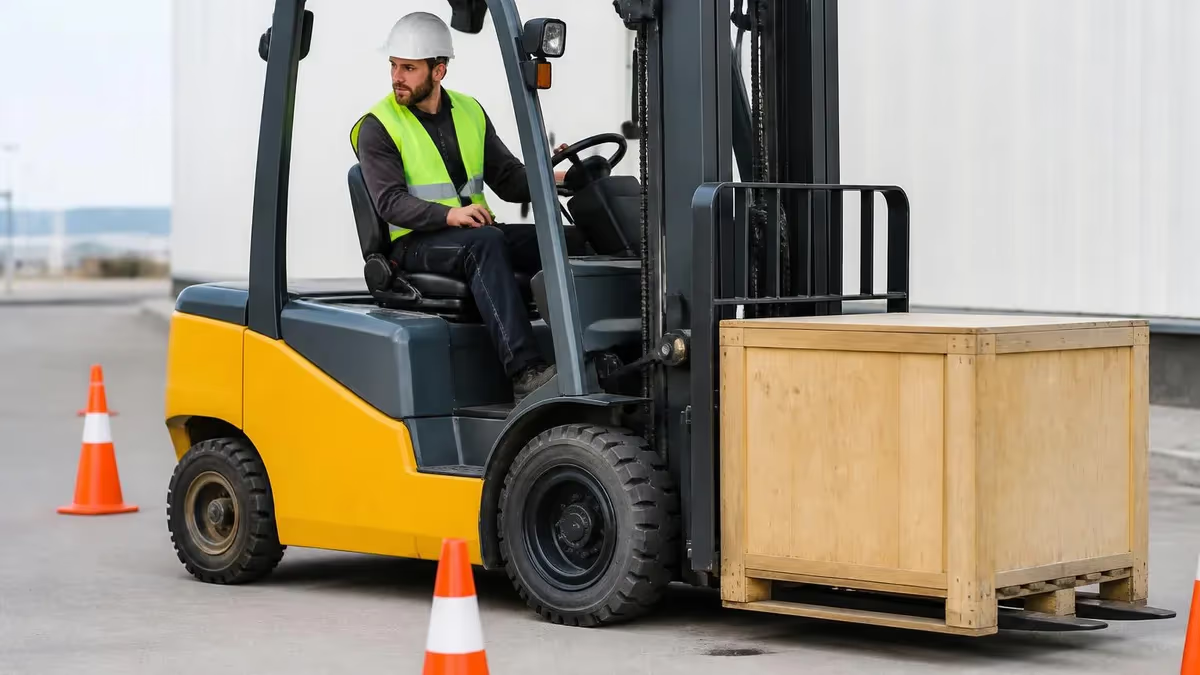
Forklift certification online has become the fastest, most affordable path for warehouse workers, construction crews, and logistics operators to satisfy OSHA's 29 CFR 1910.178(l) training requirements. In 2026, more than 1.1 million operators completed at least one module of their certification through web-based platforms, and employers increasingly accept these credentials when paired with the mandatory on-site practical evaluation. If you need to start operating a lift truck quickly — or you manage a fleet of forklifts and need every driver compliant before the next inspection — online courses deliver the formal instruction portion in 60 to 120 minutes.
The appeal is obvious: traditional classroom programs require scheduling, travel, and often a full weekend, while a self-paced online course lets you complete OSHA's classroom knowledge component on your phone during lunch. The catch most workers miss is that online-only certification is not legally sufficient. OSHA requires three distinct elements — formal instruction, practical training, and a hands-on workplace evaluation — and the internet can only cover the first one. Any provider claiming a 100% online certificate is misleading you, and that certificate will fail an OSHA audit.
This guide walks through what online certification actually covers, how much it costs in 2026, which providers issue OSHA-aligned documentation, and how the practical evaluation gets completed by your employer. We also cover renewal rules (every three years, or sooner after an accident), what happens if you change employers, and how online training stacks up against in-person bootcamps offered by equipment dealers. If you're comparing forklift rentals against purchase, certified operators are usually required by the rental contract, making this credential the gateway to actually using the machine.
Online forklift training is also reshaping how small businesses handle compliance. A contractor who needs to lift pallets twice a month no longer has to send workers to an 8-hour seminar — a $59 course plus a 20-minute on-site checkout with a qualified evaluator gets the job done. Larger employers use enterprise platforms like CertifyMe, ForkliftCertification.com, and OSHA.com to track expirations, store wallet cards digitally, and demonstrate compliance during surprise audits. The audit trail alone often justifies the subscription cost.
Beyond compliance, certified forklift operators earn between $18 and $28 per hour in 2026, with certified pickers in cold-storage and e-commerce fulfillment commanding $32+ in major metros. The certificate itself doesn't guarantee a raise, but it removes a hiring barrier — most warehouse job listings now require proof of certification before the first interview. Add a stand-up reach, order picker, or rough-terrain endorsement and your candidate pool widens significantly.
We'll explain how OSHA classifies the seven powered industrial truck classes, which classes each online course covers, and what equipment-specific evaluation looks like when you switch between a sit-down counterbalance and a narrow-aisle reach truck. By the end of this guide you'll know exactly what to buy, what to avoid, and how to walk into a job site Monday morning with a credential that holds up under scrutiny. Whether you're a first-time operator or a 20-year veteran due for renewal, the online path is faster and cheaper than ever — provided you choose a legitimate provider.
One last note on scope: this guide focuses on the standard powered industrial truck certification covering Classes I through VII. It does not cover specialty equipment like aerial work platforms (which require ANSI A92 certification under a different standard) or telehandlers used in construction, which fall under OSHA 1926 and require a separate operator qualification. If your job involves multiple equipment types, plan to certify on each one individually — your wallet card must list every class you're authorized to operate.
Forklift Certification Online by the Numbers

What OSHA Actually Requires for Forklift Certification
Classroom-style learning covering truck stability, load handling, refueling, pedestrian safety, and OSHA rules. This is the part online courses fully replace — typically 60-120 minutes of video, slides, and quizzes.
Hands-on demonstrations of pre-shift inspections, mounting, steering, lifting, stacking, and parking. Must occur on the actual equipment class the operator will use. Cannot be completed online — requires real equipment.
A qualified evaluator watches the trainee operate the lift in the actual work environment, scoring performance against a competency checklist. Must be repeated every three years and after any accident or near-miss.
Training tailored to your facility — narrow aisles, ramps, freezer environments, hazardous materials, dock plates, and pedestrian traffic patterns. Generic online courses cannot satisfy this; supervisor must add it.
Written record of trainer name, evaluator name, training date, and equipment class. OSHA inspectors ask for this first. Most online providers store digital wallet cards and certificates accessible 24/7.
Online forklift certification follows a predictable flow: you register, pay, watch modules, pass a quiz, and download a temporary certificate. The serious providers — CertifyMe, OSHA.com, ForkliftCertification.com, and National Forklift Foundation — break the course into 10 to 15 short video segments covering OSHA history, the seven truck classes, stability triangle physics, capacity plate reading, refueling and battery-changing protocols, pedestrian rules, and load-handling techniques. Each segment ends with a knowledge check, and the final exam usually contains 25 to 40 multiple-choice questions requiring 80% to pass.
Most platforms allow unlimited retakes, which is why first-try pass rates exceed 90%. The exam is not designed to weed out students — it's designed to confirm they paid attention. That said, the material is genuinely useful: questions on the stability triangle and load center calculations trip up experienced operators who learned bad habits on the job. If you've never thought about why a 4,000-pound rated truck can only safely lift 2,800 pounds with a 36-inch load center extension, the physics modules are worth slowing down for.
After passing, you receive an immediate PDF certificate and operator card, with a printed wallet card mailed within 5-10 business days. This documentation covers the formal instruction portion only. Your employer must still complete the practical training and workplace evaluation, then sign the same certificate to make it OSHA-compliant. Many online providers include downloadable evaluator checklists and a fillable employer signature page to simplify this step. If your employer refuses or doesn't know how, you need a different employer — operating without complete certification exposes both of you to fines starting at $16,131 per violation in 2026.
The big advantage of online training shows up at scale. A logistics company with 80 operators across four facilities can purchase enterprise seats for around $35 per operator, assign courses through a learning management system, and receive automated renewal alerts 60 days before expiration. The compliance manager downloads a single audit report showing every operator's status, class endorsement, and evaluator name. Compare that to coordinating 80 individuals through a Saturday in-person class and the math gets obvious fast. Many companies also look up forklift certification near me for in-person options when online doesn't fit their timeline.
What online certification does NOT do is teach you to drive. You will not feel the rear-wheel steering quirk, the weight shift when you tilt a loaded mast forward, or the way a propane-powered truck behaves differently on a wet warehouse floor. That's why the practical training requirement exists. Most workplace injuries involving certified operators happen within the first 60 days — operators who passed the online exam but didn't get adequate seat time. Push your employer for real practice hours, not just a 15-minute checkout drive.
For operators who change jobs frequently, a portable online certification feels valuable, but remember: certification is technically employer-specific under OSHA's rule. A new employer can accept your existing card as evidence that the formal instruction was completed, but they're still legally required to conduct their own workplace evaluation. The good news is this typically takes 20-30 minutes if you're already trained, versus restarting from scratch. Keep your wallet card, your training records, and your evaluator's signed checklist — together they make onboarding at the next employer painless.
Refresher training is another area where online wins on convenience. OSHA requires a new evaluation every three years, plus immediate retraining after accidents, near-misses, unsafe operation observations, equipment changes, or workplace condition changes. Most online providers offer a discounted refresher course covering rule changes and reinforcing core safety concepts. Stack this with a fresh in-house evaluation and you maintain continuous compliance without burning a full training day.
Forklift certification Practice Test Questions
Prepare for the Forklift certification Certification exam with our free practice test modules. Each quiz covers key topics to help you pass on your first try.
Forklift certification Certification Forkl...
Forklift certification Exam Questions covering Certification Forklift certification Maintenance and Repairs. Master Forklift certification Test concepts for certification prep.
Forklift certification Certification Forkl...
Free Forklift certification Practice Test featuring Certification Forklift certification Maintenance and Repairs Questions and Answers. Improve your Forklift certification Exam score with mock test prep.
Forklift certification Certification Forkl...
Forklift certification Mock Exam on Certification Forklift certification Operator Training and Certification Requirements. Forklift certification Study Guide questions to pass on your first try.
Forklift certification Certification Forkl...
Forklift certification Test Prep for Certification Forklift certification Operator Training and Certification Requirements Questions and Answers. Practice Forklift certification Quiz questions and boost your score.
Forklift certification Load Handling and S...
Forklift certification Questions and Answers on Load Handling and Stability. Free Forklift certification practice for exam readiness.
Forklift certification OSHA Regulations an...
Forklift certification Mock Test covering OSHA Regulations and Compliance. Online Forklift certification Test practice with instant feedback.
Forklift certification Pre-Operation Inspe...
Free Forklift certification Quiz on Pre-Operation Inspections. Forklift certification Exam prep questions with detailed explanations.
Forklift certification Refueling and Recha...
Forklift certification Practice Questions for Refueling and Recharging Procedures. Build confidence for your Forklift certification certification exam.
Forklift certification Safe Driving and Ma...
Forklift certification Test Online for Safe Driving and Maneuvering. Free practice with instant results and feedback.
Forklift certification Workplace Hazard Id...
Forklift certification Study Material on Workplace Hazard Identification. Prepare effectively with real exam-style questions.
Forklift certification Forklift Instructions
Free Forklift certification Test covering Forklift Instructions. Practice and track your Forklift certification exam readiness.
Forklift certification Forklift MCQ
Forklift certification Exam Questions covering Forklift MCQ. Master Forklift certification Test concepts for certification prep.
Forklift certification Forklift Employer R...
Free Forklift certification Practice Test featuring Forklift Employer Responsibilities. Improve your Forklift certification Exam score with mock test prep.
Forklift certification Forklift Penalties ...
Forklift certification Mock Exam on Forklift Penalties for Non-Compliance. Forklift certification Study Guide questions to pass on your first try.
Forklift Training Formats Compared
Self-paced online forklift training runs $59 to $99 for a single operator and covers OSHA's classroom requirement in 60 to 120 minutes. You watch videos, answer interactive quiz questions, and complete a final exam from any device with internet access. Most platforms allow you to pause, rewind, and retake the exam without additional fees, making this format ideal for shift workers, ESL learners, and anyone who absorbs information better at their own pace.
The trade-off is that online courses cover only the formal instruction component. You still need a workplace evaluator — typically a supervisor or third-party trainer — to conduct hands-on practical training and the final competency evaluation on real equipment. Reputable providers include downloadable evaluator checklists, fillable certificate templates, and instructions so your employer knows exactly what to do. Without that completion step, your certificate is legally incomplete and won't survive an OSHA inspection.

Online vs In-Person Forklift Certification: Which Is Better?
- +Costs 50-70% less than in-person bootcamps with rates starting at $59 per operator
- +Self-paced format allows completion in 60-120 minutes on any device, anywhere
- +Instant digital certificate available immediately after passing the final exam
- +Unlimited exam retakes on most platforms keep first-try failure low-stakes
- +Enterprise dashboards track expirations, store records, and simplify audits
- +Easier to deploy across multiple shifts, locations, and time zones simultaneously
- +ESL-friendly with subtitles, translations, and pause-as-needed accessibility
- −Cannot satisfy OSHA's practical training and workplace evaluation requirements alone
- −Some employers and unions distrust online-only credentials despite OSHA acceptance
- −No tactile practice with rear-wheel steering, load shift, or mast tilt physics
- −Generic content does not cover site-specific hazards your facility may have
- −Workplace evaluator must still be a qualified person — often hard to source
- −Fly-by-night providers issue certificates that fail OSHA scrutiny when audited
Pros and Cons at a Glance
| Pros | Cons |
|---|---|
| Instant digital certificate available immediately after passing the final exam | Cannot satisfy OSHA's practical training and workplace evaluation requirements alone |
| Unlimited exam retakes on most platforms keep first-try failure low-stakes | Some employers and unions distrust online-only credentials despite OSHA acceptance |
| Enterprise dashboards track expirations, store records, and simplify audits | No tactile practice with rear-wheel steering, load shift, or mast tilt physics |
| Easier to deploy across multiple shifts, locations, and time zones simultaneously | Generic content does not cover site-specific hazards your facility may have |
| ESL-friendly with subtitles, translations, and pause-as-needed accessibility | Workplace evaluator must still be a qualified person — often hard to source |
Forklift Certification Online: Complete Checklist
- ✓Confirm which OSHA truck class (I-VII) you'll operate before purchasing a course
- ✓Choose a provider that explicitly references 29 CFR 1910.178(l) compliance
- ✓Verify the course covers stability triangle, capacity plates, and pedestrian rules
- ✓Complete all video modules without skipping — most platforms log watch time
- ✓Pass the final exam with 80% or higher; retake if needed at no extra cost
- ✓Download the temporary PDF certificate immediately after passing
- ✓Schedule a workplace practical training session with a qualified evaluator
- ✓Complete the hands-on operation demonstration on the exact equipment class
- ✓Have your employer sign the evaluator section to complete OSHA compliance
- ✓Store your wallet card, certificate, and signed evaluation in one accessible folder
- ✓Set a calendar reminder 60 days before your three-year renewal date
- ✓Request refresher training immediately after any near-miss or accident on equipment
Your certificate is incomplete without an employer signature
OSHA 1910.178(l)(6) requires the employer to certify that each operator has been trained AND evaluated. An online-only certificate satisfies the training portion but NOT the evaluation portion. If your wallet card lacks an evaluator name, date, and signature, an OSHA inspector will treat it as if you have no certification at all — and the citation is $16,131 per uncertified operator.
The real cost of forklift certification online depends on how you count it. A single operator paying out of pocket spends $59 to $99 for the course itself, but a complete OSHA-compliant certification requires the workplace evaluation, which an employer must conduct or pay a third-party trainer $75 to $150 to perform. Enterprise customers buying 25+ seats drop to $29 to $45 per operator, plus annual platform fees of $300 to $1,200 depending on dashboard features, multi-language support, and integration with HR systems like Workday or BambooHR.
Beyond the course fee, smart employers budget for refresher training and re-evaluations. Even though OSHA only mandates retraining every three years, real-world triggers happen often: a near-miss, an equipment change, observed unsafe behavior, or assignment to a new facility all reset the clock. Companies that proactively retrain every 18 months see roughly 40% fewer recordable injuries than those that wait the full three years, and the insurance savings usually exceed the training spend. Forklift accidents cost employers an average of $135,000 per recordable incident when you factor in medical, lost time, and equipment damage.
Renewal logistics matter too. Most online providers send automated 60-day, 30-day, and 7-day expiration alerts to both the operator and the safety manager. Some platforms allow grace-period renewals — you can complete the refresher up to 30 days late without losing your record — while others auto-expire the wallet card the moment the three-year window closes. If your job requires continuous certification, choose a provider with grace-period flexibility and verify their policy in writing before purchasing seats.
Employer responsibilities under OSHA extend beyond just paying for the course. Employers must designate qualified evaluators, document every training session, maintain records for the duration of employment plus three years, and retrain anyone involved in an accident or unsafe behavior. They must also provide site-specific hazard training — narrow aisles, freezer environments, dock work, hazardous materials handling — that no generic online course can cover. Skipping this step is the #1 source of OSHA citations even for companies whose operators have current cards.
If you're an independent contractor or self-employed forklift operator, you face a unique challenge: you ARE the employer for OSHA purposes, which means you must self-certify and have a qualified third party evaluate you. Some online providers offer add-on evaluation services where a certified instructor travels to your site, or you can partner with a local equipment dealer who routinely performs evaluations for $75-$200. Document everything as if you were managing a 50-person team — when a general contractor asks for your certification, you'll need it bulletproof.
Renewal isn't the only trigger for fresh training. If you upgrade or change equipment classes — say, moving from a sit-down counterbalance to a stand-up reach truck or a rough-terrain telehandler — you must complete class-specific training and evaluation before operating the new machine. Many online providers offer class-bridging modules covering the differences between truck types for $25-$45 each, which is significantly cheaper than retaking the full course. Browsing options for a forklift for sale often reveals which equipment classes need fresh certifications.
Tracking certifications across a fleet is where online platforms truly shine over paper records. Modern systems offer mobile apps where operators scan a QR code on each forklift before starting their shift — the system verifies their certification is current for that specific class, logs the pre-shift inspection, and locks out the machine if the operator isn't authorized. Companies running these systems report dramatic reductions in unauthorized operation incidents and find OSHA audits go from stressful all-day affairs to 30-minute report exports.

Dozens of websites sell $25-$40 forklift certificates that take less than 15 minutes and require no real exam. These do NOT meet OSHA 1910.178(l) standards. OSHA inspectors recognize the most common fake-cert brands on sight, and your employer faces full citation as if you had zero training. Always verify the provider lists 29 CFR 1910.178(l) compliance and offers a real timed exam.
Forklift certification opens doors to roles paying $18 to $32+ per hour in 2026, and the wage premium grows with each additional class endorsement on your wallet card. A basic Class IV (sit-down counterbalance) operator at a general warehouse averages $19.50 per hour, while a Class II narrow-aisle reach operator in cold storage earns $24.80, and Class V or VI specialty operators in port logistics or heavy manufacturing routinely clear $30. Adding rough-terrain (Class VII) for construction work pushes the hourly rate even higher, especially in markets with active commercial real estate development.
The most strategic move for a new certified operator is to stack endorsements during the first 12 months on the job. Start with the most common class your employer uses, prove competence over 60-90 days, then ask for cross-training on adjacent classes. Each new endorsement costs the employer maybe $50 in training fees but adds 8-15% to your earning potential. Within two years, an operator with five class endorsements becomes the floor's go-to person — and the first considered for lead, supervisor, and trainer roles that pay $55,000 to $78,000 annually.
Specialty endorsements worth pursuing include order picker (Class III high-reach), pantograph reach trucks, sideloaders for long-load handling, and rough-terrain telehandlers. Each requires additional training hours and a separate practical evaluation, but online providers offer modular add-ons starting at $35. The order picker certification in particular has exploded in demand thanks to e-commerce fulfillment — Amazon, Walmart, and Target each operate fleets of thousands of pickers and pay premium wages for certified operators willing to work nights or weekends.
Career advancement beyond operator roles typically requires trainer or evaluator certification. Becoming a qualified workplace evaluator means demonstrating knowledge, training experience, and competency in operating the equipment — not just holding a current operator card. Many online providers offer trainer-the-trainer (T-the-T) courses for $200-$400 that prepare you to conduct in-house evaluations, sign off on new hires, and run refresher sessions. This credential alone often justifies a $4-$7/hour raise plus increased responsibility.
Geographic variation matters too. Operators in California, New York, Washington, and Illinois consistently earn 18-25% above the national median, while operators in Mississippi, Alabama, and West Virginia earn 8-12% below. Some states have additional certification requirements layered on top of federal OSHA — California's Cal/OSHA, Michigan's MIOSHA, and Washington's WISHA all maintain state plans with state-specific documentation rules. Online providers that operate nationally typically include the strictest state requirements in their courses, but verify before purchasing if you work in a state-plan state. For state-specific guidance, our cherry picker forklift certification map covers each jurisdiction.
If you're considering forklift work as a career rather than a stopgap, the path beyond operator is real and well-defined. Operators move into lead positions, then supervisors, then warehouse managers earning $65,000-$95,000. From there, logistics coordinator, distribution center manager, and operations director roles open up — and a forklift operator background is genuinely valuable at every step. Knowing how the floor actually works, what slows operators down, and what creates safety risk separates good managers from bad ones, regardless of MBA credentials.
Finally, don't overlook the benefits side of certified operator roles. Major employers offer health insurance, 401(k) matching, paid time off, and education reimbursement that easily adds $8,000-$15,000 of annual value beyond the hourly wage. Cold storage and night shift premiums add another $2-$4 per hour. Union positions in warehouse, port, and rail logistics often start operators at $28+ with full benefits and pension. Your forklift certification is a credential, not a career ceiling — treat it as the entry point to a 30-year career trajectory, not just a Monday morning hiring requirement.
Passing the online forklift certification exam is straightforward if you treat the modules as actual learning material rather than something to skip through. Focus first on the stability triangle — questions about it appear on every exam and consistently trip up new operators. Understand that a forklift's stability triangle is formed by the two front wheels and the pivot point of the rear axle, and that the center of gravity must stay inside this triangle for the truck to remain upright. Once you grasp that, capacity plate questions, load center math, and tilt-forward warnings all become intuitive.
Second priority: pre-shift inspection. Every exam includes 4-8 questions on the daily checklist, and OSHA inspectors love auditing inspection logs. Memorize the categories — leaks, brakes, controls, forks, mast, tires, horn, lights, seat belt, capacity plate, and battery/fuel. Develop a habit of walking the same path around the forklift every shift so nothing gets skipped. Many warehouse incidents trace back to a missed pre-shift check that would have caught the failure before it caused harm.
Third priority: pedestrian rules and traffic protocols. Most warehouse fatalities involve a forklift striking a pedestrian, so OSHA emphasizes this heavily. Know the rules: sound the horn at intersections, yield to pedestrians, maintain three forklift-lengths of stopping distance, drive in reverse when carrying loads that block forward visibility, and never allow riders on the forks or running boards. These rules sound obvious but they're violated daily in real warehouses, which is exactly why exams test them.
Fourth priority: refueling and battery safety. Propane (LPG) tanks must be inspected, secured, and changed in well-ventilated areas with the engine off. Electric forklift batteries weigh 1,500-3,000 pounds and contain sulfuric acid — they require eye protection, neutralizing agents nearby, and proper lifting equipment. Diesel and gasoline trucks should never be refueled with the engine running. Questions on hot-work zones, smoking restrictions, and PPE requirements show up consistently.
Take the practice exams seriously. Most platforms offer 2-3 practice tests before the real one, and they pull from the same question bank as the final. If you're scoring above 90% on practice tests, you'll pass the real exam comfortably. If you're scoring 70-85%, identify the question categories you're missing and rewatch those specific modules. Use scratch paper for load-center math — even though you can mentally estimate, writing out the calculation prevents careless errors that cost easy points.
On the practical evaluation day, slow down. Evaluators look for deliberate, methodical operation, not speed. Conduct your pre-shift inspection out loud, narrating each step so the evaluator can score you accurately. When you mount the truck, fasten the seat belt before touching any control. Sound the horn at every blind corner. Carry loads low — 4-6 inches above the floor — and tilt the mast slightly back to lock the load. When parking, lower the forks to the floor, set the parking brake, turn off the ignition, and only then dismount.
After certification, the operators who excel long-term commit to continuous learning. Subscribe to industry publications, watch OSHA accident reports, attend equipment dealer workshops, and request cross-training on new equipment classes. Forklift technology is changing fast — lithium-ion batteries, automated guided vehicles (AGVs), telematics tracking, and AI-assisted collision avoidance are reshaping warehouse operations. Operators who stay current on this technology will hold premium positions for the next two decades. Your wallet card is a starting line, not a finish line.
Forklift Questions and Answers
Forklift Tires: Complete Guide to Types, Sizing, Wear Patterns, and Replacement Costs
Forklift Safety Training: Complete OSHA Compliance Guide for Operators and Employers
Forklift Repair Service: Complete Guide to Costs, Common Repairs, and Choosing the Right Technician
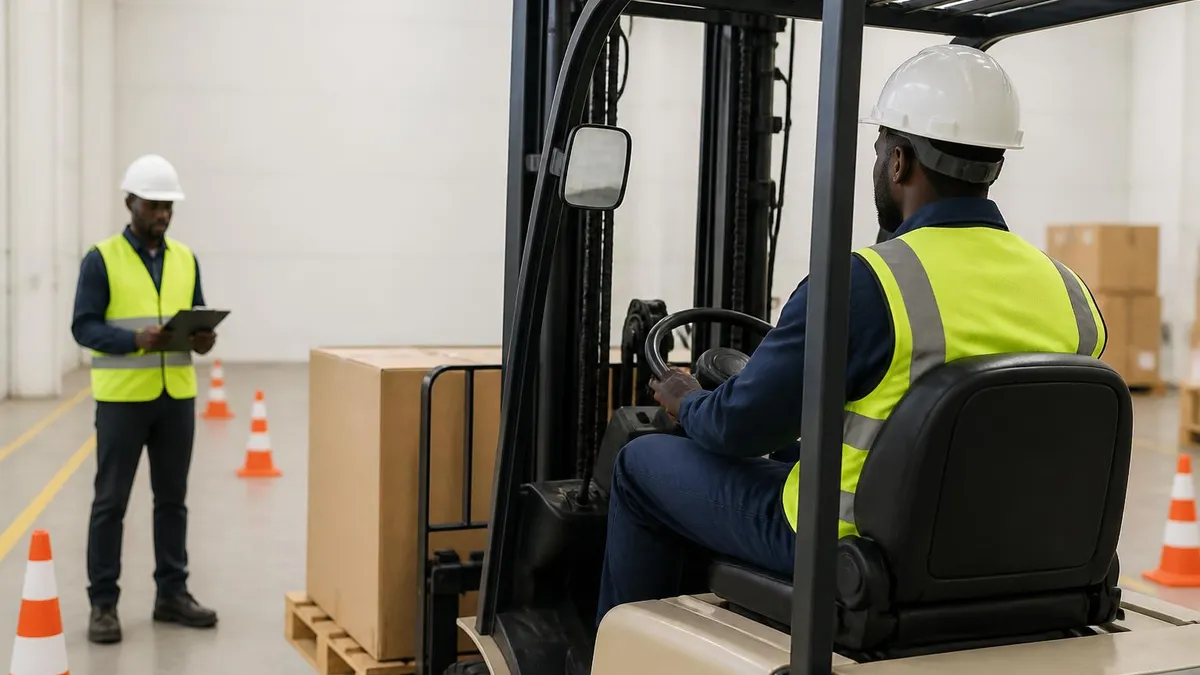
Forklift Certification by State: Complete 50-State Guide to OSHA-Compliant Operator Training, Costs, and Renewal Requirements
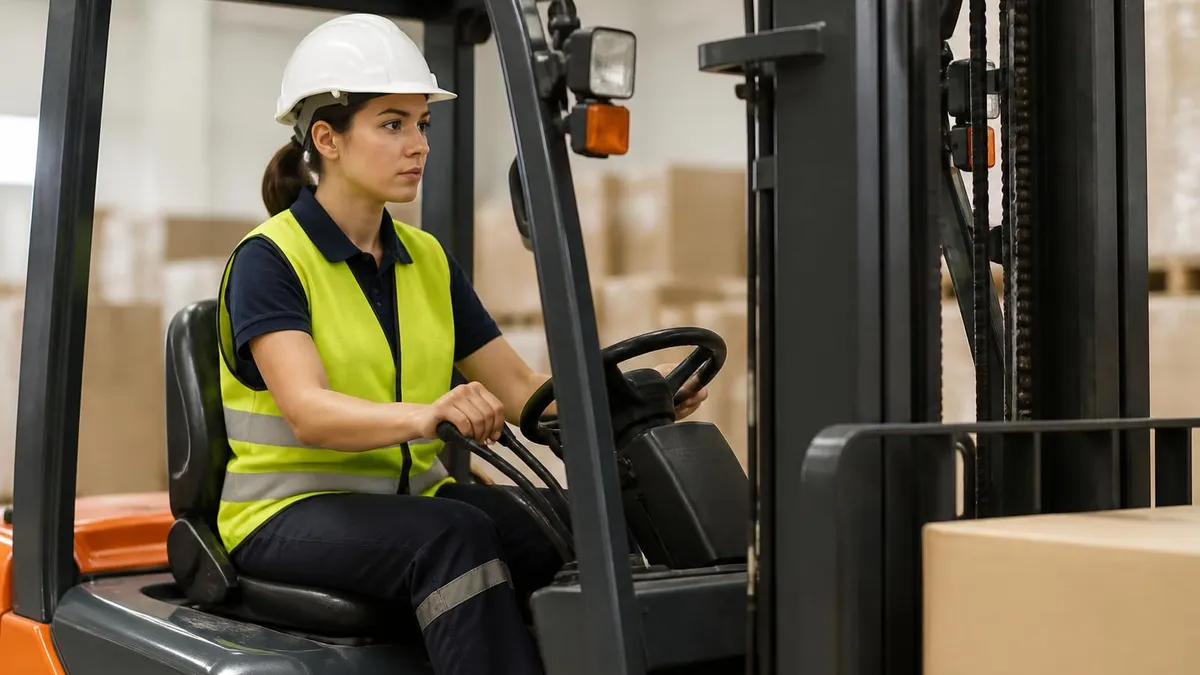
Forklift Price Guide 2026: New, Used, Rental, and Total Cost of Ownership Breakdown
About the Author

Certified Crane Operator & Skilled Trades Exam Specialist
Ferris State UniversityRobert Martinez is a Journeyman Ironworker, NCCCO-certified crane operator, and forklift trainer with a Bachelor of Science in Construction Technology from Ferris State University. He has 21 years of ironworking, rigging, and heavy equipment operation experience across high-rise and industrial construction sites. Robert prepares candidates for crane operator, rigger, forklift, and skilled trades certification examinations.