
Forklift for Rent — Complete Guide (2026 October)
Forklift for rent: 🧠 daily $100-500, weekly $400-1,200, monthly $1,500-4,000. Home Depot, United Rentals, Dallas, Dubai options compared.
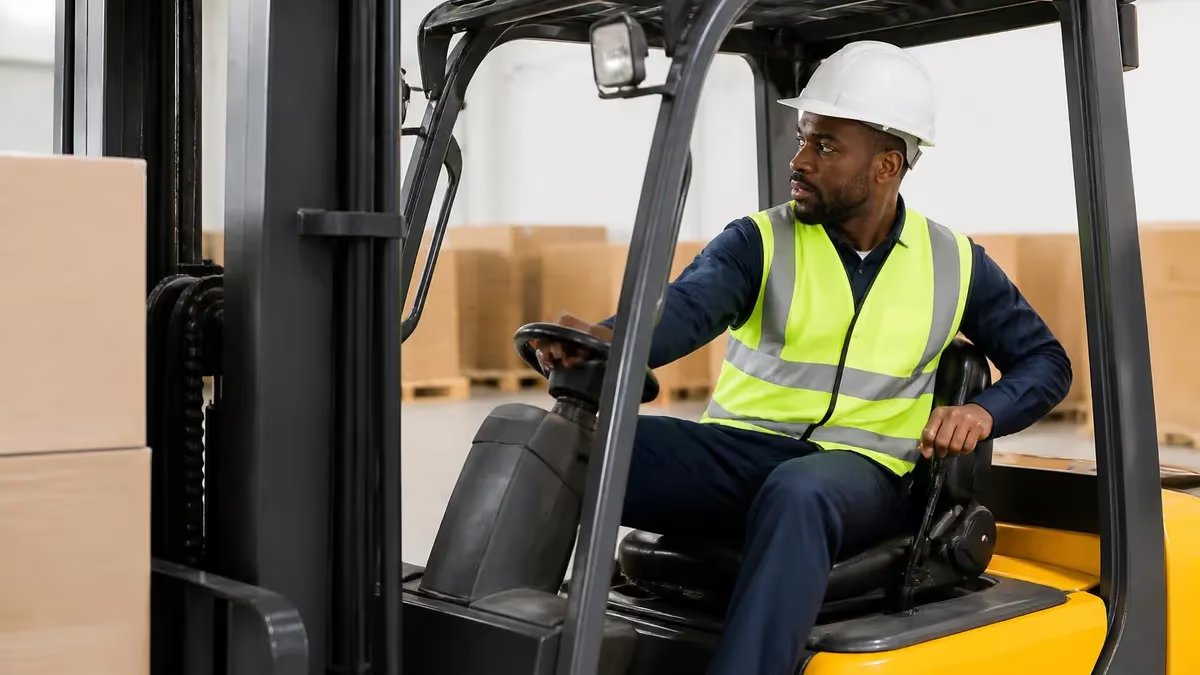
Forklift for Rent: Complete 2026 Rental Guide
You need a forklift for a week. Maybe a month. Buying one outright? That's $20,000 to $80,000 — money you don't want to spend if the job ends in 30 days. Renting solves it. A forklift for rent runs anywhere from $100 a day for a small electric walkie to $500 a day for a diesel pneumatic that lives outdoors and lifts pallets in mud. Renting beats buying for any job under 6 months — if the project drags past that, look at used forklifts for sale instead.
This guide walks through what it actually costs, which rental chains cover your zip code, what gear matches your job, and the paperwork nobody warns you about — like the fact that OSHA still requires a forklift training certificate before anyone climbs in the seat, rental or not.
Short version: pick the tire type first (cushion for indoors, pneumatic for outdoors), pick the fuel (electric, LPG, diesel), then call two suppliers. Get quotes. Compare delivery fees. Most renters end up paying $400 to $1,200 for a standard week-long rental of a 5,000 lb capacity unit. That's the sweet spot — and it's where most warehouse, construction, and event-prep jobs land.
Worth knowing: rental contracts include damage liability. You bend a fork, you pay. Insurance riders cost $25 to $75 a week and they're usually worth it. Skip them and a single accident bill can equal a month of rent. Don't skip them.
One more thing — Home Depot rents forklifts, but only the small electric kind (Class I and II). Need a 6,000 lb capacity diesel? Home Depot can't help. You're going to forklift dealers or national chains like United Rentals.
Average Rental Pricing (2026 US)
Daily: $100-$300 small electric · $200-$500 diesel/LPG. Weekly: $400-$1,200. Monthly: $1,500-$4,000. Long-term (3+ months): negotiated, often 20-30% below standard monthly. Delivery and pickup typically $75-$200 each way within a 25-mile radius.
Rental Period Breakdown

Picking the Right Forklift Type
Tire choice matters more than fuel choice, and most first-time renters get it wrong. Cushion tires are solid rubber. They roll smooth on concrete, they grip indoor floors, and they fail badly on gravel. Pneumatic tires are air-filled, they handle ruts and uneven ground, and they make any outdoor job possible. Pick wrong and you'll be calling the rental company on day two asking to swap units. That's a delivery fee you didn't budget for.
Cushion Tire
Indoor only. Smooth concrete floors, warehouses, distribution centers. Smaller turning radius — useful in tight aisles. If your job is entirely inside a building, cushion tire is faster and cheaper. The solid rubber wears slowly, so rental yards keep these on the road longer between refurbishments. That's why daily rates run 15-20% under pneumatic equivalents of the same lift capacity.
Pneumatic Tire
Outdoor capable. Lumber yards, construction sites, ports, gravel lots. Bigger machine, wider stance, more lift power. Costs about 20% more per day than cushion equivalent — worth it if any of your work is outside. Two pneumatic flavors exist: air-filled (true pneumatic) and solid pneumatic. Solid pneumatic is the rental-yard favorite because it can't go flat — and a flat tire on a 9,000 lb forklift on a Sunday is a delivery nightmare nobody wants.
Electric
Battery-powered. Quiet. Zero emissions. Required indoors for food-grade and pharma warehouses. Downside: 6-8 hour shift before recharge, and you need a charging station. Best for single-shift indoor work.
LPG (Propane)
The versatile pick. Indoor and outdoor capable, tanks swap in 30 seconds, no charging downtime. Roughly 80% of US warehouse rentals are LPG for a reason. If you don't know what to rent, rent LPG.
Diesel
Heavy-duty outdoor only. Construction, ports, lumber yards, scrap yards. Lifts 6,000+ pounds without breathing hard. Loud. Emissions disqualify it from any indoor work. Daily rates run $300-$500 for standard capacity — the most expensive category. If your crew handles diesel daily, formal forklift certification covering high-capacity outdoor units is a smart pre-rental investment — most insurance carriers ask for proof of class-specific training before they'll write a damage waiver.
Gasoline and Dual-Fuel
Gasoline forklifts are rare in modern rental fleets but still available for outdoor light-medium jobs. Daily rates run $175-$325. Dual-fuel units that switch between LPG and gasoline give the operator backup fuel options on long jobsites where LPG resupply is uncertain. These are niche rentals — call ahead to confirm a yard has one, because most fleets phased them out a decade ago in favor of dedicated LPG or diesel platforms.
Related reading: forklift for rent covers the next step in more detail.
Fuel Type Comparison
- Best For: Indoor warehouses, food/pharma
- Daily Rate: $100-$250
- Runtime: 6-8 hrs per charge
- Emissions: Zero
- Best For: Indoor + outdoor mixed work
- Daily Rate: $150-$350
- Runtime: 8 hrs per tank, 30-sec swap
- Emissions: Low — indoor OK with ventilation
- Best For: Heavy outdoor lifting
- Daily Rate: $300-$500
- Runtime: All day on one tank
- Emissions: High — outdoor only
- Best For: Outdoor light/medium duty
- Daily Rate: $175-$325
- Runtime: 5-7 hrs per tank
- Emissions: Medium — outdoor preferred
Where to Rent: National Chains, Local Dealers, and Home Depot
The rental industry has consolidated hard over the last decade. United Rentals owns more than 1,200 branches in the US alone. Sunbelt is right behind. Between them and Herc, three companies handle most of the daily and weekly material handling business in North America. That's good news on availability — you can almost always find a unit on short notice. It's mixed news on price.
You've got two real paths. National chains stock thousands of units across hundreds of branches, so availability is rarely a problem. Local dealers — the Toyota, Crown, Yale-Hyster shops in your metro — usually have better service, faster delivery, and operators who'll actually train your team on the spot. For a month-long rental of a high-capacity unit, the local dealer route often saves 10-15% versus the national chains.
United Rentals
The biggest in the US. 1,200+ branches coast to coast, fleet runs into the tens of thousands. Online booking, same-day delivery in major metros. If you need a forklift in any zip code, UnitedRentals.com is the first call. Their rates aren't always the lowest, but their reliability is hard to beat.
Sunbelt Rentals
Second-largest national chain. Strong in the South and Midwest. Their forklift fleet skews toward construction-grade pneumatic units. Good choice if you're working a job site, less ideal for pure warehouse work.
Herc Rentals
Third-place national. Solid coverage, good app for booking. Their material handling division is competitive on monthly rates — worth a quote if your job is 30+ days. BlueLine Rental got absorbed into United Rentals years ago but the brand still appears in some markets. Aerial Equipment Rentals runs smaller, friendlier branches in the Northeast and Mid-Atlantic.
OEM Dealers and Home Depot
The OEM route — Toyota Material Handling, Crown Lift Trucks, Yale-Hyster — gets you newer equipment and certified service. Daily rates are competitive, sometimes 10-15% under national chains. If you also want forklift operator training for your crew, dealer locations often bundle that with rental contracts. Home Depot Tool Rental fills a different niche: small electric pallet jacks under 4,000 lb at $50-$150/day, no delivery, walk-in pickup. See the tabs and pros-and-cons below for the full breakdown of which path fits your job.
Top National Rental Chains
1,200+ branches nationwide — the biggest US rental fleet. Online booking, same-day delivery in metros. Strong on Class I-V forklifts. Website: UnitedRentals.com. Daily rates start around $175 for Class IV/V units.

Renting from Home Depot
- +Cheap daily rates ($50-$150)
- +1,000+ store locations — close to most metros
- +Online reservation, walk-in pickup
- +No long-term contract pressure
- +Good for half-day pallet jobs
- −Only Class I/II walkie stackers — no seated forklifts
- −Max capacity around 4,000 lb
- −No outdoor pneumatic tires
- −No diesel, no LPG — electric only
- −No delivery — you transport the unit yourself
Pros and Cons at a Glance
| Pros | Cons |
|---|---|
| Online reservation, walk-in pickup | Only Class I/II walkie stackers — no seated forklifts |
| No long-term contract pressure | No outdoor pneumatic tires |
| Good for half-day pallet jobs | No diesel, no LPG — electric only |
Forklift Rental by Major US City
Pricing and availability shift hard by metro. Dallas runs cheaper than Boston. Phoenix has the best outdoor pneumatic inventory because half the warehouses there don't bother with climate control. Here's how the major markets stack up — what to expect on rate, who to call first, and which neighborhoods have the most rental yards within easy delivery.
Dallas / Fort Worth
One of the largest material handling markets in the country. DFW Forklift Rental and Toyota Lift of North Texas are the top local picks. United Rentals covers DFW with 30+ branches. Standard 5,000 lb LPG: $200-$280/day, weekly $700-$950. Delivery within 25 miles typically free for weekly+ contracts.
Irving, TX
TLE Industrial sits in Irving and serves the entire DFW industrial corridor. Faster delivery to Las Colinas, Coppell, and Grapevine than the bigger chains. Worth a direct quote — they often beat United Rentals by 10-15% on shorter rentals.
Houston
Crown Lift Trucks Houston is the dominant local dealer. United Rentals and Sunbelt both have strong Houston coverage. Port traffic keeps pneumatic and diesel demand high — book a week ahead for outdoor units during peak Gulf shipping season. Expect $220-$320/day for standard 5,000 lb LPG. Heavy-duty diesel 8,000+ lb runs $400-$550/day with longer lead times during hurricane recovery seasons when contractor demand spikes.
Industrial Corridors and Suburban Demand
The DFW industrial corridor (Las Colinas, Coppell, Grapevine, Lewisville, Garland) generates as much rental volume as central Dallas itself. Same dynamic in Houston suburbs — Pasadena, Baytown, Pearland have their own rental yards. If your job site is suburban, call yards in the suburb first; you'll get faster delivery and a friendlier delivery driver than dispatching from downtown.
Atlanta, Phoenix, Chicago, Los Angeles
All four are well-served by every national chain plus strong local Toyota and Crown dealer networks. Phoenix runs hottest on pneumatic — heavy desert construction demand. Chicago and LA have the most electric inventory because of indoor warehouse density. Atlanta sits in the middle and competes on price. Expect $180-$300/day for standard LPG across all four metros.
Smaller Metros and Rural Markets
Tulsa, Kansas City, Memphis, Nashville, Indianapolis, and Columbus all have United Rentals branches plus 2-3 local dealer options. Daily rates run 10-20% under coastal metros. Delivery radius is wider — most yards will haul a forklift 50+ miles in flat states like Texas, Oklahoma, and Kansas without huge surcharges. Rural areas with no rental branch within 75 miles? Expect delivery to add $300-$600 each way and book at least a week ahead.
Forklift Rental Checklist — Before You Book
- ✓Confirm tire type matches your job site (cushion = indoor, pneumatic = outdoor)
- ✓Verify fuel type — electric needs charging access; LPG needs ventilation
- ✓Check capacity rating matches your heaviest load (with safety margin)
- ✓Confirm operator certification — every operator must hold valid OSHA card
- ✓Get delivery and pickup fees in writing — both directions
- ✓Ask about insurance and damage waiver — $25-$75/week typical
- ✓Confirm fuel/charging policy — return full or pay surcharge
- ✓Check after-hours support — breakdowns happen on Saturdays
- ✓Inspect unit at delivery — photograph existing damage before signing
- ✓Save the rental contract — needed for any insurance claim later
Renting in Dubai and the UAE
The UAE rental market is different. Most rentals are monthly. Daily and weekly options exist but they're niche — typically only for event work or short construction punch-list jobs. Insurance is bundled into nearly every contract by default. Operator licensing rules are stricter than the US: UAE requires a Roads and Transport Authority (RTA) forklift permit in addition to OSHA-equivalent training before anyone operates on a job site.
Al Faris
One of the biggest equipment rental firms in the Gulf. Massive fleet, full coverage of Dubai, Abu Dhabi, and the Northern Emirates. Strong on heavy-duty diesel and rough-terrain units. Used by major construction contractors across Dubai.
Galaxy Equipment
Mid-size player based in Dubai. Mix of forklifts, telehandlers, and scissor lifts. Competitive monthly pricing — usually 10-15% under Al Faris for similar capacity. Strong service in Dubai South, Jebel Ali, and DIP.
Saif Industrial
Sharjah-based with Dubai coverage. Focus on Toyota and Crown equipment. Newer fleet on average than competitors. Good fit for warehouse rentals in Al Quoz, Ras Al Khor, and the Sharjah industrial areas.
Typical UAE Pricing
Monthly: AED 3,000-7,500 ($820-$2,040) for 2-3 ton capacity LPG. Daily rates rare — when offered, AED 250-450 ($68-$122). VAT (5%) applies. Insurance and operator usually included in monthly contracts. Delivery free within 30 km of branch on monthly rentals.
Abu Dhabi, Sharjah, and Northern Emirates
Pricing drops slightly outside Dubai. Abu Dhabi runs about 5-8% cheaper than Dubai on equivalent capacity, mainly because rental yards have less premium real-estate overhead. Sharjah's industrial zones — Hamriyah Free Zone, Sharjah Airport International Free Zone — have multiple local rental firms competing aggressively for warehouse contracts.
Ras Al Khaimah and Fujairah have fewer rental options; expect longer delivery times and book at least two weeks ahead for heavy-duty units. Saudi Arabia and Oman tap the same Gulf supplier networks — Al Faris and Galaxy both ship cross-border for projects over AED 50,000 in total contract value, though customs paperwork adds 3-5 days to delivery.
Insurance and Operator Bundling in the Gulf
One real advantage of UAE monthly contracts: insurance and a certified operator are nearly always bundled into the rate. That's a stark contrast with the US, where insurance is sold separately and operators are your responsibility. Budget about 15-20% of the total rental value for these bundled extras — already baked into the AED 3,000-7,500 monthly figure quoted above.

How to Book a Forklift Rental — Step by Step
Scope the Job
Get Two Quotes Minimum
Verify Operator Certification
Confirm Delivery Site Access
Inspect at Delivery
Return Clean and Fueled
Forklift Rental Numbers
What You Actually Need to Rent (and Operate)
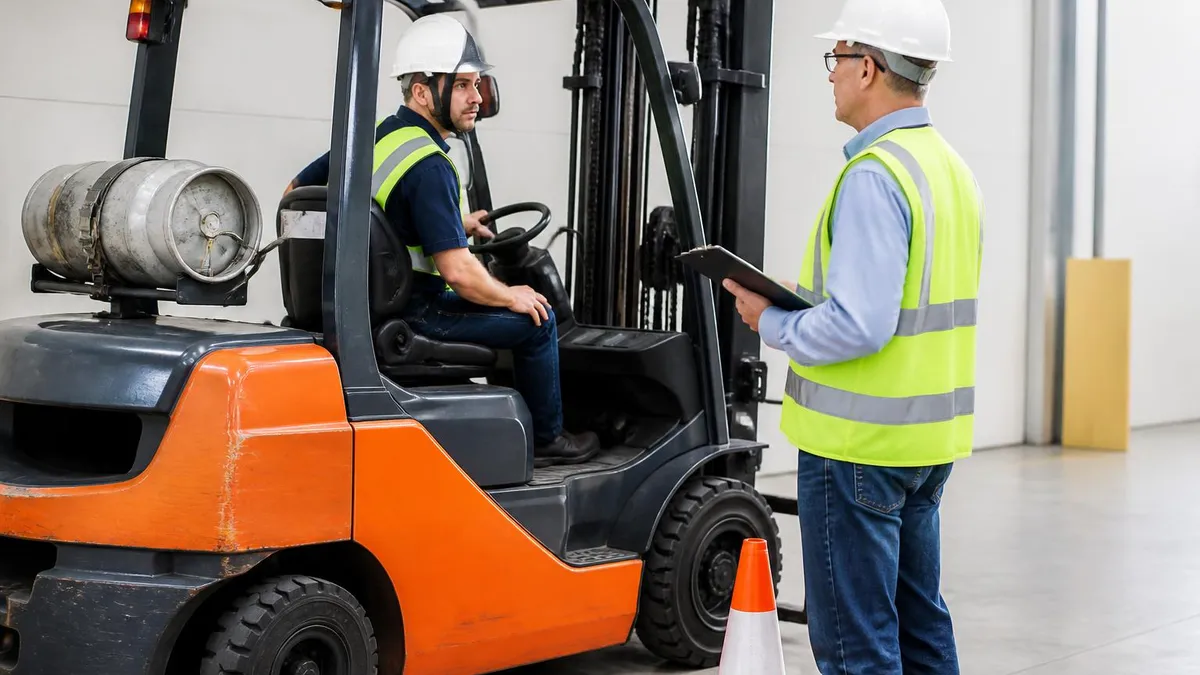
Rental companies don't hand over forklift keys to just anyone. Federal law — OSHA 1910.178(l) — requires every forklift operator to hold a current certification from a qualified trainer. Rental companies will ask for it. No card, no keys. Some chains will quietly look the other way for short rentals, but if anything goes wrong on site, liability lands hard on you and the rental contract is void.
Operator Certification
Required before stepping into the seat. Most certifications run 4-8 hours, cost $50-$150 per operator, and are valid for 3 years. The card must list the operator's name, the equipment class trained on, and the trainer's signature. You can run through prep materials online or via your rental supplier — many national chains offer same-day certification for $75-$100 alongside the rental. Rental yards verify the card before releasing the keys; expired or missing certification means no rental.
Insurance and Liability
The rental contract will name you as responsible for any damage to the unit during the rental period. Your business general liability policy may cover this — but most don't. The damage waiver from the rental company costs $25-$75 a week and caps your out-of-pocket liability. For a $40K piece of equipment, that's a bargain.
Delivery, Pickup, and Site Prep
Delivery fees aren't negotiable on short rentals — expect $75-$200 each way within 25 miles. Make sure your delivery location is firm flat ground a flatbed truck can reach. Soft mud or steep grade = the driver refuses delivery and you eat the fee anyway.
Damage Deposit
Most rentals require a refundable deposit of $500-$2,000, charged to your credit card at delivery and released after the unit returns clean and undamaged. Photograph every panel before signing the delivery receipt — that protects you when the unit goes back and the rental company tries to claim a pre-existing scratch.
Fuel and Charging
Return-with-full-fuel is standard. Skip it and you'll pay 3-4x retail fuel price as a surcharge. Electric units must return fully charged or accept a $25-$50 partial-charge fee. For LPG, most rental contracts include the first tank free and bill you for each subsequent swap at retail rate ($25-$40 per tank). Diesel returns are checked against the delivery odometer reading — pay attention to the fuel level photo your driver takes at drop-off.
Forklift certification Practice Test Questions
Prepare for the Forklift certification Certification exam with our free practice test modules. Each quiz covers key topics to help you pass on your first try.
Forklift certification Certification Forkl...
Forklift certification Exam Questions covering Certification Forklift certification Maintenance and Repairs. Master Forklift certification Test concepts for certification prep.
Forklift certification Certification Forkl...
Free Forklift certification Practice Test featuring Certification Forklift certification Maintenance and Repairs Questions and Answers. Improve your Forklift certification Exam score with mock test prep.
Forklift certification Certification Forkl...
Forklift certification Mock Exam on Certification Forklift certification Operator Training and Certification Requirements. Forklift certification Study Guide questions to pass on your first try.
Forklift certification Certification Forkl...
Forklift certification Test Prep for Certification Forklift certification Operator Training and Certification Requirements Questions and Answers. Practice Forklift certification Quiz questions and boost your score.
Forklift certification Load Handling and S...
Forklift certification Questions and Answers on Load Handling and Stability. Free Forklift certification practice for exam readiness.
Forklift certification OSHA Regulations an...
Forklift certification Mock Test covering OSHA Regulations and Compliance. Online Forklift certification Test practice with instant feedback.
Forklift certification Pre-Operation Inspe...
Free Forklift certification Quiz on Pre-Operation Inspections. Forklift certification Exam prep questions with detailed explanations.
Forklift certification Refueling and Recha...
Forklift certification Practice Questions for Refueling and Recharging Procedures. Build confidence for your Forklift certification certification exam.
Forklift certification Safe Driving and Ma...
Forklift certification Test Online for Safe Driving and Maneuvering. Free practice with instant results and feedback.
Forklift certification Workplace Hazard Id...
Forklift certification Study Material on Workplace Hazard Identification. Prepare effectively with real exam-style questions.
Forklift certification Forklift Instructions
Free Forklift certification Test covering Forklift Instructions. Practice and track your Forklift certification exam readiness.
Forklift certification Forklift MCQ
Forklift certification Exam Questions covering Forklift MCQ. Master Forklift certification Test concepts for certification prep.
Forklift certification Forklift Employer R...
Free Forklift certification Practice Test featuring Forklift Employer Responsibilities. Improve your Forklift certification Exam score with mock test prep.
Forklift certification Forklift Penalties ...
Forklift certification Mock Exam on Forklift Penalties for Non-Compliance. Forklift certification Study Guide questions to pass on your first try.
Hidden Fees and Surcharges to Watch
Sample Forklift certification Practice Questions
Try these questions from our free Forklift certification practice tests. The correct answer and an explanation follow each question.
An operator is about to use an electric forklift. In addition to the standard checks, what is a specific inspection point unique to this type of forklift?
- A. Engine oil and coolant levels
- B. Condition of battery connectors and looking for frayed cables
- C. Proper mounting of the propane tank
- D. The condition of the radiator and air filter
Answer: B. Condition of battery connectors and looking for frayed cables
Electric forklifts have specific components to inspect related to their power source. This includes checking for frayed or exposed wires, ensuring battery connectors are secure, and checking electrolyte levels (with proper PPE). Engine oil, coolant, and propane tanks are components of internal combustion forklifts.
When changing a Liquid Propane Gas (LPG) cylinder on a forklift, what is the correct first step after parking the forklift in a designated area and setting the brake?
- A. Immediately disconnect the fuel hose from the cylinder.
- B. Close the valve on the LPG cylinder.
- C. Unfasten the straps holding the cylinder in place.
- D. Use a wrench to check the tightness of the fittings.
Answer: B. Close the valve on the LPG cylinder.
Before disconnecting any hoses, the valve on the LPG cylinder must be closed to stop the flow of gas. The engine should then be run until it stops to purge any remaining fuel from the lines, preventing a release of flammable gas when the hose is disconnected.
Before starting a forklift shift, what must the operator complete first?
- A. A pre-operation inspection
- B. A lunch break
- C. A parking check only
- D. A fuel receipt
Answer: A. A pre-operation inspection
OSHA requires a daily pre-operation inspection before the forklift is used.
During an emergency facility evacuation, what should a forklift operator do with the forklift?
- A. Drive the forklift toward the nearest exit for use in the evacuation
- B. Lower the forks, shut off the engine, set the brake, and evacuate on foot
- C. Leave the forklift running to allow quick repositioning when the alarm ends
- D. Park the forklift in front of emergency exits for easy access
Answer: B. Lower the forks, shut off the engine, set the brake, and evacuate on foot
The operator must lower the forks, shut off the engine, apply the parking brake, and then evacuate on foot — blocking exits with a forklift creates an additional hazard.
Forklift Questions and Answers
Related Forklift Guides
About the Author

Certified Crane Operator & Skilled Trades Exam Specialist
Ferris State UniversityRobert Martinez is a Journeyman Ironworker, NCCCO-certified crane operator, and forklift trainer with a Bachelor of Science in Construction Technology from Ferris State University. He has 21 years of ironworking, rigging, and heavy equipment operation experience across high-rise and industrial construction sites. Robert prepares candidates for crane operator, rigger, forklift, and skilled trades certification examinations.