
Forklift for Sale: Types, Prices & What to Check 2026 September
Looking for a forklift for sale? Compare new vs used prices, ❓ electric vs propane, and what to inspect before buying. Plus OSHA certification requirements.
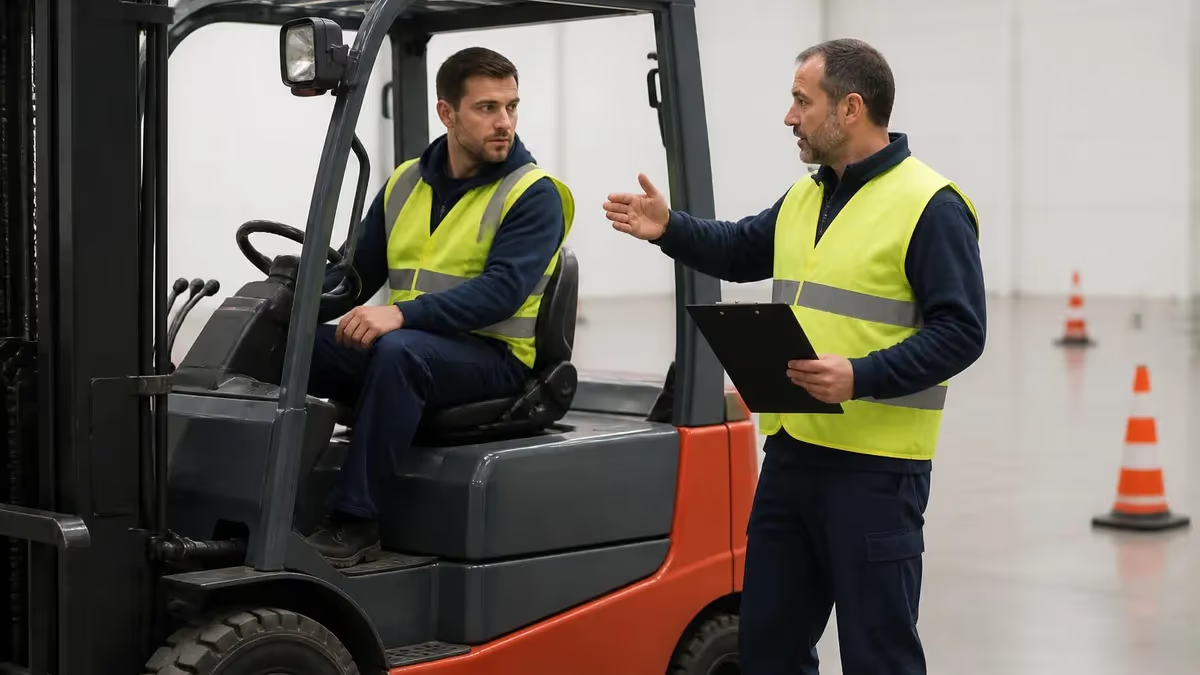
Why Businesses Buy Instead of Rent
If you're using a forklift more than a few days a month, buying almost always beats renting. Rental rates run $150–$400/day or $1,500–$3,000/month — and those costs add up fast. A $20,000 used forklift can pay itself off in under a year for a warehouse running daily operations. And unlike a rental, you're not paying daily even when the machine sits idle over a holiday weekend.
Ownership gives you something rentals can't: consistency. Your operators train on the same machine, learn its quirks, and develop the situational awareness that reduces accidents. You set the maintenance schedule rather than inheriting someone else's deferred service. You don't lose productivity waiting for a rental depot to deliver a replacement when something breaks down mid-shift — because you've stocked the parts and know the machine's history.
There's also an asset dimension worth considering. A well-maintained Toyota or Crown forklift holds value surprisingly well. Buy a quality used unit for $12,000, maintain it properly for five years, and you can still sell it for $5,000–$7,000. Rental payments disappear completely with nothing to show for them.
That said, buying isn't always the right call. If you're running a seasonal operation or a short-term project, forklift rental keeps capital free and puts maintenance on the vendor. The decision comes down to utilization — how often will the machine run, and for how long. Run the numbers honestly before you sign anything.

Forklift Market Snapshot (2025)
Types of Forklifts for Sale
Not all forklifts are built for the same job. Buying the wrong type is expensive — you'll either overpay for capacity you don't need, or underpower your operation. Walk through your actual use case before you shop: What are you lifting? How heavy? What height? Indoors, outdoors, or both?
Counterbalance forklifts are the most common type you'll see in warehouses and loading docks. The counterweight at the rear balances the load on the forks — no outriggers needed, which makes them highly maneuverable. They handle 3,000–36,000 lbs and run on propane, diesel, or electric. New units start around $20,000; used ones in good shape can be found for $8,000–$15,000. This is the workhorse most operations should start with.
Reach trucks are built for narrow aisles and high racking — they use outrigger legs to stabilize loads and can reach 30+ feet into rack systems. They're almost exclusively electric, which keeps indoor air quality clean. Expect to pay $15,000–$30,000 used and $30,000–$60,000 new. Don't buy a reach truck if you mostly work on flat ground with standard 10-foot racking — you're overbuying.
Pallet jacks — both manual and electric — are the entry point for businesses that don't need full lift capability. Walkie stackers and powered pallet jacks run $3,000–$12,000 and handle lighter loads up to about 4,500 lbs. They're ideal for receiving docks and short-haul movement within a facility.
Order pickers let operators ride the platform up with the load — the operator physically picks items at height rather than picking from a pallet dropped at floor level. This is ideal for e-commerce fulfillment and distribution centers. They're all-electric and range from $15,000–$35,000 depending on lift height and capacity.
Rough terrain forklifts use large pneumatic tires and higher ground clearance for outdoor job sites, lumber yards, and construction. They're typically propane or diesel-powered and handle 6,000–12,000 lbs. Prices range from $25,000–$70,000 new. Don't use one indoors — the emissions and tire damage make them the wrong tool for that environment.
Side loaders handle long materials like lumber, pipe, steel bars, and extruded aluminum — they pick up loads from the side rather than the front. These specialty machines run $40,000–$100,000+ and are purpose-built for specific industries. If you're not handling long product, you don't need one.
New vs Used vs Refurbished Forklifts
Price range: $20,000–$80,000+ depending on type, capacity, and fuel source.
Pros: Full manufacturer warranty (typically 1–3 years), latest safety features, zero wear — you know exactly what you're getting. Dealers offer financing and service packages.
Cons: Highest upfront cost. Depreciation hits hardest in the first 2–3 years. For occasional use, you're paying for reliability you may not need.
Best for: High-utilization operations, safety-critical environments, or when financing terms make monthly payments manageable against daily revenue.
Electric vs Propane vs Diesel: Running Cost Breakdown
The fuel type you choose affects not just daily running costs — it shapes where the machine can operate, how much maintenance it needs, and what your operators deal with every shift. Get this decision right at purchase; switching fuel types after the fact means buying a new machine.
Electric forklifts run on lead-acid or lithium-ion batteries. They're quieter, produce zero emissions at the point of use, and cost significantly less per hour to run — roughly $0.10–$0.25/hour in electricity vs $1.50–$3.00/hour for propane. The downside: battery replacement costs $3,000–$8,000 for lead-acid packs, and fast-charge infrastructure requires electrical panel upgrades. Lithium-ion batteries charge faster and last longer, but add $8,000–$15,000 to the upfront cost. Best for indoor warehouses with consistent multi-shift patterns.
Propane forklifts offer operational flexibility — swap the tank and you're back running in under five minutes, no waiting for a charge cycle. They work indoors and outdoors, though prolonged indoor use requires adequate ventilation to manage exhaust. Propane cylinders cost $20–$40 each to refill. These machines handle temperature extremes better than electric and remain the most popular choice for mixed-use facilities and operations with irregular schedules.
Diesel forklifts are built for outdoor and rough terrain use — higher torque, better performance under heavy loads, and they don't care about cold weather. Emissions restrict indoor use entirely. Diesel costs more to maintain over time: fuel filters, injectors, turbochargers, and diesel particulate filter (DPF) systems all add up. Best for construction sites, lumber yards, container yards, and shipping facilities.
A practical rule: if the machine stays indoors and runs two full shifts a day, go electric. If it moves between inside and outside regularly, propane is your best bet. If it lives outdoors on rough or uneven ground and pulls heavy weight, diesel wins.

Forklift Price Guide by Type (2025)
- Used: $8,000–$15,000
- New (propane/diesel): $20,000–$45,000
- New (electric): $25,000–$55,000
- Capacity: 3,000–36,000 lbs
- Used: $10,000–$25,000
- New: $30,000–$60,000
- Fuel: Electric only
- Best for: Narrow aisle, high rack
- Used: $2,000–$6,000
- New: $4,000–$12,000
- Capacity: Up to 4,500 lbs
- Best for: Flat floor, short haul
- Used: $8,000–$20,000
- New: $20,000–$40,000
- Fuel: Electric only
- Best for: Fulfillment, piece picking
- Used: $15,000–$35,000
- New: $25,000–$70,000
- Fuel: Propane or diesel
- Best for: Outdoor, uneven ground
Where to Buy a Forklift
Your buying channel affects price, condition assurance, and what happens after the sale. Know your options before you shop — each has real trade-offs.
Authorized dealers are the safest route for used and new machines. Major brands — Toyota, Crown, Hyster, Yale, Raymond — have certified dealer networks that inspect, service, and warranty every unit. You'll pay more than a private sale, but you get documented service history, a service contract option, and an actual phone number to call when something breaks. For businesses that depend on uptime, that support is worth real money.
Equipment auctions like GovPlanet and IronPlanet list government surplus and fleet equipment that often comes from well-maintained fleets. Prices run lower than dealers, but you're usually buying as-is, sometimes sight-unseen. IronPlanet offers Certified Equipment inspections with detailed condition reports and photos — worth the premium if you can't physically inspect the unit before bidding. Set a firm max bid and don't get caught up in auction momentum.
Online marketplaces (eBay, Craigslist, Facebook Marketplace) carry private-party listings at the lowest prices — and the highest risk. No inspection guarantee, cash deals are common, and shipping a forklift adds $500–$2,000 depending on distance. Only buy locally through these channels, and always — always — inspect in person before paying. A seller who won't let you test-drive the machine before buying is a seller to walk away from.
Manufacturer direct programs exist at Toyota, Hyster, and Crown — mostly for fleet accounts buying 5+ units. Discounts are real but require volume. Lead times on new equipment can run 8–16 weeks in high-demand periods, so plan ahead if you need new machines on a timeline.
Whatever channel you use, budget for delivery. Moving a forklift requires a flatbed truck or specialized transport — typically $200–$800 locally and $1,000–$3,000 for longer hauls. Factor that into your total cost.
Used Forklift Pre-Purchase Inspection Checklist
- ✓Check mast condition — look for cracks, bent rails, and damaged lift chains
- ✓Measure fork thickness — worn forks should not be less than 90% of original thickness
- ✓Read the engine hours — under 3,000 hrs is low, 8,000+ hrs means major components are near end of life
- ✓Inspect tires — cushion tires should not show the wear line; pneumatic tires need uniform tread
- ✓Test hydraulics — raise and hold the mast fully loaded; it should not drift down more than 1 inch in 15 minutes
- ✓Check for oil leaks — look under the counterweight, around the mast cylinders, and at hydraulic hoses
- ✓Review service history — request maintenance logs; missing records are a red flag
- ✓Test the overhead guard and seatbelt — both are OSHA-required safety features
- ✓Run the machine through all functions — forward, reverse, lift, tilt, horn, lights
- ✓Check the data plate — it must be legible and match the actual configuration (attachments change rated capacity)
Forklift Attachments That Affect Your Purchase
Attachments are bolt-on tools that expand what a forklift can do — but they're not free add-ons. Every attachment changes the forklift's rated capacity, which is documented on the data plate. A forklift rated at 5,000 lbs with forks may only safely carry 3,500 lbs with a side shifter installed. That difference isn't just a spec curiosity — it's an OSHA compliance issue and a real safety risk if operators don't know the de-rated limit.
The most common attachment is the side shifter, which lets operators shift the load left or right without repositioning the entire truck. It dramatically speeds up pallet placement in tight rack aisles. Side shifters are nearly standard on new machines and typically add $500–$1,500 to used unit prices. If you're shopping used and the machine doesn't have one, factor in the cost of adding it after purchase.
Clamp attachments replace forks entirely for handling round, irregular, or boxed loads — paper rolls, bales, appliances, and drums. They're expensive ($2,000–$8,000) and require a specific third hydraulic circuit. When buying a used machine already equipped with clamps, verify the hydraulic circuit is compatible and functioning before you commit. A clamp that doesn't grip consistently is a dropped load waiting to happen.
Rotating forks allow the load to be rotated up to 360 degrees without repositioning the truck — useful in foundries, waste handling, and recycling operations where loads need to be dumped or oriented. These are specialty attachments that drive up unit cost significantly and require operators with specific skills.
Push-pull attachments handle slip-sheet loads — goods stacked on thin plastic sheets instead of pallets. They're common in food distribution and consumer goods warehouses trying to reduce pallet costs. Not every forklift can accommodate a push-pull, so verify carriage compatibility before purchasing.
Bottom line: if the forklift you're buying has attachments installed, get the de-rated capacity in writing and verify it matches the data plate. Operators must also receive specific forklift training for each attachment type they use — general certification doesn't automatically cover specialty attachments.

OSHA Certification: What Every Forklift Owner Must Know
Buying a forklift doesn't just mean finding a machine — it means taking on a legal obligation. OSHA standard 29 CFR 1910.178 requires that every powered industrial truck operator be trained and evaluated before operating any forklift. The employer — not the operator — is responsible for ensuring that certification happens. There are no exceptions for small businesses, owner-operators, or infrequent use.
Certification must cover three specific elements: formal instruction (classroom or online content covering safety rules, controls, load handling, and fueling), practical training on the specific type of truck being used, and a workplace evaluation conducted by a qualified person — typically a safety officer, trainer, or experienced supervisor who can observe the operator in actual conditions. All three elements must be completed before solo operation.
Forklift certification isn't a permanent credential. OSHA requires re-evaluation every 3 years, or sooner if the operator is involved in an accident, observed operating unsafely, assigned to a different truck class, or moved to a new operating environment. A reach truck operator moving to a rough terrain forklift needs re-certification for the new truck type — even if their existing certification is current.
The paperwork matters too. Employers should document all training — who was trained, who conducted the training, what equipment was covered, and the date of evaluation. If OSHA audits your facility, those records are what protects you. Using a forklift certification practice test is a practical way for operators to build confidence and surface knowledge gaps before their formal evaluation. A solid foundation in forklift safety principles doesn't just satisfy OSHA — it protects operators, co-workers, and inventory from the accidents that happen when shortcuts get taken.
If you're managing a multi-operator facility, consider scheduling your team's certification together with a third-party trainer who can document everything in one session. It's more efficient, and it ensures consistency in what everyone learned.
Buying vs Renting a Forklift
- +Lower total cost for operations using forklifts daily or weekly
- +Operators build proficiency on a consistent, familiar machine
- +No rental availability issues or delivery delays during peak seasons
- +Asset can be sold or traded in when your needs change
- +Customize with attachments for your specific workflow
- −High upfront capital requirement — $10,000–$80,000 depending on type
- −You own the maintenance costs, downtime, and repair bills
- −Depreciation — used units lose value faster than most equipment
- −Seasonal or project-based use makes ownership costly per hour
- −Storing equipment when idle ties up valuable floor space
When Renting Makes More Sense Than Buying
There's no shame in renting — it's often the smarter financial move. If your forklift need is seasonal (a holiday rush, a construction phase, an annual inventory project), renting keeps your capital flexible and puts maintenance responsibility on the rental company. You're not on the hook for a broken hydraulic pump at 2 AM on a Sunday before a big shipment.
Short-term projects — building expansions, equipment relocations, facility moves — rarely justify the capital of a purchase. A $200/day rental for two weeks costs $2,800. That's a fraction of even the cheapest decent used forklift, with none of the storage, insurance, or maintenance overhead that follows you home.
Renting also makes sense when you need a specialty machine you don't regularly use — a rough terrain forklift for an outdoor job site, a high-reach order picker for a one-time fulfillment surge, or a heavy-capacity counterbalance for an equipment installation. Rental depots stock a wide variety of configurations; you don't have to own every type you might occasionally need.
The calculus shifts decisively toward buying once you're running a forklift more than 10–15 days per month. At that frequency, monthly rental costs typically exceed what you'd pay on a financed used machine — and at the end of the year, the rental company has your money and you have nothing to show for it. A purchased machine, even a modest used one, is an asset on your books.
Some operations find a hybrid approach works best: own one general-purpose counterbalance forklift for daily use, and rent specialty equipment — a rough terrain unit, a high-reach order picker — when a specific job demands it. It's worth modeling out both scenarios with your actual utilization numbers before you sign anything long-term.
Forklift for Sale Questions and Answers
About the Author

Certified Crane Operator & Skilled Trades Exam Specialist
Ferris State UniversityRobert Martinez is a Journeyman Ironworker, NCCCO-certified crane operator, and forklift trainer with a Bachelor of Science in Construction Technology from Ferris State University. He has 21 years of ironworking, rigging, and heavy equipment operation experience across high-rise and industrial construction sites. Robert prepares candidates for crane operator, rigger, forklift, and skilled trades certification examinations.