
Used Forklifts for Sale: Buying Guide, Inspection & Pricing 2026 September
Smart guide to used forklifts for sale: how to inspect, what to pay, financing, dealer vs private, and avoiding common buyer mistakes. ✅
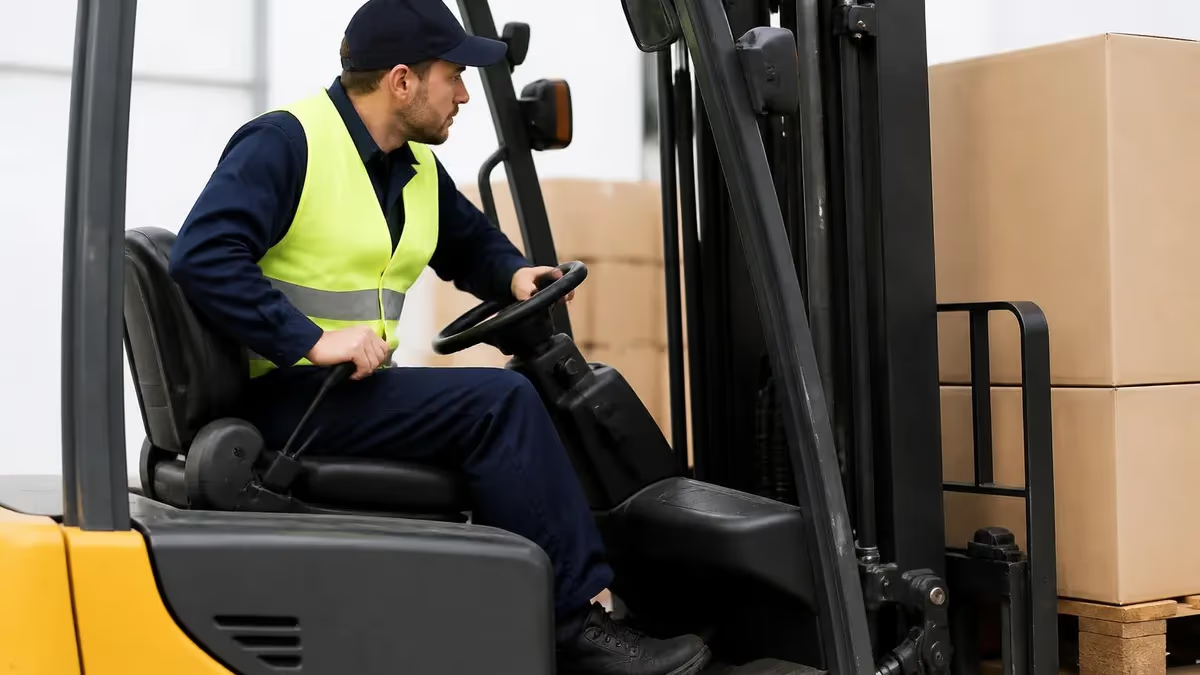
Used forklifts for sale offer significant cost savings compared to new equipment, but the savings only materialize when you buy the right machine. A used forklift in good condition can serve a warehouse, manufacturing facility, or construction site reliably for 8,000-15,000 hours of additional service — often at half or less the cost of new. A used forklift with hidden problems can cost more in repairs and downtime than a new unit would have cost in the first place. Knowing how to evaluate, inspect, and price used forklifts is what separates smart purchases from expensive mistakes.
The used forklift market has many sellers and price points. Authorized dealers (Toyota, Yale, Hyster, Crown, Mitsubishi) often sell certified pre-owned units with warranties and refurbishment. Independent forklift dealers offer broader selections at varied price points with their own inspection standards. Auctions sell forklifts as-is with limited or no inspection. Private sellers offer the lowest prices but typically no warranty or recourse if problems emerge after purchase. Each source has different risk-reward trade-offs that buyers should weigh.
Pricing varies enormously based on age, hours, condition, brand, and capacity. A 5-year-old, 4,000-hour, well-maintained Toyota electric forklift might sell for $12,000-$18,000 used compared to $25,000-$35,000 new. A 15-year-old propane forklift with 15,000+ hours might sell for $3,000-$6,000 — often a bargain if the chosen application doesn't demand intensive use. Understanding what affects price, and what condition factors most affect long-term value, helps you negotiate confidently and avoid overpaying.
This guide walks through evaluating used forklifts: pre-purchase inspection essentials, how to interpret hour meter readings, common problem areas to investigate, financing options for used equipment, certification and training considerations after purchase, and how to negotiate effectively with different seller types. Whether you're buying your first forklift for a new business or replacing aging equipment in an established operation, you'll find practical buying guidance here.
Beyond the equipment evaluation itself, consider the total ecosystem you'll be operating within. Reliable parts and service from local dealers, qualified mechanics in your area, and operator training capacity all affect how successfully you'll deploy the equipment over its service life. A great deal on a forklift in a brand poorly supported in your region can become a poor deal once the first repair becomes a multi-week parts wait. Local market dynamics matter alongside the unit-specific evaluation, especially for buyers in smaller markets without abundant equipment service options.

Typical price range: $5,000-$25,000+ depending on age, hours, capacity
Hour meter: Like miles on a car — under 5,000 hrs is low; over 15,000 hrs is high
Critical inspection areas: Mast and forks, hydraulics, engine/battery, tires, frame
Best buying sources: Authorized dealers > independent dealers > auctions > private sellers
Average lifespan: 20,000+ hours of service with proper maintenance
Forklift hour meters are the single most important data point when evaluating used equipment. The hour meter records actual operating time — not idle time — and gives you a clear picture of how heavily the unit has been used. A 10-year-old forklift with 5,000 hours has been used relatively lightly and likely has substantial life remaining. A 3-year-old forklift with 12,000 hours has been worked hard and may need major maintenance soon. Verify the hour meter is original and hasn't been replaced or tampered with.
Different forklift power sources have different ideal use cases and different used market dynamics. Electric forklifts are common in indoor warehouse settings and tend to have longer service lives because electric motors have fewer wear parts than internal combustion engines. Propane (LPG) and natural gas (CNG) forklifts work indoors with proper ventilation and outdoors. Diesel forklifts are predominantly used outdoors and at heavy industrial sites. Battery condition is the major used-electric-forklift concern; engine condition is the major used-IC-forklift concern.
Mast and lift system inspection is critical. The mast supports the forks and is responsible for the lifting work. Hydraulic leaks, bent or worn forks, damaged chains, and excessive play in the mast carriage are all expensive to repair. Have a qualified mechanic inspect these systems before purchase, or buy from dealers who provide pre-purchase inspection reports.
Pay particular attention to the lift cylinder rods, which can be scored or pitted from years of use, leading to seal failures and oil leaks. The forklift rental market often involves equipment that's been heavily used; inspecting accordingly applies whether you're renting or buying.
Engine condition matters most for IC forklifts. Listen for unusual noises, watch for excessive smoke at startup or under load, and check oil for metal particles or coolant contamination. A compression test from a qualified mechanic provides quantitative data about engine health. For electric forklifts, battery condition is the equivalent critical factor. A worn-out battery can cost $5,000-$10,000 to replace. Reading the battery's age (typically stamped on the case), testing voltage under load, and asking for water consumption history all help assess remaining battery life.
Tire condition affects both safety and operating cost. Solid pneumatic tires are common on heavy industrial forklifts; cushion (solid rubber) tires are common on indoor warehouse units. Worn tires reduce traction, increase tipping risk, and impair load handling. New tire sets can cost $1,000-$3,000 for a typical forklift. Factor tire replacement cost into your offer if existing tires are nearing end of life. The forklift for sale listings vary widely in how they describe tire condition; insist on inspection and document existing wear before purchase.
Inspection costs should be factored into purchase decisions. Hiring a qualified forklift mechanic to perform pre-purchase inspection typically costs $200-$500. This represents excellent value relative to the financial risk of buying a problematic unit. Many independent forklift dealers will perform inspections for buyers, sometimes for free if you're considering equipment they have for sale, sometimes for a fee on equipment you found elsewhere. The investment in professional inspection consistently pays back through avoided problem purchases and stronger negotiating position when issues are documented.
Inspection Areas for Used Forklifts
Check for bent or worn forks, damaged chains, hydraulic leaks at lift cylinders, mast rail condition, and excessive carriage play. Major mast repairs can cost $3,000-$8,000. Bent forks must be replaced for OSHA compliance — they can't be straightened safely.
IC engines: listen for noise, check for smoke, examine oil quality, request compression test. Electric: check battery age, test voltage under load, review water-consumption history. Replacement: engine $4,000-$12,000; battery $5,000-$10,000.
Check fluid level and condition (clear amber = good; dark or milky = problem). Look for leaks at hoses, fittings, and cylinders. Test all hydraulic functions: lift, tilt, side shift, attachment functions. Faulty cylinders/pumps can cost $1,500-$5,000 to repair.
Inspect tires for wear; check frame for cracks, bent components, or repair welds suggesting damage history. Solid pneumatic tires last 4,000-8,000 hrs. Cushion tires last 6,000-12,000 hrs. Frame damage can disqualify forklifts from safe operation.

Working with authorized dealers offers the most buyer protection but typically the highest prices. Manufacturer-authorized dealers refurbish trade-ins, replace worn components, and sell with limited warranties (often 30-90 days, sometimes longer for certified pre-owned units). The premium for dealer purchases is real — typically 15-30% more than equivalent equipment from independent sellers — but so is the value of warranty protection and confidence in the unit's condition. For first-time forklift buyers without diagnostic expertise, this premium is often worth paying.
Independent forklift dealers occupy a middle ground. Reputable independent dealers often have decades of experience and may specialize in particular brands or industries. Their inspection standards vary widely — some are excellent, some minimal. Asking for service records, inspection reports, and references from previous customers helps assess dealer reliability. Independent dealers often have flexibility in negotiating that authorized dealers don't, making them good options for buyers who can do some due diligence.
Auctions can produce excellent deals but require more buyer expertise. Government surplus auctions, retail bankruptcy auctions, and dealer-to-dealer auctions all sell forklifts as-is with limited inspection time before bidding. Bring a qualified mechanic to pre-bid inspections if possible. Set firm maximum bid limits before the auction starts — auction excitement can lead to overpaying. Know what you'll need to spend on transport, registration, and any immediate repairs to get the unit operational.
Private sellers offer the lowest prices but no warranty or recourse for problems. The savings can be substantial — often 30-50% less than dealer prices for equivalent equipment. The risk is real: a private-sale forklift with hidden problems is your problem entirely. Buyers comfortable with mechanical inspection or able to bring expertise may find private sales attractive. Buyers without diagnostic skills face higher risk that may exceed the savings. Verify ownership documentation, get the unit's service history if available, and inspect thoroughly before paying.
Certification and training requirements continue regardless of how the forklift was acquired. OSHA requires operator training for any powered industrial truck, and operators must be certified specifically on the type of forklift they'll use. Forklift training programs are widely available and required regardless of whether the equipment was purchased new or used. Building training costs into your forklift acquisition planning ensures you can put the equipment to safe productive use immediately after purchase.
Working with sellers who provide complete service records dramatically reduces purchase risk. A used forklift with documented maintenance history — oil changes, hydraulic service, repairs performed — gives you confidence about how the unit has been treated. Sellers who maintained their equipment well typically have records to prove it; those who didn't often can't produce them. Asking for service records is a useful filter early in the buying process. Sellers who provide records are typically the ones who maintained the equipment properly.
Used Forklift Buying Sources Compared
Manufacturer-authorized dealers selling certified pre-owned units.
- Pricing: Highest of all sources (15-30% premium)
- Inspection: Comprehensive — refurbished and serviced before sale
- Warranty: 30-90 days typical; sometimes 6 months on CPO units
- Best for: First-time buyers, businesses needing reliable equipment immediately
- Watch for: Year-end discounts; trade-in inventory cycles

Financing options for used forklifts are widely available. Equipment financing companies specialize in commercial equipment loans, often offering rates and terms competitive with new equipment financing despite the used-asset status. Bank loans are also available for businesses with established credit. Some dealers offer in-house financing or partner financing arrangements. Comparing total cost of financing across several lenders before committing helps avoid overpaying for the financing alongside the equipment itself.
Lease options for used equipment are less common than for new but exist for some buyers. Operating leases let you use equipment for 2-4 years and return it without ownership obligation; capital leases function more like financing with eventual ownership. For businesses uncertain about long-term equipment needs, leasing provides flexibility that ownership doesn't. The math on lease vs. buy depends on tax considerations, expected use levels, and end-of-term plans for the equipment.
Total cost of ownership extends beyond the purchase price. Operating costs (fuel or electricity, propane refills, battery replacement schedules), maintenance and repairs, insurance, training and certification of operators, and eventual replacement when the unit reaches end of life all factor into the true cost of forklift ownership. A cheap initial purchase that requires expensive repairs in year one can cost more total than a more expensive but well-maintained unit. Spreading the purchase price over expected useful life and adding annual operating costs gives you a clearer comparison between options.
For businesses with seasonal or intermittent forklift needs, the rental and used-purchase calculations differ. Heavy seasonal use that doesn't justify year-round ownership often makes rental more economical. Steady year-round use of even moderate intensity typically favors ownership. The break-even point between rental and ownership for a typical mid-capacity forklift is around 1,500-2,000 hours per year of use — well below most steady commercial use levels. Calculating your expected hours and comparing rental costs to ownership costs over a 5-year horizon clarifies which approach makes financial sense for your situation.
The forklift market has grown more transparent over the past decade with online listings, auction platforms, and specialty equipment websites. Sites like MachineryTrader, EquipmentTrader, and ForkLiftAction aggregate listings from dealers and private sellers across the U.S. Comparing similar units listed by multiple sellers gives you a sense of fair market pricing before you negotiate any specific deal. Online research before in-person inspection saves time and ensures you're working with realistic price expectations.
For buyers planning to expand operations, building relationships with one or two preferred used-forklift dealers makes future acquisitions easier. Dealers who know your operation, the types of equipment that work for your applications, and your reliability as a customer often reach out when ideal units come into their inventory. Some buyers maintain ongoing relationships across decades, with dealers helping them rotate equipment as needs evolve. This relational approach to equipment acquisition reduces transaction friction and often produces better deals than purely transactional purchases from strangers.
Every used forklift purchase should include a thorough inspection by someone qualified to evaluate the equipment — either you, a mechanic you bring, or a dealer-provided inspection report you trust. Photos and descriptions in online listings rarely reveal the problems that matter most. Schedule inspection before committing to purchase. If a seller refuses inspection access, walk away — legitimate sellers welcome buyer due diligence because they know their equipment is sound.
Brand considerations affect both initial price and long-term parts availability. Toyota, Yale, Hyster, Crown, Caterpillar, Mitsubishi, and Komatsu are major brands with widespread parts and service networks across the U.S. Buying these established brands means parts are readily available years into ownership and qualified service technicians can be found in most markets. Buying lesser-known brands or imported units can save money initially but creates parts availability and service challenges later that may exceed the savings.
Capacity matters significantly for matching forklift to job. A forklift's rated capacity (3,000 lb, 5,000 lb, 8,000 lb, etc.) is the maximum load it can safely lift at the load center distance specified. Buying capacity well above your typical needs provides a safety margin but increases initial cost and ongoing operating costs (heavier units use more fuel). Buying capacity that matches your actual needs efficiently is more cost-effective than over-buying. Calculate your typical and maximum load weights before shopping to match capacity to actual requirements.
Lift height is another specification to match carefully. Standard forklifts lift 12-15 feet — adequate for typical warehouse pallet work. High-bay warehouses may need 18-22 foot lifts. Specialized applications may need much higher (some reach trucks lift over 30 feet). Higher lift capability typically costs more both new and used, and unnecessary capability adds cost without operational benefit. Match lift height to your actual rack heights and product handling requirements rather than buying maximum capability.
Beyond the equipment itself, factor in transport from the seller to your facility. Forklifts typically require flatbed truck transport, which can cost $300-$1,500 depending on distance. Some sellers include transport in the price; others charge separately. Confirm transport arrangements before purchase. Self-transport using a heavy-duty trailer is possible for buyers with appropriate equipment, but most buyers find professional transport more convenient and safer for the equipment.
Used Forklift Buying Numbers
Used vs. New Forklift Purchase
- +Used: 30-60% lower initial cost than equivalent new equipment
- +Used: depreciation hit already absorbed by previous owner
- +Used: faster availability (no factory order lead times)
- +New: full manufacturer warranty (typically 1-3 years)
- +New: zero hours and unknown maintenance history avoided
- −Used: limited or no warranty depending on source
- −Used: maintenance history may be unknown or incomplete
- −Used: hidden problems can drive total cost above new equipment cost
- −New: significantly higher capital outlay required upfront
- −New: longer payback period before equipment generates net positive return
Forklift Questions and Answers
About the Author

Certified Crane Operator & Skilled Trades Exam Specialist
Ferris State UniversityRobert Martinez is a Journeyman Ironworker, NCCCO-certified crane operator, and forklift trainer with a Bachelor of Science in Construction Technology from Ferris State University. He has 21 years of ironworking, rigging, and heavy equipment operation experience across high-rise and industrial construction sites. Robert prepares candidates for crane operator, rigger, forklift, and skilled trades certification examinations.