
What Is the Most Common Cause of a Forklift Accident? Complete 2026 October Safety Knowledge Guide
What is the most common cause of a forklift accident? Learn the top hazards, 🎯 OSHA stats, and prevention tactics every operator must know in 2026 October.
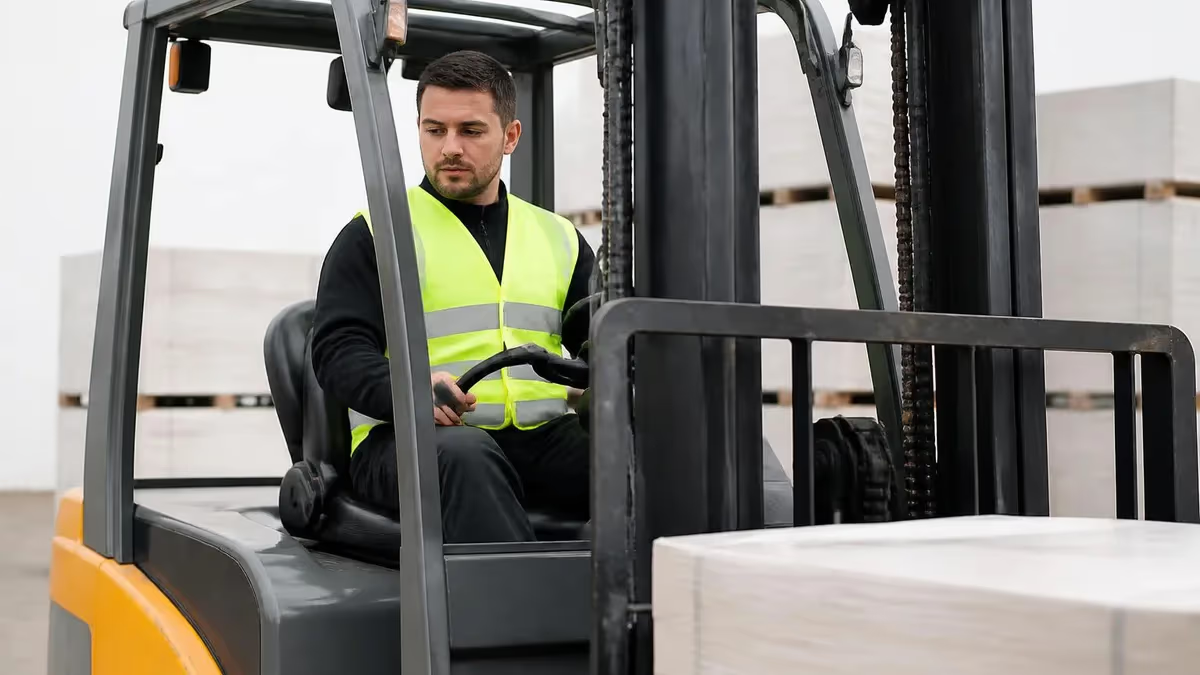
What is the most common cause of a forklift accident? According to OSHA investigation data and National Safety Council reports from the past five years, operator error tied directly to inadequate training is the leading root cause, accounting for roughly 70% of all serious forklift incidents reported across American warehouses, distribution centers, and construction yards. Whether you manage a fleet of stand up forklift units or oversee a single forklift rental on a temporary jobsite, understanding why crashes happen is the first step toward preventing the next one in your facility.
The Bureau of Labor Statistics tracks roughly 7,500 nonfatal forklift injuries and 70 to 100 fatalities every year in the United States. Tipovers alone account for almost a quarter of fatal incidents, while pedestrian strikes, falls from elevated forks, and crushing between the truck and a fixed object round out the remaining majority. These numbers have remained stubbornly consistent for over a decade, which tells safety professionals that the underlying causes are systemic, not random freak events.
Most accidents trace back to a small handful of preventable failures: rushed pre-shift inspections, unclear traffic patterns inside warehouses, missing or expired certification of forklift operators, and equipment that has been pushed past its service interval. A telehandler forklift with worn drive tires on a wet concrete floor is a different risk profile than a sit-down electric forklift on a polished retail floor, but both can become deadly when the operator skips even one step of the daily check.
This guide breaks down the real-world causes behind every major forklift accident category, citing OSHA case files, manufacturer engineering data, and insurance claim analysis. We will walk through tipovers, struck-by incidents, falls, and load-related crushing events, then look at how forklift training, supervisor accountability, and modern telematics close the gap between theory and the warehouse floor. The goal is practical: by the time you finish reading, you should be able to walk your own facility and identify three to five specific risks you can fix this week.
If you operate forklifts, supervise forklift operator teams, or sign off on equipment purchases, this is foundational knowledge. The safety data we will cover applies equally to a brand-new propane unit, a used forklift for sale picked up at auction, or a short-term forklift rental near me search that lands a machine in your facility tomorrow morning. The physics of a 9,000-pound counterbalanced truck do not care about who paid for it.
We will also tackle the questions that supervisors keep asking us: How often should refresher training happen? What are the warning signs of an at-risk operator? When does an aging fleet cross the threshold from cost-effective to dangerous? You will find concrete answers, not vague encouragement, throughout the sections below.
Treat this article as a working document. Bookmark the checklists, share the statistics with your safety committee, and use the quiz tiles at the bottom to test your knowledge before your next OSHA audit. Safety culture is built through repetition, and every fact you internalize today is one less incident report you will write next quarter.
Forklift Accidents in the U.S. by the Numbers

The Seven Root Causes Behind Most Forklift Accidents
OSHA cites untrained or under-trained operators in roughly 7 out of 10 serious incidents. Skipped initial certification or expired three-year refreshers leave operators guessing about load limits, ramp grades, and pedestrian protocols.
Driving too fast for floor conditions causes tipovers on turns, late stops at intersections, and pedestrian strikes in blind aisles. Most warehouse speed limits sit at 5 mph indoors and 8 mph outdoors for good reason.
Overloaded forks, off-center loads, raised loads during travel, and unsecured stacks shift the center of gravity and trigger forward or lateral tipovers. Always confirm the load against the data plate capacity.
Narrow aisles, blocked sightlines, mixed pedestrian and forklift traffic, and missing floor markings create predictable collision points. Engineering controls solve more problems than reminders ever will.
OSHA requires a documented inspection at the start of every shift. Brake failures, hydraulic leaks, low tire pressure, and faulty horns are routinely caught only after an incident when the checklist was skipped.
The single most common cause of a forklift accident is operator behavior shaped by gaps in training, supervision, or facility design. When OSHA investigators close out a case file, the proximate cause is usually something concrete like a tipover on a ramp or a pedestrian strike at a blind corner, but the contributing factors almost always include missing training records, ignored speed limits, or equipment that should have been red-tagged days earlier. Removing any one of those contributors prevents the entire chain.
Tipovers are the deadliest category. A counterbalanced forklift becomes unstable the moment the combined center of gravity of the truck and its load moves outside the stability triangle formed by the two front wheels and the center of the rear axle. Turning too sharply at speed, lifting a load while moving, or driving with the forks elevated all push the center of gravity toward the edge of that triangle. The operator usually has less than a second to react, and the only correct response is to stay in the seat, brace, and lean away from the direction of the fall.
Pedestrian struck-by incidents are the second-leading fatality cause. They almost always happen at intersections, dock edges, or aisle ends where sightlines are compromised. The driver assumes pedestrians will yield because they can see the lift truck; the pedestrian assumes the driver sees them. Forklift truck operators who install blue safety lights, motion-triggered intersection alarms, and convex mirrors at corners cut these incidents by more than half, according to multiple insurance loss-control studies.
Falls from elevated forks are the third major category, and they are almost entirely preventable. Using forks as a personnel lift without an approved work platform violates 29 CFR 1910.178(m)(12). When a proper platform is used, it must be secured to the carriage, the operator must remain at the controls, travel must be restricted, and the worker on the platform must wear fall protection. Skipping any one of those steps converts a routine task into a potential fatality.
Crushing incidents between the lift truck and a fixed object such as a trailer wall, a rack upright, or a loading dock are often categorized as preventable through wheel chocks, dock locks, and trailer restraint systems. A truck driver pulling away from a dock while a forklift is inside the trailer is one of the most documented warehouse fatality scenarios in OSHA's database. Dock communication procedures and trailer restraints have nearly eliminated these incidents at facilities that adopted them.
Mechanical failure accounts for a smaller but still meaningful share of incidents. Brake failure, steering failure, hydraulic hose ruptures, and tire blowouts are the most cited mechanical contributors. Every one of them is detectable in a thorough pre-shift inspection. The cost of taking five minutes per shift to walk around the truck, check fluids, test brakes, and verify horn and lights is trivial compared to the cost of a single lost-time injury claim.
Finally, a category that does not appear neatly in OSHA buckets but shows up in nearly every root-cause analysis: organizational pressure. Operators consistently report that they were told to move faster, skip the inspection because the truck was needed immediately, or use a forklift for a task it was not designed for. Safety culture starts at the supervisor level, and any facility where production pressure routinely overrides safety procedures will eventually generate a serious incident.
Forklift certification Practice Test Questions
Prepare for the Forklift certification Certification exam with our free practice test modules. Each quiz covers key topics to help you pass on your first try.
Forklift certification Certification Forkl...
Forklift certification Exam Questions covering Certification Forklift certification Maintenance and Repairs. Master Forklift certification Test concepts for certification prep.
Forklift certification Certification Forkl...
Free Forklift certification Practice Test featuring Certification Forklift certification Maintenance and Repairs Questions and Answers. Improve your Forklift certification Exam score with mock test prep.
Forklift certification Certification Forkl...
Forklift certification Mock Exam on Certification Forklift certification Operator Training and Certification Requirements. Forklift certification Study Guide questions to pass on your first try.
Forklift certification Certification Forkl...
Forklift certification Test Prep for Certification Forklift certification Operator Training and Certification Requirements Questions and Answers. Practice Forklift certification Quiz questions and boost your score.
Forklift certification Load Handling and S...
Forklift certification Questions and Answers on Load Handling and Stability. Free Forklift certification practice for exam readiness.
Forklift certification OSHA Regulations an...
Forklift certification Mock Test covering OSHA Regulations and Compliance. Online Forklift certification Test practice with instant feedback.
Forklift certification Pre-Operation Inspe...
Free Forklift certification Quiz on Pre-Operation Inspections. Forklift certification Exam prep questions with detailed explanations.
Forklift certification Refueling and Recha...
Forklift certification Practice Questions for Refueling and Recharging Procedures. Build confidence for your Forklift certification certification exam.
Forklift certification Safe Driving and Ma...
Forklift certification Test Online for Safe Driving and Maneuvering. Free practice with instant results and feedback.
Forklift certification Workplace Hazard Id...
Forklift certification Study Material on Workplace Hazard Identification. Prepare effectively with real exam-style questions.
Forklift certification Forklift Instructions
Free Forklift certification Test covering Forklift Instructions. Practice and track your Forklift certification exam readiness.
Forklift certification Forklift MCQ
Forklift certification Exam Questions covering Forklift MCQ. Master Forklift certification Test concepts for certification prep.
Forklift certification Forklift Employer R...
Free Forklift certification Practice Test featuring Forklift Employer Responsibilities. Improve your Forklift certification Exam score with mock test prep.
Forklift certification Forklift Penalties ...
Forklift certification Mock Exam on Forklift Penalties for Non-Compliance. Forklift certification Study Guide questions to pass on your first try.
Forklift Training and Accident Prevention Deep Dive
Tipovers happen when the load and truck center of gravity exits the stability triangle. Lateral tipovers occur during sharp turns at speed, especially with elevated loads. Forward tipovers happen when an overloaded fork or sudden braking with a raised load shifts weight ahead of the front axle. Both scenarios are predictable and preventable through speed control, load awareness, and respecting the data plate capacity for every attachment combination on the truck.
If a tipover begins, the operator must never jump. OSHA training video data and real-world fatality reports consistently show that operators who jump from a tipping seat are crushed by the overhead guard. The correct response is to stay seated, hold the steering wheel firmly, brace your feet, and lean in the opposite direction of the fall. Seat belts dramatically reduce injury severity and are required equipment on virtually every modern lift truck sold in the United States.

Renting vs. Buying Forklifts: Safety Implications
- +Forklift rental fleets are typically newer with current safety features like blue spotlights and presence detection
- +Rental companies handle maintenance and repair, reducing mechanical failure risk
- +Easy to scale up for seasonal demand without parking depreciating assets
- +No capital outlay means easier budget approval for safety upgrades
- +Operators get exposure to multiple makes and models, broadening competency
- +Rentals can be returned and swapped if a unit develops a safety issue mid-contract
- −Operators may not be familiar with the specific rental unit's controls, increasing early-shift incident risk
- −Rental units arrive with the previous user's wear patterns that may not match your application
- −Per-hour cost over multi-year horizons exceeds purchase price for high-utilization fleets
- −Less incentive for operators to treat the truck carefully when it is not company-owned
- −Inspection documentation responsibility still falls on the renting employer under OSHA
- −Familiarization training is still required on every new rental unit before use
Pros and Cons at a Glance
| Pros | Cons |
|---|---|
| Forklift rental fleets are typically newer with current safety features like blue spotlights and presence detection | Operators may not be familiar with the specific rental unit's controls, increasing early-shift incident risk |
| Rental companies handle maintenance and repair, reducing mechanical failure risk | Rental units arrive with the previous user's wear patterns that may not match your application |
| Easy to scale up for seasonal demand without parking depreciating assets | Per-hour cost over multi-year horizons exceeds purchase price for high-utilization fleets |
| No capital outlay means easier budget approval for safety upgrades | Less incentive for operators to treat the truck carefully when it is not company-owned |
| Operators get exposure to multiple makes and models, broadening competency | Inspection documentation responsibility still falls on the renting employer under OSHA |
| Rentals can be returned and swapped if a unit develops a safety issue mid-contract | Familiarization training is still required on every new rental unit before use |
Daily Forklift Operator Safety Checklist
- ✓Inspect tires for cuts, wear, and correct pressure before starting
- ✓Test service brakes and parking brake on level ground with no load
- ✓Verify horn, backup alarm, headlights, and warning beacons all function
- ✓Check hydraulic hoses, mast chains, and fork heels for cracks or leaks
- ✓Confirm seat belt operation and overhead guard integrity
- ✓Review the data plate capacity for any attachments installed today
- ✓Walk the planned travel route to identify pedestrians and obstructions
- ✓Verify load weight and center of gravity before every lift
- ✓Sound the horn at all intersections, blind corners, and dock edges
- ✓Lower forks fully, set parking brake, and remove key when leaving the truck
Why every operator must visualize the stability triangle
The forklift stability triangle is formed by the two front wheels and the pivot point of the rear axle. As long as the combined center of gravity of the truck plus its load stays inside this triangle, the forklift remains stable. Speed, turning radius, load height, and load weight all shift that center of gravity. Visualizing this triangle on every move is the single most important habit a forklift operator can develop.
Certification of forklift operators under OSHA 29 CFR 1910.178(l) is not optional, but the gap between paper compliance and real competency is where most accidents originate. The standard requires formal classroom or computer-based instruction, hands-on practical training, and a documented evaluation by a qualified trainer before an operator drives unsupervised. It also requires refresher training every three years at minimum, and immediately after any observed unsafe operation, near-miss, accident, or assignment to a different type of truck.
Many employers treat the initial certification as a one-and-done event. They run a new hire through a four-hour video, hand them a card, and put them on a truck the same afternoon. That approach satisfies the letter of the regulation only if a qualified evaluator actually watched the operator perform the required maneuvers and signed off. Skipping the evaluation step is one of the most common citations OSHA writes during post-incident inspections, and it routinely triggers willful violation penalties that exceed $150,000 per instance.
Truck-specific familiarization is a separate requirement that catches many employers off guard. An operator certified on a sit-down counterbalanced electric forklift is not automatically qualified to run a stand up forklift, a reach truck, an order picker, or a rough-terrain machine. Each truck class under OSHA's seven classifications requires its own evaluation. A crown forklift reach truck behaves differently than a Toyota cushion-tire warehouse truck, and the controls layout, visibility, and stability characteristics are not interchangeable.
Refresher triggers go beyond the three-year clock. Any of the following events resets the requirement: the operator is observed driving unsafely, has been involved in an accident or near-miss, has received an evaluation revealing the operator is not driving safely, is assigned to a different type of truck, or workplace conditions change in a way that could affect safe operation. Documenting these triggers and the corrective training that follows is critical evidence in any OSHA inspection or workers' compensation defense.
Evaluator qualifications are another commonly overlooked detail. The person who signs off on a new operator must have the knowledge, training, and experience to train forklift operators and evaluate their competence. A supervisor who has never been certified themselves cannot legally evaluate operators. Many facilities solve this by sending one or two supervisors to a train-the-trainer course annually, which pays for itself the first time it prevents a citation.
Modern training programs increasingly blend e-learning modules with virtual reality simulation and live evaluation. VR simulators let trainees experience tipovers, pedestrian strikes, and brake failures without real-world consequences, accelerating skill development and embedding muscle memory for emergency responses. Early data from logistics companies that have adopted VR training show meaningful reductions in first-year operator incident rates compared to traditional video-and-evaluation programs.
Beyond regulatory minimums, the most safety-conscious employers run monthly toolbox talks, quarterly skills drills, and annual full-day refreshers. They publish near-miss reports widely, celebrate operators who report close calls, and treat safety metrics as production metrics with the same level of management attention. That cultural investment is what separates facilities with zero recordable incidents per year from those that quietly accept a steady drip of injuries as the cost of doing business.

As of 2026, OSHA serious violation penalties exceed $16,500 per instance, and willful or repeat violations can exceed $165,000 per instance. A single accident involving an uncertified operator can trigger multiple citations covering training, evaluation, recordkeeping, and equipment maintenance. Most facilities cited after a fatality face total penalties between $250,000 and $750,000 before legal and workers' comp costs are added.
Building a sustainable forklift safety culture requires aligning equipment, training, supervision, and incentives. The facilities with the lowest incident rates tend to share a handful of structural traits: senior leadership visibly participates in safety meetings, near-miss reporting is rewarded rather than punished, equipment is replaced before it reaches the point of routine failure, and supervisors are evaluated on safety outcomes alongside production metrics. None of these are expensive, but all of them require consistency over years, not quarters.
Equipment selection plays a quiet but powerful role. An electric forklift in an indoor warehouse eliminates carbon monoxide exposure and reduces noise levels enough that operators can hear pedestrians and audible alarms more clearly. A modern stand up forklift with presence-sensing technology automatically stops if the operator steps off the platform. Rear-camera systems, blue spotlights, red zone projections, and 360-degree obstacle detection are now standard options on many new units and available as retrofits for older fleets. The capital cost is meaningful, but the insurance savings and incident reduction usually recover the investment within three to four years.
Maintenance discipline is the other half of the equipment story. A planned maintenance program with documented service intervals catches developing problems before they become safety issues. Hydraulic leaks, worn brake pads, frayed lift chains, and chassis cracks all telegraph themselves through subtle changes in performance long before they fail catastrophically. Reliable hyster forklift technicians who know your fleet are worth their weight in gold during a busy season when downtime is unacceptable.
Supervisor accountability is the lever most underused at most facilities. When supervisors actively walk the floor, observe operators, and provide immediate corrective feedback, behavioral compliance with safety rules climbs dramatically. When supervisors stay in offices and only respond to incidents after they happen, safety drift accelerates. Behavioral observation programs that track specific safe and unsafe behaviors with measurable monthly trend data give supervisors the structure they need to manage safety as a continuous process.
Reporting culture is the final piece. In facilities where reporting a near-miss leads to praise and a process improvement, near-misses get reported and the lessons spread. In facilities where reporting leads to discipline or finger-pointing, near-misses get buried and the same conditions cause an actual injury six months later. The single best predictor of long-term safety performance is the ratio of near-miss reports to actual injuries: high ratios indicate a healthy safety culture, while low ratios suggest underreporting.
Technology is reshaping what is possible. Telematics platforms now track speed, impact events, login times, pre-shift checklist completion, and operator certification expiration in real time. Geofencing can automatically slow trucks in pedestrian zones. RFID badges can prevent uncertified operators from starting a truck at all. These systems are not replacements for training and supervision, but they amplify what trained supervisors can see and respond to in a way that was impossible ten years ago.
Ultimately, every facility's safety performance reflects the choices leadership makes about resource allocation, training depth, equipment quality, and accountability. The most common cause of a forklift accident is not bad luck, and it is not one rogue operator. It is the accumulated effect of dozens of small decisions about whether to fund refresher training, replace a worn truck, paint a pedestrian walkway, or stop work to address a near-miss. Get those decisions right, and the statistics in this article become other people's problem.
Practical implementation starts with a 30-day safety reset. In week one, pull every operator's training file and verify current certification, evaluator signature, truck-type endorsements, and refresher dates. Flag anyone past their three-year mark, anyone evaluated by an unqualified person, and anyone driving a truck class they were not specifically evaluated on. This step alone often surfaces 20 to 40 percent of operators who are technically out of compliance, even at facilities that consider themselves well-managed.
In week two, conduct a facility walk with fresh eyes. Walk every aisle, every intersection, every dock, and every storage area as both an operator and a pedestrian. Look for blind corners without mirrors, intersections without painted markings, pedestrian walkways that cross forklift lanes without barriers, racks within striking distance of travel lanes without rack-protectors, and any area where production pressure pushes operators to take shortcuts. Document each finding with a photo and a proposed engineering or administrative control.
Week three is equipment week. Pull the maintenance file on every truck in service. Check the last documented service date, the hour meter, the inspection log, and any open work orders. Identify any unit with a deferred repair on a safety-critical system: brakes, steering, hydraulics, horn, lights, or seat belt. Red-tag those units until repairs are complete. If the volume of red-tagged trucks creates a production problem, that is a leading indicator that maintenance budgets have been underfunded for too long.
Week four ties it together with a refreshed training rollout. Schedule refresher training for every operator flagged in week one, conduct truck-specific evaluations for any class mismatches, and integrate the engineering control findings from week two into the training content. Use real photos from your own facility rather than generic training videos. Operators engage differently when they recognize the actual intersection where the near-miss happened last month.
Sustaining the program after the 30-day reset is where most facilities fall down. Build the following habits into the calendar: monthly toolbox talks on a rotating safety topic, quarterly skills observations with documented feedback, semi-annual leadership safety walks involving the plant manager or facility director, and annual third-party safety audits that bring an outside perspective. None of these are time-consuming individually, but together they create the cadence that sustains a safety culture.
Budget realistically for safety investment. As a rule of thumb, allocate at least 2 to 3 percent of total fleet operating cost to safety-specific spending: training, signage, mirrors, lighting, retrofit safety devices, third-party audits, and recognition programs. This is below typical insurance savings from a strong safety record, so the spending is self-funding over a multi-year horizon. Facilities that try to run safety as a zero-budget line item are essentially borrowing against future claims.
Finally, treat every incident and near-miss as the most important data point of the year. Conduct a real root-cause analysis, not a blame-assignment exercise. Document the contributing factors, identify the systemic gaps, and update procedures, training, or equipment to close those gaps. Then communicate the lessons across the facility within 72 hours. The half-life of organizational learning is short, and lessons not communicated quickly tend to be forgotten before the next shift starts.
Forklift Questions and Answers
Forklift Tires: Complete Guide to Types, Sizing, Wear Patterns, and Replacement Costs
Forklift Accessories: Complete Guide to LED Lights, Attachments, Safety Gear, and Productivity Upgrades for 2026
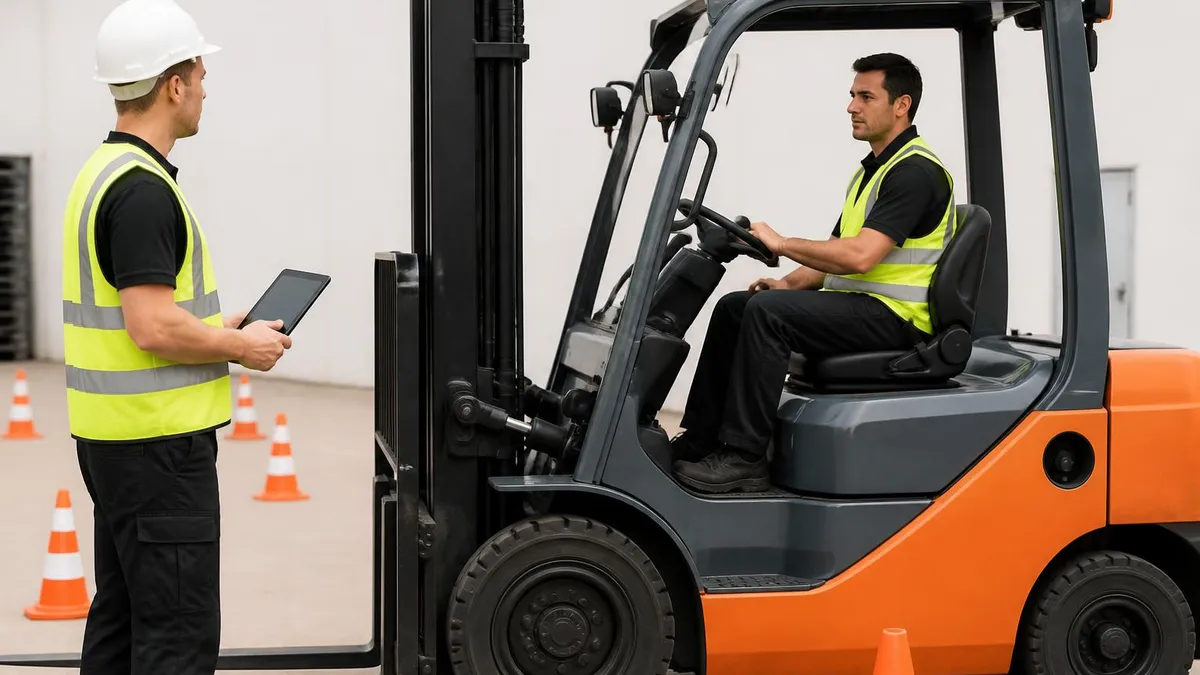
Forklift Safety Training: Complete OSHA Compliance Guide for Operators and Employers
Forklift Repair Service: Complete Guide to Costs, Common Repairs, and Choosing the Right Technician
Forklift Price Guide 2026: New, Used, Rental, and Total Cost of Ownership Breakdown
About the Author

Certified Crane Operator & Skilled Trades Exam Specialist
Ferris State UniversityRobert Martinez is a Journeyman Ironworker, NCCCO-certified crane operator, and forklift trainer with a Bachelor of Science in Construction Technology from Ferris State University. He has 21 years of ironworking, rigging, and heavy equipment operation experience across high-rise and industrial construction sites. Robert prepares candidates for crane operator, rigger, forklift, and skilled trades certification examinations.