
Forklift OSHA Training — Complete Guide (2026)
✍🏼 Forklift OSHA training under 29 CFR 1910.178(l): formal + practical + evaluation. What counts as OSHA-compliant, refresher rules, 7 classes.
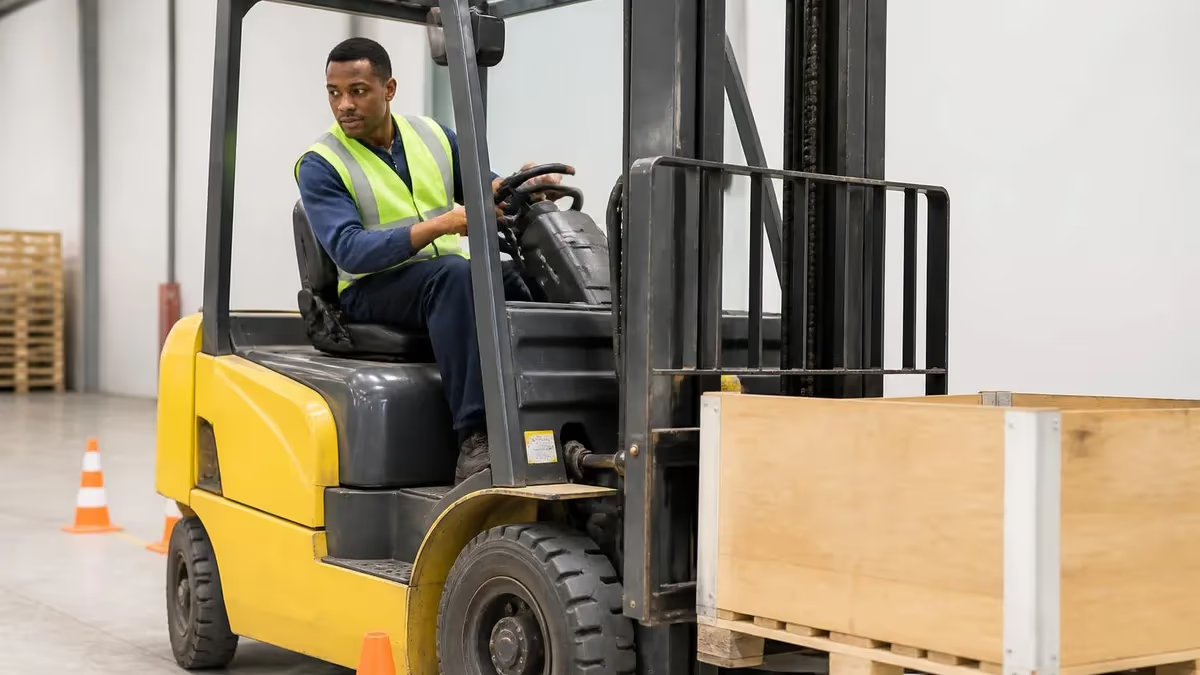
Forklift OSHA Training — Complete Guide (2026)
Short answer: no online course alone makes you OSHA compliant. The federal rule that governs powered industrial truck training — 29 CFR 1910.178(l) — has three pieces, and only one of them can happen on a laptop. The other two have to happen on the floor of the workplace where you'll actually operate the truck, under the eye of a qualified person your employer designates. Practice with the free Forklift certification practice test on PracticeTestGeeks (7 questions with answer explanations).
That's the whole game. Skip a piece, and you're not compliant. Take a $59 "100% OSHA-certified online" course and walk into a warehouse expecting to drive? You're not certified. Your employer can be cited. You can be hurt.
This guide walks through every requirement OSHA actually puts in the standard — the formal instruction, the hands-on practical, the workplace evaluation, the refresher triggers, the recordkeeping, and the equipment-specific bit that catches almost everyone off guard. Treat it as the playbook. If you want the cheaper or faster path, read forklift training online for how online modules fit into a compliant program. For the credentialing piece after training, see osha forklift certification.
What "OSHA Compliant" Actually Means
Worth knowing up front: OSHA doesn't approve, endorse, or certify any specific training program. Not one. If a vendor says "OSHA approved," they're lying — or being sloppy with language. What OSHA does is publish a performance standard, and your training program either meets it or it doesn't. There's no federal stamp, no decal, no registry. The compliance burden sits with the employer of the operator — always.
The standard is 29 CFR 1910.178(l). It says the employer is responsible. Not the trainer. Not the online vendor. The employer. You can outsource the formal instruction. You can outsource the practical training. You cannot outsource the certification — that's the employer's signature, the employer's records, the employer's liability. When a citation lands, the inspector hands it to the employer, not the vendor who sold the $89 e-learning module.
Three pieces. Formal instruction. Practical training. Workplace evaluation. Miss any one and the operator isn't compliant. Need the cost breakdown? See forklift certification cost.
Why the Distinction Matters in Practice
Walk through a typical compliance failure. A small warehouse hires a temp through a staffing agency. The agency forwards a certificate showing a national online course was completed two months ago. The warehouse owner glances at it, hands the temp a key, and the truck rolls.
Three weeks later there's a near-miss with a pedestrian, OSHA shows up, asks for the written certification for that operator on that specific truck class at that specific workplace, and the owner has nothing. The online certificate proves Step 1 happened — but Steps 2 and 3 never did at that warehouse on that truck. Citation. Penalty. Possible repeat violation if it happens again.
The fix is boring but cheap. Block out two hours, have a qualified employee ride along, demonstrate, watch the temp drive, sign a form, file it. That's Step 2 and Step 3 combined. The whole compliance gap closes for the cost of two hours of supervisor time.
- OSHA requires forklift operators to undergo a performance evaluation at least once every three years. (Occupational Safety and Health Administration (OSHA), U.S. Department of Labor; employers certify operators)
- Forklift operator certification under OSHA requires formal and practical training and an employer evaluation of the operator's workplace performance. (Occupational Safety and Health Administration (OSHA), U.S. Department of Labor; employers certify operators)
- For forklift operator certification, the employer must evaluate the operator's performance and determine that the operator can operate safely before workplace operation. (Occupational Safety and Health Administration (OSHA), U.S. Department of Labor; employers certify operators)
Facts verified Oct 15, 2026 against Occupational Safety and Health Administration (OSHA), U.S. Department of Labor; employers certify operators. Dates that have passed are removed automatically.
Forklift certification Certification Exam at a Glance
| Item | Detail | Official source |
|---|---|---|
| Renewal | Performance evaluation at least every three years | Occupational Safety and Health Administration (OSHA), U.S. Department of Labor; employers certify operators |
| Delivery | Formal instruction, practical training and workplace evaluation | Occupational Safety and Health Administration (OSHA), U.S. Department of Labor; employers certify operators |
| Eligibility | Training and demonstrated competence before workplace operation | Occupational Safety and Health Administration (OSHA), U.S. Department of Labor; employers certify operators |
Facts verified Oct 15, 2026 against Occupational Safety and Health Administration (OSHA), U.S. Department of Labor; employers certify operators. Dates that have passed are removed automatically.
Free Forklift certification Study Tools
Interactive Forklift certification resources on PracticeTestGeeks, free to start:
- Forklift certification flashcards — review key terms and concepts card by card
- Forklift certification study guide — topic-by-topic overview of what the exam covers
- Forklift certification cheat sheet — one-page printable summary for last-minute review
29 CFR 1910.178(l) requires three things before any worker operates a powered industrial truck: (1) formal instruction (classroom, video, or online), (2) practical hands-on training (must be in-person, on the actual truck type), and (3) employer evaluation at the workplace. The employer signs the certificate. Refresher every 3 years — or sooner if there's a near-miss, accident, new equipment, or workplace change.
The Three Required Steps
- Format: Classroom, video, online, or written
- Can be online: Yes
- Topics: Truck operation, stability, hazards, OSHA rules
- Duration: Typically 4–8 hours
- Format: Hands-on, in-person ONLY
- Can be online: No — never
- Where: On the truck type the operator will use
- Who teaches: Qualified trainer (experience + knowledge)
- Format: Performance check in the actual workplace
- Can be online: No
- Who: Employer or designated evaluator
- Result: Pass = certificate signed and dated

Step 1 — Formal Instruction (the online-friendly part)
Formal instruction is the only piece of the OSHA training trio that can happen on a screen. This is the lecture component — slides, video modules, written materials, quizzes. OSHA lists what has to be covered, and the list is long: stability triangles, load handling, pedestrian awareness, attachments, fueling, surface conditions, narrow aisles, pinch points. Around 25 specific topics in 1910.178(l)(3)(i) and (ii).
What a Good Formal Module Looks Like
You should walk out of formal instruction able to explain why a forklift tips, what a center of gravity is, why a loaded truck travels in reverse going down a ramp, and what the data plate tells you about load capacity. Not memorize. Explain. If your online course is just a click-through with no comprehension check, it's not meeting the standard — even though OSHA doesn't dictate a specific format. Click-through fatigue is real, and an operator who can't articulate the stability triangle hasn't learned the topic, regardless of what the completion screen says.
Vendors who do this well include written or video lectures, periodic knowledge quizzes, a final exam (usually 80% to pass), and a certificate of completion. That certificate proves you finished Step 1. It does not — repeat, does not — make you OSHA compliant on its own. For more on the credential side, see forklift license requirements.
Topics OSHA Actually Requires in Formal Instruction
The standard breaks topics into two buckets: truck-related and workplace-related. Truck-related covers operating instructions, the differences between trucks and cars, the controls and instrumentation on the operator's specific truck, the engine or motor operation, steering and maneuvering, visibility (including limits caused by loading), fork and attachment adaptation, vehicle capacity, vehicle stability, vehicle inspection and maintenance the operator will perform, refueling or charging of batteries, and operating limitations.
Workplace-related covers surface conditions, composition of loads, load manipulation, stacking and unstacking, pedestrian traffic in operating areas, narrow aisles and restricted places, hazardous (classified) locations, ramps and sloped surfaces, closed environments where insufficient ventilation could cause buildup of carbon monoxide or diesel exhaust, and any other unique potentially hazardous conditions in the workplace.
Step 1 Quick Verification
- ✓Course covers all truck-related topics in 1910.178(l)(3)(i)
- ✓Course covers all workplace-related topics in 1910.178(l)(3)(ii)
- ✓Comprehension is tested (final exam, not just click-through)
- ✓Completion certificate issued for the operator's file
- ✓Operator can explain the stability triangle in their own words
Step 2 — Practical Training (the part that has to be in-person)
Here's where every "100% online OSHA forklift certification" claim falls apart. The standard at 1910.178(l)(2)(ii) says practical training must include demonstrations by the trainer and exercises performed by the trainee. You cannot demonstrate driving a sit-down counterbalance through a video call. The trainee has to physically sit in the seat, manipulate the controls, lift loads, navigate aisles, and stop on a grade. Period.
Equipment-Specific Is Not Optional
This is the rule that catches employers most. Training on a Class IV sit-down counterbalance does not qualify the operator to drive a Class III walkie pallet jack. New equipment type? New practical training. New attachment (slip-sheet, drum clamp, fork extensions)? New practical training. The standard at 1910.178(l)(3)(i)(A) is explicit — operating instructions, warnings, and precautions for the types of truck the operator will be authorized to operate. Different truck means different training. Period. See types of forklifts for the seven OSHA classes.
Step 3 — Workplace Evaluation (the employer's signature)
Even after Steps 1 and 2, the operator still isn't certified. Step 3 is a performance evaluation conducted at the workplace where the operator will work — same aisles, same loads, same surface conditions. The evaluator watches the operator complete real or simulated tasks and decides: competent or not. There's no checklist OSHA mandates here, but most employers use one anyway — pre-shift inspection, mount and start, travel loaded, travel unloaded, stack at height, navigate a pedestrian zone, park properly.
If competent, the employer signs and dates a written certificate showing operator name, training date, evaluation date, and evaluator name. That signed record is what makes the operator OSHA-certified. Keep it on file. Bring it out when an inspector knocks. Lose it and you've got nothing — the standard at 1910.178(l)(6) requires written certification.
Some employers also issue a wallet card and a hard-hat sticker so supervisors can verify status at a glance. Neither is required by OSHA. Both are useful in the field. A wallet card costs pennies and saves the supervisor a trip to the filing cabinet during shift handovers, and inspectors generally smile when an operator can produce one on the spot — even though they'll still ask for the written record on file.
Formal vs Practical vs Evaluation
Can be online or classroom. Covers OSHA rules, truck operation theory, stability, hazards, load handling. Typically 4–8 hours. Ends in a written exam (~80% pass). Provides a completion certificate — but completion ≠ OSHA certification.
Trainer credential: knowledge and experience in operating the truck type. No federal trainer license exists.

Refresher Training — Every 3 Years, Plus Triggers
OSHA requires refresher training and an evaluation every three years. Set a calendar reminder. Inspectors check the dates on certificates, and an expired one is an instant citation — even if the operator drives perfectly. Three years from the evaluation date, not the formal instruction date. Most employers tie them to the same day to simplify tracking.
That's the baseline. Then there are the triggers — events that force a refresher regardless of where you are in the three-year cycle. The triggers are in 1910.178(l)(4)(ii): observed unsafe operation, an accident or near-miss, a workplace evaluation revealing inadequate skill, a new truck type, or a workplace condition change (new aisles, new loads, new surface). Any one of them. No exceptions.
Common Refresher Triggers in Practice
Tip-over even without injury? Refresher. Operator clips a rack and dents the leg? Refresher. Pedestrian had to jump out of the way? Refresher. Warehouse adds a new section with steeper grades? Every operator who uses that area needs refresher training before they drive there. The standard isn't squishy on this. For ongoing safe-driving fundamentals, our forklift safety training coverage walks through the daily checks.
How Much of a Refresher Counts as a Refresher
OSHA doesn't dictate the length. A refresher can be as short as a focused module on the issue that triggered it — say, an hour on pedestrian safety after a near-miss, followed by a re-evaluation. But the evaluation piece is non-negotiable. Don't just hand someone a packet to read at lunch and call it done. Watch them drive. Sign the form. Update the certificate date. If the trigger was a new truck class, the refresher has to include actual practical time on that new class — that's not optional either.
The Seven OSHA Forklift Classes
OSHA recognizes seven classes of powered industrial trucks under 29 CFR 1910.178. Training is class-specific. Certified on Class I (electric sit-down counterbalance)? You're not automatically certified on Class V (internal combustion sit-down). Each requires its own practical training and its own workplace evaluation. Most operators end up certified on 2–3 classes over their careers, not all seven.
Class Quick Reference
Class I — Electric motor rider trucks (sit-down counterbalance, electric). Class II — Electric motor narrow aisle trucks (reach trucks, order pickers). Class III — Electric motor hand or hand/rider trucks (walkie pallet jacks, walkie stackers). Class IV — Internal combustion engine trucks with cushion tires (indoor LP gas). Class V — Internal combustion engine trucks with pneumatic tires (outdoor LP/diesel/gas). Class VI — Electric and internal combustion engine tractors. Class VII — Rough terrain forklift trucks (construction sites, telehandlers without the boom function).
Why Class Matters for Liability
If your operator is certified on Class IV and you hand them the keys to a Class V because "it's basically the same thing," you've created a citation and a lawsuit. The trucks handle differently — pneumatic tires absorb shock, cushion tires don't. Outdoor surfaces tilt differently than warehouse floors. The center of gravity shifts. An experienced Class IV operator who climbs into a Class V without training is statistically more likely to tip the truck in the first ten minutes than a brand-new operator who got proper instruction. Familiarity breeds confidence; confidence without training breeds incidents.
For a deeper look at this topic, see our guide to forklift osha training.
Related reading: forklift osha training covers the next step in more detail.
If you want the full picture, the forklift osha training guide walks through it step by step.
The 7 OSHA Forklift Classes
- Power: Electric
- Type: Sit-down counterbalance
- Use: Indoor warehouses, food handling
- Power: Electric
- Type: Reach trucks, order pickers
- Use: High-density storage
- Power: Electric
- Type: Walkie pallet truck, walkie stacker
- Use: Loading docks, short-distance moves
- Power: Internal combustion (LP gas)
- Type: Sit-down counterbalance, cushion tire
- Use: Indoor on smooth floors
- Power: Internal combustion (LP / diesel / gas)
- Type: Sit-down counterbalance, pneumatic
- Use: Outdoor yards, lumber, mixed surfaces
- Power: Electric or IC
- Type: Tow tractors / tugs
- Use: Airports, auto plants, trailer trains
- Power: IC, pneumatic tire
- Type: Rough terrain forklifts
- Use: Construction sites, lumberyards, outdoor uneven ground
Aerial Lifts vs Forklifts — Different Standards, Different Training
People conflate these constantly. They're separate OSHA standards with separate training requirements. A forklift is a powered industrial truck under 29 CFR 1910.178. An aerial lift — scissor lift, boom lift, articulating boom — is governed by 29 CFR 1910.67 (vehicle-mounted) and ANSI A92 standards. Training on a forklift does not certify you on an aerial platform. Training on an aerial platform does not certify you on a forklift.
Where it gets tricky: telehandlers. A telescopic handler with forks is treated as a forklift (Class VII, rough terrain) under 1910.178 when used to lift materials. Bolt an aerial work platform onto the same telehandler and it becomes an aerial lift under 1910.67 — completely different training and equipment certification required. The operator needs both if the machine does both jobs. ANSI A92.5 covers boom-supported elevating work platforms; A92.6 covers self-propelled scissor lifts.
Worth knowing: under 1910.67, vehicle-mounted aerial work platforms also require a daily pre-shift inspection, fall protection training, and ground-control familiarization. None of that overlaps with forklift practical training. Two machines, two programs.
What Doesn't Count as OSHA Compliant
Run through this list. If anyone has handed you a credential based on any of these, you're not compliant — and your employer is exposed.
Online-only completion. Failing to do Step 2 (practical) and Step 3 (workplace evaluation) is the most common gap. The online vendor's certificate is fine for the formal piece. It cannot substitute for the rest. Same-day classroom-only courses that skip the workplace evaluation also miss the mark — the evaluator has to watch the operator in their actual workplace, on their actual equipment.
Training on the wrong truck class. A reach truck operator transferred to a sit-down without new practical training and evaluation isn't certified for the new equipment, even if the old certificate isn't expired. Self-certification. "I've been driving forklifts for 20 years" doesn't qualify under OSHA. The employer still has to evaluate and certify in writing. Long-expired refresher. Three years and one day past the evaluation date = not compliant. For credential renewal, see forklift license.
Recordkeeping — Keep for 3 Years
The certification record must include: operator name, training date, evaluation date, and identity of the person performing the evaluation. Keep on file. There's no federal mandate to keep records longer than the current certification period, but most employers hold them for the full operator employment history. Make it easy to retrieve. Inspectors will ask.
One Last Compliance Note on Recertification
If an operator leaves and comes back six months later, the old certification doesn't automatically reset to a fresh three-year clock. The employer can either re-evaluate (Step 3 only) and confirm competence on the same truck class, or run a full refresher. Most employers re-evaluate — it's faster and cheaper. The new evaluation date becomes the start of the next three-year cycle.
Document the gap and the re-evaluation in writing. That's the boring detail that keeps a small business out of trouble during an inspection. Treat the file like an insurance policy — you hope you never need it, but the day you do, it's the only thing standing between your company and a five-figure penalty.
OSHA-Compliant Forklift Training Checklist
- ✓Formal instruction completed (classroom, video, or online) covering all 1910.178(l)(3) topics
- ✓Written exam passed (typically 80%+)
- ✓Practical hands-on training completed in-person on the actual truck class
- ✓Trainer is qualified by knowledge, training, and experience
- ✓Workplace evaluation conducted by employer or designated evaluator
- ✓Written certificate signed and dated: operator name, training date, eval date, evaluator name
- ✓Records on file and retrievable on demand
- ✓Refresher scheduled for 3 years from evaluation date
- ✓Equipment-specific training documented for every truck class operated
- ✓Refresher triggered after any near-miss, accident, or new equipment

Forklift OSHA Training by the Numbers
Online Formal Instruction — Pros and Cons
- +Cheaper than in-person classroom (often $59–$150)
- +Self-paced — pause, rewind, repeat sections
- +Covers Step 1 only — fully compliant for the formal portion
- +Convenient for distributed teams and shift workers
- +Same OSHA topic coverage as in-person if the vendor is reputable
- −Does NOT replace practical training (Step 2) or workplace evaluation (Step 3)
- −Vendors claiming '100% OSHA certification online' are misleading customers
- −No way to verify operator comprehension beyond a multiple-choice quiz
- −Employer still bears full liability — outsourcing doesn't transfer it
- −Some online courses skip equipment-specific content, which OSHA requires
Pros and Cons at a Glance
| Pros | Cons |
|---|---|
| Self-paced — pause, rewind, repeat sections | No way to verify operator comprehension beyond a multiple-choice quiz |
| Convenient for distributed teams and shift workers | Employer still bears full liability — outsourcing doesn't transfer it |
| Same OSHA topic coverage as in-person if the vendor is reputable | Some online courses skip equipment-specific content, which OSHA requires |
Powered industrial truck training (29 CFR 1910.178(l)) ranks in OSHA's top 10 most-cited general industry standards almost every year. Typical citations: no certification on file, expired refresher, untrained operator, employer never conducted workplace evaluation. Average penalty per serious violation is around $16,131 in 2026 — and OSHA can cite per untrained operator.
A Realistic OSHA-Compliant Training Timeline
Day 1 Morning
Day 1 Afternoon
Day 2
Day 2 or 3
Day 3 (same week)
+3 Years
Any Trigger
What Compliant Training Typically Costs
Sample Forklift certification Practice Questions
Try these questions from our free Forklift certification practice tests. The correct answer and an explanation follow each question.
An employee has been operating the same counterbalanced forklift safely for five years. Workplace conditions and the type of forklift have not changed. According to OSHA 29 CFR 1910.178(l)(4), what is the MAXIMUM interval at which this operator must receive refresher training and an evaluation?
- A. Every year.
- B. Only after an accident or near-miss.
- C. Every five years.
- D. At least once every three years.
Answer: D. At least once every three years.
OSHA standard 1910.178(l)(4)(iii) mandates that all forklift operators must be evaluated at least once every three years to ensure their skills are current. Refresher training is also required sooner if the operator is involved in an accident, is observed operating unsafely, is assigned to a different truck, or if workplace conditions change.
Who is authorized to perform repairs on a forklift according to OSHA standards?
- A. Any warehouse employee
- B. Only trained and authorized mechanics or technicians
- C. The forklift operator on duty
- D. Any supervisor on site
Answer: B. Only trained and authorized mechanics or technicians
OSHA requires that forklift repairs be performed only by trained and authorized personnel to ensure safety.
Refresher training for a forklift operator is required after which event?
- A. An accident or near-miss involving the operator
- B. Every completed shift
- C. A change in weather
- D. A pay raise
Answer: A. An accident or near-miss involving the operator
An accident or near-miss is one of the conditions that requires the employer to provide refresher training.
According to OSHA, how frequently must a forklift be inspected before use?
- A. Weekly
- B. Monthly
- C. Before each shift or use
- D. Annually
Answer: C. Before each shift or use
OSHA requires forklifts to be inspected before each shift or before being placed in service.
Forklift Questions and Answers
Related Forklift Articles
Forklift Training Online — Complete Guide (2026)
OSHA Forklift Certification: 29 CFR 1910.178 Training, Evaluation & Recertification Guide
Forklift Safety Training: Complete OSHA Compliance Guide for Operators and Employers
Do You Need a License to Drive a Forklift? Complete US Requirements Guide for Operators and Employers
Forklift Types and Classifications: Complete Guide to Equipment Classes, Uses, and Operator Training
Forklift Certification Cost 2026: What You Pay Online, In-Person, and for OSHA-Compliant Training
How this page was made: written with AI tools. Exam facts are checked against the official sources listed below. Not reviewed by a subject-matter expert. Editorial policy
Sources & references
Exam facts on this page (fees, format, dates, passing scores) are checked against these official sources; the date is our last check. Editorial policy
- osha.gov — Test delivery, eligibility, renewal · verified Oct 2026