
OSHA Forklift Certification: 29 CFR 1910.178 Training, Evaluation & Recertification Guide
OSHA forklift certification explained: 🔎 29 CFR 1910.178 rules, the 3 required training parts, employer duties, recert every 3 years, classes, and cost.
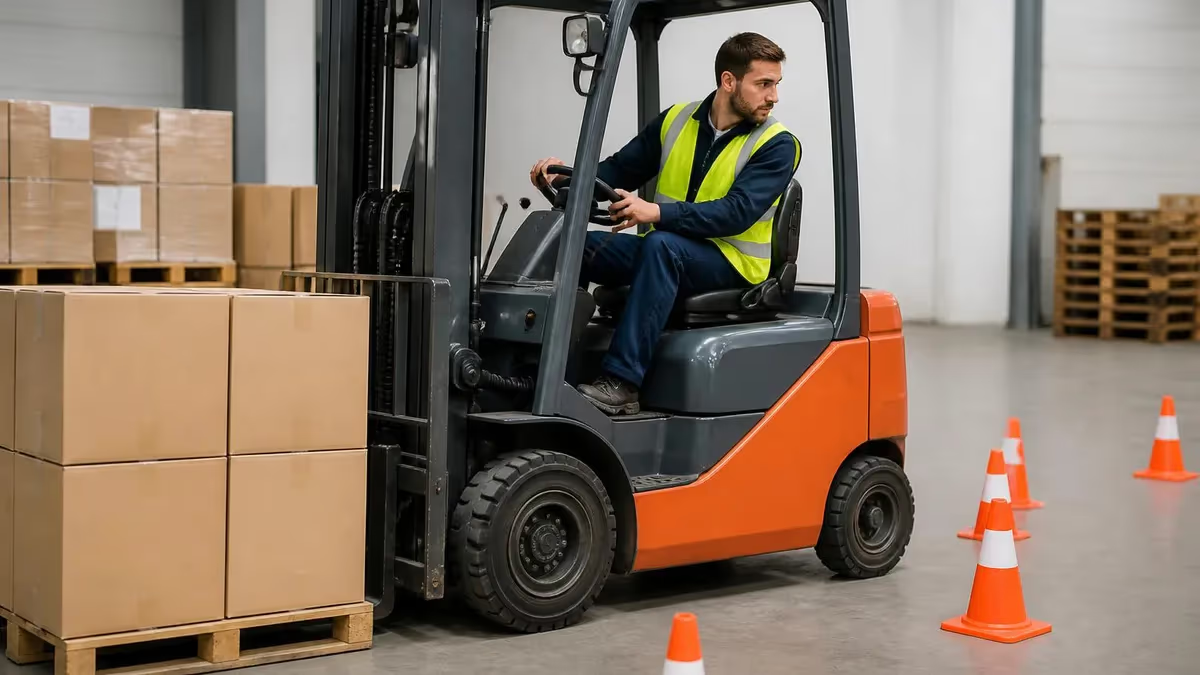
If you operate a forklift on the job, OSHA forklift certification isn't optional, and it isn't a card you can just buy online and forget about. The federal rule that governs it, 29 CFR 1910.178(l), spells out exactly what your employer has to do before letting you climb into a powered industrial truck. And yes, that includes electric pallet jacks, reach trucks, order pickers, and the big propane lifts you see in warehouses everywhere.
Here's the thing most people get wrong: OSHA does not issue forklift cards. Your employer does. A training provider can hand you a wallet card after class, but that card is just evidence of training. The actual certification, the legal one OSHA cares about, only happens when your employer documents that you completed formal instruction, hands-on practice, and a workplace evaluation by a competent person.
This guide walks you through the entire OSHA forklift certification process, what the rule actually requires, what employers have to do, how recertification works, what counts as a qualifying class of truck, and how much you should expect to pay. Whether you're a new operator trying to get hired or a safety manager trying to stay compliant, you'll find the federal requirements broken down in plain English below.

OSHA's powered industrial truck standard, 29 CFR 1910.178, has been on the books since 1971, but the training rule in subsection (l) was substantially rewritten in 1999. That update is what created the modern three-component model: formal instruction, hands-on practical training, and a workplace evaluation. Before 1999, the rule was vague enough that a lot of employers got away with a quick safety video and called it good. Not anymore.
The standard applies to every powered industrial truck used in general industry, construction (under 1926.602), and maritime work. That covers way more than just the warehouse forklift you're picturing. Reach trucks, order pickers, electric pallet jacks, rough terrain forklifts on a job site, even the little tug used to pull carts around a factory floor, all of them fall under the same training rule. If it has a power source and you ride or walk behind it to move materials, it counts.
The 3 Required Components of OSHA-Compliant Training
- What it is: Lectures, written materials, videos, computer-based learning
- Where it happens: Classroom, online, or self-study
- Who delivers it: Person with knowledge, training, and experience
- Typical duration: 4-8 hours of content
- Topics covered: Truck-specific operating instructions, workplace hazards, and the OSHA standard
- What it is: Demonstrations and hands-on exercises with the actual equipment
- Where it happens: On-site, with the trucks the operator will actually use
- Who delivers it: Competent trainer who can demonstrate safe operation
- Typical duration: 2-6 hours per truck class
- Topics covered: Pre-shift inspection, mounting, traveling, stacking, parking
- What it is: Operator's skills observed and rated by a competent evaluator
- Where it happens: In the actual workplace, on the actual equipment
- Who delivers it: Person qualified to judge safe operation (often a supervisor)
- Typical duration: 30-60 minutes per operator
- Documented: Operator name, training date, evaluation date, evaluator identity
This three-part structure is non-negotiable. You can't skip the evaluation. You can't skip the hands-on. And you definitely can't replace any of them with a longer online video. OSHA inspectors know the model and they look for documentation of each step. If you're researching how to get forklift certified, the answer always comes back to these three components, in this order.
The mistake most small employers make is buying an online course, having the new hire watch it, then handing them keys. That's only step one. Without the practical training and evaluation, OSHA still considers the operator untrained, and the employer faces the full citation if anything goes wrong. The rule is written so the employer cannot delegate the practical or evaluation steps to a third party, at least not in the actual workplace where the operator will work.
What Each Training Component Looks Like in Practice
The formal instruction part of OSHA forklift certification has to cover both truck-specific topics and workplace-specific topics. The federal rule lists out about a dozen items under each. Truck-related: operating instructions, differences between the truck and a car, controls and instrumentation, engine or motor operation, steering and maneuvering, visibility limits, fork attachments, vehicle capacity, vehicle stability, inspection requirements, refueling or recharging, and any other operating limitations the manufacturer lists.
Workplace-related: surface conditions, composition of likely loads and load stability, load handling, pedestrian traffic, narrow aisles, restricted areas, hazardous classifications, ramps and sloped surfaces, closed environments where exhaust or noise builds up, and any other unique conditions on the site. Some of those won't apply to your workplace, and OSHA is fine with skipping irrelevant ones, but you have to be able to defend why.
One of the most common questions I see from new safety managers is whether the OSHA card from a third-party trainer is enough. Short answer: no. A wallet card from a training company proves the operator sat through formal instruction. It does not satisfy the practical training or workplace evaluation requirements unless that trainer came on-site, used your equipment, and signed off on the operator working in your specific environment. Most online and classroom-only programs cannot, by definition, do this.
So if you're hiring an operator who already has a card, treat that card as evidence that step one of the forklift certification process is done. You still owe them the practical training and evaluation in your workplace before they can run a truck for you. Document it just like you would for a brand-new operator. The 3-year clock starts on the date of your evaluation, not the date on their old card.
OSHA Forklift Certification by the Numbers
Forklift training citations show up in OSHA's annual top 10 list almost every year. In recent enforcement data, 1910.178 has consistently ranked in the top 10 most-cited standards across all general industry. The most common citations aren't for failing to train at all; they're for incomplete documentation, missing evaluation records, or training that didn't cover the specific truck class the operator was using when an inspector showed up.
If you're already exploring the forklift driver career path or sizing up forklift operator jobs in your area, knowing the rule from the operator side is a real advantage. Hiring managers love candidates who can talk about pre-shift inspections, the stability triangle, and the difference between Class I and Class IV trucks. It signals you understand the safety culture, not just the controls.

OSHA recognizes seven classes of powered industrial trucks, and the certification rule applies to all of them. The classes are based on power source, design, and intended use. An operator who is certified on one class is not automatically qualified on another. If your job involves multiple truck types, you need separate practical training and evaluation for each class. Knowing the types of forklifts helps you understand which training certification you actually need.
The 7 Classes of Powered Industrial Trucks
- Power: Electric (battery)
- Examples: Sit-down counterbalance, stand-up rider
- Common use: Indoor warehousing, retail, manufacturing
- Power: Electric (battery)
- Examples: Reach trucks, order pickers, turret trucks
- Common use: High-density warehouse storage, narrow aisles
- Power: Electric (battery)
- Examples: Walkie pallet jacks, walkie stackers, walk-behind tugs
- Common use: Loading docks, retail back rooms, light moving
- Power: Internal combustion (propane, gasoline, diesel)
- Examples: Sit-down counterbalance with solid tires
- Common use: Indoor work on smooth concrete, manufacturing
- Power: Internal combustion (propane, gasoline, diesel)
- Examples: Sit-down counterbalance with air-filled tires
- Common use: Outdoor yards, lumberyards, mixed indoor/outdoor
- Power: Electric or internal combustion
- Examples: Tugger trucks for towing carts and trailers
- Common use: Airports, factories with line-side delivery, baggage
- Power: Internal combustion (usually diesel)
- Examples: Telehandlers, vertical mast rough terrain trucks
- Common use: Construction sites, lumberyards, agriculture
Notice how different the use cases are. The skills to operate a Class III walkie pallet jack at a retail loading dock are nothing like the skills needed to run a Class VII telehandler on a construction site. OSHA's rule reflects that.
You can be fully certified to run a sit-down counterbalance forklift in your warehouse and still be considered untrained the day your boss asks you to hop on a reach truck. The fix is straightforward: a few hours of formal instruction on the new class, hands-on time with the new truck, and an evaluation. Document it and you're compliant.
Cost is one of the first questions every employer asks. The good news: OSHA forklift certification is one of the cheapest pieces of compliance training out there. The bad news: there's no single price because the cost depends on whether you're buying online instruction, on-site training, or building your own program in-house. Here's what the market looks like in 2026.
Typical OSHA Forklift Certification Costs (2026)
- Cost per person: $50 to $150
- Time: 1 to 4 hours self-paced
- Covers: Step 1 (formal instruction) only
- Still need: Practical training and evaluation on-site
- Cost per person: $150 to $300
- Time: 4 to 8 hours, single day
- Covers: All three components if held at your site
- Best for: Small employers without an in-house trainer
- Cost: $250 to $1,500 per trainer
- Time: 2 to 5 days
- Covers: Qualifies someone in-house to certify other operators
- Best for: Mid to large employers with ongoing turnover
For a single new hire at a small warehouse, an in-person class held on-site by a third-party trainer is usually the simplest path: one purchase, one day, all three components handled. For a 50-operator distribution center with constant turnover, the math flips. Pay $1,000 once to send a supervisor through train-the-trainer and that supervisor can certify every new hire for the next several years. Either approach is OSHA-compliant. The standard doesn't care who does the training, only that all three components happen and get documented.
One more cost to factor in: the time operators spend off the floor. A full certification day takes 4 to 8 hours of an operator's time. If your warehouse is running tight, building that into the labor budget for new hires matters. Some employers split formal instruction (online, on the operator's own time during week one) from practical training and evaluation (on-clock during week two). That cuts in-class hours roughly in half.
Recertification is where a lot of compliance programs quietly fall apart. The rule is simple: every operator must be re-evaluated at least every 3 years. That doesn't mean a full retrain every 3 years. Just an evaluation. If the operator passes the evaluation, they're good for another 3 years and you document the new evaluation date. Refresher formal instruction is only required if specific triggers happen, like an accident, a near-miss, observed unsafe operation, a workplace change, or a switch to a different truck class.
The 3-year clock can sneak up on you, especially in companies where operators were all trained at once when the program was set up. Three years later, every certification expires in the same week. The fix is to spread evaluations throughout the year as part of normal supervision. Many companies build the evaluation into the annual safety review or into the operator's birthday week. Whatever cadence works, just make sure the documented evaluation date is no more than 36 months old at any point.

OSHA Forklift Certification: Employer Workflow
Step 1: New Operator Hired or Assigned
Step 2: Formal Instruction Delivered
Step 3: Practical Training On-Site
Step 4: Workplace Evaluation
Step 5: Documentation Filed
Step 6: Re-evaluate Within 3 Years
Documentation is where OSHA inspectors find most of their citations. The standard requires four pieces of information for each operator: name, date of training, date of evaluation, and identity of the person doing the evaluation. That's it. There's no required form, no specific format, no government template. A simple spreadsheet works. A signed paper checklist works. Even a properly tracked entry in a learning management system works. What doesn't work is no record at all, or a record that's missing one of those four data points.
OSHA recommends keeping training records for at least the length of one re-evaluation cycle, which is 3 years. Most employers keep them for the duration of employment plus 3 years after, just to be safe. If an operator transfers between facilities within the same company, the certification follows them as long as the new facility has the same equipment classes. If equipment differs, additional training is required for the new equipment.
Documentation Checklist for OSHA Compliance
- ✓Operator's full legal name on every training and evaluation record
- ✓Specific date the formal instruction was completed
- ✓Specific date the workplace evaluation was passed
- ✓Name and signature of the person who conducted the evaluation
- ✓Truck class or classes the operator is certified to operate
- ✓Records kept for at least 3 years and accessible during OSHA inspections
- ✓Refresher triggers logged when they occur (accidents, near-misses, unsafe operation)
- ✓Re-evaluation scheduled within 36 months of the previous evaluation
- ✓Separate documentation for each truck class the operator uses
- ✓Records updated immediately when an operator is reassigned to a new equipment type
What does an actual evaluation look like? It's not a written test, although some employers add one as a layered safety check. The OSHA evaluation is a hands-on observation of the operator completing real tasks. A good evaluator sets up a representative scenario, watches without interfering, and grades the operator on technique.
The skill items most evaluators look at include the pre-shift inspection, proper mounting and dismounting with three points of contact, traveling without a load (forks low, eyes in the direction of travel), and traveling with a load (forks tilted back, load low). Add stacking and destacking pallets, fork positioning, and parking the truck properly with brake set and key out.
Communication with pedestrians and other operators rounds out the list. If an operator fails an item, the evaluator stops, explains what went wrong, has the operator practice the correct technique, and then resumes. Failure on a critical item like load handling or pedestrian awareness usually means the operator goes back for more practical training before another evaluation attempt.
In-House vs. Third-Party OSHA Forklift Training
- +In-house programs can train new hires immediately, no scheduling delays
- +Once a trainer is qualified, the per-operator cost drops to almost nothing
- +In-house trainers know the actual workplace hazards and equipment intimately
- +Refresher training and re-evaluations can happen on demand without coordination
- +Documentation stays under direct control of the safety manager
- −Train-the-trainer programs require an upfront investment of $250 to $1,500
- −In-house trainers must keep their own knowledge current as equipment and rules change
- −Small employers with low turnover often can't justify the in-house overhead
- −Third-party trainers offer specialized expertise on rare equipment classes
- −An outside auditor's perspective sometimes catches blind spots an in-house trainer misses
Pros and Cons at a Glance
| Pros | Cons |
|---|---|
| In-house programs can train new hires immediately, no scheduling delays | In-house trainers must keep their own knowledge current as equipment and rules change |
| Once a trainer is qualified, the per-operator cost drops to almost nothing | Small employers with low turnover often can't justify the in-house overhead |
| In-house trainers know the actual workplace hazards and equipment intimately | Third-party trainers offer specialized expertise on rare equipment classes |
| Refresher training and re-evaluations can happen on demand without coordination | An outside auditor's perspective sometimes catches blind spots an in-house trainer misses |
One question that comes up a lot: who exactly counts as a competent evaluator? OSHA defines this loosely, which is intentional. The standard says the evaluator must have the knowledge, training, and experience to train operators and evaluate their competence. That's it. There's no certification required to be an evaluator. In practice, most evaluators are supervisors, lead operators, or safety managers who have years of forklift experience and have themselves been trained on the standard. Some employers send their evaluators through a train-the-trainer program for the documentation trail and the structured curriculum, but it's not required by the rule.
What is required is that the evaluator be designated by the employer as competent. Document who your evaluators are. If an inspector asks why a particular supervisor signed off on an operator's evaluation, you want a clean answer: this person is our designated forklift evaluator, here are their qualifications, here's the train-the-trainer certificate or the years of operating experience that qualifies them.
Age is another rule that gets missed. OSHA's forklift rule itself doesn't specify a minimum age, but the U.S. Department of Labor's Hazardous Occupations Order #7 (under the Fair Labor Standards Act) prohibits anyone under 18 from operating a powered industrial truck in a non-agricultural workplace. So even if a 16-year-old has the skills and even if they pass an evaluation, federal law still bars them from running a forklift on the job. The minimum effective age is 18, period. Some states layer additional restrictions on top of that, but 18 is the federal floor.
For employers, this means hiring practices need to gate forklift assignments by age. A 17-year-old hired into a warehouse can do plenty of useful work, but they cannot be assigned to a powered industrial truck until they turn 18, even if you've completed training and evaluation. The training itself can happen before 18 if you want to be ready, but the actual operation has to wait.
Choosing a Third-Party OSHA Forklift Training Provider
- ✓Provider explicitly covers all three components: formal instruction, practical training, and on-site evaluation
- ✓Course content matches the truck classes you actually use (Class I, II, III, IV, V, VI, or VII)
- ✓Trainer comes to your facility for the practical training and evaluation steps
- ✓Provider issues documentation that includes operator name, dates, and evaluator identity
- ✓Industry-specific training available (warehouse, construction, manufacturing, retail)
- ✓Reasonable refresh and re-evaluation pricing for ongoing compliance
- ✓References from similar employers in your industry
- ✓Trainer can answer detailed questions about 29 CFR 1910.178 from memory
- ✓Bilingual training available if your workforce needs it
- ✓Optional written test in addition to the OSHA-required hands-on evaluation
The single biggest mistake to avoid: assuming that any wallet card, online certificate, or training receipt equals OSHA compliance. It doesn't. The certification is the documented combination of all three components, signed by a competent evaluator, in your workplace, on your equipment. Until that's in the personnel file, the operator is not certified, and you the employer are exposed if something goes wrong.
Forklift accidents are not rare. OSHA estimates around 85 fatalities and tens of thousands of serious injuries annually involving powered industrial trucks in the United States. The vast majority are preventable, and proper training is one of the most cost-effective preventions. Spending $200 per operator now beats a six-figure citation, a workers' comp claim, and a wrongful death suit later. The math isn't even close.
Sample Forklift certification Practice Questions
Try these questions from our free Forklift certification practice tests. The correct answer and an explanation follow each question.
An employee has been operating the same counterbalanced forklift safely for five years. Workplace conditions and the type of forklift have not changed. According to OSHA 29 CFR 1910.178(l)(4), what is the MAXIMUM interval at which this operator must receive refresher training and an evaluation?
- A. Every year.
- B. Only after an accident or near-miss.
- C. Every five years.
- D. At least once every three years.
Answer: D. At least once every three years.
OSHA standard 1910.178(l)(4)(iii) mandates that all forklift operators must be evaluated at least once every three years to ensure their skills are current. Refresher training is also required sooner if the operator is involved in an accident, is observed operating unsafely, is assigned to a different truck, or if workplace conditions change.
According to OSHA regulations (29 CFR 1910.178), when must a forklift pre-operation inspection be performed?
- A. Only when a new operator uses the forklift
- B. At the beginning of each shift or daily, whichever is more frequent
- C. Once per week, if the forklift is used regularly
- D. After the forklift has been refueled or recharged
Answer: B. At the beginning of each shift or daily, whichever is more frequent
OSHA standard 29 CFR 1910.178(q)(7) mandates that powered industrial trucks must be inspected at least daily before being used. If a forklift is used around the clock, it must be inspected after each shift.
Under OSHA 29 CFR 1910.178(l), who is responsible for ensuring forklift operators are trained and evaluated?
- A. The forklift manufacturer
- B. The employer
- C. The local government
- D. The forklift operator themselves
Answer: B. The employer
OSHA places the legal responsibility on employers to ensure all forklift operators receive proper training and evaluation before operating powered industrial trucks.
How often must forklift operators undergo re-evaluation to remain compliant?
- A. Every 6 months
- B. Every year
- C. Every 3 years
- D. Never, after initial certification
Answer: C. Every 3 years
OSHA regulations (29 CFR 1910.178(l)(3)(ii)) mandate that forklift operators must undergo a performance evaluation at least once every three years. This re-evaluation ensures that operators maintain the necessary skills and knowledge to safely operate powered industrial trucks. Regular assessments help prevent complacency and reinforce safe operating practices over time, contributing to a safer work environment.
OSHA Forklift Certification Questions and Answers
OSHA forklift certification isn't complicated once you see the structure: one federal rule, three required training components, four pieces of documentation, seven truck classes, and a 36-month re-evaluation cycle. That's the whole framework. Whether you're an operator getting certified for the first time, a hiring manager verifying a new employee's credentials, or a safety manager building a compliance program from scratch, the requirements are spelled out in 29 CFR 1910.178(l) and they apply equally to every powered industrial truck in every workplace covered by OSHA.
The biggest takeaway: this is the employer's responsibility, not the operator's. The employer has to provide the training, document it, and re-evaluate every 3 years. Operators can take the initiative and bring an OSHA-aligned training certificate to a new job, but until the new employer completes the practical training and evaluation in their specific workplace, that operator is not yet legally certified to drive there. Build that step into onboarding and you'll never have an OSHA citation under 1910.178(l).
About the Author

Certified Crane Operator & Skilled Trades Exam Specialist
Ferris State UniversityRobert Martinez is a Journeyman Ironworker, NCCCO-certified crane operator, and forklift trainer with a Bachelor of Science in Construction Technology from Ferris State University. He has 21 years of ironworking, rigging, and heavy equipment operation experience across high-rise and industrial construction sites. Robert prepares candidates for crane operator, rigger, forklift, and skilled trades certification examinations.