
Forklift Operator Salary: Pay Rates, Raises, and How to Earn More in 2026 October
Forklift operator salary guide: hourly rates, annual pay by state, certification boosts, overtime, and how to earn $60K+ in 2026 October. 🏆
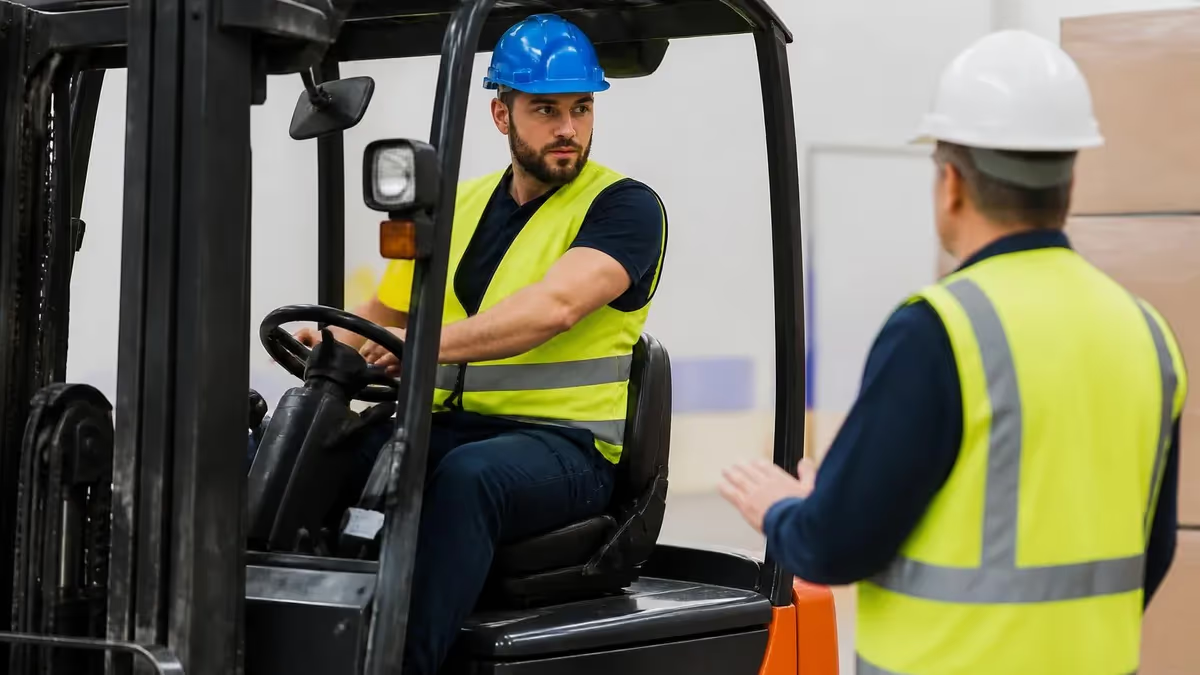
Understanding forklift operator salary in 2026 is the first step toward planning a stable warehouse, distribution, or construction career that pays well above many entry-level positions. The national average for a certified forklift operator now sits between $19 and $24 per hour, with annualized pay landing around $44,000 to $52,000 before overtime. Those numbers shift dramatically based on industry, region, shift differential, and the specific lift trucks you are trained to drive, including reach, order picker, and high-capacity diesel units.
Pay has climbed sharply since 2021 because warehouse demand exploded alongside e-commerce growth, cold storage expansion, and reshoring of US manufacturing. Companies like Amazon, FedEx, UPS, Costco, and Walmart now compete aggressively for certified operators, often offering sign-on bonuses between $500 and $3,000. If you have looked into a certification of forklift or noticed the surge in local hiring boards, you have already seen this competition play out in real time.
The biggest factor separating a $16 per hour operator from a $32 per hour operator is not luck — it is documented OSHA certification, equipment versatility, and a clean safety record. Operators who can run a stand up forklift, a sit-down counterbalance, and a reach truck inside a narrow-aisle rack system command top quartile pay. Cold storage operators earn even more because not everyone tolerates a 12-hour shift at minus 10 degrees Fahrenheit handling fast-moving frozen pallets.
Geography matters as much as skill. A forklift operator in rural Mississippi might top out near $17 per hour, while the same operator in Seattle, Newark, or the Inland Empire of California can pull $28 to $34 hourly base, plus shift premium. Union shops, especially Teamsters-affiliated warehouses and longshore terminals, regularly pay above $40 per hour after several years on the seniority list, with full pension and health benefits attached.
This guide breaks down everything that affects your paycheck: certification cost, hourly versus salaried roles, overtime math, union versus non-union, specialty equipment premiums, and the realistic career ladder from entry level loader to lead trainer or warehouse supervisor. We pulled data from the Bureau of Labor Statistics, Indeed salary aggregators, ZipRecruiter postings, and direct job listings from Fortune 500 logistics employers active in early 2026.
You will also see how a $150 certification course pays for itself within the first two weeks of work, why night shift typically adds $1.50 to $3.00 per hour, and how reefer warehouses, port terminals, lumber yards, and beverage distributors structure pay differently. By the end, you will know exactly what to ask for at your next interview and which equipment endorsements deliver the highest return on training time.
Whether you are a high school graduate weighing trade options, a career changer leaving retail, or a current operator wondering if your wage is fair, the numbers below give you a clear, honest snapshot. Forklift work is not just a stopgap job anymore — for thousands of Americans it is a $60,000 to $80,000 career with predictable hours, real benefits, and a clear path to lead, supervisor, or operations roles inside the country's biggest distribution networks.
Forklift Operator Salary by the Numbers (2026)

Forklift Operator Pay by Experience Level
What actually determines your forklift operator salary boils down to seven factors: certification status, equipment range, industry vertical, geographic market, shift, employer size, and union status. Most new operators underestimate how much each of these stacks on top of the others. A non-certified material handler in a small shop in Alabama might earn $15.50 per hour, while a certified, multi-equipment, night-shift operator at a Costco distribution center in New Jersey takes home $31.75 hourly plus benefits worth another $9 per hour in real value.
Certification is the single highest return-on-investment credential in the warehouse world. OSHA 29 CFR 1910.178 requires every operator to be formally trained and evaluated, and employers cannot legally let you touch the controls without it. A complete certification through an in-person school or employer-sponsored program costs between $75 and $250 and takes one day to one week. That investment typically pays back within the first 60 hours of work because certified pay starts about $3.50 higher than uncertified labor pools.
Equipment versatility multiplies your value quickly. The classic Class IV sit-down counterbalance is the baseline, but operators who can also handle a Class II narrow-aisle reach truck, a Class III walkie pallet jack with rider platform, or a Class V high-capacity diesel for outdoor lumber and steel yards earn 15 to 25 percent more. Knowing how to inspect and operate multiple forklifts safely is what separates a generalist from a specialist on the schedule board.
Industry vertical matters enormously. Beverage distribution (Pepsi, Coca-Cola, Anheuser-Busch wholesalers) and grocery DC work tend to pay near the top because pallets are heavy, throughput is brutal, and turnover is expensive. Cold storage at companies like Lineage Logistics and Americold pays an additional $2 to $5 per hour because operators tolerate sub-zero conditions in full freezer suits. Cross-dock LTL freight operators at FedEx Freight, Old Dominion, and XPO often clear $26 to $30 per hour with overtime baked in.
Geography produces the wildest swings. The same job in different ZIP codes can pay double. Coastal and high cost-of-living markets — Seattle, Oakland, Los Angeles, the Inland Empire, Newark, Boston, and Chicago metro — sit at the top. Mid-tier markets like Atlanta, Dallas, Phoenix, Indianapolis, and Columbus offer strong pay with lower expenses, which often nets a better real income than coastal jobs after housing costs are deducted.
Shift differential is one of the easiest pay bumps available. Second shift (typically 3 PM to 11 PM) usually adds $0.75 to $1.50 per hour. Third shift (11 PM to 7 AM) adds $1.50 to $3.00, and weekend overnights can stack even higher at distribution-heavy operations. If you can work a Sunday through Wednesday or Tuesday through Friday 10-hour graveyard rotation, you can add $6,000 to $10,000 per year over the same dayside job without changing employers.
Finally, employer size and union status set the ceiling. Large publicly traded logistics firms, port terminals, and unionized food and beverage warehouses anchor the high end of the pay scale because they have structured wage progressions, defined seniority lists, and contractual annual raises. Small private warehouses pay less but often offer faster promotion paths into lead and supervisor roles, where salary plus quarterly bonuses can outperform hourly union work in absolute dollars.

Forklift certification Practice Test Questions
Prepare for the Forklift certification Certification exam with our free practice test modules. Each quiz covers key topics to help you pass on your first try.
Forklift certification Certification Forkl...
Forklift certification Exam Questions covering Certification Forklift certification Maintenance and Repairs. Master Forklift certification Test concepts for certification prep.
Forklift certification Certification Forkl...
Free Forklift certification Practice Test featuring Certification Forklift certification Maintenance and Repairs Questions and Answers. Improve your Forklift certification Exam score with mock test prep.
Forklift certification Certification Forkl...
Forklift certification Mock Exam on Certification Forklift certification Operator Training and Certification Requirements. Forklift certification Study Guide questions to pass on your first try.
Forklift certification Certification Forkl...
Forklift certification Test Prep for Certification Forklift certification Operator Training and Certification Requirements Questions and Answers. Practice Forklift certification Quiz questions and boost your score.
Forklift certification Load Handling and S...
Forklift certification Questions and Answers on Load Handling and Stability. Free Forklift certification practice for exam readiness.
Forklift certification OSHA Regulations an...
Forklift certification Mock Test covering OSHA Regulations and Compliance. Online Forklift certification Test practice with instant feedback.
Forklift certification Pre-Operation Inspe...
Free Forklift certification Quiz on Pre-Operation Inspections. Forklift certification Exam prep questions with detailed explanations.
Forklift certification Refueling and Recha...
Forklift certification Practice Questions for Refueling and Recharging Procedures. Build confidence for your Forklift certification certification exam.
Forklift certification Safe Driving and Ma...
Forklift certification Test Online for Safe Driving and Maneuvering. Free practice with instant results and feedback.
Forklift certification Workplace Hazard Id...
Forklift certification Study Material on Workplace Hazard Identification. Prepare effectively with real exam-style questions.
Forklift certification Forklift Instructions
Free Forklift certification Test covering Forklift Instructions. Practice and track your Forklift certification exam readiness.
Forklift certification Forklift MCQ
Forklift certification Exam Questions covering Forklift MCQ. Master Forklift certification Test concepts for certification prep.
Forklift certification Forklift Employer R...
Free Forklift certification Practice Test featuring Forklift Employer Responsibilities. Improve your Forklift certification Exam score with mock test prep.
Forklift certification Forklift Penalties ...
Forklift certification Mock Exam on Forklift Penalties for Non-Compliance. Forklift certification Study Guide questions to pass on your first try.
Equipment Endorsements That Boost Your Forklift Operator Pay
An electric forklift is the workhorse of indoor warehousing because it produces zero exhaust, runs quietly, and pairs cleanly with food, pharma, and retail environments. Operators trained on lead-acid and lithium-ion units typically earn $0.50 to $1.50 more per hour than diesel-only operators in indoor facilities. Lithium fleets are growing fast at Amazon, Target, and Home Depot DCs, where opportunity-charge batteries eliminate change-outs and speed up shift productivity considerably across multi-shift operations.
Knowing how to perform pre-shift battery checks, watering schedules on flooded cells, and recognizing thermal warnings on lithium packs is now considered baseline knowledge. Operators who can also handle rapid-charge bays and report charger faults earn supervisor-track credibility quickly. If you are pursuing certification, ask whether the program includes electric-specific modules. That extra hour of training is often the difference between being offered the day shift in a clean indoor facility versus the yard shift on diesel equipment in bad weather.
Hourly Forklift Operator vs Salaried Lead Operator — Which Pays More?
- +Hourly operators capture 1.5x overtime after 40 hours, which can add $10,000–$18,000 per year
- +Predictable schedules with clear clock-in and clock-out times protect work-life balance
- +Shift differentials stack cleanly on top of base rate without negotiation
- +Easier to job-hop for raises since hourly pay is publicly posted on every listing
- +Unionized hourly roles offer defined raises and pensions tied to seniority
- +No unpaid 'extra' hours expected after the shift bell rings
- +Sign-on bonuses are common in hourly roles right now
- −No paid overtime — salaried leads work the hours required to finish the shift
- −Pressure to cover call-outs, coach new hires, and handle escalations
- −Performance bonuses can be cut in slow quarters or missed entirely
- −Promotion tracks may stall without supervisor openings above you
- −Schedules can shift seasonally and on short notice
- −Salaried roles sometimes require weekend coverage rotations
- −Health insurance contribution often higher than union hourly plans
Pros and Cons at a Glance
| Pros | Cons |
|---|---|
| Predictable schedules with clear clock-in and clock-out times protect work-life balance | No paid overtime — salaried leads work the hours required to finish the shift |
| Shift differentials stack cleanly on top of base rate without negotiation | Pressure to cover call-outs, coach new hires, and handle escalations |
| Easier to job-hop for raises since hourly pay is publicly posted on every listing | Performance bonuses can be cut in slow quarters or missed entirely |
| Unionized hourly roles offer defined raises and pensions tied to seniority | Promotion tracks may stall without supervisor openings above you |
| No unpaid 'extra' hours expected after the shift bell rings | Schedules can shift seasonally and on short notice |
| Sign-on bonuses are common in hourly roles right now | Salaried roles sometimes require weekend coverage rotations |

Forklift Operator Salary Negotiation Checklist
- ✓Pull current local pay rates from Indeed, ZipRecruiter, and BLS before the interview
- ✓List every equipment class you are certified to operate, with hours of seat time on each
- ✓Document your safety record — zero incidents in the past 24 months is a strong asking point
- ✓Ask for the published shift differential in writing, not just verbal commitment
- ✓Request the sign-on bonus payout schedule and any clawback terms
- ✓Confirm whether overtime is paid weekly over 40 or daily over 8 hours
- ✓Verify the wage progression schedule for the first 12 months on the job
- ✓Ask about referral bonuses you can earn after onboarding
- ✓Confirm boot, glove, and high-visibility vest allowances or reimbursements
- ✓Get the medical, dental, and 401k match details in the written offer before signing
Ask for cross-training during your first 30 days.
Most warehouses will train you on additional equipment classes at no cost during onboarding, but only if you ask. Getting checked off on reach truck and order picker within your first month typically unlocks the next pay band 6–12 months ahead of schedule and makes you eligible for premium shifts that pay $2–$4 more per hour.
The highest-paying forklift operator employers in 2026 cluster around five industries: parcel and LTL freight, grocery and beverage distribution, port and intermodal terminals, cold storage logistics, and heavy manufacturing. Each of these verticals operates around the clock, runs heavy and dense pallet loads, and faces serious financial penalties when a shift is short-staffed. That combination produces wage pressure that has pushed top operator hourly rates well past $30 in many US markets, with full benefit packages worth another 25 to 35 percent of base pay on top of that.
Parcel and LTL carriers — FedEx Freight, Old Dominion Freight Line, Saia, XPO, ABF Freight, and Yellow's surviving network — operate massive cross-dock terminals where forklift operators unload trailers, sort freight by destination, and reload outbound trucks against tight cutoff times. Pay typically runs $24 to $30 per hour base, with consistent overtime adding another $12,000 to $18,000 annually. Many of these roles are unionized through the Teamsters, which adds defined annual raises and strong health and pension benefits not commonly found at non-union competitors.
Grocery and beverage distribution is the other top tier. Companies like Sysco, US Foods, Performance Food Group, Coca-Cola Bottlers, Pepsi Beverages, and Anheuser-Busch wholesalers run high-throughput pick operations where speed and accuracy are everything. Operator pay typically starts at $22 and climbs above $30 within three to five years, with productivity bonuses adding another $3,000 to $8,000. Be prepared for 50 to 60 hour weeks during peak holiday cycles — the overtime checks during November and December are legendary in the industry.
Port terminals offer the absolute top of the forklift earnings ladder. Operators at Los Angeles/Long Beach, Oakland, Seattle/Tacoma, Newark/Elizabeth, Savannah, Houston, and Charleston who earn ILWU or ILA membership routinely make $40 to $55 per hour after seniority kicks in. These roles are extremely competitive, but if you can get on a casual list and work your way up, total compensation including benefits regularly exceeds $130,000 annually for experienced terminal operators on heavy lift equipment.
Cold storage logistics has exploded since 2020 thanks to e-grocery, pharma cold chain, and frozen meal kit growth. Lineage Logistics, Americold, US Cold Storage, and NewCold pay solid premiums for operators who tolerate freezer environments down to minus 20 degrees Fahrenheit. Base rates typically run $1 to $3 above comparable ambient warehouses, plus a defined cold premium. Annual earnings of $58,000 to $68,000 are common for experienced cold storage operators with a few years of clean records.
Heavy manufacturing — automotive, aerospace, steel, paper, and building materials — uses Class V high-capacity diesel and LPG forklifts for outdoor yards and oversized loads. Operators at plants run by Toyota, Boeing, Caterpillar, Nucor, and Georgia-Pacific often earn $26 to $34 per hour with strong benefits. These jobs reward operators who can handle 15,000 to 36,000 pound capacity units and work safely around steel coils, lumber bundles, and engine blocks where a single dropped load can damage hundreds of thousands of dollars of product.
Beyond the headline pay, the real value at top employers shows up in the benefits column. Full medical with low premiums, dental, vision, life insurance, 401k matches between 3 and 6 percent, defined-benefit pensions at union shops, paid time off accruing from day one, and tuition reimbursement programs are all common. When you add it all up, a $28 per hour union forklift job at a major DC often delivers total compensation north of $85,000 — a number very few unskilled or semi-skilled jobs in America come anywhere close to matching.
Many staffing agencies advertise rates like 'up to $28/hour' that only apply to very specific shifts, equipment, or after 12 months of perfect attendance. Always ask for the starting base, the guaranteed first-90-day rate, and any conditions tied to bonuses. Get every number in your written offer before you give notice at your current job.
The forklift operator career path is more flexible than most people realize, and the long-term earnings potential depends heavily on which fork in the road you take after your first two years. Roughly speaking, you can move horizontally into specialty equipment, vertically into supervision, laterally into adjacent logistics roles like inventory control and shipping coordinator, or out into entrepreneurship through equipment ownership, leasing, or a forklift rental near me business serving local contractors and small warehouses.
The specialty equipment path is the simplest and most predictable. After 18 to 24 months on basic counterbalance and reach truck, you cross-train on order pickers, swing reach, very-narrow-aisle (VNA) turret trucks, and high-capacity units. Each new class typically adds $1 to $3 per hour. Top specialty operators in major metros pull $32 to $38 per hour without ever taking a supervisor role, which appeals to operators who like the equipment and dislike paperwork or scheduling other people.
The supervisor path moves faster financially in many companies but requires soft skills that not every operator wants to develop. A lead operator or working supervisor usually earns $55,000 to $72,000 salaried. A shift supervisor or area supervisor in a large DC can clear $75,000 to $95,000 with bonus, and an operations manager running multiple shifts often hits $100,000 to $135,000. Companies promote heavily from within, so a strong forklift operator with two years of clean attendance and trainer experience is a natural candidate.
Adjacent roles inside the same warehouse also pay well and can lead to longer-term stability. Inventory control specialists, cycle counters, shipping and receiving clerks, and yard coordinators typically earn $22 to $28 per hour and work indoors with less physical wear. WMS (warehouse management system) super-users who understand SAP EWM, Manhattan, or Blue Yonder add another premium, and that knowledge translates directly into salaried planner and analyst roles that pay $65,000 to $85,000 with much better long-term ergonomics.
Operators who like the equipment side of the business often move into maintenance technician roles after a few years. A certified forklift mechanic for Toyota, Crown, Hyster-Yale, or Raymond commonly earns $28 to $40 per hour, plus a service truck, on-call premium, and overtime. Manufacturers run formal apprenticeship programs that pay you while you learn, and a journey-level technician with five years of experience can build a six-figure career servicing fleets at multiple regional accounts without ever returning to driving.
The entrepreneurial path is real but takes capital. Buying a used Class IV electric forklift for $8,000 to $15,000 and renting it out to local contractors at $250 to $400 per day can produce strong returns once you have two or three units. Some experienced operators also pivot into brokering used equipment by listing inventory through marketplaces, dealer networks, and a forklift for sale referral pipeline, where commissions on a single $25,000 used unit can match a week's hourly earnings on the floor.
However you slice it, forklift work in 2026 is a real career, not a placeholder. The combination of OSHA certification, equipment versatility, a clean safety record, and a willingness to keep learning produces predictable income growth from $35,000 in year one to $70,000 or more by year seven for most operators who stay focused. The path is not glamorous, but it is honest, in demand across every US state, and resilient against the kind of automation hype that has dominated logistics headlines for the past decade.
If you are ready to push your forklift operator salary into the top quartile this year, the practical playbook below is what experienced operators and warehouse recruiters consistently recommend. None of these steps require returning to school, taking on debt, or relocating across the country. They simply require a deliberate approach to your certification, your equipment range, your shift selection, and your willingness to switch employers when the math favors it.
Step one is to formalize and document your OSHA certification with a complete paper trail. Keep digital photos of your certification card, the written exam score, the practical evaluation form, and any equipment-specific endorsements. Recruiters who can verify your credentials in two minutes will move your application to the top of the stack, and a tidy documentation packet is one of the simplest signals that you are a serious professional, not a casual applicant who will quit in 30 days.
Step two is equipment versatility. Identify the two or three equipment classes you have not operated yet and ask your current employer for cross-training. If your employer will not invest in you, find a community college or vocational school within driving distance and pay out of pocket for an additional class. The $200 to $400 cost is recovered in the first month of higher pay at your next employer, and your resume jumps from generic to specialist almost overnight.
Step three is shift optimization. If you are on day shift and your household schedule allows it, calculate the annual dollar value of moving to second or third shift at your current employer. For most operators the differential adds $3,000 to $6,000 per year, often more than a one-step raise would deliver. Night shifts also tend to have less management oversight and steadier hours, which many experienced operators prefer once they get used to the sleep schedule.
Step four is employer comparison every 18 to 24 months. Loyalty is rarely rewarded in hourly logistics work — the fastest raises almost always come from changing jobs. Apply to three or four competing employers in your area, take the highest offer to your current manager, and either negotiate a match or leave for the better job. This single tactic is responsible for most of the wage growth experienced operators see during their first decade in the trade.
Step five is building a clean digital footprint. A simple Indeed profile with verified employment history, certifications listed, and a short, professional summary attracts recruiter messages with unlisted openings that often pay above the public posting. LinkedIn matters less in hourly warehouse work but still helps for supervisor-track candidates. A clean profile with realistic photos, no controversial content, and a clear pay expectation cuts your job search time roughly in half.
Finally, invest a small amount of time each quarter in practice questions and refresher training. OSHA requires recertification every three years and after any incident, but operators who casually review inspection, load-handling, and pedestrian-safety material outperform peers during evaluations and promotion interviews. Treat your forklift career like a real trade — because it is — and the income trajectory will reflect that effort within one to two pay cycles, not years.
Forklift Questions and Answers
Forklift Jobs Near Me: Complete Guide to Finding Best Opportunities
Forklift Operation & Equipment Knowledge Practice Test Video Answer
Forklift Inspection & Maintenance Practice Test Video Answer
Forklift Operator Jobs Near Me: Pay, Top Employers, Specialty Roles
30-Day Forklift certification Certification Study Plan — Pass on Your First Try
About the Author

Certified Crane Operator & Skilled Trades Exam Specialist
Ferris State UniversityRobert Martinez is a Journeyman Ironworker, NCCCO-certified crane operator, and forklift trainer with a Bachelor of Science in Construction Technology from Ferris State University. He has 21 years of ironworking, rigging, and heavy equipment operation experience across high-rise and industrial construction sites. Robert prepares candidates for crane operator, rigger, forklift, and skilled trades certification examinations.