
Forklift Controls: Complete Guide to Operating Levers, Pedals, Hydraulics, and Safety Switches for Certified Operators
Master forklift controls with our complete guide to levers, pedals, hydraulics, and OSHA safety switches. Essential for forklift training and operators. 🆕
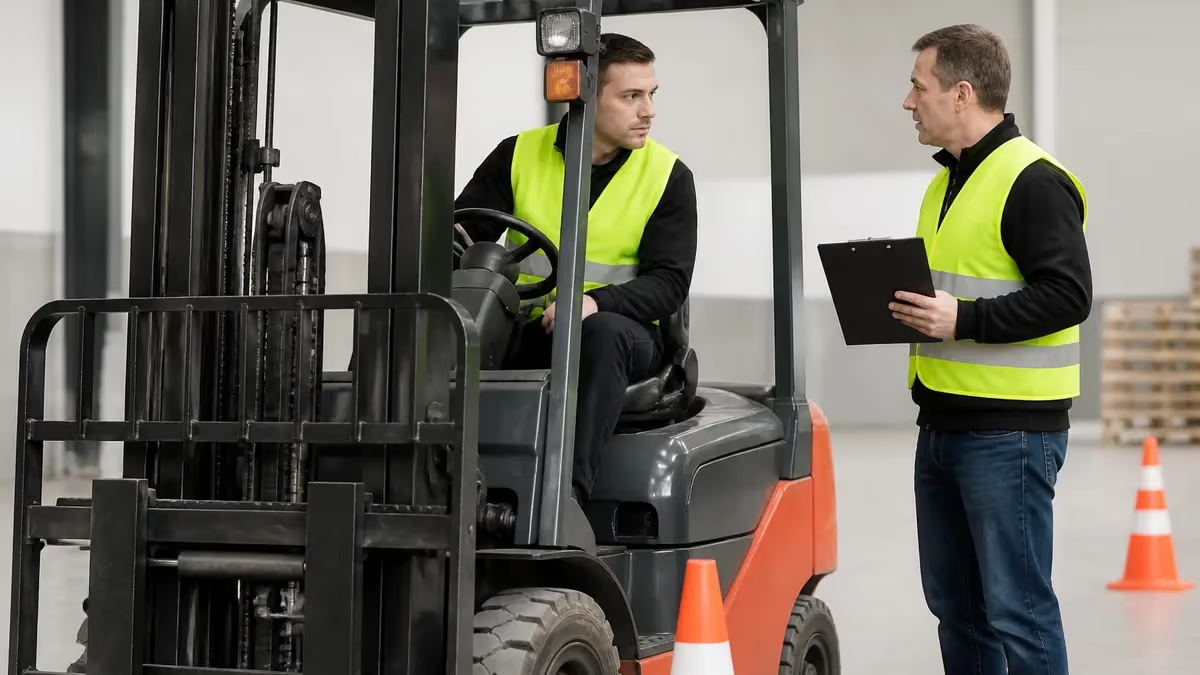
Understanding forklift controls is the foundation of safe, productive material handling, whether you are renting a unit for a weekend job or operating a fleet of warehouse trucks every shift. Every operator who has searched for forklift rental, forklift rental near me, or forklift for sale eventually faces the same reality: forklifts look similar on the outside, but the control layouts vary significantly by manufacturer, fuel type, and lift class. Knowing the universal principles behind those controls protects you, your coworkers, and the load itself.
The modern forklift cab integrates three primary control systems: directional and travel controls (steering wheel, accelerator, brake, and direction selector), hydraulic mast controls (lift, lower, tilt, and auxiliary functions), and safety interlocks (seat switches, parking brakes, horn, and emergency stops). Whether you are training on a propane sit-down truck, an electric forklift, or a narrow-aisle lull forklift, mastering these three systems is non-negotiable before you ever lift a pallet.
OSHA's Powered Industrial Truck standard (29 CFR 1910.178) requires that every certified forklift operator demonstrate hands-on competency with the specific controls of every truck they will operate. This rule matters because a stand up forklift, a sit-down counterbalance, a reach truck, and an order picker each use different hand and foot positions. Certification of forklift operators is class-specific for exactly this reason: the muscle memory you build on a Class IV cushion-tire truck does not transfer cleanly to a Class II electric narrow-aisle.
This guide walks certified and aspiring forklift operators through every control surface in a modern truck. We will cover the steering wheel and travel pedals, the hydraulic lever bank, finger-tip and joystick controls, the seat-presence safety system, parking brake variants, and the dashboard warning indicators that signal when something is wrong. Each section includes the OSHA-aligned best practices that examiners look for during a forklift training evaluation.
You will also learn how control ergonomics influence operator fatigue, accident rates, and productivity. Companies that buy forklifts often focus only on capacity and price, but the smartest fleet managers evaluate control layout, lever throw distance, joystick sensitivity, and pedal feel before committing. A poorly matched control set can cost a warehouse thousands of dollars in dropped loads, rack damage, and workers' compensation claims over a five-year ownership cycle.
By the end of this guide, you will be able to walk up to almost any unfamiliar forklift, identify the major control surfaces in under two minutes, perform a complete pre-operation check, and operate the truck safely at training-evaluation level. That is the skill set every employer wants and every OSHA inspector expects to see when they audit your operator certification records.
This article is written for U.S. operators, supervisors, safety managers, and rental customers. It complements your hands-on training but does not replace it. Always complete employer-provided evaluation and written certification before operating any forklift in a workplace setting, even if you are simply moving a rented unit across a job site.
Forklift Controls by the Numbers

Primary Forklift Control Surfaces You Must Know
Rear-wheel steering means forklifts pivot sharply. The spinner knob lets operators make quick one-handed turns while the other hand manages hydraulic levers and load positioning.
Most sit-down trucks have brake, accelerator, and inching/clutch pedals. Electric forklifts often use a deadman brake that engages when the operator steps off, preventing roll-away accidents.
A column-mounted or finger-tip lever switches between forward, neutral, and reverse. OSHA requires a full stop before changing direction to prevent transmission damage and tip-over risk.
Two to five levers control lift, tilt, side-shift, and auxiliary attachments. Modern electric forklifts often replace levers with finger-tip mini-levers or a single multi-axis joystick.
Hour meter, battery indicator, fuel gauge, temperature warning, and fault codes live here. Always check before each shift and document any active warning lights on the inspection sheet.
Travel controls are the foundation of every forklift operator's skill set. The steering wheel sits low and horizontal, similar to a bus, because forklifts steer with the rear wheels. This rear-wheel geometry is what allows tight turning radii in narrow warehouse aisles, but it also produces a counterintuitive swing of the rear end during cornering. New operators frequently misjudge clearance and clip racks, pallets, or even pedestrians with the rear counterweight. Slow, deliberate steering inputs and constant rear-view mirror checks are essential.
The steering knob, sometimes called a spinner or suicide knob, is standard on virtually every forklift sold in the U.S. It allows one-handed steering so the operator's right hand stays on the hydraulic levers. Properly used, the knob increases productivity and reduces wrist fatigue. Improperly used, it can break a wrist if the steering wheel kicks back during a curb strike or hard turn. Always grip the knob between the thumb and forefinger, never wrap your full hand around it.
Foot pedals follow a near-universal layout on internal combustion forklifts: brake on the left, accelerator on the right, and an inching pedal between them on units with a torque converter. Electric forklifts simplify this to a single accelerator and a brake, with regenerative braking handled automatically when the operator lifts off the throttle. Stand up forklift models often use a deadman pedal that must be depressed continuously; releasing it triggers an automatic park brake and motor cutoff.
The direction selector deserves special attention. On older trucks it is a stalk on the steering column similar to a turn signal. On newer models it is often a finger-tip switch on the hydraulic lever or a rocker on the armrest. Regardless of location, OSHA's expectation is the same: come to a complete stop before shifting between forward and reverse. Plugging the truck (changing direction while still moving) wears out the transmission, can tip an unstable load, and reads as an automatic fail on most operator evaluations.
Speed control is governed by the accelerator, but most modern forklifts also include a programmable maximum travel speed set by the fleet manager or safety officer. Limits of 5 to 7 mph are common in mixed pedestrian environments, while outdoor yards may allow 10 to 12 mph. Operators cannot override these limits from the cab, but they should know that turning, lifting, or carrying tall loads further reduces the safe maximum well below the programmed cap. Speed kills more forklift operators than any other single factor.
Braking on a forklift is more aggressive than on a car because of the counterweight and the absence of suspension. Slamming the brake pedal can tip a load forward, especially if the mast is elevated. The correct technique is progressive: light pressure first, increasing as the truck slows. The parking brake — a hand lever on most sit-down trucks, an automatic spring-applied brake on electrics — must be set every time the operator leaves the seat, even for a moment. This single habit prevents dozens of injuries every year.
Operators handling rough-terrain or telescopic units like a forklift repair manual will note will find additional controls for outriggers, frame leveling, and boom extension. These are typically grouped on a secondary lever bank or a touchscreen on newer machines. Always study the manufacturer's operator manual before using any auxiliary system, and never assume one brand's lever layout mirrors another's. The control conventions for rough-terrain trucks evolved separately from warehouse forklifts and remain less standardized.

Forklift certification Practice Test Questions
Prepare for the Forklift certification Certification exam with our free practice test modules. Each quiz covers key topics to help you pass on your first try.
Forklift certification Certification Forkl...
Forklift certification Exam Questions covering Certification Forklift certification Maintenance and Repairs. Master Forklift certification Test concepts for certification prep.
Forklift certification Certification Forkl...
Free Forklift certification Practice Test featuring Certification Forklift certification Maintenance and Repairs Questions and Answers. Improve your Forklift certification Exam score with mock test prep.
Forklift certification Certification Forkl...
Forklift certification Mock Exam on Certification Forklift certification Operator Training and Certification Requirements. Forklift certification Study Guide questions to pass on your first try.
Forklift certification Certification Forkl...
Forklift certification Test Prep for Certification Forklift certification Operator Training and Certification Requirements Questions and Answers. Practice Forklift certification Quiz questions and boost your score.
Forklift certification Load Handling and S...
Forklift certification Questions and Answers on Load Handling and Stability. Free Forklift certification practice for exam readiness.
Forklift certification OSHA Regulations an...
Forklift certification Mock Test covering OSHA Regulations and Compliance. Online Forklift certification Test practice with instant feedback.
Forklift certification Pre-Operation Inspe...
Free Forklift certification Quiz on Pre-Operation Inspections. Forklift certification Exam prep questions with detailed explanations.
Forklift certification Refueling and Recha...
Forklift certification Practice Questions for Refueling and Recharging Procedures. Build confidence for your Forklift certification certification exam.
Forklift certification Safe Driving and Ma...
Forklift certification Test Online for Safe Driving and Maneuvering. Free practice with instant results and feedback.
Forklift certification Workplace Hazard Id...
Forklift certification Study Material on Workplace Hazard Identification. Prepare effectively with real exam-style questions.
Forklift certification Forklift Instructions
Free Forklift certification Test covering Forklift Instructions. Practice and track your Forklift certification exam readiness.
Forklift certification Forklift MCQ
Forklift certification Exam Questions covering Forklift MCQ. Master Forklift certification Test concepts for certification prep.
Forklift certification Forklift Employer R...
Free Forklift certification Practice Test featuring Forklift Employer Responsibilities. Improve your Forklift certification Exam score with mock test prep.
Forklift certification Forklift Penalties ...
Forklift certification Mock Exam on Forklift Penalties for Non-Compliance. Forklift certification Study Guide questions to pass on your first try.
Hydraulic Lever Functions Every Forklift Operator Must Master
The lift lever is almost always the leftmost or top lever in the bank. Pulling it back raises the forks; pushing forward lowers them. The lever is proportional, meaning small movements produce slow mast travel and full deflection produces maximum speed. Smooth modulation is critical when stacking loads at height, because the higher the forks travel, the more the truck's center of gravity shifts upward and forward.
Lowering an empty mast is generally faster than raising it because gravity assists the descent. Many trucks include a flow-control valve that limits descent speed to prevent shock loading. During forklift training, examiners watch closely for jerky lift inputs, especially when picking from a top rack. Practice picking and placing at full mast extension until the motion is fluid and the load never sways more than a few inches.
Traditional Levers vs. Finger-Tip / Joystick Controls
- +Finger-tip controls reduce shoulder and wrist fatigue over a full shift
- +Joysticks allow multi-axis movement, combining lift and tilt simultaneously
- +Smaller control footprint frees up cab space for better visibility
- +Programmable sensitivity matches operator skill level and load type
- +Reduced moving parts means less hydraulic-cable wear and lower maintenance
- +Modern joysticks include integrated direction and horn switches for one-hand operation
- −Operators trained on traditional levers need 20-40 hours to retrain on joysticks
- −Electronic controls can fault and disable the truck entirely if sensors fail
- −Joystick repair costs are typically 3-5x higher than lever-linkage repair
- −Lack of tactile feedback can lead to over-correction at full mast height
- −Cross-brand standardization is poor; each manufacturer uses different layouts
- −Older operators often report preferring the muscle memory of traditional levers

Pre-Operation Forklift Controls Inspection Checklist
- ✓Verify the parking brake is set and the direction selector is in neutral before starting.
- ✓Test the horn — it must produce an audible sound clearly heard 25 feet away.
- ✓Check the steering wheel and knob for free rotation and any unusual play or stiffness.
- ✓Press the brake pedal — it should feel firm with no spongy travel to the floor.
- ✓Cycle the lift lever full up and full down with the forks empty to confirm smooth travel.
- ✓Cycle the tilt lever fully forward and back, listening for any hydraulic squeal or jerking.
- ✓Test side-shift left and right through the full range without binding or hesitation.
- ✓Confirm the seat-presence switch kills hydraulics when you lift off the seat.
- ✓Verify all dashboard warning lights illuminate on start and clear within 5 seconds.
- ✓Check that the directional reversing alarm sounds whenever reverse is selected.
Never operate a forklift with any control fault, no matter how minor.
OSHA 29 CFR 1910.178(q)(1) requires that any forklift found defective during inspection be removed from service immediately. A sticky tilt lever, soft brake pedal, or non-functioning horn is not a 'fix it later' issue — it is a federally documented stop-work condition until repairs are complete and verified by a qualified mechanic.
Safety interlocks are the engineered systems that prevent operator error from becoming a fatal accident. The most important is the seat-presence switch, a pressure-sensitive sensor under the operator's cushion that kills hydraulic functions and engages the parking brake the moment the operator's weight leaves the seat. This single device has prevented thousands of pedestrian injuries from operators who jumped off to grab something without setting the parking brake. Never defeat or bypass the seat switch — it is a federal violation and almost universally an automatic termination offense at responsible employers.
The neutral-start interlock prevents the forklift from cranking unless the direction selector is in neutral. This protects against the truck lurching forward or backward when the operator turns the key. Combined with the brake-pedal interlock on many newer models, which requires the brake to be depressed before start, the modern forklift effectively cannot move accidentally during ignition. These features have measurably reduced startup-collision incidents since they became standard around 2010.
Parking brakes vary by truck class. Sit-down internal combustion trucks typically use a hand-lever ratchet brake mounted to the left of the seat. Electric stand-up trucks use a spring-applied, electrically released brake that engages automatically anytime the operator leaves the deadman pedal. Hybrid systems on newer counterbalance trucks combine an automatic parking brake with a manual override. Whichever system you use, the OSHA rule is identical: parking brake set, mast lowered, forks tilted forward to the floor, and key removed whenever you leave the truck unattended for any period.
Emergency stop systems, often called e-stops, are mandatory on Class I and Class II electric forklifts. The red mushroom-style button disconnects the main contactor and instantly removes power from the drive and hydraulic motors. Operators should know exactly where the e-stop is located on every truck they drive and should test it weekly. After activation, most trucks require a key cycle and a reset sequence before they will move again. The e-stop is for true emergencies only — pedestrian incursions, runaway loads, fires, or imminent collision.
Horn switches are positioned for easy operator access without removing hands from the steering knob, typically integrated into the joystick, finger-tip control, or a button under the left thumb. The horn must be used at every intersection, blind corner, ramp entrance, and pedestrian crossing. A surprising number of forklift fatalities involve pedestrians who never heard the truck approaching. Make the horn a reflex, not an afterthought. OSHA evaluators specifically watch for consistent horn use during practical exams.
Backup alarms, strobe lights, blue spot lights, and red zone projection systems are increasingly common but not yet universally required by OSHA. Many states and most insurance carriers now require them in mixed-traffic warehouses. The blue spot, projected 15 to 20 feet ahead of or behind the truck, gives pedestrians a visual warning even in noisy environments where audible alarms are masked. Operators should verify these supplemental safety devices are functional during the pre-shift inspection.
Operators handling propane-fueled trucks should also understand the safety interlocks around the forklift propane tank mounting bracket. The tank must be secured with the relief valve in the correct orientation, the fuel line tight, and the bracket pin fully seated. A loose tank is a fire and explosion hazard. Many newer LPG trucks include a tilt-sensor interlock that shuts down the engine if the truck angles beyond 30 degrees, preventing a runaway fire if the unit tips over.
Disabling, bypassing, or modifying any forklift safety control — seat switch, e-stop, deadman pedal, horn, or backup alarm — is a willful violation under 29 CFR 1910.178. Penalties for serious violations now exceed $15,000 each, and willful violations can exceed $156,000. Always report disabled or non-functional controls to a supervisor and tag the truck out of service immediately.
Certification of forklift operators in the United States is governed by OSHA 29 CFR 1910.178(l), which requires both classroom (or equivalent online) instruction and a hands-on practical evaluation. The practical portion is where forklift controls knowledge becomes critical. An evaluator will observe the operator performing pre-shift inspection, mounting the truck, starting it, operating it through a course with simulated loads, and dismounting properly. Failing any control-related task — improper lever use, harsh braking, neglecting the horn, leaving the truck without setting the parking brake — results in a failed evaluation.
Forklift training programs typically run 6 to 16 hours total, depending on the truck classes covered. A single-class certification on a sit-down counterbalance might be completed in a day. Multi-class certification covering sit-down, stand-up, reach, and order picker often spans two or three days. Online theory portions cover OSHA regulations, stability principles, and control identification; the hands-on portion can only be completed in person on the actual truck class the operator will use at work.
Certification is employer-specific and class-specific. A forklift operator who earned certification at one employer cannot simply transfer that card to a new job. The new employer must verify documented training, conduct their own evaluation on their specific trucks and workplace, and issue a new certification card. This is non-negotiable under OSHA — even an operator with 20 years of experience must be re-evaluated when changing employers. Likewise, an operator certified on a sit-down truck cannot legally operate a stand-up reach truck without separate evaluation on that class.
Recertification is required every three years, after any accident or near-miss, after any observed unsafe operation, or whenever the operator is assigned to a different type of truck. Most employers schedule the three-year recertification proactively to avoid lapses. Lapsed certification means the operator legally cannot touch a forklift until the new evaluation is complete. OSHA citations for operating with expired certification have risen sharply since 2022 as enforcement has focused on documentation gaps.
Forklift rental customers face a special challenge: the renter is legally the employer of whoever operates the rented truck. If you rent a forklift to move materials at a job site, you are responsible for verifying that the operator holds current certification on that class of truck, and you should document the inspection and the operator's familiarization with the specific unit's controls. Renting from a reputable dealer who offers operator-familiarization training is a small added cost that prevents major liability exposure if anything goes wrong.
Buyers searching for forklifts or a forklift for sale should evaluate control ergonomics during the test drive, not just specifications on paper. Sit in the seat, adjust it, reach for every lever, press every pedal, and verify that the controls match your existing operator workforce's training and muscle memory. A great deal on a truck with unfamiliar controls becomes an expensive deal once you add retraining costs, productivity loss, and increased accident risk. Talking to a knowledgeable community forklift dealer about control options is often more valuable than chasing the lowest sticker price.
Investing in quality forklift training pays returns far beyond OSHA compliance. Properly trained operators damage less product, last longer in the job, get into fewer accidents, and lift more pallets per hour. Industry studies consistently show that a $300 certification course saves $3,000 to $5,000 per operator per year in reduced damage and productivity gains. There is no cheaper safety investment available to a warehouse manager.
Practical control mastery comes from deliberate practice, not just hours behind the wheel. The most effective drills focus on smooth lever transitions: lifting a pallet from the floor, tilting back, traveling 50 feet, lowering, and placing — all without any visible mast sway or load shift. Time yourself on these cycles, then watch a video of your own operation. Most operators are stunned at how jerky their lever work looks on camera compared to how it feels from the seat. Smooth = safe = productive, in that order.
Visibility through the mast is a constant control challenge. Operators should keep loads tilted back to a consistent angle that allows them to see between the uprights without straining. Carrying loads too high blocks forward vision and forces unsafe travel postures. When the load blocks the forward view, drive in reverse — this is OSHA-compliant and far safer than craning your neck around a load. Always check both rear-view mirrors before reversing, and use the horn liberally at every blind corner.
Ramp operation tests every control skill simultaneously. Loaded forklifts always face the load uphill, whether traveling up or down a ramp. Empty forklifts face the forks downhill. This rule keeps the heaviest mass on the uphill side and preserves stability. Operators new to ramps often misjudge the gradient and either stall the engine or release the brake too quickly, causing dangerous rollback. Practice ramps slowly with light loads before attempting full-capacity carries on a grade.
Stacking and de-stacking from racks demands precise hydraulic lever control at heights where small inputs produce large mast movements. The technique is to approach the rack squarely, stop, raise the forks to slightly above the pocket, ease forward until the forks are fully under the pallet, lift two inches to clear, tilt back slightly, then withdraw straight back before lowering. Rushing this sequence is the number-one cause of damaged loads, broken pallets, and rack collisions in U.S. warehouses.
Battery and fuel management indirectly affect control responsiveness. A weak electric forklift battery causes sluggish lift and travel response, and operators may compensate by overusing the levers, which then overheats the hydraulic motor. A propane truck running low on LPG may surge or stumble under load. Always operate trucks with adequate fuel or charge, and report performance degradation immediately rather than working around it. Reduced control response is a maintenance issue, not an operator skill issue.
Operator posture inside the cab affects control precision more than most operators realize. Sitting upright with the seat adjusted so both feet rest flat on the pedals and the right hand falls naturally on the hydraulic levers reduces fatigue dramatically. Slouching, leaning, or stretching to reach controls causes muscle tension that magnifies through 8 hours of operation. Take 30 seconds to set the seat properly at the start of every shift — this single habit reduces operator injuries by an estimated 15 to 20 percent over a career.
Finally, treat every forklift you operate as if you were taking the certification test. Buckle the seat belt. Check the mirrors. Set the parking brake. Sound the horn at intersections. Lower the forks before leaving the seat. These behaviors are not optional habits — they are the difference between a long, accident-free operator career and a documented incident on your permanent OSHA record. Forklift controls are simple in principle but unforgiving in practice. Master them with the same discipline you would expect from a commercial pilot or heavy equipment operator, because the stakes are exactly that high.
Forklift Questions and Answers
Forklift Tires: Complete Guide to Types, Sizing, Wear Patterns, and Replacement Costs
Forklift Accessories: Complete Guide to LED Lights, Attachments, Safety Gear, and Productivity Upgrades for 2026
Can a Forklift Enter a 26 ft Box Truck? Complete Guide to Loading, Operations, and Equipment Selection
Forklift License Renewal: Complete Guide to Forklift License Expiry, OSHA Recertification, and Operator Requirements for 2026
Forklift Safety Training: Complete OSHA Compliance Guide for Operators and Employers
About the Author

Certified Crane Operator & Skilled Trades Exam Specialist
Ferris State UniversityRobert Martinez is a Journeyman Ironworker, NCCCO-certified crane operator, and forklift trainer with a Bachelor of Science in Construction Technology from Ferris State University. He has 21 years of ironworking, rigging, and heavy equipment operation experience across high-rise and industrial construction sites. Robert prepares candidates for crane operator, rigger, forklift, and skilled trades certification examinations.