
Calculate Forklift Load Capacity: Complete Guide to Data Plates, Load Centers, and Safe Lifting Limits for 2026 October
Learn how to calculate forklift load capacity using data plates, load centers, and derating formulas. OSHA-compliant guide for operators and supervisors. 🔎
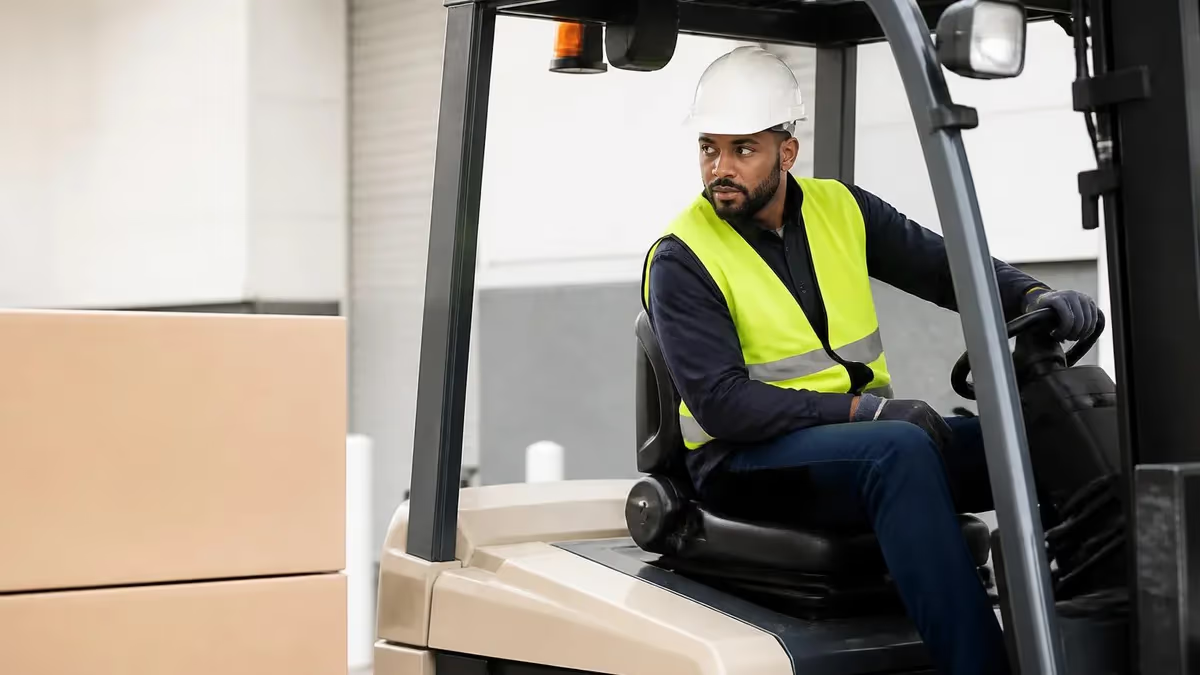
Knowing how to calculate forklift load capacity is the single most important skill separating a safe forklift operator from a workplace accident statistic. Whether you manage a fleet of forklifts in a distribution center, run a small warehouse, or just signed a forklift rental contract for a one-week project, understanding the relationship between load weight, load center, and lift height can prevent tip-overs, structural damage, and OSHA citations that average $15,625 per serious violation in 2026.
Every forklift in the United States carries a manufacturer data plate that lists its rated capacity at a specific load center, typically 24 inches for standard counterbalance trucks. That plate is the legal and engineering starting point for every lift you perform. However, the rated capacity only applies under ideal conditions, meaning the load is uniform, centered on the forks, and lifted to standard mast height. Any deviation, whether the load is longer, taller, off-center, or lifted with an attachment, forces you to derate the truck below its plate number.
The Occupational Safety and Health Administration enforces these calculations under 29 CFR 1910.178, which requires operators to know the truck's capacity for every load they handle. Failure to perform this calculation is one of the top five forklift-related citations issued every year. New operators completing forklift training programs spend hours practicing load capacity math because real-world loads rarely match the textbook 24-inch cube the manufacturer used during certification testing at the factory.
This guide walks you through every component of the calculation: reading data plates, measuring true load centers, applying derating formulas, understanding attachment penalties, and accounting for variables like mast tilt and improved lift heights. We use real examples drawn from common warehouse scenarios, including pallets of bottled water, machinery on skids, and oversized lumber bundles loaded with a forklift repair shop's pneumatic-tire rough-terrain truck.
If you are studying for OSHA certification, renewing a lapsed license, or training new hires on a stand up forklift or electric forklift, this article covers everything you need. We include downloadable formulas, practical worksheets, and example calculations you can apply to any forklift for sale, rental, or already in your fleet. Mastering these concepts protects your crew, your inventory, and your bottom line every shift.
By the end of this guide, you will be able to look at any data plate, measure any load, and confidently determine whether the lift is within the truck's safe operating envelope. You will also know when to refuse a lift, when to call a supervisor, and when to request a different forklift class better matched to the job. That confidence is what separates compliant operators from injured ones.
This material aligns with current ANSI/ITSDF B56.1 standards and OSHA enforcement guidance updated for 2026. Operators who internalize these calculations consistently pass their certification of forklift practical exams on the first attempt and reduce their workplace incident rates by measurable percentages year over year.
Forklift Load Capacity by the Numbers

The Five Critical Elements on Every Data Plate
Identifies the exact unit and links to manufacturer records for service, recall, and replacement part lookups. Required for any warranty or insurance claim.
Maximum weight the truck can safely lift at the specified load center and lift height. Often shown as 3,000, 5,000, or 8,000 pounds for warehouse trucks.
Horizontal distance from the fork face to the load's center of gravity, typically 24 inches in North America. Determines all derating math.
Maximum fork height the rated capacity applies to. Triple-stage masts often derate above 188 inches because of stability changes.
If equipped with side-shifters, clamps, or rotators, the plate must show derated capacity. Original plate values no longer apply.
The load center is the heart of every forklift capacity calculation, and misunderstanding it causes more incidents than any other single factor. Defined as the horizontal distance from the vertical face of the forks to the center of gravity of the load, the load center is measured in inches and assumes the load is symmetrical and evenly distributed. A standard 48-inch by 48-inch pallet with uniform cargo has a load center of exactly 24 inches, which matches the rating plate on most warehouse forklifts.
Problems begin the moment your load does not fit that 48-inch cube. A 60-inch deep crate has a load center of 30 inches if the weight is uniform, immediately reducing your usable capacity. A 96-inch piece of lumber has a 48-inch load center, doubling the standard and slashing capacity by roughly half on most trucks. This is why experienced forklift operator candidates spend so much time measuring loads before lifting them rather than relying on visual estimates that the human eye consistently gets wrong by 15 to 25 percent.
To calculate the effective load center for non-uniform loads, you need to identify where the actual center of gravity sits. For a load with weight concentrated on one end, measure from the fork face to the heavy end's center of mass, not the geometric middle of the pallet. A pallet of stacked engine blocks weighted toward the rear pushes the center of gravity backward, while a pallet of bricks stacked higher on one side pushes it forward and up, affecting both load center and stability triangle dynamics.
Once you have the actual load center, you apply the manufacturer's derating chart or use the simplified formula: New Capacity equals Rated Capacity multiplied by Rated Load Center divided by Actual Load Center. For a 5,000-pound truck rated at 24 inches handling a load with a 36-inch center, the math gives you 5,000 times 24 divided by 36, equaling 3,333 pounds maximum safe capacity. That is a 33 percent reduction from the plate number, and ignoring it sends pallets through racking and operators to the hospital.
Lift height adds another derating layer that catches many operators off guard. A truck rated to lift 5,000 pounds at 188 inches may only safely handle 3,500 pounds at 240 inches because the higher center of gravity shifts the stability triangle and reduces the rear counterweight's use. Always check the high-lift capacity chart on the data plate or in the operator manual, especially when racking inventory into the top beam levels of warehouse storage systems built since 2020.
Attachments such as side-shifters, fork positioners, paper roll clamps, and carton clamps all reduce capacity because they add weight at the front of the truck and often push the load center further forward. A side-shifter alone typically reduces capacity by 5 to 10 percent, while a heavy rotating clamp can cut capacity by 20 to 30 percent. The manufacturer must issue a revised data plate when any attachment is added, and OSHA inspectors specifically look for this updated plate during site visits.
Operators using a lull forklift or any telehandler face additional complexity because boom extension multiplies load center distance dramatically. A telehandler at full boom extension may only safely lift 25 percent of its base capacity, and these trucks always come with detailed load charts laminated in the cab that operators must reference before every lift. Treat these charts as required reading, not optional reference material, especially on construction and agricultural sites.

Forklift certification Practice Test Questions
Prepare for the Forklift certification Certification exam with our free practice test modules. Each quiz covers key topics to help you pass on your first try.
Forklift certification Certification Forkl...
Forklift certification Exam Questions covering Certification Forklift certification Maintenance and Repairs. Master Forklift certification Test concepts for certification prep.
Forklift certification Certification Forkl...
Free Forklift certification Practice Test featuring Certification Forklift certification Maintenance and Repairs Questions and Answers. Improve your Forklift certification Exam score with mock test prep.
Forklift certification Certification Forkl...
Forklift certification Mock Exam on Certification Forklift certification Operator Training and Certification Requirements. Forklift certification Study Guide questions to pass on your first try.
Forklift certification Certification Forkl...
Forklift certification Test Prep for Certification Forklift certification Operator Training and Certification Requirements Questions and Answers. Practice Forklift certification Quiz questions and boost your score.
Forklift certification Load Handling and S...
Forklift certification Questions and Answers on Load Handling and Stability. Free Forklift certification practice for exam readiness.
Forklift certification OSHA Regulations an...
Forklift certification Mock Test covering OSHA Regulations and Compliance. Online Forklift certification Test practice with instant feedback.
Forklift certification Pre-Operation Inspe...
Free Forklift certification Quiz on Pre-Operation Inspections. Forklift certification Exam prep questions with detailed explanations.
Forklift certification Refueling and Recha...
Forklift certification Practice Questions for Refueling and Recharging Procedures. Build confidence for your Forklift certification certification exam.
Forklift certification Safe Driving and Ma...
Forklift certification Test Online for Safe Driving and Maneuvering. Free practice with instant results and feedback.
Forklift certification Workplace Hazard Id...
Forklift certification Study Material on Workplace Hazard Identification. Prepare effectively with real exam-style questions.
Forklift certification Forklift Instructions
Free Forklift certification Test covering Forklift Instructions. Practice and track your Forklift certification exam readiness.
Forklift certification Forklift MCQ
Forklift certification Exam Questions covering Forklift MCQ. Master Forklift certification Test concepts for certification prep.
Forklift certification Forklift Employer R...
Free Forklift certification Practice Test featuring Forklift Employer Responsibilities. Improve your Forklift certification Exam score with mock test prep.
Forklift certification Forklift Penalties ...
Forklift certification Mock Exam on Forklift Penalties for Non-Compliance. Forklift certification Study Guide questions to pass on your first try.
Capacity Calculations by Forklift Type
An electric forklift typically operates in indoor warehouse environments lifting palletized goods between 3,000 and 6,500 pounds at standard 24-inch load centers. The battery itself serves as a substantial portion of the counterweight, meaning capacity calculations remain stable across the shift even as charge depletes. Operators should still verify the data plate before each task because battery swaps to different group sizes can technically alter the truck's certified rating.
Modern electric trucks include onboard load sensors and digital displays showing real-time weight and load center estimates on many 2024 and newer models. While these systems are helpful, they do not replace manual calculation, and OSHA still requires operators to demonstrate manual capacity math during practical certification testing regardless of what technology the truck offers in its cab.
Using Manufacturer Capacity Charts vs. Field Calculation
- +Manufacturer charts are engineered with safety factors built in
- +Charts account for mast tilt, lift height, and attachment combinations
- +Required reference for OSHA compliance during inspections
- +Eliminates guesswork on complex multi-variable lifts
- +Updated when attachments are added or trucks are modified
- +Provides legal defense if an incident investigation occurs
- +Standardizes calculations across multiple operators on the same fleet
- −Charts may be missing, faded, or illegible on older rental trucks
- −Operators may not have time to consult charts on every single lift
- −Some attachment combinations are not covered by factory charts
- −Charts assume ideal conditions like level ground and uniform loads
- −Language barriers can make chart interpretation difficult for crews
- −Field calculations are required when load shape is unusual
- −Charts do not account for damaged forks, worn tires, or fluid leaks
Pros and Cons at a Glance
| Pros | Cons |
|---|---|
| Manufacturer charts are engineered with safety factors built in | Charts may be missing, faded, or illegible on older rental trucks |
| Charts account for mast tilt, lift height, and attachment combinations | Operators may not have time to consult charts on every single lift |
| Required reference for OSHA compliance during inspections | Some attachment combinations are not covered by factory charts |
| Eliminates guesswork on complex multi-variable lifts | Charts assume ideal conditions like level ground and uniform loads |
| Updated when attachments are added or trucks are modified | Language barriers can make chart interpretation difficult for crews |
| Provides legal defense if an incident investigation occurs | Field calculations are required when load shape is unusual |

Pre-Lift Load Capacity Verification Checklist
- ✓Locate and read the data plate on the forklift, confirming rated capacity and load center.
- ✓Measure the actual length, width, and height of the load with a tape measure.
- ✓Calculate the true center of gravity, accounting for non-uniform weight distribution.
- ✓Apply the derating formula if the actual load center exceeds the rated load center.
- ✓Check the lift-height capacity chart if the load must be placed above 188 inches.
- ✓Verify all attachments are listed on a current data plate with revised capacity numbers.
- ✓Inspect forks for cracks, bends, or excessive wear that would reduce safe capacity.
- ✓Confirm tire condition, especially for outdoor or rough terrain applications.
- ✓Test ground conditions and slope angle at both pickup and placement locations.
- ✓Refuse the lift and notify a supervisor if calculated capacity is exceeded by any amount.
Never Round Up When Calculating Capacity
When your derating math produces a number like 3,847 pounds, the safe maximum is 3,847 pounds, not 4,000. OSHA inspectors and incident investigators look for evidence that operators applied conservative judgment. A pallet that weighs 4,000 pounds on a 3,847-pound calculated capacity is an overload, even if the difference seems minor. Always round down to the nearest 100 pounds for an additional margin of safety on every lift.
The most common forklift capacity mistake is treating the data plate number as a universal lifting limit rather than a conditional rating tied to specific assumptions. A 6,000-pound rated forklift cannot lift 6,000 pounds of anything anywhere. It can lift 6,000 pounds of a uniform load with a 24-inch load center to the rated lift height under standard conditions. Operators who ignore this distinction account for the majority of preventable tip-overs and structural collapses recorded by OSHA each year across American warehouses and construction sites.
The second most common mistake involves attachments. When a warehouse installs a side-shifter or fork positioner on a truck, the manufacturer must issue a new data plate, and the original capacity no longer applies. We routinely see forklifts in busy distribution centers running with original 1990s-era data plates after multiple attachments have been added over the decades. These trucks are operating outside their certified envelope every single shift, and a single incident investigation can produce six-figure liability exposure for the employer.
Mistake number three is assuming the load weight you were told matches reality. Pallet labels, shipping documents, and verbal estimates from coworkers are frequently inaccurate by 10 to 20 percent because of moisture absorption, repacking, mixed-load consolidation, and basic human error. When stakes are high, weigh the load on a pallet scale or use the forklift's own load-sensing system if equipped. Trust but verify is the rule that keeps experienced operators alive and incident-free year after year.
Misreading lift height capacity is another frequent error, particularly when racking inventory into upper beam levels. A truck rated to lift 5,000 pounds may only safely handle 3,000 pounds at full mast extension, and the difference is rarely posted prominently anywhere except inside the operator manual. Make a habit of memorizing the high-lift capacity for every truck you regularly operate, or post a laminated reminder card inside the cab where you can glance at it before every improved placement.
Ignoring ground conditions causes capacity miscalculations even when the math is correct on paper. A slope of just 5 degrees can reduce effective capacity by 10 to 15 percent because gravity shifts the load's center of mass beyond the stability triangle. Wet floors, loose gravel, sawdust, and ice all alter the friction coefficient and can cause loads to shift during lifting or transport. Always assess the full path of travel before committing to a lift, including the placement zone.
Some operators forget that fork length and load distribution interact. If you are using 42-inch forks on a 48-inch pallet, the load overhangs the forks by 6 inches, pushing the effective load center past the rated 24 inches. Standard practice is to match fork length to load length whenever possible, or to derate capacity manually when forks are shorter than the load. This is especially important during peak shipping seasons when warehouses borrow trucks from a forklift rental company without checking specifications.
Finally, many operators skip the data plate check entirely when running multiple trucks during one shift. Each forklift has unique ratings that depend on its specific configuration, attachments, and modifications. Treating all 5,000-pound trucks as interchangeable causes problems when one has a side-shifter that derates it to 4,500 pounds while another runs bare forks. The 30 seconds required to read a data plate is the cheapest insurance you can buy against catastrophic loss.
If your facility has added attachments to any forklift without obtaining and posting a manufacturer-approved revised data plate, you are operating in violation of 29 CFR 1910.178(a)(4). This is a frequently cited issue during OSHA inspections and can trigger fines exceeding $15,625 per truck. Contact your equipment dealer or attachment manufacturer immediately to request updated capacity documentation before your next inspection or incident occurs.
Consider this real-world scenario: a beverage distribution warehouse uses 5,000-pound capacity electric forklifts to handle pallets of bottled water that weigh exactly 2,200 pounds each on standard 48-inch pallets. The math seems trivial since each pallet is well under the rated capacity, but the operation also receives occasional pallets of glass-bottled premium water that weigh 3,400 pounds and stack 72 inches tall instead of the standard 48 inches. That taller stack moves the center of gravity upward, requiring operators to slow their travel speed and lower lift height during transport to prevent tipping.
A second scenario involves a lumber yard using a pneumatic-tire forklift rated at 8,000 pounds with a 24-inch load center, tasked with moving 24-foot bundles of pressure-treated decking. The effective load center on a 24-foot bundle is 144 inches, dramatically beyond the rated 24 inches. Applying the formula, capacity drops to 8,000 times 24 divided by 144, equaling just 1,333 pounds. Since each bundle weighs around 1,800 pounds, the lift exceeds safe capacity and requires either a larger truck or a different handling method entirely.
Construction sites present capacity challenges that combine load weight, terrain, and elevation. A telehandler placing 1,500-pound bundles of roof trusses onto the top plate of a two-story building must consult the boom-extension chart, factor the slope of the muddy ground, and confirm the outriggers are properly deployed if equipped. Many telehandler operators learn the hard way that a truck rated to lift 12,000 pounds at full retracted position handles only 2,500 pounds at maximum boom extension and angle, requiring careful planning before every truss placement.
Cold storage and freezer warehouses introduce additional variables because operators wear bulky insulated gear that reduces dexterity, and lubricants behave differently at sub-zero temperatures. Forklift hydraulic systems lift slightly slower in cold environments, but the rated capacity does not change. However, ice buildup on forks or pallets can shift load centers unpredictably. Operators should always brush forks clean before insertion and visually inspect pallets for ice or snow accumulation that could mask weight distribution problems.
Multi-pallet handling using double-pallet forks or load-stabilizing attachments multiplies capacity considerations. Two pallets stacked side by side on extended forks effectively double the load center distance from the truck face, often pushing capacity calculations below what either pallet weighs individually. Most warehouse operations should treat multi-pallet handling as a specialized lift requiring additional training and supervision, particularly for newer operators who completed certification within the past 12 months.
Renting equipment for a short-term project introduces unique capacity verification challenges because rental fleet trucks may have unfamiliar attachments, worn forks, or aftermarket modifications. Always request the current data plate and high-lift capacity chart when picking up a rental truck, and document any visible damage or missing safety equipment before signing the rental agreement. A reputable forklift rental near me service will provide all documentation proactively, but the responsibility for verifying capacity always rests with the operator and employer at the job site.
Every workplace should maintain a written load capacity reference document specific to its fleet, listing each truck by identification number, current attachments, rated capacity, derating factors, and any special considerations. This document serves operators, supervisors, and any new community forklift certified hires who need to quickly understand the fleet they are stepping into. Review and update this document quarterly or whenever any truck configuration changes.
To put this knowledge into daily practice, build the capacity calculation into your standard pre-lift routine. Before approaching any load, take 15 seconds to visually estimate dimensions, mentally locate the center of gravity, and recall the truck's rated capacity. This habit becomes automatic within a few weeks of deliberate practice and dramatically reduces the cognitive load when complex situations arise. New operators benefit from physically writing the calculation on a notepad for the first 30 days of solo work to reinforce the math pathways.
Supervisors should conduct random spot checks asking operators to verbally explain capacity calculations for whatever load they are about to lift. This coaching reinforcement keeps the knowledge fresh and identifies operators who may need refresher training before an incident occurs. Document these check-ins as part of your ongoing competency assessment program, which OSHA requires under 29 CFR 1910.178(l). Recorded coaching also demonstrates due diligence if any incident does occur on your watch in the future.
Invest in load measurement tools and make them readily available. Pallet scales, tape measures, and laser distance meters should be positioned at every receiving dock and dispatch area. Operators should never have to walk 200 yards to find a tape measure when they need to verify load dimensions. Removing friction from the verification process dramatically improves compliance rates and reduces the temptation to estimate when measurement would be more accurate but inconvenient at that moment.
Consider technology upgrades for high-volume operations. Modern forklifts can be equipped with onboard load weighing systems that display real-time weight on a cab-mounted screen, removing the guesswork from load verification. While these systems represent a meaningful upfront investment of $2,500 to $5,000 per truck, they typically pay back within two years through reduced incidents, improved inventory accuracy, and lower insurance premiums. Many newer trucks include these systems as standard equipment from the factory.
Training programs should emphasize calculation practice over rote memorization. Operators who can explain why a calculation works retain the knowledge far longer than those who simply memorize formulas for a written test. Use scenarios drawn from your specific facility, including unusual load shapes you handle, attachments you operate, and the actual trucks in your fleet. Generic training videos rarely produce the operator judgment skills your workplace actually needs day to day on the floor.
Recertification every three years under OSHA rules provides a natural opportunity to refresh capacity calculation skills, but smart employers conduct annual refresher training to maintain sharp competency. Pair these refreshers with hands-on practical exercises using actual loads from your operation, not classroom-only PowerPoint slides. A skilled forklift driver is one who can think through novel situations, not just recite memorized procedures from a manual nobody has opened in 18 months.
Finally, build a workplace culture where refusing an unsafe lift is celebrated, not punished. Operators must feel enabled to stop work and request supervisor consultation when capacity calculations indicate a lift exceeds safe limits. This psychological safety is the single most powerful factor in preventing catastrophic forklift incidents, and it costs absolutely nothing to implement. Build it into your safety meetings, recognition programs, and leadership messaging at every opportunity throughout the calendar year.
Sample Forklift certification Practice Questions
Try these questions from our free Forklift certification practice tests. The correct answer and an explanation follow each question.
The standard load center used on most forklift data plates is measured at what distance?
- A. 24 inches
- B. 12 inches
- C. 36 inches
- D. 48 inches
Answer: A. 24 inches
Most rated capacities assume a 24-inch load center, meaning the center of gravity is 24 inches from the face of the forks.
A warehouse manager wants to use a special clamp attachment to handle rolls of paper. The forklift's original data plate only shows the capacity for standard forks. What does OSHA require to be done before this clamp can be used?
- A. The operator must estimate the new safe capacity.
- B. The forklift must be marked to identify the attachment and show the new rated capacity.
- C. As long as the paper roll is lighter than the original max capacity, no changes are needed.
- D. The clamp manufacturer's capacity rating is sufficient documentation.
Answer: B. The forklift must be marked to identify the attachment and show the new rated capacity.
According to OSHA 29 CFR 1910.178(a)(5), if a truck is equipped with front-end attachments, the user must request that the truck be marked to identify the attachments and show the approximate weight of the truck and attachment combination at maximum elevation with the load laterally centered. The forklift's data plate must be updated to reflect the new capacity with the specific attachment.
What does OSHA require regarding the load capacity of a forklift?
- A. It can be exceeded briefly
- B. It must never be exceeded
- C. It applies only to new trucks
- D. It is a suggestion
Answer: B. It must never be exceeded
OSHA requires that a forklift's rated load capacity never be exceeded.
What should you do if a load is too heavy for the forklift's rated capacity?
- A. Do not lift it; use a truck rated for the load or split the load
- B. Lift it slowly at full mast height
- C. Add extra counterweight yourself
- D. Lift it with the forks tilted forward
Answer: A. Do not lift it; use a truck rated for the load or split the load
Never exceed rated capacity; use an appropriate truck or break the load into smaller pieces.
Forklift Questions and Answers
Forklift Tires: Complete Guide to Types, Sizing, Wear Patterns, and Replacement Costs
Forklift Accessories: Complete Guide to LED Lights, Attachments, Safety Gear, and Productivity Upgrades for 2026
Forklift License Renewal: Complete Guide to Forklift License Expiry, OSHA Recertification, and Operator Requirements for 2026
Forklift Safety Training: Complete OSHA Compliance Guide for Operators and Employers
Forklift Repair Service: Complete Guide to Costs, Common Repairs, and Choosing the Right Technician
About the Author

Certified Crane Operator & Skilled Trades Exam Specialist
Ferris State UniversityRobert Martinez is a Journeyman Ironworker, NCCCO-certified crane operator, and forklift trainer with a Bachelor of Science in Construction Technology from Ferris State University. He has 21 years of ironworking, rigging, and heavy equipment operation experience across high-rise and industrial construction sites. Robert prepares candidates for crane operator, rigger, forklift, and skilled trades certification examinations.