
Best Forklift Simulator 2026 October: Complete Guide to VR Training, Operator Certification Prep, and ROI for Warehouse Safety Programs
Best forklift simulator guide: 📝 VR training, operator certification prep, OSHA compliance, ROI data, and top platforms for forklift rental fleets.
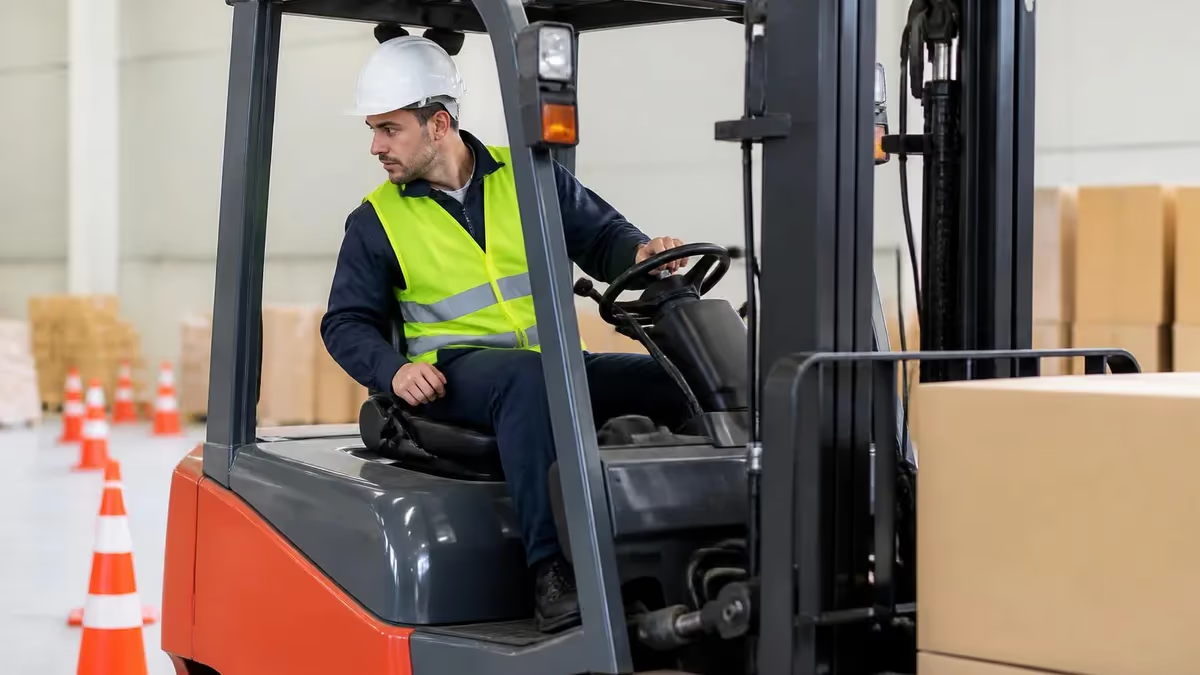
Choosing the best forklift simulator in 2026 has become a defining decision for warehouse managers, safety officers, and training coordinators who want to reduce accidents without idling expensive forklift rental equipment during operator development. Virtual reality and screen-based simulators now replicate counterbalance, reach truck, and stand up forklift handling with physics engines accurate enough to teach load stability, mast tilt, and travel speed before a trainee ever turns a real key. The result is faster certification, fewer near-misses, and measurable insurance savings.
Modern forklift simulators are no longer novelty arcade rigs bolted to plywood. Industry leaders like Serious Labs, ForkliftSim VR, CM Labs Vortex, and Tenstar Simulation deliver enterprise-grade systems with motion seats, dual-joystick controls, and pedal arrays that mirror Hyster, Toyota, Crown, and Raymond cab layouts. These platforms integrate directly with learning management systems so safety managers can track hours, error rates, and competency progression for every forklift operator on their roster across multiple shifts and sites.
The business case is compelling. The Occupational Safety and Health Administration estimates that 70% of forklift accidents could be prevented through better training, and simulator-based programs cut incident rates by 40-60% during the first year of deployment. For a single warehouse running 12 forklifts at $32 per hour in loaded rental costs, eliminating just two training collisions per quarter can pay for an entire VR rig in under nine months. Insurance underwriters increasingly offer premium credits for documented simulator usage.
Simulators also solve a workforce problem that traditional training cannot. New hires can complete 8-12 hours of immersive practice on hazard scenarios — pedestrian conflicts, dock-edge approaches, blind aisles, slippery surfaces — without consuming pallets, fuel, or supervisor time. Skills like maintaining a clear travel path, mirror checks, and tilt-back during transport become muscle memory before the operator enters live aisles. This compresses the learning curve from weeks to days. If you need to check tire wear during in-yard checks, see our forklift repair near me resource for quick reference.
However, simulators are not a complete replacement for hands-on evaluation. OSHA 1910.178(l) still requires employer-supervised practical assessment on the actual truck type and in the actual workplace before certification. The best programs blend three hours of simulator work with two hours of yard training and a final on-floor evaluation. This hybrid model satisfies federal certification of forklift requirements while dramatically reducing risk during the riskiest early-skill phase of operator development.
In this guide we compare the top platforms head-to-head, break down pricing tiers from $4,500 portable kits to $85,000 motion-base enterprise systems, walk through ROI calculations for fleets of 5, 25, and 100 trucks, and explain how to integrate simulator data into your existing certification of forklift documentation. Whether you operate a single distribution center or a national 3PL network, you will leave with a clear shortlist and implementation roadmap.
We also cover the practical questions that determine adoption success: how long it takes to deploy, what the IT footprint looks like, which trainers need certifying themselves, and how to handle the inevitable employees who report VR motion sickness. The goal is not to sell you on the technology — it is to give you the framework to decide whether a simulator belongs in your 2026 forklift training budget and, if so, which model fits your facility.
Forklift Simulator Training by the Numbers

Top Forklift Simulator Platforms in 2026
Industry-leading motion platform with full 6-DOF chair, dual joysticks, and certified curriculum covering counterbalance, reach truck, and stand up forklift modules. Used by Amazon, Walmart, and major 3PL networks for high-volume training programs.
Engineering-grade physics simulator favored by industrial training centers and union halls. Strong on heavy-capacity trucks up to 36,000 lbs and outdoor terrain. Pairs well with Hyster and Caterpillar dealer training programs.
Quest 3 standalone VR headset solution priced under $5,000 per station. Excellent for small fleets, mobile training, and remote sites. Includes 30+ scenarios from basic pallet pickup to hazmat handling and dock loading.
Swedish-built dual-screen system popular in technical colleges and apprenticeship programs. Strong curriculum integration with vocational standards and detailed scoring rubrics for instructor evaluation and progress tracking.
Mid-tier desktop simulator with realistic controls and 4K displays. Best fit for distribution centers seeking serious training capability without motion-base complexity. Around $18,000 turnkey with one-year curriculum license included.
Pricing for forklift simulators in 2026 spans an enormous range, and understanding the tiers prevents both overbuying and underbuying. Entry-level standalone VR kits built on Meta Quest 3 hardware start around $4,500 per station including a one-year scenario license. These are perfect for sites with five or fewer forklifts, mobile training trailers, or as supplementary refresher tools. They are not a replacement for hands-on evaluation but they deliver remarkable value for foundational skills and hazard recognition training across most warehouse environments.
Mid-tier desktop systems run $15,000 to $25,000 and add realistic joystick and pedal hardware, 4K curved displays, and instructor dashboards. Vortex Edge Plus, Tenstar TS Pro, and similar units are the sweet spot for distribution centers with 10-40 forklifts. They handle batch training of three operators per day with structured curriculum and produce documentation suitable for OSHA recordkeeping. Many include lifetime hardware warranties and quarterly content updates that keep scenarios fresh for returning trainees.
Enterprise motion-base systems from Serious Labs and CM Labs range from $65,000 to $120,000 depending on configuration. These deliver the highest realism, including yaw, pitch, and roll motion that triggers the vestibular feedback operators need to truly internalize load stability and tip-over avoidance. For high-volume training centers, union halls, and Fortune 500 logistics operations, the per-trainee cost over five years drops below $30 per hour — competitive with live forklift rental training when fuel, supervisor wages, and damaged inventory are factored in.
ROI calculation should include four buckets: avoided incidents, reduced training labor, lower insurance premiums, and faster operator productivity. For a 25-forklift facility experiencing two minor collisions per quarter at an average cost of $4,200 each — a conservative blended figure including racking repair, product damage, and lost productivity — eliminating half those incidents saves roughly $16,800 annually. Add 30% lower workers comp premiums and the ROI window for a $25,000 mid-tier rig shrinks to under 14 months. Larger fleets see proportionally faster payback windows.
Don't overlook ongoing costs. Annual content subscriptions typically run $2,400 to $6,000 per station and unlock new scenarios, truck models, and analytics features. Hardware refreshes every four to five years are realistic given how fast VR optics improve. Budget for a dedicated training space of roughly 80 square feet per station, including clearance for the motion seat and trainee gear storage. Don't forget consumables like replacement headset face cushions and disinfecting wipes, especially for shared multi-shift training rooms operating 16 hours daily.
For sites already paying for forklift rentals near me on a monthly basis, redirecting two weeks of rental fees into simulator amortization frequently nets positive cash flow within the first quarter. Talk to your finance team about treating the simulator as a capital expense subject to Section 179 depreciation, which can shelter up to $1.16 million in qualifying equipment costs during the year of purchase. Many sales reps will provide a custom worksheet showing tax-adjusted ROI for your specific situation and depreciation schedule.
One frequently missed variable is trainer time. A senior forklift operator costs $28-$38 per hour fully loaded. Traditional one-on-one shadow training requires that senior employee to be physically present in the cab area for 12-20 hours per trainee. Simulator-based programs cut that supervised time roughly in half because trainees arrive at the live evaluation with intuitive control familiarity. For sites onboarding 20 operators per year, recovered trainer hours alone justify a $20,000 simulator investment within roughly fourteen months of continuous program operation across both shifts.

Forklift certification Practice Test Questions
Prepare for the Forklift certification Certification exam with our free practice test modules. Each quiz covers key topics to help you pass on your first try.
Forklift certification Certification Forkl...
Forklift certification Exam Questions covering Certification Forklift certification Maintenance and Repairs. Master Forklift certification Test concepts for certification prep.
Forklift certification Certification Forkl...
Free Forklift certification Practice Test featuring Certification Forklift certification Maintenance and Repairs Questions and Answers. Improve your Forklift certification Exam score with mock test prep.
Forklift certification Certification Forkl...
Forklift certification Mock Exam on Certification Forklift certification Operator Training and Certification Requirements. Forklift certification Study Guide questions to pass on your first try.
Forklift certification Certification Forkl...
Forklift certification Test Prep for Certification Forklift certification Operator Training and Certification Requirements Questions and Answers. Practice Forklift certification Quiz questions and boost your score.
Forklift certification Load Handling and S...
Forklift certification Questions and Answers on Load Handling and Stability. Free Forklift certification practice for exam readiness.
Forklift certification OSHA Regulations an...
Forklift certification Mock Test covering OSHA Regulations and Compliance. Online Forklift certification Test practice with instant feedback.
Forklift certification Pre-Operation Inspe...
Free Forklift certification Quiz on Pre-Operation Inspections. Forklift certification Exam prep questions with detailed explanations.
Forklift certification Refueling and Recha...
Forklift certification Practice Questions for Refueling and Recharging Procedures. Build confidence for your Forklift certification certification exam.
Forklift certification Safe Driving and Ma...
Forklift certification Test Online for Safe Driving and Maneuvering. Free practice with instant results and feedback.
Forklift certification Workplace Hazard Id...
Forklift certification Study Material on Workplace Hazard Identification. Prepare effectively with real exam-style questions.
Forklift certification Forklift Instructions
Free Forklift certification Test covering Forklift Instructions. Practice and track your Forklift certification exam readiness.
Forklift certification Forklift MCQ
Forklift certification Exam Questions covering Forklift MCQ. Master Forklift certification Test concepts for certification prep.
Forklift certification Forklift Employer R...
Free Forklift certification Practice Test featuring Forklift Employer Responsibilities. Improve your Forklift certification Exam score with mock test prep.
Forklift certification Forklift Penalties ...
Forklift certification Mock Exam on Forklift Penalties for Non-Compliance. Forklift certification Study Guide questions to pass on your first try.
Forklift Simulator Training Modules by Truck Type
Counterbalance forklift modules form the core curriculum on every major simulator platform because Class IV and V trucks represent the majority of warehouse units. Scenarios cover pallet pickup at floor level, racking placement to 240 inches, dock loading, ramp navigation, and tilt-back protocols during transport. Trainees practice load weight estimation, mast extension timing, and proper travel posture with forks lowered four to six inches above ground at all required moments.
Advanced counterbalance scenarios introduce environmental hazards: wet floors, pedestrian intersections, blind corner intersections, and overhead obstructions like sprinkler heads and dock-door springs. The best simulators include weather variations for outdoor yard work and visibility reduction for nighttime shifts. Performance metrics track speed compliance, horn usage at blind intersections, parking brake engagement, and load stability scores during every recorded session for instructor review.
Forklift Simulator vs Traditional Training Only
- +Zero risk to operators, equipment, racking, and product during early skill development phase
- +Trainees gain reps on rare emergency scenarios like brake failure, tip-over, and pedestrian strikes safely
- +Standardized curriculum delivers identical training quality across multiple shifts and facilities
- +Automated scoring eliminates instructor bias and provides defensible documentation for OSHA audits
- +Faster certification timeline reduces labor cost and accelerates productive deployment of new hires
- +Insurance premium credits of 15-40% available with documented simulator program implementation
- +Refresher and remedial training available on demand without idling productive forklift fleet hours
- −Initial capital outlay ranges from $4,500 portable up to $120,000 for full motion-base enterprise systems
- −Roughly 8-12% of trainees experience VR motion sickness requiring alternative training accommodations
- −Cannot fully replace mandatory hands-on practical evaluation required under OSHA 1910.178(l)(3)(ii)
- −Annual content subscription fees of $2,400 to $6,000 per station add ongoing operating expense
- −Requires dedicated training space of 60-80 square feet per station with controlled lighting environment
- −Hardware refresh cycles every 4-5 years as VR display and sensor technology continues advancing rapidly

Forklift Simulator Implementation Checklist
- ✓Define training volume targets by truck class and shift to size the right number of stations
- ✓Survey trainees and senior operators about VR experience and motion sensitivity baselines
- ✓Identify a dedicated 80-square-foot training space with controlled lighting and ventilation
- ✓Verify IT requirements including network bandwidth, power circuits, and LMS integration capabilities
- ✓Request site visits and live demos from at least three vendors before issuing purchase orders
- ✓Negotiate multi-year content subscription pricing and hardware warranty terms during procurement
- ✓Certify two internal trainers per shift on the simulator platform before launch day rollout
- ✓Build documentation templates linking simulator scores to existing certification of forklift records
- ✓Schedule quarterly content updates and annual hardware inspection visits with the vendor
- ✓Establish remediation protocols for operators who fail simulator benchmarks before live evaluation
- ✓Track baseline incident rates for at least 90 days before launch to measure program ROI accurately
- ✓Run pilot program with 10-15 operators for 60 days before full facility rollout and expansion
Run a 30-day vendor pilot with your worst-performing shift
Most enterprise simulator vendors offer 30-day on-site pilots at no cost or for a small refundable deposit. Place the unit with your shift that has the highest incident rate or slowest certification velocity — not your best performers. If a struggling shift shows measurable improvement in two weeks, the business case for facility-wide rollout writes itself for executive sign-off.
OSHA compliance is the foundation of any forklift training program and simulator integration must reinforce — not replace — federal requirements. 29 CFR 1910.178(l) mandates a three-part operator certification process: formal instruction, practical training, and workplace evaluation by a qualified person. Simulators satisfy the formal instruction component and contribute meaningfully to practical training, but a competent supervisor must still witness the operator handle the actual truck in the actual workplace before certification can be issued and signed.
The certification of forklift must include the operator name, date of training, date of evaluation, and identity of the evaluator. Best practice simulator programs export this data automatically into a learning management system that generates audit-ready records. During an OSHA inspection, inspectors will request these records for any operator on shift, and the ability to produce complete documentation within minutes signals a mature safety culture that often shortens the inspection significantly compared to scrambling sites.
Recertification triggers are equally important. OSHA requires retraining when the operator is observed operating unsafely, involved in an accident or near-miss, evaluated as needing retraining, assigned a different type of truck, or working in a workplace condition that has changed materially. Simulator-based remediation handles these triggers efficiently because operators can be pulled offline for a 60-minute focused refresher without disrupting the entire shift schedule or burning daylight forklift rental hours that should be moving product.
Three-year refresher cycles are also mandated. Many sites struggle to manage the rolling recertification calendar across 50-200 operators because each operator hit their three-year mark on a different date. Modern simulator platforms include compliance dashboards that flag upcoming expirations 90 days in advance and route operators automatically into the refresher curriculum. This eliminates the manual spreadsheet tracking that causes most compliance gaps and provides documented proof of proactive program management for any insurance carrier review.
State plan jurisdictions including California, Washington, Oregon, and Michigan add requirements on top of federal OSHA rules. Cal/OSHA Section 3668, for example, requires specific written authorization for each truck type the operator will use. Simulator platforms designed for the US market include state-specific compliance modules that document the additional training elements. Confirm during vendor evaluation that the platform handles your specific state plan requirements rather than only federal baseline OSHA standards before signing any multi-year contract or subscription.
Documentation should also link simulator performance data to incident investigation files. If an operator is involved in an incident, the simulator history becomes part of the root cause analysis: did the operator pass all required modules, when was the last refresher, what were the historical scoring trends? This data strengthens disciplinary defensibility if termination becomes necessary and conversely protects employers from negligent training claims if the operator can demonstrate complete program compliance and recent satisfactory evaluation records on file.
One operational area worth flagging is propane and electric power source training. Stand up trucks and reach trucks are almost universally battery-electric, but counterbalance fleets often include propane units. If your facility runs Class IV propane trucks, ensure your simulator includes the cylinder change procedure module and post-change inspection workflow. For deeper coverage of operator daily responsibilities including forklift propane tank handling, refer to our companion operator duties guide for complete protocol details.
OSHA 1910.178(l)(3)(ii) is explicit: the employer must conduct an evaluation of each forklift operator's performance in the workplace before certification. No amount of simulator time satisfies this requirement. Sites that skip the live evaluation step have lost OSHA citations and civil litigation. Treat simulator training as a powerful complement, never a complete substitute for supervisor-witnessed practical performance on the operator's assigned forklift in their actual work environment.
Measuring training effectiveness separates simulator programs that generate ROI from those that become expensive equipment that gathers dust. Establish four baseline metrics before launch: incident rate per 100,000 forklift hours, near-miss reports per month, time from hire to certification, and product damage claims per quarter. These figures captured for 90 days pre-launch create the comparison baseline for every executive review of the program. Without that baseline, even genuine improvements look like noise during the post-launch period.
Post-launch tracking should run monthly for the first year and quarterly thereafter. The most common pattern is a modest improvement in months one and two as the new program ramps, followed by a sharper decline in incidents during months three through six as the trained cohort grows. By month nine, well-run programs typically show 40-60% incident reductions and 30-45% lower product damage claims. Document these numbers carefully because they support insurance renegotiation in year two and budget defense thereafter for ongoing operations.
Operator-level analytics are equally valuable. Modern simulator platforms produce a competency scorecard for every individual covering load handling, travel speed compliance, intersection protocols, mast control, and pedestrian awareness. Cross-reference these scores with on-floor performance reviews to identify operators whose simulator strengths and weaknesses match real-world performance. When the patterns align, supervisors trust the simulator data more deeply, which expands its use into pre-promotion screening, second-truck-type certification, and incident-triggered remedial training programs.
Trainer effectiveness is another underused metric. Simulators capture every trainee outcome by instructor, so it becomes obvious which trainers produce the strongest operators. Use this data to identify your best instructional talent, share their session approaches across the training team, and provide targeted coaching to instructors whose cohorts underperform consistently. This creates a continuous improvement loop that pure equipment investment cannot match through traditional training models without comparable data capture mechanisms in place across shifts.
Pedestrian incident tracking deserves special attention because pedestrian strikes are the most severe forklift event category, with fatality rates 8 times higher than other incident types. Many simulators include detailed analytics on horn usage at blind intersections, speed reduction in pedestrian zones, and proper procedures at marked crosswalks. If your facility has any history of pedestrian near-misses, prioritize simulator scenarios that drill these behaviors and track adoption metrics monthly with safety committee oversight at every monthly meeting.
Connect simulator metrics to broader safety culture indicators. Sites running successful simulator programs typically report higher near-miss reporting volumes — which seems counterintuitive but actually signals that operators feel comfortable surfacing safety issues. Pair simulator analytics with leading-indicator metrics like inspection completion rates, observation feedback responses, and safety meeting attendance. The combination paints a complete picture for safety committees, insurance underwriters, and executive sponsors evaluating continued investment in the program through annual budget cycles.
Finally, benchmark externally. Trade associations like the Industrial Truck Association and Material Handling Institute publish industry incident rates by sector and operation size. Compare your post-launch numbers against industry medians for warehousing, manufacturing, retail distribution, and cold storage. Sites in the top quartile of safety performance frequently use this benchmarking in customer audits and contract bids — particularly with retail clients like forklift repair near me's parent category audits that scrutinize 3PL safety credentials before awarding multi-million dollar contracts each year.
Practical deployment tips separate smooth simulator rollouts from troubled ones. Begin by securing visible executive sponsorship — ideally the VP of Operations or Chief Safety Officer — because mid-level management resistance is the most common cause of stalled programs. When the executive sponsor attends the kickoff session, completes a training scenario personally, and shares the experience in a company-wide communication, adoption velocity typically doubles compared to programs launched quietly through training departments alone with no senior leadership visibility.
Train your trainers thoroughly before the first operator session. Vendors typically offer two to three days of instructor certification covering platform operation, scenario customization, debrief techniques, and reporting workflows. Send two instructors per shift, not one, so vacation coverage and turnover don't cripple the program. Veteran forklift operators with strong communication skills make the best simulator instructors — pure tech-savvy trainers without operations experience often struggle to contextualize feedback in ways that resonate with skeptical experienced operators who have decades of field expertise.
Manage the motion-sickness conversation proactively. Roughly 8-12% of new VR users experience nausea or disorientation, especially with motion-base systems. Brief every trainee on this possibility before the first session, offer screen-based fallback options for affected operators, and never force someone to push through symptoms. Most affected operators adapt within three to four short sessions of 15-20 minutes each. The minority who never adapt should be routed to enhanced traditional training without stigma, which protects program credibility across the entire workforce demographic.
Build the simulator into your new-hire pathway from day one. The strongest programs require completion of foundational simulator modules within the first week of employment, before the operator touches a real truck. This sequencing protects both the trainee and your equipment during the highest-risk phase of skill acquisition. It also signals to new hires that safety is a serious institutional priority rather than poster-wall messaging, which improves overall safety culture engagement and accelerates productive integration into the operating team within their first month.
Use the simulator for incident investigation and root cause analysis. When an incident occurs, have the involved operator re-enact the scenario in the simulator within 48 hours. This often reveals skill gaps, situational awareness lapses, or environmental factors that incident reports alone miss. The exercise also gives the operator a non-punitive learning experience that reinforces correct behavior — far more effective than verbal counseling alone and significantly more defensible if the situation eventually escalates to disciplinary action or contested workers compensation review.
Refresh content regularly. The novelty of simulator training fades within six to nine months if scenarios become repetitive. Take advantage of vendor content updates, build custom scenarios specific to your facility layout, and rotate the curriculum quarterly to maintain trainee engagement. Some sites partner with vendors to create proprietary scenarios reflecting their unique racking configurations, dock layouts, and traffic patterns. This investment pays back in faster competency development for site-specific hazards and locations that generic content cannot address effectively across diverse warehouse environments.
Finally, integrate simulator data into operator coaching conversations rather than treating it as a pass-fail gate. The best safety cultures use the data to spark dialogue about technique, decision-making, and continuous improvement. Operators who feel coached rather than judged engage more deeply with the program and surface ideas that improve training scenarios, facility safety protocols, and equipment maintenance practices. The simulator becomes a cultural artifact representing serious safety investment, not just another compliance tool tracking certification dates and recertification deadlines from headquarters HR.
Sample Forklift certification Practice Questions
Try these questions from our free Forklift certification practice tests. The correct answer and an explanation follow each question.
In a warehouse aisle, what does a blind intersection require the operator to do?
- A. Slow down, sound the horn, and stop if visibility is blocked
- B. Speed up to clear it quickly
- C. Raise the forks for better sight lines
- D. Rely only on the reverse alarm
Answer: A. Slow down, sound the horn, and stop if visibility is blocked
Blind intersections demand slowing, honking, and yielding to avoid collisions with pedestrians or other equipment.
Which of the following best sums up the primary risk posed by a forklift's counterweight when operating in a small area?
- A. Crushing hazard
- B. Hazardous fumes
- C. Damage to the structure
- D. Ignition hazard
Answer: A. Crushing hazard
When operating a forklift in a small or confined area, the primary risk posed by the counterweight is a crushing hazard. The counterweight swings in a wide arc during turns, and its movement can easily trap or crush anyone standing or working nearby. This makes it crucial to maintain clear exclusion zones around the rear of the forklift, especially in tight spaces, to prevent severe injuries.
What is the maximum safe travel speed for a forklift in a busy warehouse aisle?
- A. As fast as the machine allows
- B. A walking pace or slower
- C. 25 mph
- D. Whatever keeps up with foot traffic
Answer: B. A walking pace or slower
Forklifts should travel at a walking pace or slower in areas with pedestrians and tight spaces.
What is the correct procedure if a forklift overturns and the operator is pinned or unable to exit?
- A. Rock back and forth to free the forklift from the overturned position
- B. Stay calm, do not move unnecessarily, and call for help
- C. Attempt to restart the engine to use hydraulics to right the forklift
- D. Try to push the overhead guard away to escape
Answer: B. Stay calm, do not move unnecessarily, and call for help
Moving unnecessarily can worsen injuries or shift the forklift; the operator should stay calm, avoid movement, and call for emergency assistance.
Forklift Questions and Answers
Forklift Tires: Complete Guide to Types, Sizing, Wear Patterns, and Replacement Costs
Forklift Accessories: Complete Guide to LED Lights, Attachments, Safety Gear, and Productivity Upgrades for 2026
Forklift Operator Duties: Complete Guide to Daily Responsibilities, Safety Tasks, and Career Path for 2026
Forklift License Renewal: Complete Guide to Forklift License Expiry, OSHA Recertification, and Operator Requirements for 2026
Forklift Safety Training: Complete OSHA Compliance Guide for Operators and Employers
About the Author

Certified Crane Operator & Skilled Trades Exam Specialist
Ferris State UniversityRobert Martinez is a Journeyman Ironworker, NCCCO-certified crane operator, and forklift trainer with a Bachelor of Science in Construction Technology from Ferris State University. He has 21 years of ironworking, rigging, and heavy equipment operation experience across high-rise and industrial construction sites. Robert prepares candidates for crane operator, rigger, forklift, and skilled trades certification examinations.