
Electric Forklift Rental: Complete Guide to Costs, Models, Battery Options, and How to Choose the Right Lift for Your Warehouse in 2026 October
✅ Electric forklift rental guide: daily/weekly/monthly rates, battery options, capacity classes, and how to pick the right electric forklift for your
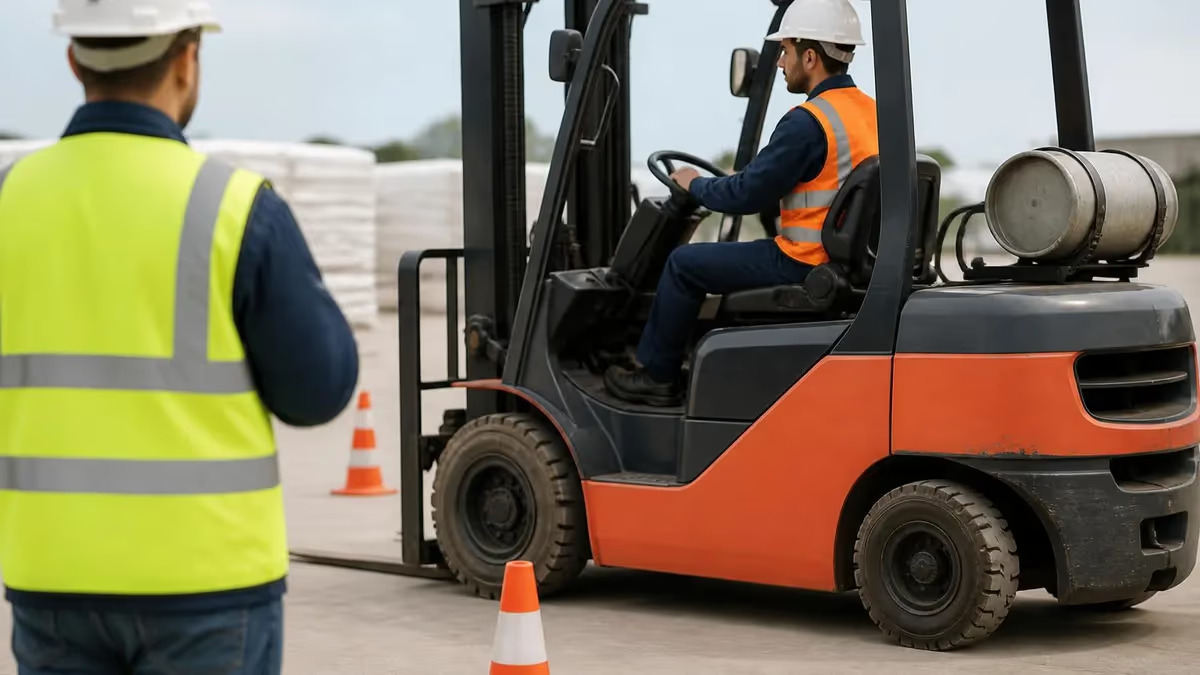
Electric forklift rental has become the default choice for warehouses, distribution centers, cold storage facilities, and indoor manufacturing plants across the United States. With diesel and propane prices fluctuating wildly and OSHA tightening indoor air quality enforcement, more operations managers are signing short-term and long-term forklift rental agreements for battery-powered lifts rather than committing to a six-figure purchase. The shift makes financial sense: a brand-new 5,000-pound capacity electric forklift retails between $28,000 and $45,000, while a monthly rental runs $650 to $1,800 depending on capacity, battery chemistry, and attachments.
The forklift rental market in 2026 is bigger than ever. According to industry data, roughly 38% of all material handling equipment in U.S. warehouses is now leased or rented rather than owned outright. Electric forklifts make up the fastest-growing segment, with lithium-ion models doubling in rental fleet share over the past three years. The reason is simple — zero tailpipe emissions, lower noise, lower maintenance, and no propane tank swaps make them ideal for food storage, pharmaceutical handling, and any indoor environment where air quality matters.
This guide walks through everything you need to know before signing a rental contract. We cover the major capacity classes, the differences between lead-acid and lithium-ion batteries, what a typical daily, weekly, and monthly rate includes, what is excluded, how delivery and pickup fees work, and the certification rules your operators must follow before touching a rented machine. We also dig into hidden costs like battery damage clauses, charger compatibility issues, and the difference between a sit-down counterbalance and a stand up forklift for tight aisles.
If you are searching for forklift rental near me, you have probably noticed that quotes vary wildly between national chains like United Rentals, Sunbelt, and Toyota Material Handling Solutions versus local independent dealers. Pricing transparency is poor in this industry, and the cheapest sticker rate often hides $300 to $800 in delivery, environmental, and damage waiver fees. Knowing what questions to ask before signing protects your budget and keeps your operation running. If something breaks mid-rental, knowing a reliable forklift repair near me contact can save days of downtime.
We also address the certification side. OSHA 29 CFR 1910.178(l) requires every forklift operator to be trained and certified on the specific type of truck they operate — and electric forklifts are classified differently than internal combustion models. A propane-certified operator is not automatically cleared to drive a lithium-powered stand-up reach truck. We explain what certification of forklift operators looks like for electric equipment, how rental companies verify it, and what liability you carry if an uncertified operator damages a rented unit.
By the end of this guide you will know exactly what an electric forklift rental costs in your region, which class of truck matches your application, how to evaluate battery condition before accepting delivery, and what contract clauses to negotiate. Whether you need a single 3,000-pound walkie pallet jack for a two-day inventory count or a fleet of ten 8,000-pound counterbalance trucks for a six-month seasonal contract, the framework below applies. Let's start with the numbers.
Electric Forklift Rental by the Numbers

Electric Forklift Rental Costs by Capacity Class
The workhorse of warehouse fleets. Daily rates $150–$220, weekly $550–$850, monthly $650–$1,200. Includes one battery and one charger. Best for general pallet handling, loading docks, and standard 96-inch aisles.
Stand-up reach and order pickers for selective racking. Daily $225–$320, weekly $850–$1,250, monthly $1,100–$1,800. Required for very narrow aisle (VNA) operations below 9 feet. Higher rates reflect specialized design.
Electric pallet jacks for ground-level transport. Daily $85–$140, weekly $295–$450, monthly $395–$695. The cheapest electric forklift rental option. No certification required for walkies under most state rules — only OSHA training.
Stand-up counterbalance for fast on-off operation in dock and cross-dock applications. Daily $195–$275, weekly $725–$1,050, monthly $895–$1,475. Popular for distribution centers running 16-hour shifts with operator rotation.
Electric counterbalance trucks for steel, lumber, and heavy manufacturing. Daily $385–$675, weekly $1,450–$2,400, monthly $1,950–$3,800. Lithium-ion strongly recommended at this capacity due to charging speed and reduced battery weight impact.
The single biggest cost variable in any electric forklift rental is the battery — both the chemistry and its physical condition on the day of delivery. Lead-acid batteries have powered electric forklifts for over 80 years and still dominate the rental fleet. They are cheap to manufacture (a replacement 36V or 48V industrial lead-acid battery runs $3,500–$8,000), use proven technology, and tolerate rough handling. The downside is weight, opportunity charging restrictions, watering requirements, and an 8-hour cooldown period after each charge to prevent damage.
Lithium-ion (specifically LiFePO4 chemistry) has rewritten the rulebook. A lithium battery can be opportunity-charged during breaks, requires zero watering, weighs 30% less than lead-acid, and lasts 3,000+ cycles compared to 1,500 for flooded lead-acid. The catch is upfront cost — lithium-equipped rental units typically run 15–25% more per month. For single-shift operations, lead-acid still pencils out. For double or triple shifts, lithium pays for itself within six months through eliminated battery swaps and reduced downtime.
When you take delivery, inspect the battery before signing the bill of lading. Check the date code stamped on the battery case — anything over 5 years old for lead-acid should be flagged. Look for white sulfation crust on terminals, cracked cases, or low electrolyte levels in any cell. Ask the delivery driver to demonstrate a hydrometer reading on three random cells. A specific gravity below 1.225 in a fully charged battery indicates a tired pack that will not hold a full shift charge. Document everything with photos before the driver leaves.
Charger compatibility trips up first-time renters constantly. A 48V battery requires a 48V charger — and not just any 48V charger. Modern smart chargers must match the battery chemistry exactly. Plugging a lead-acid charger into a lithium battery can trigger the battery management system to lock out the pack, requiring a service call to reset. Always confirm the rental company is providing a matched charger and that your facility has the correct electrical service (typically 240V single-phase or 480V three-phase) installed within 25 feet of where the truck will park.
Battery damage during the rental period is the most common source of unexpected charges. Rental contracts typically include a damage waiver of $35–$95 per month that covers normal wear but excludes battery abuse. Running the truck until it shuts down (deep discharge) damages lead-acid batteries permanently and voids the waiver. Leaving the battery uncharged over a weekend in summer heat can cost you a $4,200 replacement charge. Train your operators to plug in at 20% state of charge and never let the discharge indicator hit red.
Battery rooms or charging areas need ventilation, eye-wash stations, and spill containment for lead-acid units. OSHA 29 CFR 1910.178(g) mandates these safety provisions. Lithium chargers have fewer ventilation requirements but still need a clear 36-inch perimeter for thermal management. If your facility has not previously housed electric forklifts, budget for $1,500–$8,000 in one-time electrical and safety infrastructure before your rental arrives. Most national rental companies will do a free site survey — take them up on it.
One last battery consideration: opportunity charging changes the math entirely. A lead-acid truck on a single-shift operation gets one charge per night and never sees a midday top-up. A lithium truck can plug in during the operator's lunch break and add 30–40% charge in 20 minutes. This means you can often rent a smaller-capacity battery (and a cheaper monthly rate) and still get full-shift coverage. Ask your rental rep to run an energy audit before quoting — for tips on protecting auxiliary equipment, see our guide to forklift rentals near me attachment compatibility.
Readers who want more detail usually continue with electric forklift rental.

Forklift certification Practice Test Questions
Prepare for the Forklift certification Certification exam with our free practice test modules. Each quiz covers key topics to help you pass on your first try.
Forklift certification Certification Forkl...
Forklift certification Exam Questions covering Certification Forklift certification Maintenance and Repairs. Master Forklift certification Test concepts for certification prep.
Forklift certification Certification Forkl...
Free Forklift certification Practice Test featuring Certification Forklift certification Maintenance and Repairs Questions and Answers. Improve your Forklift certification Exam score with mock test prep.
Forklift certification Certification Forkl...
Forklift certification Mock Exam on Certification Forklift certification Operator Training and Certification Requirements. Forklift certification Study Guide questions to pass on your first try.
Forklift certification Certification Forkl...
Forklift certification Test Prep for Certification Forklift certification Operator Training and Certification Requirements Questions and Answers. Practice Forklift certification Quiz questions and boost your score.
Forklift certification Load Handling and S...
Forklift certification Questions and Answers on Load Handling and Stability. Free Forklift certification practice for exam readiness.
Forklift certification OSHA Regulations an...
Forklift certification Mock Test covering OSHA Regulations and Compliance. Online Forklift certification Test practice with instant feedback.
Forklift certification Pre-Operation Inspe...
Free Forklift certification Quiz on Pre-Operation Inspections. Forklift certification Exam prep questions with detailed explanations.
Forklift certification Refueling and Recha...
Forklift certification Practice Questions for Refueling and Recharging Procedures. Build confidence for your Forklift certification certification exam.
Forklift certification Safe Driving and Ma...
Forklift certification Test Online for Safe Driving and Maneuvering. Free practice with instant results and feedback.
Forklift certification Workplace Hazard Id...
Forklift certification Study Material on Workplace Hazard Identification. Prepare effectively with real exam-style questions.
Forklift certification Forklift Instructions
Free Forklift certification Test covering Forklift Instructions. Practice and track your Forklift certification exam readiness.
Forklift certification Forklift MCQ
Forklift certification Exam Questions covering Forklift MCQ. Master Forklift certification Test concepts for certification prep.
Forklift certification Forklift Employer R...
Free Forklift certification Practice Test featuring Forklift Employer Responsibilities. Improve your Forklift certification Exam score with mock test prep.
Forklift certification Forklift Penalties ...
Forklift certification Mock Exam on Forklift Penalties for Non-Compliance. Forklift certification Study Guide questions to pass on your first try.
Choosing the Right Electric Forklift for Your Application
For standard pallet handling in 10-foot to 12-foot aisles with racking up to 20 feet high, a Class I sit-down counterbalance electric forklift in the 4,000–5,000 pound capacity range hits the sweet spot. Look for cushion tires for smooth concrete floors and a triple-stage full free-lift mast if you need to load trailers with low overhead. Monthly rentals typically include a side shifter as standard.
For high-density storage with aisles below 9 feet, you need a Class II stand-up reach truck. These extend the forks forward to retrieve pallets from deep racking without repositioning the truck. They cost 40–60% more to rent but can triple your storage density. Order pickers — operator rides up with the load — are a separate Class II category used for case-pick operations in e-commerce fulfillment.
Electric Forklift Rental: Pros and Cons vs Buying
- +No large capital outlay — preserves cash flow and credit lines for core business needs
- +Maintenance, repairs, and routine service included in monthly rate (verify in contract)
- +Easy to swap units as needs change — upgrade capacity or class without resale hassle
- +Predictable monthly expense simplifies budgeting and chargeback to project codes
- +Latest models with current safety features, telematics, and operator assist technology
- +Tax-deductible as operating expense rather than capital depreciation schedule
- +Rental company handles end-of-life battery disposal and EPA compliance paperwork
- −Higher total cost over 5+ years compared to outright purchase or capital lease
- −Damage waivers, environmental fees, and delivery charges inflate the sticker rate 20–30%
- −Limited customization — attachments and modifications usually prohibited or extra cost
- −Battery condition varies — older rental fleet units may not hold full-shift charge
- −Contract terms often favor rental company on damage assessments and end-of-rental fees
- −No equity build-up — at end of term you return the truck with nothing to show for payments
Pros and Cons at a Glance
| Pros | Cons |
|---|---|
| No large capital outlay — preserves cash flow and credit lines for core business needs | Limited customization — attachments and modifications usually prohibited or extra cost |
| Maintenance, repairs, and routine service included in monthly rate (verify in contract) | Battery condition varies — older rental fleet units may not hold full-shift charge |
| Easy to swap units as needs change — upgrade capacity or class without resale hassle | Contract terms often favor rental company on damage assessments and end-of-rental fees |
| Predictable monthly expense simplifies budgeting and chargeback to project codes | No equity build-up — at end of term you return the truck with nothing to show for payments |

Pre-Delivery Inspection Checklist for Electric Forklift Rentals
- ✓Verify capacity plate matches the model and battery weight stated on your rental contract
- ✓Photograph all four sides of the truck, mast, forks, and overhead guard before signing receipt
- ✓Test horn, headlights, taillights, backup alarm, and seat-belt sensor with the truck powered on
- ✓Cycle the mast through full lift, lower, tilt forward, tilt back, and side shift if equipped
- ✓Check battery date code, electrolyte levels (lead-acid), and read state-of-charge indicator
- ✓Confirm charger model matches battery voltage and chemistry — request matched pair
- ✓Inspect drive tires and load wheels for cuts, flat spots, and remaining tread depth
- ✓Test parking brake on a slight incline and verify hour meter reading matches contract
- ✓Walk through emergency disconnect, key switch, and operator presence sensor functions
- ✓Document any damage, missing accessories, or fluid leaks on the bill of lading before driver leaves
The cheapest quote is rarely the cheapest rental.
National data shows the average electric forklift rental ends up costing 22% more than the original quote due to delivery surcharges, environmental fees, damage waivers, fuel surcharges (yes, even on electric — for the delivery truck), and after-hours pickup fees. Always request an itemized total-cost-of-rental quote in writing, valid for 14 days, before signing anything.
Operator certification is non-negotiable for any electric forklift rental — and the requirements are stricter than many small businesses realize. OSHA 29 CFR 1910.178(l) requires every forklift operator to complete formal classroom training, hands-on practical evaluation, and equipment-specific familiarization before operating a powered industrial truck unsupervised. Certification of forklift operators is the legal responsibility of the employer, not the rental company. Even if the rental company asks for proof of certification (and the major chains now do), you cannot transfer your liability to them.
Electric forklifts are classified differently than internal combustion trucks. A Class I sit-down electric counterbalance is one classification; a Class II stand-up reach truck is another; a Class III walkie or rider pallet jack is a third. An operator certified only on Class IV propane sit-down counterbalance trucks is not automatically qualified to operate any electric forklift you rent. Cross-classification certification requires additional training and a documented practical evaluation on the new equipment type. Skipping this step and having an accident exposes you to OSHA citations starting at $16,131 per serious violation as of 2026 enforcement rates.
Forklift training programs vary in quality. The best programs combine 4–6 hours of classroom instruction covering OSHA standards, stability principles, load handling, refueling/recharging procedures, and workplace-specific hazards, followed by 2–4 hours of hands-on practical training on the exact equipment the operator will use. The employer (you) then conducts a formal evaluation, signs the operator's certification card, and retains training records for three years. Online-only forklift training is not sufficient — OSHA requires a hands-on practical component evaluated by a qualified person.
Many rental companies now offer on-site operator training as an add-on service, typically $125–$225 per operator for a 4-hour group session. This is often the easiest path for small businesses without an in-house qualified trainer. Verify that the program covers the specific class and model you are renting and that it produces documentation OSHA will accept during an inspection — meaning a written record listing operator name, date of training, name of trainer, and equipment type evaluated.
Recertification is required every three years per OSHA, but it is also triggered by any of the following: an operator is observed driving unsafely, an operator is involved in an accident or near-miss, the operator is assigned to a new type of equipment, or workplace conditions change in a way that affects safe operation. Renting a different class of forklift than your operators normally use triggers the new-equipment-type recertification requirement automatically. Keep certification cards in each operator's truck or in the breakroom binder for easy verification.
For long-term rentals (90+ days), consider building a written training matrix that maps each operator to each class of rented equipment, with refresher dates and evaluator signatures. National rental chains often provide a free certification tracking portal for fleet customers — useful for multi-location operations. Daily pre-shift inspections must also be documented per OSHA 1910.178(q)(7). Pre-printed inspection cards are usually provided with rentals; if not, request them.
Operators who skip pre-shift inspection put your business at legal risk regardless of how new the rental unit is. For a complete breakdown of operator responsibilities including refueling, charging protocols, and safe parking, review our guide on forklift propane tank handling and electric equivalents.
Even if you rent a forklift for just one day, you are the employer of record for OSHA purposes. Any operator injury, property damage, or violation citation comes to your business — not the rental company. Verify operator certification BEFORE the truck is unloaded, not after. The $185 daily rental can turn into a $32,000 OSHA penalty if an uncertified operator causes an injury accident.
Hidden fees turn a $1,200 monthly electric forklift rental into a $1,650 charge by the time the invoice arrives. The single most common surprise is delivery and pickup, which most rental companies quote separately at $185–$425 each way depending on distance and equipment size. A 50-mile round-trip for a standard Class I counterbalance averages $375; a heavy-capacity unit requiring a specialty trailer can hit $850. Always get delivery costs in writing as a flat fee, not an estimate.
Environmental fees show up on nearly every rental invoice at 3–5% of the base rate. These cover battery acid disposal, tire recycling, hydraulic fluid changes, and EPA compliance paperwork. They are negotiable on longer contracts but rarely waived entirely. Loss damage waivers run 8–12% of monthly base rate and cover accidental damage but exclude operator negligence, battery abuse, and damage from improper attachments. Some rental companies bundle the waiver into the base rate; others itemize it. Either way, read the exclusions carefully.
Fuel surcharges still appear on electric rental invoices — they cover the diesel cost of the delivery truck. Typical fee is $35–$75 per delivery event. After-hours delivery or pickup (defined as before 7 AM, after 5 PM, weekends, or holidays) adds $150–$350. Plan deliveries during normal business hours whenever possible. Express or expedited delivery (same-day or next-day) carries a 25–50% premium on the delivery fee.
End-of-rental charges are where renters lose the most money. The return inspection typically happens 24–72 hours after pickup, at the rental yard, without you present. The rental company assesses any damage beyond normal wear and bills you directly. Common surprise charges include $185 for cleaning if the truck returns dirty, $325 for cracked plastic body panels, $850 for forks bent more than 3% from spec, and $1,200–$4,200 for damaged batteries. Take date-stamped video walkaround footage at pickup — this is your only defense against disputed charges.
Battery damage clauses deserve special attention in electric forklift rental contracts. Most agreements specify that the renter is liable for battery replacement if the unit returns with cycle damage, deep-discharge damage, sulfation from improper maintenance, or physical damage to the case or terminals. Replacement cost runs $3,500–$8,000 for lead-acid and $7,500–$15,000 for lithium-ion. Train operators on proper charging procedures during the first shift the rental is on site. A 15-minute briefing prevents a $6,000 charge.
Contract length affects pricing dramatically. Daily rates carry a premium of roughly 8–12% over weekly equivalent, and weekly rates are 15–22% above the monthly-equivalent daily rate. Commit to the longest term you reasonably need — most rental companies allow early return with prorated refund of any unused full months, minus a $150–$250 early termination fee. Conversely, extending a daily or weekly rental at the last minute often costs 30–50% more than originally negotiating a longer term upfront.
Finally, watch for automatic renewal clauses. Standard rental contracts auto-renew on a month-to-month basis unless you provide 30 days written notice of return. Miss the notice window and you can be locked into another full month at the same rate, even if you only needed the truck for two more days. Set a calendar reminder for day 25 of every rental month and submit return notice in writing via email with delivery confirmation. Verbal notice to a delivery driver or salesperson does not count under most contract terms.
Now for the practical playbook. Before you contact any rental company, document your application requirements in writing: maximum load weight, lift height, aisle width, floor type (concrete, asphalt, gravel), indoor versus outdoor use, hours per day the truck will operate, ambient temperature range, and any attachments needed. This one-page spec sheet lets you compare quotes apples-to-apples and prevents the bait-and-switch tactic of being quoted on a smaller truck than you actually need.
Get three quotes minimum — one from a national chain (United Rentals, Sunbelt, or Toyota Material Handling Solutions), one from a regional dealer (typically Caterpillar, Hyster, or Mitsubishi dealer networks), and one from a local independent. National chains have the deepest inventory and best availability but list pricing. Regional dealers often beat national pricing by 8–15% and provide better service responsiveness. Local independents are hit-or-miss on equipment quality but can be 20–30% cheaper for older equipment in a pinch.
Negotiate beyond the base rate. Free delivery in exchange for a 3-month commitment, waived environmental fees on rentals over $1,000/month, included operator training for groups of three or more, and prorated month-to-month flexibility are all standard negotiation points. Rental sales reps have authority to discount 10–15% on monthly rates without manager approval and 18–25% with approval. If your first quote is firm, ask for the manager — pricing flexibility almost always exists.
Consider rental-to-own (RTO) programs if you suspect this rental need is becoming permanent. Most major rental companies apply 50–70% of paid rental fees toward purchase if you exercise the buy option within the first 12 months. RTO programs require a contract that locks the truck and pricing — you cannot swap units mid-rental. For operations that have rented the same forklift for over 6 months, the math almost always favors RTO conversion or outright purchase.
Plan for the long term. If your peak season requires three trucks but baseline demand is one, rent the two seasonal units rather than owning idle equipment. If you operate two shifts year-round and run lithium-ion equipment, the rent-versus-buy break-even crosses at about 36 months. Triple-shift operations break even at 18–24 months. These rules of thumb assume you have in-house maintenance capability — outsource everything and the break-even point extends 12–18 months further.
Document everything throughout the rental period. Operator certifications on file, daily inspection records, any maintenance calls placed to the rental company, any near-miss incidents, any repairs performed. This paper trail protects you at end-of-rental inspection and during any OSHA visits during the rental term. Most rental companies provide a digital portal — use it. If they do not, maintain a binder in the warehouse office with all rental paperwork. For a deeper look at what to track day-to-day, our operator duties guide covers daily logs and inspection protocols in detail.
Finally, build relationships. The forklift rental industry runs on relationships — the rep who knows your facility, your seasonal patterns, and your operators will get you a truck during peak season when their competitors say sold out. Stay loyal to one or two vendors, pay invoices on time, return equipment clean and on time, and your rental rep will become your single most valuable supply chain partner. The best rental experiences happen when the vendor treats you as a long-term account rather than a single transaction.
Sample Forklift certification Practice Questions
Try these questions from our free Forklift certification practice tests. The correct answer and an explanation follow each question.
Before starting an electric forklift, what should you check on the battery?
- A. Its color
- B. Charge level, connections, and electrolyte
- C. The manufacturer's logo
- D. Only the weight
Answer: B. Charge level, connections, and electrolyte
Electric forklift inspections include verifying charge, secure cable connections, and proper electrolyte levels.
You will be using your forklift to drive up and down the hill that is your project site. Which method is usually the safest for doing this?
- A. Keep the heaviest part of the vehicle on the downhill side
- B. Use ballast to ensure the vehicle is always heaviest at the back
- C. Keep the heaviest part of the vehicle on the uphill side
- D. Use ballast to ensure the vehicle weight and load is evenly distributed
Answer: C. Keep the heaviest part of the vehicle on the uphill side
When driving a forklift up or down a hill, it is safest to keep the heaviest part of the vehicle on the uphill side. This means the load should face uphill when ascending, and the forklift should drive in reverse down the slope if loaded, with the load still facing uphill. This method helps maintain stability by counteracting the natural tendency for the vehicle to tip or roll, ensuring the center of gravity remains secure.
What is the primary hazard when charging an electric forklift battery?
- A. Excessive noise
- B. Hydrogen gas released during charging
- C. Radiation exposure
- D. Carbon monoxide buildup
Answer: B. Hydrogen gas released during charging
Lead-acid batteries emit flammable hydrogen gas while charging, which can ignite.
During operation, the forklift's warning alarm for low battery charge activates. What should the electric forklift operator do?
- A. Ignore the alarm and complete all pending tasks
- B. Immediately park the forklift and swap or charge the battery according to facility procedures
- C. Turn off the alarm and continue operating
- D. Reduce speed by half and continue until the forklift stops
Answer: B. Immediately park the forklift and swap or charge the battery according to facility procedures
Operating with a critically low battery can cause sudden power loss; the operator must follow facility procedures to safely swap or charge the battery.
Forklift Questions and Answers
Forklift Tires: Complete Guide to Types, Sizing, Wear Patterns, and Replacement Costs
Forklift Accessories: Complete Guide to LED Lights, Attachments, Safety Gear, and Productivity Upgrades for 2026
Forklift Operator Duties: Complete Guide to Daily Responsibilities, Safety Tasks, and Career Path for 2026
Forklift License Renewal: Complete Guide to Forklift License Expiry, OSHA Recertification, and Operator Requirements for 2026
Forklift Safety Training: Complete OSHA Compliance Guide for Operators and Employers
About the Author

Certified Crane Operator & Skilled Trades Exam Specialist
Ferris State UniversityRobert Martinez is a Journeyman Ironworker, NCCCO-certified crane operator, and forklift trainer with a Bachelor of Science in Construction Technology from Ferris State University. He has 21 years of ironworking, rigging, and heavy equipment operation experience across high-rise and industrial construction sites. Robert prepares candidates for crane operator, rigger, forklift, and skilled trades certification examinations.