
Forklift Hand Signals: The Complete OSHA Guide to Spotter Communication, Standard Gestures, and Safe Warehouse Operations
Master forklift hand signals with our OSHA-compliant guide. Learn standard spotter gestures, safety protocols, and certification tips for operators. 📝
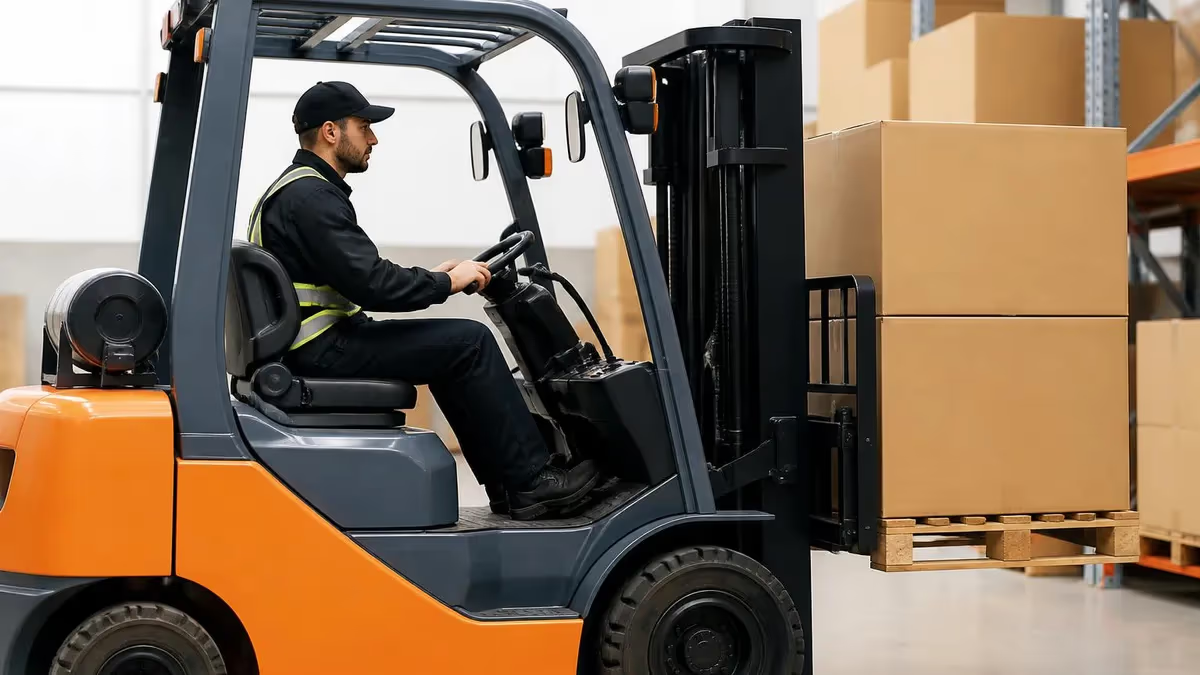
Forklift hand signals are the universal silent language that keeps warehouses, construction sites, and loading docks safe when verbal communication fails. Whether you operate a stand up forklift in a noisy distribution center or maneuver a rough terrain machine on a busy job site, knowing the correct gestures can mean the difference between a routine lift and a catastrophic accident. OSHA reports that nearly 25% of forklift incidents involve communication breakdowns between operators and ground personnel, making signal mastery non-negotiable for every certified operator working in 2026.
The Occupational Safety and Health Administration codifies these signals under 29 CFR 1910.178, requiring all forklift operators to understand spotter communication during blind lifts, congested aisle work, and pedestrian-heavy zones. The same standards extend to anyone using a hyster forklift or comparable industrial truck where visibility becomes compromised by load size, rack heights, or environmental conditions. Companies that integrate hand signal training into onboarding see measurably fewer near-misses and workers comp claims.
Forklift rental customers face an additional learning curve because rented equipment often differs in mast height, fork length, and turning radius from their primary fleet. Spotters using consistent, standardized hand signals bridge this gap by guiding operators through unfamiliar machinery confidently. Whether you searched for forklift rental near me last week or operate company-owned forklifts daily, the signals remain identical across manufacturers, models, and power sources including electric forklift units that operate silently and demand even sharper visual communication.
This comprehensive guide walks through every standard hand signal recognized by OSHA, ANSI B56.1, and the American National Standards Institute. We cover stop signals, directional commands, lift and lower gestures, and the critical emergency stop motion every operator must recognize instantly. You will also learn the protocols for designating spotters, positioning them safely outside the swing radius, and confirming receipt of each signal before executing the maneuver. These habits separate professional operators from accident statistics.
Beyond the basics, we examine how hand signals integrate with broader safety culture, including pre-shift inspections, certification requirements, and refresher training cycles. Forklift training programs that emphasize signal drills produce operators who react 40% faster to ground personnel commands. We also share real-world scenarios from warehouse managers, construction supervisors, and rental yard operators about how proper signaling prevented serious injury and property damage on their watch.
Finally, this article includes practice quiz tiles, downloadable checklists, and a frequently asked questions section addressing the most common operator concerns about hand signal protocols. Whether you are renewing certification, training a new spotter, or evaluating your company's safety procedures, treat this guide as the authoritative reference for forklift hand signals in industrial and construction environments. Bookmark it, share it with your crew, and review it before every shift that requires spotter-guided operations to keep yourself and your coworkers safe.
Forklift Hand Signals by the Numbers

Standard Signal Categories Used in Forklift Operations
Arm and finger motions that guide the operator forward, backward, left, or right. Used during tight maneuvering, parking, and dock approach where mirrors and direct sight lines are insufficient for safe positioning.
Vertical hand motions controlling mast elevation and fork height. Essential during pallet stacking in racking systems where operators cannot see the top of the load or the contact point with the destination beam.
Immediate halt commands recognized universally by every operator. Includes the standard stop signal (open palm raised) and the emergency stop (both arms crossed overhead) that triggers immediate shutdown.
Signals for adjusting mast tilt forward or backward and extending reach forks. Critical during pallet pickup, rack placement, and securing unstable loads before transit through congested warehouse aisles.
Signals indicating the operator should slow down, creep forward, or stop entirely. Used near pedestrians, narrow aisles, blind intersections, and during precision placement of fragile or hazardous materials.
Every certified forklift operator must master a foundational vocabulary of standardized hand signals before stepping into the cab of any industrial truck. These gestures are not arbitrary or company-specific; they derive from ANSI B56.1 standards adopted by OSHA, the American Society of Mechanical Engineers, and equivalent international bodies. Whether you operate a counterbalance, reach truck, order picker, or stand up forklift, the signals remain consistent so that any properly trained spotter can guide any properly trained operator regardless of where either learned their craft.
The stop signal is the most important gesture in the entire vocabulary. To signal stop, the spotter raises one arm straight up with the palm facing the operator and fingers extended. This signal must trigger immediate cessation of all forklift movement including mast travel and steering. Some companies require operators to also engage the parking brake when this signal appears, particularly during fork raising or lowering near elevated workers. Practice this signal until your reaction becomes instinctive and automatic.
Directional signals use the entire arm to communicate intended travel direction. To signal forward, the spotter points their flat hand in the direction of desired travel with the palm facing the operator and waves it gently toward themselves. To signal reverse, the same arm motion reverses with the palm facing outward, pushing the operator backward. Always confirm directional signals visually before responding, since misreading forward for reverse during a tight maneuver can crush a coworker against racking.
Lifting and lowering signals control vertical mast movement during pallet stacking and retrieval. To raise the forks, the spotter extends their index finger upward and rotates their hand in small circles. Larger or faster circles indicate faster lift speed, while smaller circles request creeping or fine adjustment. The lower signal mirrors this: index finger pointed downward with rotating motions. Both signals require the operator to maintain eye contact with the spotter throughout the entire mast travel cycle.
Tilt signals adjust the mast angle either forward or backward to secure loads or align with destination beams. To signal tilt back, the spotter places a thumb up against their chest and motions backward toward their body. Tilt forward reverses this with thumb pointing away from the body. These signals frequently combine with lift commands during high stacking operations, requiring operators to interpret two simultaneous gestures from a single spotter without confusion or hesitation.
The emergency stop signal overrides every other command in the signal vocabulary. The spotter crosses both arms overhead in an X formation, signaling that all motion must cease immediately due to imminent danger. This signal may come from anyone on the floor, not just the designated spotter, because emergencies do not respect chain of command. Operators must also know forklift parts well enough to engage emergency braking and shutdown procedures within two seconds of recognizing this critical gesture.
Acknowledging receipt of every signal closes the communication loop and prevents dangerous assumptions. The simplest acknowledgment is a brief nod from the operator combined with a hand wave through the cab window. More sophisticated operations require verbal callouts on radios paired with visual signals to confirm understanding. Whatever your facility's protocol, never execute a maneuver without confirming that the spotter saw your acknowledgment. Silent assumption is the most common precursor to spotter-related incidents on warehouse floors and construction sites nationwide.

Forklift certification Practice Test Questions
Prepare for the Forklift certification Certification exam with our free practice test modules. Each quiz covers key topics to help you pass on your first try.
Forklift certification Certification Forkl...
Forklift certification Exam Questions covering Certification Forklift certification Maintenance and Repairs. Master Forklift certification Test concepts for certification prep.
Forklift certification Certification Forkl...
Free Forklift certification Practice Test featuring Certification Forklift certification Maintenance and Repairs Questions and Answers. Improve your Forklift certification Exam score with mock test prep.
Forklift certification Certification Forkl...
Forklift certification Mock Exam on Certification Forklift certification Operator Training and Certification Requirements. Forklift certification Study Guide questions to pass on your first try.
Forklift certification Certification Forkl...
Forklift certification Test Prep for Certification Forklift certification Operator Training and Certification Requirements Questions and Answers. Practice Forklift certification Quiz questions and boost your score.
Forklift certification Load Handling and S...
Forklift certification Questions and Answers on Load Handling and Stability. Free Forklift certification practice for exam readiness.
Forklift certification OSHA Regulations an...
Forklift certification Mock Test covering OSHA Regulations and Compliance. Online Forklift certification Test practice with instant feedback.
Forklift certification Pre-Operation Inspe...
Free Forklift certification Quiz on Pre-Operation Inspections. Forklift certification Exam prep questions with detailed explanations.
Forklift certification Refueling and Recha...
Forklift certification Practice Questions for Refueling and Recharging Procedures. Build confidence for your Forklift certification certification exam.
Forklift certification Safe Driving and Ma...
Forklift certification Test Online for Safe Driving and Maneuvering. Free practice with instant results and feedback.
Forklift certification Workplace Hazard Id...
Forklift certification Study Material on Workplace Hazard Identification. Prepare effectively with real exam-style questions.
Forklift certification Forklift Instructions
Free Forklift certification Test covering Forklift Instructions. Practice and track your Forklift certification exam readiness.
Forklift certification Forklift MCQ
Forklift certification Exam Questions covering Forklift MCQ. Master Forklift certification Test concepts for certification prep.
Forklift certification Forklift Employer R...
Free Forklift certification Practice Test featuring Forklift Employer Responsibilities. Improve your Forklift certification Exam score with mock test prep.
Forklift certification Forklift Penalties ...
Forklift certification Mock Exam on Forklift Penalties for Non-Compliance. Forklift certification Study Guide questions to pass on your first try.
Forklift Training Programs and Hand Signal Certification
Becoming a certified forklift operator requires completing formal training that combines classroom instruction with hands-on evaluation. The classroom portion covers OSHA standards, equipment-specific operation, load capacity calculations, and hand signal recognition. Most programs run between 8 and 24 hours depending on equipment complexity and prior experience. Forklift training programs delivered by accredited providers meet 29 CFR 1910.178 requirements and prepare candidates for the practical skills examination administered by a qualified trainer.
The practical examination tests every signal we have covered including emergency stop response. Candidates must demonstrate proper acknowledgment, execute maneuvers based on spotter guidance, and recognize hazardous signal scenarios. Failure rates for first-time test takers hover around 15% according to industry data, with most failures stemming from poor signal interpretation rather than mechanical operation. Certification cards are valid for three years before mandatory recertification.
Using Spotters and Hand Signals: Advantages vs Limitations
- +Eliminates blind spots during high-rack stacking operations
- +Provides immediate emergency stop capability from ground level
- +Standardized gestures work across all manufacturers and equipment types
- +Reduces collision risk in pedestrian-heavy zones by up to 60%
- +No batteries, radios, or technology required to function reliably
- +Builds team awareness and shared responsibility for workplace safety
- +Universal signals work even with non-English speaking crews
- −Requires line of sight between operator and spotter at all times
- −Lighting conditions can obscure hand positions during night shifts
- −Glove-wearing spotters lose finger articulation for fine signals
- −Long-distance signaling becomes unreliable past 50 feet
- −Adds labor cost for dedicated spotter positions
- −Signal fatigue during long shifts reduces gesture clarity
- −Training requires ongoing reinforcement to prevent drift

Pre-Operation Hand Signal Verification Checklist
- ✓Confirm spotter is positioned outside the forklift swing radius and load drop zone
- ✓Verify clear line of sight between operator cab and spotter location
- ✓Review the specific signal vocabulary being used for this lift sequence
- ✓Test stop and emergency stop signals before beginning the maneuver
- ✓Confirm both parties acknowledge radio backup if line of sight may be lost
- ✓Check spotter visibility wear including high-visibility vest and hard hat
- ✓Ensure adequate lighting for clear signal recognition throughout the operation
- ✓Identify pedestrian traffic patterns and barricade affected zones
- ✓Establish a single designated spotter to prevent conflicting commands
- ✓Confirm acknowledgment protocol so operator signals receipt of each command
- ✓Practice one full signal sequence in slow motion before commencing live operation
- ✓Document the spotter assignment on the daily shift safety log
One Signal Override Rule
If any worker on the floor signals emergency stop, the operator must comply immediately regardless of who issued the signal. The crossed-arms gesture is not restricted to the designated spotter; anyone witnessing imminent danger can and should trigger it. Train every employee in your facility to recognize and use the emergency stop signal, not just certified forklift operators.
Even seasoned forklift operators make signal mistakes that compromise safety and trigger near-miss incidents. Understanding the most common errors helps prevent them before they cascade into property damage or injury. The single most frequent mistake is operators executing maneuvers without confirming the spotter actually saw their acknowledgment gesture. This silent assumption breaks the communication loop and creates dangerous ambiguity about whether both parties share situational awareness during the lift sequence.
Another common error involves spotters positioning themselves in unsafe locations such as directly beneath an elevated load, inside the swing radius during turns, or between the forklift and a fixed wall. Properly trained spotters maintain a minimum 10-foot buffer from the equipment at all times and choose positions that allow rapid escape if the situation deteriorates. Operators should refuse to begin a maneuver if their spotter is standing in an unsafe location, even if the spotter is the shift supervisor.
Signal drift occurs when individual operators or teams gradually modify standardized gestures over time until their signals no longer match OSHA-recognized conventions. A team using drifted signals operates safely among themselves but creates serious risk when interacting with temporary workers, contractors, or rental equipment crews. Regular signal audits during safety meetings reset the vocabulary back to ANSI standards and prevent localized drift from becoming a workplace-wide hazard.
Mixing verbal and visual signals without protocol creates confusion during noisy operations. Some facilities allow radio communication as a primary channel with hand signals as backup, while others reverse this hierarchy. Whichever protocol your site uses, document it clearly and train every operator and spotter on the priority system. When verbal and visual signals conflict, operators must default to the more restrictive command, meaning stop signals always override go signals regardless of channel.
Glove selection significantly affects signal clarity yet rarely receives attention during safety planning. Bulky winter gloves obscure finger positions needed for lift and lower signals, while fingerless gloves expose hands to injury in industrial environments. The optimal solution is high-visibility orange or yellow gloves with reinforced palms and clearly defined finger seams. Spotters working in cold storage facilities should rotate glove styles based on the precision required for the upcoming task sequence.
Spotters who fail to maintain consistent eye contact with the operator create gaps in the communication chain. Looking away to check pedestrian traffic, watching the load instead of the operator, or glancing at a clipboard during signaling all break the visual connection that makes hand signals work. Train spotters to dedicate full attention to the operator and assign separate ground personnel to monitor pedestrian traffic, document the lift, or perform other auxiliary tasks during the operation.
Finally, fatigue degrades signal quality during long shifts in ways that operators rarely notice. Spotters and operators working back-to-back lift sequences develop hand gesture imprecision and slower reaction times after about four hours of continuous signaling work. Build mandatory rotation cycles into your safety procedures so that spotters rotate roles every two hours during heavy lifting operations, preventing fatigue-induced communication failures that lead to predictable accidents on extended shifts.
Failure to provide adequate forklift training including hand signal recognition can result in OSHA fines up to $156,259 per willful violation in 2026. Repeat violations can trigger criminal referrals if they result in serious injury or fatality. Document every training session, signal drill, and certification renewal in writing to protect your operation during OSHA audits.
Building a signal-driven safety culture requires more than memorizing gestures and posting OSHA charts in the break room. It demands leadership commitment, recurring practice, and integration of hand signal protocols into every operational decision your facility makes. Companies that achieve zero spotter-related incidents over multi-year periods share common characteristics including daily signal warmups before shift start, anonymous reporting systems for signal protocol concerns, and visible executive participation in safety stand-downs that include hand signal demonstrations.
Start by auditing your current signal vocabulary against ANSI B56.1 and OSHA 29 CFR 1910.178. Identify any drift, missing signals, or undocumented site-specific extensions. Update your written safety program to reflect the current standardized signal vocabulary, then train every operator and spotter on the refreshed protocol. Maintain a signed acknowledgment from each worker confirming they understand the updated signals and agree to follow them during all operations involving forklift equipment.
Visual reinforcement throughout the facility keeps signals top of mind during the workday. Post laminated signal charts at every forklift charging station, dock door, and high-traffic intersection. Include signal reminders on bathroom mirrors, break room walls, and electronic message boards. Some operations project signal diagrams onto warehouse floors using overhead projectors to create unmissable visual cues. These environmental nudges reinforce training and provide just-in-time reminders before workers begin lift operations.
Integrate hand signal proficiency into performance evaluations and promotion decisions. When workers know that signal mastery influences their career advancement, they invest in maintaining sharp skills throughout their tenure. Forklift operators who progress into supervisor roles should demonstrate exceptional signal proficiency because they become the trainers and auditors for the next generation of operators. This creates a virtuous cycle where signal excellence compounds over time across your workforce.
Regular drills under realistic conditions test signal proficiency in ways classroom training cannot replicate. Conduct unannounced emergency stop drills during routine lift operations to measure response times and identify operators who hesitate or fail to comply. Rotate spotters and operators through unfamiliar pairings to ensure signal recognition does not depend on personal familiarity. The goal is a workforce where any properly trained operator can safely respond to any properly trained spotter regardless of prior interaction history.
Cross-training programs that teach operators how to spot and spotters how to operate build mutual respect and deeper signal understanding. When workers experience both sides of the communication relationship, they develop empathy for each role's challenges and produce clearer signals during their primary duties. This approach also creates workforce flexibility during absences and enables continuous safety improvement through perspectives that span the entire lift operation. Many operators learn how to get forklift certified through cross-training pathways at well-organized facilities.
Finally, celebrate signal excellence visibly throughout your organization. Recognize teams that complete extended periods without signal-related incidents. Share success stories in company newsletters and during all-hands meetings. Tie safety bonuses to measurable signal proficiency metrics including drill response times, audit scores, and clean inspection records. A culture that celebrates safety produces measurably better outcomes than one that only punishes failures, transforming hand signals from a regulatory requirement into a source of professional pride for your entire workforce.
Practical preparation for hand signal mastery begins long before your certification exam or first day on a new job site. Start by studying OSHA's official forklift operator training requirements and the ANSI B56.1 standard documents available through industry safety associations. Many forklift rental companies provide complimentary signal reference cards with every equipment delivery, and these laminated quick references make excellent pocket tools for operators new to spotter-guided lifts or returning after extended absences from active forklift duty.
Set up practice scenarios in low-stakes environments before applying signals to real production work. Pair with a coworker in an empty warehouse area and walk through every signal in the vocabulary at decreasing distances and varying lighting conditions. Time your response to emergency stop signals and aim for under two seconds from gesture recognition to complete forklift stoppage. These drills build the muscle memory that emerges automatically during high-pressure real-world situations when conscious deliberation would be too slow.
Invest in proper personal protective equipment that supports clear signaling. Spotters should wear ANSI Class 2 or Class 3 high-visibility vests, hard hats with reflective tape, and contrasting gloves that make hand positions easily visible against any background. Operators should ensure cab windows are clean, mirrors are properly adjusted, and any obstructions to signal visibility are removed before each shift. Small environmental improvements compound into measurable signal recognition gains over an entire workday or week.
Take advantage of free and low-cost training resources offered by equipment manufacturers, insurance carriers, and trade associations. Toyota, Crown, Hyster, and Yale all provide free signal training videos through their dealer networks. Workers compensation insurers often subsidize or provide free safety training including hand signal modules. Your state OSHA consultation program may offer no-cost site visits to evaluate your current signal protocols and recommend improvements without triggering enforcement actions or citations.
Practice quiz tiles like the ones included in this article are excellent self-assessment tools for identifying weak spots in your signal knowledge. Take each quiz multiple times until you achieve consistent passing scores, then revisit them quarterly to maintain proficiency. The questions cover not just signal recognition but also the contextual judgment that separates safe operators from accident statistics. Track your scores over time to demonstrate documented self-improvement during performance reviews and certification renewals.
Consider pursuing additional certifications beyond basic forklift operator credentials. Specialty certifications in narrow aisle operation, high-rack stacking, and hazardous material handling all incorporate advanced signal protocols beyond the basics covered in standard training. These credentials enhance your earning potential while building deeper safety expertise. Operators searching for forklift training near me should ask providers about specialty add-on certifications that can be completed alongside or after initial credentialing for maximum career impact.
Finally, maintain a personal signal journal documenting unusual scenarios, near-misses, and lessons learned from your daily operations. Review this journal monthly and share relevant insights during safety meetings to help your coworkers avoid similar pitfalls. Operators who treat signal proficiency as an ongoing professional development goal rather than a one-time certification box-check produce dramatically safer outcomes throughout their careers. Forklift hand signals are a craft that rewards continuous improvement and deserves the same dedicated practice as any other technical skill in your professional toolkit today.
Forklift Questions and Answers
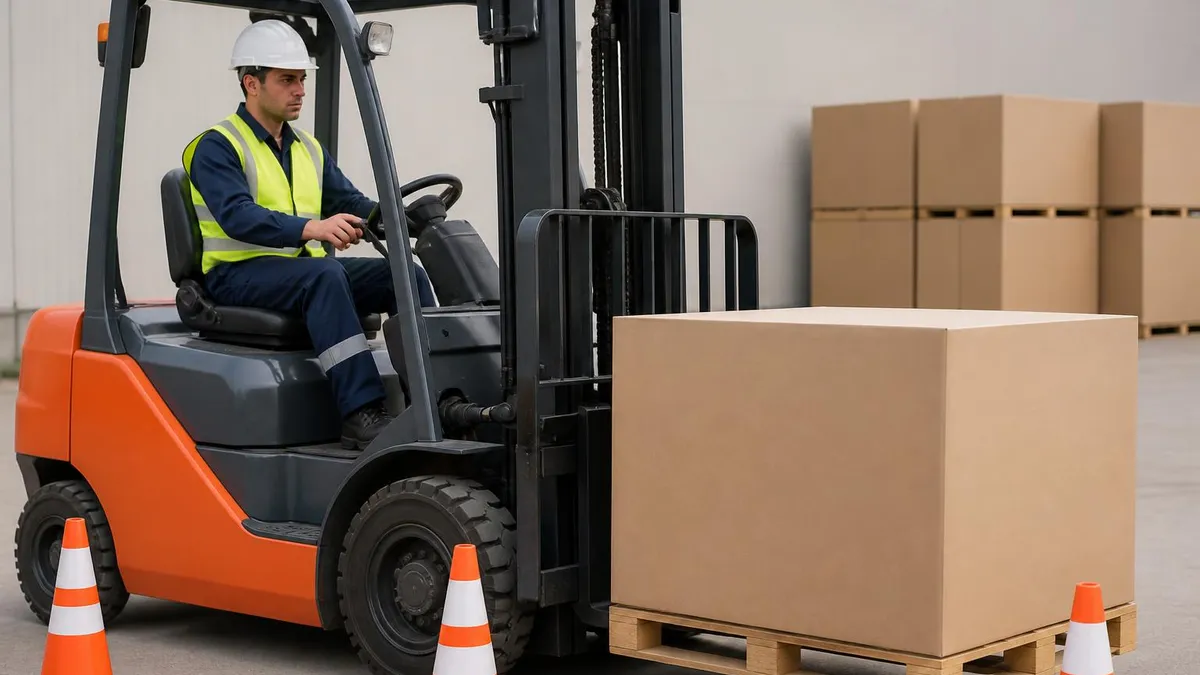
Forklift Tires: Complete Guide to Types, Sizing, Wear Patterns, and Replacement Costs
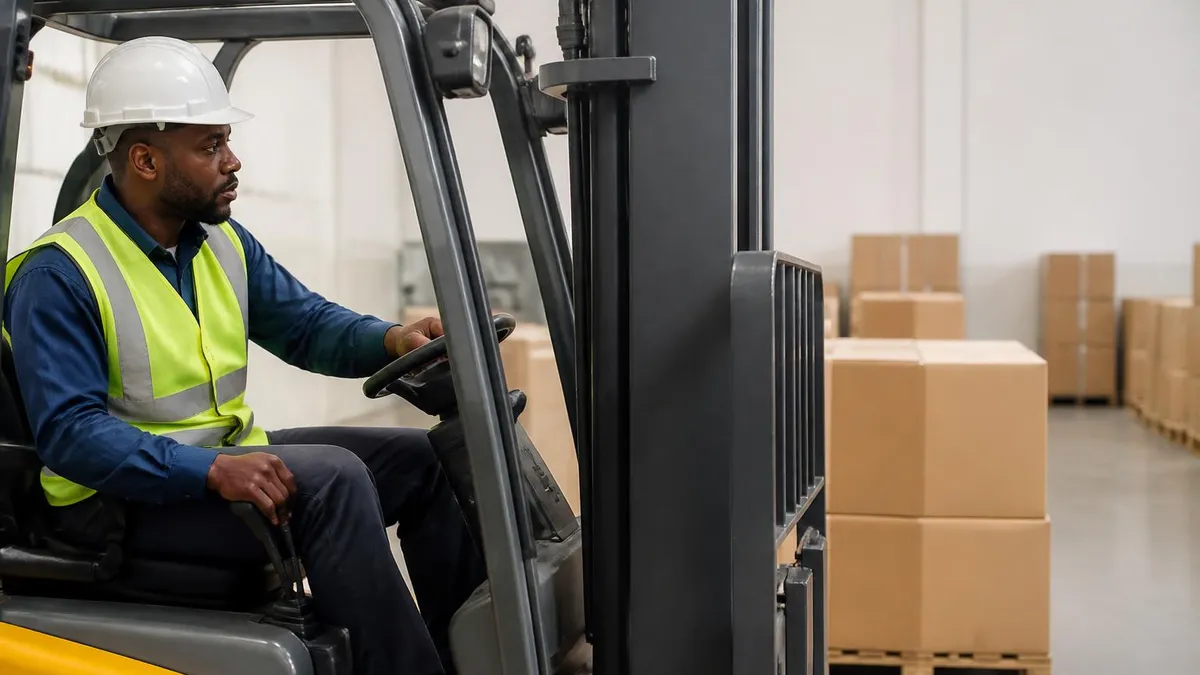
Forklift Accessories: Complete Guide to LED Lights, Attachments, Safety Gear, and Productivity Upgrades for 2026
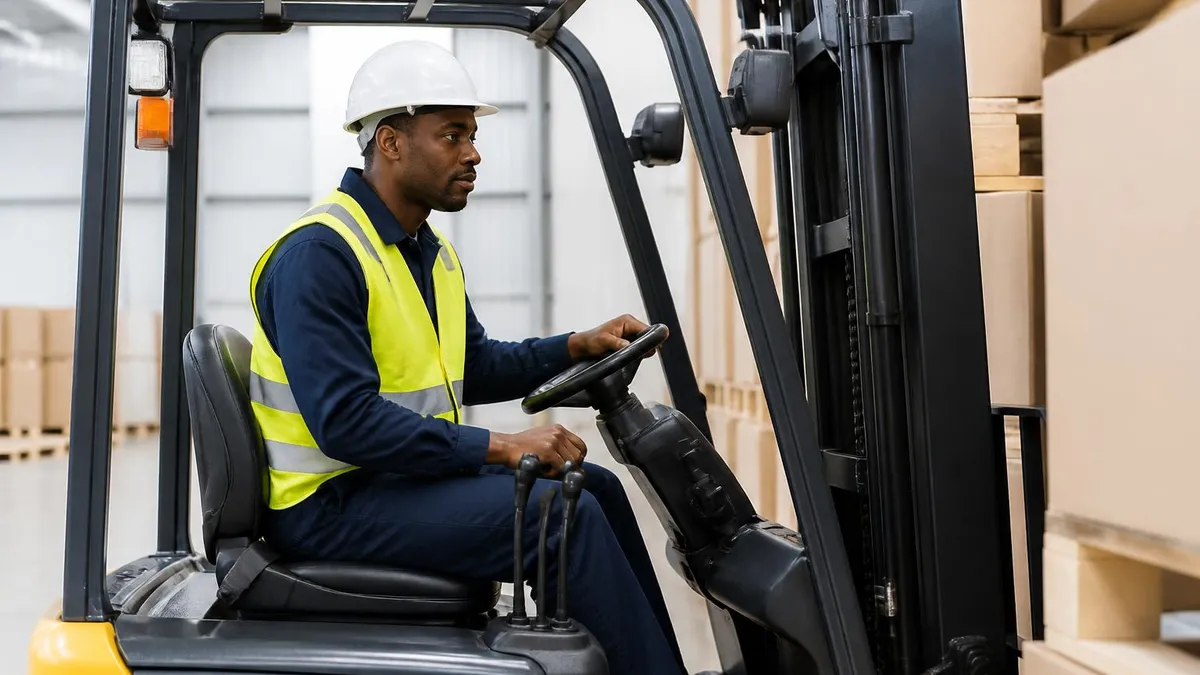
Can a Forklift Enter a 26 ft Box Truck? Complete Guide to Loading, Operations, and Equipment Selection
Forklift License Renewal: Complete Guide to Forklift License Expiry, OSHA Recertification, and Operator Requirements for 2026
Forklift Safety Training: Complete OSHA Compliance Guide for Operators and Employers
About the Author

Certified Crane Operator & Skilled Trades Exam Specialist
Ferris State UniversityRobert Martinez is a Journeyman Ironworker, NCCCO-certified crane operator, and forklift trainer with a Bachelor of Science in Construction Technology from Ferris State University. He has 21 years of ironworking, rigging, and heavy equipment operation experience across high-rise and industrial construction sites. Robert prepares candidates for crane operator, rigger, forklift, and skilled trades certification examinations.