
Forklift Operator License: Complete Guide to OSHA Certification, Training Requirements, and Career Opportunities for 2026 October
Complete forklift operator license guide: OSHA certification requirements, training costs, exam prep, renewal rules, and career opportunities for 2026 October. 📚
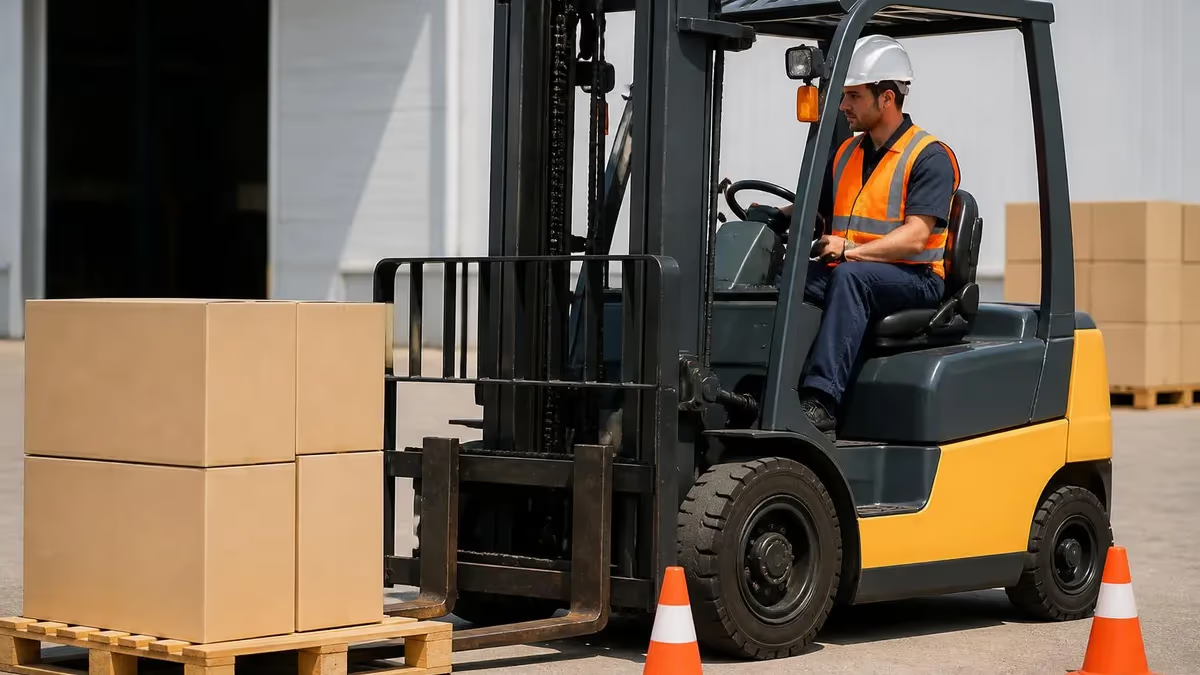
Getting your forklift operator license is the single most important step toward a stable, well-paying career in warehousing, construction, manufacturing, and logistics. OSHA standard 29 CFR 1910.178 requires every powered industrial truck operator in the United States to hold a valid, employer-issued certification before stepping onto a forklift, and that rule applies whether you work with a sit-down counterbalance, a stand up forklift, a reach truck, or a heavy-duty rough terrain machine. Without proper credentials, both you and your employer face serious legal and financial consequences.
The good news is that earning a forklift operator license is faster and more affordable than most professional certifications. Most workers complete the entire process in one to three days, including formal classroom instruction, hands-on practical evaluation, and a written knowledge test. Training programs typically cost between $100 and $300 when self-paid, and the majority of employers cover the full expense for new hires because they need certified operators to remain compliant with federal safety regulations.
Demand for certified forklift operators continues to climb in 2026. The U.S. Bureau of Labor Statistics projects steady growth in material handling occupations, driven by e-commerce fulfillment, cold storage expansion, and the rapid replacement of internal combustion equipment with electric forklift fleets. Operators who add specialty endorsements — narrow aisle, order picker, or rough terrain — routinely earn $5 to $10 more per hour than those certified only on basic sit-down units.
This guide covers everything you need to know about becoming a licensed operator, from eligibility requirements and training options to renewal timelines and salary expectations. We'll walk through the OSHA certification process step by step, compare in-person versus online programs, explain the differences between class designations, and show you how to prepare for the practical evaluation. If you're unsure where to start, our how to get forklift certified walkthrough explains the full sequence in plain language.
Whether you're a first-time applicant trying to break into a warehouse role, an experienced driver switching companies, or a supervisor responsible for keeping your team compliant, this resource provides the practical detail you need. We've included real cost ranges, exam content breakdowns, sample test questions, and renewal rules straight from current OSHA guidance, so you can plan your certification timeline with confidence.
Forklift training is not optional, and it is not something employers can skip to save money. OSHA fines for operating uncertified can reach $16,131 per violation, and willful or repeat offenses climb to $161,323. Beyond penalties, an untrained operator is statistically far more likely to be involved in a tip-over, pedestrian strike, or load-drop incident. Proper certification protects your paycheck, your coworkers, and your long-term employability across every industry that moves freight.
By the end of this guide, you'll understand exactly what a forklift operator license requires, how long it takes, what it costs, what the evaluation looks like, and how to keep your credential current. You'll also know how to use your license into higher wages, supervisory roles, and specialty equipment opportunities that consistently outpace general warehouse pay.
Forklift Operator License by the Numbers

Forklift Operator License Requirements & Eligibility
OSHA mandates operators be at least 18 years old to operate powered industrial trucks in non-agricultural settings. There are no maximum age limits, and physical capability matters more than years.
Operators must have adequate vision (corrected acceptable), hearing, depth perception, and reaction time. Many employers require pre-employment physicals, drug screening, and ongoing fitness-for-duty evaluations.
OSHA licenses are issued by the employing company, not a government agency. Your training credential transfers in concept but the new employer must verify competency before allowing operation.
Certification is class-specific. Training on a sit-down counterbalance does not certify you for a stand up forklift, reach truck, or rough terrain unit. Each class requires separate evaluation.
Every operator must pass both a formal knowledge test and a hands-on driving assessment supervised by a qualified trainer. Both components must be documented and retained by the employer.
Forklift training programs in the United States fall into three broad categories: employer-provided in-house training, third-party certification schools, and online hybrid courses that combine remote classroom learning with on-site practical evaluation. Each path satisfies OSHA requirements when delivered properly, but the cost, scheduling flexibility, and depth of instruction can vary significantly. Understanding the differences helps you pick the route that fits your situation, budget, and timeline best.
Employer-provided training remains the most common route for new warehouse hires. Large employers like Amazon, Walmart, FedEx, and Home Depot run continuous in-house programs because they need a steady pipeline of certified operators across hundreds of facilities. These programs are free to the trainee, typically last one to three days, and include both classroom instruction on the specific forklifts you'll use and a practical evaluation on the actual warehouse floor. The downside is the certification only covers that employer's equipment fleet.
Third-party certification schools charge between $100 and $300 for a full operator course. National providers include CertifyMe, ForkliftCertification.com, NSC, and dozens of regional vocational schools. These programs work well for job seekers who want a credential before applying, for owner-operators of small businesses, and for workers who need certification on equipment their current employer doesn't own. Many offer same-day completion and printable cards you can show recruiters immediately.
Online forklift training has expanded rapidly since 2020 and now accounts for the majority of new certifications issued in the United States. OSHA permits the formal instruction component to be delivered remotely as long as the practical evaluation happens in person under a qualified evaluator. The advantage is enormous scheduling flexibility — you complete coursework on your phone or laptop at your own pace, then arrange a hands-on session at your workplace or a local testing center.
When evaluating training providers, look for OSHA-compliant curriculum coverage, qualified trainer credentials, written documentation of both knowledge and practical components, and clear renewal guidance. A legitimate program will issue an operator card showing your name, the date of training, the equipment classes covered, the trainer's name, and the expiration date three years out. Anything missing those elements may not hold up in an OSHA audit. For specialty add-ons like attachment training, see our guide to forklift training near me for nearby options and accessory-specific endorsements.
Cost should not be your only filter. A cheap online-only course that skips meaningful practical evaluation creates legal exposure for both you and your employer. OSHA citations after an accident frequently reveal that the operator held a paper certificate but never demonstrated competency on a real machine. Pay slightly more for a program that includes documented hands-on time, ideally on the specific equipment class you'll use daily on the job.
Employers should also remember that OSHA requires refresher training whenever an operator is observed driving unsafely, involved in an accident or near-miss, assigned to a new type of equipment, or when workplace conditions change significantly. These triggers reset the evaluation requirement even if the original three-year certification is still valid. Building refresher capacity into your training budget prevents compliance gaps during audits.
Finally, keep a personal copy of every training certificate, evaluation form, and operator card you receive. While the employer holds the official record, having your own documentation makes it easier to transfer to new jobs, demonstrate qualifications to staffing agencies, and respond to OSHA requests during a workplace inspection.
Forklift certification Practice Test Questions
Prepare for the Forklift certification Certification exam with our free practice test modules. Each quiz covers key topics to help you pass on your first try.
Forklift certification Certification Forkl...
Forklift certification Exam Questions covering Certification Forklift certification Maintenance and Repairs. Master Forklift certification Test concepts for certification prep.
Forklift certification Certification Forkl...
Free Forklift certification Practice Test featuring Certification Forklift certification Maintenance and Repairs Questions and Answers. Improve your Forklift certification Exam score with mock test prep.
Forklift certification Certification Forkl...
Forklift certification Mock Exam on Certification Forklift certification Operator Training and Certification Requirements. Forklift certification Study Guide questions to pass on your first try.
Forklift certification Certification Forkl...
Forklift certification Test Prep for Certification Forklift certification Operator Training and Certification Requirements Questions and Answers. Practice Forklift certification Quiz questions and boost your score.
Forklift certification Load Handling and S...
Forklift certification Questions and Answers on Load Handling and Stability. Free Forklift certification practice for exam readiness.
Forklift certification OSHA Regulations an...
Forklift certification Mock Test covering OSHA Regulations and Compliance. Online Forklift certification Test practice with instant feedback.
Forklift certification Pre-Operation Inspe...
Free Forklift certification Quiz on Pre-Operation Inspections. Forklift certification Exam prep questions with detailed explanations.
Forklift certification Refueling and Recha...
Forklift certification Practice Questions for Refueling and Recharging Procedures. Build confidence for your Forklift certification certification exam.
Forklift certification Safe Driving and Ma...
Forklift certification Test Online for Safe Driving and Maneuvering. Free practice with instant results and feedback.
Forklift certification Workplace Hazard Id...
Forklift certification Study Material on Workplace Hazard Identification. Prepare effectively with real exam-style questions.
Forklift certification Forklift Instructions
Free Forklift certification Test covering Forklift Instructions. Practice and track your Forklift certification exam readiness.
Forklift certification Forklift MCQ
Forklift certification Exam Questions covering Forklift MCQ. Master Forklift certification Test concepts for certification prep.
Forklift certification Forklift Employer R...
Free Forklift certification Practice Test featuring Forklift Employer Responsibilities. Improve your Forklift certification Exam score with mock test prep.
Forklift certification Forklift Penalties ...
Forklift certification Mock Exam on Forklift Penalties for Non-Compliance. Forklift certification Study Guide questions to pass on your first try.
Forklift Training Pathways Compared
Traditional in-person training delivered at a vocational school, community college, or dedicated certification center remains the gold standard for first-time operators. You spend roughly four to eight hours in a classroom covering OSHA regulations, stability principles, load handling, pedestrian safety, and hazard recognition. The instructor demonstrates concepts live, answers questions in real time, and provides immediate feedback on misunderstandings.
The practical portion follows immediately, with each student rotating through actual driving exercises under direct supervision. You'll demonstrate pre-shift inspection, maneuvering through cones, picking and placing loads at various heights, and emergency procedures. Most schools certify students on basic Class IV sit-down counterbalance trucks, with optional upgrades for Class II narrow aisle equipment, Class III pallet jacks, or Class VII rough terrain units depending on enrollment.

Should You Get Forklift Certified? Pros and Cons
- +Higher starting wages than non-certified warehouse roles
- +Faster hiring across logistics, retail, and manufacturing
- +Transferable skill recognized in every U.S. state
- +Low upfront cost compared to most trade credentials
- +Pathway to higher-paying specialty equipment roles
- +Improved workplace safety for you and coworkers
- −Three-year recertification required by OSHA
- −Physical demands including standing, twisting, and lifting
- −Initial training time off work if self-funded
- −Class-specific certification limits cross-equipment work
- −Higher insurance and liability scrutiny on operators
- −Refresher training triggered by any safety incident
Pros and Cons at a Glance
| Pros | Cons |
|---|---|
| Higher starting wages than non-certified warehouse roles | Three-year recertification required by OSHA |
| Faster hiring across logistics, retail, and manufacturing | Physical demands including standing, twisting, and lifting |
| Transferable skill recognized in every U.S. state | Initial training time off work if self-funded |
| Low upfront cost compared to most trade credentials | Class-specific certification limits cross-equipment work |
| Pathway to higher-paying specialty equipment roles | Higher insurance and liability scrutiny on operators |
| Improved workplace safety for you and coworkers | Refresher training triggered by any safety incident |
Forklift Operator License Pre-Exam Checklist
- ✓Confirm you are at least 18 years old and physically able to operate equipment
- ✓Complete all formal classroom or online instruction hours before scheduling the practical
- ✓Review OSHA 29 CFR 1910.178 standard sections relevant to your equipment class
- ✓Memorize the pre-shift inspection checklist including 12 daily verification points
- ✓Practice load center calculations and capacity plate reading until automatic
- ✓Study stability triangle principles and counterbalance physics fundamentals
- ✓Take at least two full-length practice tests scoring 85% or higher
- ✓Wear closed-toe steel-toe boots, hi-vis vest, and approved safety glasses
- ✓Bring photo identification and any prior training certificates to the evaluation
- ✓Get adequate sleep the night before — fatigue causes most first-attempt failures
Your operator card is only as strong as the paperwork behind it
OSHA inspectors don't just check for a card in your wallet — they request the underlying evaluation forms, trainer credentials, and topic coverage logs. A certificate without documented practical evaluation is invalid and exposes both the operator and employer to citation. Always keep personal copies of every form you sign during training.
The financial case for getting a forklift operator license is one of the strongest in the entire skilled-labor market. According to the most recent Bureau of Labor Statistics occupational data, certified industrial truck operators earn a median wage of $20.58 per hour, translating to approximately $42,800 annually for full-time work. The top ten percent of operators — typically those with specialty certifications and several years of experience — earn over $58,000 per year, and overtime opportunities push many veteran drivers past $70,000 in peak fulfillment seasons.
Geographic location significantly influences pay. Operators in California, Washington, New Jersey, Illinois, and Massachusetts consistently earn 15 to 25 percent more than the national median due to higher cost of living and stronger union representation. Port cities like Long Beach, Newark, Houston, and Savannah pay premium wages for container-yard operators handling heavy reach stackers and top-pick equipment, with experienced drivers clearing $30 to $40 per hour plus benefits.
Industry sector matters even more than geography in many markets. Cold storage warehousing pays 10 to 20 percent above general warehouse rates because of the harsh working environment and equipment complexity. Beverage distribution, automotive parts, aerospace manufacturing, and pharmaceutical logistics all command above-average wages for certified operators, often paired with full benefits, retirement contributions, and tuition reimbursement for continued certification on specialty equipment like hyster forklift models and other heavy-duty industrial trucks.
Specialty endorsements multiply your earning potential. An operator certified only on basic Class IV sit-down counterbalance trucks might earn the median wage, but adding Class II narrow aisle reach truck certification typically bumps pay by $2 to $4 per hour. Class VII rough terrain certification for construction sites pays even more, with telehandler operators in major metros routinely earning $28 to $35 per hour. Multi-class certifications make you the operator a facility cannot afford to lose.
The job market for certified operators remains strong heading into 2026. E-commerce growth continues to drive new fulfillment center construction at a record pace, and each new facility needs 50 to 200 certified operators across all shifts. Electric forklift fleet expansion has created additional demand for operators trained on lithium-ion battery handling and high-density storage systems. Cold chain growth, driven by grocery delivery and pharmaceutical distribution, adds another high-paying niche.
Career progression from operator to lead, supervisor, and warehouse manager is well established and largely meritocratic. Most warehouse general managers started as operators, picked up certifications across multiple equipment classes, took on shift-lead responsibilities, and progressed into supervision within three to seven years. Senior operations roles routinely pay $75,000 to $120,000 with full benefits, and the operator license remains a foundational requirement throughout that progression.
For workers transitioning from other careers, forklift certification offers one of the fastest returns on training investment available in the United States. A $200 investment in a third-party course can be recouped in the first week of employment, and many staffing agencies will even reimburse certification costs after you complete a contracted work period. Few credentials offer this combination of low cost, fast completion, broad demand, and clear career advancement.

OSHA mandates formal recertification at least every three years, but earlier refresher training is required after any accident, near-miss, observed unsafe operation, equipment change, or workplace condition change. Letting your certification lapse exposes you to immediate suspension and your employer to citations up to $16,131 per violation.
Recertification is straightforward when you plan ahead, but operators who let their three-year window expire often face delays getting back on equipment. OSHA does not provide a grace period — once your certification date plus three years has passed, you are legally uncertified until a new evaluation is completed and documented. Smart operators schedule renewal 60 to 90 days before expiration to ensure continuity and avoid any pay loss from being temporarily reassigned to non-driving duties.
The recertification process is shorter than initial certification because OSHA recognizes that experienced operators don't need to relearn fundamentals. Most renewal programs run four to six hours total, covering regulatory updates, accident case studies from the past three years, equipment changes specific to your fleet, and a refresher practical evaluation. The written exam is typically condensed to 20 to 30 questions focused on changes and high-risk topics rather than the full curriculum.
Employers handle renewal differently. Some run quarterly batch sessions where all expiring operators recertify together, others handle renewals one at a time as expirations approach, and a few outsource the entire process to third-party providers who come on-site annually. Ask your safety manager early in your second year on a job to confirm the renewal process so you're not surprised when your expiration approaches. Our complete forklift parts renewal walkthrough breaks down employer-by-employer practices and what documentation to request.
Refresher training between three-year intervals is triggered by specific events, not calendar dates. The five most common triggers are: any accident or near-miss the operator is involved in, observation of unsafe operation by a supervisor or safety officer, evaluation that the operator is operating unsafely, assignment to a different type of forklift than originally certified, and changes in workplace conditions that affect safe operation. Each trigger resets the practical evaluation requirement.
Switching employers does not invalidate your underlying training, but the new employer must conduct their own evaluation before allowing you to operate their forklifts. This is not a full re-training requirement — it's a competency verification that typically takes one to two hours, covering the specific equipment models, facility layout, and any unique hazards. Bring your prior training documentation to expedite the process, and ask about credit toward your next three-year cycle.
Maintaining a clean operating record between renewals significantly impacts your recertification experience. Operators with documented incidents, even minor ones, often face additional scrutiny including longer evaluation sessions, drug testing, and supervisor sign-off requirements. Operators with three years of incident-free driving frequently complete renewal in a single afternoon with minimal disruption to their normal shift schedule.
Keep digital and physical copies of every certification card, evaluation form, and renewal document throughout your career. A folder containing your original training certificate, all subsequent renewals, any specialty endorsements, and incident-free attestations becomes a valuable career asset when applying for senior operator, lead, or supervisor positions. Many warehouse managers specifically request to see this documentation during hiring interviews for higher-paying roles.
Practical exam day preparation makes the difference between confident first-attempt success and the frustration of having to reschedule. Arrive at least 30 minutes early so you can review the testing facility layout, locate the equipment you'll operate, and complete any paperwork without rushing. Bring two forms of identification, your training completion certificate, closed-toe steel-toe boots, a hi-vis vest if not provided, and approved safety glasses. Wear comfortable, fitted clothing that won't catch on controls.
The evaluator will typically begin with the pre-shift inspection. Walk around the forklift systematically — most evaluators want to see you start at the operator's seat, move counterclockwise around the machine, and return to the controls. Check tires for damage and proper inflation, forks for cracks or bends, mast chains for tension and lubrication, hydraulic hoses for leaks, the data plate for legibility, horn and lights for function, and brakes for responsiveness. Verbalize your inspection out loud so the evaluator hears your decision-making.
Once you mount the forklift, demonstrate proper seating, seatbelt use, mirror adjustment, and control familiarization before starting the engine. Many evaluators specifically watch for these pre-operation habits because they're the most commonly skipped steps under workplace time pressure. Starting the engine, checking gauges, and testing controls in a stationary position takes 30 seconds and signals professionalism that influences the evaluator's overall scoring throughout the rest of the assessment.
The driving portion typically includes a course with cones, simulated load handling, elevation changes, and a final parking maneuver. Drive in reverse when carrying a load that obstructs forward vision, keep loads tilted slightly back and low to the ground during travel, sound the horn at intersections and blind corners, and maintain a smooth, predictable pace. Speed errors are less common than judgment errors — most failures come from poor load placement, missed inspection points, or pedestrian-awareness mistakes.
Load handling demonstrations require you to approach a pallet squarely, level the forks before insertion, insert the forks fully under the load, tilt back slightly to stabilize, lift to travel height of four to six inches, and back away in a straight line before turning. Reverse the process for placement, ensuring the load is level and the forks fully clear before retracting. Practice this sequence at home mentally so each movement feels automatic during the actual evaluation.
Communication with the evaluator matters more than most candidates realize. Acknowledge instructions clearly, ask for clarification if any direction is ambiguous, and explain your reasoning when you make discretionary decisions. Evaluators are scoring your overall competency, not just whether you hit every cone. A candidate who makes one small error but clearly understands why and how to correct it scores better than a candidate who completes the course mechanically without demonstrating understanding.
If you don't pass on the first attempt, don't panic. Most training providers allow one or two retests within a defined window at no additional cost, and the evaluator will tell you exactly which areas need improvement. Use the feedback to focus practice on specific deficiencies, and retest within two weeks while the material is fresh. Operators who fail the first attempt and successfully pass the second often demonstrate better long-term safety records because the additional practice cements correct habits.
Forklift Questions and Answers
Forklift Tires: Complete Guide to Types, Sizing, Wear Patterns, and Replacement Costs
Forklift Accessories: Complete Guide to LED Lights, Attachments, Safety Gear, and Productivity Upgrades for 2026
Can a Forklift Enter a 26 ft Box Truck? Complete Guide to Loading, Operations, and Equipment Selection
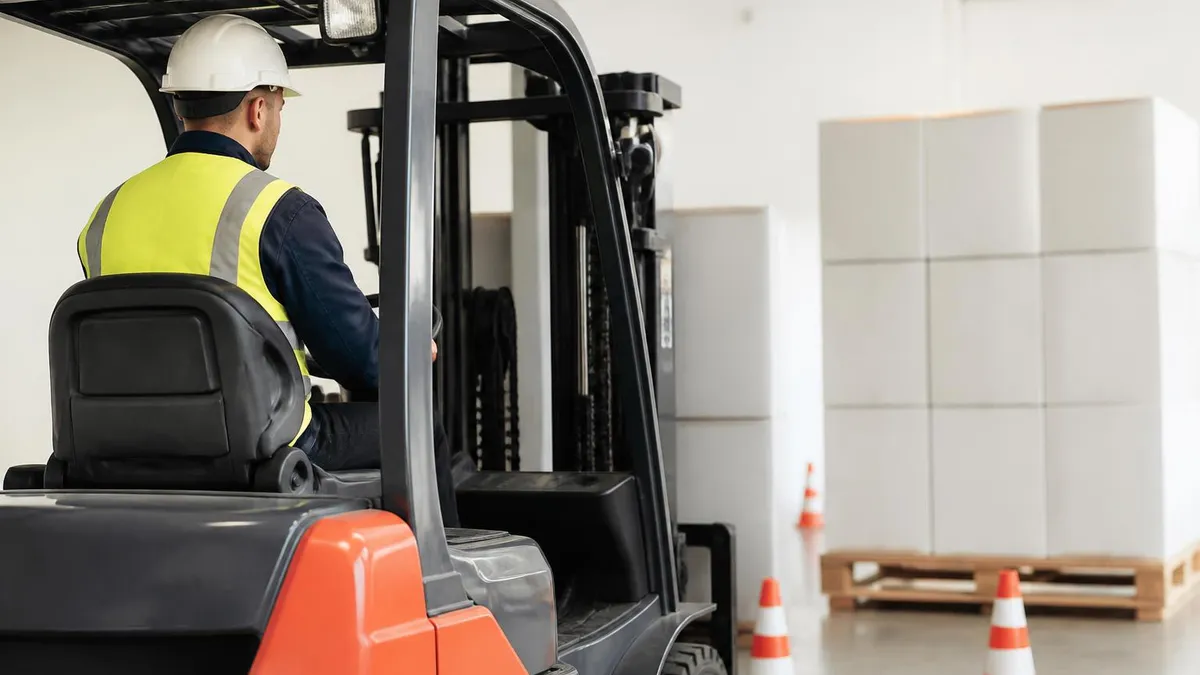
Forklift License Renewal: Complete Guide to Forklift License Expiry, OSHA Recertification, and Operator Requirements for 2026
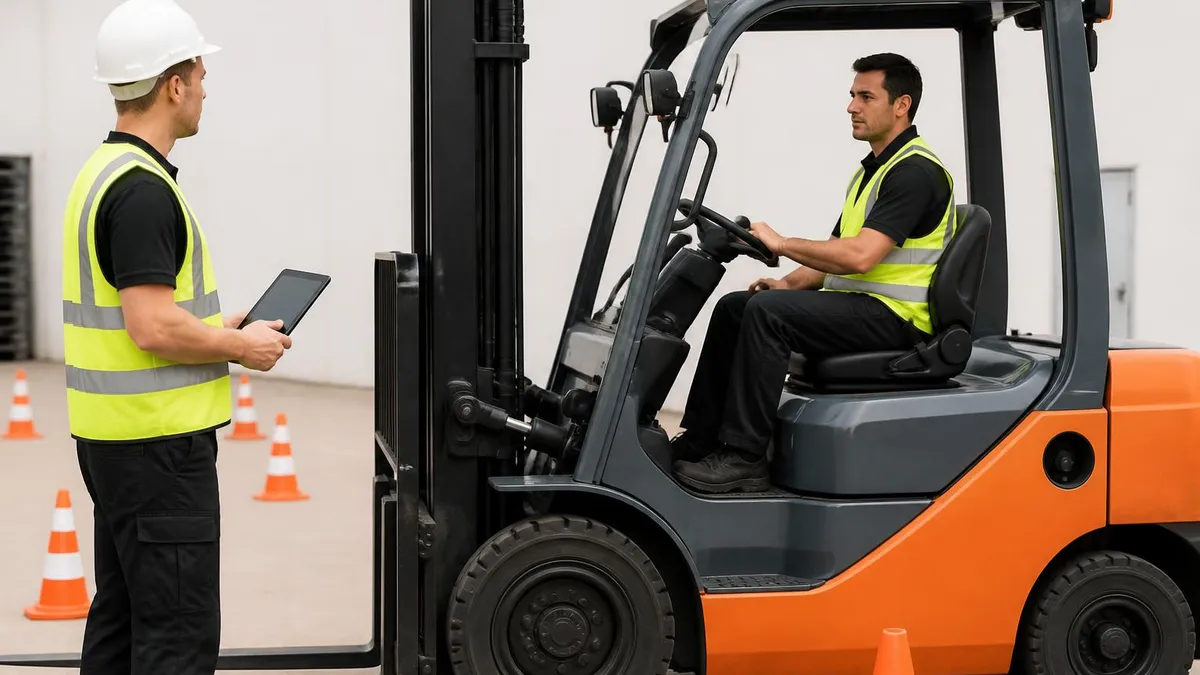
Forklift Safety Training: Complete OSHA Compliance Guide for Operators and Employers
About the Author

Certified Crane Operator & Skilled Trades Exam Specialist
Ferris State UniversityRobert Martinez is a Journeyman Ironworker, NCCCO-certified crane operator, and forklift trainer with a Bachelor of Science in Construction Technology from Ferris State University. He has 21 years of ironworking, rigging, and heavy equipment operation experience across high-rise and industrial construction sites. Robert prepares candidates for crane operator, rigger, forklift, and skilled trades certification examinations.