
Forklift Operator Age Requirements — Complete Guide (2026)
💡 Forklift operator age requirements explained: federal FLSA bans under-18s, OSHA training rules, exceptions, and state limits. 2026 employer guide.

Forklift Operator Age Requirements: The 2026 Federal and State Rules
Eighteen. That's the floor. Under federal law, no one younger than 18 is allowed to operate a powered industrial truck in any non-agricultural workplace in the United States. The rule comes from the Fair Labor Standards Act, not OSHA — and it's been on the books since 1939. People assume osha forklift certification sets the age, but OSHA defers to the Department of Labor's child labor regulations on that one specific point. Practice with the free Forklift certification practice test on PracticeTestGeeks (7 questions with answer explanations).
The relevant section is 29 CFR 570.58. It's called Hazardous Occupation Order No. 7. The order prohibits employees under 18 from operating, riding on, or assisting with powered industrial trucks — that covers sit-down forklifts, stand-up reach trucks, order pickers, pallet jacks with riders, telehandlers, and rough-terrain machines. The rule applies whether the work is full-time, part-time, summer, or temporary.
Why so strict? Forklifts kill roughly 85 American workers every year and injure tens of thousands more. The Department of Labor classified them as hazardous because tip-overs, pedestrian strikes, and load drops cause catastrophic injuries even when the operator is fully trained. A 17-year-old simply cannot work that equipment, no matter how much forklift training they've completed.
If you're an employer hiring lift truck operators, the short version: verify date of birth before the first shift. Document it. Keep the I-9 records. A signed application that shows age 17 is enough to trigger a federal investigation if something goes wrong on the floor.
Free Forklift certification Study Tools
Interactive Forklift certification resources on PracticeTestGeeks, free to start:
- Forklift certification flashcards — review key terms and concepts card by card
- Forklift certification study guide — topic-by-topic overview of what the exam covers
- Forklift certification cheat sheet — one-page printable summary for last-minute review

How Old Do You Have to Be?
18 years old minimum for all non-agricultural forklift work in the U.S. (federal FLSA 29 CFR 570.58). 16 in agriculture on certain family farms. 16-17 in approved CTE/apprenticeship programs meeting strict Department of Labor exemption rules. Many employers set 21 as their internal minimum because of insurance underwriting requirements.
The Numbers Behind the Rule
Key Facts at a Glance
| Item | Value | Details |
|---|---|---|
| Federal Minimum Age (Non-Ag) | 18 | |
| Agriculture Minimum (Family Farm) | 16 | |
| CTE Exemption Minimum | 16-17 |
Three Layers of Legal Rules
- Authority: U.S. Department of Labor — Wage and Hour Division
- Citation: 29 CFR 570.58 (HO No. 7)
- Minimum Age: 18 for all non-ag forklift work
- Applies To: Every state — no opt-out, no waiver
- Authority: Occupational Safety and Health Administration
- Citation: 29 CFR 1910.178(l)
- Minimum Age: Not specified — defers to FLSA
- Requires: Formal + practical + evaluation; recert every 3 yrs
- Authority: State labor departments
- Can Set: Higher minimums (e.g., 21 in some industries)
- Cannot Set: Lower than the federal 18 floor
- Note: When federal and state differ, the stricter rule wins
FLSA 29 CFR 570.58 — What the Law Actually Says
The text of Hazardous Occupation Order No. 7 is short. It prohibits anyone under 18 from being employed in the occupation of operating power-driven hoists, lifts, and conveyors, including forklifts. The regulation lists specific equipment by name. Forklifts are on that list. Pallet jacks with riders are on that list. Order pickers are on that list.
It doesn't matter if the teen has a forklift license from a private training school. The federal age rule trumps any certificate. A 17-year-old can take the OSHA course, pass the written test, demonstrate practical skills on a real truck — and still cannot legally drive that forklift at work. The training credit waits until the 18th birthday.
What Counts as "Operating" Under the Rule
The DOL reads this broadly. Operating includes sitting in the seat and driving. It also includes:
- Riding as a passenger on a forklift
- Standing on a pallet jack platform while another worker drives
- Loading or unloading a forklift while the engine is on
- Assisting an operator during lift operations on a dock
- Performing maintenance on a powered truck while energized
A 17-year-old warehouse worker can sweep floors, organize shelves, count inventory, and use non-powered hand pallet jacks (the manual kind without a powered drive). The line gets drawn at any motorized lift truck.
How the 1939 Rule Got Updated
The original Order No. 7 was written for tractor-style industrial trucks. In 2004, the DOL revised the language to cover modern equipment — telehandlers, rough-terrain forklifts, and stand-up rider lifts. The 2004 amendment also explicitly listed pallet jacks with rider platforms. If the machine has a powered drive system and lifts loads, it falls under HO No. 7.
The 16-17 Apprentice Exemption (Very Narrow)
One exception exists. Workers age 16 or 17 can operate powered industrial trucks if they're enrolled in a registered apprenticeship or a state-approved Cooperative Vocational Training (CVT) program. The program must be certified by the DOL's Wage and Hour Division. The minor must have completed at least 90% of the required theory hours. Operation must be incidental to training and supervised at all times by a qualified instructor. Production work doesn't qualify. The exemption covers learning environments only.
Employer Pre-Hire Age Verification Checklist
- ✓Collect government-issued photo ID at offer stage — driver's license or state ID
- ✓Confirm date of birth on I-9 Form Section 1 before first shift
- ✓Cross-check DOB against company HRIS — flag anyone under 18 automatically
- ✓Document age verification with signed acknowledgment in personnel file
- ✓Re-screen at promotion to lift truck role if originally hired in non-forklift position
- ✓Hold an under-18 worker in non-powered roles until the 18th birthday — no exceptions
- ✓Train supervisors to recognize the FLSA rule (most don't know it exists)
- ✓Audit age-restricted positions quarterly via HR compliance review

OSHA Training Rules and the Three-Part Course
Once a worker turns 18, they still can't just hop on a forklift. OSHA's 29 CFR 1910.178(l) requires a three-part training program before any solo operation. The standard sets no minimum age — it leaves that to FLSA — but it does set strict content and assessment rules. how to get forklift certified is a common search because the steps confuse new employers.
Part 1 — Formal Instruction
Classroom-style training. Can be in-person, online, or video-based. Must cover: truck-specific topics (controls, instrumentation, engine type, capacity, stability), workplace-specific topics (surface conditions, pedestrian traffic, narrow aisles, ramps, hazardous atmospheres), and operating limitations. The 2026 OSHA guidance allows online formal instruction provided it ends with a graded knowledge check.
Part 2 — Practical Training
Hands-on. The trainee operates the actual truck — same make and model they'll use in production — under direct supervision. Pre-trip inspection, mounting/dismounting, load handling, traveling forward and reverse, turning, stacking, and stopping. No solo work. The trainer rides along or watches from a marked safety zone.
Part 3 — Performance Evaluation
A qualified evaluator certifies that the operator can safely perform the job. The evaluation must be documented with operator name, evaluator name, date, and truck type. Without this signature, the operator is not certified — even if Parts 1 and 2 are complete.
The Three-Year Recertification Rule
OSHA requires re-evaluation at least every three years. Recertification is also triggered by: an accident or near-miss, a workplace change (new aisle layout, new product mix), assignment to a different truck type, or observation of unsafe operation. The recert can be a shortened version of the original course — it doesn't need to repeat formal instruction in full.
Operator Certification Card
Most employers issue a wallet card showing operator name, certified truck types, evaluation date, expiration date, and trainer signature. The card isn't a federal requirement, but it's the easiest way to prove compliance during an OSHA inspection. Workers should carry it on-shift.
Age Rules by Employment Type
Minimum age: 18 (federal FLSA, no exceptions).
Includes Amazon DC, FedEx hubs, third-party logistics, and grocery warehouses. Underage workers may stock shelves manually and use unpowered hand pallet jacks only.
State Rules and Where They Diverge From Federal
The federal floor is 18. No state can lower it. But many states raise the bar — adding stricter training, parental consent rules, work-hour limits, or industry-specific minimums. The federal rule and the state rule both apply, and the stricter one wins.
Here's a fast tour of where it gets unusual.
California
Cal/OSHA mirrors federal age rules at 18. The state also requires Spanish-language training materials if more than 10% of the workforce primarily speaks Spanish. California's Title 8 Section 3668 requires written certification on file at the worksite.
New York
State Labor Law Section 132 prohibits anyone under 18 from operating motorized lifts in non-agricultural settings. NYC has additional Department of Buildings rules for construction-site forklift operators that require a separate city-issued lift permit on top of OSHA training.
Texas
Texas follows federal FLSA without state modifications for forklift age. Federal minimum 18 applies. There is no state-issued forklift license — Texas defers entirely to employer-provided OSHA training.
Massachusetts
Massachusetts adds parental work-permit requirements for any worker under 18, even in roles where they're allowed to work. Forklift operation requires the worker to be 18+, so the permit issue doesn't apply to the truck itself but does affect hiring paperwork for younger warehouse staff.
Florida
Florida follows federal FLSA. The state's child labor law (Chapter 450) cross-references HO No. 7 and prohibits anyone under 18 from operating power-driven hoists. Florida also requires hurricane-prep training in coastal warehouse roles, which can affect refresher cycles.
Washington
Washington L&I sets age 18 and adds a written employer attestation requirement. The state also tracks forklift-related injuries through a separate reporting system, and underage operation is investigated automatically when injuries occur.
Setting an Internal Minimum Above 18
- +Lower workers' compensation insurance premiums
- +Reduced incident rate from inexperienced drivers
- +Stronger safety culture and fewer near-misses
- +Easier to attract candidates with prior CDL or military forklift experience
- +Better retention — mature workers stay longer in DC roles
- −Smaller hiring pool, especially in tight labor markets
- −Potential age discrimination claim if minimum is set unreasonably high
- −Loses 18-20 year-old workers who could have been trained well
- −May conflict with EEOC guidance unless tied to insurance underwriting evidence
- −Higher starting wages required to attract older workers

Why Some Employers Set 21 Instead of 18
Walk into a Costco distribution center or a UPS hub and ask the hiring manager what age they want for lift truck roles. Many will say 21. The legal floor is 18 — so why are they adding three years?
Insurance Underwriting
The honest answer: commercial general liability and workers' comp carriers price younger drivers higher. A typical carrier surcharges forklift drivers under 21 by 8-15% on the policy line. For a fleet of 200 trucks across multiple sites, that's a six-figure premium swing. Setting an internal minimum at 21 protects the underwriting bracket.
Safety Data
OSHA and BLS injury data show that workers in their first year of employment account for roughly 30% of forklift-related serious injuries. The 18-20 age band overlaps heavily with first-year workers. Statistically, raising the minimum age also raises the average tenure, and tenure correlates with safety.
Auto-Insurance Crossover Analysis
Some larger employers borrow the actuarial logic from auto insurance — drivers under 25 have higher crash rates across the board. Forklifts aren't cars, but the underwriting math leaks across product lines. A facility that runs 21-and-up drivers can negotiate package premiums down 5-12%.
The EEOC Wrinkle
An employer cannot set an arbitrary age minimum. Under the Age Discrimination in Employment Act (ADEA), age minimums must be tied to a documented business necessity — usually insurance, safety records, or specific job requirements. A blanket "must be 21" without documentation can trigger a complaint. Employers who set higher minimums should keep the underwriting letter or safety study on file as evidence.
How to Document the Higher Minimum
Three-step paper trail: (1) request a written rate quote from the insurance carrier showing the surcharge tier breakpoints, (2) reference industry injury data from BLS or NIOSH, (3) write a brief internal policy memo citing both. That memo, kept on file, defeats almost any age discrimination challenge.
Path From 17 to Certified Operator
Age 14-15
Age 16-17 (No CTE)
Age 16-17 (Registered CTE)
18th Birthday
Day 1 of Training
Day 2-3 — Practical
Performance Evaluation
3-Year Recert
Agriculture, CTE, and the Narrow Exceptions
The blanket 18-and-up rule has two carve-outs, and both are narrower than people think. Misreading either one is a fast way to a federal investigation.
Agriculture — 16 in Most Cases, Younger on Family Farms
The agricultural child labor framework is separate from the non-ag framework. The agricultural Hazardous Occupation Orders live in 29 CFR 570.71. Ag-HO No. 1 covers operating tractors over 20 PTO horsepower and any tractor connecting/disconnecting implements. Most farm forklifts (rough-terrain telehandlers, pallet forks on a tractor) fall under this. Minors 16-17 can operate them on commercial farms. Minors 14-15 cannot.
Family-owned farms are a different story. A minor of any age working on a farm owned by their parent — and only on that farm — is exempt from the federal age rules. The exemption doesn't extend to leased land, contracted operations, or neighbors' farms. The farm must be owned by the parent or legal guardian.
Career and Technical Education (CTE) Exemption
This is the most common point of confusion. Some vocational high schools run forklift training programs for 16-17 year-olds. Are those students legally allowed to operate the truck?
Only inside the training environment, only under direct instructor supervision, and only when the program is registered with the DOL Wage and Hour Division as a Cooperative Vocational Training program. The student must have completed 75% of the program's classroom hours before any equipment use. They cannot operate the truck for production purposes — only for skill-building. And the moment the student leaves the supervised training environment for a paid work shift at any employer, the standard age-18 rule reapplies.
Apprenticeship Programs
Federally registered apprenticeships have slightly broader exemption language than CTE — but the same rule applies to forklifts. A 16-17 year-old in a registered apprenticeship can operate a forklift only as part of structured training, only under qualified supervision, and only when the operation is genuinely instructional. Full-time production work on a forklift remains an 18-and-up activity.
What Doesn't Qualify as an Exception
Things that look like exceptions but aren't: school work-study programs that aren't registered CVTs, summer jobs at family businesses that aren't farms, internships at warehouses regardless of how supervised, military reserve roles for under-18 enlistees handling forklifts at civilian facilities, and any informal "teaching" arrangement at a non-registered workplace. None of these override the federal rule.
Compliance Checklist for HR and Safety Managers
- ✓Written hiring policy stating 18+ minimum for all forklift roles (or higher if insurance requires)
- ✓Date-of-birth verification documented in personnel file before first shift
- ✓OSHA 29 CFR 1910.178(l) training records on file for every certified operator
- ✓Wallet certification card issued with name, date, evaluator, and truck types
- ✓Recertification calendar tracking 3-year cycle for every operator
- ✓Incident review protocol that auto-triggers re-evaluation for any forklift event
- ✓Truck-specific certification — operator cleared on sit-down does not mean cleared on reach truck
- ✓Workplace change re-evaluation when aisle, product, or facility layout shifts
- ✓Annual EEOC review if internal minimum is above 18
- ✓Insurance underwriting documentation on file backing any age premium above federal floor
Penalties for Hiring Underage Forklift Operators
The Department of Labor enforces 29 CFR 570.58 through the Wage and Hour Division. The penalty structure has teeth, and 2026 inflation adjustments have pushed maximums up again.
Civil money penalties for violating the FLSA child labor provisions are tiered by severity:
- Standard violation — up to $15,138 per violation per minor as of 2026
- Violation causing serious injury or death — up to $68,801 per violation
- Willful or repeated violations — penalty doubled, plus criminal referral
Each underage employee operating a forklift counts as a separate violation. Each shift can count as a separate occurrence if the violation is repeated. A facility that staffed three 17-year-olds across multiple shifts can face six-figure penalties even without an incident.
Criminal Liability
Willful violations are misdemeanors under FLSA Section 16(a). First offense: up to $10,000 fine and possible imprisonment for willful violators. Second offense: up to six months in prison. The DOL refers cases to the U.S. Attorney's office, and criminal prosecutions, while rare, do happen — especially after a fatality.
OSHA Layer on Top
If an underage operator was also untrained per 1910.178(l), OSHA can stack penalties. Serious violation: up to $16,131 per violation. Willful or repeated: up to $161,323. The two agencies coordinate on serious incident investigations.
Workers' Comp and Civil Suits
An injury to an underage forklift operator triggers immediate civil exposure beyond regulatory fines. Most state workers' compensation statutes void the employer's exclusive remedy protection if the worker was illegally employed. That means the family can sue directly for full damages — often seven figures in cases involving permanent injury.
Insurance Cancellation
Almost every commercial GL policy has a child labor compliance warranty. A documented underage operator violation can void the policy retroactively. The employer becomes self-insured for the incident and any subsequent claims. This is the financial event that breaks small employers, not the fines themselves.
What an Investigation Looks Like
DOL investigations usually start one of three ways: a worker complaint to the WHD hotline, a referral from OSHA after an incident, or a routine audit triggered by industry risk profile. Investigators show up with subpoena authority. They request I-9s, training records, time cards, and personnel files going back three years. They interview operators on-site. The investigation typically takes 30-90 days. A finding of violation triggers the penalty assessment within 15 days of the final report.
Sample Forklift certification Practice Questions
Try these questions from our free Forklift certification practice tests. The correct answer and an explanation follow each question.
An operator must leave a forklift to speak with a supervisor who is 30 feet away, but the forklift remains in the operator's direct line of sight. According to OSHA 29 CFR 1910.178(m)(5), the forklift is considered 'unattended'. What specific actions must the operator take?
- A. Lower the forks, set the parking brake, and keep the engine running.
- B. Set the parking brake and turn on the hazard lights.
- C. Neutralize controls, lower the forks, set the brake, and shut off the power.
- D. Lower the forks to the ground and place the controls in neutral.
Answer: C. Neutralize controls, lower the forks, set the brake, and shut off the power.
OSHA defines a forklift as 'unattended' when the operator is 25 feet or more away, or out of sight. The regulations require that when a truck is left unattended, the load engaging means (forks) must be fully lowered, controls neutralized, power shut off, and brakes set.
During a pre-use inspection, a forklift operator is required to perform which of the following tasks?
- A. Carry out all checks required by the manufacturer
- B. Carry out any cosmetic repairs
- C. Make a record of the checks
- D. Immediately report any defects
Answer: B. Carry out any cosmetic repairs
While a pre-use inspection primarily focuses on safety and operational checks, an operator might also be expected to address very minor cosmetic issues that could affect visibility or become a nuisance, such as wiping dirty mirrors or securing a loose, non-critical cover. These small actions contribute to maintaining the vehicle's overall condition and ensuring a clear, unobstructed operating environment. Major repairs, however, are typically reported to maintenance.
An operator is refueling a gasoline-powered forklift. They notice a small amount of fuel has spilled on the floor. What is the correct immediate action?
- A. Ignore the spill as it will evaporate quickly.
- B. Cover the spill with a piece of cardboard and continue working.
- C. Use a lighter to burn off the spilled fuel safely.
- D. Wipe up the spill and wash down the area with water immediately.
Answer: D. Wipe up the spill and wash down the area with water immediately.
Gasoline is highly flammable. Any spills must be cleaned up immediately to remove the fire hazard. The recommended procedure is to wipe up the fuel and then wash the area with water to ensure all flammable residue is gone.
How often must forklift operators be re-evaluated under OSHA requirements?
- A. Every month
- B. Only when a new forklift model is purchased
- C. At least every three years
- D. No re-evaluation is required after initial certification
Answer: C. At least every three years
OSHA requires operators to be re-evaluated at least every three years to ensure continued safe operation.
Forklift Questions and Answers
More Forklift Guides
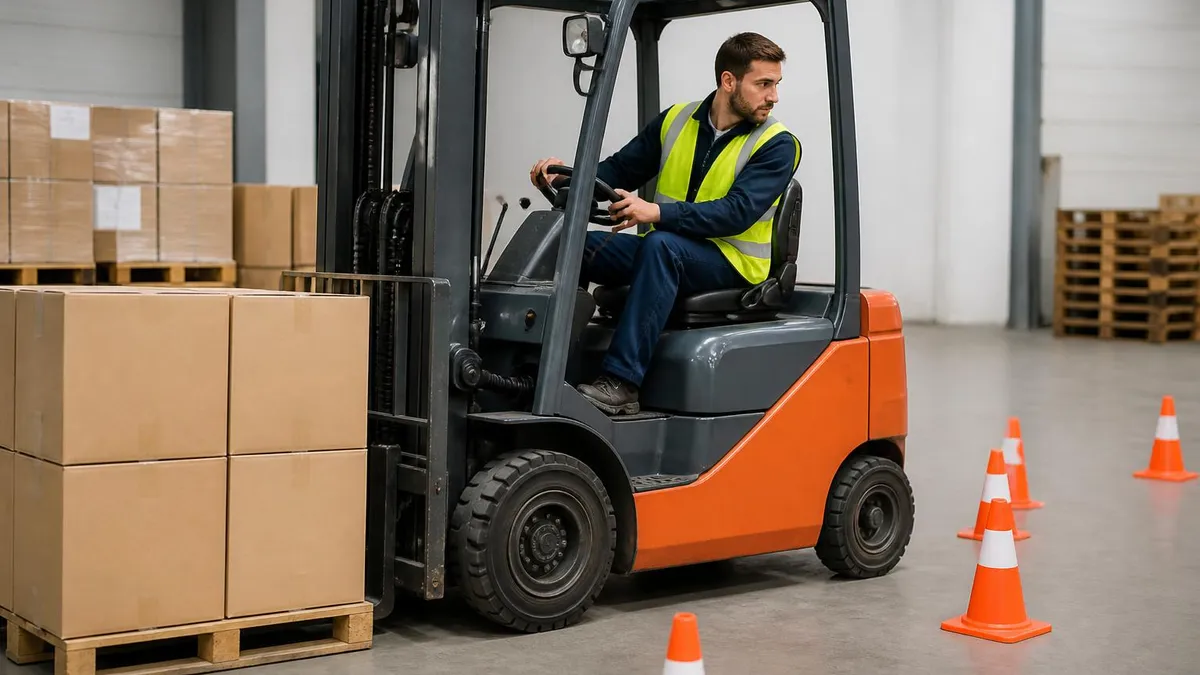
OSHA Forklift Certification: 29 CFR 1910.178 Training, Evaluation & Recertification Guide
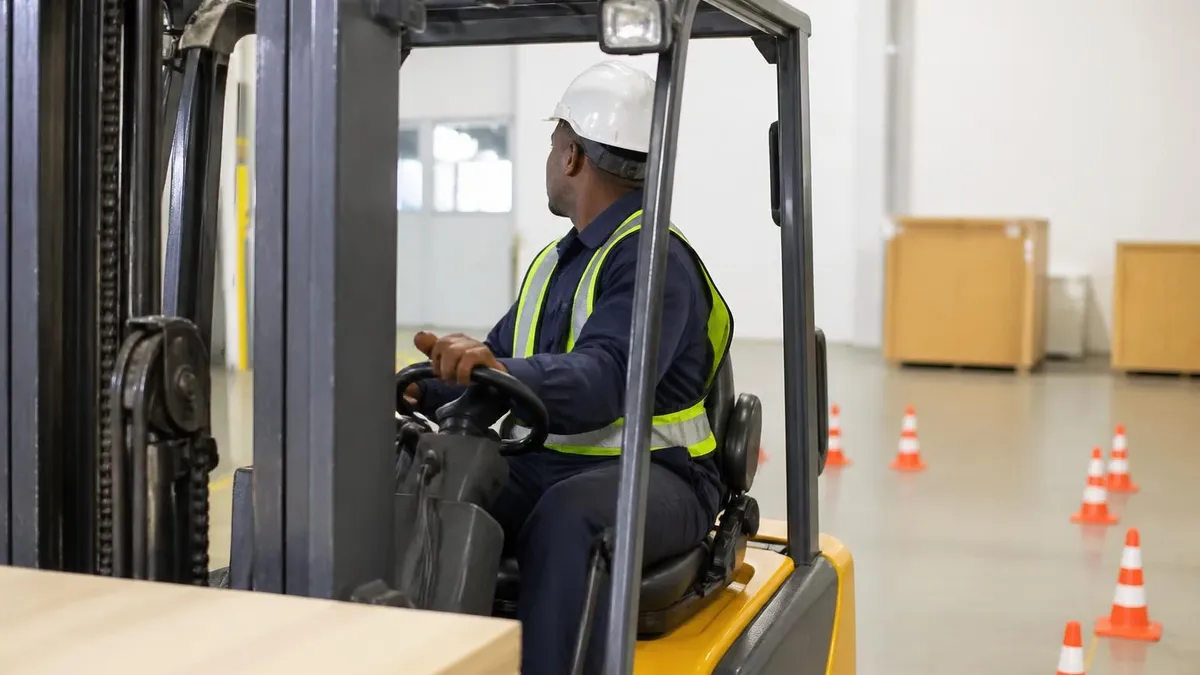
Forklift Certification: OSHA Requirements, Training & How to Get Certified
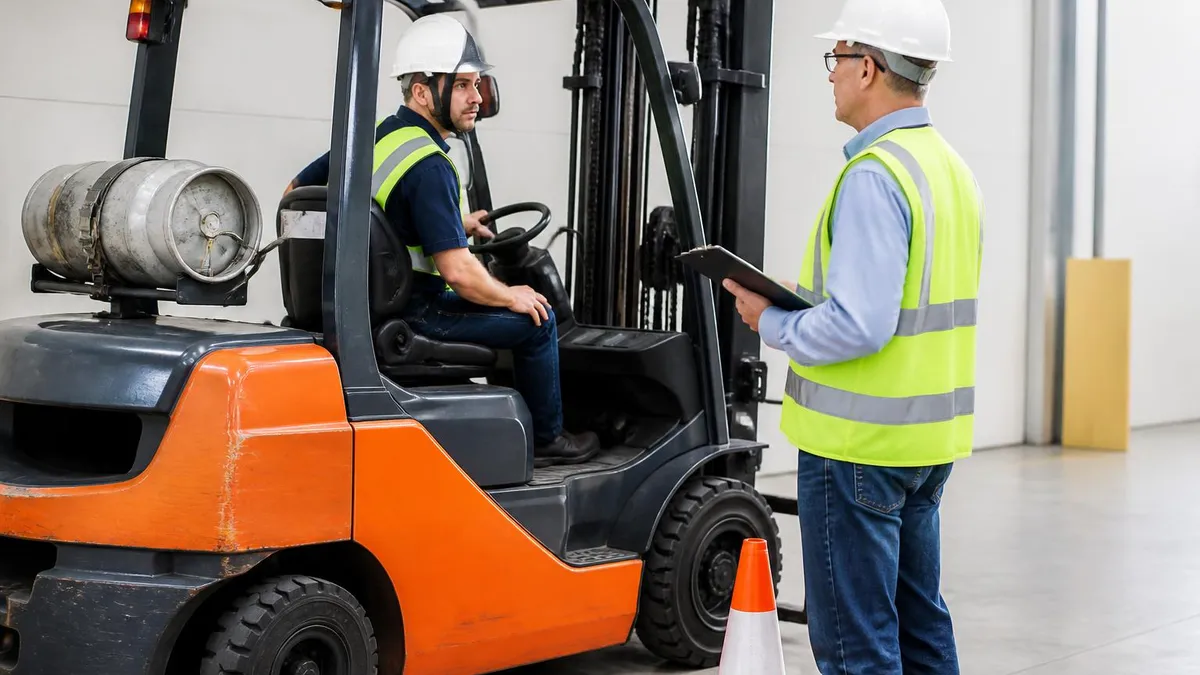
How to Get Forklift Certified: Complete Step-by-Step Guide
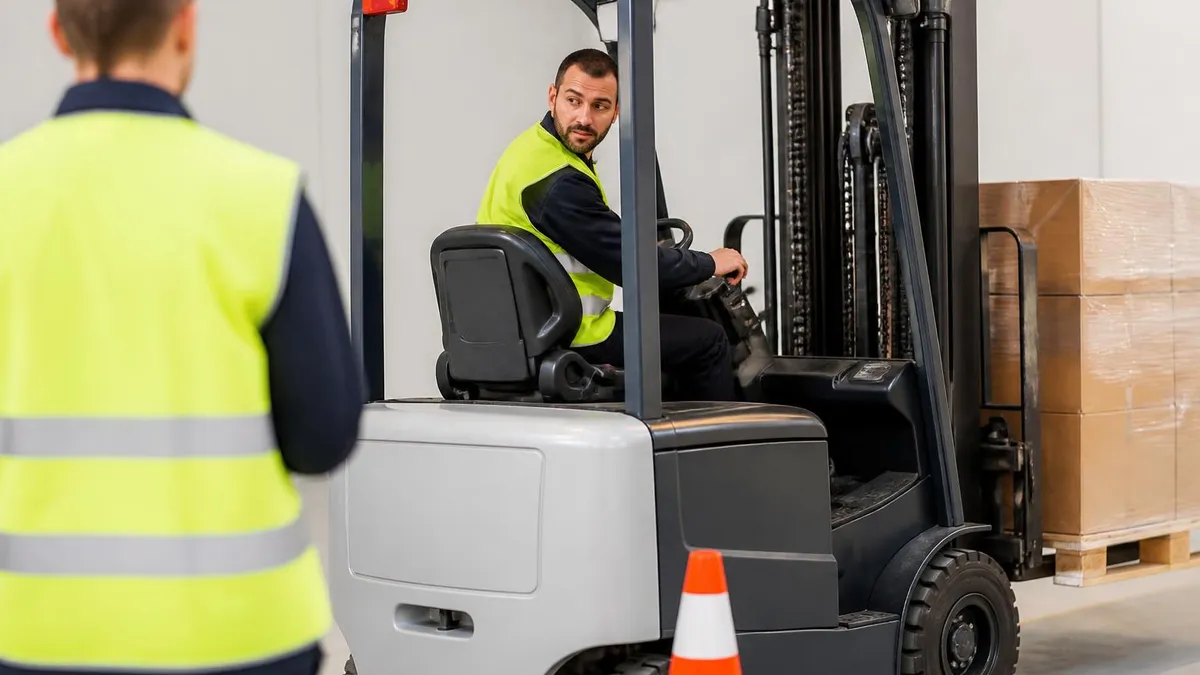
Forklift License vs Certification: OSHA Requirements, Cost, and Training
Forklift Operator: Job Duties, Pay & Certification Requirements
How this page was made: written with AI tools and published by Nathan Beja, founder of Practice Test Geeks, who is responsible for its content. Exam facts are checked against the official sources listed below. Not reviewed by a subject-matter expert. Editorial policy
Sources & references
Exam facts on this page (fees, format, dates, passing scores) are checked against these official sources; the date is our last check. Editorial policy
- osha.gov — Test delivery, eligibility, renewal · verified Oct 2026