
Forklift Types and Models: Complete Guide to Choosing the Right Lift Truck for Your Operation
🎓 Compare forklift types and models, PIT forklift classes, electric and stand-up options, plus forklift rental tips, training, and certification advice.
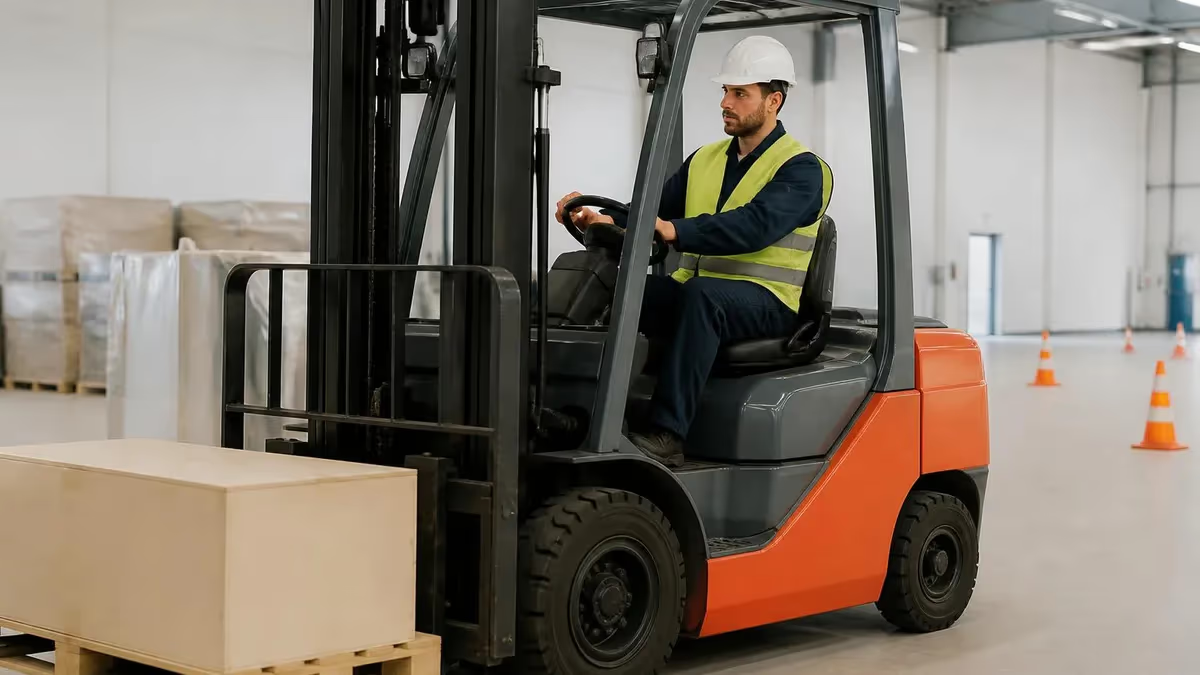
Choosing the right pit forklift for your warehouse, yard, or construction site is one of the most consequential equipment decisions a facility manager will make this year. Powered industrial truck (PIT) classifications from OSHA cover seven distinct categories, and each one is engineered for specific load weights, aisle widths, fuel sources, and surface conditions. Picking the wrong class wastes money on forklift rental near me contracts, slows productivity, and can trigger serious safety violations that cost employers thousands in fines.
This guide breaks down every major forklift type you will encounter in 2026, from compact electric pallet jacks to massive 36,000-pound capacity diesel trucks used at shipping terminals. We compare counterbalance, reach, stand-up, order picker, rough terrain, and side-loader designs side by side so you can match the machine to the mission without overspending on capacity you will never use.
Whether you are evaluating forklift rental options for a seasonal demand spike, comparing forklift for sale listings before a capital purchase, or simply trying to understand which truck a new operator should train on first, the right model depends on three variables: load profile, environment, and duty cycle. We walk through each variable with real numbers, manufacturer specs, and lessons pulled from busy distribution centers.
Beyond hardware, this article also covers the human side: forklift operator skill requirements by class, the certification path mandated by OSHA 29 CFR 1910.178, and the difference between sit-down and stand-up forklift control schemes that affect operator fatigue and pick rates. You will learn why a Class II reach truck operator needs different muscle memory than a Class IV cushion-tire driver, and why electric forklift fleets dominate indoor facilities.
We also dig into total cost of ownership. A new Class I electric forklift can range from $25,000 to $45,000, while comparable internal combustion models start around $20,000 but burn through fuel, oil, and emission filters that add up fast. Forklift rentals priced between $150 and $400 per day make sense for projects under three months. Above that, financing or leasing usually wins on math.
By the end of this guide, you will know exactly which forklift class fits your facility, which models lead each category in 2026, and how to staff and certify operators safely. We close with a 10-item buying and renting checklist, a frequently asked questions section, and links to free practice quizzes that prepare new operators for their certification exam.
Forklift Industry by the Numbers

The Seven OSHA PIT Forklift Classes
Sit-down counterbalance trucks powered by lead-acid or lithium-ion batteries. Capacities of 3,000 to 12,000 lb. Standard for indoor warehousing, grocery distribution, and clean manufacturing where exhaust is unacceptable.
Reach trucks, order pickers, and turret trucks designed for aisles under 96 inches. Operators stand or sit sideways. Used in high-density racking up to 40 feet tall in modern distribution centers.
Walkies, riders, and pallet jacks rated 4,500 to 8,000 lb. Operator walks behind or rides a platform. The most common forklift on earth and the typical first machine a new operator learns.
Cushion tire (IV) for smooth indoor floors and pneumatic tire (V) for outdoor lots. LPG, gasoline, or diesel power. Capacities reach 36,000 lb. Common at lumber yards, ports, and heavy manufacturing.
Class VI tow tractors pull trailers in airports and assembly plants. Class VII covers rough terrain forklifts including telehandlers and the cherry picker forklift used on construction sites with uneven ground.
The single biggest fork in the road when shopping for forklifts is power source. Electric forklift models dominate indoor operations because they produce zero tailpipe emissions, run quietly, and have fewer moving parts than internal combustion equivalents. A lithium-ion Class I truck can run two full shifts on opportunity charging without a battery swap, which has shifted the math decisively against propane in food, pharma, and retail distribution centers since 2022.
Internal combustion (IC) forklifts still win in outdoor yards, lumber operations, and applications above 15,000 pounds of capacity. Diesel and LPG engines deliver more peak torque, refuel in five minutes, and tolerate dust, rain, and cold without battery degradation. If your duty cycle includes heavy outdoor work or three-shift operation in a non-climate-controlled space, IC remains the practical choice despite higher fuel and maintenance costs.
Cost-per-hour is the cleanest way to compare. Industry studies from 2025 put electric forklift operating costs at roughly $2.50 to $3.50 per hour including electricity, scheduled maintenance, and battery amortization. Comparable LPG trucks run $5.50 to $7.00 per hour when propane is included. Over a 2,000-hour annual duty cycle, that gap exceeds $6,000 per truck per year — enough to justify the higher sticker price on most electric models within three years.
Hydrogen fuel cell forklifts are the fastest-growing segment in 2026, particularly at large grocery and e-commerce distribution centers. Plug Power, Toyota, and Hyster-Yale all offer fuel cell stacks that drop into existing battery compartments. Refueling takes about two minutes versus 15 minutes for a battery swap, which makes hydrogen attractive for very high throughput operations where every minute of operator downtime is expensive.
Battery chemistry inside the electric category matters too. Lead-acid batteries cost less upfront, around $4,000 to $6,000, but require watering, equalization charges, and a dedicated charging room with ventilation. Lithium-ion batteries cost two to three times more but last twice as long, charge anywhere on the warehouse floor, and recover their premium through labor savings. Most new electric purchases in 2026 specify lithium.
Don't forget infrastructure costs. Switching from LPG to electric means installing 480-volt charging stations, possibly upgrading the building service, and training maintenance staff on battery handling. Switching from electric to hydrogen means buying or leasing a hydrogen dispenser and signing a fuel supply agreement. These hidden costs can add $50,000 to $250,000 to a fleet conversion and should be modeled before you sign anything. Buying forklifts without planning infrastructure is the most common procurement mistake.
Finally, consider resale value. Toyota, Crown, Raymond, and Hyster electric forklifts hold 50 to 65 percent of original value at five years on used markets. Off-brand IC models often drop below 30 percent in the same window. If you plan to refresh your fleet every five to seven years, brand and power source materially affect what you recover when the truck rolls off your asset list.

Forklift certification Practice Test Questions
Prepare for the Forklift certification Certification exam with our free practice test modules. Each quiz covers key topics to help you pass on your first try.
Forklift certification Certification Forkl...
Forklift certification Exam Questions covering Certification Forklift certification Maintenance and Repairs. Master Forklift certification Test concepts for certification prep.
Forklift certification Certification Forkl...
Free Forklift certification Practice Test featuring Certification Forklift certification Maintenance and Repairs Questions and Answers. Improve your Forklift certification Exam score with mock test prep.
Forklift certification Certification Forkl...
Forklift certification Mock Exam on Certification Forklift certification Operator Training and Certification Requirements. Forklift certification Study Guide questions to pass on your first try.
Forklift certification Certification Forkl...
Forklift certification Test Prep for Certification Forklift certification Operator Training and Certification Requirements Questions and Answers. Practice Forklift certification Quiz questions and boost your score.
Forklift certification Load Handling and S...
Forklift certification Questions and Answers on Load Handling and Stability. Free Forklift certification practice for exam readiness.
Forklift certification OSHA Regulations an...
Forklift certification Mock Test covering OSHA Regulations and Compliance. Online Forklift certification Test practice with instant feedback.
Forklift certification Pre-Operation Inspe...
Free Forklift certification Quiz on Pre-Operation Inspections. Forklift certification Exam prep questions with detailed explanations.
Forklift certification Refueling and Recha...
Forklift certification Practice Questions for Refueling and Recharging Procedures. Build confidence for your Forklift certification certification exam.
Forklift certification Safe Driving and Ma...
Forklift certification Test Online for Safe Driving and Maneuvering. Free practice with instant results and feedback.
Forklift certification Workplace Hazard Id...
Forklift certification Study Material on Workplace Hazard Identification. Prepare effectively with real exam-style questions.
Forklift certification Forklift Instructions
Free Forklift certification Test covering Forklift Instructions. Practice and track your Forklift certification exam readiness.
Forklift certification Forklift MCQ
Forklift certification Exam Questions covering Forklift MCQ. Master Forklift certification Test concepts for certification prep.
Forklift certification Forklift Employer R...
Free Forklift certification Practice Test featuring Forklift Employer Responsibilities. Improve your Forklift certification Exam score with mock test prep.
Forklift certification Forklift Penalties ...
Forklift certification Mock Exam on Forklift Penalties for Non-Compliance. Forklift certification Study Guide questions to pass on your first try.
Sit-Down, Stand-Up, and Reach Forklift Operation
Sit-down counterbalance forklifts are the iconic image most people picture when they hear the word forklift. The operator sits in an enclosed cab or open seat behind a steering wheel and operates pedals like a small car. Counterweight in the rear balances the load on the forks, and capacities range from 3,000 to over 30,000 pounds depending on class and mast configuration.
These trucks excel in standard-aisle warehouses, loading docks, and outdoor yards. They are the easiest class for new operators to learn because the controls mirror automotive conventions. However, sit-down counterbalance trucks need wide aisles of at least 12 feet for right-angle stacking, which limits storage density in expensive square footage.
Electric Forklift vs Internal Combustion: Which Is Right for You?
- +Zero tailpipe emissions allow indoor use in food, pharma, and retail
- +Lower operating cost per hour, often half of LPG equivalents
- +Quieter operation reduces noise complaints and operator fatigue
- +Lithium-ion batteries support opportunity charging and two-shift duty
- +Fewer moving parts mean less scheduled maintenance and downtime
- +Higher resale value at five and seven years on major brands
- −Higher upfront purchase price, typically 15 to 25 percent more
- −Charging infrastructure requires upgraded electrical service
- −Lead-acid batteries need dedicated rooms with ventilation
- −Cold storage below 32°F reduces battery runtime significantly
- −Battery replacement at end of life can cost $5,000 to $15,000
- −Outdoor use in rain or mud requires sealed IP-rated components
Pros and Cons at a Glance
| Pros | Cons |
|---|---|
| Zero tailpipe emissions allow indoor use in food, pharma, and retail | Charging infrastructure requires upgraded electrical service |
| Lower operating cost per hour, often half of LPG equivalents | Lead-acid batteries need dedicated rooms with ventilation |
| Quieter operation reduces noise complaints and operator fatigue | Outdoor use in rain or mud requires sealed IP-rated components |

How to Choose the Right Forklift: 10-Point Selection Checklist
- ✓Measure your heaviest load including pallet and packaging weight, then add 20 percent safety margin
- ✓Document narrowest aisle width and lowest door clearance in your facility
- ✓Identify floor surface type: smooth concrete, rough concrete, asphalt, or gravel
- ✓Calculate annual duty cycle in operating hours to choose battery or fuel type
- ✓Verify ventilation capacity if considering propane or diesel indoors
- ✓Confirm maximum lift height including the load and overhead clearances
- ✓Check turning radius requirements against your tightest right-angle stack
- ✓List attachments needed: side shift, fork positioner, paper clamp, rotator
- ✓Compare new purchase, used purchase, lease, and forklift rentals over five years
- ✓Match operator skill level and certification class to the equipment you specify
Every attachment and load center change reduces rated capacity.
A 5,000-pound nameplate capacity assumes a 24-inch load center and standard forks. Adding a side-shifter, raising the mast above 188 inches, or shifting the load center to 36 inches can drop usable capacity by 20 to 40 percent. Always consult the truck's data plate after any attachment change, and never exceed the derated rating — overloading is the leading cause of tip-over fatalities in OSHA's incident database.
Picking a leading model in 2026 means looking at uptime, dealer support network, and total cost rather than just sticker price. In Class I electric sit-down counterbalance, Toyota's 8FBE series remains the volume leader thanks to its standard System of Active Stability that automatically reduces tip-over risk. Crown's SC 6000 series is the close runner-up and a favorite of cold storage operators because of its sealed AC motors and corrosion-resistant frame. Both models deliver 5,000-pound capacity in the most popular configuration.
For Class II reach trucks, the Raymond 7500 Reach-Fork and Crown RR 5700 dominate North American distribution centers. Both offer cab options for cold storage, deliver lift heights above 360 inches, and include telemetry packages that report runtime, impacts, and operator IDs back to a fleet management dashboard. The Yale MR Series is a strong third option for facilities that already standardize on Yale parts and service.
Class III electric pallet jacks are dominated by Crown's WP and PE Series, Raymond's 8210, and Toyota's 8HBW23. Specifications across the three are nearly identical at 4,500-pound capacity, so most fleets choose based on local dealer responsiveness and parts availability. Walkie-rider variants like the Crown PC 4500 add a platform for the operator and double pick speed in long aisles, which is why most grocery distribution centers specify them.
In Class IV and V internal combustion, Hyster H50-80FT and Caterpillar GP25N5 are the most common choices for 5,000- to 8,000-pound LPG cushion-tire applications. For larger pneumatic-tire work in lumber and steel yards, Komatsu's BX50 and Mitsubishi's FD80N handle 17,500 pounds with reliable Tier 4 Final diesel engines. Above 20,000 pounds, you are typically looking at Hyster, Taylor, or Konecranes machines built to order with lead times of 12 to 20 weeks.
Telehandlers and rough terrain forklifts in Class VII have a different competitive landscape. JLG, Genie, and Bobcat lead the construction telehandler segment with reach heights from 19 to 56 feet and capacities from 6,000 to 12,000 pounds. The Skytrak 10054 and JLG 1644 are the contractor favorites for residential and commercial framing work. The popular cherry picker forklift hybrid designs combine boom reach with fork carriages and need separate certification.
Used markets are strong in 2026. A three-year-old Toyota 8FBE Class I truck with 4,000 hours typically resells for $14,000 to $18,000, roughly 50 percent of new pricing. Auction sites like IronPlanet and dealer-certified pre-owned programs from Crown and Raymond offer warranty options that close the risk gap with new purchases. For startups and seasonal users, buying used at three to five years old often delivers the best dollar per hour over the next five years of service.
Operator certification is not transferable across PIT classes. A certified Class I sit-down operator must complete additional training and evaluation before legally operating a Class II reach truck or Class IV LPG cushion truck. Employers who let uncertified operators run equipment face fines starting at $16,131 per violation and personal liability exposure if injuries occur.
Federal law under 29 CFR 1910.178(l) requires that every forklift operator complete formal training, hands-on evaluation, and a refresher every three years. The certification of forklift operators must be performed by a qualified trainer who has the knowledge, training, and experience to teach the operator and evaluate competence. Self-certification or online-only certification with no in-person evaluation does not meet the standard, regardless of what discount certification websites advertise.
Training content must cover truck-related topics including controls, instrumentation, engine or motor operation, steering, visibility, fork attachments, load capacity, stability, inspection, refueling, charging, and operating limits. It must also cover workplace-related topics like surface conditions, load composition, load stacking, narrow aisle operation, hazardous locations, ramps, and pedestrian traffic. The required topics differ slightly by truck class, which is why class-specific evaluations matter.
The evaluation portion must be a live, observed performance test where the trainer watches the operator perform pre-shift inspection, mount and dismount, load handling, travel with and without a load, stacking, unstacking, and shutdown. Pass-fail criteria should be written and consistent across operators. OSHA inspectors routinely ask to see written evaluation records during post-incident investigations, and missing or incomplete records are treated as a separate violation from any operational issue.
Forklift training programs typically last four to eight hours for an initial class on a single PIT class and one to two hours for a refresher. Costs range from $75 per operator for in-house training using employer trainers up to $295 per operator at third-party training schools that include classroom instruction, hands-on time on real equipment, and a wallet card. Some employers pay this; others require operators to fund their own credential before being hired into a forklift operator role.
Refresher training is required when an operator is observed driving unsafely, is involved in an accident or near-miss, is assigned a different type of truck, or when workplace conditions change in ways that affect safe operation. The three-year clock on certification refresh runs from the date of the most recent evaluation. Fleet managers should track certification dates in a spreadsheet or HRIS module with automatic email reminders 60 days before expiration.
For employers planning to grow their certified operator pool, the most efficient path is to designate one or two qualified in-house trainers using a train-the-trainer course offered by Toyota Material Handling University, Crown Lift Trucks University, or Pride Industries. In-house programs cost $1,500 to $3,500 per trainer up front, then deliver per-operator certifications at less than $50 in materials and time over the trainer's tenure. This pays back after about 25 operator certifications.
Operators who hold credentials across multiple classes — particularly Class I, II, III, and IV — earn 15 to 25 percent more in 2026 than single-class operators in the same labor market. They also have first claim on the most desirable shifts and rarely face layoff during seasonal slowdowns. For anyone making forklift work a career, investing in multi-class certification within the first two years pays back many times over the life of the career.
Practical preparation for buying, renting, or staffing forklifts in 2026 starts with a simple site visit and tape measure. Walk every aisle the truck will use and measure the narrowest right-angle turning point. Compare against the manufacturer's right-angle stack data sheet, not just the truck's listed turning radius. A reach truck rated for an 8'6" aisle still needs room to enter the aisle, and dock plate transitions can complicate clearance in ways spec sheets never show.
When evaluating forklift rental options for short projects, ask for an explicit list of what is included: delivery, pickup, scheduled maintenance, propane tanks or charger, damage waiver, and operator training. Cheap day rates often exclude items that become expensive surprises mid-contract. National rental fleets like United Rentals, Sunbelt, and Herc Rentals publish all-in pricing on request and are usually competitive for jobs of 30 days or more. Local independents often beat them on weekly deals.
For new operators, the single best preparation step before reporting to a job site is to complete free practice tests covering OSHA general industry rules, daily inspection requirements, and load stability calculations. Most certification failures happen on the written portion, not the hands-on driving evaluation. Practice tests reveal gaps in code knowledge that on-the-job experience does not catch. Plan on three to five hours of self-study before any formal training class.
Establish a daily pre-shift inspection routine and never skip it, even when the schedule is tight. The pre-shift checklist takes five to seven minutes and catches problems like low hydraulic fluid, worn fork heels, leaking hoses, and damaged safety lights before they cause failures or injuries. OSHA requires the inspection in writing on a separate sheet for each shift. Many employers now use mobile app checklists that timestamp completion and flag issues to maintenance automatically.
Plan attachments early. Side shifters add about $2,000 to $3,500 to a new truck and pay back in productivity within months at any dock that handles slip-sheet loads or misaligned pallets. Fork positioners cost $4,000 to $6,000 and earn back even faster in mixed-pallet operations. Specialty attachments like rotators, paper clamps, and carton clamps run $6,000 to $15,000 and only make sense for facilities that handle those load types daily.
Finally, treat data telemetry as a standard option, not a luxury. Modern fleets installed since 2024 increasingly include OEM telematics that record operator IDs, impact events, runtime, and battery health. The data identifies coaching opportunities, supports OSHA investigations, and informs the next purchasing cycle with real duty-cycle numbers instead of guesses. Without telemetry you are flying blind on the most expensive moving asset in your operation.
If you walk away with one takeaway, make it this: there is no universal best forklift. The right truck for your operation depends on your load profile, your aisle layout, your floor surface, your duty cycle, and your operator skill level. Spend two weeks gathering those data points before you sign a purchase or rental contract, and you will avoid the costly mismatches that plague operations that picked equipment based on someone else's spec sheet.
Sample Forklift certification Practice Questions
Try these questions from our free Forklift certification practice tests. The correct answer and an explanation follow each question.
Which OSHA standard specifically governs powered industrial truck operation in general industry?
- A. 29 CFR 1910.178
- B. 29 CFR 1926.602
- C. 29 CFR 1910.147
- D. 29 CFR 1904.7
Answer: A. 29 CFR 1910.178
29 CFR 1910.178 is OSHA's standard covering powered industrial trucks in general industry.
You will be using your forklift to drive up and down the hill that is your project site. Which method is usually the safest for doing this?
- A. Keep the heaviest part of the vehicle on the downhill side
- B. Use ballast to ensure the vehicle is always heaviest at the back
- C. Keep the heaviest part of the vehicle on the uphill side
- D. Use ballast to ensure the vehicle weight and load is evenly distributed
Answer: C. Keep the heaviest part of the vehicle on the uphill side
When driving a forklift up or down a hill, it is safest to keep the heaviest part of the vehicle on the uphill side. This means the load should face uphill when ascending, and the forklift should drive in reverse down the slope if loaded, with the load still facing uphill. This method helps maintain stability by counteracting the natural tendency for the vehicle to tip or roll, ensuring the center of gravity remains secure.
What is the main purpose of a forklift pre-operational inspection?
- A. To check the operator's driving skills
- B. To ensure the forklift is safe to operate
- C. To test the forklift's maximum lifting capacity
- D. To clean the forklift before use
Answer: B. To ensure the forklift is safe to operate
The primary purpose of a forklift pre-operational inspection is to identify any defects or issues that could compromise the safe operation of the equipment. By thoroughly checking critical components before use, operators can prevent accidents caused by mechanical failures. This proactive safety measure is essential for protecting both the operator and other workers in the vicinity.
Which part of the pre-operation inspection is done with the engine OFF?
- A. Testing the horn
- B. Checking fluid levels and tires
- C. Testing the brakes
- D. Checking the steering
Answer: B. Checking fluid levels and tires
Visual checks like fluid levels, tires, forks, and leaks are performed during the engine-off portion of the inspection.
Forklift Questions and Answers
Forklift Jobs Near Me: Complete Guide to Finding Best Opportunities
Forklift Operation & Equipment Knowledge Practice Test Video Answer
Forklift Inspection & Maintenance Practice Test Video Answer
30-Day Forklift certification Certification Study Plan — Pass on Your First Try
Forklift Certification 2026
About the Author

Certified Crane Operator & Skilled Trades Exam Specialist
Ferris State UniversityRobert Martinez is a Journeyman Ironworker, NCCCO-certified crane operator, and forklift trainer with a Bachelor of Science in Construction Technology from Ferris State University. He has 21 years of ironworking, rigging, and heavy equipment operation experience across high-rise and industrial construction sites. Robert prepares candidates for crane operator, rigger, forklift, and skilled trades certification examinations.