
Forklift for Sale Near Me: Complete 2026 October Buyer's Guide to Pricing, Inspection, and Local Dealer Negotiation
Searching forklift for sale near me? Compare local dealer prices, inspection checklists, financing options, and used vs new costs in this 2026 October 🎯
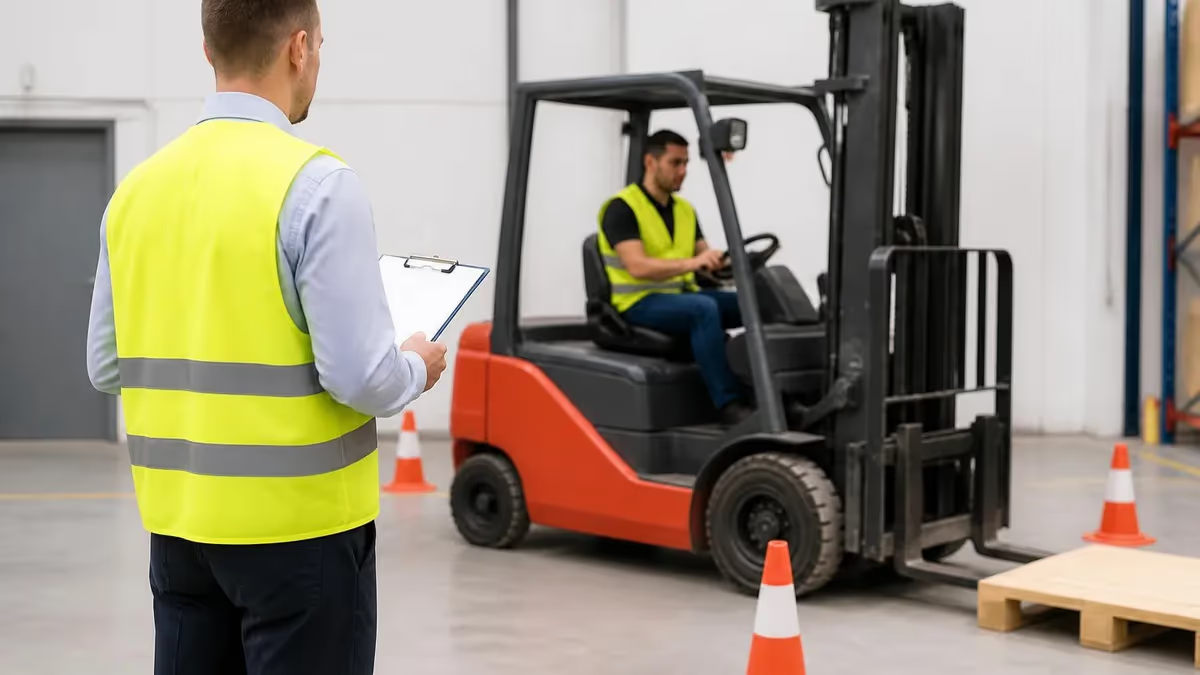
Typing forklift for sale near me into a search engine returns dealers, auction houses, equipment brokers, and private sellers within a 50-mile radius — but the listing prices you see rarely tell the whole story. A used 5,000-pound capacity Toyota with 8,000 hours may show at $14,500, yet add freight, pre-delivery inspection, new tires, propane tank certification, and operator training and the out-the-door figure jumps closer to $18,200. Understanding what local availability really means is the first step toward a smart purchase rather than an expensive lesson.
Local sourcing matters because forklifts are heavy, expensive to ship, and benefit from in-person inspection. A lift truck weighing 8,000 to 12,000 pounds typically costs $4 to $7 per loaded mile to transport, meaning a unit 400 miles away can add $1,600 to $2,800 in delivery fees alone. Buying within a 75-mile radius lets you arrive at the dealer's yard, start the machine cold, watch hydraulic cycle times, and inspect the mast channels before money changes hands.
Demand for forklifts and forklift rental options has surged alongside warehouse construction, last-mile fulfillment growth, and reshoring of light manufacturing. Industry tracking firms report that North American forklift sales crossed 300,000 units annually for the third year running, while the rental fleet grew an estimated 8.3% year over year. That growth means more local inventory to choose from, but also more competition from buyers who know exactly what a fair price looks like.
This guide walks you through how to evaluate local dealer inventory, what hour counts and serial numbers actually reveal about a forklift's life, how to compare new versus used forklifts for sale, when renting beats buying, and how to budget for total cost of ownership over a five-year window. You'll also learn the questions that separate honest sellers from those hoping you won't notice a worn drive tire or a leaking lift cylinder.
Whether you operate a small warehouse moving 40 pallets a day or a regional distribution center cycling 600 loads per shift, the right local purchase can save $8,000 to $25,000 compared with retail new pricing. The wrong purchase, on the other hand, leads to weekly breakdowns, idle operators billed at $24 to $32 per hour, and OSHA exposure if maintenance records cannot be produced during an inspection.
We'll cover electric forklift options for indoor applications, propane and diesel for outdoor yards, cherry picker forklift configurations for high-bay picking, and specialty units like rough-terrain machines for construction sites. Each category has different buying signals, different reasonable price ranges, and different ongoing cost profiles you should weigh before signing a purchase order or financing agreement.
By the end of this article you'll have a repeatable framework: where to source, what to inspect, how to negotiate, and how to document the deal so warranty claims and resale value remain protected. Bookmark the inspection checklist below and bring it to every dealer visit — it is the single highest-use tool in this entire guide.
Forklift Buying Market by the Numbers
Where to Find Local Forklift Inventory
Toyota, Hyster-Yale, Crown, Raymond, and Mitsubishi-Caterpillar dealers carry certified pre-owned units with warranties, financing, and PDI. Expect a 15-25% premium over private sale but with documented service history and trade-in flexibility.
Regional resellers stock 30-150 machines across brands. Inventory turns fast and prices sit 10-18% below dealer rates. Service records are inconsistent — bring your own inspection checklist and budget for unexpected hydraulic or transmission work.
Ritchie Bros, IronPlanet, and local liquidators auction fleet retirements weekly. Savings reach 25-40% but you bid as-is, where-is, with no warranty. Inspect in person on preview day and confirm titles for any over-the-road transport.
Companies offering forklift rental near me sell off units at 4,000-6,000 hours. These machines received scheduled PM every 200 hours and come with full service logs, making them among the lowest-risk used purchases available locally.
Facebook Marketplace, Craigslist, and Equipment Trader list owner-direct forklifts at the lowest sticker prices. Risk is highest — no PDI, no warranty, no recourse if the mast cracks the next week. Best for buyers with mechanical experience.
Pricing for forklifts varies dramatically by class, capacity, fuel type, hours, and condition — so much that two seemingly identical 5,000-pound machines can sell for $9,500 and $22,000 in the same market on the same day. The single biggest pricing variable after capacity is hour meter reading. Industry convention treats every 2,000 hours as roughly equivalent to one shift-year of use, with most internal combustion units lasting 10,000 to 15,000 hours before a major powertrain rebuild becomes likely.
For a Class IV cushion-tire propane lift truck rated at 5,000 pounds, expect roughly $32,000 to $38,000 new from an authorized dealer, $18,000 to $24,000 certified pre-owned with under 4,000 hours, $11,000 to $17,000 for a clean 6,000 to 10,000 hour unit, and $4,500 to $9,000 for high-hour or auction-grade machines that need work. Class I electric counterbalanced units typically run $4,000 to $7,000 higher new because of the included battery and onboard charger compatibility.
Reach trucks, order pickers, and other Class II narrow-aisle equipment carry a steep premium — a quality used Raymond reach truck with 5,000 hours commonly lists $22,000 to $34,000 because the warehouse buyers who need them have few alternatives. Rough-terrain forklifts in Class VII sit in the $28,000 to $55,000 range used because construction demand keeps residual values high, especially for 8,000-pound and 10,000-pound machines.
Hour-for-hour comparisons must account for application history. A 7,000-hour lift truck from a frozen-food warehouse — humid air, constant cold cycling, and salted dock plates — has lived a harder life than a 10,000-hour unit from a climate-controlled paper distribution center. Always ask what the forklift moved, how many shifts it ran, and whether it spent time outdoors. Bring this context into any conversation with someone who has only worked toward becoming forklift certified rather than running purchasing.
Local market premiums also exist. Coastal metros like Los Angeles, Newark, Houston, and Savannah see warehouse-driven demand push used prices 8-15% above national averages. Rural Midwest and Plains states often run 5-10% below average because regional fleets retire equipment faster than local buyers can absorb it. Searching forklift for sale within a 250-mile radius rather than just 25 miles can save thousands if you can arrange affordable freight.
Financing changes the math significantly. Most dealers offer 36, 48, or 60-month installment loans at 7.9% to 11.9% APR depending on credit. A $18,000 used purchase financed for 48 months at 9.9% costs roughly $456 per month, with total interest near $3,900. Compare that against renting the same Class IV unit at $750 to $1,100 per month and the break-even occurs around 24 to 30 months of use, after which ownership wins decisively.
Tax treatment also tilts the decision. Section 179 of the U.S. tax code lets qualifying small businesses immediately deduct up to $1.25 million of equipment purchases in tax year 2026, including new and used forklifts placed in service that year. A $20,000 forklift purchase in a 24% bracket effectively costs $15,200 after the deduction — a meaningful tilt away from rental and toward ownership for stable, predictable operations.

Forklift certification Practice Test Questions
Prepare for the Forklift certification Certification exam with our free practice test modules. Each quiz covers key topics to help you pass on your first try.
Forklift certification Certification Forkl...
Forklift certification Exam Questions covering Certification Forklift certification Maintenance and Repairs. Master Forklift certification Test concepts for certification prep.
Forklift certification Certification Forkl...
Free Forklift certification Practice Test featuring Certification Forklift certification Maintenance and Repairs Questions and Answers. Improve your Forklift certification Exam score with mock test prep.
Forklift certification Certification Forkl...
Forklift certification Mock Exam on Certification Forklift certification Operator Training and Certification Requirements. Forklift certification Study Guide questions to pass on your first try.
Forklift certification Certification Forkl...
Forklift certification Test Prep for Certification Forklift certification Operator Training and Certification Requirements Questions and Answers. Practice Forklift certification Quiz questions and boost your score.
Forklift certification Load Handling and S...
Forklift certification Questions and Answers on Load Handling and Stability. Free Forklift certification practice for exam readiness.
Forklift certification OSHA Regulations an...
Forklift certification Mock Test covering OSHA Regulations and Compliance. Online Forklift certification Test practice with instant feedback.
Forklift certification Pre-Operation Inspe...
Free Forklift certification Quiz on Pre-Operation Inspections. Forklift certification Exam prep questions with detailed explanations.
Forklift certification Refueling and Recha...
Forklift certification Practice Questions for Refueling and Recharging Procedures. Build confidence for your Forklift certification certification exam.
Forklift certification Safe Driving and Ma...
Forklift certification Test Online for Safe Driving and Maneuvering. Free practice with instant results and feedback.
Forklift certification Workplace Hazard Id...
Forklift certification Study Material on Workplace Hazard Identification. Prepare effectively with real exam-style questions.
Forklift certification Forklift Instructions
Free Forklift certification Test covering Forklift Instructions. Practice and track your Forklift certification exam readiness.
Forklift certification Forklift MCQ
Forklift certification Exam Questions covering Forklift MCQ. Master Forklift certification Test concepts for certification prep.
Forklift certification Forklift Employer R...
Free Forklift certification Practice Test featuring Forklift Employer Responsibilities. Improve your Forklift certification Exam score with mock test prep.
Forklift certification Forklift Penalties ...
Forklift certification Mock Exam on Forklift Penalties for Non-Compliance. Forklift certification Study Guide questions to pass on your first try.
Choosing Fuel Type: Electric Forklift, Propane, or Diesel
An electric forklift uses a lead-acid or lithium-ion battery to power a DC or AC traction motor and a separate hydraulic pump motor. Indoor operations almost always benefit from electric — no exhaust emissions, lower noise around 65-70 dBA, and fuel costs roughly 40-60% lower per hour than internal combustion equivalents. Lithium-ion units cost $8,000-$15,000 more upfront but eliminate watering, equalization charging, and battery swap labor entirely.
Total cost of ownership for electric typically beats propane after 4,000-6,000 hours of annual use. Charging infrastructure is the catch — you'll need 240V or 480V power, ventilation if you use lead-acid, and floor space for charging stalls. Battery replacement at 5-7 years adds $4,500-$9,500 to the lifecycle. For grocery, pharma, food service, and electronics warehouses, electric is the default correct answer.
Should You Buy or Rent a Forklift?
- +Lower long-term cost per hour for operations running 1,500+ hours annually
- +Section 179 tax deduction lets you expense the full purchase in year one
- +Build equity and recover 30-50% of cost at resale after 5-7 years
- +Customize attachments, paint, and ergonomic options to your exact workflow
- +No rental return penalties for tire wear, paint chips, or damaged forks
- +Predictable monthly cost with fixed financing instead of variable rental rates
- +Available 24/7 without scheduling conflicts during peak season
- −Upfront capital outlay or financing approval required
- −You own all maintenance, tires, batteries, and unexpected major repairs
- −Depreciation hits the balance sheet whether the forklift runs or sits
- −Insurance, registration, and storage become your responsibility
- −Wrong capacity or fuel choice locks you into a 5-7 year mistake
- −Disposal or trade-in friction when business needs change
Pros and Cons at a Glance
| Pros | Cons |
|---|---|
| Customize attachments, paint, and ergonomic options to your exact workflow | Upfront capital outlay or financing approval required |
| No rental return penalties for tire wear, paint chips, or damaged forks | You own all maintenance, tires, batteries, and unexpected major repairs |
| Predictable monthly cost with fixed financing instead of variable rental rates | Depreciation hits the balance sheet whether the forklift runs or sits |

Pre-Purchase Inspection Checklist for Used Forklift Sale
- ✓Verify hour meter reading matches the service records and visible wear
- ✓Start the engine cold and listen for knocks, smoke, or extended cranking
- ✓Cycle the mast through full lift, lower, and tilt three times checking for drift
- ✓Inspect lift chains for stretch, broken plates, side wear, and proper lubrication
- ✓Examine forks for cracks at the heel, blade wear over 10%, and bent tips
- ✓Check drive and steer tires for chunking, flat spots, and minimum tread depth
- ✓Test brakes on a flat surface and on a 5% grade with a typical load
- ✓Pull the data plate and confirm capacity, serial number, and attachment ratings
- ✓Inspect the overhead guard and load backrest for cracks or weld repairs
- ✓Request complete service history including PMs, repairs, and component replacements
- ✓Confirm propane tank certification dates or battery capacity test results
- ✓Negotiate a 24-72 hour return window pending independent mechanic inspection
Spend 10% of purchase price on independent inspection
For any used forklift over $10,000, budget $150-$400 for an independent mobile mechanic to perform a pre-purchase inspection before the deal closes. A two-hour inspection routinely uncovers $2,000-$8,000 in hidden issues — leaking lift cylinders, worn mast bearings, failing transmissions — that justify either a price reduction or walking away entirely. This single step has the highest ROI of any action in the buying process.
Buying the forklift is only the first step — OSHA 29 CFR 1910.178(l) requires every operator to be trained, evaluated, and certified specifically on the make and model they will use, in the actual workplace where they will use it. A perfectly legal purchase becomes an immediate compliance violation the moment an untrained employee climbs into the seat. Average OSHA fines for untrained operators reached $7,000 per violation in 2025, with willful or repeated violations climbing past $70,000.
Certification has three components: formal classroom or online instruction, hands-on practical training, and a workplace evaluation of operator skill. The certification must be renewed every three years, and immediately retriggered after any accident, near-miss, observed unsafe operation, change of equipment type, or change of work environment. Many new buyers don't realize that switching from a sit-down counterbalanced unit to a stand up forklift legally requires a new evaluation even for experienced operators.
For small businesses with one to five forklifts, the most cost-effective path is a hybrid program: employees complete a 4-6 hour online formal training module for $55-$120 each, then receive on-site hands-on training and evaluation from a designated trainer — typically the owner, supervisor, or experienced operator who has completed a train-the-trainer course. Total cost per operator runs $90-$250 versus $300-$600 for fully outsourced certification.
Larger operations with 10+ forklifts often justify in-house OSHA-authorized trainers who can certify unlimited operators for a one-time investment of $850-$1,400 in trainer credentials. The trainer manages a documented program covering each forklift class used at the facility, maintains evaluation records for three years minimum, and updates training when new equipment is added to the fleet.
Documentation is the half of certification new buyers most often skip. OSHA inspectors expect to see, for each operator: written name, training date, evaluation date, trainer name, equipment class, and the trainer's signature. Missing records are treated as missing training during an inspection. Many buyers use simple templates from their dealer or industry associations rather than building paperwork from scratch.
Forklift operator wages have climbed sharply, with median hourly pay reaching $20.85 nationally in 2025 and $24-$32 in major distribution hubs. Certified operators command 8-15% premiums over uncertified peers because employers face lower OSHA exposure and lower insurance premiums when their workforce is documented. Investing in training protects both the operator and the equipment from preventable damage.
Practical exam scenarios typically include pre-shift inspection, loading and stacking on the right and left, traveling with a load on a grade, loading and unloading from a truck or trailer, and recognizing pedestrian hazards. Operators must demonstrate competence before solo operation is permitted — and the trainer's signature creates personal accountability for that competency judgment. Don't sign off on operators who aren't ready; the legal and human cost of a tip-over far exceeds another training session.
The day your new forklift arrives, every employee who operates it must already be trained and evaluated for that specific equipment type — not the old machine you traded in. OSHA inspectors who visit during the first week of operation routinely cite buyers who 'planned to train next month.' Schedule operator certification to complete BEFORE the delivery date, not after.
Negotiating a forklift purchase rewards preparation more than charisma. Walk into the dealer with three competing quotes from local sellers, screenshots of comparable units on MachineryTrader and IronPlanet, and your independent inspection report. Sellers who know you have alternatives consistently drop 8-15% off initial asking prices, especially near end-of-quarter when sales teams chase volume targets. The last week of March, June, September, and December are particularly favorable buying windows.
Always negotiate the full bundle, not just the sticker price. Pre-delivery inspection, freight, new tires, a full hydraulic and engine fluid service, six months of parts warranty, a propane tank exchange, and operator training delivery are all line items dealers can absorb or discount. A $500 sticker concession matters less than $1,800 in bundled extras, but most buyers focus on the headline number and leave value on the table.
For financing, get pre-approved through your business bank or an equipment finance specialist before walking into the dealer. Captive financing from manufacturers like Toyota Financial or Crown Credit sometimes beats bank rates with 0% or 1.9% promotional offers on new units, but rarely matches independent lenders on used purchases. Pre-approval gives you use to accept dealer financing only when it's genuinely better.
Trade-ins often hide poor value. Dealers may offer $3,500 for your old unit while quietly raising the sale price $2,800, netting you $700 instead of the visible $3,500. Sell your used forklift privately or to a wholesale buyer like a regional forklift certification near me dealer who routinely takes trades, and use that cash as a down payment to keep the new purchase price negotiation clean and transparent.
Insurance must be in place before delivery. Most general liability policies exclude motorized industrial trucks — you'll need an inland marine or equipment floater rider running $180-$420 annually for a $20,000 forklift. Workers' compensation premiums may also adjust upward when you add forklift operations to your class codes. Get the quote before you sign the purchase agreement to avoid uncomfortable surprises in your first month.
Warranty coverage on used units is typically 30, 60, or 90 days on the powertrain only, with extensions available at $400-$1,200 per six months. Certified pre-owned programs from major brands offer 6-12 month full machine warranties and are worth a $1,500-$2,500 premium over equivalent non-certified units. Read the warranty fine print — many exclude wear items like tires, brakes, forks, chains, and hydraulic hoses that fail most often.
Finally, document everything. Get the bill of sale, title transfer, manufacturer statement of origin for new units, service records, warranty terms, and PDI report in writing before payment. Reputable dealers provide all of this automatically; sellers who hesitate are signaling future problems. The 30 minutes spent collecting paperwork at closing prevents months of frustration if a warranty claim or resale question arises later.
Once your forklift is delivered, the first 90 days determine whether you've made a great purchase or inherited someone else's problems. Run a documented pre-shift inspection every single day — even on brand new units. Record any defects in writing, address safety-critical items immediately, and use the inspection log as evidence of due diligence if a warranty dispute arises. New owners who skip daily inspections forfeit 60-80% of warranty claims because manufacturers can argue the damage was operator-induced rather than defective workmanship.
Schedule preventive maintenance at the intervals specified in your owner's manual — typically every 200 hours or 90 days, whichever comes first. PM service from a dealer technician runs $180-$340 per visit for a Class IV propane unit and includes oil and filter changes, hydraulic fluid check, brake adjustment, chain lubrication, and a 40-point inspection. Skipping PM voids most warranties and shortens machine life by 30-50% in the long run, costing far more than the PM contract itself.
Tire selection deserves a dedicated decision. Cushion tires suit smooth indoor floors and cost $90-$180 each installed. Pneumatic and solid pneumatic tires handle outdoor and uneven surfaces, running $220-$480 each. Foam-filled options eliminate flats in puncture-prone environments but reduce ride comfort. Match tire compound to your floor type — non-marking white tires for clean rooms and food service, standard black for general warehouse use, and oil-resistant compounds for manufacturing.
Build a parts inventory of high-wear items before you need them. Keep on hand: one set of forks, a spare lift chain, drive and steer tires, hydraulic filter, engine oil filter, air filter, spark plugs for gasoline or LPG units, a propane tank gasket kit, and brake pads. Total inventory investment runs $800-$1,800 but eliminates 3-7 days of downtime when a part fails mid-shift, which always happens during your busiest week.
Train every operator on basic troubleshooting — checking battery water levels, recognizing low hydraulic fluid, identifying when forks need replacement, and reporting unusual noises immediately. Operators who notice a hydraulic leak on Monday morning prevent the $3,200 cylinder rebuild that happens when the same leak goes unreported until Thursday. Enable operators to shut down a unit and report problems without fear of being blamed for the downtime.
Plan for end-of-life from day one. Track every hour, every repair, every cost in a simple spreadsheet. When annual maintenance costs exceed 50% of the unit's current resale value, it's time to sell or trade. Selling at 8,000 hours typically returns 35-50% of original cost; waiting until 14,000 hours returns 10-20% while you've spent another $6,000-$12,000 keeping it running. The disciplined seller is always more profitable than the optimist who hopes for one more good year.
Finally, build a relationship with one local dealer's service department, even if you bought the unit elsewhere. Independent dealers happily service competitor brands at standard shop rates of $145-$195 per hour, and having a known mechanic who has seen your machine matters enormously when an emergency strikes at 4 PM on a Friday. Loyalty cuts both ways — pay invoices promptly and the service manager will move your call to the front of the queue when production is on the line.
Sample Forklift certification Practice Questions
Try these questions from our free Forklift certification practice tests. The correct answer and an explanation follow each question.
If a forklift is found unsafe during a pre-shift inspection, what should the operator do?
- A. Use it carefully anyway
- B. Remove it from service and report it
- C. Finish the shift then report
- D. Repair it while operating
Answer: B. Remove it from service and report it
An unsafe forklift must be taken out of service and reported until repaired.
When should a forklift pre-operational inspection be performed?
- A. Once per week
- B. At the start of each shift before use
- C. Only after a repair
- D. Once per month
Answer: B. At the start of each shift before use
OSHA requires forklifts to be inspected at least daily, or after each shift when used around the clock.
When must a pre-operation inspection of a forklift be performed?
- A. Once a week
- B. At the start of each shift before use
- C. Only after a repair
- D. Once a month
Answer: B. At the start of each shift before use
OSHA requires a forklift to be examined at least daily, or before each shift when used around the clock.
A forklift's horn fails to work during a pre-shift inspection. What should the operator do?
- A. Operate the forklift carefully while shouting to warn pedestrians
- B. Report the horn failure, tag out the forklift, and do not operate it until repaired
- C. Use the headlights as an alternative warning system
- D. Only operate the forklift in areas with no pedestrians
Answer: B. Report the horn failure, tag out the forklift, and do not operate it until repaired
A non-functional horn is a safety defect that requires the forklift to be removed from service and tagged out until the horn is repaired.
Forklift Questions and Answers
Forklift Tires: Complete Guide to Types, Sizing, Wear Patterns, and Replacement Costs
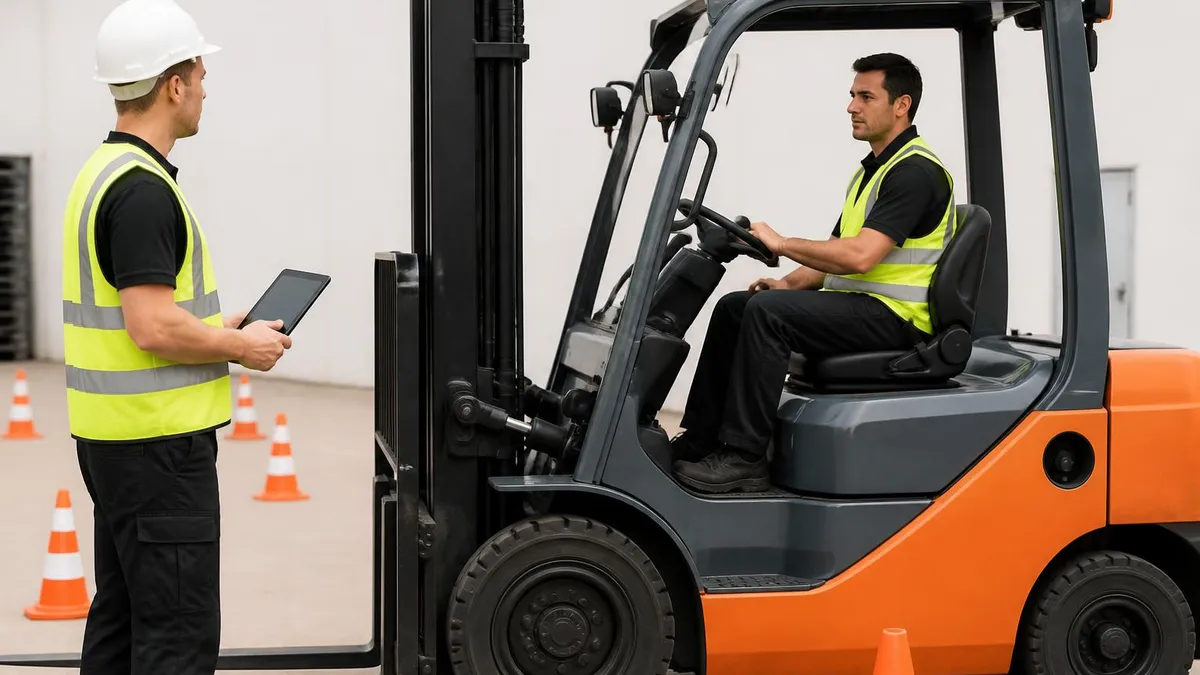
Forklift Safety Training: Complete OSHA Compliance Guide for Operators and Employers
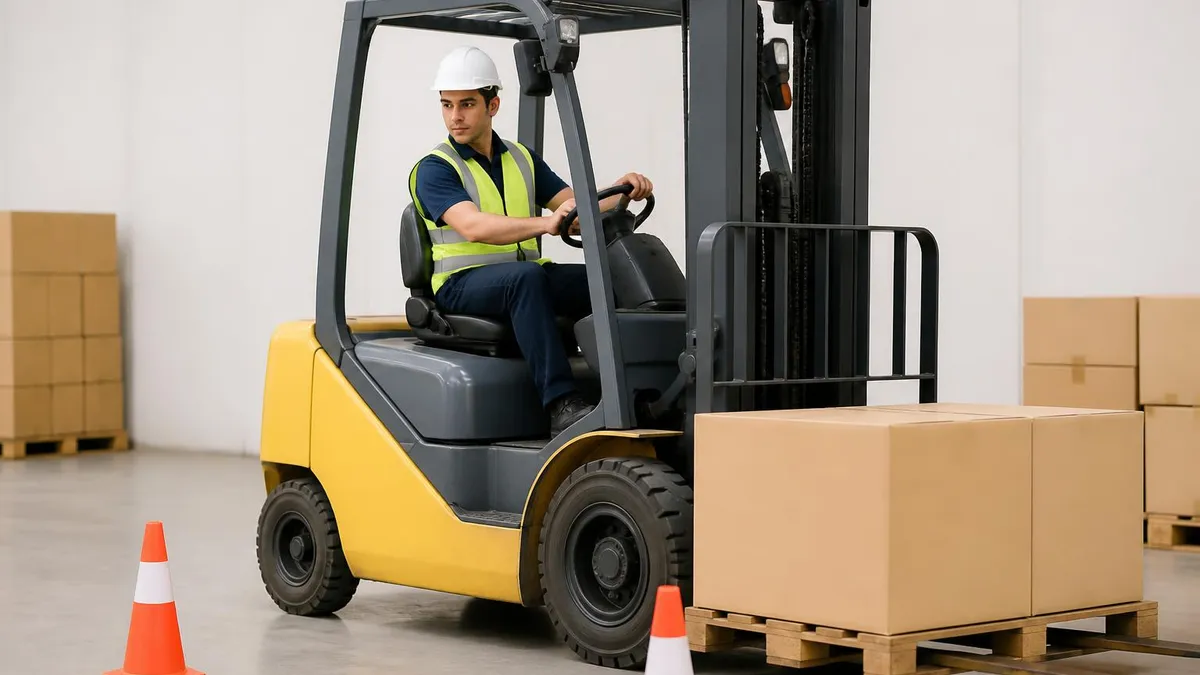
Forklift Repair Service: Complete Guide to Costs, Common Repairs, and Choosing the Right Technician
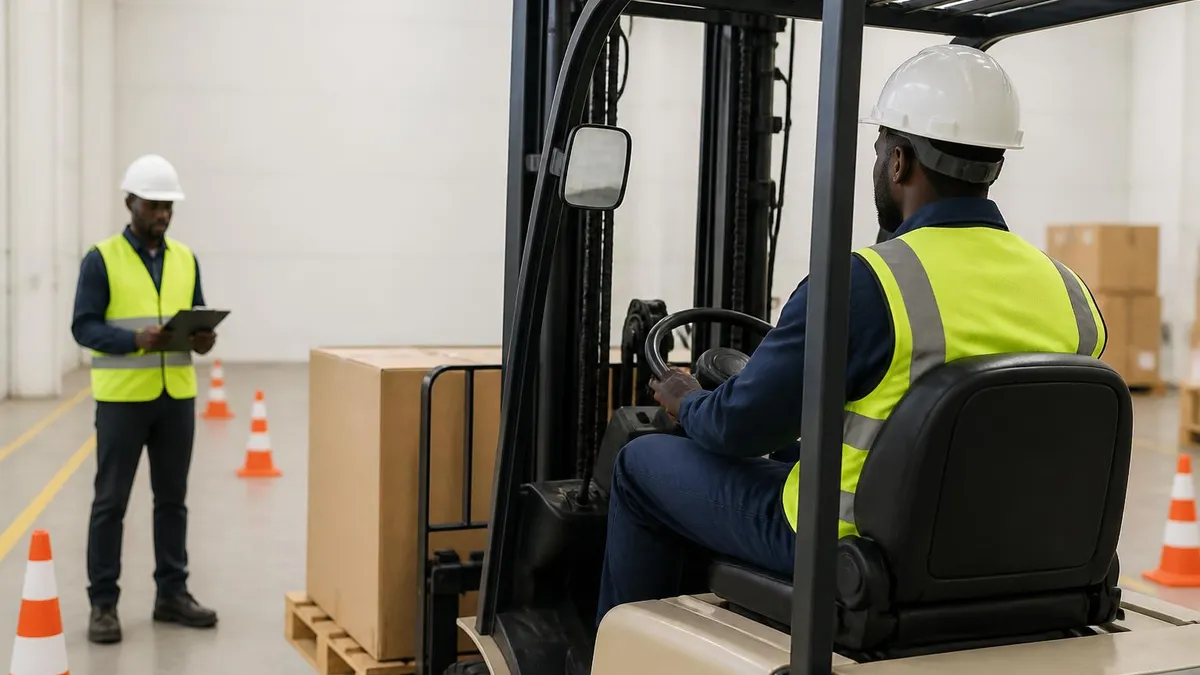
Forklift Certification by State: Complete 50-State Guide to OSHA-Compliant Operator Training, Costs, and Renewal Requirements
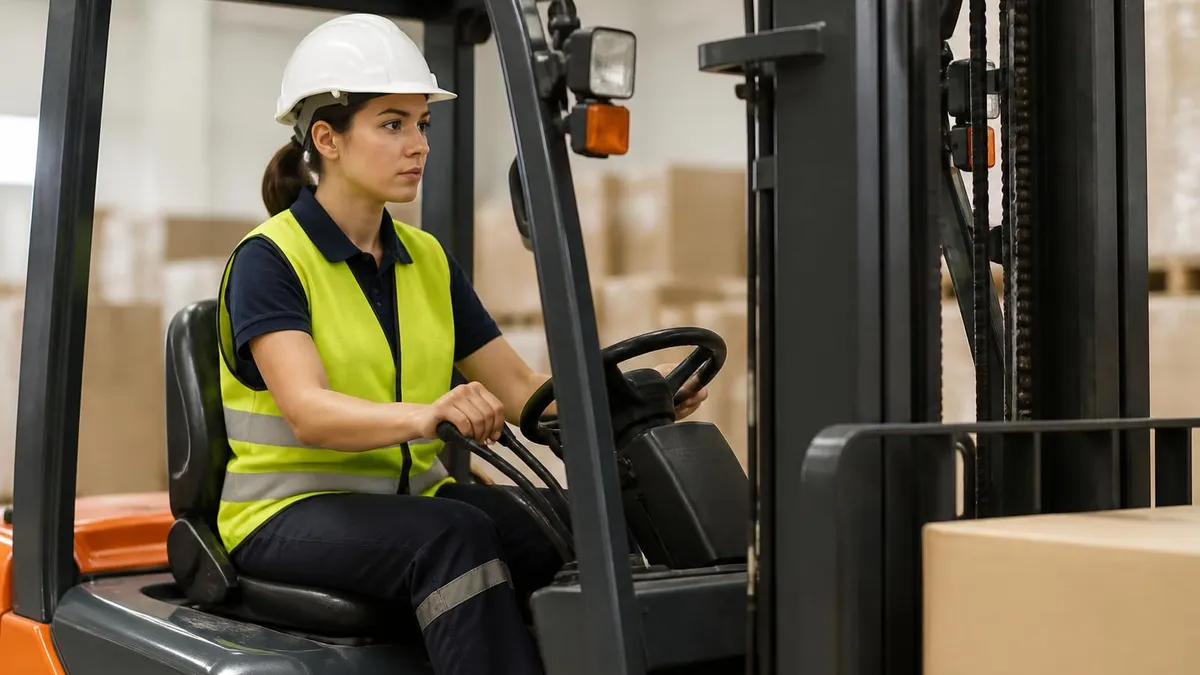
Forklift Price Guide 2026: New, Used, Rental, and Total Cost of Ownership Breakdown
About the Author

Certified Crane Operator & Skilled Trades Exam Specialist
Ferris State UniversityRobert Martinez is a Journeyman Ironworker, NCCCO-certified crane operator, and forklift trainer with a Bachelor of Science in Construction Technology from Ferris State University. He has 21 years of ironworking, rigging, and heavy equipment operation experience across high-rise and industrial construction sites. Robert prepares candidates for crane operator, rigger, forklift, and skilled trades certification examinations.