
Forklift Certification Training: OSHA Requirements, Cost, Length & Top Providers (2026 October)
Forklift certification training explained: 🧠 OSHA's 3 required parts, online vs in-person, cost ($50-$300), length, top providers, and recertification
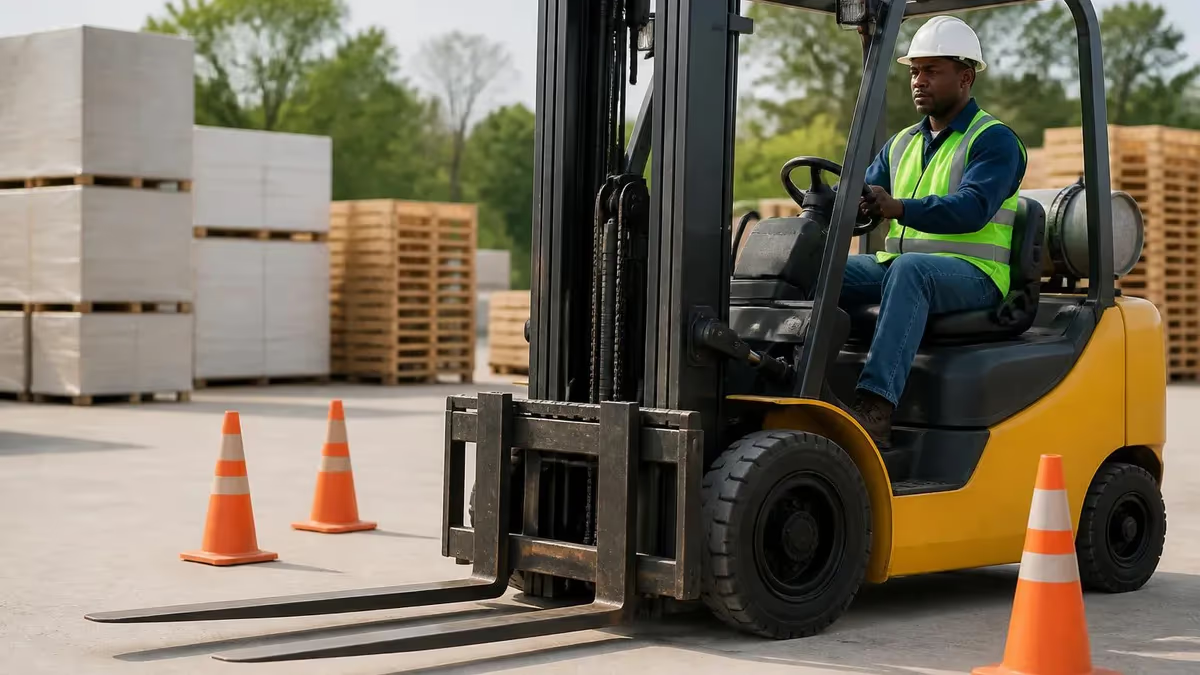
Forklift certification training is what gets you legally cleared to operate a powered industrial truck on the job in the United States. It's not optional, and it's not a one-day formality. OSHA spells out exactly what training has to include, how it has to be delivered, and how often you have to redo it. If you skip any piece, your employer is on the hook, and so are you the moment something goes wrong.
This guide walks through what the training actually covers, the three delivery options (online, in-person, employer-provided), realistic 2026 costs, top providers, and the recertification timeline. Whether you're an employee getting certified for the first time or an employer trying to stand up a compliant program, you'll find what you need below.
Quick orientation: there's no national license, no federal card, and no shortcut. There's a federal standard (OSHA 29 CFR 1910.178), and your employer is responsible for making sure your training meets it. Everything else is just packaging — different providers, different formats, different price tags, all aiming at the same compliance target.

The OSHA rule in one sentence: Per 29 CFR 1910.178(l), every forklift operator must complete formal instruction, practical hands-on training, and a workplace evaluation by a qualified person before operating a powered industrial truck. Online-only courses cover Part 1 and that's it — the practical and evaluation must happen on-site.
Let's start with what counts as legitimate training. OSHA doesn't care whether you took a class at a community college, watched a video module, or learned on the floor from your supervisor — what matters is that all three required components got delivered, documented, and evaluated. The OSHA forklift certification framework is performance-based, meaning the rule cares about outcomes (a competent operator) more than the format. That flexibility is good news, but it also opens the door to a lot of bad actors selling "certifications" that don't actually meet the standard.
The three required components are not interchangeable. Formal instruction is the classroom or e-learning piece — concepts, rules, hazards, and OSHA standards. Practical training is hands-on operation of the actual equipment in the actual environment. Evaluation is a competent person watching you operate and signing off.
Each piece serves a different purpose, and OSHA insists on all three because skipping any one of them creates a real-world safety gap. A driver who knows the theory but has never sat in the seat is dangerous. So is one who learned by trial and error with no formal grounding in stability and load capacity.
The Three OSHA-Required Components
- Format: Lectures, written materials, videos, computer-based learning
- Topics: Vehicle types, controls, stability, hazards, OSHA standards, rules of the road
- Length: 1-3 hours typically
- Can be online?: Yes — this is the only piece that can
- Format: Demonstrations + hands-on practice
- Where: On the actual equipment, in the actual work environment
- Length: 1-4 hours, varies by experience
- Can be online?: No — must be in-person
- Format: Skills test observed by a competent person
- Where: At the operator's workplace
- Length: 30-60 minutes
- Can be online?: No — must happen on-site
Skip any one of those three and the certification isn't valid — even if you have a wallet card that says otherwise. This is the single most common compliance failure OSHA finds during inspections, and it's why so many "certified" operators get flagged when an inspector actually digs in.
The wallet card is convenience, not proof. The proof is the documented training file your employer keeps: who was trained, on what equipment, by whom, when, and the result. If any of that is missing, the operator isn't legally certified, regardless of what's printed on a piece of plastic in their wallet.
Now for the part most people are searching for: how do you actually get the training? You've got three realistic paths, and each has tradeoffs around cost, time, and how complete the certification is when you walk away. Online courses are fast and cheap but only cover the formal-instruction piece. In-person classes pack everything into one visit. Employer-provided programs are usually the most thorough and the cheapest at scale. The right choice depends on whether you already have an employer in the picture, how many operators need certification, and how much hands-on coaching the trainee actually needs.
Three Ways to Get Forklift Certification Training
Length: 1-2 hours. Cost: $50-$150.
Online forklift training covers only the formal instruction piece — Topic 1 of the three OSHA requirements. You log in, work through modules on stability, controls, hazards, and OSHA standards, then take a written quiz. Done in an afternoon. You'll get a printable certificate immediately.
The catch: the certificate alone doesn't make you OSHA-compliant. Your employer still has to put you through hands-on practical training and evaluate you on the actual equipment at your workplace. Online is best as a documentation tool — it proves the theory portion happened, and your employer handles the rest.
Best for: employers who want their operators' theory training standardized and documented; operators changing jobs who want a head start.
For most working operators, the path looks something like this: your employer pays for an online formal-instruction course (or runs one in-house), then schedules a hands-on session and evaluation with a qualified trainer. Total time: half a day to a full day. Total cost to the employer: usually under $200 per operator.
If you're paying out of pocket — say you're job hunting and want a card to put on your resume — expect to spend $150-$300 for a one-day in-person class that gets you fully certified. There's no in-between option that magically costs less; anyone selling "complete OSHA certification" for $30 online is selling you a piece of paper, not a real certification.
Forklift Training by the Numbers (2026)
If you want to know how to get forklift certified step by step, the path is short but specific — and the order matters. Most people try to shortcut it by getting an online certificate and assuming they're done. They aren't. The full forklift certification process runs from picking a training method through receiving documentation, with the evaluation as the gating step before you can legally operate. Here's what each stage looks like in practice, with realistic timing for someone starting from zero.

Step-by-Step Certification Timeline
Choose your training method
Complete formal instruction
Schedule practical training
Complete hands-on training
Pass workplace evaluation
Receive certification documentation
Start operating
One thing worth flagging early: OSHA does not issue forklift cards. There is no federal forklift license. Your employer issues your certification, based on training that meets the OSHA standard. Anyone selling you a "federal forklift license" is selling you nothing — that document doesn't exist. The wallet card from a training provider is just a convenience; the real proof is the documentation your employer keeps on file.
So what actually gets covered in formal instruction? OSHA lists the topics, but the depth varies by program. A solid course will hit every item on the list below — and a thin one will skip half of them. If you're evaluating an online provider, this is the checklist to compare against.
If a course says it's OSHA-aligned but only covers four or five of these topics, it's probably cutting corners. The good ones spend real time on stability, load capacity calculations, and the data plate, because those concepts protect operators from the most common fatal incidents (tipovers and dropped loads).
What Formal Instruction Must Cover
- ✓OSHA 29 CFR 1910.178 powered industrial truck standard
- ✓Forklift classes (I through VII) and their differences
- ✓The stability triangle and load center concept
- ✓Reading the data plate and load capacity
- ✓Pre-operational inspection procedure
- ✓Traveling rules: forks down, load tilted back, no raised loads
- ✓Pedestrian awareness and right-of-way
- ✓Refueling and recharging procedures (LPG, diesel, electric)
- ✓Workplace conditions: slopes, surfaces, narrow aisles, doorways
- ✓Attachments and how they affect capacity (clamps, side-shifts, fork extensions)
- ✓Combustion emissions and ventilation
- ✓Tipover prevention and what to do if it happens
Practical training covers a different set of skills — the ones you can only learn by doing. You'll be on a real forklift, doing real lifts, in a real (or realistic) workplace. The trainer is watching for safe habits, smooth operation, and judgment under typical workplace conditions. This is where bad operators get caught and good ones get polished.
A first-time operator usually needs the full 2-4 hours; someone with prior experience on similar equipment might wrap up in an hour or two. The trainer's job is to make sure the operator can handle every routine task and a few non-routine ones (a tight aisle, a partially blocked exit, a load that's heavier on one side) without losing control of the equipment.
The evaluation is the third piece, and it's the one most online-only programs leave out completely. A competent person — meaning someone with the knowledge, training, and authority to assess forklift operation — watches you run the equipment in your actual workplace. They check that you can do a pre-shift inspection, mount up, travel safely, pick up and place a load, and park properly.
They sign off, document the date and equipment, and you're certified. What gets documented matters as much as the evaluation itself. OSHA wants the operator's name, training and evaluation dates, and the evaluator's identity on file. Most employers keep these records for at least three years (until the next required re-evaluation), and many keep them longer.
Heads up on "lifetime certification" scams: any provider claiming to issue a "lifetime" forklift certification is misleading you. OSHA requires re-evaluation every three years, and sooner if certain triggers happen. There is no such thing as a permanent forklift card. If a provider says otherwise, walk away.
Speaking of recertification — let's get specific about timing. OSHA requires every operator to be re-evaluated at least once every three years. That doesn't always mean redoing the full training from scratch; often a refresher session plus a fresh evaluation is enough. But there are also triggers that force a refresher sooner, regardless of where you are in the three-year cycle.
The triggered refreshers are easy to miss if you're not paying attention — a near-miss in the warehouse last month means refresher training now, not at the next scheduled re-evaluation. The same goes for switching equipment types or moving to a facility with significantly different conditions.
When Refresher Training Is Required
- Frequency: Every 3 years, minimum
- Format: Refresher topics + practical evaluation
- Length: 1-2 hours typically
- Cost: $50-$150
- After accident or near-miss: Refresher required immediately
- Observed unsafe operation: Refresher required
- Workplace conditions change: New layout, new hazards = refresher
- New equipment type: Class-specific training required
- Why: Operators must be trained per forklift class
- Example: Class I (sit-down electric) ≠ Class II (narrow aisle)
- What's needed: Formal + practical + evaluation for new class
- Time: Half-day to full day
That class-specific point trips up a lot of employers. If you're certified on a sit-down counterbalance and your shift lead asks you to hop on a reach truck because someone called in sick, you're not certified to do that. The fact that both are forklifts doesn't matter — they handle differently, the controls are different, and OSHA wants documented training on each class.
Knowing the types of forklifts you might encounter will tell you how many class certifications you really need. A typical warehouse operator might need certification on two or three classes; a multi-purpose distribution worker might need four or more. Each one is a separate training and evaluation event, but the formal-instruction portion can often be consolidated into a single session covering the relevant topics for all the classes at once.

Top Forklift Training Providers (2026)
- Type: Online formal instruction
- Cost: About $59 per operator
- Strength: Cheap, fast, employer-friendly LMS
- Limitation: Online portion only — practical handled by employer
- Type: In-person classes + train-the-trainer
- Cost: $150-$400 per student
- Strength: Industry-respected; full coverage
- Limitation: Higher cost; scheduling required
- Type: Online formal instruction
- Cost: About $69
- Strength: Simple interface, OSHA-aligned content
- Limitation: Online only — same caveat as CertifyMe
- Type: Full in-person training packages
- Cost: Bundled with equipment lease or $200-$500 standalone
- Strength: Brand-specific expertise; on-site delivery
- Limitation: Tied to dealer's equipment line
- Type: Broader workplace safety, includes forklift module
- Cost: $60-$180
- Strength: Covers wider safety knowledge
- Limitation: Not a complete forklift certification on its own
- Type: 1-2 day in-person programs
- Cost: $100-$300
- Strength: Affordable, often grant-funded for job seekers
- Limitation: Limited schedule; might not cover all classes
If you're an employer with five or more operators, the train-the-trainer route usually pays for itself within a year. Programs like Crown TrainSafe and Toyota's Materials Handling Forklift Certification Trainer Course teach a designated employee (often a supervisor or warehouse lead) how to deliver all three OSHA components in-house. The upfront cost is $250-$1,500, and from then on you're paying maybe $20-$80 per operator instead of $150-$300.
If you cycle through new hires, that math is hard to ignore. There's also an intangible benefit: an in-house trainer knows the specific layout, equipment quirks, and workflows of your facility. They can train new operators on the exact aisles, intersections, and load patterns they'll be working in, which is much more useful than a generic warehouse simulation.
Online vs in-person is the question I get most often. Both have a place, and the right answer depends on who's paying and what's already in place at the workplace. The honest tradeoff: online wins on cost and convenience, in-person wins on completeness and credibility. For someone changing jobs or new to the industry, in-person almost always pays off because you walk away with a real, fully OSHA-compliant certification you can hand to a hiring manager. For an operator already employed at a facility with a working program, online formal instruction is fine — the employer handles the rest.
Online Training: Pros and Cons
- +Cheapest option ($50-$150)
- +Fast — usually done in 1-2 hours
- +Self-paced, available 24/7
- +Immediate printable certificate for the formal instruction portion
- +Easy audit trail for compliance documentation
- +Good fit for employers who handle the practical themselves
- −Cannot fulfill the OSHA practical and evaluation requirements alone
- −Some employers don't accept online-only without their own evaluation
- −Quality varies wildly between providers
- −No real-time questions or hands-on coaching
- −Easy to click through without absorbing the material
In-Person Training: Pros and Cons
- +Complete OSHA-compliant certification in one visit
- +Real hands-on time with actual equipment
- +Immediate evaluation by a qualified instructor
- +Better for first-time operators with no prior experience
- +Direct answers to your specific questions
- +Easier to demonstrate competency to a future employer
- −More expensive ($150-$300 per student)
- −Requires scheduling around the provider's calendar
- −Travel may be needed if no provider is local
- −Less flexible than online for shift workers
Here's a useful rule of thumb: if you already have an employer who's going to handle the practical and evaluation, do online. It's cheaper and faster. If you're job hunting or your employer expects you to show up already certified, do in-person — you'll get a complete certification and a much better chance of being trusted on day one.
Whichever route you pick, here's what to look for in any training program before you hand over your money. The forklift training market has plenty of legitimate providers and plenty of bad ones. The criteria below separate them. If a provider can't tick most of these boxes, find another one.
How to Choose a Forklift Training Provider
- ✓Explicitly states OSHA 29 CFR 1910.178(l) compliance
- ✓Includes hands-on practical training (not online-only marketed as complete)
- ✓Evaluator credentials are clear and verifiable
- ✓Provides documentation suitable for employer recordkeeping
- ✓Offers training on the specific forklift class(es) you'll operate
- ✓Industry-relevant: warehouse, construction, marina, lumber yard, etc.
- ✓Reviews from past students or client companies
- ✓Pricing is transparent — no hidden fees for the certificate
- ✓Refresher and recertification options available
- ✓Doesn't claim 'lifetime' certification or 'federal forklift license'
Employers carry the heavier compliance burden. OSHA inspections frequently flag missing documentation, expired certifications, and operators trained on the wrong equipment class. Powered industrial truck violations consistently land in OSHA's top 10 most-cited standards every year. The penalties aren't trivial: a serious violation runs up to about $15,625 per occurrence in 2026, and willful or repeat violations can hit $156,259.
Multiply that by the number of untrained operators on a floor and the math gets ugly fast. The good news is that compliance isn't expensive when it's done right — a well-run in-house program costs less per operator than a single OSHA fine, and avoids the legal exposure that comes with an injury or fatality involving an uncertified driver.
Employer Responsibilities Under OSHA
- Who: Every employee who operates a forklift, period
- What: Each forklift class they will operate
- When: Before the operator's first solo run
- Formal: In-house, online, or third-party
- Practical: Hands-on at the workplace
- Evaluation: By a qualified competent person
- Required: Operator name, training date, evaluation date, evaluator name
- Recommended retention: 3+ years minimum
- Format: Paper or digital — both acceptable
- Re-evaluate: Every 3 years minimum
- Refresher triggers: Accident, near-miss, unsafe operation, equipment change
- New hires: Train before solo operation, even if previously certified elsewhere
That last point matters a lot for new hires. If you walk into a job with a forklift card from a previous employer, your new employer still has to evaluate you on their equipment in their workplace before you can operate. Certifications don't transfer between employers — only the formal instruction portion carries over.
The new employer is responsible for confirming you can safely operate their specific equipment in their specific environment. This catches a lot of new hires off guard. They show up day one waving a card from the old job, and HR tells them they still need to wait for an evaluation before they can touch a forklift. It's not bureaucratic foot-dragging — it's the law.
Career-wise, forklift operation is a steady gig with a clear path forward. The Bureau of Labor Statistics counts more than 700,000 forklift operator jobs in the US, with median pay around $40,000 in 2026 and sign-on bonuses common in tight labor markets. From there, the typical forklift driver career path goes operator → lead operator → warehouse supervisor → operations manager. Some operators pivot into safety roles after picking up additional certifications like the OSHA 30-hour or a Certified Safety Professional designation.
Sectors hiring hard right now: distribution centers (Amazon, Walmart, FedEx, UPS), manufacturing plants, ports and rail yards, lumber yards and home improvement warehouses, and cold storage facilities. Anywhere pallets move, forklifts move, and trained operators are in demand. Operators who pick up multi-class certifications and a few specialty endorsements (hazmat, narrow aisle, rough terrain) make themselves significantly more employable and can usually negotiate higher pay.
Forklift Certification Training Questions and Answers
Bottom line: forklift certification training isn't complicated, but it has to be done right. Three OSHA components — formal instruction, practical, evaluation. All three required. Re-evaluation every three years. Class-specific. Documented. If you check those boxes, you're good. If you skip any of them, you're exposed.
For most operators, the realistic path is online formal instruction plus on-site practical and evaluation through your employer. For job seekers without an employer in the picture, a one-day in-person class at $150-$300 is the cleanest way to walk away fully certified. For employers training five or more operators, train-the-trainer pays for itself fast and gives you full control over quality and scheduling.
About the Author

Certified Crane Operator & Skilled Trades Exam Specialist
Ferris State UniversityRobert Martinez is a Journeyman Ironworker, NCCCO-certified crane operator, and forklift trainer with a Bachelor of Science in Construction Technology from Ferris State University. He has 21 years of ironworking, rigging, and heavy equipment operation experience across high-rise and industrial construction sites. Robert prepares candidates for crane operator, rigger, forklift, and skilled trades certification examinations.