
Forklift Parts and Maintenance: Complete Guide to Batteries, Chargers, and Replacement Components
Complete guide to forklift parts and maintenance, 🎯 including 24 volt forklift battery charger specs, rental costs, and replacement components.
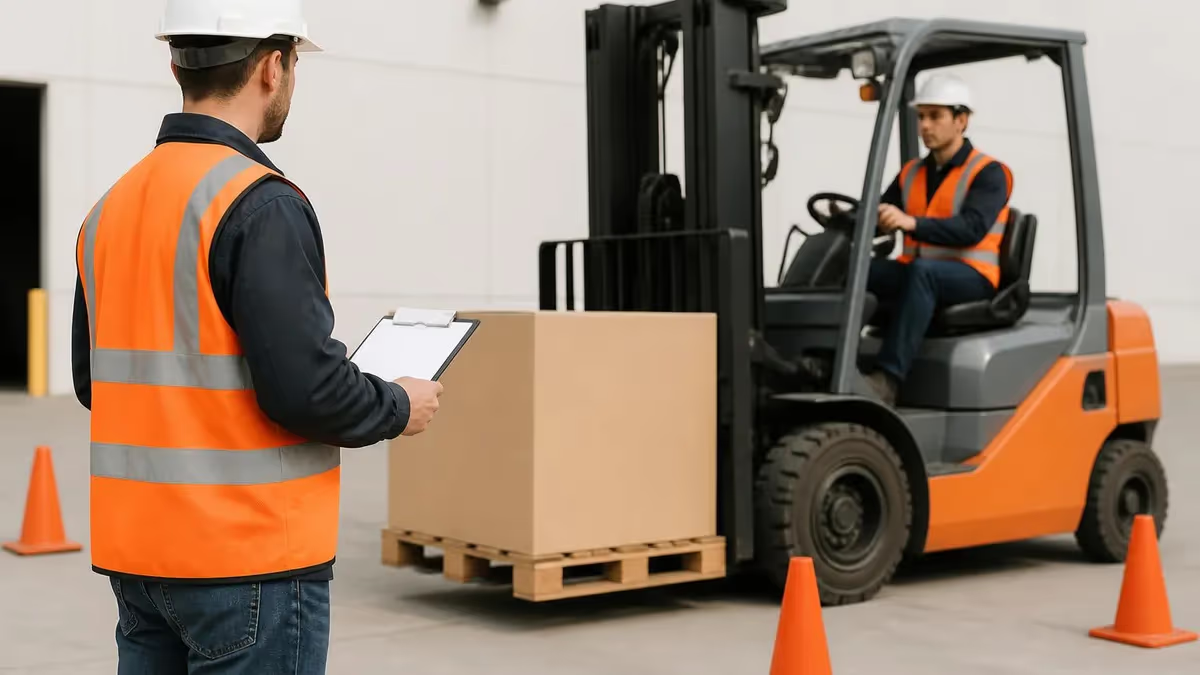
A reliable 24 volt forklift battery charger sits at the center of every well-run electric fleet, and understanding how it interacts with the battery, motor, and control system is the difference between a forklift that lasts a decade and one that fails inside three years. Whether you operate a single warehouse truck or manage a fleet through a forklift rental contract, parts and maintenance decisions drive the largest share of your total cost of ownership. This guide walks through every major component, the wear patterns operators should recognize, and the preventive intervals that keep machines productive.
Forklifts come in dozens of configurations, but they share a common skeleton: a power source, a hydraulic lift system, a drive train, a mast assembly, and an operator compartment. Each subsystem has its own service rhythm. Electric trucks rotate around battery chemistry and charger cycles, while internal combustion units demand fuel system care, exhaust scrubbing, and engine oil discipline. Knowing which truck you own changes the maintenance calendar dramatically, and rental customers should always request the manufacturer service log before signing.
The numbers tell a clear story. The U.S. material handling market exceeds 600,000 forklift units in active service, and roughly 40 percent of all unscheduled downtime traces back to battery, tire, or hydraulic problems that proper preventive maintenance would have caught early. Operators trained to perform OSHA pre-shift inspections catch about 70 percent of those issues before they become failures. That is why every forklift operator certification program devotes significant time to component recognition, fluid checks, and the daily walk-around.
Battery systems deserve special attention because they represent the single largest replacement cost on an electric truck. A 24-volt lead-acid traction battery typically lasts 1,500 charge cycles when paired with a matched charger and watered on schedule. Lithium-ion equivalents stretch that to 3,000 cycles or more, but they require completely different chargers, monitoring software, and operator habits. Mixing chemistries across a fleet without segregating chargers is one of the most expensive mistakes a warehouse manager can make.
Tires, often overlooked, are the second-largest wear item. A cushion tire on a stand up forklift running on a clean concrete floor will last 2,000 to 3,000 operating hours, while a pneumatic tire on an outdoor yard truck may need replacement at 1,200 hours due to cuts and chunking. Tire selection affects stability, stopping distance, and load capacity, and OSHA inspectors routinely cite operators for running on tires worn past the 50 percent wear line.
Hydraulic systems power the lift, tilt, and attachment functions, and they fail in predictable ways. Cylinder seals weep, hoses crack at fitting bends, and contaminated fluid degrades pump performance. The good news is that hydraulic maintenance is cheap relative to the damage neglect causes. A $35 filter change every 1,000 hours protects a pump assembly that costs $1,800 to replace. Most rental fleets perform this swap automatically; private owners must add it to their calendar.
This guide covers chargers, batteries, tires, hydraulics, brakes, masts, and the full range of forks, carriages, and attachments. By the end you will know which parts to stock on-site, which to source through OEM channels, and which can safely be ordered through aftermarket suppliers without voiding your warranty or compromising the OSHA compliance posture of your fleet.
Forklift Parts and Maintenance by the Numbers

Battery Charger Systems for Electric Forklifts
Deliver a steady 16 to 18 amps per 100 amp-hours over an 8-hour cycle. Best for single-shift operations where the truck sits idle overnight. Typical 24V unit costs $1,200 to $1,800 and lasts 10-12 years with minimal maintenance.
Designed for break and lunch charging during multi-shift operations. Push 25-40 amps per 100 amp-hours and complete partial charges in 15-30 minutes. Require batteries rated for high-rate charging or service life drops by 30 percent.
Deliver 40 amps or more per 100 amp-hours and can fully restore a battery in under 2 hours. Ideal for 24/7 operations but generate significant heat, requiring battery cooling systems and tight temperature monitoring to prevent damage.
Communicate directly with the battery management system over CAN bus, adjusting voltage and current dynamically. Not interchangeable with lead-acid chargers. A 24V lithium charger costs $2,500 to $4,000 but pays back in cycle life and labor savings.
Beyond the charger and battery, a forklift contains hundreds of replacement parts grouped into predictable failure categories. Understanding which parts wear, which break, and which simply need adjustment turns reactive repair into planned maintenance. The most cost-effective fleets keep a small inventory of high-turnover parts on-site and rely on regional distributors for everything else. A nearby parts supplier, often the same vendor that handles forklift rental near me searches, will typically deliver common items within 24 hours.
Forks and carriages are the workhorses that contact every load. ITA hooks, the standard mounting interface, allow forks to slide on and off without specialized tools, but inspection rules under OSHA 1910.178 require quarterly checks for cracks, heel wear exceeding 10 percent, and angle deviation greater than 3 degrees from horizontal. Replacement forks for a Class II carriage cost $400 to $700 per pair, and a bent fork must be retired immediately. Welding repairs on forks are explicitly prohibited by ANSI/ITSDF B56.1.
Mast assemblies contain chains, rollers, hoses, and cylinders. Lift chains stretch over time, and once elongation exceeds 3 percent of the original pitch length the chain must be replaced. A simple chain gauge confirms this in seconds. Hydraulic hoses inside the mast suffer constant flex fatigue, and a single ruptured hose can spray 2,000 psi fluid that creates both a slip hazard and a serious skin-injection risk. Many fleets replace mast hoses on a fixed 5-year schedule regardless of visible condition.
Drive units differ sharply between electric and internal combustion forklifts. Electric trucks rely on AC traction motors that are nearly maintenance-free until 10,000 hours, while LPG and diesel engines follow standard automotive service intervals adjusted for severe duty. Engine oil should be changed at 250 hours rather than the more familiar 5,000 miles, and air filters fill quickly in dusty warehouses. Many used forklifts for sale hide neglected engines beneath fresh paint, so always pull the dipstick and inspect the air filter before buying.
Braking systems use either drum brakes with wet-disc immersion or dry-disc setups. Wet brakes last 8,000 to 12,000 hours because they run in cooled oil. Dry brakes wear faster, especially on trucks operating on ramps or in cold storage. Parking brake adjustments are a leading cause of OSHA citations because a truck that rolls when parked is a runaway hazard. Adjustment takes 15 minutes and costs nothing in parts.
Steering and hydraulic pumps, control valves, and lift cylinders round out the major systems. These components rarely fail catastrophically but degrade slowly, producing symptoms like drift in a raised load, slow lift speed, or excessive steering effort. Operators trained to report these symptoms early save thousands in repair costs. The OSHA pre-shift inspection form lists every one of these check points, which is why operators who complete a full certification program become the best maintenance early-warning system any fleet can deploy.
Counterweights, overhead guards, and load backrests are structural parts that almost never need replacement but must be inspected after any collision. A bent overhead guard cannot be straightened; it must be replaced. Welding repairs to structural components require documentation from a qualified engineer and re-certification of the truck. Skipping that paperwork creates serious liability if the truck is involved in a future incident.

Forklift certification Practice Test Questions
Prepare for the Forklift certification Certification exam with our free practice test modules. Each quiz covers key topics to help you pass on your first try.
Forklift certification Certification Forkl...
Forklift certification Exam Questions covering Certification Forklift certification Maintenance and Repairs. Master Forklift certification Test concepts for certification prep.
Forklift certification Certification Forkl...
Free Forklift certification Practice Test featuring Certification Forklift certification Maintenance and Repairs Questions and Answers. Improve your Forklift certification Exam score with mock test prep.
Forklift certification Certification Forkl...
Forklift certification Mock Exam on Certification Forklift certification Operator Training and Certification Requirements. Forklift certification Study Guide questions to pass on your first try.
Forklift certification Certification Forkl...
Forklift certification Test Prep for Certification Forklift certification Operator Training and Certification Requirements Questions and Answers. Practice Forklift certification Quiz questions and boost your score.
Forklift certification Load Handling and S...
Forklift certification Questions and Answers on Load Handling and Stability. Free Forklift certification practice for exam readiness.
Forklift certification OSHA Regulations an...
Forklift certification Mock Test covering OSHA Regulations and Compliance. Online Forklift certification Test practice with instant feedback.
Forklift certification Pre-Operation Inspe...
Free Forklift certification Quiz on Pre-Operation Inspections. Forklift certification Exam prep questions with detailed explanations.
Forklift certification Refueling and Recha...
Forklift certification Practice Questions for Refueling and Recharging Procedures. Build confidence for your Forklift certification certification exam.
Forklift certification Safe Driving and Ma...
Forklift certification Test Online for Safe Driving and Maneuvering. Free practice with instant results and feedback.
Forklift certification Workplace Hazard Id...
Forklift certification Study Material on Workplace Hazard Identification. Prepare effectively with real exam-style questions.
Forklift certification Forklift Instructions
Free Forklift certification Test covering Forklift Instructions. Practice and track your Forklift certification exam readiness.
Forklift certification Forklift MCQ
Forklift certification Exam Questions covering Forklift MCQ. Master Forklift certification Test concepts for certification prep.
Forklift certification Forklift Employer R...
Free Forklift certification Practice Test featuring Forklift Employer Responsibilities. Improve your Forklift certification Exam score with mock test prep.
Forklift certification Forklift Penalties ...
Forklift certification Mock Exam on Forklift Penalties for Non-Compliance. Forklift certification Study Guide questions to pass on your first try.
Maintenance Profiles by Forklift Type
An electric forklift centers its maintenance program on the battery, charger, and electrical control system. The traction battery represents 30 percent of new truck cost, and water levels must be checked every 5 charge cycles for flooded lead-acid units. Lithium-ion batteries skip watering entirely but require periodic cell balancing and BMS firmware updates. Brushless AC motors are essentially sealed for life and need only contactor inspection every 2,000 hours.
Brake adjustment, mast lubrication, and hydraulic fluid changes follow the same schedule as any other truck. The big advantage is that electric units have far fewer moving parts than IC equivalents, which translates to roughly 50 percent lower annual maintenance costs. Indoor air quality, lower noise levels, and zero exhaust make electric trucks the default choice for food, pharmaceutical, and retail distribution environments where IC fumes would contaminate product.
Owning Forklifts vs Choosing Forklift Rentals for Maintenance Control
- +Full control over service intervals and parts quality
- +No hourly utilization caps or overage charges
- +Tax depreciation benefits over 5-7 years
- +Custom attachments and modifications allowed
- +Operator familiarity improves with consistent equipment
- +Long-term cost per hour drops below $4 after year three
- +Resale value preserved with documented service history
- −Capital outlay of $25,000-$55,000 per new electric forklift
- −In-house mechanic or service contract required
- −Battery replacement costs land on owner at year 5-7
- −Downtime during repairs disrupts operations
- −Insurance, registration, and storage costs are owner responsibility
- −Disposal of old batteries requires EPA-compliant recycling
- −Technology obsolescence as lithium and telematics advance
Pros and Cons at a Glance
| Pros | Cons |
|---|---|
| Full control over service intervals and parts quality | In-house mechanic or service contract required |
| No hourly utilization caps or overage charges | Downtime during repairs disrupts operations |
| Custom attachments and modifications allowed | Insurance, registration, and storage costs are owner responsibility |
| Operator familiarity improves with consistent equipment | Disposal of old batteries requires EPA-compliant recycling |
| Resale value preserved with documented service history | Technology obsolescence as lithium and telematics advance |

Daily Pre-Shift Inspection Checklist for Forklift Operator
- ✓Check engine oil, coolant, and hydraulic fluid levels before startup
- ✓Inspect tires for cuts, chunking, and tread depth below 50 percent wear
- ✓Verify horn, backup alarm, and all lights function correctly
- ✓Test service brake, parking brake, and inching pedal response
- ✓Examine forks for cracks, heel wear, and angle deviation
- ✓Check mast chains for stretch using a manufacturer chain gauge
- ✓Inspect hydraulic hoses and cylinders for leaks or weeping seals
- ✓Confirm battery water levels and clean any terminal corrosion
- ✓Verify overhead guard, load backrest, and seatbelt integrity
- ✓Document findings on the OSHA daily inspection log before operation
Never mix charger types across battery chemistries
Connecting a lead-acid charger to a lithium-ion battery, or vice versa, can damage thousands of dollars of equipment in seconds. Color-code your charging stations, label every battery clearly, and train every forklift operator to verify the match before plugging in. A simple labeling system pays for itself the first time it prevents an incident.
Parts costs vary dramatically based on whether you source through the original equipment manufacturer, an authorized dealer, or the aftermarket. OEM channels guarantee fit and preserve warranty coverage but charge 30 to 60 percent more than equivalent aftermarket components. For high-value items like control modules, hydraulic pumps, and traction motors, the OEM premium is usually justified. For consumables like filters, belts, hoses, and bulbs, aftermarket suppliers deliver identical quality at half the price.
A typical 24-volt traction battery for a Class II electric forklift runs $3,800 to $4,800 new, plus a core charge of $200 to $400 that gets refunded when you return the old battery for recycling. Refurbished batteries cost roughly half that and come with 12-month warranties from reputable rebuilders. The rebuild process involves replacing failed cells, re-strapping connections, and load-testing the unit to verify capacity. Refurbished is an excellent option for secondary trucks that handle low-priority work.
Tire pricing follows the same OEM versus aftermarket pattern. A press-on cushion tire for a 5,000-pound capacity electric truck costs $180 to $260 per tire from an OEM supplier and $120 to $180 from an aftermarket brand. Pneumatic tires for outdoor trucks range from $200 to $450 depending on size and tread pattern. Solid pneumatic tires, which never go flat, cost 60 to 80 percent more than air-filled equivalents but pay back within 18 months on rough terrain.
Filters, fluids, and small consumables make up the bulk of routine maintenance spend. A complete fluid and filter package for a 250-hour service runs $85 to $140 in parts, and labor adds another $90 to $180 depending on local shop rates. Many fleets bundle these into a fixed-price service agreement at $1,200 to $1,800 per year per truck, which simplifies budgeting and ensures intervals never slip. Service contracts also include emergency response with guaranteed arrival times.
Hydraulic cylinders, control valves, and lift chains live in the middle tier of part costs. A replacement lift cylinder for a standard 188-inch triplex mast runs $850 to $1,400. Mast roller sets cost $300 to $500. Lift chains, sold by pitch and length, run $180 to $320 per chain, and they should always be replaced in matched pairs. Rebuilding rather than replacing a hydraulic cylinder saves about 40 percent if the rod, barrel, and gland are still serviceable.
Big-ticket components like traction motors, drive axles, and electronic control units climb into the $2,000 to $6,000 range. These are the parts where you absolutely want OEM sourcing and a factory-trained technician handling installation. A wrong programming step on a modern control unit can disable safety interlocks or void manufacturer warranties. Holding a current forklift certified credential helps operators recognize when symptoms point to these systems so they can pull a truck out of service before secondary damage occurs.
Finally, attachments such as side-shifters, fork positioners, rotators, and clamps each have their own maintenance schedules. A side-shifter needs lubrication every 250 hours and seal replacement every 5,000 hours. Clamps and rotators include rotation bearings that fail without warning if grease intervals slip. Attachment maintenance is often overlooked because it falls outside the standard truck service menu, but a failed attachment can drop a load and create both injury and product damage liability.
OSHA 1910.178(q)(1) requires that any forklift found in unsafe condition be removed from service immediately. Operating a truck with documented defects in the inspection log carries fines starting at $15,625 per violation and rising to $156,259 for willful or repeated offenses. Document every repair and retain records for at least 12 months.
A well-designed preventive maintenance program follows the manufacturer's recommended intervals while adjusting for actual operating conditions. A truck running two shifts in a clean grocery distribution center can stretch standard intervals by 20 to 30 percent, while a truck working in a foundry or recycling facility needs the calendar compressed by half. Severe duty conditions include high ambient temperatures, heavy dust, frequent ramp work, and continuous high-cycle operation above 80 percent of rated capacity.
The standard intervals are 250 hours for minor service, 500 hours for an intermediate service, 1,000 hours for major service, and 2,000 hours for top-tier inspection. Minor service covers fluid checks, filter replacements, and basic adjustments. Intermediate service adds brake inspection, mast lubrication, and electrical contactor checks. Major service includes hydraulic fluid replacement, drive train inspection, and chain measurement. Top-tier service rebuilds wear items and verifies structural integrity.
Telematics systems have transformed maintenance scheduling for fleets of five or more trucks. Modern systems track engine hours, impact events, battery state of charge, and operator login data. Maintenance alerts fire automatically when hour thresholds approach, and impact events trigger immediate inspection requirements. A telematics subscription runs $20 to $45 per truck per month and typically pays back within nine months through reduced unplanned downtime and improved operator accountability.
Building an in-house maintenance capability makes sense once your fleet exceeds eight trucks. Below that threshold, a service contract with a local dealer usually delivers better economics because dedicated technicians spread their fixed costs across many customers. A full-time forklift mechanic earns $58,000 to $78,000 annually in most U.S. markets, plus another $20,000 to $35,000 in tools, training, and shop space. Doing the math against contract pricing tells you when the crossover point arrives.
Spare parts inventory should match your failure history rather than a generic checklist. Track every parts purchase for 12 months, then stock the items you used three or more times. Common candidates include hydraulic filters, oil filters, light bulbs, fuses, common belts, and standard fork tine sets. Carrying $3,000 to $5,000 of inventory per truck reduces downtime by an average of 35 percent according to material handling industry data published by MHI and ITA.
State-specific compliance adds another dimension. Cal/OSHA, Michigan MIOSHA, and Washington L&I all have stricter recordkeeping requirements than federal OSHA. If you operate across state lines, your maintenance documentation must satisfy the strictest jurisdiction in your footprint. The detailed requirements for forklift truck operators vary significantly, and savvy fleet managers maintain a single set of records that exceeds every state minimum to avoid surprises during inspections.
Finally, document every repair with photos, parts numbers, labor hours, and the technician's name. This audit trail does three things: it supports warranty claims, it preserves resale value, and it protects you in litigation following any incident involving the truck. Cloud-based maintenance management systems like UpKeep, Limble, and Fiix make this documentation effortless and cost less than $50 per truck per month.
Practical maintenance success comes from establishing routines, training operators to spot problems early, and choosing the right parts sourcing strategy for each component class. Start every shift with the OSHA pre-operation inspection and refuse to release any truck with documented defects until repairs are complete. This single discipline prevents the majority of catastrophic failures and signals to your workforce that safety drives every operational decision in your facility, not just signage on the wall.
When selecting a 24 volt forklift battery charger, match the charger's amp-hour output to the battery's rated capacity using the formula recommended by the battery manufacturer. A general rule is 16 to 20 percent of the battery's amp-hour rating as a charging current for conventional chargers, scaled higher for opportunity and fast chargers. Pair lithium batteries only with lithium-rated chargers and verify CAN bus compatibility before purchase. Mismatched chargers cause premature failure and void manufacturer warranties.
Tire selection deserves more attention than most operators give it. Cushion tires work indoors on smooth concrete; pneumatic tires handle outdoor and rough surfaces. Cold-storage facilities below 20 degrees Fahrenheit need polyurethane press-on tires that resist cracking. Cherry picker forklift platforms and order pickers use specialized non-marking tires that prevent floor scuffs in retail environments. Match the tire to the application and you double the service life compared to running whatever tire came with the used truck you purchased.
Battery watering is the single most neglected maintenance task on electric trucks. Flooded lead-acid cells lose water during every charge cycle, and exposed plates suffer permanent capacity loss within minutes. Install a single-point watering system that fills all cells at once through a quick connect, then schedule watering after every 5 to 10 charge cycles based on your duty profile. Single-point systems cost $250 to $400 per battery and pay back within the first prevented battery replacement.
Develop relationships with two or three parts suppliers rather than relying on a single source. OEM dealers provide warranty parts and technical support. Aftermarket distributors deliver consumables at competitive prices. Specialty rebuilders handle batteries, hydraulic cylinders, and electronic controls economically. Having multiple sources prevents supply disruptions and gives you pricing use when a vendor tries to push through unjustified increases on common parts.
Investing in proper training transforms maintenance economics. Operators who complete certification understand the systems they operate and recognize abnormal behavior immediately. A trained operator who reports a slight steering pull saves the company a $1,400 drive axle rebuild that would have happened a week later. Operator training pays back faster than any other maintenance investment, and OSHA requires it anyway, so the question is whether your program delivers real learning or just paperwork compliance.
Finally, treat maintenance as a profit center rather than a cost center. Every dollar spent on preventive maintenance returns three to seven dollars in avoided downtime, extended equipment life, and reduced incident liability. Track your maintenance ROI with simple metrics: hours of unplanned downtime per truck per quarter, parts cost per hour of operation, and incident rate per 10,000 hours. Watch those numbers improve year over year and you will know your maintenance program is working as designed.
Sample Forklift certification Practice Questions
Try these questions from our free Forklift certification practice tests. The correct answer and an explanation follow each question.
What maintenance record should be kept for each forklift?
- A. Only the purchase date
- B. A log of all inspections, repairs, and maintenance performed
- C. The operator's personal notes
- D. No records are required by OSHA
Answer: B. A log of all inspections, repairs, and maintenance performed
OSHA and best practices require maintaining a complete maintenance log for each forklift to track its service history and identify recurring problems.
What PPE is recommended when handling or watering lead-acid batteries?
- A. Sandals and a t-shirt
- B. Acid-resistant gloves, face shield, and apron
- C. Only a hard hat
- D. Hearing protection only
Answer: B. Acid-resistant gloves, face shield, and apron
Battery electrolyte is corrosive sulfuric acid, so acid-resistant gear protects skin and eyes.
What is the 'stability triangle' on a counterbalance forklift?
- A. The area formed by the two front wheels and the center of the rear axle
- B. The shape of the overhead guard
- C. The zone where pedestrians must stand
- D. The angle of the mast tilt
Answer: A. The area formed by the two front wheels and the center of the rear axle
The stability triangle connects the two front wheels and the rear axle pivot; the combined center of gravity must stay inside it to remain stable.
What is a counterweight on a forklift designed to do?
- A. Add speed
- B. Balance the weight of the load on the forks
- C. Protect the operator's head
- D. Cool the engine
Answer: B. Balance the weight of the load on the forks
The counterweight at the rear offsets the load on the forks to keep the truck balanced.
Forklift Questions and Answers
Forklift Tires: Complete Guide to Types, Sizing, Wear Patterns, and Replacement Costs
Forklift Safety Training: Complete OSHA Compliance Guide for Operators and Employers
Forklift Repair Service: Complete Guide to Costs, Common Repairs, and Choosing the Right Technician
Forklift Certification by State: Complete 50-State Guide to OSHA-Compliant Operator Training, Costs, and Renewal Requirements
Forklift Price Guide 2026: New, Used, Rental, and Total Cost of Ownership Breakdown
About the Author

Certified Crane Operator & Skilled Trades Exam Specialist
Ferris State UniversityRobert Martinez is a Journeyman Ironworker, NCCCO-certified crane operator, and forklift trainer with a Bachelor of Science in Construction Technology from Ferris State University. He has 21 years of ironworking, rigging, and heavy equipment operation experience across high-rise and industrial construction sites. Robert prepares candidates for crane operator, rigger, forklift, and skilled trades certification examinations.