
Forklift Certified Mario Pin: The Meme, the Pin, and What Real Forklift Certification Actually Means
✍🏼 The forklift certified Mario pin meme explained — plus real OSHA forklift certification, training costs, rental tips, and how to actually get certified.
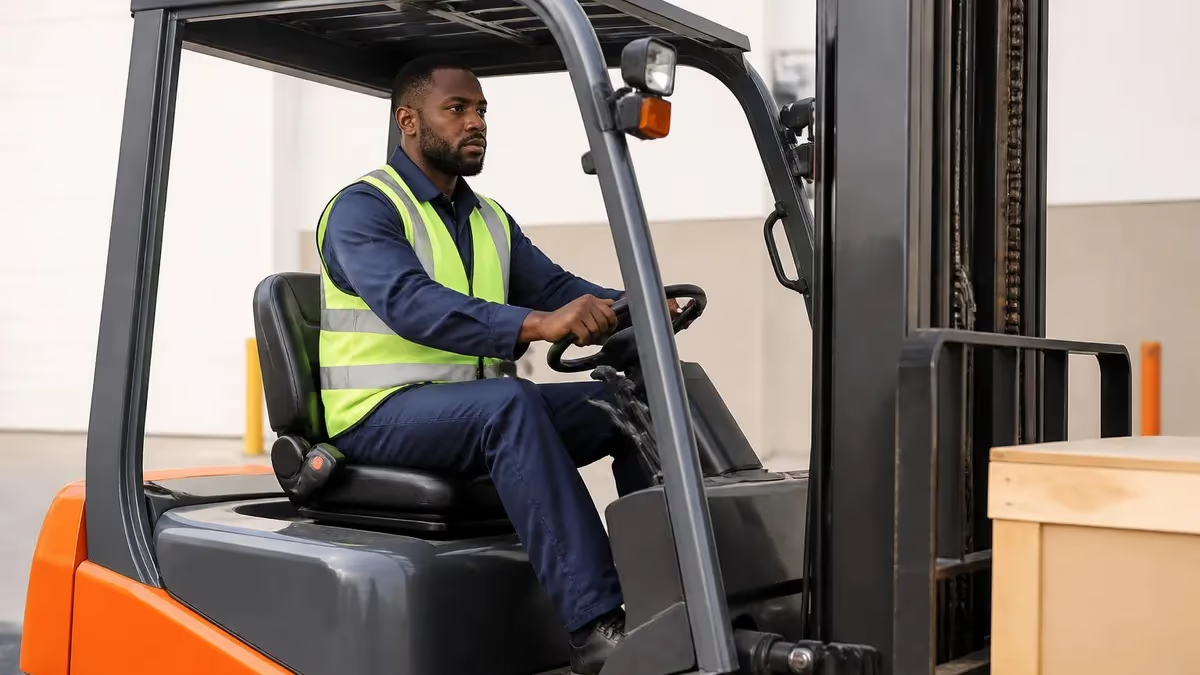
If you have spent more than five minutes on warehouse TikTok or industrial Twitter in the last two years, you have almost certainly seen the forklift certified Mario pin floating across your feed. The image is simple: Mario, grinning, wearing an enamel pin that reads Forklift Certified. It is absurd, it is wholesome, and it has somehow become the unofficial mascot of every operator who has ever sat through eight hours of OSHA training and walked out feeling like a video game hero with a brand-new power-up.
The meme exploded because it captures something true. Earning a real forklift operator credential is a small but genuine victory. You learn to balance a 9,000-pound machine, read a load chart, navigate a crowded aisle, and not kill anyone. Then someone hands you a wallet card and suddenly you feel ten feet tall, even if your actual job still involves moving pallets of dog food at three in the morning. The pin is a joke, but the pride behind it is not.
This article uses the meme as a doorway into the real thing. We will look at how the forklift certified Mario pin became a phenomenon, why it resonates with operators, and then pivot into the practical questions people actually ask once the laughter dies down — how certification of forklift operation really works in the United States, how much a telehandler forklift rental costs, what OSHA expects, and how to avoid the mistakes that get people fired or hurt.
We will cover forklift rental rates and where to find a reputable forklift rental near me search result that is not a scam. We will talk about forklift training programs, the difference between an electric forklift and an internal combustion model, and what stand up forklift operators need to know that sit-down drivers often overlook. We will explain why the forklift operator job market is unusually strong in 2026 and what employers really want to see on a resume.
You will also find a breakdown of the legal requirements under 29 CFR 1910.178, the federal regulation that governs powered industrial trucks. Yes, that is the boring part — but the meme exists because the certification is real, and the certification is real because the regulation is real. Skipping the legal layer is how warehouses end up on the wrong side of a six-figure fine after a single preventable tip-over incident.
By the time you finish reading, you will understand the cultural moment behind the pin, the regulatory framework behind the credential, and the practical steps to either get certified yourself or hire someone who already is. We have packed in real numbers, real costs, and real OSHA citations, plus a handful of free practice quizzes so you can test what you have learned. Consider this the long-form companion piece the meme never knew it needed.
The Forklift Certified Mario Pin by the Numbers

Why the Forklift Certified Mario Pin Became a Meme
Mario is a working-class plumber turned hero. Pinning a forklift cert on him reframes blue-collar credentials as legitimate achievements worth bragging about, not jobs people apologize for at parties.
Disney pins, Pokémon pins, and military challenge coins all use enamel pins as identity markers. The forklift pin mimics that aesthetic and applies it to warehouse culture for the first time.
Real operators carry a laminated card. The meme turned that quiet credential into a visual flex, helping workers showcase a skill that often goes unrecognized in non-industrial circles.
Younger workers reject the four-year degree pipeline. Memes celebrating trades, certs, and skilled labor went viral because they validate paths that high school counselors rarely discuss.
Strip away the Mario pin and the meme leaves you face to face with a real federal regulation. The certification of forklift operators in the United States is governed by OSHA 29 CFR 1910.178(l), which requires every employer to train, evaluate, and certify each powered industrial truck operator before that person operates a truck independently. The rule applies to warehouses, construction sites, ports, lumberyards, and any other workplace where forklifts move loads. It does not matter if the operator drives once a week or eight hours a day — certification is mandatory.
The certification has three components that confuse most newcomers. First, formal instruction, which can include classroom lecture, video, written material, or interactive computer learning. Second, practical training that includes demonstrations by the trainer and hands-on exercises by the trainee. Third, an evaluation of the operator's performance in the actual workplace, on the actual truck, with the actual loads they will handle. A nationally recognized online course alone does not satisfy the rule — the workplace evaluation must happen on site.
Recertification is required every three years at minimum, but several events trigger immediate retraining. An operator who is observed driving unsafely, an operator involved in an accident or near-miss, an operator assigned to a different type of truck, and any change in the workplace that could affect safe operation all require fresh evaluation. Many employers go further and run annual refreshers because their insurance carriers offer premium discounts for documented ongoing training programs.
Penalties for non-compliance are significant. As of 2025, OSHA can assess up to $16,131 per serious violation and up to $161,323 per willful or repeated violation. A single warehouse caught with five uncertified operators could face an $80,000 fine on a routine inspection. After a fatality investigation, that number climbs fast, especially when the employer cannot produce signed training records. This is why crown forklift dealers and other major OEMs now bundle training packages with new equipment sales.
The certification card itself has no expiration date printed on it because the three-year clock starts from the date of the last evaluation, not the date the card was printed. Operators who switch employers technically need to be re-evaluated by the new employer even if their previous certification is still within the three-year window. The card travels with the worker, but the legal responsibility for verification stays with whoever signs the paycheck.
For employers, documentation matters more than the training itself when OSHA shows up. The records must include the name of the operator, the date of the training, the date of the evaluation, and the identity of the person performing the training and evaluation. Lose those records and you effectively have no certified operators, even if every person in the building can drive a forklift in their sleep.
The meme makes this all sound goofy, but the underlying credential is one of the most enforceable workplace certifications in American industry. That is part of why the joke lands — there is real weight behind the goofy pin.
Forklift certification Practice Test Questions
Prepare for the Forklift certification Certification exam with our free practice test modules. Each quiz covers key topics to help you pass on your first try.
Forklift certification Certification Forkl...
Forklift certification Exam Questions covering Certification Forklift certification Maintenance and Repairs. Master Forklift certification Test concepts for certification prep.
Forklift certification Certification Forkl...
Free Forklift certification Practice Test featuring Certification Forklift certification Maintenance and Repairs Questions and Answers. Improve your Forklift certification Exam score with mock test prep.
Forklift certification Certification Forkl...
Forklift certification Mock Exam on Certification Forklift certification Operator Training and Certification Requirements. Forklift certification Study Guide questions to pass on your first try.
Forklift certification Certification Forkl...
Forklift certification Test Prep for Certification Forklift certification Operator Training and Certification Requirements Questions and Answers. Practice Forklift certification Quiz questions and boost your score.
Forklift certification Load Handling and S...
Forklift certification Questions and Answers on Load Handling and Stability. Free Forklift certification practice for exam readiness.
Forklift certification OSHA Regulations an...
Forklift certification Mock Test covering OSHA Regulations and Compliance. Online Forklift certification Test practice with instant feedback.
Forklift certification Pre-Operation Inspe...
Free Forklift certification Quiz on Pre-Operation Inspections. Forklift certification Exam prep questions with detailed explanations.
Forklift certification Refueling and Recha...
Forklift certification Practice Questions for Refueling and Recharging Procedures. Build confidence for your Forklift certification certification exam.
Forklift certification Safe Driving and Ma...
Forklift certification Test Online for Safe Driving and Maneuvering. Free practice with instant results and feedback.
Forklift certification Workplace Hazard Id...
Forklift certification Study Material on Workplace Hazard Identification. Prepare effectively with real exam-style questions.
Forklift certification Forklift Instructions
Free Forklift certification Test covering Forklift Instructions. Practice and track your Forklift certification exam readiness.
Forklift certification Forklift MCQ
Forklift certification Exam Questions covering Forklift MCQ. Master Forklift certification Test concepts for certification prep.
Forklift certification Forklift Employer R...
Free Forklift certification Practice Test featuring Forklift Employer Responsibilities. Improve your Forklift certification Exam score with mock test prep.
Forklift certification Forklift Penalties ...
Forklift certification Mock Exam on Forklift Penalties for Non-Compliance. Forklift certification Study Guide questions to pass on your first try.
Forklift Training by Truck Class
Class I covers electric motor rider trucks — the sit-down counterbalanced forklifts you see in most indoor warehouses. An electric forklift in this class typically lifts 3,000 to 6,000 pounds and runs on a 36V or 48V battery that lasts roughly one eight-hour shift. Training emphasizes battery handling, charging station safety, and recognizing reduced lifting capacity as the battery discharges.
Operators learn to navigate narrow aisles, stack pallets in rack systems up to 25 feet high, and handle the distinctive regenerative braking these trucks use. Because there are no emissions, Class I is the default for food, pharmaceutical, and cold storage facilities. The hyster forklift family dominates this segment alongside Toyota and Crown, and certification on one brand transfers to others with a brief orientation, not a full retraining cycle.

Should You Pursue Forklift Certification?
- +Entry-level positions typically pay $18-$24 per hour with overtime
- +Training takes one day, not months or years like other credentials
- +Strong job market with 92,000 openings projected annually through 2032
- +Certification transfers across employers within the same truck class
- +Path to higher pay through reach truck, narrow aisle, and high reach specialty
- +Adds legitimate, verifiable skill to your resume in under a week
- −Physically demanding work with neck, back, and repetitive motion risks
- −Shift work including nights, weekends, and mandatory overtime is common
- −OSHA citations on your record can follow you across employers
- −Re-evaluation required after any accident, even a minor scrape
- −Some employers require additional hazmat or rigging certifications
- −Cold storage and frozen warehouse environments are physically brutal
Pros and Cons at a Glance
| Pros | Cons |
|---|---|
| Training takes one day, not months or years like other credentials | Physically demanding work with neck, back, and repetitive motion risks |
| Certification transfers across employers within the same truck class | Shift work including nights, weekends, and mandatory overtime is common |
| Path to higher pay through reach truck, narrow aisle, and high reach specialty | OSHA citations on your record can follow you across employers |
| Adds legitimate, verifiable skill to your resume in under a week | Re-evaluation required after any accident, even a minor scrape |
Pre-Certification Checklist for New Forklift Operators
- ✓Confirm you are at least 18 years old as required by federal labor law
- ✓Locate an OSHA-compliant training provider or in-house program
- ✓Review the operator manual for the specific truck class you will drive
- ✓Complete the formal classroom or online instructional component first
- ✓Schedule hands-on practical training with a qualified evaluator
- ✓Perform a full pre-shift inspection under direct supervision
- ✓Demonstrate safe load handling, stacking, and traveling on grades
- ✓Pass the workplace evaluation on the actual truck you will operate
- ✓Collect your dated training certificate and signed evaluation form
- ✓Set a reminder for your three-year recertification deadline
No, the Pin Does Not Certify You
Several novelty shops sell actual enamel pins that say Forklift Certified, and that is fine as a joke. But the pin is not a credential. OSHA requires documented training, hands-on evaluation, and a signed record on file with your employer. If a hiring manager asks for proof, the wallet card and dated certificate are what count. The pin goes on your hat. The card goes in your wallet. Do not confuse the two on day one of a new job.
The forklift rental market in the United States is enormous and surprisingly competitive. Average daily rental for a standard 5,000-pound Class IV cushion-tire truck runs $150 to $250 per day, $450 to $750 per week, and $1,200 to $2,400 per month in most metro areas. Pneumatic-tire outdoor trucks add 15 to 25 percent. Searches for forklift rental near me have tripled since 2021 as construction and last-mile logistics demand surged, and dealers have responded by expanding short-term fleets and offering same-day delivery in major markets.
Renting beats buying when you need a truck fewer than 1,200 hours per year, when you need specialty equipment for a single project, or when your space constraints change seasonally. Forklift rentals also make sense during equipment downtime — keeping a backup unit eliminates the productivity hit when your primary truck goes in for major service. Most rental contracts include planned maintenance, but operator training is rarely bundled and remains the renter's legal responsibility under OSHA.
Buying makes sense when you cross roughly 1,500 hours of annual use. A new electric forklift in the 5,000-pound class runs $28,000 to $42,000, while a quality used unit with under 8,000 hours can be found for $12,000 to $22,000. A diesel or LP forklift for sale on the secondary market in the same capacity range usually lists $9,000 to $18,000 depending on hours, brand, and attachment package. Factor in batteries, chargers, and tires across a seven-year ownership window and total cost of ownership often surprises first-time buyers.
Forklift operator wages have climbed faster than overall warehouse wages since 2020. The Bureau of Labor Statistics puts median operator pay at $42,360 as of mid-2025, with the top decile earning over $58,000 in markets like New Jersey, California, and the Texas triangle. Specialty operators on high reach trucks, narrow aisle turret trucks, and container handlers regularly clear $30 per hour with full benefits. Night-shift and cold-storage differentials add another $2 to $4 per hour on top of base.
Training itself is cheap. A standalone OSHA-compliant course at a community college or third-party provider runs $75 to $200 and takes one day. Online portions can be completed in three to four hours, with the practical evaluation scheduled separately at your workplace or the provider's facility. Many employers pay for training as part of onboarding and reimburse the cost if you stay 90 days. There is essentially no scenario where the up-front training cost is a meaningful barrier to entering the field.
One under-discussed expense is the cost of replacement steel-toed boots, hi-vis vests, and bump caps, which most warehouses now require. Budget $150 to $250 in personal PPE for your first month. Good ANSI Z41 boots last six to nine months under daily forklift work, longer if you stay seated most of the shift. Cheap boots will destroy your feet in three weeks, and that pain ends careers faster than any OSHA violation.
Whether you rent, buy, or operate, the financial picture for 2026 strongly favors workers with current certification and any specialty endorsement. The labor shortage in skilled material handling is real, and employers are paying premiums to keep certified operators on the schedule.

Online marketplaces are flooded with sellers offering same-day forklift certification cards for $50 with no training, no evaluation, and no employer involvement. These cards are worthless. OSHA does not maintain a national database, but inspectors do verify training records on site, and a card without a corresponding signed evaluation will not protect the employer or the worker. Buying a fake card can also be prosecuted as fraud in several states. Get certified the real way — it takes one day and costs less than the fake.
The forklift certified Mario pin started as a joke about taking pride in blue-collar credentials, but the joke has aged into something more interesting. It has helped reframe the public perception of warehouse and logistics work for a generation that was told repeatedly that the only path to financial security ran through a four-year degree. The pin signals competence, identity, and community in the same way a fraternity pin or a master's diploma signals those things in other tracks.
That cultural shift is showing up in the data. Vocational program enrollment is at a ten-year high. Apprenticeship sign-ups in skilled trades have grown for six consecutive years. Logistics companies are paying signing bonuses to certified forklift operators in markets like Memphis, Indianapolis, and the Inland Empire. The labor market has, for the first time in decades, started rewarding people who carry the very credentials the meme celebrates.
For workers thinking about their own path, the takeaway is straightforward. Forklift certification is one of the highest return-on-time-invested credentials available in the United States. One day of training, one evaluation, and you have a verifiable skill that employers in every region need. Add a second specialty within a year — reach truck, narrow aisle, high reach, or rough terrain — and you have effectively doubled your earning potential without spending a single dollar on tuition.
For employers, the meme is a free recruiting tool. Operators want to feel that their work matters and that their skills are recognized. Cultures that celebrate certification — through actual pins, jackets, callouts at safety meetings, or quarterly recognition — retain operators at noticeably higher rates than cultures that treat certification as a checkbox. Turnover in material handling is brutal, often 40 to 60 percent annually. Anything that signals respect for the role reduces churn.
Beyond entry-level work, the certification serves as a foundation for a real career. Operators move into lead positions, then shift supervisor, then operations manager. Many warehouse managers started by driving a stand up forklift overnight while studying logistics or supply chain management on the side. The path is genuine, well-trodden, and underadvertised compared to the dominant white-collar narrative. Find a quality hyster forklift training program and you have a credible first rung.
The pin also points to a healthier conversation about skilled trades in general. CDL drivers, HVAC technicians, electricians, and crane operators all need similar pop-culture validation. Memes that started as inside jokes have repositioned entire occupations as legitimate, even desirable. Whether that energy compounds over the next decade depends on whether young workers see actual upward mobility, not just internet validation.
If you are reading this and considering getting certified, do not overthink it. Find a community college, a national chain like ProLogistix or Adecco, or your local OSHA-authorized training provider. Pay your $100. Show up sober. Pass the evaluation. Put the card in your wallet. Then, sure, buy the pin. You will have earned it.
Practical preparation for your certification exam comes down to three habits. Read the OSHA powered industrial truck standard end to end — it is shorter than you think, about 30 pages, and most questions on any reputable test pull language directly from it. Walk the actual truck you will be evaluated on at least once before the day of the exam, ideally with the trainer present, and get familiar with the parking brake, the horn, the seat belt, the load chart sticker, and the data plate.
Memorize the pre-shift inspection sequence cold. Most failed practical evaluations are not failed at the controls — they are failed at the inspection. Operators skip the fork inspection, miss a chain link, forget to check tire pressure, or omit the hydraulic leak walk-around. Evaluators count every missed item. Build a habit of doing the inspection the same way every single time, even on truck number forty of the day, and you will pass the practical on the first attempt.
Understand the data plate. The data plate is the legal source of truth for what the truck can lift, at what fork height, at what load center, with what attachment, and on what tire configuration. Questions on the data plate appear in every reputable certification test because a misread data plate is the leading cause of tip-overs. Learn to read the rated capacity at different load centers and you will outperform 80 percent of test takers.
Practice load handling with a focus on the stability triangle. The three points are the two front wheels and the pivot point of the rear axle, and the truck stays stable only when the combined center of gravity falls inside that triangle. Speed in turns, raised loads, and uneven floors all shrink the safe zone. Evaluators specifically test whether you slow before turning, lower the load before traveling any meaningful distance, and tilt the mast back before lifting.
Get clear on traffic rules in the actual facility. Forklift traffic patterns vary wildly between warehouses. Some run one-way aisles. Some require horn at every intersection. Some require headlights on regardless of lighting. Ask your evaluator for the site rules before the practical and you will avoid the small avoidable penalties that turn an otherwise strong run into a failure. A quality forklift training near me search can connect you with local programs that mirror the rules in your future workplace.
On test day, eat breakfast, hydrate, and skip caffeine if it makes you jittery. Most exams are roughly two hours of written material followed by an hour of practical. Take your time on the written. Read each question twice. There is no bonus for finishing first. On the practical, talk through what you are doing — verbalizing your inspection and your load planning helps evaluators score you correctly and forces you to slow down, which is exactly what they are looking for.
Finally, treat the certification as a starting point, not an ending. The best operators keep learning years after their first card. Read incident reports. Watch safety videos. Compare load charts across truck classes. The job rewards curiosity, and curiosity is what separates a forklift driver from a forklift professional. The pin is fun, but the habits behind the pin are what build a 20-year career.
Sample Forklift certification Practice Questions
Try these questions from our free Forklift certification practice tests. The correct answer and an explanation follow each question.
What does it mean when a forklift is placed on 'lockout/tagout'?
- A. The forklift is locked in the charging bay overnight
- B. Energy sources are isolated and the equipment is labeled unsafe to operate
- C. The forklift is assigned exclusively to one operator
- D. The forklift is scheduled for a future inspection
Answer: B. Energy sources are isolated and the equipment is labeled unsafe to operate
Lockout/tagout procedures isolate all energy sources and warn others not to operate the equipment until repairs are complete.
What is the maximum allowable travel speed for a forklift in a busy pedestrian work area?
- A. Whatever speed the operator feels safe with
- B. A speed that allows stopping safely, typically walking pace (about 5 mph or less)
- C. The forklift's top rated speed
- D. 15 mph at all times
Answer: B. A speed that allows stopping safely, typically walking pace (about 5 mph or less)
In pedestrian areas operators must slow to a speed that allows a safe, controlled stop, usually walking pace.
If a forklift starts to tip over, what should a seated operator do?
- A. Jump clear of the machine
- B. Stay in the seat, hold on, and lean away from the fall
- C. Stand up and step off the side
- D. Grab the load to steady it
Answer: B. Stay in the seat, hold on, and lean away from the fall
Operators should stay belted in the seat, brace, and lean away from the direction of the tip rather than jumping.
What happens to a forklift's stability if the load is placed farther out on the forks than the rated load center?
- A. Capacity increases
- B. Effective capacity decreases and tip-over risk rises
- C. Nothing changes
- D. The truck becomes more stable
Answer: B. Effective capacity decreases and tip-over risk rises
A load beyond the rated center shifts the center of gravity forward, reducing capacity and increasing tip-over risk.
Forklift Questions and Answers
Forklift Tires: Complete Guide to Types, Sizing, Wear Patterns, and Replacement Costs
Forklift Accessories: Complete Guide to LED Lights, Attachments, Safety Gear, and Productivity Upgrades for 2026
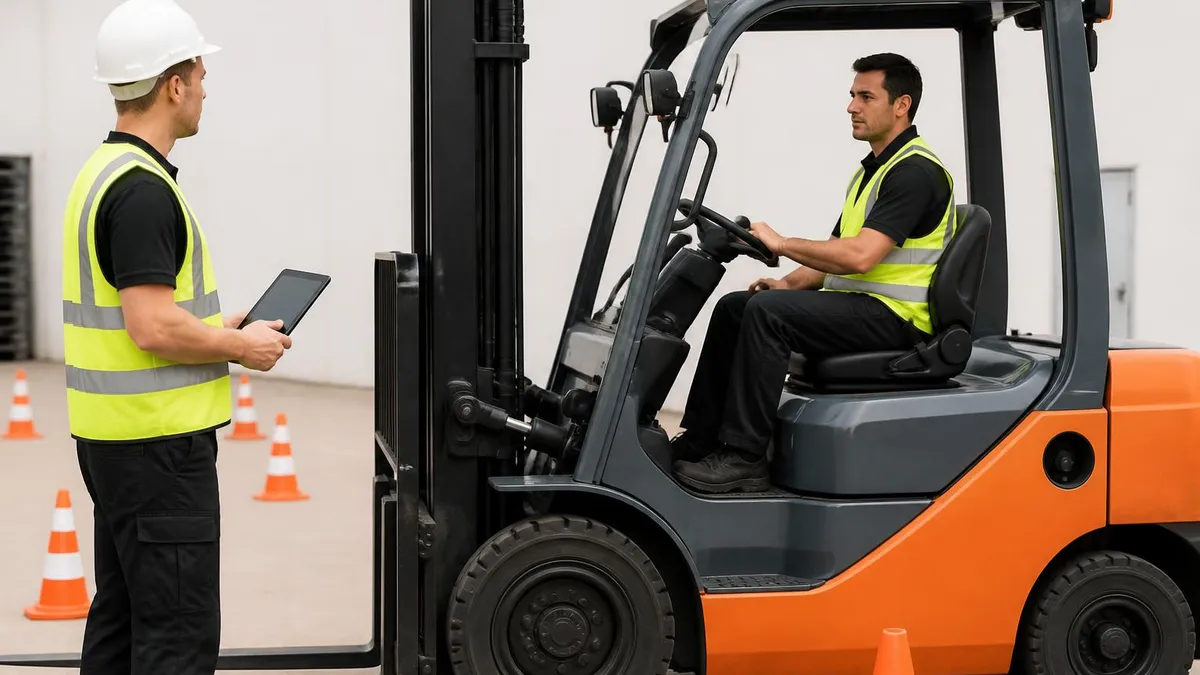
Forklift Safety Training: Complete OSHA Compliance Guide for Operators and Employers
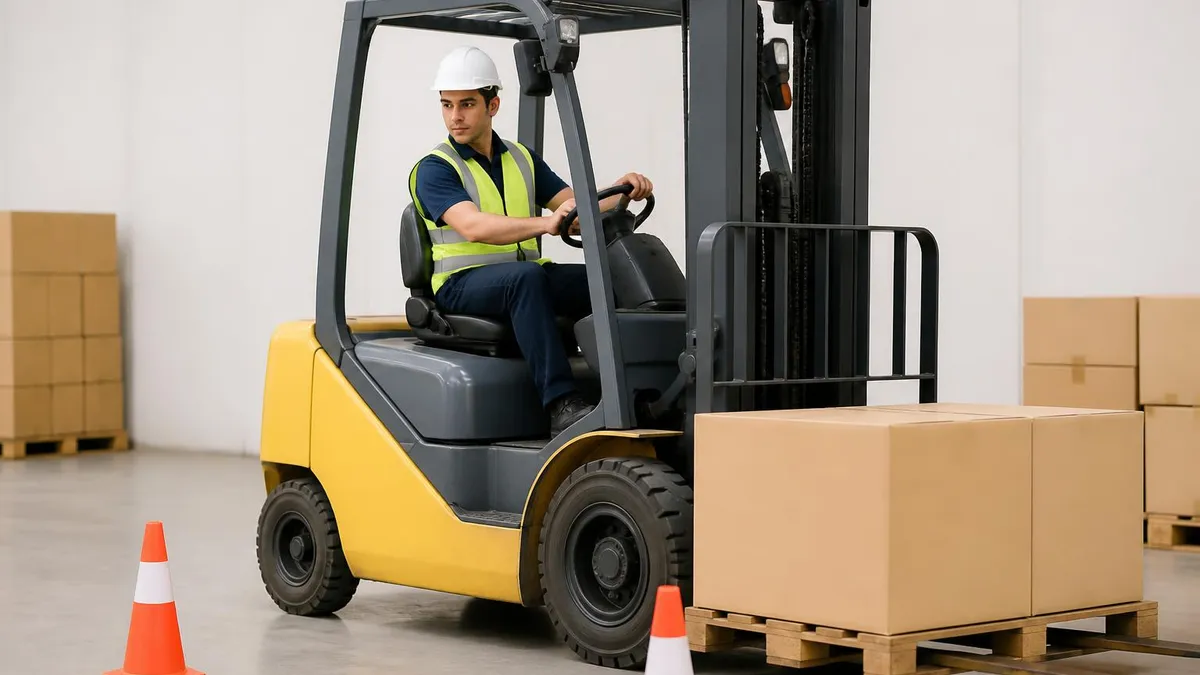
Forklift Repair Service: Complete Guide to Costs, Common Repairs, and Choosing the Right Technician
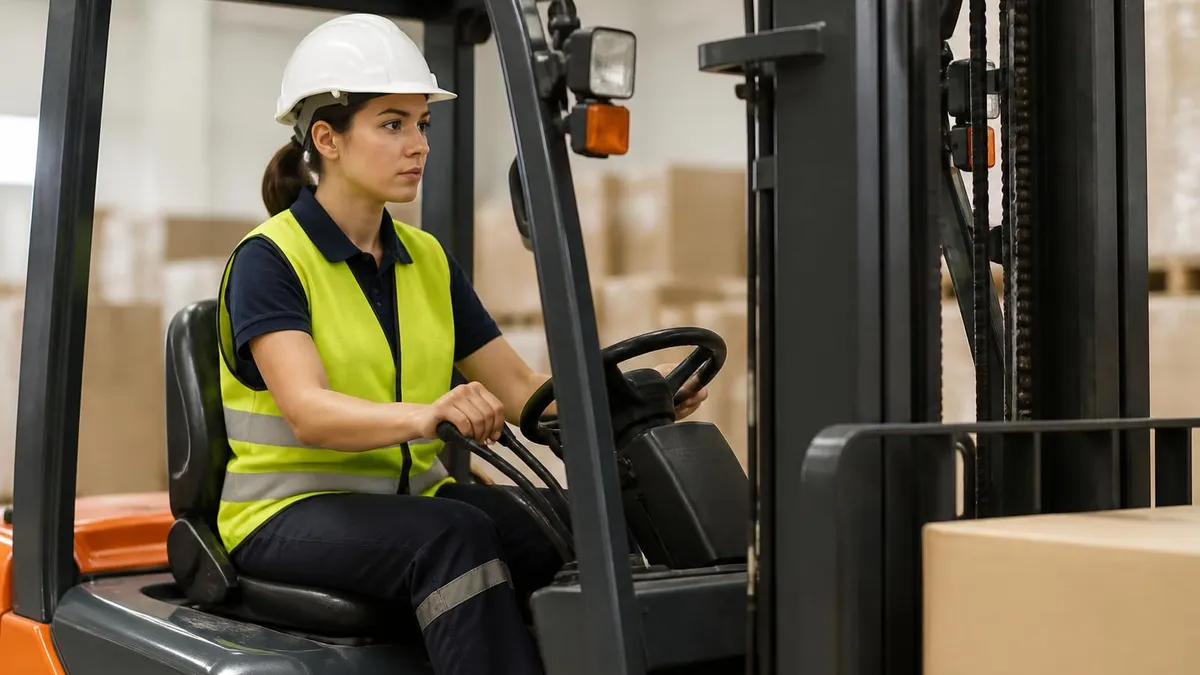
Forklift Price Guide 2026: New, Used, Rental, and Total Cost of Ownership Breakdown
About the Author

Certified Crane Operator & Skilled Trades Exam Specialist
Ferris State UniversityRobert Martinez is a Journeyman Ironworker, NCCCO-certified crane operator, and forklift trainer with a Bachelor of Science in Construction Technology from Ferris State University. He has 21 years of ironworking, rigging, and heavy equipment operation experience across high-rise and industrial construction sites. Robert prepares candidates for crane operator, rigger, forklift, and skilled trades certification examinations.