
Forklift Driver Salary: Complete Pay Guide for 2026 October
🧠 Costco forklift driver pay, salary ranges, certification costs, forklift rental insights, and career growth data for 2026 October forklift operators.
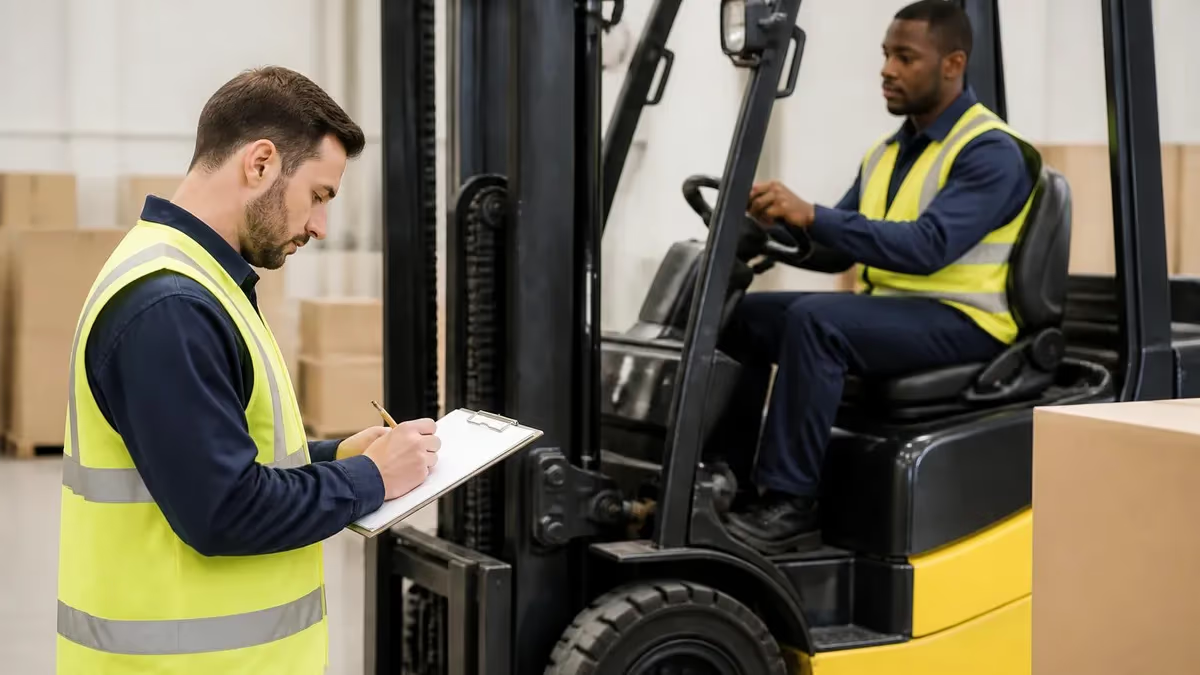
If you searched costco forklift driver pay, you are part of a massive group of warehouse workers trying to figure out whether forklift driving is a sustainable career or just a stepping stone. The short answer is that costco forklift driver pay ranges from roughly $22 to $32 per hour depending on tenure, location, and shift, putting full-time wages between $46,000 and $66,000 annually before benefits. That puts Costco near the top of the national forklift wage scale, especially when you factor in their well-known benefits package and predictable raise structure.
Before we get into the numbers, it helps to zoom out. The broader forklift industry is enormous, driven by warehousing growth, e-commerce fulfillment, and a constant churn of equipment moving through forklift rental fleets and resale lots. Companies that lean heavily on forklift rental, like seasonal distributors and construction outfits, often pay premium wages for short-term, experienced operators. That demand pressure trickles down to retailers, grocers, and big-box stores who must compete for skilled drivers.
Forklift operator pay also varies significantly by certification level, equipment class, and industry vertical. A reach truck operator at a cold storage facility earns differently than a sit-down operator at a lumber yard, and a stand up forklift driver in a high-density e-commerce DC may earn the most of all. Pay ladders inside companies like Costco, Walmart, Amazon, Home Depot, and Sam's Club all reward additional endorsements, night shifts, and clean safety records — and they all start with the same OSHA-required certification of forklift training program.
Geography is a huge variable too. A forklift operator in the Inland Empire of California, in northern New Jersey, or in the Dallas–Fort Worth metroplex will typically out-earn an operator in rural Mississippi by $4 to $8 per hour for the same job. Costco specifically pays a regional differential, which is why their wages in Seattle, the Bay Area, or Long Island top out well above the national mid-point. Cost of living adjustments, union influence, and warehouse density all shape what you can realistically expect.
This guide breaks down what forklift drivers earn at Costco and beyond, the certifications and endorsements that move you up the pay scale, how electric forklift and stand up forklift work compares with sit-down propane jobs, and how forklift rental companies, OEMs, and dealers fit into the pay ecosystem. We'll cover entry-level wages, peak earnings, overtime patterns, holiday pay, and the safety credentials hiring managers prioritize when offering a top-of-band salary.
You'll also see real-world examples — actual job postings, wage data from BLS, internal pay bands disclosed in employee filings, and what experienced operators in forklift forums report. By the end you'll know whether forklift driving is right for your goals, how to negotiate your offer, and which credentials to chase first if you want to maximize earnings without going back to college.
Forklift Driver Salary by the Numbers

Forklift Driver Pay by Employer
Starts around $22/hour with regular step raises, topping out near $32/hour for senior operators. Strong benefits, predictable scheduling, and one of the most generous warehouse wage ladders in U.S. retail.
Powered industrial truck (PIT) operators earn $19–$26/hour depending on tier. Includes shift differentials of $1–$3/hour for nights and weekends, plus signing bonuses in high-demand fulfillment regions.
Distribution center forklift drivers earn $21–$30/hour. Sam's Club tends to mirror Costco's structure with steady step raises, while Walmart DCs pay above retail-store rates with overtime opportunities.
Lot loader and yard forklift operators earn $17–$24/hour. Cherry picker and stand-up forklift specialists in RDCs (regional distribution centers) earn closer to $25–$28/hour with night premiums.
Demo drivers and yard operators at rental dealers (Toyota, Hyster, Crown) earn $20–$30/hour. Travel technicians who deliver and train customers on rented units can clear $80K with commissions.
National forklift operator wages depend on three big levers: industry, geography, and equipment class. According to BLS data updated through 2025, the median industrial truck and tractor operator earns about $46,440 per year, with the bottom 10% near $32,000 and the top 10% above $72,000. That spread tells you the ceiling is much higher than most people assume — and is well within reach for any operator willing to add endorsements, work shifts others avoid, and stay accident-free for several years.
Industry vertical is the biggest swing factor. Cold storage operators earn 10–20% more than ambient warehouse drivers because few people want to spend ten hours in a 28°F freezer. Petroleum, chemical, and heavy manufacturing pay even higher due to hazardous material handling. Retail distribution sits in the middle, while construction sites and lumber yards usually pay less per hour but offer more overtime. Forklift rental yards pay competitively because they need flexible, experienced operators who can run anything thrown at them.
Equipment class also shapes earnings. Sit-down cushion-tire forklifts are entry-level, while reach trucks, order pickers, side-loaders, and specialized cherry picker forklift units command premium wages. Many large employers will list multiple PIT endorsements on a single job description — and pay $1–$3/hour more per endorsement. Operators who can run electric forklift, propane, narrow-aisle, and outdoor pneumatic rigs become indispensable, especially during seasonal peaks when forklift rental units flood in to handle surge volume.
Shift differentials matter more than new operators realize. A Costco overnight stocker driving a stand up forklift can earn $2.50/hour extra simply by accepting a 10pm–6am schedule. Across all retailers, night-shift differentials range from $1.00 to $3.50/hour, while weekend bumps add another $0.50–$1.50. Stacked together, a base $24/hour wage can become $28/hour real take-home — which is the difference between $50K and $58K per year for the same job.
Geography drives the rest. California, Washington, New Jersey, Massachusetts, and the New York metro area are top-paying markets, with hourly wages 20–35% above the national median. Texas, Georgia, and Tennessee fall in the middle thanks to heavy logistics investment, while rural Midwestern and Southern markets sit at the bottom. Even within a single metro, fulfillment-dense suburbs like Lehigh Valley PA or the Inland Empire CA pay more than the urban core because warehouse competition for labor is fierce.
Tenure compounds all of this. Most large employers — Costco especially — use a step-raise system that automatically bumps wages every 1,000 or 2,000 hours worked, often without requiring a performance review. After three to five years, a Costco forklift driver who started at $22 can be earning $30+ without ever asking for a raise.
Combined with overtime, holiday premiums, and bonuses, total compensation can rival entry-level office careers — without any college debt. Just remember to verify your forklift for sale knowledge stays sharp if you handle dealership or rental yard responsibilities, since equipment expertise often unlocks the highest pay tiers.
Forklift certification Practice Test Questions
Prepare for the Forklift certification Certification exam with our free practice test modules. Each quiz covers key topics to help you pass on your first try.
Forklift certification Certification Forkl...
Forklift certification Exam Questions covering Certification Forklift certification Maintenance and Repairs. Master Forklift certification Test concepts for certification prep.
Forklift certification Certification Forkl...
Free Forklift certification Practice Test featuring Certification Forklift certification Maintenance and Repairs Questions and Answers. Improve your Forklift certification Exam score with mock test prep.
Forklift certification Certification Forkl...
Forklift certification Mock Exam on Certification Forklift certification Operator Training and Certification Requirements. Forklift certification Study Guide questions to pass on your first try.
Forklift certification Certification Forkl...
Forklift certification Test Prep for Certification Forklift certification Operator Training and Certification Requirements Questions and Answers. Practice Forklift certification Quiz questions and boost your score.
Forklift certification Load Handling and S...
Forklift certification Questions and Answers on Load Handling and Stability. Free Forklift certification practice for exam readiness.
Forklift certification OSHA Regulations an...
Forklift certification Mock Test covering OSHA Regulations and Compliance. Online Forklift certification Test practice with instant feedback.
Forklift certification Pre-Operation Inspe...
Free Forklift certification Quiz on Pre-Operation Inspections. Forklift certification Exam prep questions with detailed explanations.
Forklift certification Refueling and Recha...
Forklift certification Practice Questions for Refueling and Recharging Procedures. Build confidence for your Forklift certification certification exam.
Forklift certification Safe Driving and Ma...
Forklift certification Test Online for Safe Driving and Maneuvering. Free practice with instant results and feedback.
Forklift certification Workplace Hazard Id...
Forklift certification Study Material on Workplace Hazard Identification. Prepare effectively with real exam-style questions.
Forklift certification Forklift Instructions
Free Forklift certification Test covering Forklift Instructions. Practice and track your Forklift certification exam readiness.
Forklift certification Forklift MCQ
Forklift certification Exam Questions covering Forklift MCQ. Master Forklift certification Test concepts for certification prep.
Forklift certification Forklift Employer R...
Free Forklift certification Practice Test featuring Forklift Employer Responsibilities. Improve your Forklift certification Exam score with mock test prep.
Forklift certification Forklift Penalties ...
Forklift certification Mock Exam on Forklift Penalties for Non-Compliance. Forklift certification Study Guide questions to pass on your first try.
Forklift Operator Pay Across Equipment Classes
Stand up forklift operators — especially those trained on Crown, Raymond, or Yale reach trucks — earn $1–$4/hour more than sit-down drivers because narrow-aisle work demands precise depth perception and rapid pallet handling. In Costco depots and Amazon AR sortation centers, certified stand-up operators routinely clear $26/hour base.
Reach truck specialists handle racks 25–35 feet high, which carries real risk. Employers pay a premium because mistakes drop pallets, damage product, and trigger OSHA investigations. If you want top wages without going outdoors, master the reach truck. It is the single most reliable pay accelerator inside modern fulfillment operations.

Is a Forklift Driving Career Worth It?
- +No college degree required — certification can be completed in days
- +Median pay above the national average for non-degree work
- +Strong job security driven by e-commerce and logistics growth
- +Clear step-raise ladders at major retailers like Costco and Walmart
- +Overtime, shift differentials, and holiday pay add 15–25% to base
- +Skills transfer across industries — warehouse, manufacturing, retail, rental
- −Physically demanding — long hours standing, climbing, and twisting
- −Night and weekend shifts are common for top-paying positions
- −Cold storage and outdoor work involve harsh environmental conditions
- −Injury risk is real — OSHA reports thousands of forklift incidents annually
- −Upward mobility past lead operator often requires management training
- −Wage growth slows after 5–7 years without additional endorsements
Pros and Cons at a Glance
| Pros | Cons |
|---|---|
| No college degree required — certification can be completed in days | Physically demanding — long hours standing, climbing, and twisting |
| Median pay above the national average for non-degree work | Night and weekend shifts are common for top-paying positions |
| Strong job security driven by e-commerce and logistics growth | Cold storage and outdoor work involve harsh environmental conditions |
| Clear step-raise ladders at major retailers like Costco and Walmart | Injury risk is real — OSHA reports thousands of forklift incidents annually |
| Skills transfer across industries — warehouse, manufacturing, retail, rental | Upward mobility past lead operator often requires management training |
Forklift Operator Salary Boost Checklist
- ✓Earn OSHA-compliant forklift certification before applying
- ✓Add a stand up forklift endorsement within your first year
- ✓Get reach truck and order picker certified for narrow-aisle premium pay
- ✓Maintain a zero-incident safety record for at least 24 months
- ✓Volunteer for overnight or weekend shifts to capture differentials
- ✓Cross-train on electric, propane, and pneumatic equipment classes
- ✓Document every load, inspection, and refusal-to-operate event
- ✓Pursue battery-swap or lithium-ion handling endorsements
- ✓Earn a trainer-of-trainers credential to unlock lead-operator pay
- ✓Track competing local wages quarterly to time your raise asks
Multi-class endorsements drive 80% of operator pay growth
Across every major U.S. employer — Costco, Walmart, Amazon, Home Depot, and forklift rental dealers — the operators earning top-of-band wages share one trait: they hold certifications across multiple equipment classes. A driver with sit-down, stand-up, reach, and order picker endorsements is paid 20–30% more than a single-class operator doing identical hours. Stack endorsements first, then chase shift differentials.
Costco's pay ladder is one of the most transparent and well-documented in the warehouse industry, which is why so many job seekers research costco forklift driver pay specifically. The company uses a step-raise system tied to hours worked rather than annual reviews. New hires typically start between $20.50 and $22.50/hour depending on region, with forklift operator roles carrying a $1.00 to $1.50/hour premium over general warehouse positions. After roughly 1,000 hours, drivers see their first automatic step raise.
Each subsequent step raise typically adds $1.00 to $1.50/hour. Within two to three years, most forklift drivers reach $26–$28/hour. Within five years, top-of-scale wages of $30–$32/hour are common, especially at depots and depots' adjacent warehouses. Costco also pays meaningful holiday premiums — typically time-and-a-half on seven recognized holidays plus a flat "Sunday differential" of $2.00–$2.50/hour, which can transform a typical weekend schedule into a substantially higher annual paycheck.
Benefits compound the cash compensation. Costco provides health insurance with low premiums, a 401(k) match, paid vacation that grows with tenure, paid sick time, and an annual bonus for long-tenured employees. When you total base wage, overtime, premiums, and benefits, an experienced Costco forklift driver's total compensation can exceed $80,000 per year — a figure that competes with skilled trades and many entry-level professional roles.
Costco's depot operations differ from warehouse-club store operations. Depot forklift drivers handle large volumes of pallets in cross-dock environments and tend to use stand-up reach trucks and electric pallet jacks more than sit-down units. These positions often pay above the standard warehouse-club forklift rate because the work is faster-paced and requires more endorsements. If you have flexibility, applying directly to a depot is often the fastest path to top wages.
Promotion paths inside Costco also offer pay growth without leaving the floor. Lead operator and supervisor-in-training roles add $2–$4/hour. Beyond that, depot supervisor positions move into salaried compensation in the $70K–$95K range. Many lifelong Costco employees start as forklift drivers, move into lead roles, then into salaried operations management — all without a college degree. The same trajectory exists at Walmart, Amazon, and Target distribution networks.
For those weighing other employers, the comparison is straightforward. Costco's predictable raise structure and benefits package make it one of the highest-total-comp forklift jobs in the country, but Amazon's signing bonuses and rapid shift premiums can outpace Costco in the first 12 months. Walmart and Sam's Club fall in the middle, while forklift rental yards and third-party logistics providers can offer either premium wages or below-market rates depending on the market.

OSHA requires forklift operator certification renewal every three years, or sooner if there is an incident, near-miss, or evaluation failure. An expired certification means you cannot legally operate a powered industrial truck — and most employers will either reassign you to lower-paid duties or send you home unpaid until the credential is restored. Track your expiration date and book renewal training at least 30 days in advance.
Negotiating a forklift driver offer is more straightforward than negotiating an office job, but it still requires preparation. Start by collecting three real data points: the posted wage range on the company's careers site, the wages reported on Glassdoor or Indeed by current operators, and the wages at nearby competitors. If you have multiple endorsements or relevant cross-industry experience, every one of those is a lever you can pull during the conversation. Recruiters expect you to mention them.
Time your negotiation around hiring urgency. Most warehouses ramp aggressively from August through November to prepare for the holiday peak, which is when forklift rental fleets surge into facilities and contract drivers are easier to hire than full-time staff. Applying in late summer or early fall gives you the strongest use because hiring managers are under pressure to close roles quickly. Off-peak hiring, by contrast, often locks you into the lower end of the posted band.
Bring your training documentation. Saved certificates, equipment-specific endorsements, and any safety awards or zero-incident records you can document will move your starting offer up by $0.50–$2.00/hour. If you completed your forklift certification near me through a respected provider, mention the curriculum specifically — recruiters know which programs produce competent operators and will quietly adjust offers accordingly.
Don't ignore non-wage compensation. Schedule flexibility, guaranteed hours, shift assignments, and tuition assistance all carry real dollar value. A guaranteed 40-hour schedule at $22/hour beats a variable 30-hour schedule at $24/hour. Tuition reimbursement programs at Costco, Walmart, and Amazon can fund certifications that later lead to dispatcher, planner, or supervisor roles paying $60K–$90K. Always ask about these benefits in the final interview round.
Counter politely and once. Forklift driver offers are rarely negotiated through extended back-and-forth. Instead, hear the offer, thank the recruiter, ask if there is flexibility on starting wage or shift assignment based on your experience, and let them respond. Recruiters routinely have $1–$2/hour of discretionary room when justified. Use it. The difference between $22 and $24 to start compounds over years of step raises and is worth tens of thousands of dollars over a full career.
Finally, plan your next move before you accept. Identify the endorsement you'll chase in your first 90 days, the shift differential you'll pursue at six months, and the lead-operator opportunity you'll target by year two. Walking into the job with a clear progression map signals professionalism, makes raise conversations easier, and shortens the timeline to top-of-band wages. Operators who plan their career arc rarely stall at entry-level pay.
Once you've landed the job and locked in a competitive starting wage, the next phase is execution. The operators who reach top-of-scale pay quickly share three habits: relentless safety, voluntary cross-training, and proactive communication with supervisors. Each of these costs you nothing but time, and each one compounds into higher wages within 18–24 months. The drivers who plateau early are almost always the ones who treat the job as transactional rather than professional.
Safety is non-negotiable, but it's also the most under-used pay lever. Operators with zero incidents over 24 months are dramatically more likely to be selected for trainer roles, depot transfers, and supervisor tracks — all of which pay $2–$5/hour more. Document every pre-shift inspection, every refusal-to-operate decision, and every near-miss you report. That paper trail is exactly what supervisors use when justifying promotions, and it makes you the obvious candidate when leadership roles open up.
Volunteer for the unpopular shifts and equipment. The driver who consistently runs the cherry picker forklift in the high rack, takes the overnight reach truck rotation, or covers the cold storage shift will be paid more — and will become harder to replace. Indispensability is the foundation of top-of-band wages. Once managers cannot run the floor without you, every raise conversation tilts in your favor. Combine that with formal endorsements and you build a compensation moat that lasts your whole career.
Stay current on equipment trends. The shift toward electric forklift fleets, lithium-ion batteries, and autonomous mobile robots is reshaping what skills warehouses pay for. Operators who can manage hybrid fleets, supervise AMR handoffs, or troubleshoot lithium battery systems will dominate the next decade of pay growth. Even casual self-education — reading manufacturer manuals, watching OEM training videos, attending vendor demos — gives you a measurable edge during raise conversations.
Build relationships across departments. Supervisors, planners, schedulers, and safety leads all influence which operators get the best shifts, the lead roles, and the cross-training opportunities. Treat every interaction as professional development. The forklift drivers who eventually move into salaried supervisor roles are almost always the ones their peers and leaders already trust to coordinate work across teams. That trust starts with how you show up every shift, not with how loudly you advocate for a raise.
Finally, revisit the market every six months. Forklift wages have moved meaningfully each of the past five years, driven by e-commerce expansion, warehouse construction, and persistent labor shortages. If your wage hasn't kept up with the local market, you have use — either to negotiate internally or to jump to a competitor. Loyalty matters, but so does fair compensation. The operators who track market wages and act on the data consistently out-earn those who don't, often by tens of thousands of dollars over a career.
Sample Forklift certification Practice Questions
Try these questions from our free Forklift certification practice tests. The correct answer and an explanation follow each question.
What is the maximum safe travel speed for a forklift in a busy warehouse aisle?
- A. As fast as the machine allows
- B. A walking pace or slower
- C. 25 mph
- D. Whatever keeps up with foot traffic
Answer: B. A walking pace or slower
Forklifts should travel at a walking pace or slower in areas with pedestrians and tight spaces.
What is the primary hazard of using a forklift on a wet or icy loading dock?
- A. Reduced traction leading to skids and tip-over
- B. Faster braking performance
- C. Better tire grip
- D. Lower center of gravity
Answer: A. Reduced traction leading to skids and tip-over
Wet or icy surfaces reduce tire traction, increasing the chance of skidding, sliding off the dock, or tipping.
What does it mean when a forklift is placed on 'lockout/tagout'?
- A. The forklift is locked in the charging bay overnight
- B. Energy sources are isolated and the equipment is labeled unsafe to operate
- C. The forklift is assigned exclusively to one operator
- D. The forklift is scheduled for a future inspection
Answer: B. Energy sources are isolated and the equipment is labeled unsafe to operate
Lockout/tagout procedures isolate all energy sources and warn others not to operate the equipment until repairs are complete.
If the forklift's counterweight approaches any structure closer than a predetermined distance, extra safety precautions need to be taken. How far away is that?
- A. 750 mm
- B. 1000 mm
- C. 300 mm
- D. 600 mm
Answer: D. 600 mm
If a forklift's counterweight approaches any structure closer than 600 mm (approximately 2 feet), extra safety precautions are required. This predetermined distance is a safety standard to prevent crushing hazards for personnel or damage to structures. Operating within this zone necessitates heightened awareness, clear communication, and often the implementation of exclusion zones or spotters to ensure safety.
Forklift Questions and Answers
Forklift Jobs Near Me: Complete Guide to Finding Best Opportunities
Forklift Operation & Equipment Knowledge Practice Test Video Answer
Forklift Inspection & Maintenance Practice Test Video Answer
30-Day Forklift certification Certification Study Plan — Pass on Your First Try
Forklift Certification 2026
About the Author

Certified Crane Operator & Skilled Trades Exam Specialist
Ferris State UniversityRobert Martinez is a Journeyman Ironworker, NCCCO-certified crane operator, and forklift trainer with a Bachelor of Science in Construction Technology from Ferris State University. He has 21 years of ironworking, rigging, and heavy equipment operation experience across high-rise and industrial construction sites. Robert prepares candidates for crane operator, rigger, forklift, and skilled trades certification examinations.