
Forklift Repair Services: Costs, Providers, and Maintenance Schedules
Forklift repair services explained — typical costs, national providers like Wiese and Toyota, on-site vs shop, OSHA checks, and finding local techs. 📗
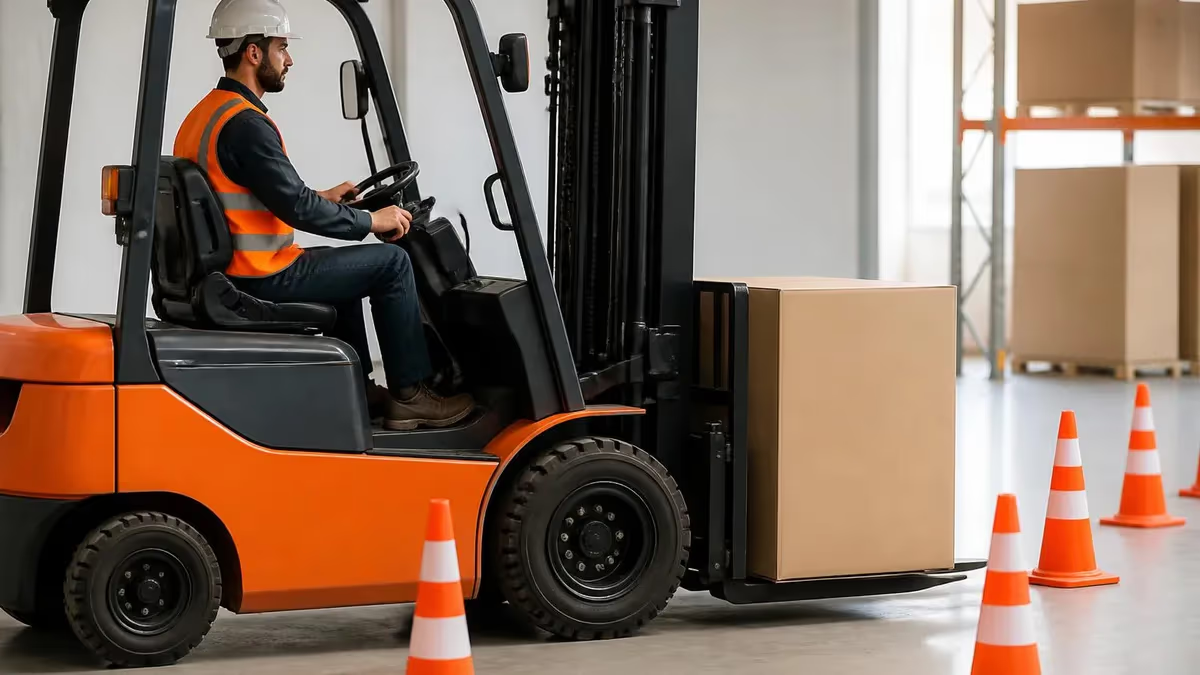
A forklift that won't lift, leaks hydraulic fluid, or limps through the warehouse isn't just an inconvenience — it's a bottleneck that costs you orders, drives up overtime, and quietly chips away at margin. That's where forklift repair services come in. Whether you run a single 5,000-lb rental returned grimy from a remodel or a fleet of forty Class IV trucks moving pallets twenty hours a day, repair isn't optional. It's a line item you plan for, not a surprise that hits you on a Tuesday morning.
Here's the short version: most repair bills fall between $500 and $3,000. Major rebuilds — transmission swaps, full mast resets, engine overhauls — can hit $10,000 or more. The real cost picture depends on the truck's age, fuel type, parts availability, and whether you've kept up with preventive maintenance or let it slide. We'll walk through all of that, including what national chains charge versus the local independent down the road, and how to spot a repair shop that knows what it's doing.
You're not just paying a tech to swap parts. You're paying for diagnostics, parts sourcing, OSHA-compliant inspection paperwork, and the knowledge of someone who's seen the same hydraulic pump fail on a Toyota 8FGCU25 about three hundred times. Cheap repair is rarely cheap — and the wrong repair is sometimes worse than no repair at all. Done right, repair extends the working life of a forklift by years; done wrong, it sets up the next failure six months later.
This guide breaks down what to expect from a forklift repair service call — pricing ranges, typical turnaround, the parts that fail most, the national and independent shops worth knowing, and the questions to ask before you authorize work. By the time you're done reading, you'll know exactly what good repair service looks like, what the typical timelines and costs really are, and how to spot a shop that's quietly selling you something you don't need.

So what actually breaks on a forklift? More than you'd think — but the same parts fail again and again, and a tech can usually narrow it down in fifteen minutes. The big categories are hydraulics, transmission and drivetrain, brakes, the mast assembly, forks, and the power source itself (battery for electric, propane system or diesel/gas engine for IC trucks).
Hydraulics are the workhorse and the most common failure point. Worn seals leak fluid. A failing pump won't generate lift pressure. Tilt cylinders pit and score. You'll see drip patterns on the floor first — that's your early warning. Ignore it, and you'll be replacing the pump itself instead of a $40 seal kit.
Transmissions on older trucks are mechanical; newer ones are hydrostatic or electric. Either way, transmission rebuilds are the single biggest line item you'll face — $3,000 to $8,000 on most mid-size trucks. Catch slipping early and you might escape with a fluid flush and filter change for under $400.
Brakes wear like any other vehicle, but forklift drum brakes are exposed to more dust, grease, and abrasive debris than a car ever sees. Pads, shoes, master cylinders, wheel cylinders — all standard wear items. Plan on brake service every 2,000 to 4,000 hours depending on application.
Forklift Repair by the Numbers
The mast is the part that lifts. It's also the part that, when it fails, takes the truck out of service immediately. Mast chains stretch over time and need adjustment or replacement — usually every 6,000 hours or so. Mast rollers wear, bend, or pop out of alignment. A bent mast section from a low-clearance collision is rebuildable but expensive — count on $2,500 to $6,000 plus crane time to disassemble it.
Forks themselves are inspection items, not really repair items. OSHA requires you to pull a fork from service if it shows a 10% wear loss at the heel, a crack, or visible bending. You don't repair forks — you replace them. A pair of standard 48-inch forks runs $400 to $900 depending on capacity.
Batteries on electric forklifts are their own beast. A flooded lead-acid battery for a Class I or II truck costs $4,000 to $8,000 new. Maintenance is the difference between a five-year battery and a two-year battery — water levels, equalization charges, terminal cleaning, and not running the battery below 20% state of charge.
Propane systems on IC trucks are simpler than you'd think. The regulator, the vaporizer, the lock-off valve — these are the parts that fail. A full LPG system overhaul is usually under $1,200. Diesel and gasoline systems share most failure modes with light trucks: injectors, fuel pumps, starters, alternators.
Preventive maintenance is where smart fleet managers separate themselves from the rest. The rhythm is built around hour-meter milestones, not calendar dates. Most manufacturers structure PMs around 250-hour, 500-hour, and 1,000-hour intervals — and then a major service every 2,000 hours.
At 250 hours you're looking at engine oil and filter, hydraulic filter check, battery water top-off for electrics, and a quick once-over on hoses and chains. Call it a $150 to $300 visit. At 500 hours you add transmission fluid check, brake inspection, mast chain measurement, and a full functional test. At 1,000 hours you're doing coolant service, full hydraulic flush on heavy-use trucks, complete brake service, and a deep inspection of the lift chains and rollers.
The 2,000-hour service is the big one. Engine valve adjustment if your tech recommends it, full mast strip and inspect, transmission service, complete electrical diagnostic. Budget $800 to $1,500 for this one — and don't skip it. The truck that goes to 4,000 hours without a 2,000-hour service is the truck that's going to cost you $7,000 in a single phone call.
Daily inspections are non-negotiable. OSHA mandates a documented pre-shift check on every forklift, every day, by the operator. You'd be amazed how many operations skip this and then act surprised when an inspector shows up. Fluid level checks, horn, lights, brakes, steering, mast operation, tire condition — the whole list takes five minutes once the operator knows what they're doing. Train them once, audit the logs quarterly, and you'll catch ninety percent of developing problems before they cost real money.

What Gets Repaired and How Often
Seals, pumps, cylinders, hoses — the most common repair category by volume
- ▸Seal kits: $40–$120 in parts
- ▸Cylinder replacement: $600–$1,400 installed
- ▸Pump rebuild: $1,200–$2,800
- ▸Hose replacement: $80–$300 per hose
Biggest single repair category by cost — catch problems early
- ▸Fluid + filter: $200–$400
- ▸Clutch service (mechanical): $1,500–$3,000
- ▸Full rebuild: $3,500–$8,000
- ▸Drive axle service: $800–$2,000
Safety-critical — OSHA inspection required after any repair
- ▸Mast chain replacement: $400–$900 per chain
- ▸Roller and bearing service: $500–$1,200
- ▸Bent mast rebuild: $2,500–$6,000
- ▸Fork replacement: $400–$900 per pair
Battery for electric, engine + fuel system for IC trucks
- ▸Battery replacement (lead-acid): $4,000–$8,000
- ▸Lithium-ion conversion: $9,000–$18,000
- ▸Propane regulator service: $500–$900
- ▸Engine overhaul: $6,500–$9,500
National chains versus local independents — this is the question every fleet manager wrestles with. Both have a real place. Let's break it down honestly.
Wiese USA covers the Midwest and runs one of the largest factory-trained tech rosters in the country, and Wiese forklift repair shows up consistently in vendor recommendations across Missouri, Illinois, and Kentucky distribution corridors. Toyota Material Handling has a dealer network that gives you OEM parts, Toyota-trained techs, and warranty integration if you bought the truck new.
Crown's service network is built around their own trucks — superb if you run Crown equipment, less useful for mixed fleets. Yale and Hyster share parent ownership and a service network through their dealer chain. Mitsubishi and Caterpillar have their own dealer programs too, and several regional specialty providers cover narrow-aisle and rough-terrain trucks where general dealers may lack depth.
National chains charge more per hour — typical labor runs $115 to $165 hourly, plus travel. What you're paying for is parts inventory, factory training, warranty access, and standardized PM contracts that scale across multiple sites. If you have three warehouses in three states, a national contract is worth real money. The single point of contact, unified billing, and consistent paperwork across locations matter more than most people realize until they've tried to coordinate six different vendors at year-end.
Local independents are different. Hourly rates run $75 to $110. The tech might have thirty years on the same brands you run. Parts come from their own stock or wholesale distributors overnight. They'll bend on emergency calls and remember your name. The trade-off is variability — quality depends entirely on the shop. A great independent can outperform any national chain in their home market; a mediocre one can leave you stranded when you need them most.
Hybrid strategies work well too. Many fleet managers run an independent for daily PMs and emergency calls, and pull in a brand-specific dealer for warranty work or specialty diagnostics on newer electric equipment. You get the responsiveness of the local shop plus the depth of the OEM dealer when it matters.
National Chains vs. Local Independents
Who: Wiese USA, Toyota Material Handling dealers, Crown service network, Yale and Hyster dealers, Mitsubishi and Caterpillar dealer programs.
Pricing: $115–$165/hour labor, plus travel. Higher overall but predictable.
Strengths: OEM parts, factory-trained techs, multi-site contracts, warranty integration, telematics support.
Weaknesses: Less flexibility on emergencies, longer scheduling lead times in busy seasons, premium pricing on common parts.
On-site versus shop service comes down to one calculation: what's the cost of moving the truck versus the cost of the technician's drive time? Most small repairs — anything under three hours of labor — happen on-site. The tech rolls a truck stocked with common parts, fixes the unit on your dock, and moves on.
Bigger jobs head back to the shop. Transmission rebuilds, mast tear-downs, engine work, full electrical diagnostics on stubborn problems — these need lift equipment, parts washers, hydraulic test benches, and a controlled environment. Plan on three to ten business days for a shop repair, sometimes longer if parts are on backorder.
Towing a forklift isn't simple. Most service companies use a flatbed with hydraulic loading or a roll-back. Tow charges run $150 to $400 each way within a metropolitan area. That cost alone is worth a hard look before you send a 3-hour repair back to the shop — it might be cheaper to pay the tech to stay an extra hour at your facility.
One trick experienced fleet managers use: bundle on-site visits. If the tech is already coming for a hydraulic leak, get the PM done at the same time. You save the trip charge and the truck only goes down once.

Costs are where everything gets real. We've thrown numbers around, so let's lay them out properly. Diagnostic fees run $85 to $150 — and most shops credit it against the repair if you authorize the work. Standard labor sits between $95 and $165 per hour, with travel charged on top at most national chains.
Typical jobs by ballpark: hydraulic seal repair $300 to $800. Tilt cylinder replacement $600 to $1,400. Brake job $400 to $1,200 depending on whether you're replacing wheel cylinders. Mast chain replacement $400 to $900 per chain plus install. Starter or alternator $400 to $700 installed. Propane regulator and vaporizer $500 to $900. Transmission rebuild $3,500 to $8,000. Engine overhaul on a Toyota 4Y or Mitsubishi 4G54 around $6,500 to $9,500 fully installed.
Battery replacement for a Class I electric truck — that's the big surprise on the budget for a lot of operations. A new battery and charger combo for a 36V lift truck can hit $12,000. Reconditioned batteries cut that in half but rarely match new-battery cycle life.
Warranty matters. New trucks come with one- to three-year warranties depending on brand. Extended warranties through dealers run $400 to $1,200 a year and usually pay for themselves on a single transmission claim. Read the fine print — most warranties exclude wear items like brakes, forks, and tires.
Forklift Repair Pre-Service Checklist
- ✓Pull the hour meter reading — know exactly where this truck sits on its PM schedule
- ✓Document the symptom in writing before the tech arrives: when it started, what you've tried, error codes if any
- ✓Check warranty status — call the dealer if the truck is under three years old
- ✓Get two written quotes for any repair quoted over $1,500
- ✓Verify the shop carries factory training on your brand
- ✓Confirm parts availability before authorizing — ask about OEM versus aftermarket pricing
- ✓Lock out and tag out the truck if it's already unsafe to operate
- ✓Schedule a post-repair OSHA inspection on safety-critical work (brakes, mast, steering, forks)
- ✓Save the invoice and inspection paperwork — keep on file 3 years minimum
- ✓Update your fleet maintenance log with parts replaced and hours at repair
Finding a local repair shop is part research, part word-of-mouth. Start with brand-specific dealer locators — Toyota, Crown, Yale, Hyster, Mitsubishi, and Cat all have dealer-finder tools on their websites. For independent shops, ask other warehouse and distribution managers in your area which crew they use and why. Industry groups like MHI and local material handling associations keep member directories.
When you call a prospective shop, ask specific questions. What brands do you specialize in? Do you carry factory-trained certifications? What's your typical response time for an emergency call? Do you offer flat-rate quotes or open-time-and-materials only? Can you provide references from current contract customers?
Get at least two quotes for any repair over $1,500. The spread on transmission work especially can be staggering — we've seen $3,800 versus $7,200 quotes on the exact same truck. The cheap one isn't always best (a rebuilt transmission with no warranty is a gamble), but the expensive one isn't always justified either.
If you're new to forklift ownership or your operators need a refresher, working through a structured forklift certification program also covers basic maintenance and pre-shift inspection — exactly the daily checks that catch problems before they become repairs.
Fleet Service Contracts: Pros and Cons
- +Predictable monthly cost — easier to budget than pay-as-you-go
- +Provider absorbs risk on major repairs
- +Scheduled PMs happen automatically, no chasing visits
- +Single point of contact across multi-site fleets
- +Often includes operator training and OSHA documentation support
- +Telematics monitoring catches problems before failure
- −Only cost-effective at 15+ trucks with consistent utilization
- −Lock-in periods of 24–36 months are common
- −Wear-item exclusions can surprise you on the first big repair
- −Less flexibility to shop competitive quotes mid-contract
- −Coverage gaps for specialty equipment (rough-terrain, narrow-aisle)
Pros and Cons at a Glance
| Pros | Cons |
|---|---|
| Predictable monthly cost — easier to budget than pay-as-you-go | Wear-item exclusions can surprise you on the first big repair |
| Provider absorbs risk on major repairs | Less flexibility to shop competitive quotes mid-contract |
| Scheduled PMs happen automatically, no chasing visits | Coverage gaps for specialty equipment (rough-terrain, narrow-aisle) |
Fleet management contracts deserve their own paragraph because they're where you actually save money long-term. A full-service contract typically covers all scheduled PMs, all wear-item replacements, all emergency repairs, and sometimes telematics monitoring and operator training. You pay a flat monthly fee per truck — usually $90 to $250 depending on the truck's hours and application.
The math works because the provider absorbs risk on big repairs in exchange for predictable revenue on small ones. If you run a fleet of fifteen or more trucks with consistent utilization, fleet contracts almost always come out ahead of pay-as-you-go.
Parts availability is the silent killer on older trucks. A 2003 Hyster might run perfectly well, but try to find a specific solenoid for one and you'll learn what backorder really means. Before you commit to a major repair on a truck over fifteen years old, get your tech to confirm parts are still in production or available used. Sometimes the smart move is to part-out the old truck and pick up a refurbished unit instead of pouring $6,000 into a rebuild.
If your existing equipment shows up on your forklift inspection checklist with repeated yellow-flag items, that's also a signal — write it up, get the repair done, and document the fix.
Sample Forklift certification Practice Questions
Try these questions from our free Forklift certification practice tests. The correct answer and an explanation follow each question.
When operating a propane-powered forklift inside a poorly ventilated truck trailer, which of the following represents the MOST significant, invisible hazard that OSHA regulations address?
- A. Excessive noise levels from the engine.
- B. High concentrations of carbon monoxide (CO).
- C. Depletion of oxygen due to combustion.
- D. Vibrations affecting the trailer's stability.
Answer: B. High concentrations of carbon monoxide (CO).
Internal combustion engines, like those on propane forklifts, produce carbon monoxide (CO), a colorless, odorless, and highly toxic gas. In enclosed or poorly ventilated spaces, CO can quickly accumulate to dangerous levels, posing a severe risk of poisoning to the operator. OSHA has specific limits for CO exposure (29 CFR 1910.1000).
A propane-powered forklift develops a strong fuel odor inside a warehouse. What is the FIRST action the operator should take?
- A. Continue working but alert a supervisor at the end of the shift
- B. Shut off the forklift, move to fresh air, and report the leak immediately
- C. Open all warehouse doors and continue operating
- D. Refill the propane tank to ensure it seals properly
Answer: B. Shut off the forklift, move to fresh air, and report the leak immediately
A propane leak is a fire and explosion hazard; the operator must immediately shut off the engine, evacuate the area, and report it to a supervisor.
What is the maximum allowable travel speed for a forklift in a busy pedestrian work area?
- A. Whatever speed the operator feels safe with
- B. A speed that allows stopping safely, typically walking pace (about 5 mph or less)
- C. The forklift's top rated speed
- D. 15 mph at all times
Answer: B. A speed that allows stopping safely, typically walking pace (about 5 mph or less)
In pedestrian areas operators must slow to a speed that allows a safe, controlled stop, usually walking pace.
What is the main purpose of a forklift pre-operational inspection?
- A. To check the operator's driving skills
- B. To ensure the forklift is safe to operate
- C. To test the forklift's maximum lifting capacity
- D. To clean the forklift before use
Answer: B. To ensure the forklift is safe to operate
The primary purpose of a forklift pre-operational inspection is to identify any defects or issues that could compromise the safe operation of the equipment. By thoroughly checking critical components before use, operators can prevent accidents caused by mechanical failures. This proactive safety measure is essential for protecting both the operator and other workers in the vicinity.
Forklift Certification Questions and Answers
About the Author

Certified Crane Operator & Skilled Trades Exam Specialist
Ferris State UniversityRobert Martinez is a Journeyman Ironworker, NCCCO-certified crane operator, and forklift trainer with a Bachelor of Science in Construction Technology from Ferris State University. He has 21 years of ironworking, rigging, and heavy equipment operation experience across high-rise and industrial construction sites. Robert prepares candidates for crane operator, rigger, forklift, and skilled trades certification examinations.