
Where to Get Forklift Certified: Complete Guide to OSHA-Approved Training Programs, Costs, and Local Options for 2026 October
Where to get forklift certified: OSHA-approved programs, costs, online vs in-person training, employer options, and step-by-step certification paths 📚
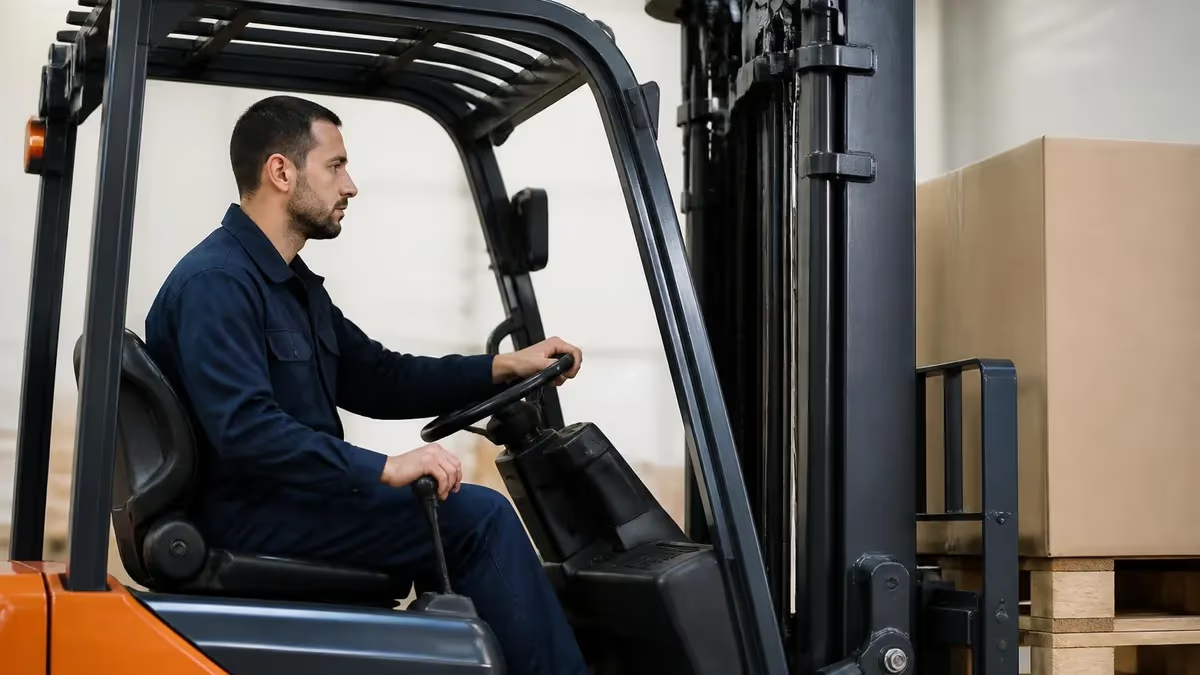
Figuring out where to get forklift certified is the single most common question warehouse workers, construction laborers, and career-changers ask before stepping onto a loading dock. The short answer is that OSHA does not run a single national certification school — instead, certification can be obtained through your employer, an OSHA-authorized third-party training provider, a community college, a forklift rental company that offers training packages, or an accredited online course paired with in-person evaluation. Knowing which path fits your job, schedule, and budget changes everything about how quickly you can start operating forklifts legally.
The Occupational Safety and Health Administration requires every powered industrial truck operator in the United States to be trained and evaluated before driving any class of forklift, including sit-down counterbalance trucks, stand up forklift models, electric pallet jacks, and rough-terrain machines. The standard, 29 CFR 1910.178(l), sets the rules but leaves delivery flexible. That flexibility is why prices range from free employer-paid programs to $300 weekend bootcamps at private training centers.
Forklift training is also one of the fastest credentials in the skilled-trades world. A typical program runs four to eight hours of classroom instruction, one to three hours of hands-on evaluation, and produces a wallet card the same day. Compare that to a CDL, which can take eight weeks, or an electrician apprenticeship that runs four years, and it is easy to see why forklift operator certification is the entry point into warehouse, logistics, and manufacturing careers paying $18 to $28 per hour to start.
This guide walks through every legitimate place to get certified, the real cost ranges in 2026, what online programs actually cover (and what they cannot legally do), how to handle the practical evaluation, and which providers are worth your money. We also cover the documentation you need, how to verify any school is OSHA-compliant, and the renewal cycle so your card never lapses. If you want a primer on the broader process first, read our walkthrough on how to get forklift certified before choosing a provider.
One important note before you spend any money: certification of forklift operators is always job-site specific. Even a perfect online course cannot finish the job alone — federal law requires a qualified evaluator to watch you operate the exact truck class and in the exact environment where you will work. That is why employer-based training remains the gold standard, and why standalone online-only certificates are sometimes rejected by HR departments. We will show you how to combine options to satisfy both OSHA and a picky hiring manager.
Finally, the demand side matters. The Bureau of Labor Statistics tracks more than 750,000 forklift operator jobs nationwide, with steady growth tied to e-commerce fulfillment, cold-storage expansion, and reshoring of US manufacturing. Whether you want a stable warehouse role, a stepping-stone to a logistics management career, or a side gig running a stand up forklift on weekends, knowing where to get certified — and which credential employers actually accept — is the difference between a wasted Saturday and a paycheck within the week.
Forklift Certification by the Numbers

Five Legitimate Places to Get Forklift Certified
Most warehouses, distribution centers, and manufacturing plants pay for in-house certification. The trainer is usually a supervisor or safety officer who completed a train-the-trainer course. Card is typically free, employer-specific, and valid for that job site.
Independent OSHA-authorized providers like NSC, CertifyMe, and ForkliftCertification.com offer same-day classes at fixed prices. Best for job seekers without employer sponsorship who need a portable wallet card to take to interviews.
Programs at community colleges often bundle forklift training with warehouse operations or supply chain certificates. Costs run $200–$400 but include college credit, financial aid eligibility, and stronger resume value for entry-level applicants.
Major forklift rental and dealer networks like Toyota, Crown, Raymond, and Hyster-Yale offer customer training programs. Excellent for small businesses renting equipment and needing operators certified on a specific machine class.
OSHA permits the classroom portion to be completed online, but a qualified evaluator must still observe hands-on operation. Hybrid is the fastest path for busy workers, typically costing $50–$100 for the online half.
The decision between employer-provided training and a third-party program comes down to one practical question: do you already have the job, or are you trying to get one? If you are hired, almost every U.S. employer with forklifts on site is legally required to provide certification at no cost to you. Refusing to do so or charging you for it violates OSHA general duty obligations. Walk into orientation, ask the safety manager for the certification schedule, and you typically have a card within your first week.
If you are still job-hunting, a third-party certificate gives you something concrete to put on your resume. Hiring managers reviewing dozens of warehouse applicants will frequently filter for candidates who arrive pre-certified because it reduces onboarding time and signals initiative. Even though the new employer will still need to re-evaluate you on their specific equipment, having that wallet card cuts the time-to-productivity from one week to one shift, which materially improves your odds at the interview stage.
Third-party providers also matter for temp agencies and staffing firms. Companies like ProLogistix, Aerotek, and Adecco place tens of thousands of warehouse workers each year, and they will often refuse to dispatch a candidate without pre-existing certification because the assignment may be short-term. Spending $79 on an online program before applying to a temp agency can unlock placement at a $20-per-hour assignment within 48 hours, making it one of the highest-ROI training investments in the trades.
The third major group is small business owners and independent contractors. If you run a landscaping company, a small warehouse, or a construction outfit that uses a hyster forklift for occasional material handling, you need certification but probably do not have a full-time safety officer. Third-party providers specialize in this market with mobile training units that come to your site, certify your entire crew in a single day, and provide the documentation you need for insurance and OSHA inspections. A useful adjacent resource on equipment basics is our guide to hyster forklift selection and maintenance.
Community colleges deserve special mention because they bridge the gap between job training and career credentialing. A typical 16-week warehouse operations certificate at a community college will include forklift certification, OSHA 10, basic logistics, inventory software, and sometimes a CDL Class B unit. The total cost might be $1,200–$2,400, but Pell Grants, WIOA workforce development funds, and employer tuition reimbursement frequently cover the entire bill. Graduates emerge with multiple credentials that open doors at warehouse-supervisor pay levels rather than entry-level operator wages.
One often-overlooked option is union-sponsored training. Locals affiliated with the Teamsters, Laborers, and Operating Engineers run forklift programs for members and apprentices, often at no cost. If you are entering construction or freight, joining an apprenticeship can mean getting certified on multiple equipment classes — counterbalance, reach truck, telehandler, rough-terrain — alongside structured wage progression. The catch is that union slots are competitive and may require an application window, so it is rarely the fastest route, but it produces the most portable and respected credentials in the industry.
Finally, do not overlook military and veterans programs. The VA covers forklift training under GI Bill Section 122 benefits at approved schools, and Helmets to Hardhats places transitioning service members directly into pre-apprenticeship roles that include certification. Many states also operate veteran-priority workforce centers where forklift training is free for any qualifying applicant, with placement assistance built in. For job seekers eligible for these programs, they almost always beat paying out of pocket.

Forklift certification Practice Test Questions
Prepare for the Forklift certification Certification exam with our free practice test modules. Each quiz covers key topics to help you pass on your first try.
Forklift certification Certification Forkl...
Forklift certification Exam Questions covering Certification Forklift certification Maintenance and Repairs. Master Forklift certification Test concepts for certification prep.
Forklift certification Certification Forkl...
Free Forklift certification Practice Test featuring Certification Forklift certification Maintenance and Repairs Questions and Answers. Improve your Forklift certification Exam score with mock test prep.
Forklift certification Certification Forkl...
Forklift certification Mock Exam on Certification Forklift certification Operator Training and Certification Requirements. Forklift certification Study Guide questions to pass on your first try.
Forklift certification Certification Forkl...
Forklift certification Test Prep for Certification Forklift certification Operator Training and Certification Requirements Questions and Answers. Practice Forklift certification Quiz questions and boost your score.
Forklift certification Load Handling and S...
Forklift certification Questions and Answers on Load Handling and Stability. Free Forklift certification practice for exam readiness.
Forklift certification OSHA Regulations an...
Forklift certification Mock Test covering OSHA Regulations and Compliance. Online Forklift certification Test practice with instant feedback.
Forklift certification Pre-Operation Inspe...
Free Forklift certification Quiz on Pre-Operation Inspections. Forklift certification Exam prep questions with detailed explanations.
Forklift certification Refueling and Recha...
Forklift certification Practice Questions for Refueling and Recharging Procedures. Build confidence for your Forklift certification certification exam.
Forklift certification Safe Driving and Ma...
Forklift certification Test Online for Safe Driving and Maneuvering. Free practice with instant results and feedback.
Forklift certification Workplace Hazard Id...
Forklift certification Study Material on Workplace Hazard Identification. Prepare effectively with real exam-style questions.
Forklift certification Forklift Instructions
Free Forklift certification Test covering Forklift Instructions. Practice and track your Forklift certification exam readiness.
Forklift certification Forklift MCQ
Forklift certification Exam Questions covering Forklift MCQ. Master Forklift certification Test concepts for certification prep.
Forklift certification Forklift Employer R...
Free Forklift certification Practice Test featuring Forklift Employer Responsibilities. Improve your Forklift certification Exam score with mock test prep.
Forklift certification Forklift Penalties ...
Forklift certification Mock Exam on Forklift Penalties for Non-Compliance. Forklift certification Study Guide questions to pass on your first try.
Online vs In-Person vs Hybrid Forklift Training
Online forklift training programs typically cost between $50 and $99 and cover the classroom portion required by OSHA — load capacity, stability triangles, pedestrian safety, hazard recognition, and equipment-specific operating procedures. Programs run two to four hours and end with a multiple-choice exam. Reputable providers include CertifyMe.net, ForkliftAcademy.com, and OSHA Education Center, all of which offer instant certificate downloads upon passing.
However, online-only certification is incomplete by federal law. OSHA 1910.178(l)(2)(iii) explicitly requires hands-on performance evaluation by a qualified person at the actual workplace. An online certificate alone is not sufficient to legally operate a forklift. Reputable platforms make this clear and provide a separate evaluation checklist for an on-site supervisor to complete. Use online for the classroom; never claim you are fully certified until the practical is done.
Employer-Paid vs Self-Paid Certification
- +Employer-paid training is completely free to the operator
- +Employer-paid programs include hands-on time on the exact truck you will operate
- +Self-paid certificates are portable across jobs and staffing agencies
- +Self-paid courses can be completed before you even start applying
- +Third-party providers issue tamper-resistant wallet cards employers recognize
- +Online classroom portions let you study around an existing work schedule
- −Employer-paid certificates are often site-specific and require re-evaluation elsewhere
- −Employer-paid training schedules depend on supervisor availability, sometimes delayed
- −Self-paid online-only certificates are not legally sufficient by themselves
- −Third-party prices vary wildly with no quality guarantee tied to cost
- −Some online providers are not actually OSHA-compliant despite marketing claims
- −Self-paid recertification costs recur every three years out of pocket
Pros and Cons at a Glance
| Pros | Cons |
|---|---|
| Employer-paid training is completely free to the operator | Employer-paid certificates are often site-specific and require re-evaluation elsewhere |
| Employer-paid programs include hands-on time on the exact truck you will operate | Employer-paid training schedules depend on supervisor availability, sometimes delayed |
| Self-paid certificates are portable across jobs and staffing agencies | Self-paid online-only certificates are not legally sufficient by themselves |
| Self-paid courses can be completed before you even start applying | Third-party prices vary wildly with no quality guarantee tied to cost |
| Third-party providers issue tamper-resistant wallet cards employers recognize | Some online providers are not actually OSHA-compliant despite marketing claims |
| Online classroom portions let you study around an existing work schedule | Self-paid recertification costs recur every three years out of pocket |

Vetting a Forklift Training Provider Checklist
- ✓Confirm the provider references 29 CFR 1910.178(l) directly in their curriculum
- ✓Verify the program covers the specific forklift class you will operate (Class I through VII)
- ✓Ask for a sample evaluator checklist that meets OSHA practical requirements
- ✓Check that the wallet card includes operator name, dates, evaluator name, and truck class
- ✓Read at least 10 recent Google or Trustpilot reviews from actual graduates
- ✓Confirm the price includes both written and practical components without upsells
- ✓Ask whether the certificate is accepted by major staffing agencies in your region
- ✓Verify the recertification process and refresher pricing for year three
- ✓Check if the program offers free retakes if you fail the first attempt
- ✓Confirm the training language matches your strongest comprehension language
Online-Only Certificates Are Not Full Certification
Any provider that claims you can be fully OSHA-certified entirely online without a hands-on evaluation is misrepresenting federal law. OSHA 1910.178(l)(2)(iii) explicitly requires on-site performance testing by a qualified evaluator. Use online courses for the written portion only, and always pair them with documented practical evaluation before operating any forklift.
Pricing for forklift certification ranges more widely than most prospective operators realize, and understanding what drives the cost helps you avoid both overpaying and falling for scam discount programs. The cheapest legitimate online classroom-only programs start around $50 and top out near $100 for premium providers with better content and faster evaluator-checklist turnaround. These prices reflect what you actually get: written instruction, a knowledge test, and documentation, but no equipment time.
Mid-tier hybrid programs run $125 to $200 and bundle the online classroom with an in-person practical evaluation either at a partner facility or via a traveling evaluator. The biggest variable is whether you can drive to the evaluator or whether they must come to you. Mobile evaluation typically adds a $75–$150 travel surcharge but saves you a half-day of logistics. For groups of five or more, the per-operator cost drops dramatically — most providers quote $75–$120 per person for on-site corporate training, making it the most cost-efficient model for small businesses.
Full-service in-person programs at dedicated training centers usually cost $175 to $300 and include classroom, written test, and hands-on driving on multiple forklift classes. The high end of that range buys you exposure to specialized equipment like reach trucks, order pickers, and rough-terrain telehandlers — credentials that immediately differentiate your resume. Community college programs sit in a similar price band but often unlock financial aid, employer tuition assistance, or WIOA workforce funds that drop your out-of-pocket cost to zero.
Hidden fees are real and worth budgeting for. Some providers add charges for printed wallet cards (typically $10–$25), expedited certificates, retake exams ($35–$75 if you fail), and recertification reminders. Others bundle everything into a flat fee. Before paying, ask explicitly what is included and what is not, and request a written invoice showing the breakdown. A program advertising $49 that ends up costing $140 after add-ons is no longer a bargain.
Equipment matters too. If you plan to operate a stand up forklift or a specialty machine, confirm the training facility has that exact class available for the practical. Certificates technically distinguish between Class I (electric counterbalanced), Class II (narrow-aisle), Class III (electric pallet jacks), Class IV (cushion-tire IC), Class V (pneumatic-tire IC), Class VI (electric tow tractor), and Class VII (rough-terrain). An operator certified only on Class I cannot legally drive a Class IV at a new job without additional evaluation, so paying slightly more for a multi-class program often pays back within the first job change.
Recertification is where many operators get caught off guard. OSHA requires refresher training every three years, after any accident or near-miss, when assigned a new truck class, or when workplace conditions change significantly. Recertification through your employer is almost always free, but if you switched jobs and your previous employer was your certifier, you may need to re-pay for a third-party refresher. Budget $50–$100 every three years if you expect to job-hop or work as a contractor.
Finally, watch for genuine financial assistance. Many states operate workforce development boards that fund forklift training for unemployed or underemployed workers — apply through American Job Centers or your state's Department of Labor. Veterans qualify for GI Bill funding at approved schools. SNAP recipients in some states qualify for SNAP E&T training dollars. And many large employers will reimburse pre-employment certification costs upon completion of a probationary period, so save your receipts.
If a provider promises a forklift certificate in under 30 minutes, requires no evaluation at all, or sells cards with no expiration date, walk away. OSHA inspectors and most employers can spot fraudulent cards instantly, and using one can result in termination, denial of workers' comp claims after an accident, and personal liability. Always verify your provider lists their physical address, evaluator credentials, and OSHA standard citations on their website.
Finding local options often comes down to three simple search strategies that consistently surface legitimate providers. First, search Google for "forklift training" plus your city name and filter for results with verified business addresses, real Google reviews, and physical training facilities visible on Street View. Avoid websites that only display a contact form and a logo — legitimate centers proudly show their classroom, their fleet, and their instructors. A good local search returns three to five viable providers in any metro area with a population over 100,000.
Second, contact your nearest community college's continuing education or workforce training department directly. Even if their website does not advertise forklift training, many run quarterly cohorts as contract training for local employers, and you can often join one of those classes as an individual. The administrator can also point you to local rental dealers that subcontract training to their college — a useful referral chain that most job-seekers never discover on their own.
Third, walk into nearby forklift rental dealers and ask directly. Major dealer networks like Toyota Material Handling, Crown, Raymond, Yale, and Hyster operate authorized training programs and often welcome individual paying customers between corporate clients. The benefit is that you train on the newest models in the industry on machines that are professionally maintained. For a parallel reference on equipment compatibility, see our overview of forklift parts and renewal cycles.
If you live in a smaller town or rural area without a local training center, mobile evaluators are your best option. Companies like Forklift Certification Institute and CertifyMe Mobile dispatch certified evaluators to remote job sites for a small per-mile fee on top of standard training pricing. For groups, the math usually works out cheaper than driving employees to a distant city. Schedule evaluations during a slow production day so the entire crew can get through the practical in a few hours without disrupting operations.
For job-seekers, timing matters as much as location. Apply for staffing agency placement immediately after completing your online classroom portion, even before the in-person evaluation. Many agencies will accept a written commitment letter from a training provider scheduling your practical, and they will dispatch you to a job site where their client provides the evaluation as part of onboarding. This strategy can collapse the timeline from "start training" to "paycheck" into a single week.
For employers vetting providers, prioritize relationships over single transactions. A training provider you use repeatedly will learn your equipment, your facility layout, and your safety culture, producing better-prepared operators every cycle. Most providers offer volume discounts at 10, 25, and 50 operators per year, and an annual contract typically saves 20% versus ad-hoc bookings. Also ask about complimentary refresher visits when a near-miss occurs — the best providers fold this into their service rather than charging incident-based fees.
Finally, do not overlook the human element. Read instructor bios when available, and choose programs taught by people who have actually operated forklifts in production environments rather than career classroom instructors. Real-world stories about what happens when you skip a pre-shift inspection or take a corner too fast stick with operators in a way that textbook lessons never do. The best training experience produces operators who instinctively make safe choices under pressure — and that is ultimately what every employer is paying for, regardless of which certification path you choose.
Once you have chosen a provider and paid for your course, your job is to actually pass the written and practical exams on the first attempt. Start by downloading the OSHA quick-reference card on powered industrial trucks — it's free, ten pages, and contains roughly 80% of what shows up on any written certification exam. Read it twice, paying particular attention to the stability triangle, load center calculations, and the data plate on each forklift class. Many test-takers fail because they overstudied irrelevant content while skipping the basics that account for the majority of exam questions.
Use practice tests aggressively in the days before your exam. Our quiz tiles above target the exact question patterns OSHA-aligned tests use, including maintenance scenarios, daily inspection procedures, and operator training requirements. If you can score 85% or higher on three different practice quizzes in a row, you are almost guaranteed to pass the real exam. The biggest mistake is taking one practice test, getting a passing score, and assuming you are ready — repetition and variety are what build the test-day recall you need.
For the practical evaluation, prepare like a driver's road test. Rehearse the pre-shift inspection out loud, naming each item as you check it: forks, mast, chains, tires, horn, lights, brakes, hydraulics, controls, data plate, and fluid levels. Evaluators are required to watch for verbal confirmation of inspection steps, so silent operators frequently fail this portion even when they technically performed every check. Treat the evaluation as a teaching demonstration, not a test, and your evaluator will respond accordingly.
If you can find a friend or coworker who already operates forklifts, ask for thirty minutes of supervised seat time before your evaluation day. Just learning how the foot pedals respond, how tight the steering reacts at the rear wheels, and how the mast shifts the center of gravity will eliminate 90% of the test-day surprises. Most warehouses will allow brief familiarization runs in a controlled area, especially if you bring donuts. For additional pre-test prep beyond forklift fundamentals, our guide to forklift training near me options covers location-specific tips.
Common practical-test failures cluster around predictable mistakes. Drivers who skip the seatbelt earn an immediate failing score in most programs. Drivers who turn while elevated are usually failed even if no accident occurs. Drivers who travel with a raised load above eight inches off the ground typically fail. And drivers who fail to sound the horn at intersections or blind corners often fail. Memorize this list, role-play through each scenario mentally, and you will pass on the first attempt at a rate well above the national average.
After certification, treat your card and documentation like a passport. Photograph it, store the image in cloud storage, and keep a copy in your wallet plus one at home. If you change employers, the new safety manager will want to see proof and may request a copy of the original training records — not just the wallet card. Reputable providers retain electronic records for at least five years, so you can almost always request a duplicate, but having your own copy avoids any awkward gap during onboarding.
Finally, plan for renewal from day one. Add a calendar reminder thirty days before your three-year anniversary so you are not caught operating with an expired card. Many employers will quietly cover renewal once you remind them, but only if you bring it up early. If you let it lapse and continue operating, you are personally liable in the event of an incident and your employer's workers' compensation coverage may decline the claim. Staying ahead of recertification is the cheapest insurance policy in the entire trade.
Sample Forklift certification Practice Questions
Try these questions from our free Forklift certification practice tests. The correct answer and an explanation follow each question.
According to OSHA standard 29 CFR 1910.178, which of the following actions is required before performing any modification or adding an attachment that affects a forklift's capacity or safe operation?
- A. Documenting the change in the maintenance log.
- B. Obtaining written approval from the forklift manufacturer.
- C. Conducting a load test certified by the operator.
- D. Informing the site safety supervisor of the intended change.
Answer: B. Obtaining written approval from the forklift manufacturer.
OSHA regulation 29 CFR 1910.178(a)(4) explicitly states that no modifications or additions that affect the capacity and safe operation of a forklift shall be performed by the user without the manufacturer's prior written approval. This ensures that any changes do not compromise the equipment's structural integrity or stability.
Which of the following is a mandatory requirement under OSHA 29 CFR 1910.178(g) for areas designated for changing and charging forklift batteries?
- A. The area must be kept at a constant temperature below 70°F.
- B. A certified electrician must be present during all charging activities.
- C. Smoking must be prohibited and 'No Smoking' signs posted.
- D. Floors must be carpeted to absorb potential spills.
Answer: C. Smoking must be prohibited and 'No Smoking' signs posted.
OSHA 29 CFR 1910.178(g) lists several safety requirements for battery charging areas. Due to the emission of flammable hydrogen gas during charging, smoking is strictly prohibited, and precautions must be taken to prevent open flames, sparks, or electric arcs in the area.
A near-miss or accident involving a forklift triggers what OSHA requirement?
- A. No action needed
- B. Operator refresher training
- C. Immediate termination
- D. A one-time fine
Answer: B. Operator refresher training
An accident or near-miss requires the operator to receive refresher training.
How often must OSHA require that each forklift operator's performance be evaluated?
- A. Every 6 months
- B. At least once every 3 years
- C. Every 5 years
- D. Only after an accident
Answer: B. At least once every 3 years
OSHA requires an operator evaluation at least once every three years.
Forklift Questions and Answers
Forklift Tires: Complete Guide to Types, Sizing, Wear Patterns, and Replacement Costs
Forklift Accessories: Complete Guide to LED Lights, Attachments, Safety Gear, and Productivity Upgrades for 2026
Can a Forklift Enter a 26 ft Box Truck? Complete Guide to Loading, Operations, and Equipment Selection
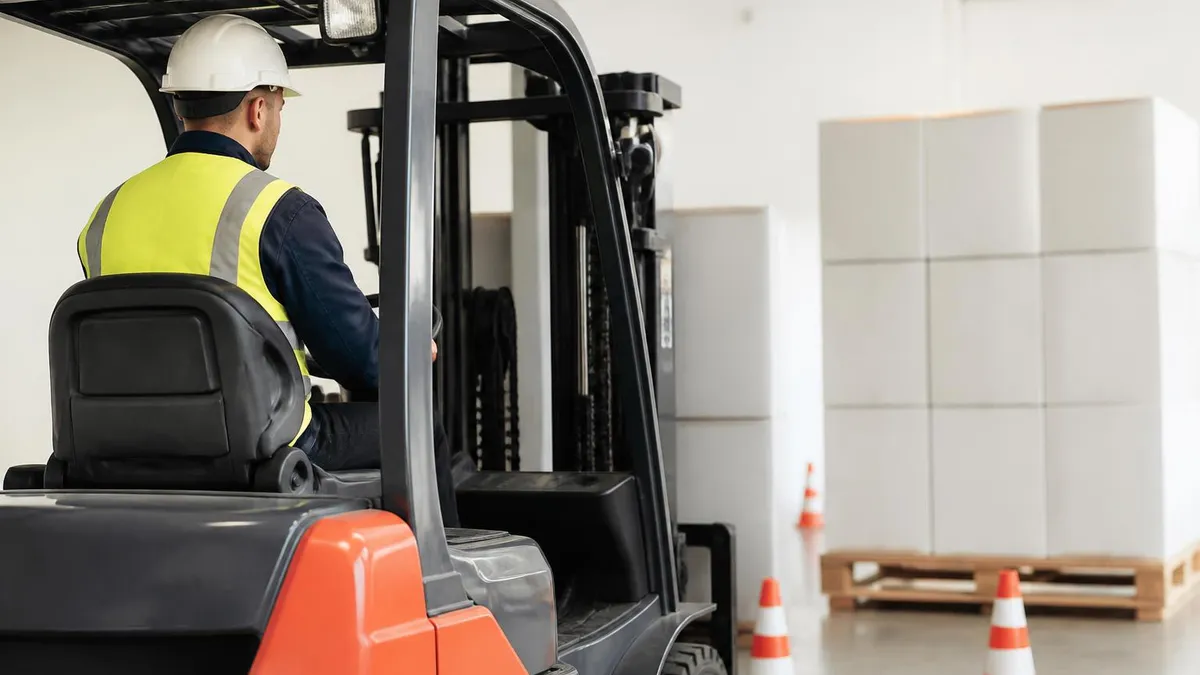
Forklift License Renewal: Complete Guide to Forklift License Expiry, OSHA Recertification, and Operator Requirements for 2026
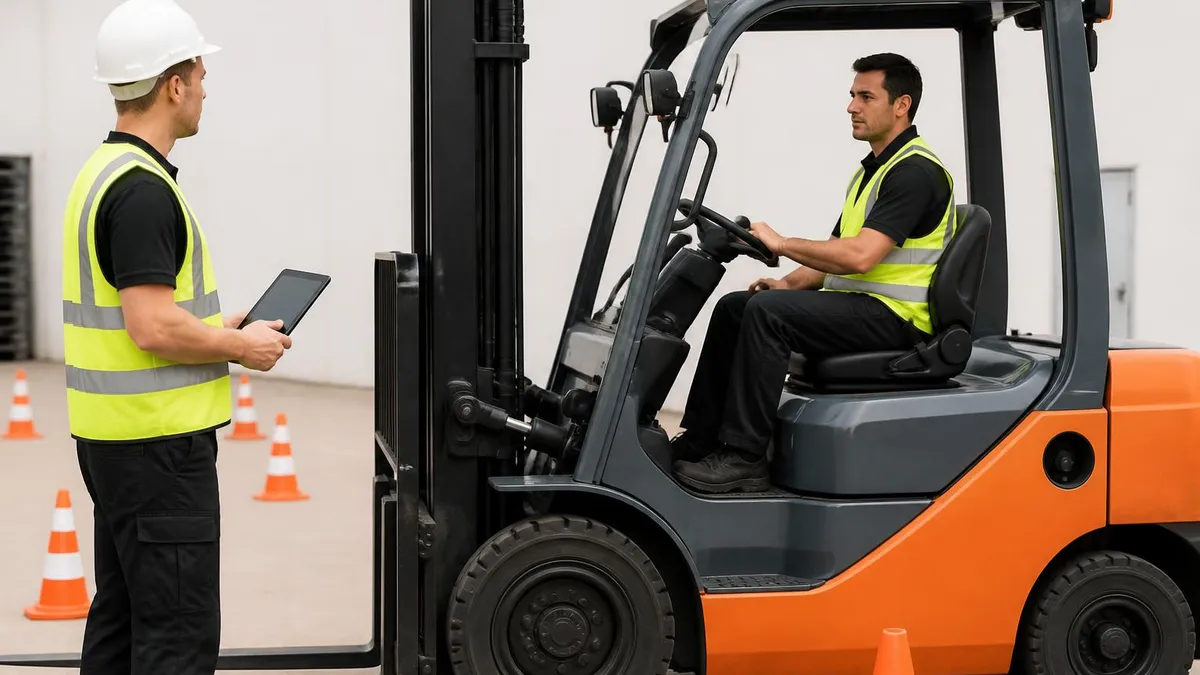
Forklift Safety Training: Complete OSHA Compliance Guide for Operators and Employers
About the Author
Certified Crane Operator & Skilled Trades Exam Specialist
Ferris State UniversityRobert Martinez is a Journeyman Ironworker, NCCCO-certified crane operator, and forklift trainer with a Bachelor of Science in Construction Technology from Ferris State University. He has 21 years of ironworking, rigging, and heavy equipment operation experience across high-rise and industrial construction sites. Robert prepares candidates for crane operator, rigger, forklift, and skilled trades certification examinations.