
Forklift Technology Guide: Telematics, Electric Forklifts, and Smart Fleet Management
Forklift telematics, electric forklifts & smart fleet tech explained. Certification, rental tips & operator training. ✅ Complete 2026 guide.

Forklift rental has become one of the most cost-effective ways for warehouses, distribution centers, and construction sites to keep operations running without the capital burden of ownership. But behind the familiar yellow lift truck sits an entirely new generation of technology transforming how fleets are managed, monitored, and maintained. From forklift telematics in Atlanta logistics hubs to cloud-connected electric forklifts in Pacific Coast fulfillment centers, technology is reshaping what it means to operate a forklift safely and efficiently in 2026.
The modern forklift operator is no longer just a driver — they are the human interface of an increasingly data-driven machine. Telematics systems track speed, impact events, idle time, fuel or battery consumption, and operator identity. Every lift, every corner taken too fast, and every pre-shift inspection is logged, timestamped, and transmitted to fleet managers in real time. For companies operating dozens or hundreds of forklifts across multiple sites, this visibility is significant, cutting injury rates and slashing maintenance costs simultaneously.
Understanding forklift technology is also directly tied to the certification of forklift operators. OSHA 29 CFR 1910.178 requires that operators be evaluated on the specific truck type they will operate, and as truck types become more sophisticated, training programs must evolve accordingly. Electric forklifts behave differently than internal combustion units — their instant torque delivery, regenerative braking, and battery management systems all demand updated operator knowledge. Certification programs that do not address these technology shifts leave operators underprepared for the realities of modern warehouses.
Forklift training has expanded well beyond the forklift yard. Online modules now cover telematics interfaces, battery charging protocols, and software dashboards that fleet managers use to assign trucks and track compliance. Stand up forklift operators, in particular, must understand how electronic stability controls and operator presence systems function, since these vehicles are engineered with far more electronic intervention than their sit-down counterparts. The integration of technology into daily forklift operation is no longer optional — it is baked into how these machines work.
For businesses exploring forklift for sale options versus rentals, technology plays a central role in the financial calculus. A new telematics-equipped electric forklift can cost $30,000 to $80,000 depending on capacity and features, while forklift rentals with equivalent technology often run $800 to $2,500 per month. Rental fleets increasingly include telematics as a standard feature, meaning smaller operations can access enterprise-grade fleet management tools without purchasing the underlying equipment outright. The forklift technology landscape now benefits operations of every size.
This guide covers everything you need to know about the technology transforming the forklift industry — from telematics systems and electric powertrains to the impact on operator training and certification. Whether you manage a single stand up forklift or a 200-unit mixed fleet, understanding these technological shifts will help you make smarter decisions about equipment selection, operator development, and total cost of ownership. We also address how technology is changing what appears on forklift operator certification exams and what OSHA expects from employers adopting automated and semi-automated lift equipment.
Staying current with forklift technology is not just a competitive advantage — in many jurisdictions it is becoming a compliance requirement. As OSHA updates its powered industrial truck standards to address autonomous and semi-autonomous equipment, forklift training programs must reflect these changes. Operators and fleet managers who understand the technology at the heart of modern forklifts will be better positioned to maintain safe operations, pass audits, and optimize the return on every dollar invested in forklift rentals or owned equipment.
Free Forklift certification Study Tools
Interactive Forklift certification resources on PracticeTestGeeks, free to start:
- Forklift Instructions 1 — 7 questions with answer explanations
- Forklift certification flashcards — review key terms and concepts card by card
- Forklift certification study guide — topic-by-topic overview of what the exam covers
- Forklift certification cheat sheet — one-page printable summary for last-minute review
Forklift Technology by the Numbers

How Forklift Telematics Systems Work
Operator Login & Pre-Shift Check
Real-Time Motion & Impact Monitoring
Battery or Fuel Consumption Tracking
Geofencing & Zone Speed Control
Data Upload & Fleet Dashboard Reporting
Certification Compliance Audit Trail
Electric forklifts have moved from a niche alternative to the dominant choice in indoor material handling, and the technology powering them has advanced dramatically over the past decade. Lithium-ion battery systems now offer energy densities 40 to 50 percent higher than traditional lead-acid alternatives, enabling a stand up forklift or counterbalanced sit-down unit to complete a full eight-hour shift on a single charge where lead-acid packs required mid-shift swaps. For operations running forklift rentals across multiple shifts, lithium-ion eliminates the dedicated battery changing rooms, spare battery inventories, and watering station infrastructure that lead-acid systems require.
The economics of electric forklifts versus internal combustion units have also shifted decisively. Propane forklifts consuming one gallon per hour at current prices cost roughly $0.18 to $0.22 per operating hour in fuel alone, while electricity for an equivalent electric forklift runs $0.03 to $0.06 per hour depending on utility rates and charging schedules.
Over a 2,000-hour annual operating year, that difference amounts to $240 to $380 in fuel savings per truck — before accounting for the dramatically lower maintenance costs of electric powertrains. Electric motors have fewer moving parts than internal combustion engines, eliminating oil changes, spark plugs, air filters, and exhaust system maintenance entirely.
Regenerative braking is one of the most important and least understood features of modern electric forklifts. When an operator releases the accelerator or applies the brake, the drive motor switches to generator mode, converting kinetic energy back into electrical energy and returning it to the battery.
In facilities with significant ramp travel — such as those using dock levelers or multi-level mezzanine systems — regenerative braking can recover 15 to 25 percent of the energy used during uphill travel, meaningfully extending operating time between charges. The forklift certification of operators on electric equipment increasingly covers regenerative braking behavior, since the truck decelerates differently than a conventional forklift and new operators must adjust their stopping distances accordingly.
Opportunity charging is a technology-enabled operating strategy that lithium-ion batteries make practical. Rather than running a battery completely flat and then charging for six to eight hours, operators using lithium-ion forklifts can plug in during breaks, lunch periods, or shift changeovers, adding partial charges without damaging battery chemistry.
Lead-acid batteries suffer permanent capacity loss from partial cycling, making opportunity charging destructive to the battery over time. Lithium-ion chemistry tolerates thousands of partial cycles at full capacity, making the approach sustainable. Fleet managers using opportunity charging strategies often find they can serve two or even three shifts with a single battery and charger per truck, eliminating the capital cost of spare battery sets.
Forklift for sale listings increasingly highlight battery management systems (BMS) as a differentiating feature. A sophisticated BMS monitors individual cell temperatures, voltages, and state of charge in real time, balancing cell chemistry across the entire battery pack to maximize both performance and longevity. When a cell approaches thermal limits during fast charging, the BMS throttles the charger automatically, preventing the heat-related degradation that shortens battery life. Some enterprise-grade BMS platforms integrate directly with telematics systems, surfacing battery health data alongside operator performance metrics in a unified fleet management dashboard.
The charging infrastructure required for electric forklift fleets is itself a technology decision with significant implications. Level 2 AC chargers operating at 7.2 kW are the most common choice for standard lead-acid and entry-level lithium-ion installations, typically fully charging a depleted 48V/600Ah battery in eight to ten hours. High-frequency opportunity chargers operating at 24 kW or higher can deliver an 80 percent charge in 60 to 90 minutes, enabling aggressive opportunity charging strategies in busy operations.
DC fast chargers designed for heavy-duty industrial applications can push up to 80 kW, making them suitable for the largest lithium-ion battery packs used in forklifts exceeding 10,000-pound capacity. Sizing charger infrastructure correctly is critical to ensuring electric forklifts meet operational demands without costly downtime.
Fleet managers evaluating whether to purchase electric forklifts outright or pursue forklift rentals should factor technology refresh cycles into their analysis. Lithium-ion battery technology has improved rapidly, and a forklift purchased today may have meaningfully inferior battery technology compared to one available three or four years from now. Rental agreements, typically ranging from one to five years, can allow operations to access the latest battery and telematics technology without being locked into aging equipment. Many national rental fleets now offer forklift technology upgrades as part of long-term rental contracts, providing an ongoing path to improved efficiency as innovations mature.
Forklift Rental Technology Options: What's Included
Standard forklift rentals typically include internal combustion or basic electric models with manual hour meters and no integrated telematics. These units are best suited for short-term needs — seasonal spikes, project-based work, or single-shift operations where detailed data collection is not a priority. Renters typically receive a basic operator manual and a pre-delivery inspection sheet documenting existing condition. Rental rates for standard units range from $600 to $1,000 per month for Class IV and Class V internal combustion counterbalanced forklifts in the 5,000- to 8,000-pound capacity range.
Standard rentals remain popular because they minimize complexity. Operators familiar with conventional forklifts can step into these units with minimal additional training, and fleet managers do not need to invest in telematics platform subscriptions or IT infrastructure to support them. For companies with occasional or unpredictable forklift needs, standard forklift rentals near me from a local dealer often represent the lowest total cost of access, especially when the rental term is under 90 days. Operators should still hold current forklift certification regardless of equipment complexity.

Telematics-Equipped Forklifts: Benefits and Drawbacks
- +Real-time impact detection reduces injury rates by an average of 34% in documented fleet studies
- +Automated operator certification lockout prevents uncertified personnel from operating equipment
- +Geofencing enforces speed limits in pedestrian zones without relying on operator compliance alone
- +Battery and fuel monitoring enables predictive maintenance before breakdowns cause costly downtime
- +Cloud dashboards provide OSHA-ready audit trails for operator hours, inspections, and incident history
- +Utilization data identifies underused trucks, enabling fleet right-sizing and rental cost reduction
- −Monthly telematics platform subscriptions add $30 to $80 per truck to operating costs
- −Initial setup requires IT integration work and staff training on dashboard software
- −Privacy concerns among operators regarding continuous performance monitoring can affect morale
- −Data without action produces no ROI — managers must act on insights to realize benefits
- −Connectivity gaps in basements or reinforced-concrete facilities can create data blind spots
- −Older forklifts may require aftermarket hardware retrofits costing $500 to $1,500 per unit
Pros and Cons at a Glance
| Pros | Cons |
|---|---|
| Automated operator certification lockout prevents uncertified personnel from operating equipment | Initial setup requires IT integration work and staff training on dashboard software |
| Geofencing enforces speed limits in pedestrian zones without relying on operator compliance alone | Privacy concerns among operators regarding continuous performance monitoring can affect morale |
| Battery and fuel monitoring enables predictive maintenance before breakdowns cause costly downtime | Data without action produces no ROI — managers must act on insights to realize benefits |
| Cloud dashboards provide OSHA-ready audit trails for operator hours, inspections, and incident history | Connectivity gaps in basements or reinforced-concrete facilities can create data blind spots |
Forklift Technology Compliance Checklist for Operators and Fleet Managers
- ✓Verify all forklift operators hold current certification of forklift for each truck class they operate
- ✓Confirm telematics system operator login credentials are assigned individually — never share PINs or RFID cards
- ✓Complete and submit the digital pre-shift inspection checklist before every operating shift begins
- ✓Review your facility's geofencing zone map and understand speed restrictions in each designated area
- ✓Check electric forklift battery state of charge before each shift and report readings below 20% to a supervisor
- ✓Log all impact events exceeding the threshold in the telematics dashboard before resuming operation
- ✓Ensure operator certification expiration dates are loaded into the telematics access control system
- ✓Confirm that stand up forklift models are covered by separate operator certification evaluations
- ✓Schedule preventive maintenance based on telematics-triggered hour-meter alerts, not calendar intervals alone
- ✓Retain telematics reports and inspection records for a minimum of three years to support OSHA audits
A Single Prevented Incident Covers Years of Telematics Costs
The average cost of a lost-time forklift injury in the United States exceeds $38,000 when accounting for medical expenses, workers' compensation, OSHA fines, and productivity losses. At a typical telematics subscription cost of $60 per truck per month, a fleet of ten trucks spends just $7,200 per year on monitoring — meaning a single prevented incident delivers more than five years of telematics ROI. Fleet managers who frame telematics as a safety investment rather than an operating expense consistently secure budget approval and sustain long-term program commitment.
The return on investment case for forklift telematics extends well beyond injury prevention, though that headline number is often the most persuasive in budget conversations. Utilization data collected by telematics systems routinely reveals that 20 to 35 percent of rental or owned forklifts in a typical warehouse fleet are operating fewer than two hours per day.
For a company paying $1,200 per month per unit in forklift rentals, identifying and returning even two underutilized trucks saves $28,800 per year — an immediate, quantifiable benefit that flows directly from telematics deployment. Fleet right-sizing using utilization data is one of the fastest-payback applications of forklift technology investment.
Maintenance cost reduction is the second major ROI driver, and it operates through several distinct mechanisms. Hour-based maintenance triggers are far more accurate than calendar-based schedules for forklifts that experience variable utilization. A forklift rental returned after only 200 hours of use in a three-month period does not need the same service as one that logged 600 hours in the same period — yet calendar-based schedules treat them identically.
Telematics-driven maintenance scheduling ensures service is performed when the truck actually needs it, reducing both over-maintenance costs and the risk of failure from under-maintenance. Fleets that have transitioned to telematics-driven service intervals typically report 18 to 25 percent reductions in annual maintenance spending.
Impact event data generated by telematics systems enables a form of cost reduction that is harder to quantify but arguably more valuable over time: the prevention of rack, racking, and facility damage. Warehouse rack repair costs range from $500 for minor upright replacements to $15,000 or more for significant structural damage requiring engineering assessment and full bay replacement.
When telematics identifies a specific operator generating a disproportionate share of low-speed impact events, targeted coaching can change behavior before a high-force impact causes serious structural or human injury. The data trail also supports insurance claims and legal defense if an incident does occur, providing timestamped, unalterable records of events and operator identities.
Battery performance optimization is a telematics benefit that is especially significant for electric forklift fleets. Lithium-ion batteries represent 25 to 40 percent of a new electric forklift's purchase price, and premature battery degradation from improper charging practices can cut a battery's service life from ten years to four or five.
Telematics systems that monitor charging patterns and flag deep discharge events or opportunity-charging practice violations can meaningfully extend battery life — translating to tens of thousands of dollars in avoided replacement costs per truck over the equipment's operating life. For operations using forklift rentals, battery health reporting protects both the renter and the rental provider from disputes over end-of-term battery condition assessments.
Energy consumption benchmarking is an emerging telematics application gaining traction in sustainability-focused organizations. By tracking kilowatt-hours consumed per pallet move or per ton-mile of material handling, operations can establish energy intensity baselines and identify opportunities for efficiency improvement. Operators who routinely idle electric forklifts while waiting for loads waste both battery capacity and facility electricity. Telematics dashboards that surface idle time by operator allow managers to restructure workflows to minimize non-productive energy consumption. In facilities pursuing LEED certification or corporate sustainability targets, forklift energy efficiency data can contribute directly to documented environmental performance metrics.
The vendor landscape for forklift telematics has matured significantly, with several enterprise platforms now offering integration capabilities that extend beyond the forklift fleet itself. Systems like I'mSAFE, Toyota's T-Matics, and Crown's InfoLink integrate with warehouse management systems (WMS), allowing forklift location and utilization data to flow into the same operational dashboards that track order fulfillment, dock scheduling, and inventory movement.
When a fleet manager can see that a delay in pallet picking correlates with a cluster of telematics-recorded idle events near the charging area, they can diagnose the root cause — insufficient charging infrastructure — and solve it before it affects shipping deadlines. This systems-level view is where forklift technology delivers its most strategic value.
Forklift operators who understand telematics are also better positioned to advance their careers. Fleet managers, safety coordinators, and logistics supervisors increasingly seek candidates with demonstrated experience operating telematics-equipped forklifts. Operators who can articulate how they use telematics feedback to improve their own performance — reducing their personal impact event rate, maintaining certification currency, and completing pre-shift checklists accurately — distinguish themselves in a competitive labor market. Pairing strong telematics literacy with current forklift operator certification creates a skills profile that commands higher wages and broader employment options across the distribution and manufacturing sectors.

Telematics systems, automatic lockouts, and electronic safety features do not substitute for OSHA-mandated forklift operator certification and evaluation. Even if a forklift will only operate within a geofenced low-speed zone, every operator must hold current certification of forklift for that specific truck class under 29 CFR 1910.178(l). Employers who rely solely on technology controls to restrict uncertified operators remain in violation and subject to citations of up to $16,131 per willful violation as of 2026 OSHA penalty schedules.
Forklift training programs have had to evolve rapidly to keep pace with the technology now embedded in modern lift trucks. OSHA's core training requirements under 29 CFR 1910.178(l) establish the framework — formal instruction, practical training, and evaluation — but the content of that training must reflect the specific equipment operators will use.
An operator trained exclusively on propane counterbalanced forklifts is not prepared to safely operate a lithium-ion electric stand up forklift with integrated telematics, regenerative braking, and electronic stability control. Employers have an obligation to ensure training addresses the specific technology present in the equipment their operators will drive.
The rise of online and blended forklift training has been both accelerated and complicated by technology adoption. Online modules can now include simulations of telematics dashboards, interactive pre-shift inspection sequences, and video demonstrations of battery charging procedures. Trainees can complete the formal instruction component from any device, arriving at the practical evaluation session with a stronger conceptual foundation than traditional classroom-only training delivered.
However, no technology — no matter how sophisticated — replaces the hands-on equipment evaluation that OSHA requires before an operator is certified. The practical component must be conducted on the specific truck type the operator will use, in the actual environment where they will work.
Forklift training organizations and community colleges offering forklift operator programs have increasingly added technology-focused curriculum modules. These cover telematics system operation, lithium-ion battery handling procedures, proper use of electronic pre-shift inspection systems, and interpretation of stability control interventions. Some programs now include simulator sessions using high-fidelity forklift simulators that replicate the sensory experience of operating real equipment, including the feel of regenerative braking and the visual feedback of integrated telematics displays. Simulator training cannot replace real equipment evaluation under OSHA standards, but it can accelerate skill development and reduce the learning curve during the hands-on phase of training.
For experienced forklift operators transitioning to newer technology-equipped equipment, refresher training requirements under OSHA create a compliance obligation that employers must manage carefully. When an operator who has been certified on conventional forklifts is assigned to an electric forklift with telematics for the first time, OSHA considers this a new truck type requiring evaluation — not just a quick orientation.
Skipping a proper evaluation because the operator is experienced on other truck types is one of the most common OSHA forklift violations found during inspections. Telematics systems that flag when certified operators log into truck types not covered by their certification records can help employers catch and correct these gaps before an inspector does.
The intersection of forklift technology and certification is particularly important for stand up forklift operators. Reach trucks, order pickers, and stand-up counterbalanced forklifts require distinctly different operating skills than sit-down units, and their technology integration tends to be more sophisticated.
Many modern reach trucks include automatic mast sway dampening, height-to-weight ratio stability monitoring, and integrated wire guidance systems that keep the truck aligned in narrow aisles. Operators must understand both how to use these systems and how to respond when they intervene — which differs significantly from operating a conventional lift truck where the operator has unmediated control of all truck functions at all times.
Employers managing forklift training for large or geographically distributed workforces have found technology-enabled compliance tracking to be significant. Learning management systems (LMS) integrated with telematics platforms allow HR and safety teams to monitor certification status, assign renewal training when expirations approach, and automatically restrict equipment access for operators whose certifications have lapsed.
This automated compliance architecture reduces the administrative burden of manual certification tracking across dozens or hundreds of operators while ensuring that forklift rental fleets and owned equipment are only operated by properly credentialed personnel. The investment in building this infrastructure pays ongoing dividends in reduced audit preparation time and lower risk of OSHA citations.
Looking ahead, artificial intelligence is beginning to enter forklift operator training in meaningful ways. AI-powered coaching systems that analyze telematics data streams can generate personalized feedback for individual operators — identifying specific patterns such as consistent abrupt braking, repeated speed exceedances in the same zone, or disproportionate impact events at a particular rack location.
Rather than waiting for a supervisor to review aggregate reports, these systems can trigger in-cab alerts or post-shift coaching notifications that address specific behaviors in near real time. Early adopters report that AI-driven coaching reduces repeat impact events by 40 to 55 percent compared to traditional periodic performance review approaches, representing a step-change improvement in the effectiveness of ongoing forklift operator development programs.
For forklift operators preparing for certification exams, understanding technology is increasingly a test topic as well as a practical skill. Modern forklift certification exams include questions about electric forklift battery handling procedures, telematics pre-shift inspection systems, and the operational differences between internal combustion and electric powertrains. Candidates who have only studied conventional forklift operation may find themselves unprepared for questions about lithium-ion charging protocols, regenerative braking behavior, or electronic pre-shift inspection requirements. Reviewing technology-focused content as part of exam preparation is no longer optional for anyone operating in a modern warehouse environment.
The forklift certification renewal cycle provides a natural checkpoint for technology education. OSHA requires operators to be re-evaluated at least every three years, and any time they are observed operating unsafely, are involved in an accident or near-miss, or are assigned to a different truck type.
When a facility upgrades its fleet to telematics-equipped electric forklifts, this constitutes an assignment to a new truck type for operators previously certified only on internal combustion equipment — triggering a mandatory re-evaluation requirement. Proactive employers treat fleet technology upgrades as retraining opportunities rather than compliance burdens, using the mandated evaluation period to deliver comprehensive training on the new technology features of the upgraded equipment.
Stand up forklift operators face some of the most rapid technology evolution of any forklift operator category. Narrow-aisle reach trucks and order pickers in modern distribution centers now routinely include automated height controls, RFID-triggered location systems, and integrated warehouse management system connectivity that guides the operator to the correct pick location via onboard displays.
Some advanced systems offer voice-directed picking through headsets that integrate with the WMS, allowing operators to confirm picks hands-free while the onboard display provides navigation guidance. These technologies dramatically increase pick accuracy and throughput but require operators to develop skills that go well beyond conventional forklift operation — a reality that forklift training programs are still catching up to address comprehensively.
Battery charging discipline is one of the most technology-sensitive aspects of daily forklift operation that directly affects both safety and equipment longevity. Lithium-ion charging generates heat, and improperly installed or maintained chargers can create fire hazards that conventional lead-acid systems did not pose. NFPA 505, NFPA 1, and local fire codes govern charging area design, ventilation requirements, and fire suppression systems for lithium-ion forklift battery charging installations.
Operators and facility managers should understand that the fire behavior of lithium-ion thermal runaway differs fundamentally from conventional fires — it can reignite hours after apparent suppression and requires specialized response protocols. Forklift training programs in high-voltage electric truck environments increasingly include a module on lithium-ion fire response aligned with NFPA guidelines.
Autonomous and semi-autonomous forklifts represent the frontier of forklift technology, with commercial deployments accelerating across major distribution networks. Automated guided vehicles (AGVs) and autonomous mobile robots (AMRs) capable of performing pallet transport and staging functions are now operating alongside human forklift operators in mixed-mode facilities.
OSHA has acknowledged that its current powered industrial truck standard, written before autonomous forklifts existed, does not fully address these systems, and updated guidance or rulemaking is anticipated within the next regulatory cycle. Facilities deploying autonomous forklifts should implement interaction protocols between human operators and automated systems, including clearly marked operating zones and standardized right-of-way conventions that both humans and automated systems respect.
The total cost of ownership (TCO) analysis that informed forklift purchasing decisions for decades is now far more complex than a simple comparison of purchase price, maintenance costs, and residual value. Technology integration — telematics subscriptions, software platform licenses, charging infrastructure capital, LMS integration costs, and periodic technology refresh expenses — must all be included in a complete TCO model.
Operators and fleet managers who understand this fuller picture are better equipped to evaluate whether forklift for sale options or forklift rentals deliver better long-term value for their specific operating profile. The right answer varies significantly by fleet size, utilization intensity, facility type, and strategic flexibility requirements — and it is a question worth revisiting every two to three years as the technology landscape continues to evolve at its current pace.
Ultimately, forklift technology is not a set-it-and-forget-it investment. It requires ongoing attention, training, and management to deliver its potential benefits. The operators who perform best in technology-equipped environments are those who approach their equipment with genuine curiosity — who want to understand why the stability control intervened on that last corner, or what the battery SOC reading means for the rest of their shift.
Cultivating this mindset starts with quality forklift training and is sustained by employers who use telematics data not just to police behavior but to coach, develop, and recognize the operators who make their facilities safer and more productive every day they show up to work.
Sample Forklift certification Practice Questions
Try these questions from our free Forklift certification practice tests. The correct answer and an explanation follow each question.
During operation, the forklift's warning alarm for low battery charge activates. What should the electric forklift operator do?
- A. Ignore the alarm and complete all pending tasks
- B. Immediately park the forklift and swap or charge the battery according to facility procedures
- C. Turn off the alarm and continue operating
- D. Reduce speed by half and continue until the forklift stops
Answer: B. Immediately park the forklift and swap or charge the battery according to facility procedures
Operating with a critically low battery can cause sudden power loss; the operator must follow facility procedures to safely swap or charge the battery.
Before starting an electric forklift, what should you check on the battery?
- A. Its color
- B. Charge level, connections, and electrolyte
- C. The manufacturer's logo
- D. Only the weight
Answer: B. Charge level, connections, and electrolyte
Electric forklift inspections include verifying charge, secure cable connections, and proper electrolyte levels.
What is the primary hazard when charging an electric forklift battery?
- A. Excessive noise
- B. Hydrogen gas released during charging
- C. Radiation exposure
- D. Carbon monoxide buildup
Answer: B. Hydrogen gas released during charging
Lead-acid batteries emit flammable hydrogen gas while charging, which can ignite.
Which set of Personal Protective Equipment (PPE) is most appropriate when watering or charging an electric forklift battery?
- A. Leather gloves, safety glasses, and a hard hat.
- B. Cotton coveralls, steel-toed boots, and a dust mask.
- C. Acid-resistant face shield, goggles, neoprene gloves, and an apron.
- D. Welding helmet, hearing protection, and reflective vest.
Answer: C. Acid-resistant face shield, goggles, neoprene gloves, and an apron.
Forklift batteries contain sulfuric acid, which is highly corrosive. OSHA recommends specific PPE to protect against chemical splashes and burns. This includes an acid-resistant face shield, chemical splash goggles, acid-resistant gloves (like neoprene or rubber), and an acid-resistant apron.
Forklift Questions and Answers
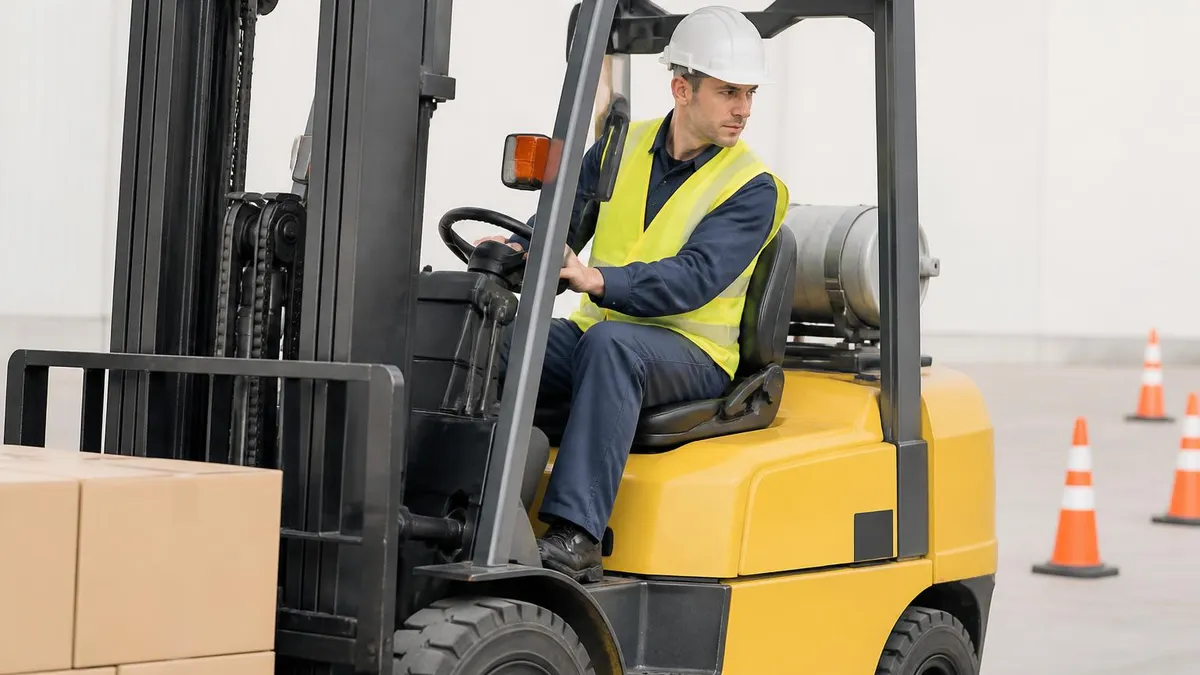
Forklift Rentals: Complete Guide to Pricing, Types, and Operator Requirements
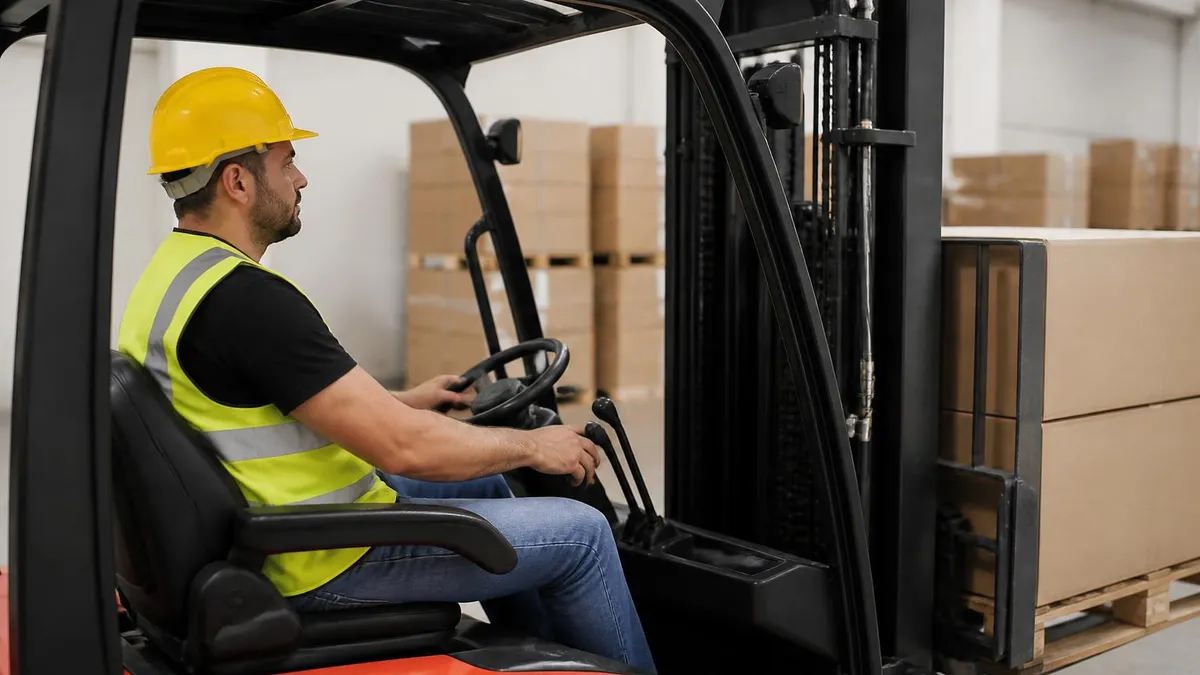
Forklift Hydraulic Fluid: Complete Guide to Types, Specifications, Change Intervals, and Troubleshooting for 2026
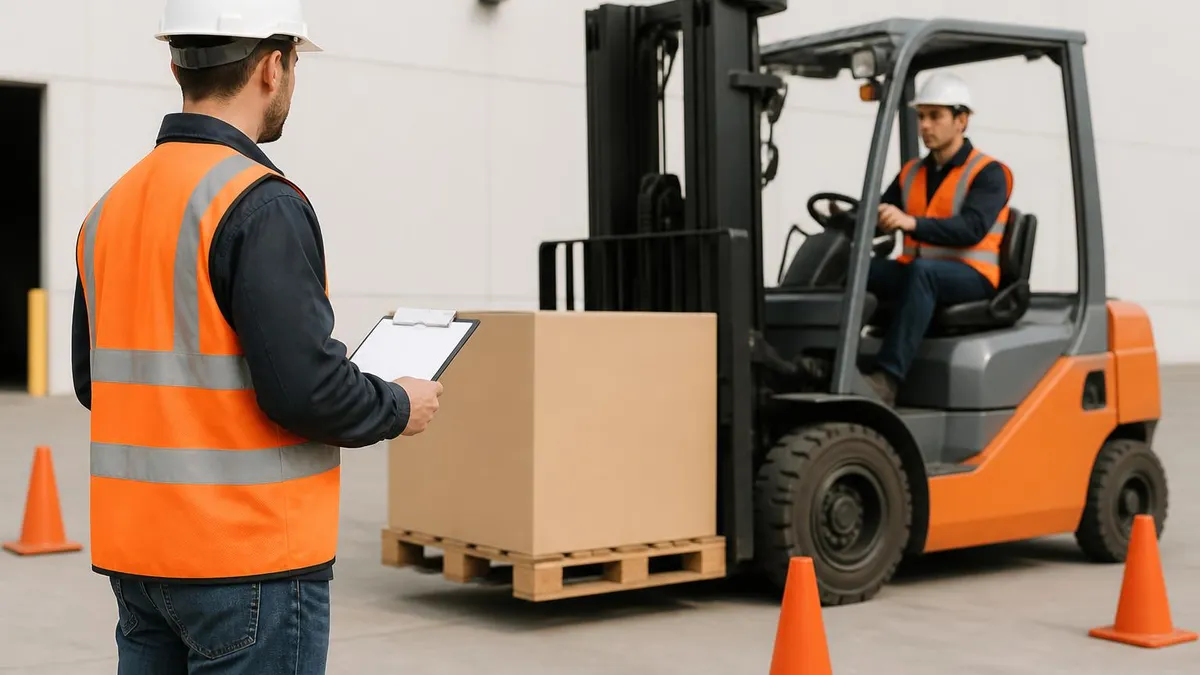
Forklift Parts and Maintenance: Complete Guide to Batteries, Chargers, and Replacement Components
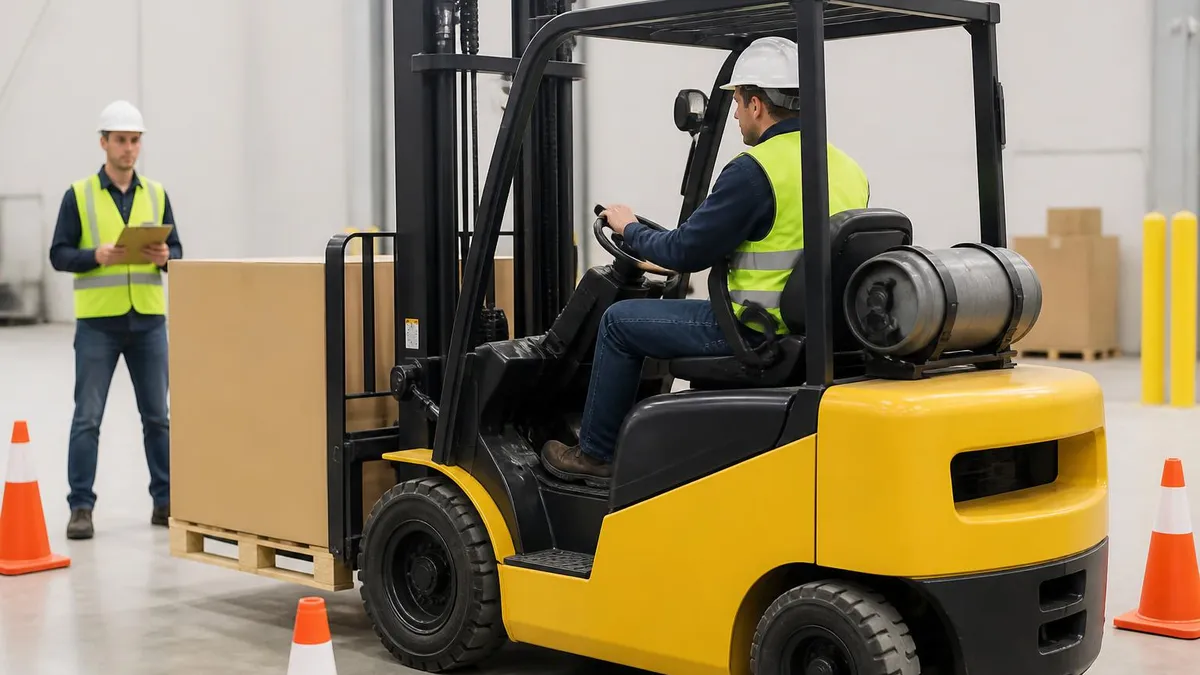
Big Forklift Guide: Heavy-Duty Lift Trucks, Capacity Classes, Rental Costs, and Operator Requirements
Forklift License Renewal: Complete Guide to Forklift License Expiry, OSHA Recertification, and Operator Requirements for 2026
How this page was made: written with AI tools. Exam facts are checked against the official sources listed below. Not reviewed by a subject-matter expert. Editorial policy
Sources & references
Exam facts on this page (fees, format, dates, passing scores) are checked against these official sources; the date is our last check. Editorial policy
- osha.gov — Test delivery, eligibility, renewal · verified Oct 2026