
Who Invented CPR? The Complete History of CPR From 1740 to 2026 October
Who invented CPR? Explore the full history of CPR from 1740 🎓 mouth-to-mouth to modern ACLS algorithm, AED, and infant CPR protocols used today.
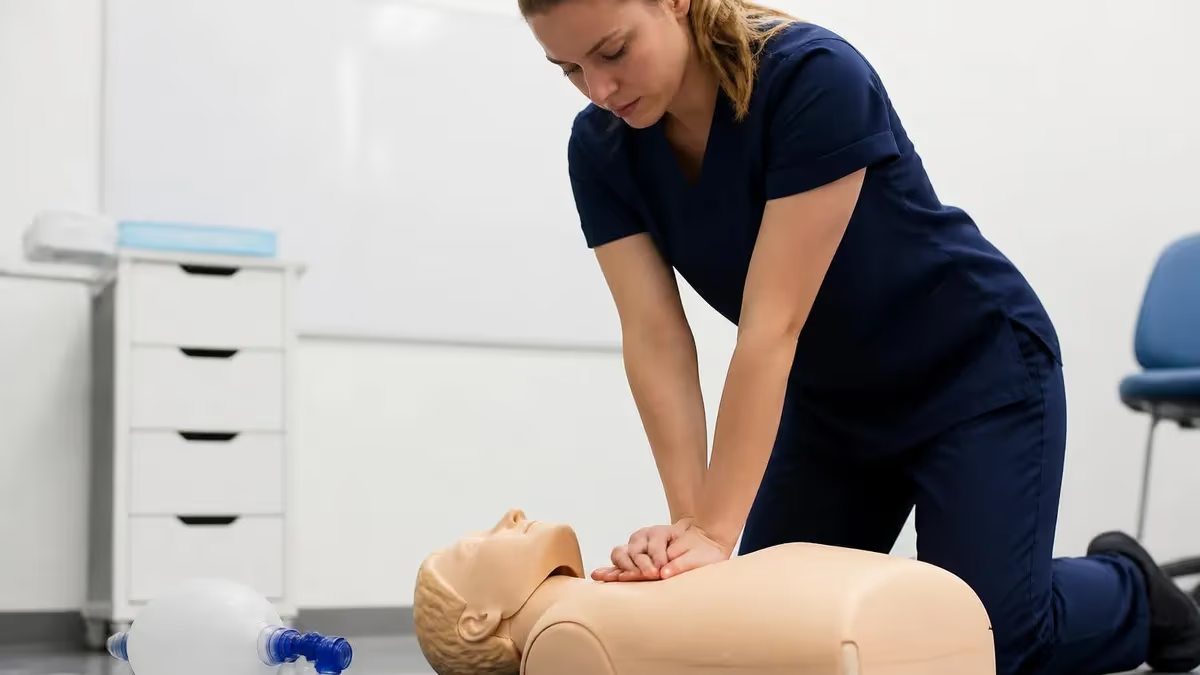
Ask any paramedic, nursing student, or curious bystander "who invented CPR" and you will get a surprisingly long answer. Modern cardiopulmonary resuscitation, the same chest-compression-and-rescue-breath sequence taught in every what does aed stand for course today, was not invented by a single person on a single day. It grew out of nearly three centuries of trial, error, and remarkable scientific courage, stretching from drowning victims in 1740s Amsterdam to the polished acls algorithm flowcharts memorized by ICU nurses in 2026.
The story matters because every step in today's CPR sequence — the 30:2 ratio, the 100-to-120 compression rate, the recovery position used after return of spontaneous circulation — exists because someone, somewhere, tested it on a patient who would otherwise have died. The history of CPR is essentially the history of refusing to accept clinical death as final, and it is one of the most consequential medical inventions of the modern era.
In 2026, more than 350,000 out-of-hospital cardiac arrests occur in the United States each year. Bystander CPR roughly doubles, and in some studies triples, the chance of survival. Yet the technique that makes this possible was considered fringe medicine within living memory. Doctors in the 1950s still debated whether external chest compressions actually moved blood, and rescue breathing was reserved for drowning victims and newborns who failed to cry.
This guide walks through the full timeline: the eighteenth-century Dutch societies that paid bounties for resuscitated drowning victims, the 1956 discovery of mouth-to-mouth by Peter Safar, the 1960 closed-chest compression breakthrough by Kouwenhoven, Knickerbocker, and Jude, the standardization push by the American Heart Association, and the modern era of hands-only CPR, AEDs, and infant cpr protocols.
You will also see how organizations like the national cpr foundation, the AHA, and the Red Cross took these laboratory discoveries and pushed them into shopping malls, swimming pools, and elementary schools. The result is a chain of survival that any reasonably trained sixth grader can now start while waiting for paramedics — a public-health miracle hiding inside a two-minute drill.
Whether you are studying for a bls certification, preparing for pals certification, brushing up your respiratory rate knowledge, or simply curious about who deserves credit for the technique that saves a life every few minutes somewhere in America, this article gives you the full, accurate, and surprisingly human history.
By the end you will know exactly which names belong on the CPR Mount Rushmore, why the timeline took 220 years, and how the principles that emerged in a Baltimore lab in 1958 still shape what a lifeguard does today on a beach in Florida.
The History of CPR by the Numbers

CPR Timeline: 1740 to 2026
1740 — Paris Academy Recommends Mouth-to-Mouth
1767 — Dutch Humane Society Founded
1891 — First Closed-Chest Cardiac Massage
1956 — Mouth-to-Mouth Rediscovered
1960 — Closed-Chest CPR Published in JAMA
1963–2026 — Standardization, AEDs & Hands-Only
The single most important decade in the history of CPR is the 1950s. Before that decade, attempts to revive the apparently dead were a confused mix of folk remedies — rolling drowning victims over barrels, blowing tobacco smoke into the rectum, hanging them upside-down from horses, or applying the Silvester and Holger-Nielsen arm-lift techniques that moved almost no air. Survival was essentially random, and most physicians considered cardiac arrest an irreversible diagnosis. The transformation came from anesthesiology, a field where keeping unconscious people breathing was the daily job.
James Elam, working in Buffalo, had used mouth-to-mouth on polio patients in respiratory failure during the late 1940s. He convinced a young Austrian-born anesthesiologist named Peter Safar that the method was both effective and safe. Together, in a now-famous 1956 experiment, they sedated and paralyzed volunteers — many of them medical students from Johns Hopkins — and demonstrated that mouth-to-mouth ventilation maintained normal blood oxygen, while the popular arm-lift methods did not. The data was undeniable.
Safar then made a second discovery that arguably matters more than the breathing technique itself: he showed that an unconscious person's tongue blocks the airway, and that a simple head-tilt-chin-lift maneuver reopens it. Without this single insight, neither rescue breaths nor compressions work reliably. Every modern course, including any classes near me search you run today, still opens its airway lesson with the exact maneuver Safar published.
Meanwhile, in a separate Johns Hopkins lab, electrical engineer William Kouwenhoven was studying defibrillation in dogs. His graduate student Guy Knickerbocker noticed that pressing the heavy paddles firmly on a dog's chest produced a brief rise in arterial pressure, even without a shock. Surgeon James Jude joined the team and they began testing rhythmic external compressions. In July 1960 they published the seminal JAMA paper, "Closed-Chest Cardiac Massage," reporting 14 successful resuscitations of cardiac arrest patients.
Safar, Elam, Kouwenhoven, Knickerbocker, and Jude met at a 1960 Maryland Medical Society meeting and realized that combining their two techniques — A-B-C, airway, breathing, circulation — produced a complete resuscitation method any trained rescuer could perform without surgery, without electricity, and without a hospital. The acronym stuck, and the modern era of CPR began with that handshake.
The fifth often-forgotten name is Asmund Laerdal, a Norwegian toymaker. Safar convinced him to mass-produce a realistic training manikin so that practicing rescue breaths on a real volunteer would not be required. Laerdal modeled the face on a famous Parisian death mask, the "L'Inconnue de la Seine," and named her Resusci Anne. She has since been kissed by an estimated half-billion CPR students and remains the most-trained-on face in human history.
By 1963 the American Heart Association formally endorsed CPR as a clinical procedure, and by 1966 a national conference produced the first standardized training guidelines. Within a decade the technique had moved from elite hospitals to fire departments, lifeguard stations, and eventually high-school health classes — an unusually fast translation from bench to bedside to backyard.

CPR Practice Test Questions
Prepare for the CPR Cardiopulmonary Resuscitation Practice exam with our free practice test modules. Each quiz covers key topics to help you pass on your first try.
CPR Basic CPR
CPR Exam Questions covering Basic CPR. Master CPR Test concepts for certification prep.
CPR and First Aid
Free CPR Practice Test featuring and First Aid. Improve your CPR Exam score with mock test prep.
CPR (Cardiopulmonary Resuscitation) Adult ...
CPR Mock Exam on (Cardiopulmonary Resuscitation) Adult CPR and AED Usage. CPR Study Guide questions to pass on your first try.
CPR (Cardiopulmonary Resuscitation) Airway...
CPR Test Prep for (Cardiopulmonary Resuscitation) Airway Obstruction and Choking. Practice CPR Quiz questions and boost your score.
CPR (Cardiopulmonary Resuscitation) Cardio...
CPR Questions and Answers on (Cardiopulmonary Resuscitation) Cardiopulmonary Emergency Recognition. Free CPR practice for exam readiness.
CPR (Cardiopulmonary Resuscitation) Child ...
CPR Mock Test covering (Cardiopulmonary Resuscitation) Child and Infant CPR. Online CPR Test practice with instant feedback.
CPR (Cardiopulmonary Resuscitation) High-P...
Free CPR Quiz on (Cardiopulmonary Resuscitation) High-Performance Team Dynamics. CPR Exam prep questions with detailed explanations.
CPR (Cardiopulmonary Resuscitation) Legal ...
CPR Practice Questions for (Cardiopulmonary Resuscitation) Legal and Ethical Considerations. Build confidence for your CPR certification exam.
CPR for Specific Populations
CPR Test Online for for Specific Populations. Free practice with instant results and feedback.
CPR Airway & Breathing Management
CPR Exam Questions covering Airway & Breathing Management. Master CPR Test concepts for certification prep.
CPR Assessment & Recognition of Cardiac Ar...
Free CPR Practice Test featuring Assessment & Recognition of Cardiac Arrest. Improve your CPR Exam score with mock test prep.
CPR Chest Compressions & Defibrillation
CPR Mock Exam on Chest Compressions & Defibrillation. CPR Study Guide questions to pass on your first try.
CPR Post-Resuscitation Care & Recovery
CPR Test Prep for Post-Resuscitation Care & Recovery. Practice CPR Quiz questions and boost your score.
Key Inventors Behind the ACLS Algorithm and Modern CPR
Peter Safar (1924–2003) is the man most historians credit when forced to name a single "inventor" of CPR. An Austrian-born anesthesiologist who escaped Nazi conscription and emigrated to the United States, Safar conducted the 1956–1958 experiments that proved mouth-to-mouth ventilation worked, established the head-tilt-chin-lift airway maneuver, and authored the A-B-C sequence that anchors every acls algorithm taught today.
Safar also founded the first multidisciplinary ICU in the United States at Baltimore City Hospital in 1958, helped create the field of critical care medicine, and wrote the original CPR training manual for the Pittsburgh Fire Department in 1957. He was nominated for the Nobel Prize three times. His own daughter died of an asthma attack at age twelve, an event he said drove his lifelong obsession with resuscitation science.
Studying the History of CPR: Worth Your Time?
- +Helps you understand why the 30:2 ratio exists, not just memorize it
- +Provides exam-friendly mnemonics — A-B-C, CAB, and the chain of survival
- +Explains where AED protocols came from and why early defibrillation matters
- +Gives context for guideline changes between 2005, 2010, 2015, 2020 and 2025
- +Adds credibility when teaching or coaching colleagues on technique
- +Connects respiratory rate physiology to the original Elam-Safar experiments
- +Reinforces why infant cpr uses different ratios than adult CPR
- −Does not replace hands-on manikin practice required for certification
- −Some historical techniques (smoke enemas, barrel rolling) are not exam-relevant
- −Older guideline ratios may confuse students if not clearly dated
- −Names and dates are easy to mix up without a structured timeline
- −Historical context is rarely tested on basic CPR cards beyond one or two questions
- −Can distract from current AHA 2025 algorithm if over-studied
Pros and Cons at a Glance
| Pros | Cons |
|---|---|
| Provides exam-friendly mnemonics — A-B-C, CAB, and the chain of survival | Does not replace hands-on manikin practice required for certification |
| Explains where AED protocols came from and why early defibrillation matters | Some historical techniques (smoke enemas, barrel rolling) are not exam-relevant |
| Adds credibility when teaching or coaching colleagues on technique | Older guideline ratios may confuse students if not clearly dated |
| Connects respiratory rate physiology to the original Elam-Safar experiments | Names and dates are easy to mix up without a structured timeline |
| Reinforces why infant cpr uses different ratios than adult CPR | Historical context is rarely tested on basic CPR cards beyond one or two questions |

Milestones in the History of CPR Every Student Should Memorize
- ✓1740 — Paris Academy of Sciences endorses mouth-to-mouth for drowning
- ✓1767 — Dutch Humane Society founded; first organized resuscitation program
- ✓1891 — Friedrich Maass performs first human closed-chest compressions
- ✓1956 — Peter Safar and James Elam prove mouth-to-mouth ventilation works
- ✓1957 — Head-tilt-chin-lift airway maneuver scientifically established
- ✓1960 — Kouwenhoven, Knickerbocker & Jude publish closed-chest CPR in JAMA
- ✓1960 — Asmund Laerdal produces Resusci Anne, the first CPR manikin
- ✓1963 — American Heart Association formally endorses CPR
- ✓1966 — First National Conference on CPR standardizes training
- ✓2008 — AHA launches hands-only CPR public-awareness campaign
- ✓2010 — Sequence officially changes from A-B-C to C-A-B for adults
- ✓2025 — AHA reaffirms 30:2 ratio and 100–120/min compression rate
Safar tested mouth-to-mouth on sedated medical students — including himself
In the 1956 experiments, Peter Safar paralyzed 78 conscious volunteers with curare and then performed mouth-to-mouth on them while measuring oxygenation. Many were Johns Hopkins medical students who had simply volunteered for "a study." The data those volunteers produced is still cited in the 2025 AHA guidelines — a reminder that almost every detail of modern CPR was paid for in personal risk by people whose names never made the textbooks.
The transition from laboratory to living room took roughly fifteen years and depended less on new science than on relentless public-education work. By 1972 Leonard Cobb, a cardiologist in Seattle, had launched the world's first mass citizen-CPR training program. Cobb's team trained more than 100,000 Seattleites within two years, and Seattle's bystander-CPR rate climbed from near zero to over 50 percent. Cardiac-arrest survival in the city more than doubled, providing the first real-world proof that teaching laypeople CPR saves lives.
The Seattle model became the template every American city eventually copied. The AHA created standardized BLS courses, the Red Cross built a parallel curriculum, and by the late 1980s the cpr index of American adults reporting any CPR training crossed 25 percent. Schools began adding CPR to health classes, and by 2017 at least 38 states required CPR training as a high-school graduation requirement — a policy footprint that very few medical interventions have ever matched.
Defibrillation moved through a similar civilian-adoption curve. The first portable defibrillator was built in 1965 by Frank Pantridge in Belfast, weighing 70 kilograms and powered by car batteries. By the late 1990s the device had shrunk to a five-pound briefcase, become fully automated, and started appearing in airports, casinos, gyms, and schools. Today's automated external defibrillator can be operated by a curious ten-year-old, and AED placement laws now cover every US state. Looking up cpr index data shows how dramatically these tools have changed survival numbers.
Guidelines themselves have evolved in five-year cycles since 1974. The biggest changes include dropping the precordial thump for routine use (2005), shifting from A-B-C to C-A-B for adults (2010), endorsing hands-only CPR for untrained bystanders (2008), raising the compression rate ceiling to 120 per minute (2015), and emphasizing high-quality compressions with minimal interruption above all else (2020 and 2025). Infant and child CPR ratios remained 30:2 single-rescuer and 15:2 two-rescuer.
One under-appreciated thread is the role of professional organizations. The national cpr foundation, the AHA, the American Red Cross, the American Safety and Health Institute, and the Emergency Care and Safety Institute all issue certifications recognized by US employers. While their methods differ slightly in wording, all teach the same underlying sequence: recognize arrest, call 911, compress hard and fast, attach an AED as soon as it arrives, and continue until ROSC or higher-level care takes over.
The international story is equally important. The International Liaison Committee on Resuscitation (ILCOR), founded in 1992, harmonizes guidelines across the AHA, the European Resuscitation Council, the Australian and New Zealand Council, and the Heart and Stroke Foundation of Canada. Every five years ILCOR publishes a Consensus on Science statement that becomes the foundation for each region's specific guidelines, meaning a paramedic in Tokyo and a lifeguard in Tampa now follow nearly identical compression protocols.
The result of all this work is a society in which clinical death is, for an increasing share of victims, reversible. The 2024 CARES registry reported an overall survival-to-hospital-discharge rate of 10.4 percent for out-of-hospital cardiac arrest in the US, and over 30 percent for shockable rhythms witnessed in public with prompt bystander CPR and AED use. Those numbers would have seemed miraculous to anyone working in resuscitation in 1959.
Several techniques used between 1740 and 1900 are now known to be useless or actively dangerous, including rolling drowning victims over barrels, hanging them upside down, abdominal pressure with rapid arm-lifts, and tobacco-smoke enemas. If you ever read older first-aid manuals or encounter test questions referencing them, recognize them as historical curiosities only — they are not part of any modern acls algorithm or BLS protocol.
CPR in 2026 looks dramatically different from the technique Safar and Jude demonstrated in 1960, even though the core mechanics are nearly identical. The biggest shift is technological: real-time CPR feedback devices now sit on the patient's chest and tell the rescuer in plain English to push faster, push harder, or allow full recoil. Studies from 2019 onward show that feedback-guided compressions improve depth and rate compliance by 20 to 40 percentage points compared to unaided rescuers.
Public-access defibrillators are now ubiquitous in airports, schools, gyms, and an increasing number of shopping centers. The 2025 AHA guidelines emphasize that any rhythm-detection device — including the AED app pushed to nearby smartphones in some cities — should be retrieved within three minutes of recognized arrest. The chain of survival has effectively added a digital link, with PulsePoint and similar apps alerting trained citizens within 400 meters of a 911-reported cardiac arrest.
Training has changed too. Adaptive software adjusts the cognitive portion to your knowledge level, while a mandatory hands-on skills check still happens with a live instructor or a smart manikin that scores depth, rate, and recoil.
Pediatric resuscitation has received particular attention. Modern pals certification courses dedicate significant time to infant cpr nuances: two-thumb encircling-hands technique for infants with two rescuers, compression depth of about 1.5 inches for infants and 2 inches for children, and special attention to airway anatomy, since a child's tongue is proportionally larger and the trachea more flexible. The respiratory rate target for rescue breaths in pediatric arrest is also different from adults — one breath every two to three seconds when an advanced airway is in place.
The position recovery maneuver remains a small but critical piece of the broader resuscitation picture. After return of spontaneous circulation in a breathing, unresponsive patient, rolling them onto their side maintains a patent airway and reduces aspiration risk. The recovery position has roots in the 1891 Schafer prone-pressure method but the modern lateral-recumbent version was standardized by the AHA and ERC in the late 1990s.
Looking forward, three trends are reshaping the field. First, AI-driven dispatcher-assisted CPR is improving 911 call quality, helping more callers start compressions within the first minute. Second, mechanical CPR devices like the LUCAS and AutoPulse are spreading to ambulance services, freeing paramedics to focus on airway and medications. Third, extracorporeal CPR (ECPR), which puts refractory arrest patients on heart-lung bypass within minutes, has produced 30 to 40 percent neurologically intact survival in select centers.
None of this changes the foundational answer to "who invented CPR." Modern resuscitation remains a layered invention built by Safar, Elam, Kouwenhoven, Knickerbocker, Jude, Laerdal, Pantridge, Cobb, and the thousands of clinicians and instructors who refined their work. What has changed is the size of the audience: a technique once practiced by a handful of anesthesiologists is now within the trained hands of well over 100 million Americans.
If you are reading this article as part of preparation for a certification exam, here is how to put the history into practical study. First, treat the timeline as a memory scaffold rather than memorization fodder. Knowing that Safar produced the breathing technique in 1956 and Kouwenhoven produced compressions in 1960 helps you remember the A-B-C ordering, even though current adult sequence is C-A-B. Examiners love asking why guidelines changed, and history explains the why.
Second, pair historical reading with active drills on a manikin. A common mistake is to over-study didactic content and underpractice the physical skills. Aim for at least 10 minutes of manikin time for every hour of reading. If you don't have a manikin, a folded bath towel on a sturdy chair seat at hip height makes a passable depth simulator — measure your compressions against a metronome set to 110 beats per minute.
Third, learn the chain of survival as a six-link concept: recognition and activation, immediate high-quality CPR, rapid defibrillation, advanced resuscitation, post-arrest care, and recovery. Most exam questions about "what to do first" are answered by remembering this chain, since the correct answer is almost always the earliest link not yet completed. This is true on basic cards, on what is a bls certification exams, and on the more complex acls algorithm scenarios.
Fourth, drill the numbers until they are automatic. Compression rate 100 to 120 per minute. Adult depth at least 2 inches but no more than 2.4. Child depth about 2 inches or one-third anteroposterior chest diameter. Infant depth about 1.5 inches. Compression-to-ventilation ratio 30:2 for single-rescuer adult and pediatric CPR, 15:2 for two-rescuer pediatric. Allow full chest recoil between compressions. Minimize interruptions to less than 10 seconds.
Fifth, practice scenario recognition. Cardiac arrest is identified by unresponsiveness plus absent or abnormal breathing — agonal gasps count as not breathing normally. Pulse check is optional for laypeople, mandatory for healthcare providers but limited to 10 seconds. Recognizing these triggers quickly is the single biggest factor in survival, far more important than perfect technique on the first few compressions.
Sixth, study the AED. Modern devices analyze rhythm automatically, deliver a shock only if indicated, and resume voice-prompted compressions afterward. Pads should be placed on bare, dry skin: anterior-lateral for adults and most children over eight, anterior-posterior for infants and small children. Continue compressions while the AED charges; only stop briefly during analysis and shock delivery.
Finally, use practice questions strategically. The free quizzes linked throughout this article cover the most commonly tested points: ratios, depths, rates, AED steps, recovery position, choking sequences, and pediatric variations. Aim for at least 80 percent on each topic before testing in person. If you can also explain the history behind each guideline, your retention will be far higher than peers who only memorize the current numbers — and you will probably teach the next generation of rescuers yourself one day.
CPR Questions and Answers

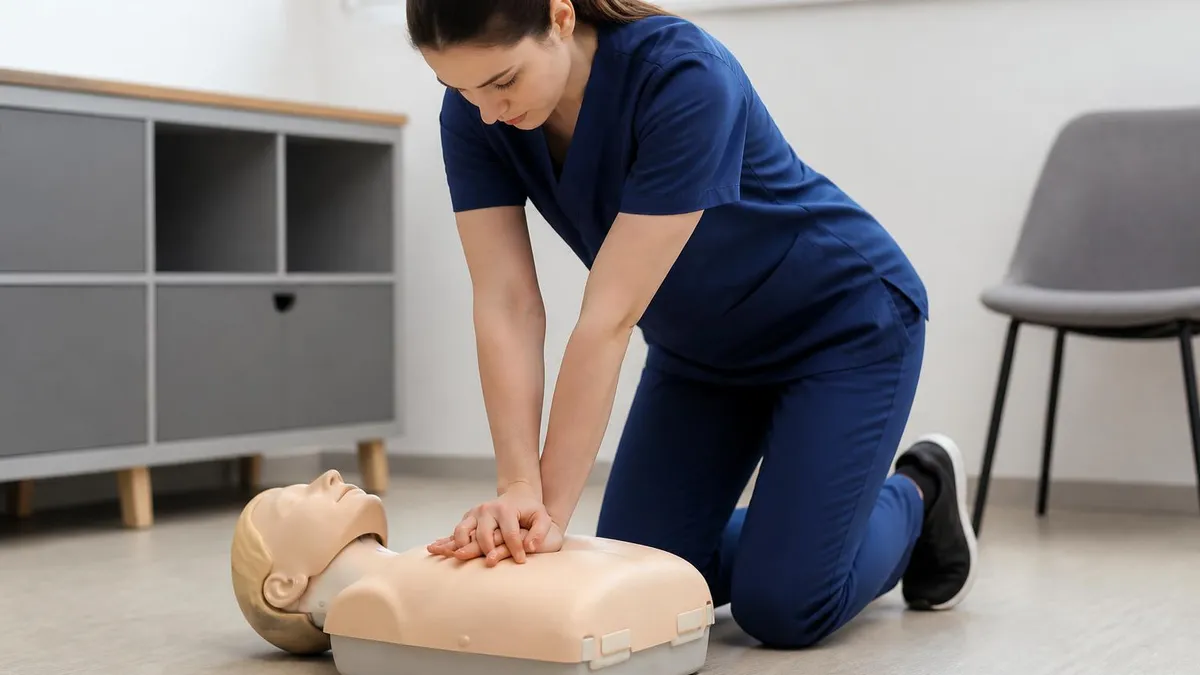
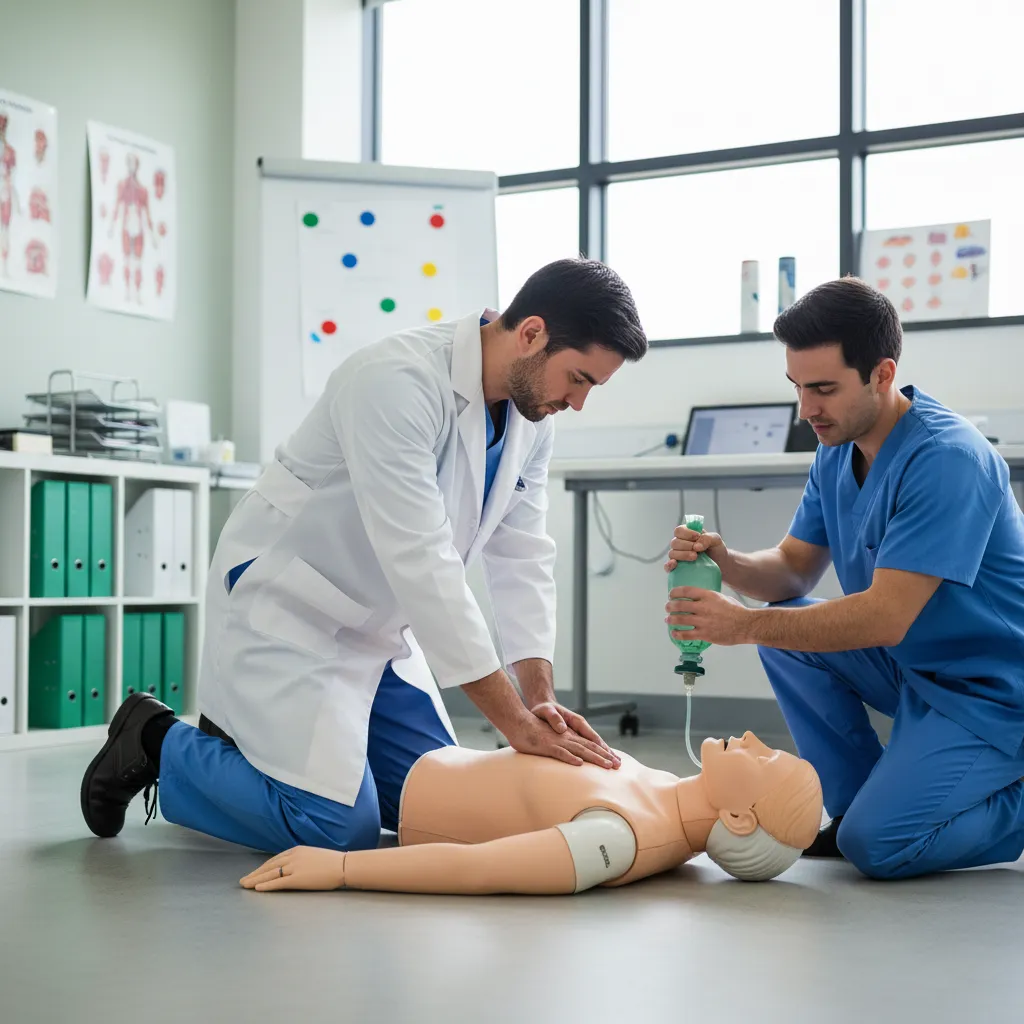
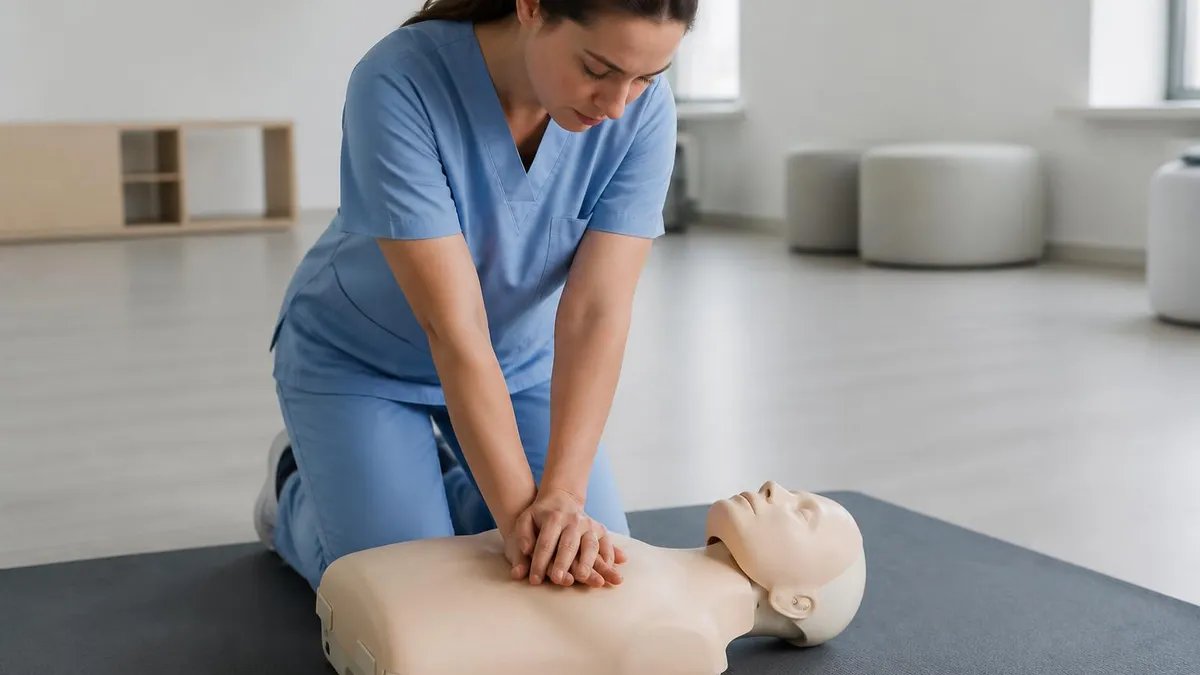
About the Author

Registered Nurse & Healthcare Educator
Johns Hopkins University School of NursingDr. Sarah Mitchell is a board-certified registered nurse with over 15 years of clinical and academic experience. She completed her PhD in Nursing Science at Johns Hopkins University and has taught NCLEX preparation and clinical skills courses for nursing students across the United States. Her research focuses on evidence-based exam preparation strategies for healthcare certification candidates.
Join the Discussion
Connect with other students preparing for this exam. Share tips, ask questions, and get advice from people who have been there.
View discussion (5 replies)