
BLS CPR Near Me: How to Find, Choose, and Complete Basic Life Support Training in 2026
🆕 Find BLS CPR near me with our 2026 guide. Compare local courses, costs, ACLS algorithm prep, PALS certification, and AED training options.
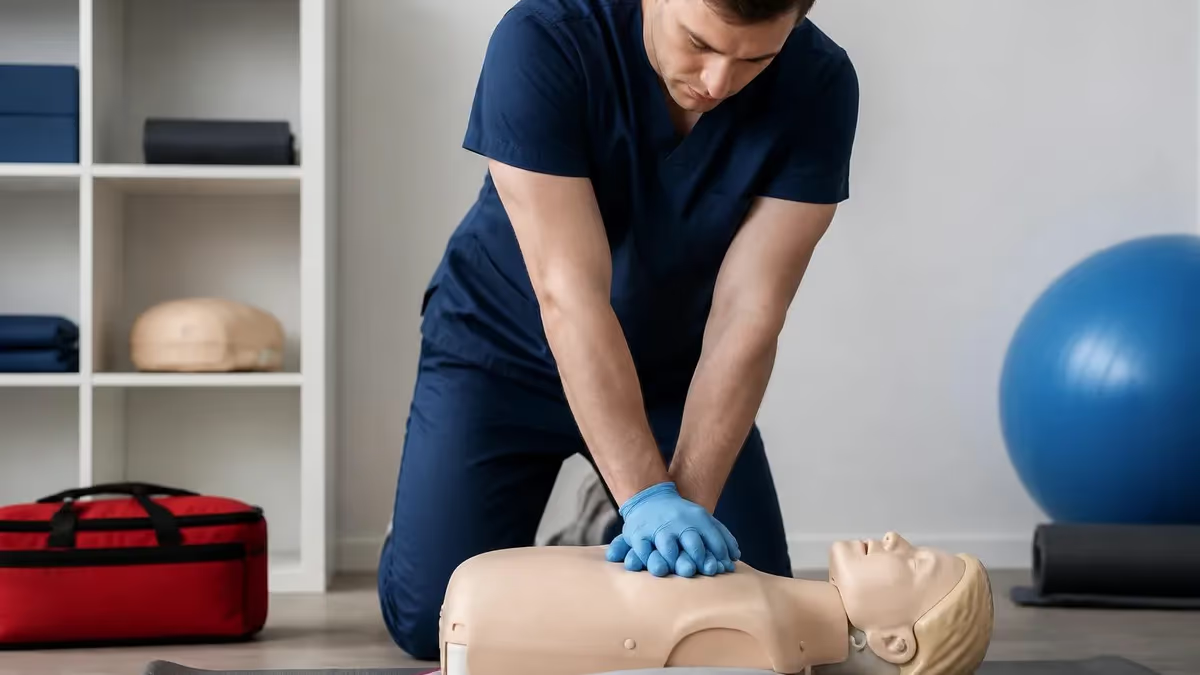
Searching for bls cpr near me usually means one of three things: your employer just asked for a card by Monday, your nursing program needs proof of Basic Life Support before clinicals, or you simply want the skills to save a life at home. Whatever the reason, the good news is that BLS training is widely available across the United States — through hospitals, fire departments, community colleges, the American Heart Association (AHA), the American Red Cross, and independent training centers that often run weekend classes within a few miles of your zip code.
BLS is not the same as a quick "hands-only" CPR demo. It is a structured, provider-level course that teaches high-quality chest compressions, ventilation with a bag-valve mask, two-rescuer team dynamics, automated external defibrillator (AED) use, choking relief, and recognition of cardiopulmonary emergencies. Most courses run three to four and a half hours, end with a written exam and a hands-on skills test, and produce a digital card valid for two years.
If you have already heard of life support certifications like PALS or ACLS, BLS is the foundation under both. The acls algorithm that hospital teams follow during cardiac arrest assumes every responder already knows BLS cold — compressions at 100 to 120 per minute, depth of at least 2 inches in adults, full chest recoil, and minimal interruptions. Master BLS first and the rest of the advanced life support pathway becomes far easier.
This guide will help you decide which BLS provider to choose, how much you should expect to pay, what is on the skills test, and how to spot legitimate cards versus the diploma-mill certificates that hospitals routinely reject. We will also point you to free practice questions so you walk into class confident. If you want a deeper review of the science before booking a seat, our complete CPR study guide is a great place to start.
By the end of this article you will know exactly how to filter local results, what red flags to avoid, and how to translate "BLS near me" into a card your employer will actually accept on day one of orientation. Let's start with the numbers that matter.
One quick note before we dive in: BLS requirements vary by employer and state, even when the underlying skills are identical. A hospital in Texas may require AHA only, while a long-term care facility in Oregon accepts AHA or Red Cross. Always check your specific employer policy before paying — it is the single most common mistake new healthcare students make. We will return to verification later in the article.
Ready to find a class? Read on for the data, the decision framework, and the practice tools that will make your BLS day painless.
BLS CPR Training by the Numbers
Key Facts at a Glance
| Item | Value | Details |
|---|---|---|
| Typical BLS Cost | $60-$110 | AHA Provider course |
| Card Validity | 2 years | AHA & Red Cross |
| Required Skills Pass | 84% | Compression accuracy |

What a BLS Course Actually Covers
Adult, child, and infant chest compressions at 100-120 per minute, depth 2 inches (adult) or about 1.5 inches (infant), full recoil, and switching compressors every 2 minutes to prevent fatigue.
Powering on the device, placing pads correctly on dry skin, clearing the patient, delivering shocks, and resuming compressions within 10 seconds — the single biggest survival factor in witnessed arrests.
Head-tilt chin-lift, jaw thrust for trauma, bag-valve mask seal (E-C technique), pocket-mask use, and avoiding hyperventilation that reduces venous return and worsens outcomes.
Abdominal thrusts in conscious adults, back blows and chest thrusts for infants, and the transition to CPR once a choking victim becomes unresponsive — a frequently tested scenario.
Closed-loop communication, clear role assignment, constructive intervention, and knowing your limits — skills the acls algorithm relies on the moment a code team takes over from a single rescuer.
Finding a legitimate "BLS CPR near me" class is mostly about knowing where to look — and which sources to trust. Start with your local hospital's education department. Almost every hospital with more than 100 beds runs monthly AHA BLS classes for both staff and the public, and these are widely accepted because they are taught by the same instructors who train the nurses you see on the floor. Call the hospital operator and ask for "Center for Learning" or "Staff Development."
Next, search the official AHA Class Connector and Red Cross course locator. Both let you filter by zip code, date, and course type. Be careful: when you Google generic terms, the top results are sometimes lead-generation sites that funnel you to an online-only course that hospitals do not accept for clinical roles. Always confirm the class includes a hands-on skills check with a live instructor — that is the legal difference between a real BLS card and a souvenir.
Fire departments and EMS agencies are an underused option. Many career fire houses host BLS for the community at cost — sometimes as low as $45 — because their paramedics are already AHA instructors. Community colleges and vocational schools run open-enrollment BLS the week before nursing, dental hygiene, and EMT cohorts start, which means seats turn over quickly and last-minute slots are common.
If you live in a rural area, look at "blended learning" pathways. You complete the cognitive portion online through the official AHA HeartCode BLS or Red Cross Simulation Learning platform, then drive to a nearby training site for a 60- to 90-minute skills session. This cuts in-person time dramatically and is the format most working healthcare professionals choose for renewal. The skills check is non-negotiable; a fully online course with no in-person component is not a valid provider-level credential.
Look for centers that publish their Training Center ID, list named instructors, and offer same-day digital eCards. Avoid any provider that promises a card without skills testing or claims accreditation from the fictional "national cpr foundation" sites that are not recognized by hospitals or OSHA.
When you compare results, sort by three factors: distance, next available date, and whether the card is AHA, Red Cross, ASHI, or another OSHA-recognized issuer. If you are unsure what your employer accepts, ask HR for the exact issuer name in writing before you pay. If you already have a card and just need to confirm validity, our CPR card lookup guide walks through the AHA eCard portal, Red Cross digital verification, and what to do when an employer claims they cannot find your record.
One last filter: read the reviews. A center with 4.8 stars across 300 reviews and recent dates is almost always a safer bet than a cheaper option with a handful of vague testimonials. People are loud and specific when a BLS class is disorganized.

CPR Practice Test Questions
Prepare for the CPR Cardiopulmonary Resuscitation Practice exam with our free practice test modules. Each quiz covers key topics to help you pass on your first try.
CPR Basic CPR
CPR Exam Questions covering Basic CPR. Master CPR Test concepts for certification prep.
CPR and First Aid
Free CPR Practice Test featuring and First Aid. Improve your CPR Exam score with mock test prep.
CPR (Cardiopulmonary Resuscitation) Adult ...
CPR Mock Exam on (Cardiopulmonary Resuscitation) Adult CPR and AED Usage. CPR Study Guide questions to pass on your first try.
CPR (Cardiopulmonary Resuscitation) Airway...
CPR Test Prep for (Cardiopulmonary Resuscitation) Airway Obstruction and Choking. Practice CPR Quiz questions and boost your score.
CPR (Cardiopulmonary Resuscitation) Cardio...
CPR Questions and Answers on (Cardiopulmonary Resuscitation) Cardiopulmonary Emergency Recognition. Free CPR practice for exam readiness.
CPR (Cardiopulmonary Resuscitation) Child ...
CPR Mock Test covering (Cardiopulmonary Resuscitation) Child and Infant CPR. Online CPR Test practice with instant feedback.
CPR (Cardiopulmonary Resuscitation) High-P...
Free CPR Quiz on (Cardiopulmonary Resuscitation) High-Performance Team Dynamics. CPR Exam prep questions with detailed explanations.
CPR (Cardiopulmonary Resuscitation) Legal ...
CPR Practice Questions for (Cardiopulmonary Resuscitation) Legal and Ethical Considerations. Build confidence for your CPR certification exam.
CPR for Specific Populations
CPR Test Online for for Specific Populations. Free practice with instant results and feedback.
CPR Airway & Breathing Management
CPR Exam Questions covering Airway & Breathing Management. Master CPR Test concepts for certification prep.
CPR Assessment & Recognition of Cardiac Ar...
Free CPR Practice Test featuring Assessment & Recognition of Cardiac Arrest. Improve your CPR Exam score with mock test prep.
CPR Chest Compressions & Defibrillation
CPR Mock Exam on Chest Compressions & Defibrillation. CPR Study Guide questions to pass on your first try.
CPR Post-Resuscitation Care & Recovery
CPR Test Prep for Post-Resuscitation Care & Recovery. Practice CPR Quiz questions and boost your score.
AHA vs Red Cross vs Online: Which BLS Course Wins?
The AHA BLS Provider course is the gold standard for hospitals, nursing schools, and most allied health programs. It uses the same acls algorithm-aligned sequence that hospital code teams follow, so the skills transfer directly to a clinical setting. Cards are issued as digital eCards through atlas.heart.org and verified in seconds by HR departments.
Expect a 3- to 4-hour blended or classroom course, a 25-question written test (passing is 84%), and a hands-on skills test scored against a posted rubric. Renewal every two years, and most clinicians choose HeartCode BLS plus an in-person skills session because it saves an evening.
In-Person vs Blended BLS: Pros and Cons
- +Hands-on feedback on compression depth and rate from a live instructor
- +Real bag-valve mask practice with manikins that report ventilation volume
- +Team scenarios that mimic actual hospital code dynamics
- +Same-day digital card issued before you leave the room
- +Networking with local healthcare workers, instructors, and EMS
- +No technology failures — power outages or login bugs can't derail your day
- +Easier to ask nuanced questions about edge cases and pediatric scenarios
- −Requires 3 to 4.5 hours of continuous classroom time
- −Limited evening and weekend availability in smaller markets
- −Slightly more expensive than blended pathways once travel is included
- −Less flexible if you work rotating shifts or have childcare constraints
- −Cognitive content is delivered at a fixed pace — slower learners may feel rushed
- −Sick days or weather can force a costly reschedule
- −Crowded class sizes can reduce one-on-one manikin time

Your BLS Class Day Checklist
- ✓Confirm course issuer (AHA, Red Cross, ASHI) matches your employer's policy
- ✓Complete the online cognitive module at least 24 hours before class
- ✓Print or download the AHA BLS Provider Manual reference card
- ✓Wear loose, comfortable clothing — you will be on the floor for compressions
- ✓Bring photo ID and your course completion confirmation email
- ✓Arrive 15 minutes early to test the digital sign-in QR code
- ✓Eat a real meal beforehand — chest compressions are surprisingly tiring
- ✓Review the BLS algorithm flowchart one final time on your phone
- ✓Practice 30:2 compression-to-ventilation timing using a metronome app
- ✓Save the eCard download link to your phone immediately after passing
Bystander CPR doubles or triples cardiac arrest survival
According to AHA data, fewer than half of out-of-hospital cardiac arrest victims receive bystander CPR before EMS arrives — yet survival jumps from roughly 10% to 24% when high-quality compressions start within 60 seconds. A real BLS class with hands-on feedback is the single biggest predictor that you will actually perform CPR when it matters, instead of freezing.
Cost is the second-biggest reason people delay BLS training, behind scheduling. Plan on $60 to $110 for an AHA BLS Provider course in most US metros, with rural areas trending lower and major cities like New York, San Francisco, and Boston trending higher. Red Cross pricing is virtually identical. Hospital-run community classes are sometimes subsidized down to $45, while concierge-style mobile instructors who come to your home or office can run $150 to $200 per student for groups of four or fewer.
Watch for hidden fees. Some training centers advertise a low headline price, then charge a separate "eCard fee," "skills check fee," or "manual rental fee." A reputable center quotes one all-in number. Also confirm whether the price includes the official AHA or Red Cross digital manual; you will need it during the cognitive module and for renewal study two years from now.
The card you receive should be a digital eCard with a unique ID, your full legal name, course completion date, expiration date (exactly two years later), and the training center code. Paper cards still exist but are being phased out. Your employer's HR or credentialing office will verify the card against the issuer's online database — this takes seconds when the card is legitimate and is impossible when it is not.
Be aware of fraudulent issuers. Several websites use official-sounding names like "national cpr foundation," promise a card in 30 minutes with no skills test, and accept any credit card. Hospitals, OSHA-regulated employers, and accredited schools will reject these cards on sight. If a deal looks too easy, it almost certainly is — and you will end up paying twice when you have to retake a real course before your start date.
Renewal is simpler than initial certification. AHA and Red Cross both allow renewal within the 30 days before your card expires, and HeartCode BLS plus a short skills session usually takes under two hours total. If you let your card lapse by more than a few months, most centers will require the full initial course again. Set a calendar reminder 60 days out. Our guide to AHA CPR recertification covers the exact steps, including how to handle expired cards and what to do if your employer's deadline is sooner than your renewal window.
Finally, save your card in three places: the issuer's app, a PDF in your cloud storage, and a screenshot on your phone. Credentialing software occasionally cannot read certain digital formats, and having a backup means you can email a copy from the parking lot on orientation day instead of scrambling.
Tracking expiration dates is the most overlooked part of being credentialed. A great habit: every January, audit every certification you hold — BLS, ACLS, PALS, NRP, TNCC, even your driver's license — and put renewal dates into your calendar with 60-day and 14-day alerts. It takes 15 minutes and prevents the panic of discovering a lapsed card the night before a shift.
AHA Heartsaver CPR/AED is a layperson course designed for daycare workers, fitness staff, and family caregivers — it is NOT the same as BLS Provider. Hospitals, nursing schools, and EMS employers require BLS Provider specifically. If you accidentally book Heartsaver, you will need to take BLS Provider before your start date, often at last-minute premium pricing. Read the course title carefully before paying.
Once you understand where the card comes from, the real learning is the skills themselves — and how they connect to advanced life support. The acls algorithm for adult cardiac arrest assumes uninterrupted, high-quality BLS as its foundation. If your compressions are shallow, slow, or paused for more than 10 seconds at a time, no amount of epinephrine or defibrillation will rescue the outcome. That is why BLS instructors obsess over compression depth, rate, recoil, and minimal interruption — these four metrics drive survival more than any drug.
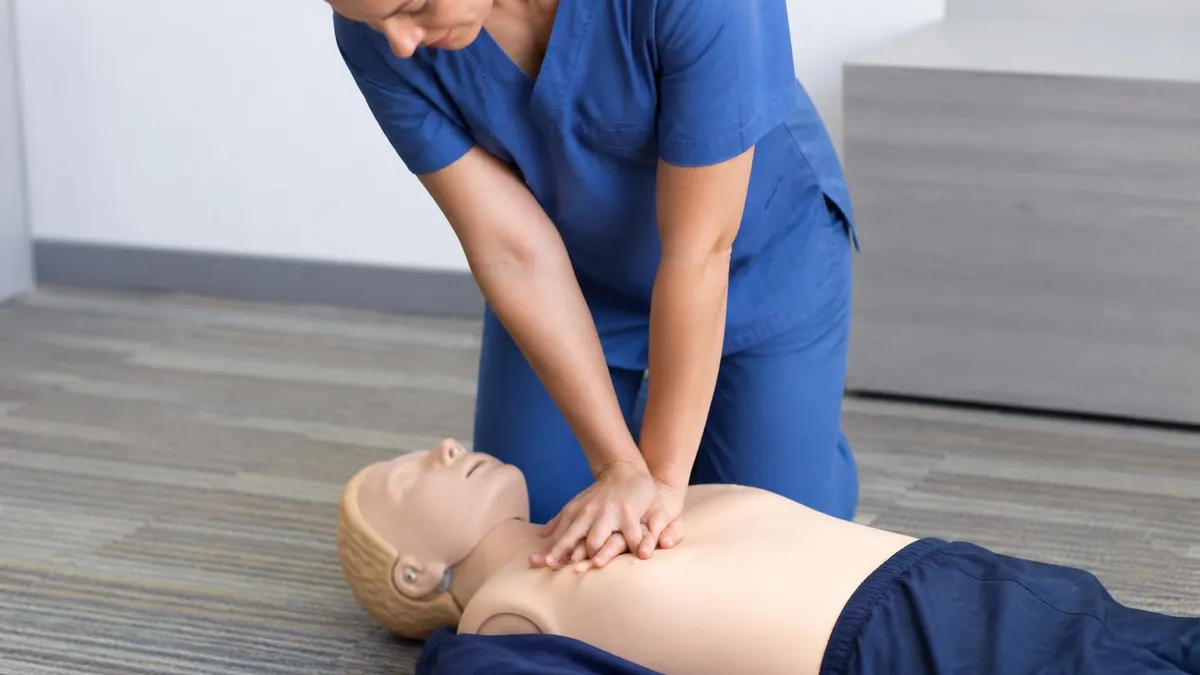
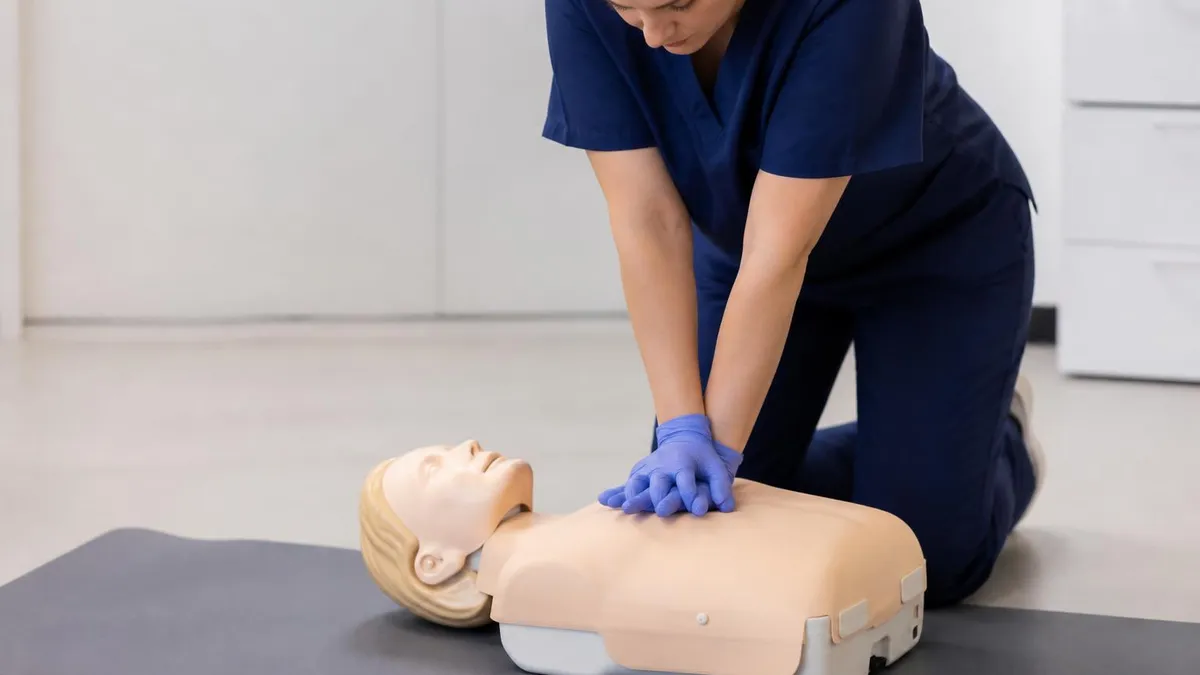
Adult chest compressions should be at least 2 inches deep but not more than 2.4 inches, at a rate of 100 to 120 per minute. Infants and children get roughly one-third the depth of the chest, which works out to about 1.5 inches for infants and 2 inches for children. The compression-to-ventilation ratio is 30:2 for single-rescuer adult, child, and infant cpr; with two rescuers and an advanced airway in place, compressions become continuous and ventilations are delivered every 6 seconds — that's a respiratory rate of 10 breaths per minute.
AED use deserves its own moment. The acronym question "what does aed stand for" appears on virtually every BLS written test: Automated External Defibrillator. The device analyzes the heart's rhythm and recommends a shock only if it detects ventricular fibrillation or pulseless ventricular tachycardia. Pads go on dry skin, one upper right chest and one lower left side. Shave excessive chest hair, remove transdermal patches, and never place pads over a pacemaker bulge. Resume compressions within 10 seconds of every shock.
Recovery position matters too. If a patient is unresponsive but breathing normally — say, after a syncope or seizure — placing them in the lateral position recovery protects the airway and prevents aspiration while you wait for help. BLS classes cover this briefly, but the technique is also tested on combined CPR and first aid exams. Practice rolling a partner on the floor before class day; it is harder than it looks.
Choking is the most likely emergency you will respond to outside of a hospital. For a conscious adult, give abdominal thrusts until the object is expelled or the patient becomes unresponsive — at which point you lower them to the ground and begin CPR, checking the mouth for the object before each set of ventilations. Infants get five back blows followed by five chest thrusts, repeated until effective. Need extra reps? Our adult CPR step-by-step guide walks through every move in detail.
Team dynamics is the section new providers underestimate. Closed-loop communication — "Push epi 1 milligram" / "Pushing epi 1 milligram now" / "Epi 1 milligram in" — is what separates a smooth code from chaos. Constructive intervention means speaking up respectfully if a team member is about to give a wrong dose or interrupt compressions unnecessarily. Knowing your limitations means handing off the compressor role before fatigue degrades depth, usually every two minutes.
Above all, remember that BLS is a perishable skill. Most providers see noticeable skill decay within six months without practice. Use a manikin at work, run mock codes with coworkers, and pull up free practice questions every few months to keep the algorithm sharp between renewals.
For a deeper look at this topic, see our guide to bls cpr near me.
Walking into BLS class prepared makes the difference between cruising through skills and stumbling on the rubric. Start your prep one week out. Spend 30 minutes reading the BLS Provider Manual sections on adult, child, and infant sequences. Watch the official AHA or Red Cross skills demonstration videos — both are free on YouTube and exactly match what your instructor will score. Take notes on the differences between adult and pediatric compression depth, rate, and ratio.
Three days before class, complete the online cognitive module if your course is blended. Take screenshots of the post-test certificate; some training centers require you to show it at sign-in. The night before, run through 50 free practice questions covering airway, AED, choking, and team dynamics. Pay attention to wrong answers — the explanation is where you learn, not the question itself.
The morning of class, eat protein. You will be on your knees doing compressions for longer than you expect, and a sugar crash mid-skills test is real. Wear athletic clothing, bring a water bottle, and leave jewelry that could snag on a manikin at home. If you wear glasses, bring a backup pair or contacts — sweat fogs lenses fast during continuous compressions.
During the written exam, read every question twice. AHA writers love to add "EXCEPT" or "LEAST likely" in the stem, and missing one word flips the answer. For the skills test, narrate what you are doing out loud: "Scene safe. Patient unresponsive. Calling 911. Sending for AED. Checking breathing and pulse simultaneously for no more than 10 seconds." Instructors score what they hear and see, not what you intend.
If you fail any portion, don't panic. Most centers allow immediate remediation — your instructor will coach you through the missed step and let you retest the same day. The pass rate for first-time BLS Provider is around 90%, and remediation pushes near-universal completion. The card you walk out with is identical to anyone else's, regardless of how many attempts the skills test took.
After class, save your digital card immediately, set a renewal reminder for 22 months from now, and consider stepping up to PALS or ACLS if your career requires it. Pals certification is the natural next step for pediatric nurses, ER staff, and PICU clinicians, while ACLS is mandatory for most adult critical care, ED, and rapid response roles. Both build directly on BLS — which is why getting BLS right the first time pays dividends for the rest of your career.
One closing tip: keep practicing even after you pass. Skill decay is real, and the day you need to perform CPR will arrive without warning. Five minutes of mental rehearsal once a month — visualizing scene safety, compressions, AED, and ventilations — keeps the algorithm reflexive when adrenaline hits.
CPR Questions and Answers
CPR Card Lookup: How to Verify, Replace, and Access Your CPR Certification in 2026
Adult CPR: Complete Step-by-Step Guide to Hands-Only and Standard CPR in 2026
CPR - Cardiopulmonary Resuscitation: Complete Study Guide 2026
Inappropriate CPR Songs: What Not to Play, Why It Matters, and Better Beat-Per-Minute Alternatives
AHA CPR Recertification: How to Recertify CPR Online with the American Heart Association in 2026
How this page was made: written with AI tools and published by Nathan Beja, founder of Practice Test Geeks, who is responsible for its content. Exam facts are checked against the official sources listed below. Not reviewed by a subject-matter expert. Editorial policy
Sources & references
Exam facts on this page (fees, format, dates, passing scores) are checked against these official sources; the date is our last check. Editorial policy
- redcross.org — Score validity, renewal, test delivery, passing score · verified Oct 2026
- elearning.heart.org — Fees, score validity, passing score · verified Oct 2026
- shopcpr.heart.org — Test delivery · verified Oct 2026