
AHA CPR Recertification: How to Recertify CPR Online with the American Heart Association in 2026 October
Recertify CPR online with the American Heart Association: renewal steps, blended learning, skills checks, costs, and how to keep your card valid 🏆
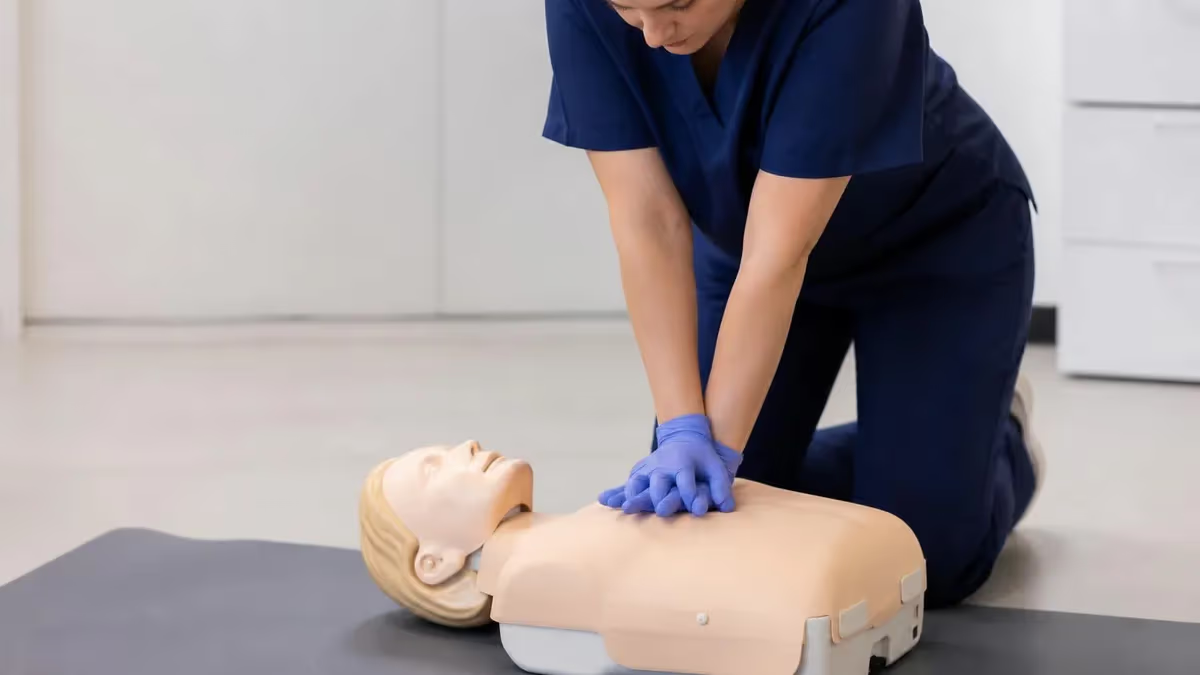
If your provider card is about to expire and you need to recertify cpr online american heart association style, you have more flexible options in 2026 than ever before. The American Heart Association now blends self-paced eLearning modules with a short hands-on skills check, which means most working professionals can finish renewal in a single afternoon instead of sitting through a full classroom day. Whether you're a nurse, paramedic, dental hygienist, lifeguard, or daycare worker, this guide walks you through every step.
Recertification is not the same as a brand-new course. The AHA assumes you already understand the acls algorithm structure, compression depth, ventilation ratios, and AED pad placement. The renewal experience is shorter, the cognitive exam is condensed, and the skills evaluation focuses on demonstrating that your muscle memory and judgment are still sharp. That's why missing your renewal window by even a few weeks usually forces you back into the full initial course at significantly higher cost.
The AHA's three core recertification pathways are BLS (Basic Life Support), ACLS (Advanced Cardiovascular Life Support), and PALS (Pediatric Advanced Life Support). Some learners also renew Heartsaver CPR AED, which is the layperson-focused credential designed for childcare staff, fitness trainers, and corporate first responders. Each one has its own eLearning bundle, but the skills session is conducted in person with an AHA-aligned instructor or through a verified Voice Assisted Manikin station.
In this article we'll compare AHA renewal to programs from the national cpr foundation, explain what counts as a valid recertification, and break down the timing, cost, and study schedule. We'll also cover how to prepare for the skills check, what happens if your card lapses, and how to find an authorized training site near you. By the end, you'll know exactly which path fits your role and how to lock in your card before your current one expires.
One important note before you click "buy": only the AHA itself and its authorized Training Centers can issue genuine AHA eCards. Be cautious of websites that promise instant printable certificates with no skills check — these are not accepted by hospitals, schools, EMS agencies, or licensing boards. A legitimate leather cpr wallet card or eCard always traces back to a verifiable Training Center ID in the AHA's Atlas database.
Finally, plan ahead. The AHA recommends starting renewal at least 30 days before your card's expiration date. That cushion gives you time to retake a section if your first skills attempt isn't perfect, troubleshoot any login issues with the online portion, and submit your eCard to your employer's compliance system. Procrastination is the single biggest reason healthcare workers end up paying for the full initial course again.
AHA Recertification by the Numbers
Key Facts at a Glance
| Item | Value | Details |
|---|---|---|
| Online Module Time | 2-3 hrs | BLS renewal average |
| Typical Total Cost | $60-$110 | varies by Training Center |
| Card Validity Period | 2 years | from issue date |
| Recommended Lead Time | 30 days | before expiration |
| Core Renewal Tracks | 3 | BLS, ACLS, PALS |

Recertification Pathways & Formats
Self-paced online cognitive portion through HeartCode BLS, ACLS, or PALS, followed by an in-person or VAM-station skills check. Most popular renewal route for nurses and paramedics with unpredictable schedules.
A condensed 3-4 hour classroom session that combines lecture review, video segments, practice scenarios, and the skills check in a single sitting. Best if you prefer structured learning or struggle with self-paced modules.
Quarterly low-dose, high-frequency micro-sessions on a CPR simulator station at your workplace. Replaces the traditional two-year card with rolling competency, offered through hospital systems and large EMS agencies.
For non-healthcare laypeople: teachers, coaches, daycare workers, and corporate responders. Skills-only or blended renewal available, focusing on compression-only and standard CPR with AED practice.
HeartCode blended learning is the backbone of AHA renewal in 2026. The online portion is hosted on elearning.heart.org, where you'll log in with the same account you used for your previous certification. The platform tracks your progress, so if you have to stop mid-module to take a patient or pick up your kids, you can resume exactly where you left off. Total seat time runs about two hours for BLS, three to four hours for ACLS, and roughly the same for PALS depending on your scenario performance.
The cognitive portion uses branching simulations rather than passive video. You'll be placed in a virtual code scenario where you direct a team, call for the crash cart, choose medications from the acls algorithm, interpret rhythms, and decide when to shock versus continue compressions. Wrong decisions trigger remediation loops that walk you through the correct sequence before you can advance. This is why HeartCode tends to feel harder than a classroom course but builds stronger retention.
At the end of the eLearning portion, you'll take a multiple-choice exam. The passing threshold is 84% for ACLS and PALS, and 84% for BLS as well. You get unlimited attempts on most platforms, but each retake locks you out for a short cool-down period. Print or save your completion certificate immediately — you'll need to bring or upload it before your skills session.
The skills check is the part that catches people off guard. Even though the online portion may feel comprehensive, you cannot earn the eCard without demonstrating hands-on competency. This includes high-quality compressions at 100-120 per minute, two-inch depth on the adult manikin, proper bag-valve-mask ventilation, AED pad placement and shock delivery, and for ACLS, leading a team through a megacode scenario with rhythm interpretation.
Pricing varies significantly by region and Training Center. The HeartCode online portion alone typically costs $35 to $50 for BLS and $130 to $160 for ACLS or PALS. The skills check adds another $40 to $90 depending on whether you use a VAM (Voice Assisted Manikin) station or an in-person instructor. Some hospitals cover the entire cost for clinical staff, so always ask your employer before paying out of pocket.
A note on third-party verification: if you're confused about which providers issue real AHA cards, you can use the AHA's Atlas search or the cpr index lookup tools to verify a Training Center's status. Sites that advertise instant printable AHA cards with no skills check are not affiliated with the AHA — and an employer who runs a cpr fix phones style verification check on your eCard number will immediately catch the discrepancy.
Finally, make sure you complete both halves within 60 days of each other. The AHA invalidates HeartCode completions older than two months when paired with a skills session, meaning you'd have to redo the online portion. This becomes a real problem for shift workers who put off scheduling the in-person component — set a calendar reminder the moment you finish the eLearning module.

CPR Practice Test Questions
Prepare for the CPR Cardiopulmonary Resuscitation Practice exam with our free practice test modules. Each quiz covers key topics to help you pass on your first try.
CPR Basic CPR
CPR Exam Questions covering Basic CPR. Master CPR Test concepts for certification prep.
CPR and First Aid
Free CPR Practice Test featuring and First Aid. Improve your CPR Exam score with mock test prep.
CPR (Cardiopulmonary Resuscitation) Adult ...
CPR Mock Exam on (Cardiopulmonary Resuscitation) Adult CPR and AED Usage. CPR Study Guide questions to pass on your first try.
CPR (Cardiopulmonary Resuscitation) Airway...
CPR Test Prep for (Cardiopulmonary Resuscitation) Airway Obstruction and Choking. Practice CPR Quiz questions and boost your score.
CPR (Cardiopulmonary Resuscitation) Cardio...
CPR Questions and Answers on (Cardiopulmonary Resuscitation) Cardiopulmonary Emergency Recognition. Free CPR practice for exam readiness.
CPR (Cardiopulmonary Resuscitation) Child ...
CPR Mock Test covering (Cardiopulmonary Resuscitation) Child and Infant CPR. Online CPR Test practice with instant feedback.
CPR (Cardiopulmonary Resuscitation) High-P...
Free CPR Quiz on (Cardiopulmonary Resuscitation) High-Performance Team Dynamics. CPR Exam prep questions with detailed explanations.
CPR (Cardiopulmonary Resuscitation) Legal ...
CPR Practice Questions for (Cardiopulmonary Resuscitation) Legal and Ethical Considerations. Build confidence for your CPR certification exam.
CPR for Specific Populations
CPR Test Online for for Specific Populations. Free practice with instant results and feedback.
CPR Airway & Breathing Management
CPR Exam Questions covering Airway & Breathing Management. Master CPR Test concepts for certification prep.
CPR Assessment & Recognition of Cardiac Ar...
Free CPR Practice Test featuring Assessment & Recognition of Cardiac Arrest. Improve your CPR Exam score with mock test prep.
CPR Chest Compressions & Defibrillation
CPR Mock Exam on Chest Compressions & Defibrillation. CPR Study Guide questions to pass on your first try.
CPR Post-Resuscitation Care & Recovery
CPR Test Prep for Post-Resuscitation Care & Recovery. Practice CPR Quiz questions and boost your score.
BLS vs ACLS vs PALS Renewal: Key Differences
Basic Life Support renewal is the most common AHA recertification and the gateway credential for nearly every clinical role. The cognitive portion focuses on high-quality compressions, two-rescuer coordination, infant cpr technique, bag-valve-mask ventilation, and adult and pediatric AED use. Most candidates finish the eLearning in 90 to 120 minutes, and the skills check runs about 30 minutes.
BLS renewal does not require rhythm interpretation or medication knowledge. The skills evaluator wants to see crisp, confident technique: hand placement, compression depth, recoil, ventilation seal, and switching positions every two minutes without losing CPR fraction. If you've been doing CPR regularly at work, this is the easiest of the three renewals to clear on the first attempt.
AHA Online Recertification: Pros and Cons
- +Self-paced eLearning fits unpredictable healthcare schedules
- +Branching simulations build stronger retention than passive video
- +Universally accepted by hospitals, EMS agencies, and licensing boards
- +eCard issues automatically to AHA Atlas for employer verification
- +HeartCode tracks progress so you can resume anytime
- +Skills check can be completed at a VAM station 24/7 at many sites
- +Cheaper than initial certification by $40 to $80
- −Two-step process requires scheduling discipline
- −Skills check still requires in-person or VAM attendance
- −Online portion expires 60 days after completion
- −Not valid if your card already expired (in most cases)
- −HeartCode platform occasionally has login or progress-save issues
- −Some employers require classroom-only renewal
- −Higher cognitive load than traditional classroom review

Pre-Renewal Skills Checklist: Get Ready Before You Click Buy
- ✓Confirm your current eCard expiration date in the AHA Atlas
- ✓Verify your employer accepts blended HeartCode renewal
- ✓Choose an authorized AHA Training Center (not a third-party impostor)
- ✓Schedule your in-person or VAM skills check within 60 days of online completion
- ✓Review the latest AHA Guidelines update (compression depth, rate, ventilation)
- ✓Practice 30:2 single-rescuer and continuous compressions with rotating rescuers
- ✓Memorize the cardiac arrest acls algorithm if renewing ACLS
- ✓Refresh infant cpr technique with two-thumb and two-finger methods
- ✓Bring photo ID and prior eCard number to your skills appointment
- ✓Print or download your eLearning completion certificate before arriving
Start renewal 30 days early to avoid taking the full initial course again
The AHA's grace period policy varies by Training Center, but most will not honor renewal pricing for cards that have already expired. Once your card lapses, you're typically required to take the full initial Provider course — which costs nearly double and takes twice as long. A simple calendar reminder 60 days before expiration is the single highest-ROI productivity move you can make as a clinician.
The skills check is where renewal becomes real. Show up dressed comfortably — scrubs or athletic clothing work best because you'll be kneeling on the floor and leaning over a manikin for 30 to 60 minutes. Bring water, your photo ID, your printed eLearning certificate, and your previous eCard number. Most Training Centers refuse to start the session if any of these are missing, and rescheduling can push you past your 60-day window.
You'll typically start with adult one-rescuer CPR. The evaluator wants to see you check responsiveness, shout for help, send someone to call 911 and get the AED, check breathing and pulse for no more than 10 seconds, and begin compressions immediately if both are absent. Compression depth is at least two inches but no more than 2.4 inches, rate is 100 to 120 per minute, and you must allow full chest recoil between each compression.
Next comes two-rescuer CPR with bag-valve-mask. Your partner (often another candidate or a staff manikin operator) manages ventilation while you compress. The ratio is 30:2 until an advanced airway is in place, then continuous compressions with one breath every six seconds. Switch roles every two minutes or sooner if compressor fatigue is evident. Minimize hands-off time to less than 10 seconds during every transition — this is one of the most commonly failed metrics.
AED use is next. The evaluator will hand you an AED trainer and watch you turn it on, expose the chest, apply pads correctly, clear the patient for analysis, deliver a shock if advised, and resume compressions immediately after the shock without checking a pulse. Many candidates lose points by pausing to recheck pulse after the shock — the algorithm says resume CPR for two minutes, then reassess.
For ACLS, you'll then move into the megacode. Expect a scenario like witnessed VF arrest progressing to PEA, or a symptomatic bradycardia transitioning to unstable tachycardia. You'll lead the team, call rhythms, choose energy levels for defibrillation or synchronized cardioversion, order medications by dose and route, and decide when to consider reversible causes (the H's and T's). The evaluator scores you on team dynamics as much as on algorithm accuracy.
Pediatric and infant CPR follow for BLS and PALS renewals. Compression depth changes to one-third the AP diameter of the chest — about 1.5 inches for infants and 2 inches for children. Two-rescuer infant CPR uses the two-thumb encircling-hands technique with a 15:2 ratio. PALS adds respiratory assessment, recognition of compensated versus decompensated shock, and pediatric medication dosing based on length-based tape.
If you don't pass on the first attempt, most Training Centers offer a free or low-cost remediation within two weeks. Don't panic — failure on a single station does not invalidate your eLearning portion. The evaluator will tell you exactly which skills need work, and a focused 30-minute practice session usually resolves the issue.
If your AHA card has been expired for more than 30 days, most Training Centers will require you to take the full initial Provider course rather than the renewal. This adds roughly two hours of class time and $40 to $80 in fees. Some employers also flag lapsed certifications in compliance audits, which can temporarily restrict your scope of practice until you re-certify.
What happens if your card has already lapsed? In most cases, the AHA expects you to complete the full initial Provider course rather than the renewal pathway. This isn't bureaucratic punishment — it reflects evidence that skills decay measurably after 12 to 18 months without practice. The initial course adds team scenarios, deeper algorithm walk-throughs, and additional skills time that renewal candidates skip. Plan on three to five hours of additional commitment if you've let your card expire.
Reciprocity is another common question. AHA cards are accepted nationwide and in most countries with US-affiliated healthcare systems. However, the reverse is not always true: cards from the American Red Cross, American Safety and Health Institute, or the national cpr foundation may or may not be accepted as substitutes depending on your state nursing board, EMS agency, or hospital credentialing department. Always check your specific employer's policy before switching providers.
For traveling healthcare professionals, RQI (Resuscitation Quality Improvement) offers a portable alternative. RQI replaces the two-year card with rolling quarterly competency assessments performed on a feedback-enabled manikin station, often located in your workplace. Your competency status updates in real time in the AHA system, and you never carry a traditional card. Many large hospital systems, especially academic medical centers, now mandate RQI for all clinical staff.
International candidates have a few additional considerations. AHA eCards are valid globally, but some countries require a co-signature from a locally licensed instructor or a translated version of the card. The AHA's international Training Centers in Canada, the UK, Australia, and Singapore can issue cards under the same standards used domestically. If you'll be working abroad, contact the destination employer's credentialing office at least 60 days before your start date.
Don't forget to update your renewal status with your state licensing board if applicable. Some boards — particularly nursing and EMS — require you to attach a copy of your current AHA card during license renewal cycles. Missing this attachment can delay license renewal by weeks, even if your AHA certification is technically valid. Set a calendar reminder to upload your new eCard the day you receive it.
If you're considering teaching CPR after recertifying, the next step is the AHA Instructor Course. Becoming an instructor requires a current Provider card plus an Instructor Essentials course, monitoring of your first two classes, and alignment with a Training Center. Many clinicians find it a rewarding side income — explore normal respiratory rate for adults opportunities once you've passed your own renewal. Instructor cards renew on a different cycle than Provider cards, so plan for two parallel certifications.
One last reciprocity note: some certifications labeled "CPR for the workplace" or "compression-only CPR" are not equivalent to AHA Heartsaver or BLS. Layperson workshops without a skills check do not satisfy healthcare provider requirements. If your job description includes any clinical duties, you almost certainly need an AHA or Red Cross card with documented hands-on evaluation — not a printable PDF from an online quiz.
Practical study tips: don't try to cram the entire course the night before. The AHA's HeartCode platform is designed around spaced repetition, so spreading your eLearning across three or four sessions of 30 to 45 minutes each will produce better retention than a single marathon session. Take notes during the branching scenarios — especially on the acls algorithm decision points where you got remediation feedback. These are exactly the questions most likely to reappear on the final cognitive exam.
Use free practice quizzes to identify weak spots before you start the paid module. If you find yourself fuzzy on rhythm strips, AED indications, infant cpr technique, or what does aed stand for in plain language, practice those domains first. Practice questions from independent sources are not a substitute for the AHA course, but they're an excellent diagnostic tool to focus your study time. The cpr index and similar free study tools also reinforce content without unlocking the official eCard until you complete the AHA pathway.
For the skills check, rehearse out loud. Compression depth and rate are muscle skills, but team communication and verbal calls are what separate a confident performance from a hesitant one. Practice saying "I'm starting compressions," "Please attach the AED," "Pulse check — no pulse, resume compressions," and "Switch on my count." Evaluators consistently rate candidates higher when their verbal direction is crisp, even if their physical technique is identical.
If you're renewing ACLS or PALS, drill the megacode scenarios from start to finish. Run through witnessed VF, PEA, asystole, bradycardia with poor perfusion, unstable narrow-complex tachycardia, and stable wide-complex tachycardia. For each, narrate the initial assessment, your first three actions, the medications and doses, and the transition criteria to the next algorithm. You'll be amazed how much faster the scenarios feel after two or three full run-throughs.
Manage your environment on test day. Eat a real meal beforehand — kneeling on the floor doing compressions while hungry is miserable. Hydrate, but not so much that you need a bathroom break mid-scenario. Wear comfortable shoes that grip the floor (loose flip-flops will betray you during compressor changes). If you wear glasses, secure them so they don't slide down your nose when you lean over the manikin.
Finally, save your eCard the moment it lands in your inbox. The PDF includes a unique QR code linked to the AHA Atlas, which is what hospitals scan to verify authenticity. Upload the PDF to your employer's compliance portal, save a copy to your personal cloud storage, and consider printing one for your wallet. Lost eCards can be reissued by your Training Center for a small fee, but it's an avoidable hassle if you back up the file immediately.
Recertification is a milestone, not just a checkbox. Each renewal is your opportunity to update your practice with the latest evidence-based guidelines, sharpen team communication, and remind yourself why these skills matter. The two hours you invest today could mean the difference between life and death for a patient or family member tomorrow — a payoff no other professional credential can claim.
CPR Questions and Answers
CPR vs BLS: Complete Comparison Guide for 2026 — Which Certification Do You Need?
CPR Card Lookup: How to Verify, Replace, and Access Your CPR Certification in 2026
AHA CPR: What It Is, Which Course You Need, and How to Get Certified
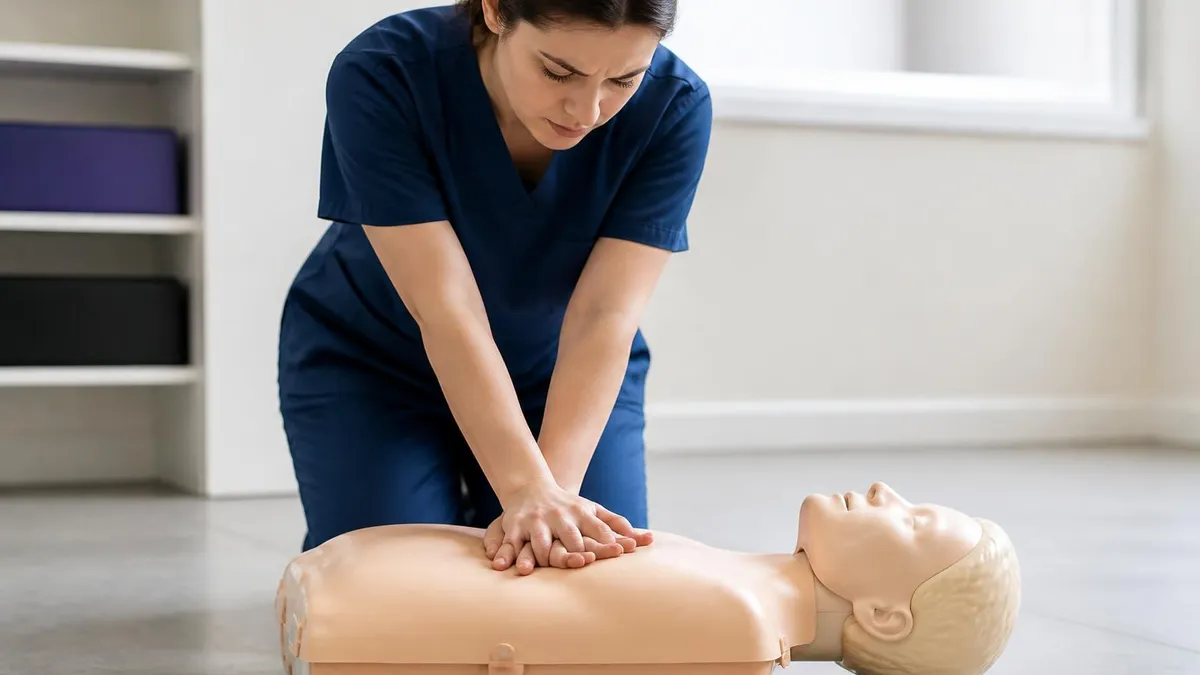
CPR Instructor Jobs 2026: How to Become a Certified Instructor, Salary Expectations, and Career Pathways
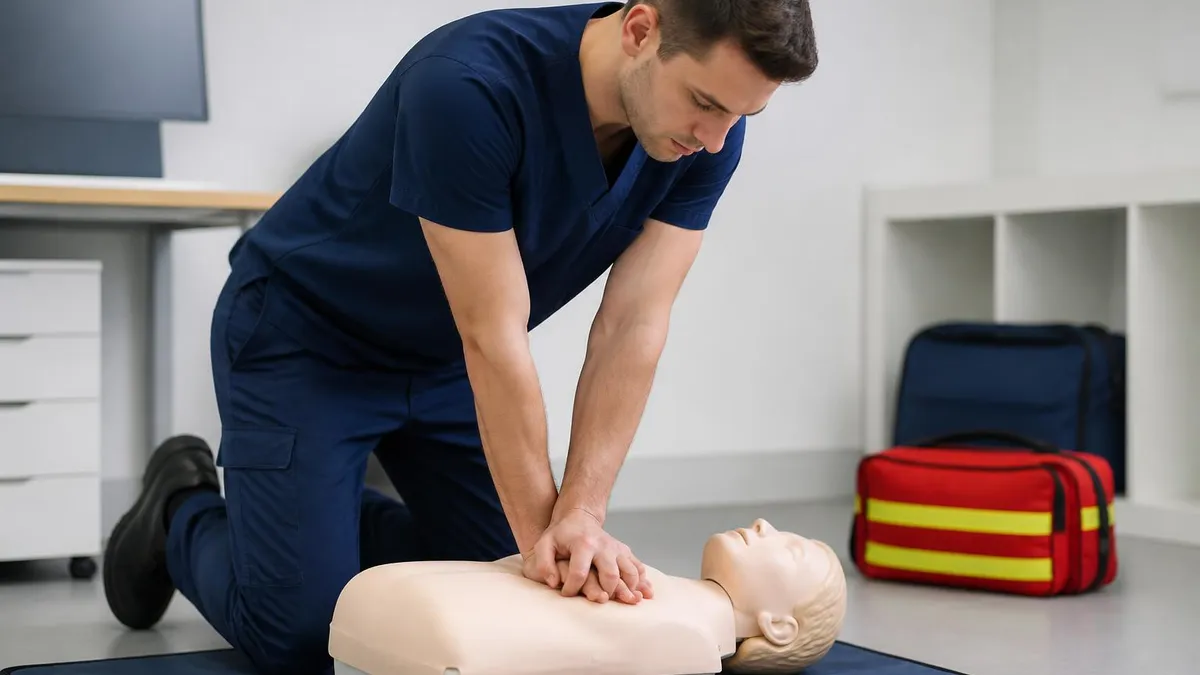
Adult CPR: Complete Step-by-Step Guide to Hands-Only and Standard CPR in 2026
About the Author

Registered Nurse & Healthcare Educator
Johns Hopkins University School of NursingDr. Sarah Mitchell is a board-certified registered nurse with over 15 years of clinical and academic experience. She completed her PhD in Nursing Science at Johns Hopkins University and has taught NCLEX preparation and clinical skills courses for nursing students across the United States. Her research focuses on evidence-based exam preparation strategies for healthcare certification candidates.
Join the Discussion
Connect with other students preparing for this exam. Share tips, ask questions, and get advice from people who have been there.
View discussion (5 replies)