
Caterpillar Forklift Specs: Complete Guide to CAT Lift Truck Models, Capacities, Dimensions, and Buyer Considerations for 2026 October
Complete caterpillar forklift specs guide covering CAT lift truck capacities, 🟢 dimensions, fuel types, and rental options for warehouses and
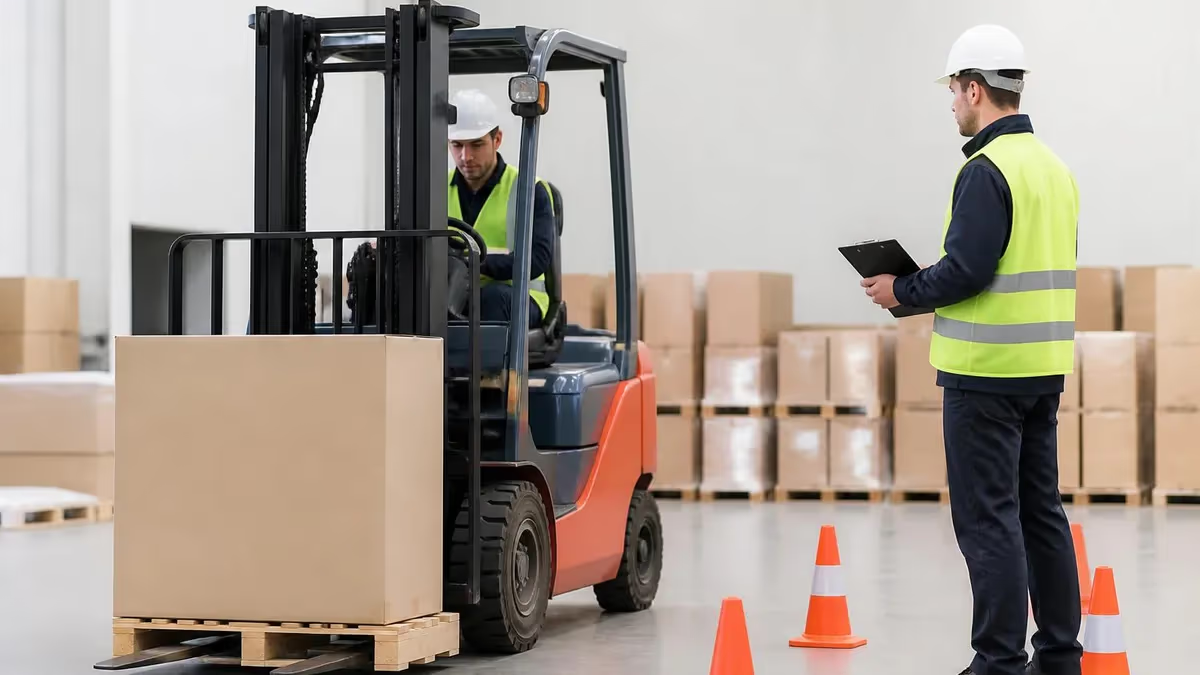
Understanding caterpillar forklift specs is essential for any warehouse manager, fleet operator, or independent contractor weighing a forklift rental against an outright purchase. Caterpillar (often branded as CAT Lift Trucks and now manufactured under license by Mitsubishi Logisnext Americas) produces one of the most recognized lines of industrial forklifts in North America, with capacities ranging from compact 3,000-pound electric pneumatics to heavy-duty 36,000-pound diesel units designed for ports, lumber yards, and steel service centers across the United States.
The CAT lineup is segmented into four major families: internal combustion cushion tire (GC and C series), internal combustion pneumatic tire (DP and GP series), electric counterbalance (EP and ET series), and warehouse equipment including reach trucks, order pickers, and the stand up forklift configuration popular in narrow-aisle distribution centers. Each family has distinct lift heights, turning radii, mast configurations, and powertrain options that directly affect productivity, operator comfort, and total cost of ownership across a typical seven-year service life.
For operators just entering the trade, knowing the spec sheet matters as much as knowing OSHA rules. A 5,000-pound capacity CAT GP25N behaves very differently from a 15,000-pound DP150N, and matching the wrong machine to a job site causes tip-overs, racking damage, and failed loads. That is why proper forklift training pairs classroom instruction on load charts with hands-on familiarization on the exact model the operator will run on shift.
This guide breaks down every major spec category you need to evaluate before signing a purchase order, a lease, or even a short-term forklift rental contract. We cover load capacity at 24-inch load centers, lift heights from standard 188-inch triple masts to 270-inch quad stage units, fuel options including LPG, diesel, gasoline, dual-fuel, and lithium-ion electric, plus the attachment compatibility that determines whether you can swap to a side shifter, fork positioner, or paper roll clamp.
We also tackle the buyer questions that spec sheets rarely answer directly. How does a CAT electric forklift compare to a Toyota 8FBE on energy cost per shift? What is the realistic resale value of a 2018 GP25N5 with 8,000 hours? Should a small business chase a used unit on the forklift for sale market or commit to a new lease backed by a manufacturer warranty? Each answer ties back to the published specs but layers in real-world performance data drawn from fleet telematics and dealer auction reports.
Finally, we explain how specs interact with the OSHA 1910.178 certification requirement. Every operator must be evaluated on the specific truck type they will run, meaning a certification on a CAT 2EP3000 electric stand up does not transfer to a DP70N1 diesel pneumatic. Understanding model designations, capacity classes, and powertrain categories is therefore not just a purchasing decision — it is the foundation for legal, safe, and productive forklift operations on every American job site. If you also manage tires, this primer on how to get forklift certified covers the certification side in depth.
By the end of this article, you will be able to read a CAT spec sheet line by line, compare it against Hyster, Toyota, and Crown alternatives, and decide whether to rent, lease, or buy the right Caterpillar forklift for your specific application and budget.
Caterpillar Forklifts by the Numbers

Caterpillar Forklift Model Families and Series
Indoor cushion-tire trucks rated 3,000 to 12,000 pounds, powered by LPG or dual-fuel. Ideal for smooth concrete warehouses, retail backrooms, and beverage distribution where tight turning matters more than rough-terrain capability.
Outdoor pneumatic-tire trucks from 3,000 to 36,000 pounds running diesel, LPG, or gasoline. Designed for lumber yards, construction sites, ports, and any unpaved surface requiring rugged traction and weather durability.
Three- and four-wheel electric trucks from 3,000 to 12,000 pounds with AC traction motors and optional lithium-ion packs. Zero-emission, quiet operation suited for food, pharmaceutical, and indoor manufacturing facilities.
Includes reach trucks, order pickers, walkies, and stand up forklift models for narrow-aisle high-density storage. Lift heights extend to 540 inches in the deep reach configuration with VNA guidance systems.
Heavy-capacity DP100 through DP160 diesel pneumatics rated 22,000 to 36,000 pounds. Used at intermodal terminals, steel mills, and concrete pipe plants where massive single-load handling is required daily.
Capacity is the single most quoted spec on any Caterpillar forklift datasheet, but the headline number only tells part of the story. CAT publishes nominal capacity at a 24-inch load center, meaning the center of gravity of the load is 24 inches from the face of the forks. Once the load center moves out — a long pallet of pipe, a stacked drum, or a side-shifted unit load — capacity drops sharply along a derate curve printed on the data plate. Operators must read that plate before every lift, not just the model number on the cowl.
The CAT GP25N5, for example, lists a 5,000-pound capacity at 24 inches but only 3,800 pounds at 36 inches with a 187-inch triple-stage mast. Add a side shifter and you lose another 200 pounds. Add a fork positioner and you might drop to 3,500 pounds. These derates compound, and the only way to know the actual safe working load is to consult the attachment-specific data tag riveted to the carriage by the dealer at the time of installation.
Lift height interacts with capacity in a similar way. Standard two-stage masts on CAT pneumatic trucks raise loads to roughly 130 inches, while triple-stage full-free-lift masts extend to 188 inches without derating. Move to a 240-inch quad-stage and you typically lose 10 to 15 percent of rated capacity due to mast deflection and stability geometry. For pallet rack systems with a 96-inch top beam, a standard 188-inch triple is usually more than enough.
Wheelbase and turning radius drive aisle width planning. A CAT EP18ANT three-wheel electric has a 51-inch wheelbase and turns inside an 80-inch radius, allowing 96-inch aisles. A four-wheel DP70N1 diesel needs a 96-inch wheelbase and 134-inch radius, demanding 144-inch aisles minimum. If you are designing a new distribution center, those numbers determine how many pallet positions fit per square foot of warehouse — a multi-million-dollar decision.
Weight and floor loading are equally important specs that get overlooked. A loaded CAT DP35N at maximum lift can exert more than 9,000 pounds per square inch on the front drive tires. Older warehouse slabs rated for 5,000 PSI can crack under repeated cycles, leading to expensive concrete repair. Always cross-reference the truck's loaded axle weight with your facility's structural engineering report before placing a new model on the floor.
Travel speeds and gradeability round out the productivity picture. CAT electric counterbalance trucks typically cruise at 10.5 mph empty and 9.5 mph loaded, with 15 to 20 percent gradeability fully loaded. Diesel pneumatics push 13 to 14 mph and climb 25 percent grades, which matters at outdoor lumber yards with sloped pavement. These numbers seem small until you multiply them across an eight-hour shift and 400 load cycles — minutes saved per cycle become hours of labor saved per week.
If you operate attachments beyond standard forks, study the compatibility matrix carefully. A lull forklift attachment is not a drop-in for a CAT carriage, and mounting non-OEM hardware can void warranty and trigger an OSHA citation if not engineered to ITA Class II, III, or IV standards matching your truck.

Forklift certification Practice Test Questions
Prepare for the Forklift certification Certification exam with our free practice test modules. Each quiz covers key topics to help you pass on your first try.
Forklift certification Certification Forkl...
Forklift certification Exam Questions covering Certification Forklift certification Maintenance and Repairs. Master Forklift certification Test concepts for certification prep.
Forklift certification Certification Forkl...
Free Forklift certification Practice Test featuring Certification Forklift certification Maintenance and Repairs Questions and Answers. Improve your Forklift certification Exam score with mock test prep.
Forklift certification Certification Forkl...
Forklift certification Mock Exam on Certification Forklift certification Operator Training and Certification Requirements. Forklift certification Study Guide questions to pass on your first try.
Forklift certification Certification Forkl...
Forklift certification Test Prep for Certification Forklift certification Operator Training and Certification Requirements Questions and Answers. Practice Forklift certification Quiz questions and boost your score.
Forklift certification Load Handling and S...
Forklift certification Questions and Answers on Load Handling and Stability. Free Forklift certification practice for exam readiness.
Forklift certification OSHA Regulations an...
Forklift certification Mock Test covering OSHA Regulations and Compliance. Online Forklift certification Test practice with instant feedback.
Forklift certification Pre-Operation Inspe...
Free Forklift certification Quiz on Pre-Operation Inspections. Forklift certification Exam prep questions with detailed explanations.
Forklift certification Refueling and Recha...
Forklift certification Practice Questions for Refueling and Recharging Procedures. Build confidence for your Forklift certification certification exam.
Forklift certification Safe Driving and Ma...
Forklift certification Test Online for Safe Driving and Maneuvering. Free practice with instant results and feedback.
Forklift certification Workplace Hazard Id...
Forklift certification Study Material on Workplace Hazard Identification. Prepare effectively with real exam-style questions.
Forklift certification Forklift Instructions
Free Forklift certification Test covering Forklift Instructions. Practice and track your Forklift certification exam readiness.
Forklift certification Forklift MCQ
Forklift certification Exam Questions covering Forklift MCQ. Master Forklift certification Test concepts for certification prep.
Forklift certification Forklift Employer R...
Free Forklift certification Practice Test featuring Forklift Employer Responsibilities. Improve your Forklift certification Exam score with mock test prep.
Forklift certification Forklift Penalties ...
Forklift certification Mock Exam on Forklift Penalties for Non-Compliance. Forklift certification Study Guide questions to pass on your first try.
Engine, Fuel, and Power Options for Electric Forklift and IC Models
Internal combustion CAT forklifts use either Mitsubishi S4S/S6S 2.5L and 3.3L diesel engines or Nissan K21/K25 LPG units, both proven powerplants producing 49 to 81 horsepower depending on capacity class. Diesel engines deliver superior torque for outdoor heavy lifting and gradeability, while LPG offers cleaner emissions suitable for indoor and outdoor mixed use. Tier 4 Final compliance means modern CAT diesels include diesel particulate filters, requiring regen cycles that operators must understand to avoid derating events.
Fuel economy varies by load and duty cycle, but a typical CAT DP35N5 consumes 1.4 gallons of diesel per hour in moderate use, while a comparable GP35N5 LPG burns roughly 4.5 pounds of propane per hour. Over a 2,000-hour annual usage profile, fuel costs alone can exceed $5,000 per truck, which is why many warehouse operations are migrating toward electric counterbalance equipment when shift duration and charging infrastructure permit.
Should You Buy a New Caterpillar Forklift?
- +Five-year/10,000-hour standard powertrain warranty on most new IC models
- +Strong U.S. dealer network with 24-hour emergency parts availability
- +High resale value retention — 45 to 55 percent after five years on average
- +Mitsubishi Logisnext manufacturing quality with proven engine reliability
- +Cat Connect telematics included on most 2024-2026 model year units
- +Tier 4 Final compliance ensures EPA approval at federal job sites
- +Operator cabin ergonomics rank in top three of all major brands per industry surveys
- −New purchase price 8 to 12 percent above Hyster or Komatsu equivalents
- −Lead times for custom-spec orders can exceed 16 weeks in current market
- −Lithium-ion options still limited compared to Toyota and Crown lineups
- −Genuine OEM parts cost 20 to 30 percent above aftermarket alternatives
- −Older pre-2015 models lack modern operator assistance and stability features
- −Service rates at authorized dealers run $145 to $185 per hour in major metros

Pre-Purchase Inspection Checklist for Used Caterpillar Forklifts
- ✓Verify hour meter reading against service records and request the Cat Connect telematics report
- ✓Inspect mast channels for wear ridges, cracked welds, and hydraulic cylinder seepage
- ✓Check fork heel thickness — replace if wear exceeds 10 percent of original blade dimension
- ✓Test all hydraulic functions including lift, tilt, side shift, and any auxiliary attachment circuits
- ✓Inspect drive tires for chunking, exposed cords, and uneven wear indicating alignment problems
- ✓Review engine oil analysis report or request a fresh sample tested for metals and coolant contamination
- ✓Confirm overhead guard and load backrest are OEM and free of weld repairs that could void OSHA compliance
- ✓Verify data plate is intact, legible, and matches the serial number stamped on the frame
- ✓Test parking brake hold on a 15 percent grade with rated load to confirm system integrity
- ✓Check battery age and capacity test results — replacement packs run $4,500 to $9,000 depending on voltage
Hour meter readings can lie — always pull telematics data
A CAT forklift with 6,000 displayed hours but 11,000 hours of actual key-on time is not uncommon on the used market. Cat Connect telematics, fleet management software exports, and dealer service histories all provide independent verification. Never trust the hour meter alone, especially on units selling below market value through online auctions or out-of-state brokers.
Pricing for a new Caterpillar forklift varies dramatically by capacity, fuel type, and configuration, but published 2026 dealer list prices give a reliable starting point. A new 5,000-pound EP25(C)PNT electric counterbalance with 188-inch triple mast, side shifter, and 80V/620Ah lead-acid battery typically lists between $42,000 and $48,000. The same capacity in a DP25N5 diesel pneumatic runs $36,000 to $42,000, while a GC25N5 LPG cushion truck for indoor warehouse use sits between $33,000 and $39,000 after typical dealer discounts.
Forklift rental rates depend heavily on geography and contract length. Daily rates for a 5,000-pound CAT GP25N from a major U.S. dealer range from $185 to $245, weekly rates run $625 to $895, and monthly rates land between $1,650 and $2,400 including a typical 160-hour usage allowance. Anything beyond that monthly hour cap incurs overage charges of $4 to $7 per hour. Long-term rental contracts of 36 to 60 months frequently price below comparable leases and include planned maintenance.
When searching for a forklift rental near me, the local CAT dealer is rarely the only option. National rental houses including United Rentals, Sunbelt, and Herc Rentals all stock CAT pneumatic units alongside Hyster and Toyota equivalents. Pricing at the national chains is often 5 to 10 percent below dealer rates for short-term needs but excludes operator training and OSHA evaluation that authorized dealers typically bundle in.
The used market for forklifts in the United States is strong, with roughly 50,000 used units changing hands annually through dealer trade-ins, auction houses, and online marketplaces. A 2019 CAT GP25N5 with 5,500 hours, full service history, and standard mast typically sells for $14,500 to $18,000 wholesale and $19,500 to $24,500 retail. Lower-hour examples under 3,000 hours command premiums, while units exceeding 10,000 hours often discount 40 to 50 percent unless they have documented engine or mast rebuilds.
Resale value is one of Caterpillar's strongest competitive advantages. Industry data from EquipmentWatch and Ritchie Bros shows CAT forklifts retaining 48 to 55 percent of MSRP after five years and 28 to 35 percent after ten years — among the highest in the industry, comparable to Toyota and ahead of most other brands. This residual value drives lower total cost of ownership even when the initial purchase price runs higher than competitors.
Lease versus buy is the perennial question. Operating leases on a $40,000 CAT forklift typically run $625 to $850 per month over 60 months with full maintenance included, while a capital lease at the same term runs $750 to $950 with a $1 buyout. Cash purchase locks in the lowest total cost but ties up working capital and exposes the buyer to all maintenance, downtime, and disposal risk. For most small and mid-size operators running one to three trucks, full-service operating leases offer the best balance of predictable cost and zero downtime risk.
If something does go wrong outside of warranty, having a relationship with a quality independent shop is invaluable. Many fleet operators keep one authorized dealer for warranty work and Cat Connect support, plus one local forklift repair shop for out-of-warranty service at competitive rates.
Used CAT forklifts imported from Asia or Europe may carry the Caterpillar name but lack U.S. EPA certification, English-language data plates, and ITA-standard carriages. These units cannot be legally operated at most U.S. job sites and parts availability is limited. Always verify the serial number with an authorized U.S. dealer before purchase, especially on units priced 30 percent or more below market value.
OSHA 29 CFR 1910.178(l) requires every powered industrial truck operator in the United States to receive formal training, hands-on evaluation, and recertification every three years or sooner if performance issues arise. The certification is type-specific, meaning a CAT GC25N cushion tire operator is not automatically qualified to run a CAT DP35N pneumatic outdoors — even though both are sit-down counterbalance trucks. The forklift operator must be evaluated on each new equipment type before solo operation begins.
Training programs typically split into three components: formal classroom or e-learning instruction covering OSHA rules and CAT-specific safety features, hands-on practical training on the actual model the operator will use, and a documented performance evaluation by a qualified trainer. Total time investment ranges from 6 to 12 hours for an experienced operator transitioning to a new CAT model, and 16 to 24 hours for a complete novice with no prior forklift experience whatsoever.
Cost varies by provider and region. Online theory-only courses run $59 to $129 and produce a wallet card, but they do not satisfy OSHA's hands-on evaluation requirement on their own. In-person training at a CAT dealer or third-party safety firm runs $189 to $395 per operator and includes the practical evaluation. Some employers run in-house programs using a designated trained employee, which is fully compliant if documentation is maintained and the trainer is genuinely qualified by experience.
Recertification is not a full retraining — it is a performance evaluation that confirms the operator still meets standards. OSHA mandates this every three years at minimum, but recertification is also required immediately after any accident, near-miss, observed unsafe operation, or assignment to a new truck type. Smart fleet managers schedule recertification annually as a best practice, catching skill drift before it causes incidents on the shop floor.
Documentation requirements often surprise employers during OSHA audits. The record must include the operator's name, date of training, date of evaluation, name of the trainer or evaluator, and the specific equipment types covered. A vague entry like "forklift training completed" will not survive scrutiny. CAT dealers typically provide certificates listing the model series and capacity class, which satisfies the requirement and protects the employer in the event of an injury claim.
The most overlooked rule is the refresher trigger for accidents, near misses, and process changes. If an operator hits a rack beam, knocks a load off a trailer, or even just drops a pallet during a routine handoff, OSHA requires documented refresher training before that operator returns to solo duty. Many companies treat this as bureaucratic overhead, but failing to retrain after an incident is one of the most commonly cited violations during forklift-related inspections nationwide.
For operators looking to expand into specialized roles, additional endorsements help. Aerial work platforms, rough-terrain telehandlers, and side-loaders each have their own training requirements. Some communities offer subsidized programs through workforce boards and nonprofit groups like community forklift that bundle multiple certifications into one curriculum, helping new workers enter the trade with marketable credentials and verified skill across multiple equipment classes.
Putting CAT specs into practice starts with a clear-eyed assessment of your operation. Map your aisle widths, load weights at the worst-case load center, lift heights at the highest beam, dock interface requirements, and shift patterns. Then build a short-list of two or three CAT models that meet every requirement with a safety margin of 15 to 20 percent on capacity and 6 to 12 inches of clearance on lift height. Skipping this exercise leads to undersized trucks, blown deadlines, and replacement orders within 18 months.
Demo every truck before signing. CAT dealers routinely deliver demo units for one- to two-week trials, and most are happy to bring two or three competing configurations to compare side by side. Have your three best operators run identical cycles on each unit and score them on lift speed, travel speed, mast visibility, control feel, and overhead guard sightlines. The cheapest truck on paper is rarely the best choice once labor productivity is factored in over a typical eight-year ownership window.
Negotiate the deal beyond just price. Free first-year planned maintenance, extended powertrain warranty to 5 years/10,000 hours, free operator certification training for three employees, and a dedicated dealer field service technician are all common concessions on multi-unit orders. Even single-unit buyers can secure free side shifters, mast height upgrades, or LED light packages — but only by asking before signing. Dealers expect negotiation and budget approximately 8 to 12 percent in negotiation room on every new truck quote.
Plan your charging or fueling infrastructure before delivery. Electric counterbalance trucks need dedicated 480V three-phase circuits for fast charging or 240V single-phase for overnight charging. LPG trucks need a tank exchange contract and outdoor storage cage compliant with NFPA 58. Diesel trucks need a fuel storage tank, drip pan, and a Tier 4 DEF management system. Failure to plan infrastructure causes day-one downtime and operator frustration that lingers long after the issue is resolved.
Set up Cat Connect telematics from day one. The system tracks utilization, impact events, operator login compliance, planned maintenance intervals, and battery health. Most CAT dealers offer the first year of telematics service free, but the data only helps if someone actually reviews it weekly. Assign a fleet supervisor to pull the report every Monday, flag anomalies, and brief operators on behaviors that indicate misuse — sharp turns, hard stops, racking impacts, and over-lift events that wear masts prematurely.
Finally, build a relationship with two parts sources. The CAT dealer is your warranty and OEM source, but a quality aftermarket supplier offering equivalent quality at 20 to 30 percent lower prices is valuable for high-wear items like forks, tires, hydraulic seals, and electrical components. Stocking common consumables on your own shelf — filters, belts, brake pads, light bulbs — keeps the truck running when the dealer parts counter cannot get next-day delivery during peak season.
Done well, a CAT forklift purchase or rental pays back in productivity, safety, and operator retention for a full decade. Done poorly — wrong capacity, wrong fuel type, no training plan, no telematics — the same truck becomes a maintenance headache, a safety liability, and a budget sinkhole. The difference is almost entirely in the upfront spec analysis and the willingness to slow down for a thorough demo and infrastructure plan.
Sample Forklift certification Practice Questions
Try these questions from our free Forklift certification practice tests. The correct answer and an explanation follow each question.
A forklift operator needs to lift a pallet that is not centered and has its weight concentrated on one side. What is the safest way to handle this off-center load?
- A. Lift with only one fork positioned under the heaviest part.
- B. Position the forks so the heaviest part of the load is closest to the mast.
- C. Drive faster than usual to minimize travel time with the unstable load.
- D. Counterbalance the load by having another person stand on the opposite side of the forklift.
Answer: B. Position the forks so the heaviest part of the load is closest to the mast.
When a load cannot be centered, the heaviest part should be positioned as close to the mast (or carriage) as possible. This minimizes the load center distance and helps keep the combined center of gravity within the stability triangle.
The standard load center used to rate most forklift capacities is measured at:
- A. 12 inches from the face of the forks
- B. 24 inches from the face of the forks
- C. 36 inches from the mast
- D. The tip of the forks
Answer: B. 24 inches from the face of the forks
Most forklift capacities are rated at a 24-inch load center measured from the fork face.
Which of the following fluid levels should be checked regularly as part of forklift maintenance?
- A. Engine oil, hydraulic fluid, and coolant
- B. Only the fuel level
- C. Only the brake fluid
- D. Battery water only
Answer: A. Engine oil, hydraulic fluid, and coolant
Regular maintenance requires checking engine oil, hydraulic fluid, and coolant to keep the forklift operating safely.
The 'stability triangle' of a sit-down counterbalanced forklift is formed by:
- A. The two front tires and the load
- B. The two front wheels and the center of the rear axle
- C. The mast and the two forks
- D. The seat and the two front wheels
Answer: B. The two front wheels and the center of the rear axle
The stability triangle connects the two front wheels and the pivot point at the center of the rear (steer) axle.
Forklift Questions and Answers
Forklift Tires: Complete Guide to Types, Sizing, Wear Patterns, and Replacement Costs
Forklift Accessories: Complete Guide to LED Lights, Attachments, Safety Gear, and Productivity Upgrades for 2026
Can a Forklift Enter a 26 ft Box Truck? Complete Guide to Loading, Operations, and Equipment Selection
Forklift License Renewal: Complete Guide to Forklift License Expiry, OSHA Recertification, and Operator Requirements for 2026
Forklift Safety Training: Complete OSHA Compliance Guide for Operators and Employers
About the Author

Certified Crane Operator & Skilled Trades Exam Specialist
Ferris State UniversityRobert Martinez is a Journeyman Ironworker, NCCCO-certified crane operator, and forklift trainer with a Bachelor of Science in Construction Technology from Ferris State University. He has 21 years of ironworking, rigging, and heavy equipment operation experience across high-rise and industrial construction sites. Robert prepares candidates for crane operator, rigger, forklift, and skilled trades certification examinations.