
CPR Certification Boston: Complete Guide to Classes, Costs, and Requirements in 2026 October
CPR certification Boston guide: classes, costs, AHA vs Red Cross, BLS/ACLS/PALS, infant CPR, AED training, and how to pick the right course in 2026 October. 🔎
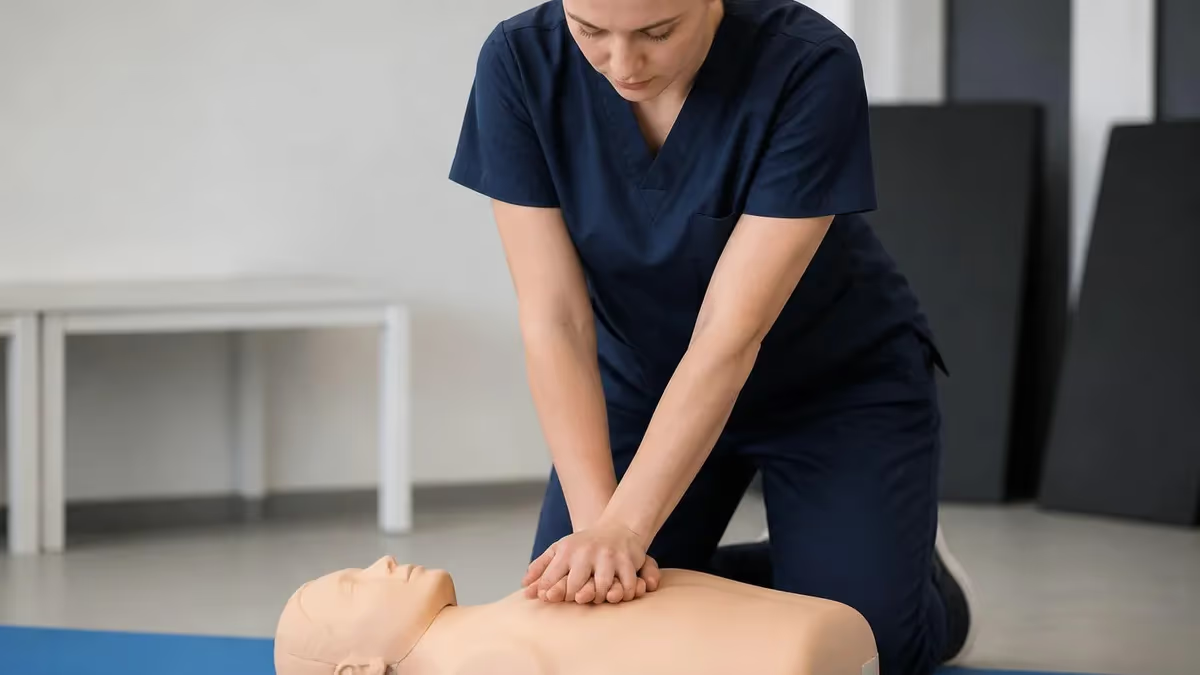
Finding the right CPR certification Boston program can feel overwhelming with dozens of training centers, online options, and conflicting price points across Massachusetts. Whether you are a healthcare worker at Massachusetts General Hospital, a teacher in Cambridge Public Schools, a fitness instructor in the Back Bay, or a parent who wants to feel confident protecting your family, the city offers more accredited CPR options than almost any other US metro. This guide breaks down every certification pathway, the real costs, the formats, and the credentialing bodies that Boston employers actually accept in 2026.
CPR certification Boston classes generally fall into three buckets: community-level Heartsaver courses for laypeople, Basic Life Support (BLS) for healthcare providers, and advanced credentials like ACLS and pals certification for nurses, paramedics, and physicians. Each tier has different content, different exam formats, and different renewal cycles. Picking the wrong one wastes both money and a Saturday morning, so understanding the distinctions before you register is critical.
The two dominant providers in Boston are the American Heart Association (AHA) and the American Red Cross, with the national cpr foundation offering a popular online-only alternative for non-clinical learners. Most Boston hospitals, EMS agencies, and nursing schools require AHA cards specifically. Daycares, gyms, lifeguard programs, and corporate offices typically accept Red Cross or other OSHA-compliant equivalents. Knowing what your employer or licensing board demands is the single most important decision factor.
Class formats range from full in-person classroom sessions to blended learning, where you complete the cognitive portion online and finish with a hands-on skills check at a Boston training site. Blended courses are especially popular near the Longwood Medical Area, Kendall Square, and Seaport, where busy professionals need flexible scheduling. A typical BLS class runs three to four hours; Heartsaver CPR/AED runs about three hours; ACLS and PALS run roughly twelve to sixteen hours over one or two days.
Costs in Boston run higher than the national average due to facility expenses and instructor demand. Expect to pay roughly $65 to $95 for Heartsaver, $80 to $120 for BLS, and $225 to $325 for ACLS or PALS. Group rates, employer-sponsored sessions, and Greater Boston YMCA community discounts can lower these prices significantly. Always confirm the eCard fee is included, because some providers tack on an extra $20 to $30 after the class.
Beyond the certification card itself, the real value of training is competence under pressure. Knowing the compression depth, the recovery position, the correct ventilation rate, and how an AED interprets a shockable rhythm can mean the difference between a survivor and a statistic. Boston has a relatively high bystander CPR rate compared to other US cities, but national survival from out-of-hospital cardiac arrest still hovers around ten percent. Quality training raises that number.
Before you book a course, brush up on the basics with our CPR - Cardiopulmonary Resuscitation: Complete Study Guide 2026 — it covers the same skills tested in any Boston class and helps you walk in already familiar with the algorithms, so you can focus on the hands-on practice rather than scrambling to memorize ratios on the day of your class.
Readers who want more detail usually continue with cpr certification boston.
CPR Certification Boston by the Numbers
Key Facts at a Glance
| Item | Value | Details |
|---|---|---|
| Typical class price range | $65–$325 | Heartsaver to ACLS |
| Course length | 3–16 hrs | Heartsaver to ACLS full |
| AHA card validity | 2 years | Renew before expiration |

Boston CPR Course Types and Formats
A community-level course for teachers, coaches, parents, and office staff. Covers adult, child, and infant cpr, choking relief, and AED use. Roughly three hours, fully in-person or blended. Ideal for non-clinical Boston workers who need OSHA-compliant training.
The standard for Boston nurses, medical students, dental hygienists, and EMTs. Includes high-quality CPR, two-rescuer scenarios, bag-mask ventilation, and AED integration. Required by Mass General Brigham, Beth Israel Lahey, and Tufts Medicine systems.
Advanced Cardiovascular Life Support, built around the acls algorithm for cardiac arrest, bradycardia, tachycardia, and stroke. Required for ICU, ED, cath lab, and rapid response nurses. Typically twelve to sixteen hours across one or two days with megacode testing.
Pediatric Advanced Life Support. Required for pediatric ICU, NICU, ED, and pediatric anesthesia teams across Boston Children's and other family-care facilities. Covers infant resuscitation, pediatric shock, and respiratory failure with team-based simulation.
Complete cognitive modules online at your own pace, then visit a Boston skills site for a 60–90 minute hands-on check. Popular near Longwood, Kendall Square, and Seaport for busy clinicians who cannot give up a full Saturday.
The first decision in any CPR certification Boston search is which credentialing body to pick. The American Heart Association issues the most widely accepted card in clinical settings — Mass General Brigham, Boston Medical Center, Tufts Medical Center, and Beth Israel Lahey all specifically require AHA BLS, not equivalents. If you work in or are pursuing a healthcare role, defaulting to AHA avoids any risk of HR rejecting your card during onboarding or credentialing.
The American Red Cross is the second most common choice, particularly for lifeguards, camp counselors, school staff, and corporate first responders. Red Cross courses meet OSHA standards and the curriculum is functionally similar — same compression depth (at least 2 inches in adults), same rate (100 to 120 per minute), same ventilation ratios, and the same emphasis on early defibrillation. The main difference is the digital card format and the specific employers that accept it.
The national cpr foundation has grown rapidly as an online-only option for non-clinical learners who need fast, low-cost certification. It uses the same 2020 ECC guidelines that underpin AHA and Red Cross content, but the entire course is delivered via web video and a multiple-choice exam. Boston gyms, daycares, and some employers accept it; hospitals, EMS, and nursing programs generally do not. Always verify acceptance with your employer in writing before paying.
For families and individuals who want CPR knowledge without a job-related credential, free community classes run regularly through the Boston Public Health Commission, the Greater Boston YMCA, and several fire departments including the BFD. These sessions are typically Hands-Only CPR and AED awareness rather than full certification, but they are excellent for parents, grandparents, and anyone who simply wants to be ready when life support depends on a bystander.
Hybrid programs — sometimes called "blended learning" — split the cognitive portion online and the psychomotor skills in person. AHA HeartCode BLS and HeartCode ACLS are the dominant blended products in Boston, and most healthcare employers explicitly approve them. They are usually $10 to $30 cheaper than fully in-person classes and shave hours off your weekend, which matters when you are also tracking continuing education credits.
Make sure any provider you book lists AHA, Red Cross, ASHI, or National Safety Council accreditation before paying.
If you are not sure which credential your employer requires, the safest move is to call HR or your unit educator before booking. Once you have certification, you can easily confirm validity through our CPR Card Lookup: How to Verify, Replace, and Access Your CPR Certification in 2026 guide, which walks through the AHA Atlas system and Red Cross digital card portal step by step.

CPR Practice Test Questions
Prepare for the CPR Cardiopulmonary Resuscitation Practice exam with our free practice test modules. Each quiz covers key topics to help you pass on your first try.
CPR Basic CPR
CPR Exam Questions covering Basic CPR. Master CPR Test concepts for certification prep.
CPR and First Aid
Free CPR Practice Test featuring and First Aid. Improve your CPR Exam score with mock test prep.
CPR (Cardiopulmonary Resuscitation) Adult ...
CPR Mock Exam on (Cardiopulmonary Resuscitation) Adult CPR and AED Usage. CPR Study Guide questions to pass on your first try.
CPR (Cardiopulmonary Resuscitation) Airway...
CPR Test Prep for (Cardiopulmonary Resuscitation) Airway Obstruction and Choking. Practice CPR Quiz questions and boost your score.
CPR (Cardiopulmonary Resuscitation) Cardio...
CPR Questions and Answers on (Cardiopulmonary Resuscitation) Cardiopulmonary Emergency Recognition. Free CPR practice for exam readiness.
CPR (Cardiopulmonary Resuscitation) Child ...
CPR Mock Test covering (Cardiopulmonary Resuscitation) Child and Infant CPR. Online CPR Test practice with instant feedback.
CPR (Cardiopulmonary Resuscitation) High-P...
Free CPR Quiz on (Cardiopulmonary Resuscitation) High-Performance Team Dynamics. CPR Exam prep questions with detailed explanations.
CPR (Cardiopulmonary Resuscitation) Legal ...
CPR Practice Questions for (Cardiopulmonary Resuscitation) Legal and Ethical Considerations. Build confidence for your CPR certification exam.
CPR for Specific Populations
CPR Test Online for for Specific Populations. Free practice with instant results and feedback.
CPR Airway & Breathing Management
CPR Exam Questions covering Airway & Breathing Management. Master CPR Test concepts for certification prep.
CPR Assessment & Recognition of Cardiac Ar...
Free CPR Practice Test featuring Assessment & Recognition of Cardiac Arrest. Improve your CPR Exam score with mock test prep.
CPR Chest Compressions & Defibrillation
CPR Mock Exam on Chest Compressions & Defibrillation. CPR Study Guide questions to pass on your first try.
CPR Post-Resuscitation Care & Recovery
CPR Test Prep for Post-Resuscitation Care & Recovery. Practice CPR Quiz questions and boost your score.
BLS, ACLS, PALS, and Heartsaver Explained
BLS is the foundational healthcare-provider course required across virtually every clinical role in Boston, from CNAs to attending physicians. It covers high-quality CPR for adults, children, and infants, two-rescuer scenarios, bag-valve-mask ventilation, the recovery position, and AED integration. Most learners complete it in three to four hours of in-person training or about ninety minutes of skills check after a HeartCode online module.
The BLS exam is a written multiple-choice test plus a hands-on skills demonstration. You must perform two minutes of continuous compressions at the correct rate and depth, switch compressors smoothly, and operate an AED safely. The card is valid for two years. Boston hospitals strongly prefer AHA-issued BLS cards, and your card is automatically uploaded to the AHA Atlas eCard system for employer verification.
In-Person vs Blended CPR Certification in Boston
- +Hands-on practice with a manikin under instructor supervision
- +Immediate feedback on compression depth and recoil
- +Easier to ask nuanced questions about real workplace scenarios
- +Networking with other Boston healthcare professionals in your class
- +All AHA-approved blended cards are accepted by Mass General Brigham and BIDMC
- +Blended cuts seat time in half — great for night-shift clinicians
- +Skills sessions near Longwood, Seaport, and Kendall make logistics easy
- −In-person classes consume a full half-day or weekend morning
- −Boston traffic and parking around teaching hospitals can be brutal
- −Blended online modules require self-discipline and reliable internet
- −Online-only providers like national cpr foundation are not accepted by hospitals
- −Travel time can exceed the actual class length for suburban learners
- −Some blended skills checks are booked weeks out during recerts season

Boston CPR Certification Checklist Before You Register
- ✓Confirm with your employer or licensing board whether AHA, Red Cross, or another credential is required.
- ✓Decide between Heartsaver, BLS, ACLS, or PALS based on your role and clinical responsibilities.
- ✓Choose in-person, blended HeartCode, or fully online based on time and acceptance rules.
- ✓Verify the provider lists active AHA Training Center or Red Cross authorization on their website.
- ✓Compare total cost — including eCard fees, parking, and any required textbook downloads.
- ✓Schedule the course at least three weeks before your existing card expires to avoid lapses.
- ✓Review compression depth, rate, ratios, and the recovery position the night before class.
- ✓Bring a photo ID, comfortable clothes for floor work, and a water bottle to your skills session.
- ✓Complete any HeartCode online modules and print the completion certificate before arrival.
- ✓Save your eCard PDF and add the verification code to your employer's compliance portal.
Book your skills session right after the HeartCode module unlocks
Boston AHA skills sites near Longwood Medical Area and Mass General fill up quickly between January and March (new resident season) and August through October (nursing onboarding). The moment your HeartCode certificate generates, log in and reserve your skills check — same-week slots disappear within hours, and waiting can push your renewal past the expiration date.
CPR certification Boston pricing varies more by provider and format than by neighborhood. A Heartsaver class taught at a downtown training center costs roughly the same as one at a Cambridge community center — $65 to $95 — because instructor fees and AHA card costs are standardized. Where you do see swings is between solo instructors operating out of rented rooms (often $20 to $40 cheaper) and full Training Centers with permanent classroom space, dedicated manikins, and integrated eCard issuance.
BLS for healthcare providers typically runs $80 to $120 in Boston. Blended HeartCode BLS is usually $90 to $110 including the online module access code and the skills session, while fully in-person classes hover around $100 to $120. Many Boston hospitals contract directly with AHA Training Centers and offer free BLS to employees as part of compliance training, so always check with your employer or union before paying out of pocket — you may already be covered.
ACLS and PALS classes are the most expensive at $225 to $325 each, reflecting the longer course length, lower instructor-to-student ratios, and the megacode simulation equipment. Discounted recertification rates of $175 to $225 apply if your card is still current. Buying ACLS and PALS together as a bundle, or scheduling consecutive days at one Training Center, often saves $40 to $75 compared with booking them separately months apart.
Location matters mostly for convenience. The densest cluster of AHA Training Centers sits in and around the Longwood Medical Area, with additional sites in Downtown Crossing, Back Bay, Cambridge (near Kendall Square), Brookline, Quincy, Somerville, and along Route 128. Suburban learners often find better availability and easier parking at sites in Waltham, Burlington, or Norwood than fighting downtown traffic for a Saturday morning class.
Scheduling is most competitive between January and March, when new residents and fellowship trainees onboard, and again from August through October when nurse residency cohorts begin. If you have schedule flexibility, booking a weekday evening or a Sunday afternoon dramatically widens your options. Many Training Centers add extra sessions during those high-demand windows but they fill within 24 to 48 hours of being posted, so set up email alerts on your preferred provider's calendar page.
Group rates can be a hidden bargain. If you can assemble six to ten coworkers, neighbors, or fellow daycare parents, most Boston Training Centers will send an instructor to your location and charge a flat group rate that breaks down to $45 to $70 per person for Heartsaver and $75 to $100 for BLS. This is especially common for restaurants, gyms, churches, and small medical practices that need everyone certified at once.
Finally, beware of suspiciously cheap offers. A $19.99 "AHA-compatible" certification advertised on Facebook is almost never actually AHA — it is usually a private provider issuing its own card, which Boston hospitals will reject. The phrase "AHA-compatible" or "meets AHA guidelines" is a red flag; only "AHA-issued" or "American Heart Association card" guarantees acceptance.
AHA and Red Cross CPR cards expire on the last day of the issue month, two years after the class date. Boston hospitals routinely pull clinicians off the schedule the day their card expires — even a single day late can mean lost shifts and emergency rescheduling. Set a calendar reminder 90 days before expiration and book your renewal at 60 days out to protect your work schedule and your license.
Renewal is where many Boston clinicians get tripped up. An AHA BLS, ACLS, or PALS card is valid for exactly two years from the issue date and expires at the end of the issue month. There is no grace period in the AHA system — your eCard simply stops verifying on day one of the following month, and Boston hospital compliance portals automatically flag you as out of date. Plan your renewal at least sixty days before expiration to give yourself buffer for scheduling conflicts.
For most healthcare workers, renewal is identical to initial certification: complete a HeartCode online module, then attend a skills check at a Boston AHA Training Center. There is no shorter "renewal-only" version of BLS, ACLS, or PALS, though some Training Centers run dedicated recert sessions for ACLS that move faster because participants are already familiar with the algorithms. Pricing is usually $20 to $50 lower than initial certification.
The Red Cross offers a similar two-year card validity and a blended online-plus-skills renewal pathway. Their digital card platform stores all your certifications in one place, making it easy to share verification with employers. If you have been holding Red Cross for years but recently took a hospital job, you will likely need to convert to AHA at your next renewal cycle since most Boston clinical employers no longer accept Red Cross for bedside roles.
The eCard verification system has replaced paper cards almost everywhere. AHA's Atlas portal lets employers verify any card by entering the eCard code, while Red Cross uses its own digital ID system. If you lose access to your eCard, you can recover it through the original Training Center for a small fee — usually $10 to $20. Never let an employer accept a screenshot only; the verification code must be confirmed live to be legitimate.
Continuing education credits are an underused benefit. Most Boston ACLS and PALS classes award eight to ten CE/CME hours, while BLS awards four. These count toward Massachusetts nursing license renewal, EMT recertification, and many physician maintenance-of-certification requirements. Track your CE certificates carefully and upload them to your licensing board portal as soon as you receive them, rather than scrambling at the end of your renewal cycle.
If you switch employers within Boston, your card transfers with you — there is no employer-specific certification. Bring your eCard PDF, the verification code, and the issuing Training Center's name to your onboarding meeting. New employers will confirm your card against the AHA Atlas system on the spot. Once your hire date is set, you can confirm your verification status using our AHA CPR Recertification: How to Recertify CPR Online with the American Heart Association in 2026 walkthrough for full details on the recert flow.
One more renewal tip Boston clinicians should know: if you let your card expire by more than thirty days, some Training Centers require you to retake the full initial course rather than the streamlined renewal. That can cost an extra $30 to $80 and add hours of seat time. Treat the expiration date as immovable — your career, your patients, and your wallet all benefit from punctual renewal.
Walking into your CPR certification Boston class fully prepared makes the day dramatically less stressful. The night before, review the core numbers: compression depth of at least two inches in adults, one-and-a-half inches in infants, a rate of 100 to 120 compressions per minute, and a 30:2 compression-to-ventilation ratio for single-rescuer adult CPR. These are the most-tested facts on every BLS and Heartsaver written exam, and instructors expect immediate, confident answers when they call on you.
Pediatric content trips up the most people. Infant cpr uses two-finger compressions for a single rescuer and the two-thumb encircling-hands technique for two rescuers, with compressions reaching about one-third the depth of the chest — roughly 1.5 inches. The ventilation respiratory rate guidance is one breath every two to three seconds (about 20 to 30 per minute) during pediatric rescue breathing without compressions. Memorizing the contrast between adult and pediatric numbers is the single fastest way to boost your exam score.
AED operation is heavily tested both in writing and on the skills floor. Know that AED stands for automated external defibrillator, that pad placement is anterior-lateral for most adults, and that you must clear the patient verbally and visually before delivering a shock. For pediatric patients under eight, use pediatric pads if available, and place pads anterior-posterior on infants. Practice saying "clear" out loud at home — instructors notice when you sound rehearsed.
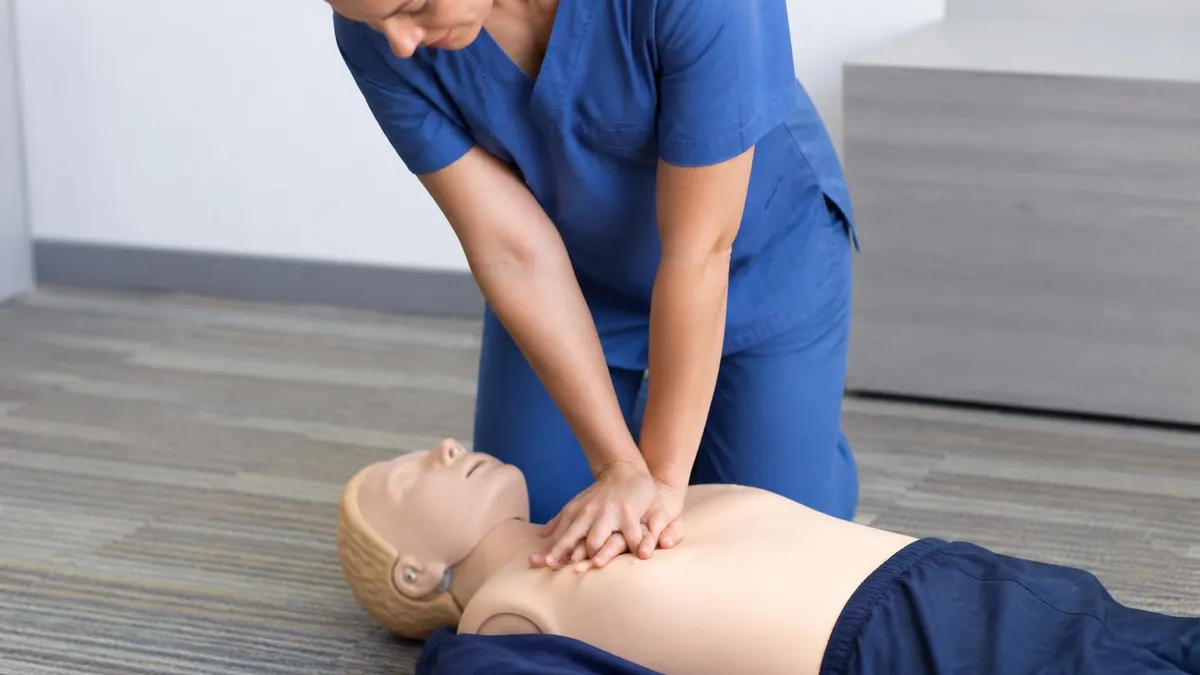
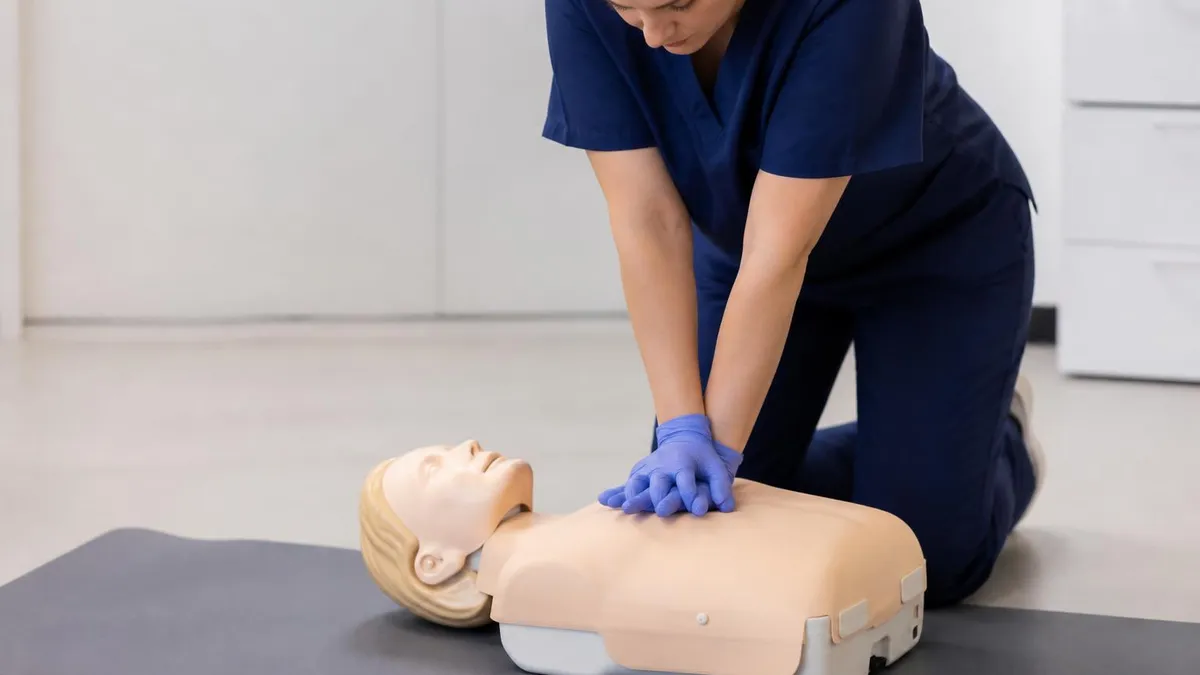
Hands-on performance is where confidence pays off. Practice 30:2 cycles on a couch cushion using a metronome app set to 110 bpm. Keep your elbows locked, shoulders directly over your hands, and allow full chest recoil between compressions. Boston instructors are trained to spot leaning, incomplete recoil, and inconsistent depth — all of which can cost you the skills check even if your written exam is perfect.
Pace yourself during the class. Most Boston AHA Training Centers run a tightly choreographed agenda, and falling behind on one module means scrambling on the next. Take five minutes during any break to stretch your wrists and back, drink water, and review the next algorithm. ACLS megacode in particular is exhausting after six hours of sitting — physical readiness matters as much as cognitive readiness when you are leading a simulated arrest.
Music can help with rhythm. The classic "Stayin' Alive" by the Bee Gees is exactly 103 BPM and sits squarely in the target compression rate range. Other songs like "Cecilia" by Simon & Garfunkel and "Crazy in Love" by Beyoncé also work. Just be careful not to play distracting lyrics during a real event — our guide on Inappropriate CPR Songs: What Not to Play, Why It Matters, and Better Beat-Per-Minute Alternatives covers what works and what to avoid.
Finally, give yourself permission to ask questions during class. Instructors at Boston Training Centers are almost always working clinicians — paramedics, ED nurses, ICU educators — and the war-story answers they give to genuine questions are some of the most valuable parts of any CPR class. The goal is not just to pass an exam but to leave the room confident that if someone collapses in front of you tomorrow, you will move toward them rather than freeze.
CPR Questions and Answers
CPR Card Lookup: How to Verify, Replace, and Access Your CPR Certification in 2026
Adult CPR: Complete Step-by-Step Guide to Hands-Only and Standard CPR in 2026
CPR - Cardiopulmonary Resuscitation: Complete Study Guide 2026
Inappropriate CPR Songs: What Not to Play, Why It Matters, and Better Beat-Per-Minute Alternatives
AHA CPR Recertification: How to Recertify CPR Online with the American Heart Association in 2026
About the Author

Registered Nurse & Healthcare Educator
Johns Hopkins University School of NursingDr. Sarah Mitchell is a board-certified registered nurse with over 15 years of clinical and academic experience. She completed her PhD in Nursing Science at Johns Hopkins University and has taught NCLEX preparation and clinical skills courses for nursing students across the United States. Her research focuses on evidence-based exam preparation strategies for healthcare certification candidates.
Join the Discussion
Connect with other students preparing for this exam. Share tips, ask questions, and get advice from people who have been there.
View discussion (5 replies)