
CAB Cardiopulmonary Resuscitation: The Complete Guide to Compressions, Airway, and Breathing Sequence in 2026 October
📝 Master CAB cardiopulmonary resuscitation — the Compressions, Airway, Breathing sequence. Step-by-step CAB CPR guide with ACLS algorithm and infant
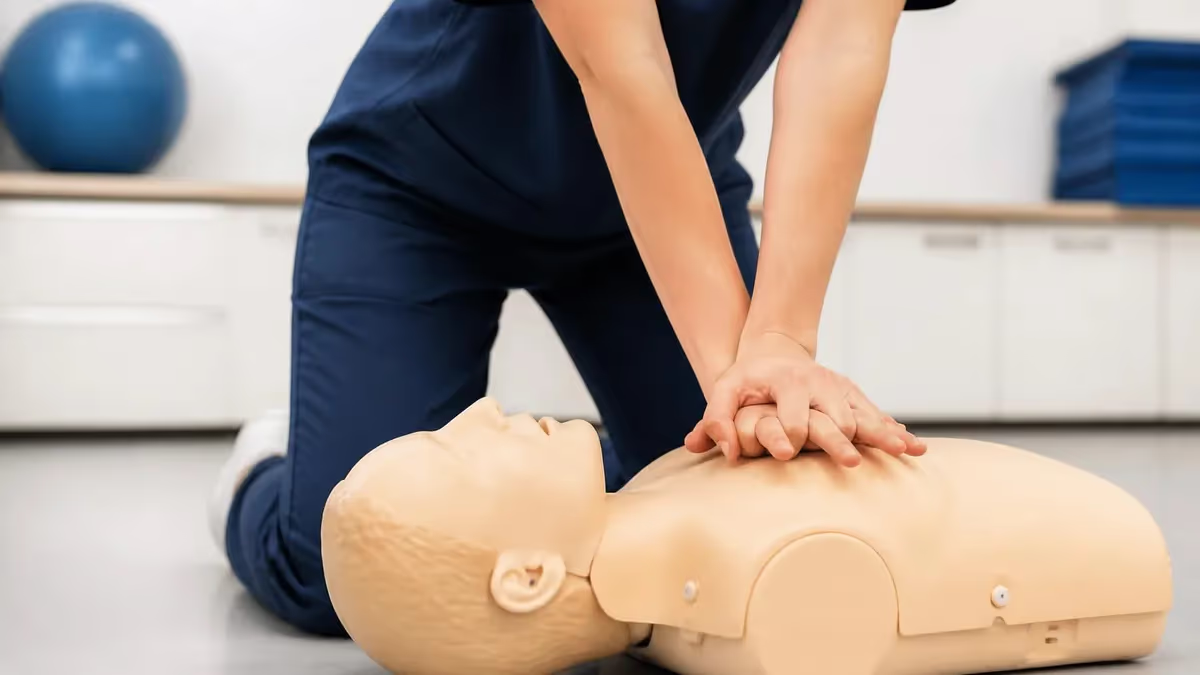
CAB cardiopulmonary resuscitation is the modern resuscitation sequence taught by the American Heart Association, the Red Cross, and the national cpr foundation, and it reorganizes the historic ABC order into Compressions, Airway, Breathing. The switch happened back in 2010 after researchers proved that starting chest compressions within the first ten seconds dramatically increased survival from out-of-hospital cardiac arrest. Today, CAB remains the foundation for every layperson, healthcare provider, and acls algorithm decision tree used in modern emergency response across the United States.
The reason CAB replaced ABC is straightforward physiology: when an adult collapses suddenly from a cardiac event, their bloodstream still carries oxygen for several minutes. What is missing is circulation. Pumping that oxygen-rich blood to the brain and coronary arteries through immediate compressions buys precious time, while pausing to assess airway and deliver rescue breaths first wastes the only currency that matters during a sudden arrest. CAB removes hesitation, lowers the cognitive barrier to action, and gets rescuers moving fast.
For bystanders, CAB also makes hands-only CPR socially easier. Many rescuers worry about mouth-to-mouth contact with strangers, and that anxiety historically caused people to walk away instead of intervening. By placing compressions first and treating breaths as optional for untrained adult rescuers, the sequence converts hesitation into useful chest pushes. Lay rescuers performing compression-only CPR achieve survival rates nearly identical to those delivering conventional CPR for the first several minutes of an adult sudden cardiac arrest event.
Healthcare professionals follow the same CAB framework but layer in additional skills. Nurses, paramedics, and emergency physicians integrate CAB into advanced cardiac life support, pediatric advanced life support, and team-based resuscitation. The sequence becomes the spine of every code, with airway adjuncts, defibrillation, and IV access slotted around it. Whether you are studying for pals certification or your initial BLS card, the muscle memory of compressions first, airway second, breaths third is non-negotiable in every credentialing exam.
The pediatric world adds a single important caveat: for infants and children whose arrests are usually respiratory in origin, the AHA still recommends starting with compressions but encourages rescue breaths much sooner. We will cover those nuances in detail later. For adults witnessed to collapse suddenly with no prior symptoms, however, the cardiac etiology dominates, and CAB delivers exactly what the heart needs first — circulation. If you want to test your sequence knowledge, browse the full CPR - Cardiopulmonary Resuscitation: Complete Study Guide 2026 for deeper drills.
This guide walks through every component of CAB cardiopulmonary resuscitation in 2026, from the science behind the sequence to the exact hand placement, compression depth, ventilation timing, and AED integration. You will learn the differences between adult, child, and infant CPR, how the acls algorithm builds on the CAB foundation, how to coordinate with 911 dispatchers, and how to keep going until professional help arrives or signs of life return. The goal is competence, confidence, and the willingness to act in those critical first seconds.
Free CPR (Cardiopulmonary Resuscitation) Study Tools
Interactive CPR (Cardiopulmonary Resuscitation) resources on PracticeTestGeeks, free to start:
- CPR (Cardiopulmonary Resuscitation) practice test — 650+ questions with instant scoring and answer explanations
- CPR (Cardiopulmonary Resuscitation) flashcards — review key terms and concepts card by card
- CPR (Cardiopulmonary Resuscitation) study guide — topic-by-topic overview of what the exam covers
- CPR (Cardiopulmonary Resuscitation) cheat sheet — one-page printable summary for last-minute review
CAB CPR by the Numbers

The CAB Sequence Step-by-Step
Check Scene and Responsiveness
Call 911 and Get an AED
C — Start Chest Compressions
A — Open the Airway
B — Deliver Rescue Breaths
Continue Until Help Arrives
Before 2010, the standard sequence taught around the world was ABC — Airway, Breathing, Circulation. That order made intuitive sense to medical educators because oxygen enters through the airway, travels via the lungs, and reaches tissues through circulation. However, decades of real-world data exposed a tragic flaw: bystanders consistently fumbled the airway step, lost valuable seconds, never reached the compression phase, and watched survival rates stagnate at roughly five to ten percent for out-of-hospital arrest. Researchers needed a better order.
The pivot to CAB was driven by registries that tracked thousands of resuscitations and consistently showed compression-only CPR matched or exceeded the outcomes of conventional CPR during the first several minutes of adult sudden cardiac arrest. When the heart stops, blood already in the lungs and pulmonary veins remains oxygenated for two to four minutes. The brain does not need a new breath right away. It needs that oxygen pushed through the coronary and cerebral arteries by mechanical compressions, and every pause for airway maneuvers degrades perfusion.
The national cpr foundation, the American Heart Association, and the European Resuscitation Council all converged on CAB after analyzing the same evidence. Their 2010 guideline update reordered the steps, simplified bystander instructions, and emphasized chest compressions as the dominant intervention. Subsequent revisions in 2015, 2020, and the 2025 focused update have only reinforced the priority of high-quality compressions. The sequence has remained CAB ever since, and modern training programs build every other resuscitation skill around it.
Equally important, CAB lowered the psychological barrier for laypeople. Surveys after the change revealed that bystanders were more likely to start CPR when they did not have to consider mouth-to-mouth contact upfront. Compression-only CPR became the default recommendation for untrained or unwilling rescuers, with hands-on compressions providing meaningful circulatory support until EMS arrived. This single behavioral shift has saved thousands of lives across the United States each year and continues to widen the survival gap between communities with strong bystander response and those without.
Importantly, CAB is not a rejection of airway management — it is a reprioritization. Trained rescuers still open the airway and deliver breaths, but only after initiating compressions. Healthcare professionals integrate advanced airway devices like supraglottic tubes or endotracheal intubation during ongoing CPR, often without interrupting compressions at all. The principle holds at every skill level: compressions are the heartbeat of resuscitation, and everything else is layered on top without sacrificing chest compression fraction.
Understanding the rationale behind CAB matters because it informs every judgment call you will make during a real emergency. Knowing that the first two minutes belong to circulation helps you stay focused under stress. It also explains why dispatcher-assisted CPR over the phone now defaults to compression-only instructions and why public access defibrillator programs emphasize speed of access. If you want to renew your skills, the AHA CPR Recertification: How to Recertify CPR Online with the American Heart Association in 2026 guide explains the latest renewal options.

CPR Practice Test Questions
Prepare for the CPR Cardiopulmonary Resuscitation Practice exam with our free practice test modules. Each quiz covers key topics to help you pass on your first try.
CPR Basic CPR
CPR Exam Questions covering Basic CPR. Master CPR Test concepts for certification prep.
CPR and First Aid
Free CPR Practice Test featuring and First Aid. Improve your CPR Exam score with mock test prep.
CPR (Cardiopulmonary Resuscitation) Adult ...
CPR Mock Exam on (Cardiopulmonary Resuscitation) Adult CPR and AED Usage. CPR Study Guide questions to pass on your first try.
CPR (Cardiopulmonary Resuscitation) Airway...
CPR Test Prep for (Cardiopulmonary Resuscitation) Airway Obstruction and Choking. Practice CPR Quiz questions and boost your score.
CPR (Cardiopulmonary Resuscitation) Cardio...
CPR Questions and Answers on (Cardiopulmonary Resuscitation) Cardiopulmonary Emergency Recognition. Free CPR practice for exam readiness.
CPR (Cardiopulmonary Resuscitation) Child ...
CPR Mock Test covering (Cardiopulmonary Resuscitation) Child and Infant CPR. Online CPR Test practice with instant feedback.
CPR (Cardiopulmonary Resuscitation) High-P...
Free CPR Quiz on (Cardiopulmonary Resuscitation) High-Performance Team Dynamics. CPR Exam prep questions with detailed explanations.
CPR (Cardiopulmonary Resuscitation) Legal ...
CPR Practice Questions for (Cardiopulmonary Resuscitation) Legal and Ethical Considerations. Build confidence for your CPR certification exam.
CPR for Specific Populations
CPR Test Online for for Specific Populations. Free practice with instant results and feedback.
CPR Airway & Breathing Management
CPR Exam Questions covering Airway & Breathing Management. Master CPR Test concepts for certification prep.
CPR Assessment & Recognition of Cardiac Ar...
Free CPR Practice Test featuring Assessment & Recognition of Cardiac Arrest. Improve your CPR Exam score with mock test prep.
CPR Chest Compressions & Defibrillation
CPR Mock Exam on Chest Compressions & Defibrillation. CPR Study Guide questions to pass on your first try.
CPR Post-Resuscitation Care & Recovery
CPR Test Prep for Post-Resuscitation Care & Recovery. Practice CPR Quiz questions and boost your score.
CAB CPR for Adults, Children, and Infants
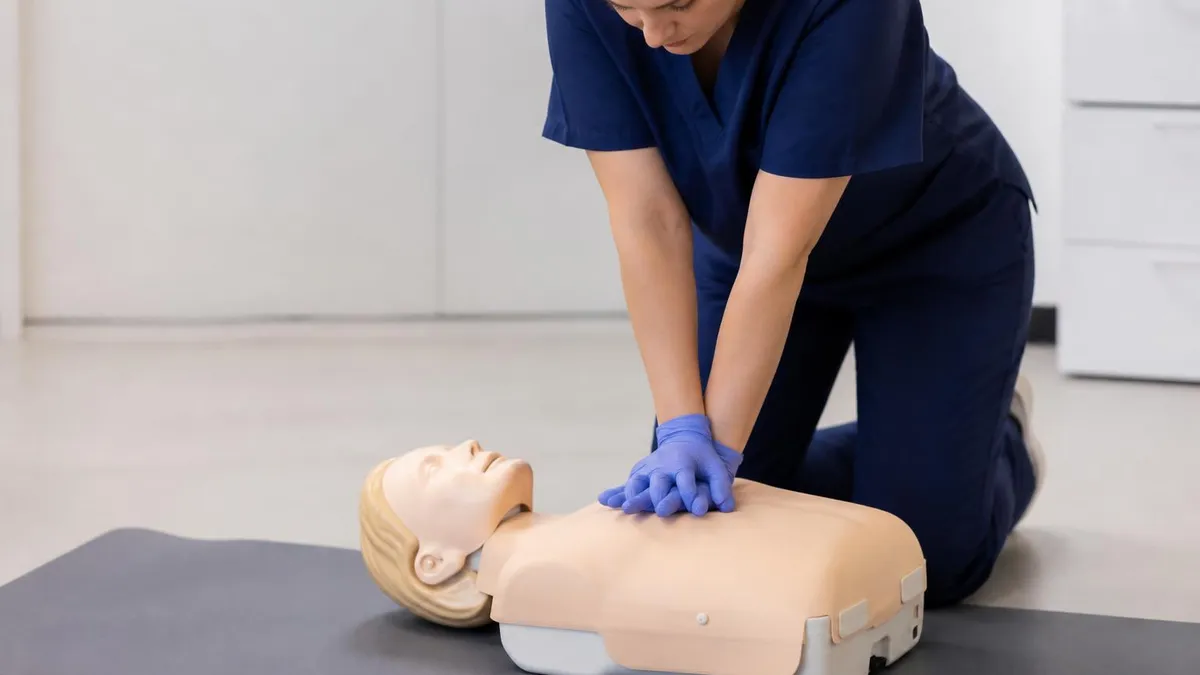
Adult CAB CPR applies to anyone showing signs of puberty or older. Place the heel of one hand on the lower half of the sternum, stack the other on top, interlock fingers, and compress at least two inches at a rate of 100 to 120 per minute. Allow complete recoil between compressions because incomplete recoil reduces venous return and starves the next compression of preload.
The compression-to-ventilation ratio is 30:2 for single rescuers. If you have not been trained or are unwilling to give breaths, compression-only CPR is acceptable and effective for adult cardiac arrest. Continue until the victim breathes normally, an AED is ready to analyze, EMS takes over, or you become physically unable to continue. Rotate rescuers every two minutes whenever possible to maintain compression quality.
CAB Sequence: Strengths and Limitations
- +Prioritizes circulation, the most time-sensitive need in sudden cardiac arrest
- +Reduces the time to first compression to under ten seconds
- +Lowers the psychological barrier for bystander intervention
- +Aligns with dispatcher-assisted compression-only CPR protocols
- +Simplifies training for laypeople and new healthcare providers
- +Improves chest compression fraction during professional resuscitations
- +Supports better integration with public access defibrillator programs
- −Less ideal for primarily respiratory arrests in pediatric and drowning cases
- −Can be misapplied if rescuers ignore the need for eventual ventilation
- −Requires reliable upper-body strength to maintain adequate depth
- −Compression-only CPR is not the recommended default for prolonged arrests
- −Does not address advanced airway needs during prolonged codes
- −Bystander fatigue still reduces effectiveness without rescuer rotation
- −Quality compressions are hard to deliver on soft surfaces like beds
Pros and Cons at a Glance
| Pros | Cons |
|---|---|
| Prioritizes circulation, the most time-sensitive need in sudden cardiac arrest | Less ideal for primarily respiratory arrests in pediatric and drowning cases |
| Reduces the time to first compression to under ten seconds | Can be misapplied if rescuers ignore the need for eventual ventilation |
| Lowers the psychological barrier for bystander intervention | Requires reliable upper-body strength to maintain adequate depth |
| Aligns with dispatcher-assisted compression-only CPR protocols | Compression-only CPR is not the recommended default for prolonged arrests |
| Simplifies training for laypeople and new healthcare providers | Does not address advanced airway needs during prolonged codes |
| Improves chest compression fraction during professional resuscitations | Bystander fatigue still reduces effectiveness without rescuer rotation |

CAB Cardiopulmonary Resuscitation Action Checklist
- ✓Confirm the scene is safe before approaching the victim.
- ✓Tap the victim's shoulder and shout to check responsiveness.
- ✓Scan for normal breathing for no more than ten seconds.
- ✓Call 911 on speaker phone and send someone for an AED.
- ✓Place the heel of your hand on the center of the chest.
- ✓Push hard at least two inches deep at 100 to 120 per minute.
- ✓Allow full chest recoil between every compression.
- ✓Open the airway with head-tilt chin-lift after 30 compressions.
- ✓Deliver two one-second rescue breaths that make the chest rise.
- ✓Apply the AED immediately and follow its voice prompts.
Recognize and respond in under ten seconds
From the moment you identify an unresponsive adult who is not breathing normally, your goal is to deliver the first chest compression within ten seconds. Every additional minute without compressions reduces survival by roughly 10 percent, making speed the single most important variable in any CAB cardiopulmonary resuscitation attempt.
The CAB sequence becomes even more powerful when paired with an automated external defibrillator. So what does aed stand for? It stands for automated external defibrillator, a portable device that analyzes the victim's heart rhythm and delivers a controlled electrical shock if a shockable rhythm such as ventricular fibrillation or pulseless ventricular tachycardia is detected. Modern AEDs guide rescuers through every step with voice prompts, making them safe for laypeople to use even without formal training in advanced life support.
When an AED arrives at the scene, turn it on and follow the prompts while another rescuer continues compressions. Expose the chest, dry it if wet, and apply the pads in the positions illustrated on the device — typically upper right chest and lower left side. The AED will pause CPR to analyze, and rescuers must clear the patient while the device reads the rhythm. If a shock is advised, ensure no one is touching the victim, deliver the shock, and resume compressions immediately for two more minutes before reanalyzing.
For trained healthcare providers, the acls algorithm builds directly on the CAB foundation. ACLS adds rhythm interpretation, IV or IO access, pharmacology such as epinephrine and amiodarone, advanced airway management, and the systematic search for reversible causes known as the H's and T's. The ACLS team-based approach assigns roles like compressor, ventilator, monitor-defibrillator operator, and team leader, but high-quality chest compressions remain the central activity around which every other intervention is coordinated.
The same principles flow into pediatric resuscitation. Providers who hold pals certification apply CAB to children with adjusted compression depth, ratios, and airway considerations. PALS algorithms incorporate weight-based drug dosing, advanced airway management with appropriately sized devices, and rapid recognition of shock or respiratory failure before progression to arrest. The shared framework keeps care consistent across the lifespan and across different prehospital and hospital environments.
Respiratory monitoring is another critical dimension. Capnography, when available, lets providers track end-tidal CO2 in real time as a marker of compression quality and return of spontaneous circulation. A sudden rise in end-tidal CO2 often signals ROSC and prompts pulse checks. Maintaining a respiratory rate of about 10 breaths per minute during continuous compressions with an advanced airway prevents hyperventilation, which can otherwise reduce coronary perfusion pressure and worsen outcomes during ongoing resuscitation efforts.
For survivors who achieve return of spontaneous circulation, post-arrest care begins immediately. Hospitals coordinate targeted temperature management, optimize ventilation and perfusion, and pursue revascularization for suspected coronary causes. Family members are increasingly invited to be present during resuscitation, which research shows improves grief outcomes regardless of survival. None of this advanced care would be possible without the foundational CAB sequence delivered by bystanders and first responders during those critical opening minutes of cardiac arrest response.
For lay rescuers, do not attempt to find a pulse — if an adult is unresponsive and not breathing normally, start compressions. Even trained healthcare providers should spend no more than ten seconds on a pulse check before initiating CAB CPR. Delaying compressions to confirm a pulse you cannot reliably find costs lives, especially in low-perfusion states.
Even experienced rescuers make recurring mistakes during CAB cardiopulmonary resuscitation, and recognizing them in training prevents them in the field. The most common error is shallow compressions. Adult chests are surprisingly stiff, especially in older patients with calcified ribs, and rescuers often underestimate the force required to compress at least two inches. Use your body weight, not just your arms, by locking elbows and pivoting from the hips so that your shoulders are directly above your hands at the bottom of each compression.
Incomplete recoil is the second most common mistake. Leaning on the chest between compressions traps blood in the heart and prevents adequate venous return, which then reduces the effectiveness of the next compression. Lift your hands just enough to feel the chest fully rebound while keeping them in contact with the skin. Compression fraction — the percentage of time spent actually compressing — should exceed 80 percent during any resuscitation, with pauses kept short and purposeful.
Hyperventilation kills resuscitations. Rescuers often deliver too many breaths or push air too forcefully, creating gastric distention, regurgitation, and rising intrathoracic pressure that reduces coronary perfusion. Each breath should take one second and produce only visible chest rise — no more. With an advanced airway in place, deliver one breath every six seconds while compressions continue without pausing, maintaining a steady, predictable respiratory rate aligned with current AHA recommendations.
Surface matters too. Soft beds, couches, and gurney mattresses absorb compression force and reduce delivered depth. Move the victim to the floor or place a firm backboard underneath whenever possible. Hospitals stock backboards on every crash cart precisely for this reason. Position recovery during resuscitation is also frequently overlooked: keep the victim flat and supine throughout CPR, and only consider a true position recovery once spontaneous breathing returns and you are confident there is no spinal injury.
Rescuer fatigue silently sabotages quality. Studies show compression depth degrades measurably after just one minute of effort, and most rescuers overestimate how well they are doing. Switch compressors every two minutes during an AED rhythm analysis to minimize interruption. If you are alone, focus on maintaining rate and depth as best you can, but call out for help loudly to recruit anyone nearby who can take over while you rest.
Finally, do not forget to coordinate with the AED. Rescuers often hesitate when the AED announces it is analyzing, sometimes continuing compressions during analysis or pausing too long before resuming after a shock. Practice the choreography: continue compressions while pads are placed, clear briefly for analysis, deliver any indicated shock, and resume compressions immediately without checking a pulse. Reviewing the CPR Card Lookup: How to Verify, Replace, and Access Your CPR Certification in 2026 guide can help confirm your training is current before you need these skills.
Practical preparation for CAB cardiopulmonary resuscitation goes beyond memorizing the sequence. The best rescuers practice on manikins regularly, ideally every quarter, because muscle memory degrades faster than knowledge. If you took a class two years ago and have not touched a manikin since, your compression depth, rate, and recoil are almost certainly off. Many community centers, fire stations, and employer wellness programs offer free or low-cost refresher sessions designed to keep your hands sharp.
Equip yourself with the right gear. A pocket CPR mask with a one-way valve makes rescue breathing safer and more palatable for both you and the victim. Keep one in your car, your backpack, and your kitchen drawer. Learn where the AEDs are located in the buildings where you spend the most time — your office, your gym, your kids' school, your house of worship. AED registries and smartphone apps can map nearby devices in many cities, shaving precious seconds off retrieval time.
If you have school-age children, teach them age-appropriate CPR basics. Children as young as nine can learn to recognize cardiac arrest, call 911, and perform compression-only CPR on adults. The earlier this knowledge enters a family, the more potential rescuers exist in any home. The same principle applies at work: encourage coworkers to attend group training, and lobby for AED installation if your facility lacks one. Workplace cardiac arrests survive at much higher rates when colleagues are prepared to act.
Mental rehearsal matters as much as physical practice. Visualize what you would do if a family member collapsed at the dinner table, if a stranger went down at the grocery store, or if a coworker became unresponsive during a meeting. Rehearse the first ten seconds in your mind — scene safety, responsiveness check, breathing scan, call to 911, hands on chest. This kind of mental drilling reduces the freezing response that paralyzes many bystanders and shortens your time to first compression dramatically.
Recognize that CPR has emotional aftermath. Even successful resuscitations are physically and psychologically demanding, and many rescuers experience flashbacks, anxiety, or grief afterward. Employee assistance programs, peer support networks, and mental health professionals can help. Survival rates for out-of-hospital arrest still hover around 10 to 12 percent in the United States, so prepare yourself emotionally for outcomes that do not always end in survival. Your effort still matters — bystander CPR doubles or triples the chance that survival is even possible.
Stay current with the science. CPR guidelines are revised approximately every five years, with focused updates between cycles. Subscribe to AHA bulletins, follow the national cpr foundation, and recertify on schedule. The 2025 focused update reinforced the importance of high-quality compressions, refined pediatric ventilation guidance, and emphasized team-based resuscitation in clinical settings. Reviewing how the modern sequence works alongside Adult CPR: Complete Step-by-Step Guide to Hands-Only and Standard CPR in 2026 will keep your skills aligned with current best practices.
CPR Questions and Answers
CPR Card Lookup: How to Verify, Replace, and Access Your CPR Certification in 2026
Adult CPR: Complete Step-by-Step Guide to Hands-Only and Standard CPR in 2026

CPR - Cardiopulmonary Resuscitation: Complete Study Guide 2026
Inappropriate CPR Songs: What Not to Play, Why It Matters, and Better Beat-Per-Minute Alternatives
AHA CPR Recertification: How to Recertify CPR Online with the American Heart Association in 2026
About the Author

Registered Nurse & Healthcare Educator
Johns Hopkins University School of NursingDr. Sarah Mitchell is a board-certified registered nurse with over 15 years of clinical and academic experience. She completed her PhD in Nursing Science at Johns Hopkins University and has taught NCLEX preparation and clinical skills courses for nursing students across the United States. Her research focuses on evidence-based exam preparation strategies for healthcare certification candidates.
Join the Discussion
Connect with other students preparing for this exam. Share tips, ask questions, and get advice from people who have been there.
View discussion (5 replies)