
CPR AED Course: Complete 2026 October Guide to Combined CPR and Automated External Defibrillator Training, Certification, and Costs
💯 Complete CPR AED course guide: certification options, costs, ACLS algorithm basics, infant CPR, AED steps, online vs in-person training, and renewal
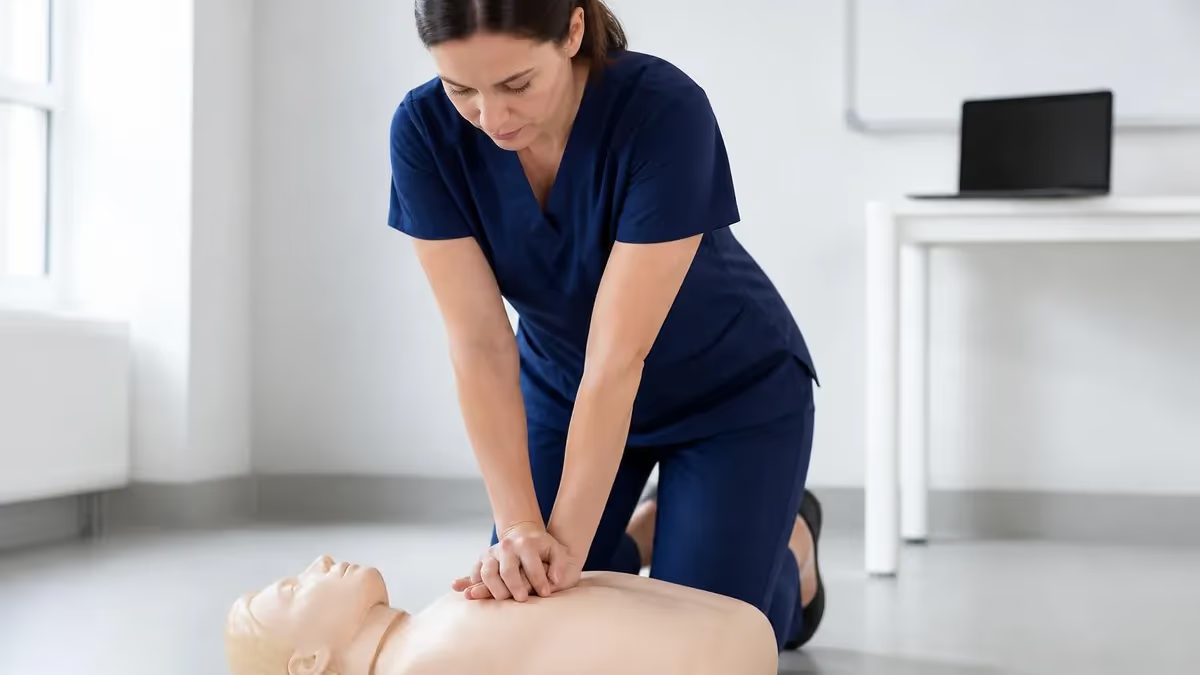
A modern cpr aed course teaches you two life-saving skills in one streamlined class: high-quality chest compressions and rescue breathing combined with safe operation of an automated external defibrillator. Most courses run between two and four hours, end with a written exam and a hands-on skills test, and produce a wallet card valid for two years. In 2026, the standard adult compression rate remains 100 to 120 per minute at a depth of at least two inches, and AED pads are now expected within the first two minutes of cardiac arrest whenever possible.
The reason these two skills are taught together is simple physics. Chest compressions buy the brain time by pushing oxygenated blood to vital organs, but only an electrical shock from a defibrillator can convert ventricular fibrillation back into a normal rhythm. National survival data shows that bystander CPR roughly doubles survival, while CPR combined with early AED use can triple or even quadruple survival when applied within three to five minutes of collapse. That is why workplaces, schools, and gyms are now legally required in most states to maintain accessible AEDs.
Anyone can take a cpr aed course, regardless of medical background. Common students include teachers, lifeguards, daycare workers, personal trainers, flight attendants, factory workers, security guards, healthcare students, and concerned parents. The class is friendly to beginners, and instructors expect you to practice on mannequins until the rhythm feels natural. You do not need to memorize the acls algorithm at this level, although understanding the basic chain of survival will help you grasp why each step matters.
You will choose between several recognized credentialing bodies, including the American Heart Association, the American Red Cross, the Health and Safety Institute, the American Safety and Health Institute, and the national cpr foundation. Each issues a certification card with a unique verification number that employers can check online. Cards typically cost between $20 and $80 depending on provider, format, and whether the class is blended online plus in-person skills or fully classroom based.
A combined course also covers special populations that pure adult CPR classes sometimes skip, including infant cpr, child rescue technique, and what to do during choking. You will learn how compression depth changes for infants (about one and a half inches), how to use pediatric AED pads or a pediatric attenuator key, and how to position someone after resuscitation. Understanding the recovery position and respiratory rate norms across age groups is part of every credible curriculum.
This guide walks you through the format, costs, providers, blended versus in-person options, the skills checklist examiners look for, and the most common renewal pitfalls. Whether you need a certification card for a new job by Friday or you are a parent who wants peace of mind, you will leave this article knowing exactly what to sign up for, what to expect on test day, and how to keep your certification current. Pair the reading with a short practice quiz at the end to lock the knowledge in.
CPR AED Course by the Numbers
Key Facts at a Glance
| Item | Value | Details |
|---|---|---|
| Typical Course Cost | $20-$80 | Card and materials included |
| Certification Validity | 2 years | Standard across providers |
| Compressions Per Minute | 100-120 | Adult and child rate |
| Ideal Shock Time | <3 min | From collapse to first AED shock |

What a Standard CPR AED Course Covers
You learn how to check the environment for hazards, evaluate responsiveness with a shoulder tap and shout, activate emergency services with 911 or facility codes, and assign tasks to bystanders so help arrives faster.
The core skill: compressions at least two inches deep, 100 to 120 per minute, full chest recoil, and a 30:2 ratio with rescue breaths. Hands-only CPR is taught as a valid alternative for untrained bystanders.
You practice powering on the device, attaching pads correctly, allowing the analysis cycle, clearing the patient, and delivering a shock. The course covers what does aed stand for and how the device detects shockable rhythms.
Pediatric CPR adjusts compression depth and hand position. Infant cpr uses two fingers or the two-thumb encircling technique, and AED use requires pediatric pads or attenuators for patients under eight years old.
Conscious choking relief uses back blows and abdominal thrusts. Unconscious choking transitions into CPR. After successful resuscitation, you place the patient in the position recovery on their side to protect the airway.
Choosing a provider matters because employers, licensing boards, and state agencies sometimes accept only specific credentials. The American Heart Association is the most widely accepted in clinical and hospital settings, while the American Red Cross dominates in lifeguarding, education, and childcare. The national cpr foundation, the American Safety and Health Institute (ASHI), MEDIC First Aid, and ProTrainings serve workplaces, contractors, and personal trainers. Always confirm with your employer before paying for a class, because a $30 mismatch can cost you a job offer or force a retake.
Every legitimate course ends with both a written knowledge check and a practical skills demonstration. The written exam is usually 20 to 30 multiple-choice questions covering scene safety, compression mechanics, AED steps, choking response, and basic life support principles. The skills test requires you to perform two minutes of high-quality CPR on a feedback-enabled mannequin, switch with a partner, deploy an AED, and resolve a choking scenario without verbal coaching from the instructor.
After passing, you receive a wallet-sized card containing your name, the certifying organization, the issue date, the expiration date, and a unique verification number or QR code. Modern cards are often digital first, delivered as a PDF or app credential that you can email to HR or print at home. Employers verify validity by entering the number on the provider's website, which prevents fraudulent or expired cards from slipping through hiring checks. Always download a backup PDF the day you receive it.
Costs vary widely. A community Red Cross class might charge $90 to $110, while a corporate group rate negotiated by your employer could be $25 per seat. Online-only certifications from less recognized providers run $14.99 to $40, but these may not satisfy hands-on requirements for healthcare jobs. The cheapest credible option for non-medical workers is usually a blended course: roughly $35 for the online portion plus $20 to $30 for a 45-minute in-person skills check at a local training center.
When searching for a course online, include words like "certification," "AED training," or "BLS class" to avoid wasting time on unrelated results. Verify the provider's accreditation badge before checkout.
If you plan to advance into healthcare, your cpr aed course becomes a stepping stone toward more advanced credentials. Basic Life Support (BLS) builds on the same skills with two-rescuer technique and bag-valve-mask ventilation. After BLS, clinicians often pursue pals certification for pediatric advanced life support and an Advanced Cardiac Life Support (ACLS) credential that introduces medications, rhythm interpretation, and the full acls algorithm. Most providers offer bundled discounts when you sign up for BLS and CPR together.
Card replacement is straightforward if you lose yours. Each provider has an online portal where you can re-download a PDF, request a duplicate plastic card for a small fee (typically $7 to $15), or look up your record using your name and date of birth. If you need to verify someone else's card before clearing them for a shift, use the official lookup page rather than trusting a photo of the credential, since images can be edited easily.

CPR Practice Test Questions
Prepare for the CPR Cardiopulmonary Resuscitation Practice exam with our free practice test modules. Each quiz covers key topics to help you pass on your first try.
CPR Basic CPR
CPR Exam Questions covering Basic CPR. Master CPR Test concepts for certification prep.
CPR and First Aid
Free CPR Practice Test featuring and First Aid. Improve your CPR Exam score with mock test prep.
CPR (Cardiopulmonary Resuscitation) Adult ...
CPR Mock Exam on (Cardiopulmonary Resuscitation) Adult CPR and AED Usage. CPR Study Guide questions to pass on your first try.
CPR (Cardiopulmonary Resuscitation) Airway...
CPR Test Prep for (Cardiopulmonary Resuscitation) Airway Obstruction and Choking. Practice CPR Quiz questions and boost your score.
CPR (Cardiopulmonary Resuscitation) Cardio...
CPR Questions and Answers on (Cardiopulmonary Resuscitation) Cardiopulmonary Emergency Recognition. Free CPR practice for exam readiness.
CPR (Cardiopulmonary Resuscitation) Child ...
CPR Mock Test covering (Cardiopulmonary Resuscitation) Child and Infant CPR. Online CPR Test practice with instant feedback.
CPR (Cardiopulmonary Resuscitation) High-P...
Free CPR Quiz on (Cardiopulmonary Resuscitation) High-Performance Team Dynamics. CPR Exam prep questions with detailed explanations.
CPR (Cardiopulmonary Resuscitation) Legal ...
CPR Practice Questions for (Cardiopulmonary Resuscitation) Legal and Ethical Considerations. Build confidence for your CPR certification exam.
CPR for Specific Populations
CPR Test Online for for Specific Populations. Free practice with instant results and feedback.
CPR Airway & Breathing Management
CPR Exam Questions covering Airway & Breathing Management. Master CPR Test concepts for certification prep.
CPR Assessment & Recognition of Cardiac Ar...
Free CPR Practice Test featuring Assessment & Recognition of Cardiac Arrest. Improve your CPR Exam score with mock test prep.
CPR Chest Compressions & Defibrillation
CPR Mock Exam on Chest Compressions & Defibrillation. CPR Study Guide questions to pass on your first try.
CPR Post-Resuscitation Care & Recovery
CPR Test Prep for Post-Resuscitation Care & Recovery. Practice CPR Quiz questions and boost your score.
Respiratory Rate, Vital Signs, and Life Support Basics
A normal adult respiratory rate sits between 12 and 20 breaths per minute at rest. Children breathe faster, generally 18 to 30 per minute, and infants faster still at 30 to 60. During a cpr aed course you will learn how to count breaths in ten seconds and multiply by six for a quick field estimate.
When a respiratory rate falls below 10 or rises above 30 in an adult, treat it as a red flag. Combined with altered consciousness, low respiratory rates often precede cardiac arrest. Recognizing this early gives you the chance to call for help and prepare your AED before the patient codes, which dramatically improves the chance of survival to hospital discharge.
Should You Take a Combined CPR AED Course or Separate Classes?
- +Combined courses cost less than two separate classes and finish in a single afternoon
- +One certification card covers both skills, simplifying HR paperwork and employer verification
- +Hands-on mannequin practice integrates AED steps directly into the compression rhythm
- +Most providers include child and infant cpr modules at no extra charge with the bundle
- +Renewal every two years covers both skills together rather than tracking two expiration dates
- +Combined credentials are accepted by virtually every non-clinical employer in the United States
- +Blended online options let you finish the knowledge portion at home before a short skills check
- −Combined certifications usually do not meet hospital BLS requirements for clinical staff
- −Online-only versions may be rejected by lifeguarding, EMS, and licensed healthcare employers
- −Class pace can feel rushed if you have never touched an AED or mannequin before
- −Some employers require American Heart Association cards specifically, limiting provider choice
- −Renewal still requires full retesting, not just continuing education credit
- −Cards expire after two years even if you have practiced regularly between certifications
- −Pediatric coverage in basic combined courses is briefer than dedicated infant CPR programs

Pre-Test Skills Checklist: What Examiners Look For
- ✓Check the scene for hazards and put on gloves before touching the patient
- ✓Tap and shout to confirm unresponsiveness within five seconds
- ✓Call 911 or activate the facility code team, and request an AED by name
- ✓Place hands on the lower half of the sternum with arms locked and shoulders over the chest
- ✓Compress at least two inches deep at 100 to 120 per minute with full recoil
- ✓Open the airway using head-tilt chin-lift and deliver two breaths in roughly one second each
- ✓Switch rescuers every two minutes or sooner if compressions visibly weaken
- ✓Power on the AED, attach pads to bare dry skin, and follow voice prompts exactly
- ✓Clear the patient by shouting and visually scanning before pressing the shock button
- ✓Place the patient in the recovery position only after pulse and breathing return
Every minute without defibrillation reduces survival by 7 to 10 percent
The single highest-impact action you can take in a sudden cardiac arrest is getting an AED on the patient's chest within the first three minutes. Bystander CPR plus rapid defibrillation can push survival to hospital discharge above 40 percent in witnessed arrests, compared to under 10 percent when help is delayed past five minutes.
Online versus in-person training is the most common decision new students face. Fully online courses are the cheapest and fastest, often completed in 90 minutes with an instant printable card. They suit office workers, volunteers, and parents who simply want a refresher and do not face employer scrutiny. However, no online-only course can actually verify whether your hands push two inches deep or whether you maintain the correct rate, so most regulated industries reject these credentials outright.
Blended learning combines an online didactic portion with a short in-person skills demonstration, often at a local fire station, training center, or community college. This hybrid is the sweet spot for most learners: you cover theory at your own pace, then drive to a 30 to 60 minute skills check where an instructor verifies your technique on a feedback mannequin and AED trainer. The wallet card you receive is identical to a traditional classroom card and carries the same employer acceptance.
Fully in-person classes remain the gold standard for clinical, public safety, and education employers. These typically run three to four hours and include extended scenario practice, two-rescuer technique, and detailed coaching on hand placement. The pace is slower than online, which benefits anxious learners and those who have never touched a mannequin. Group classes also create accountability and let you practice on real partners rather than just watching videos, which builds the muscle memory that emergencies demand.
Cost-wise, expect to pay $14.99 to $40 for online-only, $50 to $75 for blended, and $80 to $130 for fully classroom-based training. Group corporate rates can cut these prices in half. If your employer covers tuition, take the most rigorous option offered, since the marginal hour invested produces far better real-world skill retention. Research shows trainees who practice on feedback-enabled mannequins retain CPR competency roughly twice as long as those who train on basic dummies.
Watch out for diploma mills that promise cards without any skills verification, often advertised as "instant CPR certification" for under $20. Many of these are not recognized by employers, hospitals, or state licensing boards. Red flags include no provider accreditation listed, no skills check requirement, no expiration policy, and vague promises like "meets OSHA requirements" without specifying which standard. Verify any new provider against your state's emergency medical services agency or your employer's approved-vendor list before paying.
Accessibility has improved substantially since 2024. Most major providers now offer Spanish-language classes, ASL-interpreted sessions on request, and accommodations for students with limited mobility who cannot kneel on the floor for compressions. Some training centers will let you perform compressions on a mannequin placed on a table. Ask in advance, because not every instructor is trained to adapt the skills test, and showing up unannounced with an accommodation request may delay your certification.
Finally, consider your renewal cadence when choosing a format. If you take a fully online course this cycle, you can plan to take a more rigorous blended or in-person course at your next renewal to refresh your hands-on skills. Skills decay sharply after six months, so even certified rescuers benefit from quick practice sessions at home with a CPR feedback app or a $30 personal mannequin. Skill retention, not the wallet card, is what saves lives.
Lifeguarding, healthcare, daycare, EMS, and most state-licensed roles will reject CPR certifications that did not include an in-person skills check. Before paying for an online-only course, confirm in writing with your employer or licensing board that the specific provider and card type will be accepted. A $20 mistake can cost you a job start date.
Recertification is required every two years, and most providers send email reminders 60 days before your card expires. Renewal courses are shorter than initial certification, typically lasting two hours instead of four, because instructors assume you remember the foundational concepts and focus on updates to guidelines. The American Heart Association publishes new CPR guidelines every five years, with the most recent major update in 2025 that adjusted rescue breath emphasis and pediatric AED recommendations.
If your card expires by even one day, you must take the full initial course, not a renewal. This catches many learners by surprise, especially since renewal pricing is often $15 to $30 cheaper than initial certification. Set a calendar alert 90 days before your expiration date, schedule the class immediately, and download a fresh PDF copy of your current card before sitting for the exam. Some providers extend a 30-day grace period, but never count on it without written confirmation.
Skill decay between renewals is the silent risk most rescuers underestimate. Studies consistently show that compression rate, depth, and AED step sequencing degrade within three to six months without practice. Counter this with low-cost interventions: download a metronome app set to 110 beats per minute, practice on a couch cushion for five minutes monthly, and watch a 90-second AED video twice a year. Some workplaces now offer quarterly drill sessions that count toward continuing education and dramatically improve real-emergency response quality.
Documentation is critical for compliance roles. Keep a digital folder with PDFs of all current cards, the receipt showing payment, and a screenshot of the provider's verification page that displays your active status. If you change employers, this packet shortens onboarding from days to minutes. Healthcare workers should also track continuing education units (CEUs) earned through their cpr aed course, since many state nursing and EMS boards count BLS-aligned hours toward annual licensure requirements.
Group renewals through an employer typically deliver the best value. HR coordinators can negotiate per-seat rates that drop below $20 when 15 or more employees enroll, and the instructor often comes to the workplace, eliminating travel time. Ask your safety committee whether your workplace qualifies for an on-site training day. Many employers also subsidize advanced credentials like pals certification or BLS for healthcare providers when employees commit to remaining with the company for a year.
Card lookup and verification are easier than ever. Each provider maintains a public lookup page where employers can enter your name, card number, and date of birth to confirm validity instantly. QR codes printed on modern cards link directly to your active record. If you have lost your card and cannot remember the issuing organization, contact your previous training center or HR department, since they usually keep records for at least five years. A small replacement fee restores access without forcing you to retake the class.
Finally, consider stacking your certification with first aid and bloodborne pathogens training, especially if you work in childcare, fitness, or construction. Many providers bundle CPR, AED, first aid, and bloodborne pathogens into a single four-hour combined course at a discount. The combined card looks impressive on a resume and saves time at your next renewal cycle because all three credentials expire on the same date.
Final preparation for your skills test comes down to deliberate practice, not cramming. Spend the night before your class watching one full-length CPR demonstration video at normal speed, then again at half speed, and finally do five minutes of compressions on a couch cushion timed to a 110-beat-per-minute metronome. This builds the rhythm into your muscles so the instructor's feedback mannequin gives you green lights from the first cycle rather than the third.
Wear comfortable clothes you can kneel in for an hour. Athletic pants, leggings, or scrubs are ideal. Bring a hair tie if your hair is long, since it falls into your line of sight when you lean over the mannequin. Skip rings, bracelets, and watches because they snag on pads, mannequin clothing, and AED wires. Eat a real meal an hour before class, because compressions are surprisingly tiring and low blood sugar produces shaky hands during the skills test.
Memorize the five-step AED sequence as a phrase rather than a list: Power, Pads, Plug, Pause, Push. Power on the device, attach pads to bare dry skin, plug in the connector if not pre-attached, pause for analysis while everyone clears, and push the shock button if prompted. If you blank during the test, narrating these five words out loud restores the sequence and shows the instructor you understand the workflow even if you fumble one step.
When two rescuers are present, the most efficient choreography puts one person on compressions and one on the AED. The compression rescuer never stops except to clear during analysis and shock. The AED rescuer narrates each step so both know what is happening. After the shock, resume compressions immediately without checking a pulse, because cardiac output drops to zero the moment compressions pause. Train this handoff during practice so it feels automatic on test day.
For infant cpr, the most common student mistake is compressing too shallow out of fear of injury. Real infant CPR depth is about one and a half inches, roughly one third of the chest diameter. Mannequins give feedback that demonstrates this is much deeper than untrained instinct suggests. Practice the two-thumb encircling technique, which produces better perfusion than two fingers and lets you maintain rate for longer without fatigue. Pediatric AED pads or attenuators are mandatory for patients under eight.
Choking response trips up students because it transitions from conscious to unconscious mid-scenario. Start with five back blows between the shoulder blades, followed by five abdominal thrusts above the navel. If the patient collapses, lower them safely to the floor, begin compressions, and look in the mouth before each set of breaths to check for the dislodged object. Never perform a blind finger sweep, because it can push objects deeper. Teach this sequence by acting it out, not just reading it.
After certification, keep your skills sharp with a simple monthly routine. Watch a 90-second refresher video, practice 30 seconds of compressions on a cushion, and verbalize the AED steps out loud. This takes five minutes but cuts skill decay dramatically. The goal of a cpr aed course is not the wallet card, it is the ability to act in the seven minutes before paramedics arrive. Every minute you stay sharp could be the minute that saves a life.
CPR Questions and Answers
CPR Card Lookup: How to Verify, Replace, and Access Your CPR Certification in 2026
Adult CPR: Complete Step-by-Step Guide to Hands-Only and Standard CPR in 2026
CPR - Cardiopulmonary Resuscitation: Complete Study Guide 2026
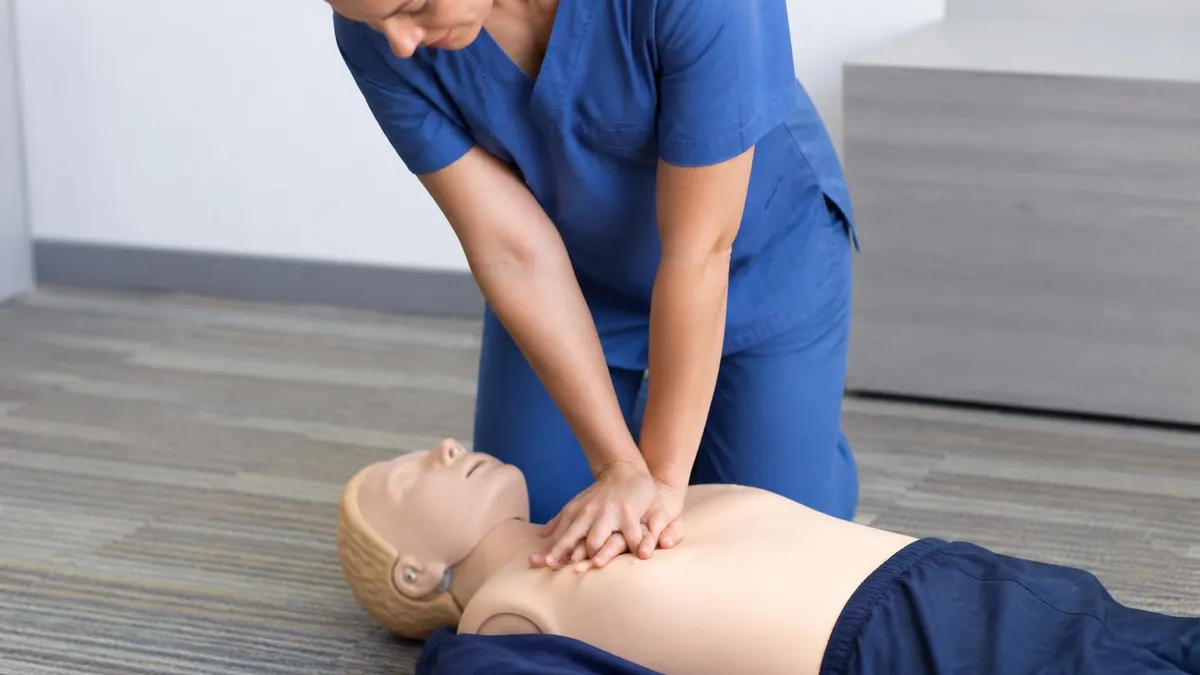
Inappropriate CPR Songs: What Not to Play, Why It Matters, and Better Beat-Per-Minute Alternatives
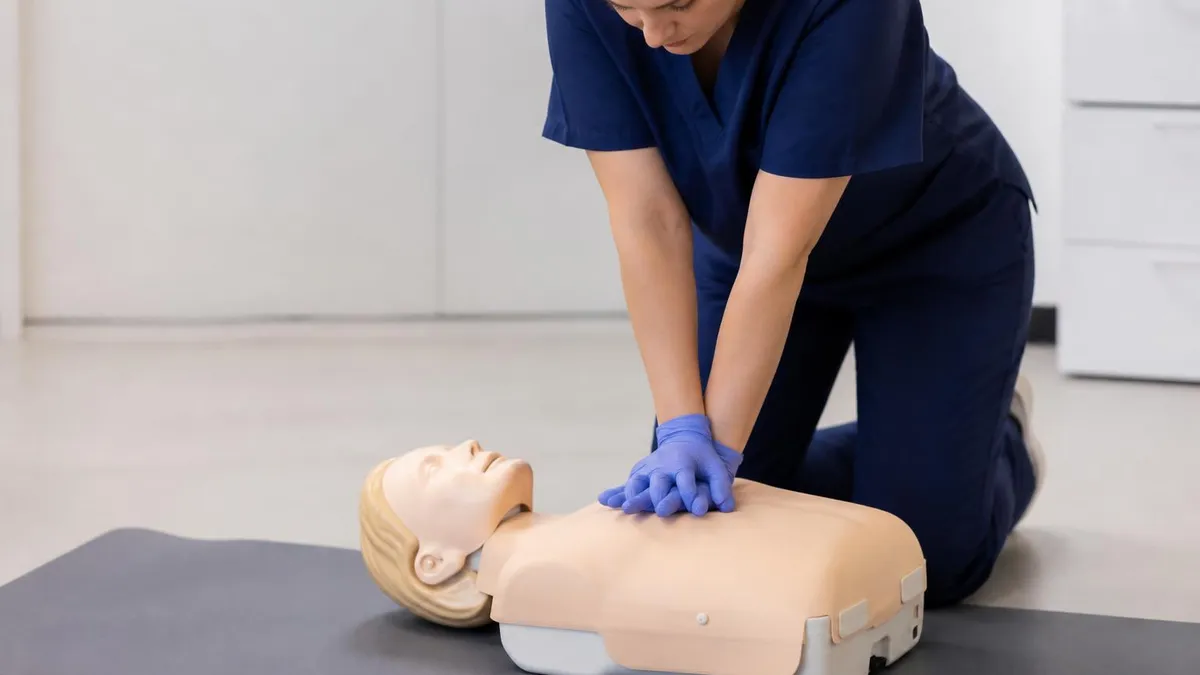
AHA CPR Recertification: How to Recertify CPR Online with the American Heart Association in 2026
About the Author

Registered Nurse & Healthcare Educator
Johns Hopkins University School of NursingDr. Sarah Mitchell is a board-certified registered nurse with over 15 years of clinical and academic experience. She completed her PhD in Nursing Science at Johns Hopkins University and has taught NCLEX preparation and clinical skills courses for nursing students across the United States. Her research focuses on evidence-based exam preparation strategies for healthcare certification candidates.
Join the Discussion
Connect with other students preparing for this exam. Share tips, ask questions, and get advice from people who have been there.
View discussion (5 replies)