
BLS CPR Renewal: Complete Guide to Recertification, Requirements, and Online Options in 2026 October
BLS CPR renewal guide: requirements, online vs in-person options, costs, ACLS algorithm prep, and step-by-step recertification for 2026 October. ✏️
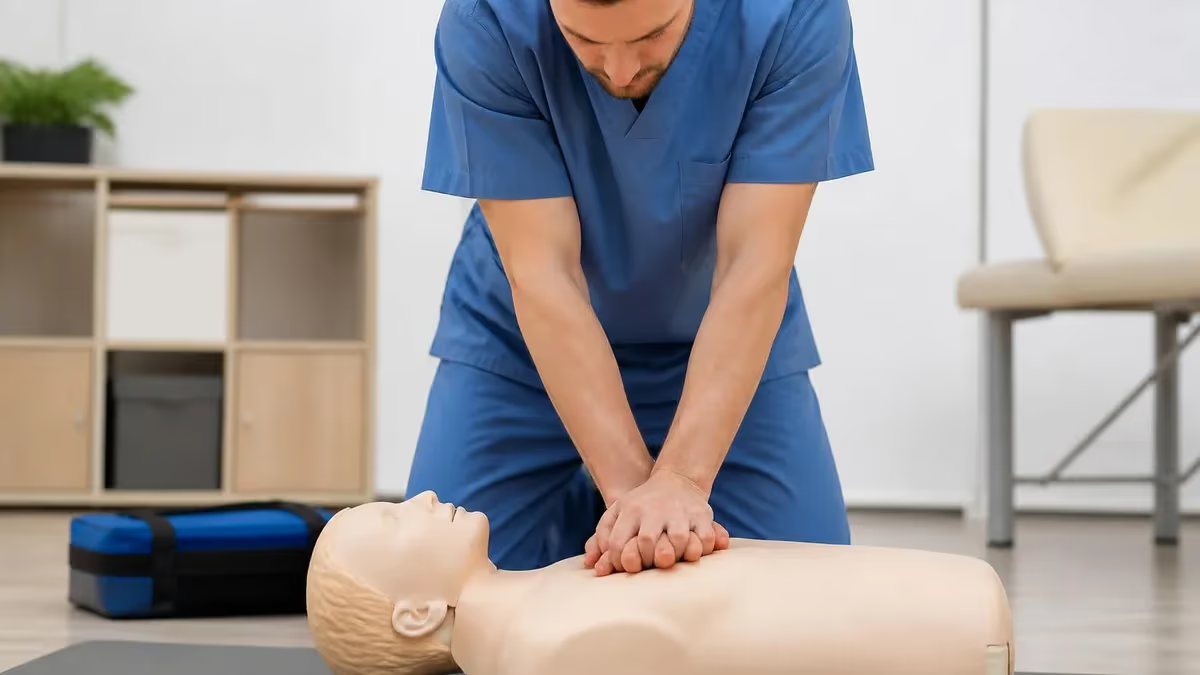
BLS CPR renewal is the mandatory recertification process that healthcare providers, EMTs, lifeguards, and clinical staff complete every two years to maintain their Basic Life Support credentials. Whether you trained through the American Heart Association, the Red Cross, or the national cpr foundation, your card carries a hard expiration date — and letting it lapse can mean suspended hospital privileges, lost shifts, or even immediate removal from a clinical rotation. Renewing on time keeps your skills sharp, your employer compliant, and your patients safe.
The 2025-2030 guidelines refined several protocols that BLS renewal courses now emphasize: high-quality chest compressions at 100-120 per minute and 2-2.4 inches deep, minimal interruptions during the cycle, and faster integration of the automated external defibrillator. If you have not touched a manikin in two years, those changes alone justify sitting through the full skills check rather than relying on memory from your initial certification class.
Renewal differs from initial certification in three important ways. First, the classroom time is roughly half — most providers finish in three to four hours instead of six to eight. Second, renewal assumes you already understand foundational anatomy, normal respiratory rate ranges, and the rationale behind compression-to-ventilation ratios, so instructors move faster. Third, you must arrive with an unexpired card or proof that yours lapsed within the recent grace window your training center allows.
Healthcare BLS is a stricter credential than the community-level CPR card you may have taken in high school. It covers two-rescuer scenarios, bag-valve-mask ventilation, infant CPR with two-thumb encircling technique, choking relief across age groups, and team dynamics that mirror an actual code response. Renewal classes test all of these elements, not just adult compressions, so review your textbook chapters on pediatric and infant resuscitation before you arrive.
Many providers ask whether they can simply skip renewal and retake the initial course later. Technically yes, but it almost always costs more, takes longer, and creates a documented gap in your professional record that some credentialing departments flag. A timely renewal — ideally 60 to 90 days before your expiration date — keeps your CV clean and your continuing education hours intact. For a deeper dive into the broader framework, the CPR - Cardiopulmonary Resuscitation: Complete Study Guide 2026 is a strong companion resource.
This guide walks you through every renewal pathway: blended online learning, full in-person classes, employer-sponsored sessions, and challenge exams. We compare costs, time commitments, accepted issuing bodies, and the practical skills you will be tested on. By the end, you will know which option fits your schedule, your budget, and your scope of practice — and you will have a clear checklist to walk into the skills station with confidence.
We also tackle the questions providers actually ask in the break room: Does an online-only card count at my hospital? What happens if I missed my expiration date by three months? Can I use my BLS renewal toward ACLS prerequisites? Is the National CPR Foundation card accepted at major health systems? Read on for direct, current answers built around the 2025-2030 emergency cardiovascular care guidelines.
Related reading: bls cpr renewal covers the next step in more detail.
Readers who want more detail usually continue with bls cpr renewal.
BLS CPR Renewal by the Numbers
Key Facts at a Glance
| Item | Value | Details |
|---|---|---|
| Typical Cost Range | $60-$110 | varies by issuer and region |
| Card Validity Period | 2 years | from issue date, not class date |
| Compressions Per Minute | 100-120 | current AHA guideline |

BLS Renewal Pathways and Formats
Self-paced online cognitive module plus a hands-on skills session with an AHA instructor. Most common pathway for working clinicians who need flexibility but require a verified skills check.
A single 3-4 hour instructor-led session combining lecture, video, and skills practice on adult, child, and infant manikins. Best for tactile learners or those returning after a long gap.
Many hospitals run on-site renewal days where credentialing pays the fee and the skills lab is set up in a conference room. Check your education department's calendar quarterly.
Issued by groups like the national cpr foundation. Fully digital, immediate card, lowest cost. Accepted by many employers but not all hospitals — verify before you pay.
Some training centers let experienced providers test out via a streamlined written and skills challenge without sitting through the full lecture. Pass rates are high but require strong recent practice.
The 2026 BLS renewal curriculum reflects the 2025-2030 AHA guideline cycle, and several updates deserve attention even if you have renewed multiple times before. The compression depth target remains 2 to 2.4 inches for adults, but instructors are emphasizing feedback-device use more aggressively. If your training center uses a manikin with a real-time depth and rate monitor, expect to be coached toward consistent metrics rather than passing on a single good cycle.
Ventilation strategy has also evolved. For adult cardiac arrest with an advanced airway, providers now deliver one breath every six seconds — a rate of about ten per minute — which roughly mirrors a low-normal respiratory rate. For pediatric and infant arrest, the recommended rate is one breath every two to three seconds, or 20-30 per minute. Renewal exams test these numbers directly, and confusing the adult and pediatric rates is one of the most common skills-station errors.
The AED integration sequence is another focus. Many providers wonder what does aed stand for in practical terms during a code — the automated external defibrillator is now expected to be attached within the first two minutes whenever possible, and the renewal scenarios reflect that urgency. Instructors will dock points if you complete a full two-minute compression cycle before reaching for the device when one is available in the room.
Team dynamics receive more attention in 2026 than in past cycles. Renewal candidates are evaluated on closed-loop communication, clear role assignment, and constructive intervention when a teammate makes an error. Even solo-scope providers like home health aides are tested on how they would coordinate with an arriving EMS crew, because real arrests almost never stay single-rescuer for long.
Infant CPR has updated guidance on the two-thumb encircling technique for two-rescuer scenarios — it is now considered the preferred method over two-finger compressions whenever a second rescuer is available, because it produces deeper, more consistent compressions. Renewal candidates must demonstrate the switch fluidly when a partner arrives. Practice with a true infant manikin if your training center allows lab time before class.
Opioid-associated emergencies appear in the renewal curriculum more prominently this cycle. Providers are taught to consider naloxone administration alongside high-quality CPR when overdose is suspected, and the algorithm flowchart now branches earlier toward this pathway. Review the most recent AHA CPR: What It Is, Which Course You Need, and How to Get Certified resource for the current branching logic.
Finally, the renewal written exam — typically 25 questions — pulls from a larger question bank than before, with more scenario-based items and fewer pure recall questions. Expect to see vignettes describing a collapsed adult in a grocery store, an infant choking at daycare, and a teammate performing compressions too shallow. Your answer choices test judgment, not just memorization, so reviewing a free practice quiz the night before class pays real dividends.
CPR Practice Test Questions
Prepare for the CPR Cardiopulmonary Resuscitation Practice exam with our free practice test modules. Each quiz covers key topics to help you pass on your first try.
CPR Basic CPR
CPR Exam Questions covering Basic CPR. Master CPR Test concepts for certification prep.
CPR and First Aid
Free CPR Practice Test featuring and First Aid. Improve your CPR Exam score with mock test prep.
CPR (Cardiopulmonary Resuscitation) Adult ...
CPR Mock Exam on (Cardiopulmonary Resuscitation) Adult CPR and AED Usage. CPR Study Guide questions to pass on your first try.
CPR (Cardiopulmonary Resuscitation) Airway...
CPR Test Prep for (Cardiopulmonary Resuscitation) Airway Obstruction and Choking. Practice CPR Quiz questions and boost your score.
CPR (Cardiopulmonary Resuscitation) Cardio...
CPR Questions and Answers on (Cardiopulmonary Resuscitation) Cardiopulmonary Emergency Recognition. Free CPR practice for exam readiness.
CPR (Cardiopulmonary Resuscitation) Child ...
CPR Mock Test covering (Cardiopulmonary Resuscitation) Child and Infant CPR. Online CPR Test practice with instant feedback.
CPR (Cardiopulmonary Resuscitation) High-P...
Free CPR Quiz on (Cardiopulmonary Resuscitation) High-Performance Team Dynamics. CPR Exam prep questions with detailed explanations.
CPR (Cardiopulmonary Resuscitation) Legal ...
CPR Practice Questions for (Cardiopulmonary Resuscitation) Legal and Ethical Considerations. Build confidence for your CPR certification exam.
CPR for Specific Populations
CPR Test Online for for Specific Populations. Free practice with instant results and feedback.
CPR Airway & Breathing Management
CPR Exam Questions covering Airway & Breathing Management. Master CPR Test concepts for certification prep.
CPR Assessment & Recognition of Cardiac Ar...
Free CPR Practice Test featuring Assessment & Recognition of Cardiac Arrest. Improve your CPR Exam score with mock test prep.
CPR Chest Compressions & Defibrillation
CPR Mock Exam on Chest Compressions & Defibrillation. CPR Study Guide questions to pass on your first try.
CPR Post-Resuscitation Care & Recovery
CPR Test Prep for Post-Resuscitation Care & Recovery. Practice CPR Quiz questions and boost your score.
Online vs Blended vs In-Person Renewal
Fully online BLS renewal is the fastest, cheapest pathway. Providers like the national cpr foundation offer self-paced modules and an immediate digital card for around $20-$40. You can finish on a lunch break, and the card is typically valid for two years. This works well for community responders, fitness instructors, daycare staff, and corporate first-aid teams whose employer has confirmed acceptance in writing.
The trade-off is verification. Many hospitals and EMS agencies require a skills check signed by an in-person instructor and will reject an online-only card outright. Before paying for a fully digital course, screenshot your employer's accepted-issuer list or email your credentialing office. If your scope involves clinical patient care, a blended or in-person pathway is almost always safer despite the higher cost and longer time commitment.
Should You Renew Online or In-Person?
- +Online renewal can be completed in under two hours, including the exam
- +Lower total cost — sometimes one-third the price of classroom training
- +Immediate digital card with QR-code verification for most accepted issuers
- +Self-paced video allows you to rewind tricky algorithm sections
- +No travel, parking, or scheduling around a training center calendar
- +Works well for non-clinical roles like teachers, coaches, and corporate responders
- −Many hospitals and EMS agencies will not accept online-only cards
- −No hands-on feedback on compression depth, rate, or hand placement
- −Skills decay faster without manikin practice during the course
- −Some online vendors are not recognized by state licensing boards
- −Harder to ask scenario-based questions or get clarification in real time
- −Two-rescuer and bag-valve-mask skills are difficult to learn from video alone

Pre-Renewal Skills Checklist
- ✓Confirm your current BLS card expiration date and renew 60-90 days before
- ✓Verify your employer's accepted issuing bodies list in writing
- ✓Review the 2025-2030 AHA guideline summary for any algorithm changes
- ✓Practice adult compressions at 100-120 per minute with a metronome app
- ✓Review infant cpr two-thumb encircling technique and pulse check location
- ✓Memorize the one-breath-every-six-seconds advanced-airway ventilation rate
- ✓Re-read the choking relief sequence for unresponsive adults, children, and infants
- ✓Take at least one free 25-question practice quiz the night before class
- ✓Print or screenshot your existing card to bring as proof of prior certification
- ✓Confirm whether your training center requires the printed textbook on arrival
Renew 60-90 Days Early — Your Card Stays Valid Through Its Original Expiration
A common myth is that renewing early shortens your two-year window. It does not. When you renew before expiration, most training centers issue a new card dated from your original expiration, giving you a full additional two years on top. This means there is zero downside to scheduling early — and significant upside, since you avoid the panic of a fully booked training calendar in the final week.
Choosing the right issuing body matters more than choosing the right format. The American Heart Association remains the gold standard for hospital-employed clinicians, and AHA-issued BLS Provider cards are accepted at virtually every U.S. health system, nursing program, and licensing board. The American Red Cross BLS is similarly well-accepted, particularly in academic medical centers on the East Coast and in any setting where Red Cross has historical training relationships.
The national cpr foundation and similar online-first organizations issue cards at lower cost and faster turnaround. These are excellent options for community responders, gym staff, school employees, and corporate first-aid teams — but their acceptance in clinical settings is uneven. Before you pay, search your employer's intranet or call human resources to ask specifically which issuing bodies they recognize for clinical privileges. Save that email; it is your defense if a credentialing audit questions your card later.
Some specialty programs accept only specific issuers. ACLS and pals certification courses, for instance, almost always list a current AHA-issued BLS card as a prerequisite. If your career trajectory includes advanced life support training within the next two years, choose AHA renewal now to avoid having to redo BLS later just to get into an ACLS class. The same logic applies if you are considering EMT-to-paramedic bridge programs, ICU step-up training, or pediatric advanced life support coursework.
State scope-of-practice rules add another layer. A few states require BLS renewal through an approved in-person provider for specific license types like respiratory therapists, dental hygienists, and emergency room technicians. Your state board's website will list approved providers — check it even if your employer accepts something more permissive, because your individual license is independently regulated.
These businesses share a famous acronym but have nothing to do with cardiopulmonary resuscitation training. When you search online, append "certification" or "renewal" to your query so you reach the right vendor. The CPR Card Lookup: How to Verify, Replace, and Access Your CPR Certification in 2026 resource explains how to verify legitimate training cards online.
Verification has become a major credentialing tool. Most modern BLS cards include a QR code or unique ID that lets an employer instantly confirm authenticity through the issuer's verification portal. If your card lacks this feature, the issuing body is probably not on most hospital accepted lists. Insist on QR-verifiable cards even when paying for the cheapest online renewal — it is the single best indicator that the certification is real and accepted.
Finally, remember that renewal recognition is bidirectional. Your AHA card transfers when you switch employers within healthcare, but moving from a community responder role into clinical work may require you to recertify with a more rigorous issuer. Plan ahead if your career goals are evolving, and ask your future employer's credentialing office what they require before you spend money on a card that may not transfer up.
If your BLS card expires before you renew, many employers will immediately remove you from the patient-care schedule until you produce a current card. Some hospitals charge back the cost of agency replacement staff to the lapsed employee's department. State boards can also flag a lapsed BLS card as a continuing-education violation for licensed clinicians. Renew before the date on the card — not the week of, not the day before.
If your BLS card has already lapsed, do not panic — but do act immediately. Most training centers honor a 30 to 60 day informal grace window during which you can renew rather than recertify, though policies vary. After 60 days, expect to retake the full initial certification course, which doubles your classroom time and increases your cost. Beyond 90 days, every major issuer treats you as a new student regardless of how many years you previously held the credential.
The administrative steps for a lapsed card are straightforward. First, locate your most recent card (digital or paper) and screenshot it. Second, call two or three training centers and ask their specific lapsed-card policy — answers genuinely differ. Third, book the earliest available skills session, even if it means driving farther than usual. Fourth, notify your manager or credentialing office in writing that you have a renewal scheduled; documentation of your good-faith effort can sometimes preserve your shift assignments while you complete the class.
Re-entering BLS after a gap of more than two years deserves more preparation than a typical renewal. Skills decay measurably after six months without practice and substantially after a year. Block out a quiet evening to review the algorithm, watch a current AHA technique video, and walk through at least one full practice quiz. The Adult CPR: Complete Step-by-Step Guide to Hands-Only and Standard CPR in 2026 guide is an excellent refresher for compression mechanics specifically.
Pay particular attention to the recovery position when reviewing — position recovery technique is tested whenever a victim regains a pulse and breathing but remains unresponsive. The lateral recumbent position protects the airway while you wait for EMS. Many providers forget this skill because cardiac arrest scenarios dominate training, but it appears on renewal exams with surprising frequency.
Respiratory assessment is another commonly missed area. Knowing the normal respiratory rate ranges — 12 to 20 breaths per minute for adults, 15 to 30 for children, and 25 to 50 for infants — helps you recognize agonal breathing versus effective respiration. Agonal gasps are not real breaths, and treating them as such delays the start of compressions in a true arrest. Renewal exams ask scenario questions specifically designed to catch this confusion.
Bring physical evidence to class. Even if your card has lapsed, an instructor can sometimes still process you through the renewal track rather than the initial track if you can document recent training history. Acceptable evidence includes the expired card itself, an employer's training transcript, a digital wallet certificate, or a verification email from the original issuing body. Walking in empty-handed forces the instructor to assume initial certification by default.
Finally, do not let embarrassment delay you. Instructors see lapsed cards constantly and rarely judge — their goal is to get competent providers back into the system as quickly as possible. The longer you wait, the harder the conversation with your employer becomes and the more likely you are to be assigned to the longer initial course. Same-week action almost always produces the best outcome.
Walking into your skills station with a clear plan beats walking in with vague confidence every time. Start your day-of-class prep the night before by reviewing the BLS algorithm out loud. Verbalizing the sequence — assess scene safety, check responsiveness, call for help and an AED, check pulse and breathing for no more than ten seconds, begin compressions — builds verbal fluency that instructors specifically listen for during the practical exam.
Warm up your hands before the skills check. Many providers fail their first attempt at the compression metric not because of weakness but because their hands and forearms are cold from the lobby. A two-minute set of fist clenches and wrist circles loosens the muscles you will use for the next half hour. If you wear rings or a watch, remove them — they shift hand position subtly and can drop your depth metric by a quarter inch.
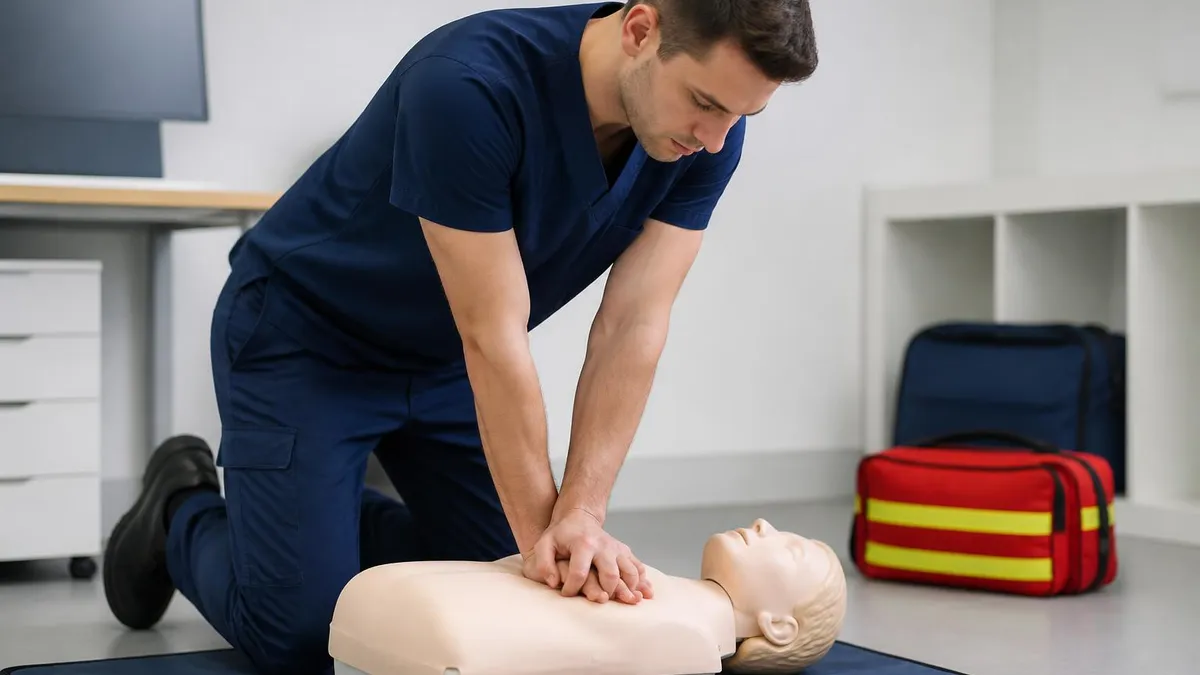
Treat the manikin like a real patient even though you know it is plastic. Instructors notice when you tilt the head firmly into a true chin-lift, place the heel of your hand on the lower half of the sternum without searching, and verbalize "no pulse, beginning compressions" rather than silently starting. These small theatrical touches signal competence and can save you if a single compression metric is slightly off.
For two-rescuer scenarios, practice the swap. The transition between compressors should take less than five seconds and should happen every two minutes or at every rhythm check. The incoming rescuer positions on the opposite side of the chest, places their hands above yours, and takes over on your count. Practicing this once with a partner before class makes the in-class skills test feel like a repeat performance.
For infant cpr, the two key skills are the brachial pulse check and the proper compression technique. The brachial pulse is on the inside of the upper arm — not the neck — and you should check for no more than ten seconds. For compressions, use two fingers in single-rescuer mode or the two-thumb encircling technique when a partner is available. Compression depth is about one and a half inches, or one-third the depth of the infant chest.
Choking relief sequences are tested across all age groups. For a responsive adult or child, alternate five back blows and five abdominal thrusts. For an infant, alternate five back blows and five chest thrusts — never abdominal thrusts on an infant. For any unresponsive choking victim, lower them to the ground and begin CPR; check the mouth for the obstruction before each ventilation attempt and remove it only if you can see it clearly.
Finally, rest before the exam. Skills tests are tiring, and dehydration plus low blood sugar will show up in your compression rate within minutes. Eat a real meal an hour before class, bring water, and skip the third cup of coffee — jittery hands compromise consistent depth and rate metrics. Show up calm, well-fed, and rehearsed, and the renewal will feel routine. Your card will arrive within days, your two-year clock will reset, and you can get back to the work that actually matters.
CPR Questions and Answers
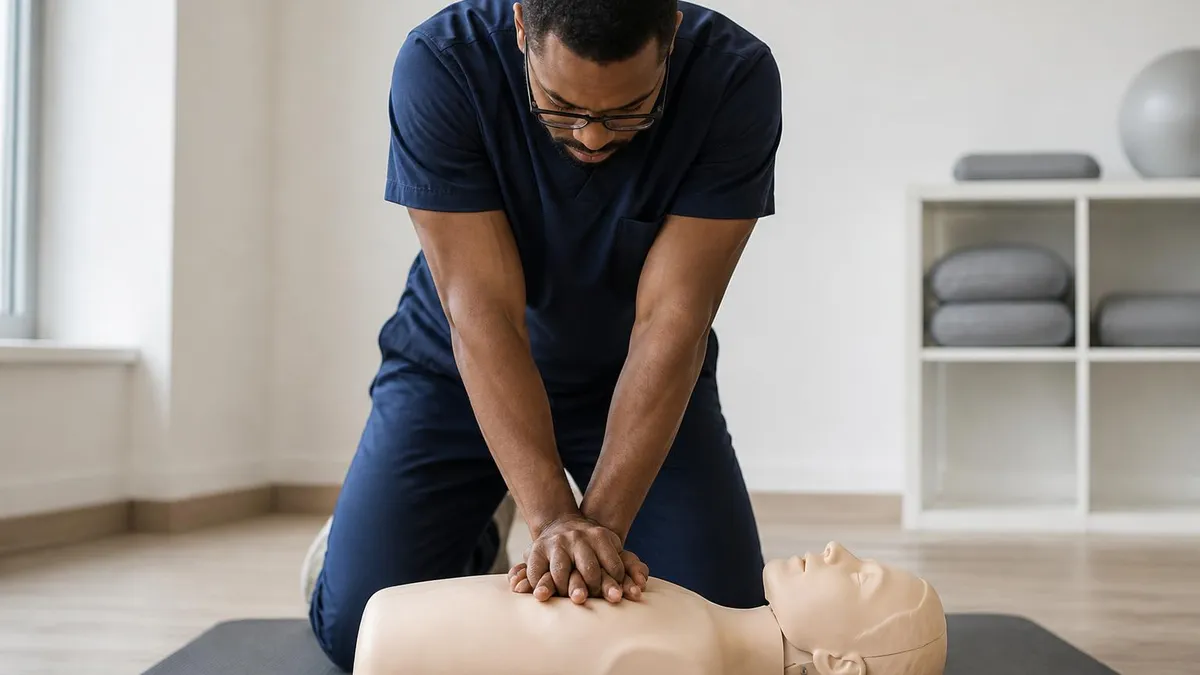
CPR Card Lookup: How to Verify, Replace, and Access Your CPR Certification in 2026
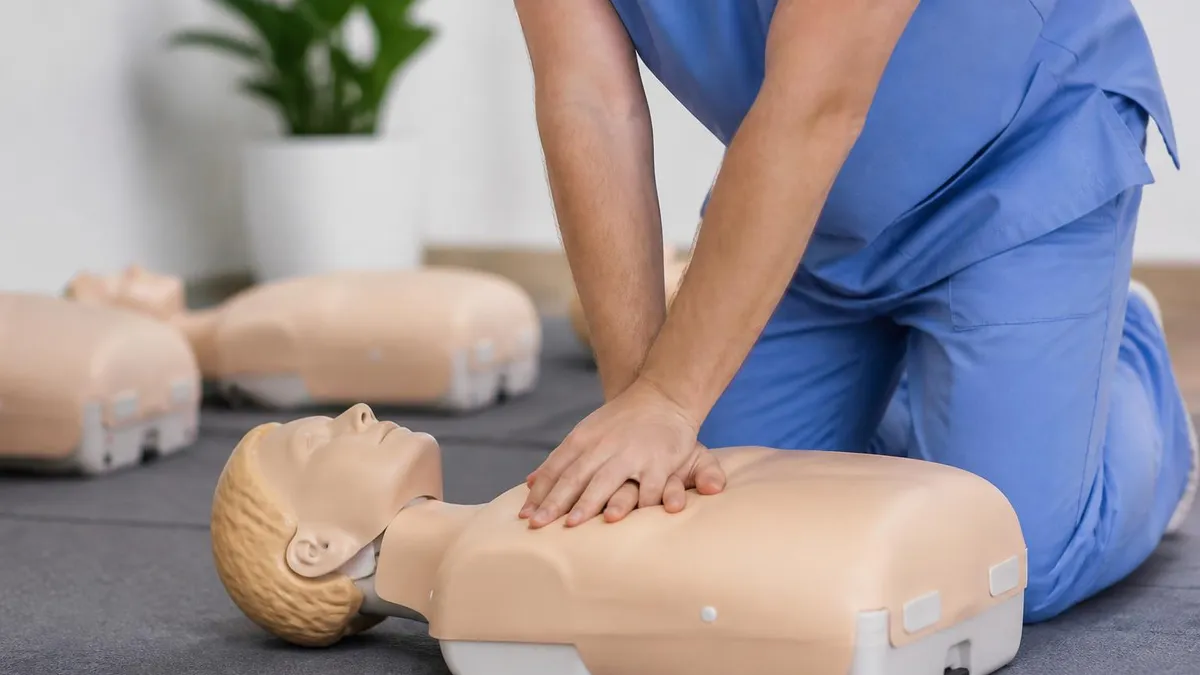
AHA CPR: What It Is, Which Course You Need, and How to Get Certified
Adult CPR: Complete Step-by-Step Guide to Hands-Only and Standard CPR in 2026

CPR - Cardiopulmonary Resuscitation: Complete Study Guide 2026
Inappropriate CPR Songs: What Not to Play, Why It Matters, and Better Beat-Per-Minute Alternatives
About the Author

Registered Nurse & Healthcare Educator
Johns Hopkins University School of NursingDr. Sarah Mitchell is a board-certified registered nurse with over 15 years of clinical and academic experience. She completed her PhD in Nursing Science at Johns Hopkins University and has taught NCLEX preparation and clinical skills courses for nursing students across the United States. Her research focuses on evidence-based exam preparation strategies for healthcare certification candidates.
Join the Discussion
Connect with other students preparing for this exam. Share tips, ask questions, and get advice from people who have been there.
View discussion (5 replies)