
CPR Renewal: How to Renew Your CPR Certification in 2026 October
Complete CPR renewal guide covering renewal timelines, ✍🏼 online vs in-person options, cost, accepted providers, and how to recertify before your card
What CPR Renewal Really Means
CPR renewal is the process of recertifying your cardiopulmonary resuscitation credential before the previous card expires, which typically happens every two years for most certification programs. Healthcare workers, teachers, childcare providers, lifeguards, fitness professionals, and millions of community members maintain CPR certification throughout their careers because expired credentials disqualify holders from job responsibilities that require current certification.
The American Heart Association and American Red Cross are the two largest certification providers in the United States, with smaller providers such as the National Safety Council, Health and Safety Institute, and American Safety and Health Institute also issuing recognized credentials. Most employers accept renewal certificates from any of these major providers, though some hospital systems specify American Heart Association credentials for clinical staff working with cardiac patients.
The renewal process compresses initial certification training into a shorter refresher format because students already have foundational knowledge of CPR technique, compression rates, ventilation methods, and automated external defibrillator use. Most renewal classes run two to four hours rather than the four to eight hour initial certification programs, with content focused on updating skills to current guidelines and recertifying proficiency through skill demonstrations and written assessment.
The two-year recertification cycle reflects the documented decay in CPR skill retention over time. Research consistently shows that compression depth, rate accuracy, hand placement, and ventilation technique all degrade meaningfully within months of initial training, with significant degradation typically apparent by twelve to eighteen months post-training. The two-year renewal interval represents a compromise between scientific evidence supporting more frequent training and practical scheduling constraints faced by certification holders.
Renewal classes also serve as an important update mechanism when guidelines change. The American Heart Association and Red Cross both update CPR guidelines based on evolving evidence about cardiac arrest outcomes. Renewal ensures that all certification holders practice the most current techniques rather than carrying outdated methods learned during their original certification five or ten years earlier. This update function matters most for professional rescuers whose techniques affect actual patient outcomes during emergencies.
CPR Renewal Quick Facts
Most CPR certifications expire two years after the issue date. Renewal classes typically run two to four hours and cost thirty to one hundred dollars depending on level and format. Healthcare provider renewals run longer and cost more. Online-only courses are accepted by some employers but in-person hands-on skill verification is required for healthcare provider certification.
Healthcare workers should verify employer-specific provider requirements before booking renewal classes since some hospital systems accept only American Heart Association credentials for clinical staff. Setting calendar reminders six weeks before card expiration prevents lapses that affect work eligibility.
When to Renew Your CPR Card
CPR cards typically expire on the last day of the month two years after the original issue date. Some employers require renewal at least thirty days before expiration to avoid any gap in certification coverage. Other employers accept renewal during a grace period of up to ninety days after expiration without requiring full recertification, though this practice varies significantly between employers and certifying organizations.
Healthcare workers should plan renewal at least sixty days before expiration to allow time for skill review, scheduling, and any required documentation updates with their employer credentialing departments. Hospitals often require evidence of current CPR certification at every credentialing cycle, with expired certifications resulting in immediate suspension of clinical privileges until renewal completes. The financial impact of suspension makes proactive renewal planning essential for clinical staff.
Community members renewing for general preparedness or volunteer roles have more flexibility in renewal timing. Many take renewal courses around vacation periods or holiday breaks when schedules permit. Setting a calendar reminder six weeks before expiration provides adequate time to research providers, schedule the class, and complete renewal before the previous card expires regardless of personal scheduling constraints.
Calendar tracking systems vary in effectiveness across different individuals. Smartphone calendar reminders set six weeks before expiration provide adequate planning time for most people. Hospital credentialing systems automatically track CPR card expiration dates and notify staff at sixty, thirty, and seven day intervals before expiration, reducing the burden on individual workers to track their own deadlines reliably. Personal calendar entries in addition to employer systems provide redundant reminders that protect against system failures.
Concurrent renewal of multiple certifications simplifies scheduling for workers holding several credentials. Healthcare workers often hold BLS, ACLS, and PALS simultaneously, with each on its own two-year cycle. Scheduling all renewals during the same week or month each cycle creates predictable training periods that integrate more smoothly with work schedules than scattered renewals across the year would produce. Multi-certification courses sometimes offer discount pricing that further rewards consolidated scheduling.

CPR Certification Levels
Designed for community members, teachers, and workplace responders. Covers adult, child, and infant CPR plus AED use with renewal taking two to three hours and costing thirty to seventy dollars. Verifying current pricing and availability with multiple providers identifies the best combination of cost, quality, and schedule fit for individual circumstances.
Required for nurses, doctors, EMTs, and most clinical staff. Covers advanced techniques including two-rescuer CPR and bag-mask ventilation with renewal taking three to four hours and costing seventy to one hundred twenty dollars. Verifying current pricing and availability with multiple providers identifies the best combination of cost, quality, and schedule fit for individual circumstances.
Required for staff working with pediatric patients in hospital settings. Renewal includes scenario-based testing on pediatric emergencies and runs eight to twelve hours over one or two days. Verifying current pricing and availability with multiple providers identifies the best combination of cost, quality, and schedule fit for individual circumstances.
Required for staff managing adult cardiac emergencies in hospital settings. Renewal includes rhythm interpretation and medication dosing scenarios over twelve to sixteen hours of intensive training. Verifying current pricing and availability with multiple providers identifies the best combination of cost, quality, and schedule fit for individual circumstances.
In-Person vs Online vs Blended Renewal
In-person renewal classes deliver complete training in a single session with hands-on practice on manikins, instructor feedback on technique, and skill demonstration assessments. The format suits learners who benefit from immediate correction and group learning dynamics. Most major certification providers offer in-person classes through hospital education departments, community colleges, fire departments, ambulance services, and private CPR training companies.
Online-only renewal courses for Heartsaver and similar non-healthcare credentials let students complete training entirely on a computer or mobile device at their own pace. The format suits learners with limited schedule flexibility or those located far from in-person training options. However, many employers including most healthcare settings do not accept online-only certifications because they lack the hands-on skill verification that ensures actual proficiency on manikins.
Blended renewal combines online didactic content with a brief in-person skill check session. The American Heart Association calls this format HeartCode BLS for healthcare providers and HeartCode Heartsaver for community responders. Students complete the cognitive portion online at their own pace, then attend a thirty to ninety minute in-person session at an authorized site for skill testing and credential issuance. This format suits busy healthcare workers seeking schedule flexibility while meeting employer requirements for hands-on verification.
State and employer regulations sometimes specify acceptable renewal formats more narrowly than the certifying agencies themselves require. California regulations for healthcare workers, for example, may require additional in-person components beyond what the AHA standard course specifies. Verifying state-specific requirements for the worker location and role prevents the discovery after completing online renewal that additional in-person components are required for state compliance.
Skills feedback technology in modern training centers has improved the quality of both in-person and blended renewal options significantly. Electronic manikins with real-time feedback on compression depth, rate, and hand placement enable students to identify and correct subtle technique issues that visual observation alone cannot detect. Programs offering feedback manikins produce stronger skill retention than traditional manikins without electronic measurement, regardless of whether the format is fully in-person or blended online plus in-person verification.
Renewal Format Comparison
Traditional classroom training with instructor demonstrations, hands-on practice on manikins, group scenarios, and final skill demonstration. Runs two to four hours for basic CPR renewal at sites including hospitals, fire stations, community colleges, and private CPR training companies across most communities.
Format selection should align with personal learning preferences, employer requirements, and schedule constraints to produce the best combination of certification success and skill development outcomes.
Cost of CPR Renewal
CPR renewal costs vary based on certification level, provider, location, and format. Heartsaver CPR AED renewal typically costs thirty to seventy dollars including the certification card. BLS Healthcare Provider renewal runs seventy to one hundred twenty dollars. Pediatric Advanced Life Support and Advanced Cardiac Life Support renewals cost two hundred to four hundred dollars due to longer course duration and specialized instructor requirements.
Employer-paid CPR renewal is common in healthcare settings where current certification is a job requirement. Many hospitals operate their own training centers that provide free or subsidized renewal to clinical staff during work hours. Workers should ask their employers about available training options before paying personally for renewal, as the workplace option often delivers equivalent quality at no out-of-pocket cost.
Group rates for organizations renewing multiple employees can reduce per-person costs substantially. Most certification providers offer group discounts when training five or more participants together. Schools, fitness centers, childcare facilities, and small healthcare practices often arrange group classes that train all required staff at significantly lower cost than individual renewal arrangements would produce.
Hidden cost considerations sometimes add to the apparent renewal price. Parking fees at hospital training centers can add five to fifteen dollars per session. Lost wages for hourly workers attending classes during work hours represent real opportunity cost. Travel costs to and from training sites add fuel and time expense. Factoring these total costs into provider comparison helps identify the option that minimizes total time and money investment rather than focusing only on the headline class price.
Insurance coverage for CPR renewal varies by health insurance plan and employer benefit structure. Some flexible spending account plans accept CPR renewal as a qualifying medical expense when training is required for healthcare worker employment. Professional development funds at many employers cover certification renewal as part of standard employee development budgets. Asking benefits administrators about available reimbursement before paying personally for renewal sometimes identifies coverage that reduces or eliminates out-of-pocket cost.

Confirm which certification providers your employer accepts before paying for renewal. Some hospital systems accept only American Heart Association credentials for clinical staff. Other employers accept any major provider including American Red Cross or National Safety Council. Paying for the wrong provider means paying again for the correct one to maintain employment.
Most healthcare credentialing systems track CPR expiration automatically and send notifications at sixty, thirty, and seven days before expiration. Personal calendar entries provide redundant tracking that protects against employer notification system failures.
What Happens During CPR Renewal Class
Renewal classes typically begin with a brief review of CPR theory including the chain of survival, current compression rate guidelines of one hundred to one hundred twenty compressions per minute, compression depth of at least two inches for adults, and the importance of minimizing interruptions during compressions. Instructors demonstrate proper technique on manikins, addressing any changes from the previous guidelines that may have occurred since the original certification.
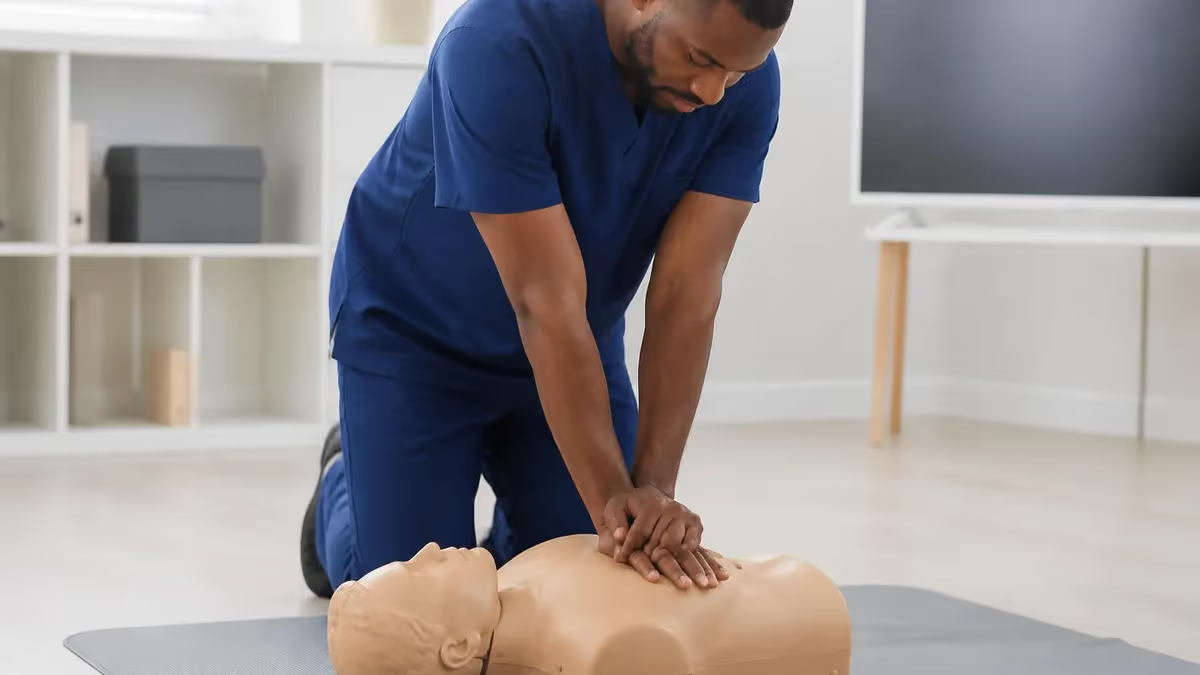
Hands-on practice on manikins forms the core of in-person renewal classes. Students perform compressions, rescue breaths, and AED use under instructor supervision, receiving feedback on technique, rate, depth, and recoil. Feedback manikins with electronic sensors provide objective measurement of compression quality, helping students identify and correct subtle technique issues that visual observation alone may miss during practice rotations.
Final skill demonstration tests proficiency before credential issuance. Students perform a complete CPR sequence including assessment, compressions, ventilations, and AED use while the instructor observes and scores performance against established criteria. Students who do not meet criteria on the first attempt typically receive coaching and additional practice opportunities before retesting within the same class session.
Adult CPR practice typically opens the hands-on portion of the renewal class. Students take turns demonstrating compressions on adult manikins at the prescribed rate and depth, with instructors providing real-time feedback on technique. Pairs work through scenarios as a team, swapping compressor and rescuer roles to practice the handoff that maintains compression continuity during sustained resuscitation efforts.
Child and infant CPR practice follows adult CPR in most renewal classes. Technique modifications for smaller bodies include shallower compression depth proportional to chest size, slightly different hand placement, and adjusted ventilation volumes for pediatric airways. Students practice on appropriately sized manikins to develop the muscle memory for adjusting technique based on patient age rather than applying adult technique to all victims regardless of body size.
CPR Renewal Preparation Checklist
- ✓Check your current card expiration date and schedule renewal at least thirty days before expiration
- ✓Confirm which certification providers and formats your employer accepts before booking the class
- ✓Review current CPR guidelines from the American Heart Association or American Red Cross website
- ✓Practice compressions on a pillow or manikin if available to refresh muscle memory before class
- ✓Bring photo identification and your current CPR card to verify previous certification status
- ✓Wear comfortable clothing that allows kneeling on the floor and physical activity during practice
- ✓Eat a meal before class to maintain energy through the physical demands of practice rotations
- ✓Verify the renewal class will issue an electronic card immediately upon completion rather than waiting for mailed cards
- ✓Confirm refund and rescheduling policies before booking in case life events prevent attendance on the scheduled date
If Your CPR Card Has Expired
Most certification providers offer a grace period of thirty to ninety days after card expiration during which the standard renewal class still applies for recertification. The grace period acknowledges that scheduling conflicts and busy lives sometimes prevent timely renewal even with good intentions. Renewing during the grace period restores certification without requiring the longer initial certification class that would otherwise be necessary.
If the grace period has passed, most providers require the full initial certification class rather than the shorter renewal format. The initial class costs more, runs longer, and covers all foundational content that renewal classes assume students remember. Avoiding the expired card scenario through proactive renewal saves both time and money compared to letting the certification fully lapse.
Employer policies vary regarding expired certifications. Most healthcare employers suspend clinical privileges immediately upon CPR card expiration and reinstate privileges only after current certification is documented. Some require workers to use paid time off for the recertification class itself rather than counting it as work time. Reviewing employer policies before allowing expiration helps avoid surprises that affect both income and work eligibility.
Some employers require continuous certification with no gap regardless of grace period availability. Lapse for even a single day triggers full retraining requirements, removal from clinical duty, and sometimes disciplinary action depending on whether the lapse was foreseeable and avoidable. Reviewing employer policies before allowing any gap helps maintain employment status while resolving certification issues that may arise during demanding life periods.
Documentation of renewal completion should be retained for at least the duration of the certification cycle and longer for audit purposes. Digital copies of renewal cards stored in personal email, employer credentialing systems, and possibly cloud storage provide redundant access in case of card loss or damage. Some employers also accept photographs of cards as documentation, though original cards remain the standard for most credentialing situations across major healthcare systems.
Current CPR Guidelines and Recent Changes
The American Heart Association updates CPR guidelines approximately every five years based on the latest research on cardiac arrest outcomes. Recent guidelines emphasize high-quality chest compressions with minimal interruption, immediate AED use, and team-based response that maximizes the proportion of time compressions are being delivered to the patient. Compression rate of one hundred to one hundred twenty per minute and depth of at least two inches for adults remain the core targets.
Hands-only CPR for untrained bystanders gained official endorsement over the past decade as research showed that compression-only CPR by bystanders produced outcomes nearly equivalent to traditional CPR with breaths. This approach simplifies the bystander decision tree, eliminates the perceived obstacle of mouth-to-mouth ventilation, and improves bystander response rates in observed cardiac arrests in public locations across various community settings.
Telephone-assisted CPR coaching by emergency dispatchers represents another important development that affects training emphasis. Dispatchers now provide step-by-step CPR coaching to callers who report cardiac arrest, walking them through compressions until emergency responders arrive on scene. This system depends on bystanders willing to begin compressions with guidance, making bystander empowerment through CPR training even more important for community survival outcomes during cardiac emergencies.
Guidelines updates do not always invalidate previous training but renewal classes provide the structured opportunity to absorb any meaningful changes since the prior certification. Reading the American Heart Association website periodically between renewal classes helps practitioners stay current with significant interim updates and emerging research. Many hospital systems also distribute internal updates to clinical staff when guidelines change between scheduled training cycles.
Defibrillator technology continues evolving with newer automated external defibrillators providing voice coaching, visual feedback on compression quality, and automatic shock advice during active resuscitation. Familiarity with the specific AED models present in the workplace matters because operational differences between brands affect speed and accuracy of use during actual emergencies. Renewal classes increasingly cover multiple AED models to prepare students for the variety they may encounter in different community settings.

CPR Renewal By the Numbers
Key Facts at a Glance
| Item | Value | Details |
|---|---|---|
| Standard Validity | 2 years | |
| Typical Class Length | 2-4 hrs | |
| Cost Range | $30-$120 | |
| Compressions Per Minute | 100-120 |
Where to Renew CPR
Hospitals frequently offer free or subsidized CPR renewal to clinical staff and sometimes community members. Quality is consistently high with instructors active in current clinical practice. Verifying current pricing and availability with multiple providers identifies the best combination of cost, quality, and schedule fit for individual circumstances.
Many fire departments offer community CPR classes including renewal at low cost. Instructors are typically paramedics or EMTs with extensive field experience teaching practical scenarios. Verifying current pricing and availability with multiple providers identifies the best combination of cost, quality, and schedule fit for individual circumstances.
Independent CPR training companies offer flexible scheduling, weekend classes, and corporate group rates. Quality varies between companies, with major brands maintaining consistent standards. Verifying current pricing and availability with multiple providers identifies the best combination of cost, quality, and schedule fit for individual circumstances.
Blended programs combining online learning with brief skill verification visits offer maximum flexibility for busy professionals managing tight schedules across multiple priorities. Verifying current pricing and availability with multiple providers identifies the best combination of cost, quality, and schedule fit for individual circumstances.
How to Choose a CPR Renewal Provider
Provider selection should start with confirming which certification programs your employer accepts. Healthcare workers should verify American Heart Association acceptance specifically since some hospital systems require AHA credentials exclusively for clinical staff. Community workers and educators have more flexibility, with Red Cross, AHA, and other major providers all typically accepted across most non-clinical workplace settings.
Class schedule fit determines feasibility for many workers balancing job, family, and other obligations. Evening and weekend class options at convenient locations remove barriers that prevent timely renewal. Providers offering classes at multiple sites and times demonstrate scheduling flexibility that supports proactive renewal rather than last-minute scramble before card expiration creates an emergency.
Instructor quality affects learning outcomes more than provider brand in most cases. Reading reviews on Google, Yelp, and specialized CPR review sites identifies instructors who deliver engaging, hands-on instruction versus those who rush through content without ensuring student proficiency. The few dollars difference in price between providers matters less than the quality of preparation for the actual emergency the certification is designed to address.
Class size affects learning quality with smaller groups producing more hands-on practice time per student and more individual instructor feedback. Class size limits of six to twelve students typically produce stronger outcomes than thirty-student lecture-style classes with limited individual practice opportunities. Asking about typical class size before booking helps identify providers committed to quality over volume in their renewal programs.
Refund and rescheduling policies matter when life events sometimes prevent class attendance after registration. Providers with flexible cancellation policies and easy rescheduling reduce the stress and cost of unavoidable conflicts. Strict no-refund policies signal providers more focused on revenue capture than serving students well, which may correlate with other aspects of training quality and customer service that affect the overall experience.
In-Person vs Online CPR Renewal
- + —
- + —
- + —
- + —
- + —
- − —
- − —
- − —
- − —
- − —
CPR Questions and Answers
About the Author

Registered Nurse & Healthcare Educator
Johns Hopkins University School of NursingDr. Sarah Mitchell is a board-certified registered nurse with over 15 years of clinical and academic experience. She completed her PhD in Nursing Science at Johns Hopkins University and has taught NCLEX preparation and clinical skills courses for nursing students across the United States. Her research focuses on evidence-based exam preparation strategies for healthcare certification candidates.
Join the Discussion
Connect with other students preparing for this exam. Share tips, ask questions, and get advice from people who have been there.
View discussion (5 replies)