
AHA CPR Card: Complete Guide to American Heart Association Credentials
🧠 Complete AHA CPR card guide covering eCard format, certification levels, employer recognition, validity period, renewal, and how to obtain American
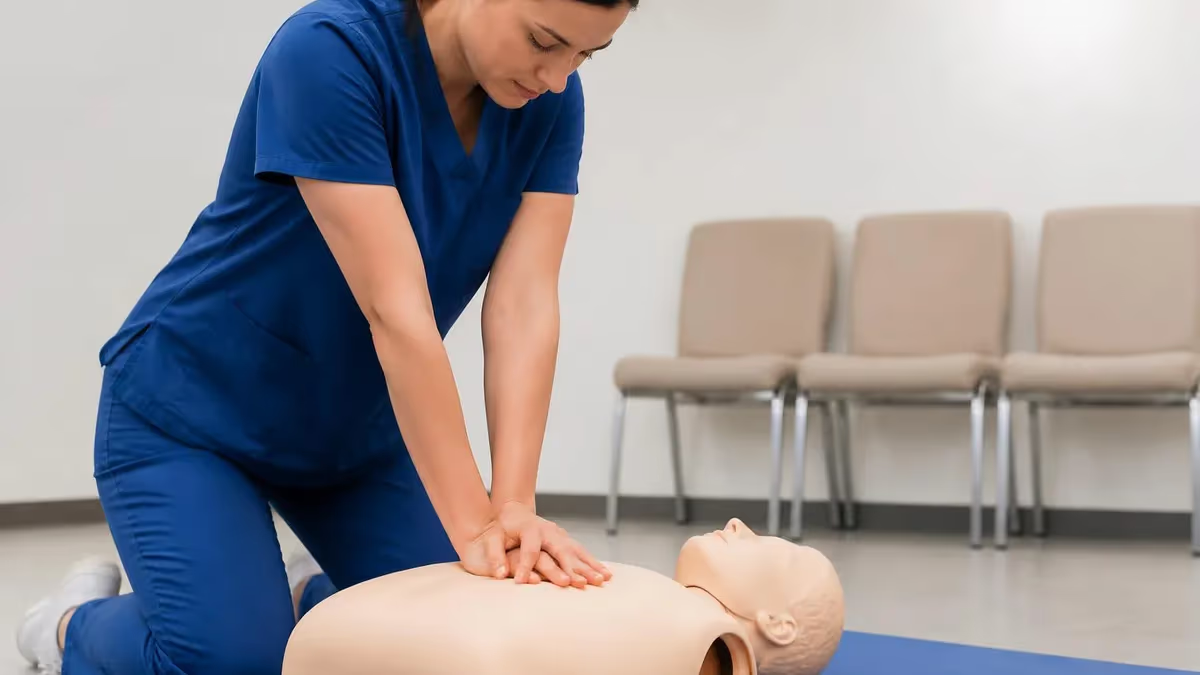
What an AHA CPR Card Represents
The AHA CPR card serves as official documentation that the holder has completed American Heart Association CPR training meeting specific competency standards. Healthcare employers, school districts, childcare facilities, and many other organizations require employees to maintain current AHA CPR cards as condition of employment. The widespread employer recognition makes AHA cards the most valuable CPR credentials in the United States supporting employment across diverse industries requiring CPR competency.
Since 2017, AHA transitioned from physical paper cards to electronic eCards accessible through the AHA Atlas portal at ecards.heart.org. The transition modernized verification while reducing fraud risks associated with paper cards that some individuals previously falsified. The eCard system maintains all CPR certifications in a centralized database accessible through unique verification codes that authorized parties can use to confirm certification authenticity in real time.
AHA offers multiple CPR card types matching different audiences and competency levels. Heartsaver CPR AED targets community responders, teachers, and workplace responders. BLS Healthcare Provider targets clinical staff in hospitals and outpatient settings. ACLS targets staff managing adult cardiac emergencies. PALS targets staff working with pediatric patients. The graduated certification levels support diverse audiences with appropriate training depth for their specific roles.
Understanding the difference between course completion and card receipt helps avoid confusion during the certification process. Course completion happens at the end of the training when the instructor verifies the student passed both skills testing and any written examination. Card issuance happens separately when the instructor or training center submits completion records to AHA, generating the official eCard. The gap between course completion and card receipt can produce anxiety for students needing immediate documentation for employment.
Card lookup through the AHA verification portal supports employer verification beyond just visual inspection of eCard PDFs. The verification system at heart.org allows entering card numbers and student names to confirm validity and check expiration dates. The independent verification protects against fraudulent cards that someone might attempt to create through PDF editing. Healthcare employers increasingly use this verification capability as part of credentialing processes for new hires and ongoing employment monitoring.
AHA CPR Card Quick Facts
AHA transitioned to eCards in 2017 from paper cards. Cards valid for 2 years from issue date. Access through ecards.heart.org Atlas portal. Multiple card types include Heartsaver, BLS, ACLS, and PALS. Employer verification through unique eCard codes confirms authenticity in real time. Most widely recognized CPR credentials in healthcare and community responder positions.
Course completion and card receipt happen at different times in the certification process. Completion happens when the instructor verifies skills testing has passed. Card issuance happens separately when records get submitted to AHA generating the official eCard documentation.
AHA CPR Card Types
Heartsaver CPR AED card targets community responders, teachers, childcare workers, fitness professionals, and other non-clinical audiences. The training covers adult, child, and infant CPR plus automated external defibrillator use. The four-hour course produces certification suitable for non-healthcare workplace requirements and community responder roles. Heartsaver cards renew through similar four-hour courses every two years.
Heartsaver First Aid CPR AED extends the basic Heartsaver content with first aid training covering common workplace injuries and emergencies. The six to eight hour course produces broader credential than basic Heartsaver supporting workplaces requiring both first aid and CPR competency. Schools, childcare facilities, fitness centers, and various other employers often require this combined certification rather than CPR alone for their staff.
BLS Healthcare Provider card targets nurses, doctors, EMTs, paramedics, and other clinical staff. The training includes advanced techniques such as two-rescuer CPR, bag-mask ventilation, and team dynamics that healthcare settings use. The four to five hour course produces certification required for most clinical positions. BLS cards renew through similar courses with possible HeartCode blended learning options combining online study with in-person skill verification.
Employer verification processes differ substantially across healthcare organizations, schools, and other entities requiring CPR certification. Large hospital systems typically have dedicated credentialing departments that verify CPR cards through the AHA verification system or by contacting issuing training centers. Smaller employers may simply visually inspect the eCard PDF and assume validity. The variation in verification rigor produces situations where invalid cards sometimes get accepted alongside legitimate ones. Strong verification protects patients and employers from undertrained responders.
Skill retention between renewal courses represents an ongoing challenge for CPR certification. Research suggests skills degrade substantially within months of training even when certification remains active for two years. Brief refresher practice between formal renewals helps maintain skills though most healthcare workers do not engage in such practice. Some progressive employers provide periodic skills practice sessions to address the retention issue beyond just biennial certification renewal which alone produces inadequate skill maintenance.

AHA CPR Card Categories
Community responder certification covering adult, child, infant CPR plus AED. Four-hour course. Suitable for teachers, childcare workers, fitness professionals, and workplace responders. Specific details follow current American Heart Association guidelines that update periodically based on resuscitation research advances.
Clinical staff certification including advanced techniques like two-rescuer CPR and bag-mask ventilation. Four to five hour course. Required for nurses, doctors, EMTs, and most healthcare positions. Specific details follow current American Heart Association guidelines that update periodically based on resuscitation research advances.
Advanced Cardiac Life Support for staff managing adult cardiac emergencies. Includes ECG rhythm interpretation and medication dosing. Twelve to sixteen hour course covering complex scenarios. Specific details follow current American Heart Association guidelines that update periodically based on resuscitation research advances.
Pediatric Advanced Life Support for staff working with pediatric patients. Includes pediatric assessment and resuscitation scenarios. Twelve to sixteen hour course for healthcare provider audiences. Specific details follow current American Heart Association guidelines that update periodically based on resuscitation research advances.
The eCard System
After completing AHA training, instructors issue eCards electronically through the AHA Atlas system. The eCard arrives via email to the address provided during course registration. The email contains a link to access and download the eCard plus instructions for accessing the AHA Atlas account where all the user AHA credentials live for ongoing reference and renewal tracking.
Each eCard includes a unique verification code that confirms credential authenticity. The code links to specific course completion data including course type, completion date, instructor name, training site, and expiration date. Sharing the verification code with employers or verification parties enables them to confirm certification details without needing personal information beyond what verification specifically requires for compliance documentation.
The Atlas portal supports managing multiple AHA certifications under a single account. Healthcare workers holding BLS, ACLS, and PALS simultaneously can manage all credentials through unified login. The unified view simplifies tracking expiration dates across multiple credentials and scheduling timely renewals before any individual certification expires beyond grace periods that might require full initial training instead of shorter renewal classes.
Card renewal timing requires planning ahead of expiration to avoid lapses in active certification. Most healthcare employers require continuous active certification with no gaps allowed. Planning renewal courses 30 to 60 days before expiration produces buffer time for scheduling difficulties or unexpected complications. Last-minute renewal scrambles can leave healthcare workers temporarily uncertified, sometimes requiring schedule changes or temporary work restrictions until renewal completes.
Pediatric and infant CPR knowledge varies across the different AHA card types. Heartsaver courses cover adult, child, and infant CPR providing broad coverage suitable for parents and general caregivers. BLS Healthcare Provider courses cover all age groups with emphasis on healthcare context. Specialized PALS certification focuses specifically on pediatric advanced life support for healthcare workers in pediatric care settings. Selecting appropriate certification depends on the specific population the certified person expects to encounter requiring resuscitation skills.
AHA Card Usage Contexts
Healthcare employers including hospitals, clinics, nursing homes, and outpatient facilities require AHA cards for clinical staff. Specific certification level depends on role with BLS being most common base requirement. ACLS and PALS add for specific clinical assignments. The widespread requirement makes AHA cards essential credentials for healthcare careers.
Each AHA CPR card type serves specific professional contexts with distinct prerequisites and renewal requirements that govern its use in healthcare and other professional environments.
Getting an AHA CPR Card
The process for obtaining an AHA CPR card begins with selecting the appropriate certification level for your role and employer requirements. Heartsaver suits community responders. BLS suits healthcare workers. ACLS and PALS add specialized clinical training. Verifying employer requirements before scheduling training ensures the chosen certification matches actual requirements supporting employment or volunteer roles requiring CPR certification.
Locate an AHA Training Center offering the desired course through the AHA Training Center directory at heart.org. Local hospitals, fire departments, community colleges, and private CPR training companies all operate as AHA Training Centers. Comparing course offerings, schedules, and pricing across nearby Training Centers identifies the best fit for individual circumstances. Most metropolitan areas have multiple Training Center options.
Schedule and complete the chosen training course with instructor delivering required curriculum including classroom instruction, hands-on practice on manikins, and final skill demonstration. Pass the cognitive assessment and skill demonstration to earn certification. The instructor issues eCard through Atlas system shortly after course completion. The eCard arrives via email typically within twenty-four to forty-eight hours of course completion supporting prompt employment documentation.
The transition from physical paper cards to electronic eCards in 2017 represented a substantial change in how certification documentation works. Physical cards had been the standard for decades before the eCard system launched. The change required adjustment from training centers, employers, and students all learning the new system. Several years into the eCard era, the system has matured with most stakeholders comfortable with electronic verification, though some traditional employers occasionally still request physical card copies despite eCards being the official format.

Only AHA-authorized Training Centers and instructors can issue valid AHA CPR cards. Unauthorized providers may offer training that does not produce recognized AHA credentials regardless of how thorough the content. Verifying authorization through the AHA Training Center directory before paying tuition prevents enrollment in unauthorized programs that cannot produce recognized cards.
Last-minute renewal scrambles can leave healthcare workers temporarily uncertified. Plan renewal courses 30 to 60 days before expiration to produce buffer time for scheduling difficulties or unexpected complications that might delay completion.
Card Validity and Renewal
AHA CPR cards remain valid for two years from issue date. The two-year cycle reflects documented skill decay over time that warrants periodic refresher training. Most healthcare employers require continuous certification with no gap regardless of grace period availability. Renewal training during the months before expiration prevents gaps in certification that could affect employment status for healthcare workers requiring active credentials.
Renewal courses run shorter than initial certification courses because students already have foundational knowledge. Heartsaver renewal typically runs two to three hours versus the four to six hour initial course. BLS renewal runs three to four hours versus the four to five hour initial course. The shorter renewal courses focus on updating skills and refreshing knowledge rather than building everything from scratch as initial courses must do.
HeartCode blended learning options combine online cognitive content with brief in-person skill verification. The format supports flexible scheduling around busy work and family demands while maintaining the hands-on skill assessment that ensures actual CPR capability. Many healthcare workers prefer HeartCode for renewal because the online portion can complete during available evening or weekend hours rather than committing full days to traditional classroom training.
International recognition of AHA CPR cards extends to many countries though local requirements vary substantially. Some countries recognize AHA certification fully while others require local certification regardless of foreign credentials held. Healthcare workers planning international work should research destination country requirements specifically rather than assuming AHA certification transfers. The American Heart Association maintains some international training networks though local requirements ultimately govern what credentials are accepted in specific countries.
AHA CPR Card Acquisition Checklist
- ✓Identify appropriate certification level matching role and employer requirements before scheduling training
- ✓Verify AHA Training Center authorization through official heart.org directory before paying tuition
- ✓Compare schedules, locations, and pricing across multiple nearby AHA Training Centers
- ✓Complete required training course including classroom and hands-on manikin practice components
- ✓Pass cognitive assessment and skill demonstration earning certification eligibility
- ✓Receive eCard through email within 24 to 48 hours of course completion
- ✓Save AHA Atlas account access for ongoing credential management and renewal tracking
- ✓Plan renewal courses 30 to 60 days before card expiration to produce buffer time for scheduling difficulties
- ✓Research training center reputations through reviews and recommendations before enrolling in courses
Employer Verification Process
Employers verify AHA cards through several mechanisms. The unique eCard code allows direct verification at ecards.heart.org where employers can confirm certification status. Some employers accept printed copies of eCards as documentation if visual inspection of authentic AHA formatting supports credential authenticity. Healthcare credentialing departments often require formal verification through the eCard code system supporting consistent compliance.
HIPAA and privacy considerations affect what information employers can collect during CPR verification. The eCard verification confirms certification status without exposing protected health information beyond just the verification result. This privacy protection makes the eCard system suitable for routine compliance verification without creating additional regulatory concerns. The targeted verification approach supports both compliance needs and worker privacy.
Documentation of verification typically gets stored in employee credentialing files alongside other compliance documentation. Some organizations maintain electronic systems that track all employee certifications with automatic alerts before expiration. These automated systems reduce administrative burden while ensuring compliance maintenance across large workforces with diverse certification requirements. The investment in tracking systems pays back through reduced compliance gaps and renewal coordination.
Military and government CPR certification sometimes follows different pathways than civilian AHA certification. Military medical training often includes CPR instruction that produces military-specific certifications rather than AHA cards. Government agencies like federal hospitals typically follow AHA standards. The variation produces situations where transferring from military to civilian healthcare may require obtaining AHA certification specifically rather than relying on prior military training credentials alone.
Lost Card Replacement
Lost or damaged AHA cards can be replaced through the AHA Atlas portal where the certification originally issued. Logging into the Atlas account at ecards.heart.org provides access to all certifications. Users can download fresh PDF copies of eCards or request reprinted physical copies depending on preference. The replacement process happens within minutes rather than requiring lengthy administrative processes that older paper card systems sometimes required.
Forgotten Atlas account access requires recovering credentials through password reset. The Atlas portal supports email-based password recovery using the email address associated with the original course registration. Users without access to the original email address may need to contact AHA customer service for identity verification supporting account recovery through alternative means beyond just automated password reset functionality.
Older paper cards from before 2017 may require contacting the original training center for replacement copies because they may not exist in the modern Atlas system. Some training centers maintain records of older certifications that can support replacement. Training centers that have closed produce more complex replacement scenarios where AHA customer service may need to support replacement through alternative documentation channels.
Training center quality affects the certification experience substantially even when all centers issue the same standardized AHA cards. Well-run training centers provide thorough instruction, adequate manikin time, and patient assessment of student readiness. Lower-quality centers may rush through material, provide inadequate hands-on practice, or pass students who have not fully mastered the skills. Researching training center reputations through reviews and recommendations helps select quality programs that build genuine competence rather than just issuing cards.

AHA CPR Card Quick Numbers
Key Facts at a Glance
| Item | Value | Details |
|---|---|---|
| Card Validity | 2 years | |
| Hours for Initial | 4-6 | |
| Hours for Renewal | 2-4 |
AHA Card Course Comparisons
Community level. Adult, child, infant CPR and AED. Four hours. Suitable for teachers, childcare workers, fitness professionals, workplace responders. Specific details follow current American Heart Association guidelines that update periodically based on resuscitation research advances.
Healthcare level. Includes two-rescuer CPR, bag-mask ventilation, team dynamics. Four to five hours. Required for clinical staff in hospitals and outpatient settings. Specific details follow current American Heart Association guidelines that update periodically based on resuscitation research advances.
Advanced level for adult emergencies. ECG rhythms, medications, complex scenarios. Twelve to sixteen hours. Required for clinical staff managing adult cardiac emergencies. Specific details follow current American Heart Association guidelines that update periodically based on resuscitation research advances.
Advanced level for pediatric emergencies. Pediatric assessment, drug dosing, resuscitation scenarios. Twelve to sixteen hours. Required for pediatric clinical staff. Specific details follow current American Heart Association guidelines that update periodically based on resuscitation research advances.
Common AHA Card Questions
AHA cards versus American Red Cross cards represent the two largest CPR certification systems in the United States. Both produce widely recognized credentials but employer preferences vary. Healthcare employers strongly prefer AHA cards for clinical positions. Community workplaces accept either provider equally for most non-clinical positions. Verifying employer-specific provider requirements before scheduling training prevents the wrong-provider problem.
Cost varies between provider types. Heartsaver typically runs sixty to one hundred dollars. BLS runs eighty to one hundred forty dollars. ACLS and PALS run three hundred to five hundred dollars given longer training duration. Renewal courses cost similar amounts to initial courses for most providers. Employer reimbursement covers AHA CPR training for many healthcare workers and others where certification supports job duties.
International recognition of AHA cards varies by country. AHA cards generally receive recognition in countries with strong healthcare relationships with the United States. Some countries operate their own resuscitation councils with separate certifications that may not accept AHA cards directly. Healthcare workers planning international employment should verify destination country acceptance before relying on AHA cards for foreign credential recognition.
AHA CPR Card Pros and Cons
- + —
- + —
- + —
- + —
- + —
- − —
- − —
- − —
- − —
- − —
CPR Questions and Answers
About the Author

Registered Nurse & Healthcare Educator
Johns Hopkins University School of NursingDr. Sarah Mitchell is a board-certified registered nurse with over 15 years of clinical and academic experience. She completed her PhD in Nursing Science at Johns Hopkins University and has taught NCLEX preparation and clinical skills courses for nursing students across the United States. Her research focuses on evidence-based exam preparation strategies for healthcare certification candidates.
Join the Discussion
Connect with other students preparing for this exam. Share tips, ask questions, and get advice from people who have been there.
View discussion (5 replies)